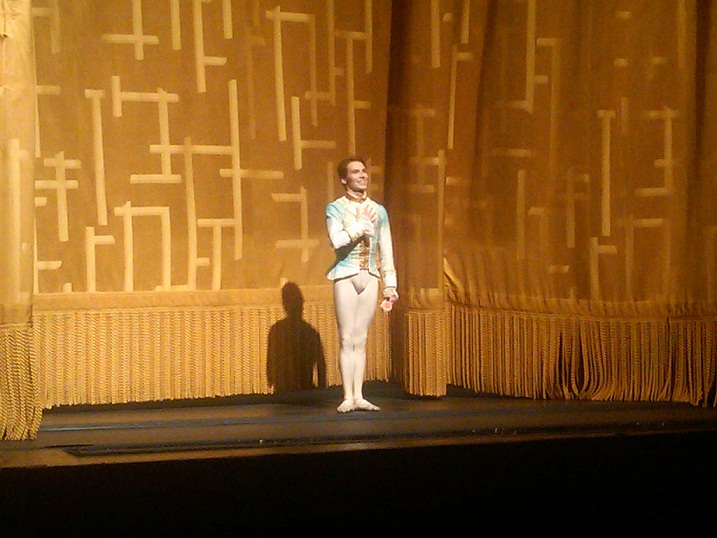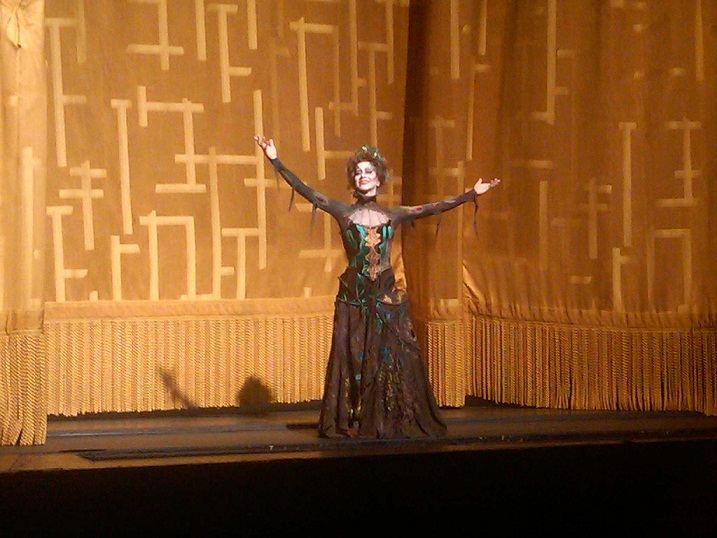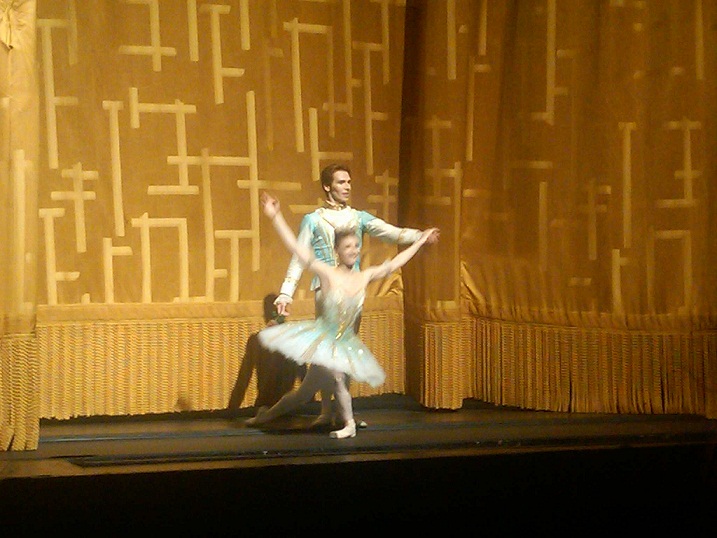
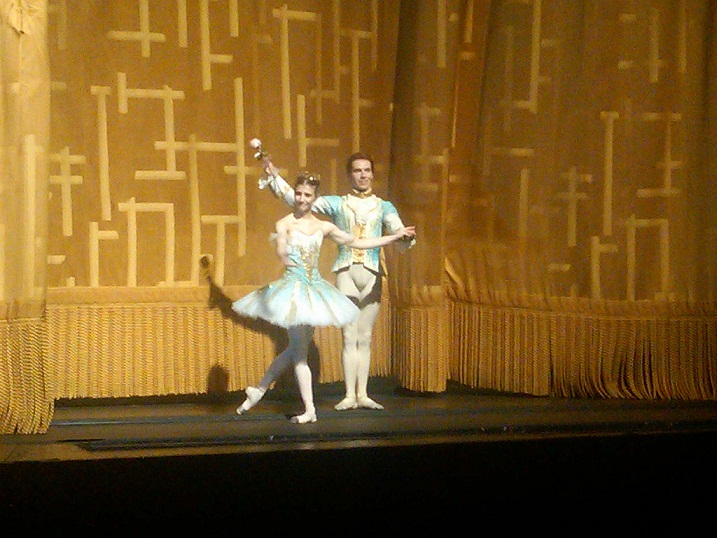
Alina Cojocaru and Johan Kobborg Guest Star in ABT’s SLEEPING BEAUTY

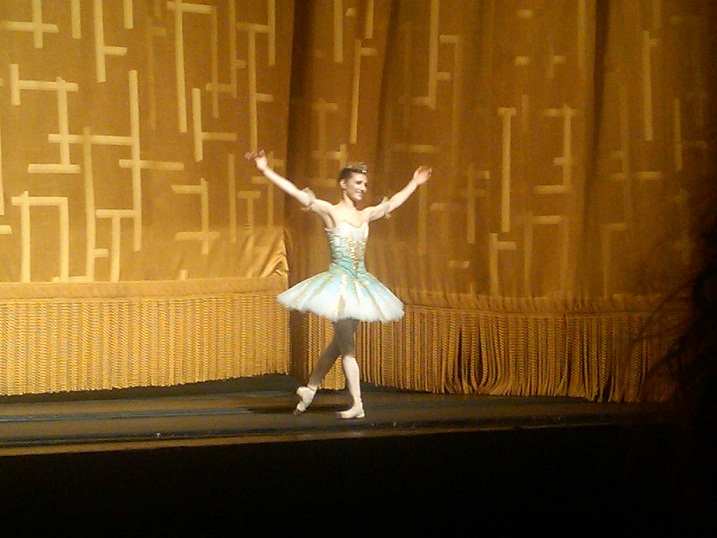
Curtain calls photos taken by my new balletomane friend, Andrea.

I have to confess, Sleeping Beauty is probably my least favorite ballet. I like the Aurora / Prince Desire wedding pas de deux, with all the gorgeous fish dives, in the last act but I could do without the rest. I just don’t have a big appreciation for sustained balances on pointe and all of the fairy variations and all that.

BUT, I have to say, Alina Cojocaru and Johan Kobborg, guest starring from the Royal Ballet in American Ballet Theater’s Met production showed me this ballet in a new light. As I said on Twitter, I feel like I now know how Sleeping Beauty is really supposed to look!

I did see Cojocaru last year (without Kobborg), but I think because I was sitting in orchestra and because it was my first time seeing her and was just getting used to her, I couldn’t stop focusing on piddly things like her feet / shoes.  Now that I’m used to them, and because I was farther up, in dress circle (my friend, Marie, gave me her tix because she had to fly last minute to Japan and couldn’t use them – thank you Marie!) I just focused on her brilliant dancing. She’s somehow so precise and does such stunning things and makes such stunning lines while making it not about doing these stunning things but about the character and about bringing her sweet story to life. That’s a crazy run-on sentence but you know what I mean? In the “Rose Adagio,” while circling around in those repeated turns while being passed from cavalier to cavalier, she’d just flick her leg up so high and so fast whenever a cavalier took her hand. I was so awed. And she has the most stunning arabesque in attitude while she’s being promenaded about by those cavaliers. To me, those fast, high, perfectly done lifts of the leg and her gorgeous arabesque were more magical than the sustained balances on pointe (which is what most hardcore ballet fans seem to adore in this ballet).

And during the wedding pas de deux, when Kobborg dipped and dropped her into a fish dive, her legs went up so high in the back. And they were perfectly crossed. And the dip was so fast. It was stunning! Sorry I keep using that word; it’s just the word that best expresses how I felt the whole night. The other dancers – the American trained ones – don’t do those fish dives that way. They take their time raising the ballerina and then fluidly taking her down into the dive. I think that’s the influence of Balanchine, where every movement’s supposed to seamlessly melt into the next and nothing is supposed to look “posey.” But I like it so much better the way Kobborg and Cojocaru did it. So much more … stunning! Okay, I’ll stop…

But my friend Natalie and I weren’t the only ones wowed. This is what I love about sitting up higher. I feel like the orchestra is filled with people who fall asleep and with critics. Higher up is where the real fans sit, and Natalie and I were sandwiched in between these giggly twenty-something girls who nearly blasted out of their seats every time a lightning speed develope or fish dive happened, and this tattooed construction-worker looking guy who was there on his own and who followed Cojocaru’s every movement with his binoculars and nearly burst my left eardrum with his applause at the end. I so love these people 🙂

Kobborg totally reminded me of NYCB’s Gonzalo Garcia, who, everyone who reads this blog regularly knows is one of my favorites. His expressiveness, his devotion to his partner, his immense charm and the way his personality really shines through from far away – I really loved his Prince Desire. On the way out one of my friends said he loved Cojocaru but found Kobborg to be not as stellar as some of the ABT men like Marcelo Gomes. That’s totally true, but what I loved about Kobborg was how he let her have her night, how everything he did was to showcase her. I love Marcelo and David Hallberg and all the ABT men of course (of course!) but sometimes it’s nice when the guy doesn’t steal the show and just lets the ballerina shine. But it wasn’t like he wasn’t as good as she was, just that he was letting it be all about her. Of course they’re now engaged so a little romantic sentiment could be at play 🙂

Anyway, a few more pictures:
Martine Van Hamel was perfect as the wicked fairy Carabosse. And, I think I’m the only one who feels this way, but damn do I love that costume! It’s very Helena Bonham-Carter / Tim Burton… Actually it’s very Helena Bonham-Carter at the Oscars…

The whole cast. Thank you again to Andrea for the first-row pics!

The rest of the cast was very good as well. In particular I loved Yuriko Kajiya as the Lilac Fairy (she was a last-minute replacement for Maria Riccetto). She stood out to me more than she ever has before; for once I realized that she has a real stage presence. Maybe it was being up higher?… All the fairies were very good – Misty Copeland, Simone Messmer, Luciana Paris, Renata Pavam, and Hee Seo (who should be promoted to principal soon!), and Daniil Simkin and Sarah Lane were, as expected, a lot of fun as Bluebird and Princess Florine. I think they tried to give Kobborg and Cojocaru the best supporting cast possible.

Anyway, that’s it for New York. ABT season is now over. The company is on to L.A. and Japan. And here in N.Y., we’re on the Mariinsky next week at the Lincoln Center Festival. And then ballet season is over for the summer.

Alina Cojocaru and Polina Semionova Guest Star in ABT’s DON QUIXOTE

Over the weekend, two European star ballerinas – Alina Cojocaru from the Royal Ballet in London, and Polina Semionova from the Berlin State Opera Ballet – guest starred in American Ballet Theater’s Don Quixote as Kitri.  Cojocaru danced with Jose Carreno, and Semionova with David Hallberg. I saw both performances. Overall, I thought both are beautiful dancers, have an innate sweetness that shines through, are absolute balance queens who can hold balances on one leg on pointe for many many seconds unassisted, and can dance the role nearly perfectly. But I thought that both of them lacked fire; they both played it too safe. Maybe it’s just that Natalia Osipova has ruined me and I just can’t see anyone else in this role now.

One thing I loved about the Cojocaru / Carreno performance were that the two seemed to have a real rapport, a genuine affection for each other. Did they ever dance together at the Royal, does anyone know? Or was Jose there too early for her? Cojocaru never threw herself into his arms with the wild abandon that Osipova did last year, and I missed that. But I don’t think Jose did 🙂 Seriously, he didn’t seem to appreciate Osipova’s theatrics that much. Cojocaru seemed to tone it down and they worked very well together. Also, as I complained about on Twitter ad nauseam, during those insane one-handed overhead lifts, Jose did not go on releve and hold one leg up in arabesque the way Ivan Vasiliev did with Osipova in the Bolshoi’s live-streamed performance. It’s okay; I still love Jose 🙂 But seriously, Vasiliev and Osipova have ruined me! Cojocaru has absolutely gorgeous developpes. She can lift her leg up so high – really stunning. And I mentioned the balances earlier. She held those for so long; crowd went wild. And sweetest thing: Jose kept demanding she return for an encore bow after each of her solos. Made me really love Jose.

Cojocaru was a little shaky during the first act, and she had a little stumble. But it wasn’t memorable. Far more memorable was her strong performance in the third act, her best. That’s when she did the crazy balances.

In the third act fan variation, Cojocaru did a completely different series of steps than I’d ever seen before, which makes me think there are a bazillion ways to do that variation. Or at least three – the American, the Russian, and the British. The Ballet Bag ladies sent me a You Tube link via twitter, of Cojocaru dancing with Johan Kobborg. Around the 7 minute point is where she does this different variation.


Jose is such a great Basilio. He’s a natural flirt, a natural macho Latin guy, and a natural actor who can be a macho and a flirt and still be totally endearing. And it really kind of made me melt when he kept insisting she take more bows.

I really enjoyed Sarah Lane and Isabella Boylston as “the flower girls.” They often weren’t in sync because Boylston danced with more expressiveness, arching her back, taking her time and drawing out the turns, playing with the musicality. Lane was more sharp and precise, hitting poses right on the beat. But I could have cared less that they weren’t perfectly in sync. I loved that each had her own personality, as people do in real life.

I missed Sascha Radetsky as Espada the matador. I’ve never seen him in that role and I think he’d make a good one. He was replaced by Gennadi Saveliev. He was replaced on opening night too, which worries me that he’s injured.

I thought Polina Semionova was really beautiful, and, where Cojocaru had a few wobbles, Semionova had none. She was very very near perfect. Like Cojocaru, the third act was the one that most brought her to life. She kind of veered all over stage on her third act series of fouettes but she threw several multiple pirouettes in, and her balances were even more stunning than Cojocaru’s, as, during her final balance, she took her leg out of arabesque and straightened it out in front of her, without ever holding Hallberg’s hand to steady herself. Audience went absolutely crazy with applause. They really loved her, and called her and David out for several curtain calls.

In the third act, she did “the American” fan variation. She’s Russian and dances in Berlin, so I really think each ballerina just chooses whichever version looks better on her body and feels most comfortable to her. I thought the little hopping “horse steps” on pointe were really sweet on her.

She and David seemed to like each other as well. The partnering was a little off at points, though, and he almost dropped her in a fish dive. She played it very safe with the second act swan dives into his arms as well, and he didn’t try any Vasilievs on the one-handed lift.

David is a beautiful dancer on his own though, and, as a critic said to me during intermission, it’s sometimes hard to focus on anyone else when he’s onstage. His movements were absolutely perfect, both the more balletic and those kind of side to side matador-looking movements. His jetes are beautiful – he’s just the most beautiful male dancer and you can completely lose yourself in the story of the ballet just watching him.

Acting-wise, I think David is wonderful in the romantic scenes. He’s definitely a romantic. But the rest of the time I think he should just be himself, make Basilio his own, and not try to be so cocky and macho. In him, I find it comes across as anger, an an intimation of violence even, like he’s really going to go off and whack someone. He’s not a natural cocky flirty Latin shit like Jose and Marcelo Gomes 🙂 And so it loses its charm with him. My thoughts anyway.

It probably won’t come to a surprise to anyone who’s read my blog for some time that Veronika Part (here as Mercedes, the “street dancer”) stood out to me. In the first two acts, I found her even more captivating than Semionova. One thing I love about her is her attempt to make the styling as authentic as possible. Part really looked like a Spanish dancer to me. And in the second act’s dream scene, I found her jetes across the stage really breathtaking – just as much as Semionova’s.

Sarah Lane danced the part of Amour in the white scene. I always want to call that character Cupid. Anyway, before the performance began, I overheard one teenage girl behind me say to another, “Sarah Lane! She was the one in Black Swan!”

All in all, really lovely performances, but I do think Cojocaru makes a better Sleeping Beauty and Giselle than Kitri. She’ll be dancing Giselle this Saturday night. She’ll also be dancing Don Quixote again with Jose tomorrow night (Monday, the 23rd). I’m excited to see Semionova in Swan Lake later in the season.

KINGS OF THE DANCE SHOWS HOW DANCER-RICH BUT CHOREOGRAPHY-IMPOVERISHED BALLET IS IN THE BALANCHINE-INUNDATED U.S.


Photo of Desmond Richardson by Andrea Mohin, taken from NYTimes.

So, “Kings of the Dance” made the New York stop of its international tour this weekend at City Center. I was there Friday night. The last time this show toured here several years ago (it is produced by Russian dance promoter Sergei Danilian) there were only four male dancers — Angel Corella, Ethan Stiefel (both of American Ballet Theater), Johan Kobborg of the Royal Ballet in England, and Nikolay Tsiskaridze of the Bolshoi. This year, there were many more dancers and Tsiskaridze was the only one who returned (and, funny, but I totally didn’t recognize him). The others were: David Hallberg, Marcelo Gomes and Jose Manuel Carreno from ABT, Joaquin De Luz from NYCB, Guillaume Cote from Canada, Denis Matvienko from Ukraine, and Desmond Richardson from NY-based Complexions Contemporary Ballet (So You Think You Can Dance fans may recognize his photo above, since he has guest performed on the show a couple times).

What I liked about this program the last time it toured here was that there were fewer dancers, and that way you kind of “got to know” them better, by seeing them each perform several different pieces. Here, you basically only saw many dancers once, and a few twice. If you weren’t familiar with them (as my two friends who came with me weren’t), you could easily get them confused. They played a short movie at the beginning where each dancer (besides Desmond Richardson; I think he may have been a late addition to the American tour) talked a bit and you saw them dance. Jose’s cute Cuban accent seems to have gotten more pronounced 🙂 — I think he did it on purpose, knowing how many female fans would be in the audience! David’s voice somehow sounded a bit deeper than it does in person. Matvienko (who, for ballroom dancers, looks A LOT like former US champ Andrei Gavriline) and Tsiskaridze spoke in Russian and their words were translated.

What I loved about this program though was that there were so many solos that exposed us to so many different choreographers whose work I’d never seen (and some of whom I’d never even heard of) before. Every company in this country is obsessed with Balanchine, so it’s a wonderful wonderful change when we actually get a taste of something else. But more on that in a moment.

As with every Danilian production, there were lots and lots of Russians in the audience, and I think Desmond Richardson and Joaquin De Luz in particular grew a new fan base. Poor Joaquin — well, maybe: after the performance and during intermission I kept hearing, “That little guy was great!”, “That little guy was just incredible,” “Where can I see that little guy dance?” So, Joaquin is the great “little guy” whom everyone is seeking out now. And everyone went wild after Richardson’s solo, Lament, choreographed of course by Dwight Rhoden, an absolute master at presenting his friend’s spellbinding combination of gracefulness and masculinity. My friends were floored, along with the rest of the audience judging by the exclamations.

After the movie, they opened with Christopher Wheeldon’s For 4, for four dancers, which is a carry-over from the last performance. On the night I went it was performed by Matvienko, Carreno, De Luz, and Cote (but the cast varied each night). It’s an adagio lyrical piece, as with the vast majority of Wheeldon’s work, and I wished there would have been some more allegro parts with bravura solos. But that’s just not Wheeldon’s thing.

Then, after intermission, we saw a solo performed by each man, ending with a drop dead gorgeous duet danced by Cote and Gomes choreographed by French choreographer Roland Petit, from his Proust ou les Intermittances du Coeur. The men were dressed in skin-toned unitards, which almost made them look naked, and the duet to me seemed to be about a man obsessed with his reflection, or another side of himself, as each’s movement was mainly a reaction to the other’s. But at some points there was some really beautiful partnering, some really beautiful lifts and it seemed like a man dancing with his soul. Breathtaking!

Anyway, other highlights of the solo section were: a really beautiful solo for Marcelo choreographed by Adam Hougland, called Small Steps, which was like lyrical iron-pumping — a series of beautiful poses showing off his musculature interspersed with flowing lyrical movement; a beautiful, lyrical piece danced by David Hallberg from Frederick Ashton’s Dance of the Blessed Spirits; a fast, fun, more virtuosity-heavy solo by David Fernandez for Joaquin De Luz called Five Variations on a Theme; Jose Carreno dancing a gorgeous adagio to Ave Maria — a modern version — by Igal Perry (which I’d seen before and fell in love with it all over again); and Rhoden’s Lament for Richardson, which, like Marcelo’s solo, reminded me of lyrical iron-pumping (which I mean in a good way of course) highlighting as it did that seemingly incongruous combination of male elegance and virility.

The only ones that didn’t really work for me well were Boris Eifman’s Fallen Angel danced by Tsiskaridze, which I think just didn’t have enough context, and Vestris by Leonid Jakobson danced by Matvienko, which was by turns a comical and bravura piece first danced by Baryshnikov in 1969. I thought Matvienko was a lovely dancer with really beautiful lines who could really deliver on the jumps and especially turns, but I just think it needed to be better acted because there were some places where it almost seemed like he made a mistake, and then you realized it wasn’t a mistake by the dancer; it was supposed to be the character who humorously screwed up. I heard Baryshnikov was excellent and I wish I could see a video of that.

Then, we saw Spanish choreographer Nacho Duato’s Remanso, which I’d never seen live before, but saw in a video performed by ABT. It involves a wall with three dancers interacting with each other around it, climbing over it, looking around it. It’s sweet, flirtatious in places, and loving and romantic. The night I saw it it was danced by Gomes, Cote, and Hallberg, though this cast alternated each night as well.

The program ended with a bravura “Grand Finale” with each dancer coming out and doing jumps and turns, and all the big fancy “male things” of classical ballet.

But the thing I kept thinking throughout was, wow, that’s really cool choreography, who’s that choreographer? Oh,  I’ve never heard of him, or, oh I’ve heard of him, how cool that I finally got to see something by him! I mean: Roland Petit, Igal Perry, David Fernandez, Adam Hougland, Nacho Duato, Leonid Jakobson. We NEVER get to see choreography by these people here. Petit is a major choreographer. As is Duato (we really see his choreography only when his own company tours here, infrequently), ditto for Eifman, and the others I’ve never even heard of. Why don’t we see more variety here? Why don’t we see more Mats Ek and Pina Bausch and John Cranko? Why do we have to drown in Balanchine over and over and over again? Why do dance companies think that we want to see Balanchine? Why do they think Americans are into this man? As far as I’m concerned, his only truly great work is Jewels. The rest, okay, his footwork is more intricate and there are certain subtle little embellishments in the variations, but really, what was so great about his ballets in their entirety? What was so great that we have to be so completely inundated with him here in the US? I mean, it makes sense that NYCB does his work because they were founded by him but every other major company in the US is likewise obsessed – San Francisco Ballet, Miami City, Boston, Pennsylvania, even the Kirov and POB when they tour here they think we want more of this crap. And whenever ABT doesn’t do classical, there seems to be an overload of Balanchine. Does anyone consider that maybe, just maybe, we might get bored? That he doesn’t speak to younger generations of Americans AT ALL? Did someone tell POB and Kirov that Americans only understand Balanchine so you have to do Balanchine when you come here? I think ballet is dying in this country because of every artistic director’s completely inscrutable obsession with this boring boring man.

Anyway, I greatly thank Mr. Danilian for allowing Americans to see something else for a change.

For a completely different perspective, see Macaulay’s review.

LET’S HAVE AN "ELOQUENTLY VIOLENT" MAYERLING FOR ABT, MR. MCKENZIE


The Royal Ballet in London recently opened their fall season with a revival of Kenneth MacMillan’s Mayerling (MacMillan of course is a SLSG favorite choreographer). It’s based on the true story of the apparent suicide / murder in 1889 of Crown Prince Rudolf of Austria and his lover Baronness Mary Vetsera whose bodies were found in Mayerling, Rudolf’s hunting lodge. Prince Rudolf, sole son of Emperor Franz Josef of Austria, was heir to the thrones of Austria, Hungary and Bohemia.

Londoners seem to be loving the ballet. From Neil Norman’s Daily Express review:

“Like John Cranko and Michael Corder, MacMillan choreographs for full-blooded men. There is never any doubt about the masculinity and virility of his creatures. The brothel scene that opens Act II reeks of cigar smoke and a sense of political unease is brilliantly conveyed by the huddled quartet of officers who periodically grab Rudolf to whisper into his ear.

“As the tragedy slides inexorably towards its conclusion, Rudolf’s entanglement with his young mistress, Mary Vetsera (Maria Galeazzi) drives him into a paroxysm of violent frustration. Watson’s tortured solo as he clutches his head and writhes in a kaleidoscope of movement had me clutching my kneecaps until my knuckles were white.

“The denouement is terrifying. As Watson duets with Galeazzi in unhinged passion, the stage seems to smoke with some of the most eloquently violent moves in classical ballet. It really doesn’t get much better than this. If you don’t have a ticket, do something dangerous to get one.”

A few other reviews are here, here, and here. For a full list of reviews see here.

And this from our friends over at the Ballet Bag, which whom I was chatting on Twitter. They told me they think our Marcelo Gomes would make an excellent Prince Rudolf. I think maybe David Hallberg would as well — may give him a chance to get all of that aggression out of his system 🙂

Here’s a photo they posted of the Royal’s excellent Johan Kobborg in the role.


Photo of Kobborg by Bill Cooper; top photo by Tristam Kenton from the Financial Times.

What do you guys think? Would an American audience take to such “eloquent violence”? Haglund thinks so, as do I — we have with his other ballets. C’mon Kevin McKenzie, give us a Mayerling!

FALL FOR DANCE ’09 PROGRAM 1


I’m on a tight schedule with my book rewrites, but here are some of the highlights of the Fall For Dance Festival (Program 1) thus far.

It’s always a delight to see Paul Taylor’s hilarious Offenbach Overtures with the would-be ballet dancers tripping all over each other, the muscly men first dueling then making up and swinging their way offstage in each others’ arms, the female cabaret dancers comically warring for attention. I was happy to see SLSG favorite Michael Apuzzo in my cast (he’s not in the photo above unfortunately, as he wasn’t in the first night’s cast) — he’s always very dramatic, full of character, and I noticed he had the highest, most straight-legged jetes as he and the other guys went sailing offstage at one point.

I was at this performance with my friend, Michael, and we hung out for a while in the lounge afterward (where they have $2 wine and beer and $4-$5 plates of food). I’m very shy, but I always seem to have really outgoing friends, and Michael went up to a woman with a bouquet and asked her what it was for — something along those lines. It turned out she was in Paul Taylor, and once I knew that, I recognized her as the striking Parisa Khobdeh, Michael’s partner (Michael Apuzzo that is, and partner in Offenbach that is). I then realized a bunch of the Paul Taylor dancers were hanging out in the lounge (except for that Apuzzo!) — so the FFD brochures  are not lying about the “come mingle with the dancers” parts of the adverts for the post-performance parties in the lounge.


Anyway, the other highlight of Program 1 was B/olero performed by the highly respected Israeli company, Batsheva, choreographed by their artistic director, Ohad Naharin, and set to the familiar Maurice Ravel music. Except this was a remix — at times the music would be slowed so that it would sound somewhat warped. The music would also veer from speaker to speaker, so it was like the sound was traveling around the auditorium.

Well, there are many Boleros around and Naharin’s was a more minimalist one in terms of the action, but not the emotion. It was a duet for two women dressed in black dresses. At times their movement was basic, at times still, at times spastic and chaotic, at times sexual and almost kinky, and at many times hypnotic. A common motif was the swinging back and forth of the arms, mechanically, like the arms of a clock, the rest of the body still. I always feel with his work that I have to see it several times to get the full effect, and I wished I could have seen this one again.


In celebration of the centennial of Ballets Russes, every night at FFD one company performs a piece on honor of that legendary company. Program 1’s was the Boston Ballet’s rendition of Nijinksy’s original Afternoon of a Faun. This was a real treat for me, as I’d never seen the Nijinsky version live and in full before. I’d only ever seen it on tape or, if I remember correctly, only the faun version (without the nymphs) performed by Royal Ballet star Johan Kobborg with the Kings of Dance.

Anyway, Nijinsky’s version is from 1912 and you can really imagine how shocking it must have been in its day, with the faun so overtly sexual, so taken with the nymphs, he ends up masturbating with a cloth left by one, which he recovers, takes up to his little rock perch, places it on the ground and begins rubbing his groin into it. You still don’t see much of that today onstage (at least not in ballet), so I think it’s still somewhat risque. And yet the faun, at least as portrayed by Altankhuyag Dugaraa, is so sweet and so endearing, and you feel for him after those nymphs tease him and you’re happy for him when he retrieves that cloth. I would so love to see a clip of Nijinsky in this. I would also love to see his Rite of Spring some day; I don’t think it’s been performed for eons though, I think because the choreography hasn’t really been preserved, sadly.


And completing Program 1 was Savion Glover, which I wrote about briefly in my previous post.

See the rest of Andrea Mohin’s NY Times slide show of Program 1 here.

WHY NOT MORE JOHN CRANKO IN THE US?


My friend, Mika, who is half Austrian, half Japanese and who spends a significant amount of time abroad was asking me the other day why I thought there wasn’t much of John Cranko’s work performed here when his ballets are so popular in Europe. I didn’t know. But I do know from some of Evan and Patricio’s Winger posts that his ballets are widely performed elsewhere, including obviously Chile. I was intrigued

Continue reading “WHY NOT MORE JOHN CRANKO IN THE US?”