
NEW YORK CITY BALLET OPENS THEIR WINTER SEASON WITH MIDSUMMER NIGHT'S DREAM & GERSHWIN

New York City Ballet opened their Winter 2010 season last week with rotating performances of Balanchine’s Midsummer Night’s Dream, and a two-ballet program of his Who Cares?, set to Gershwin music, and Peter Martins’ Naive and Sentimental Music.

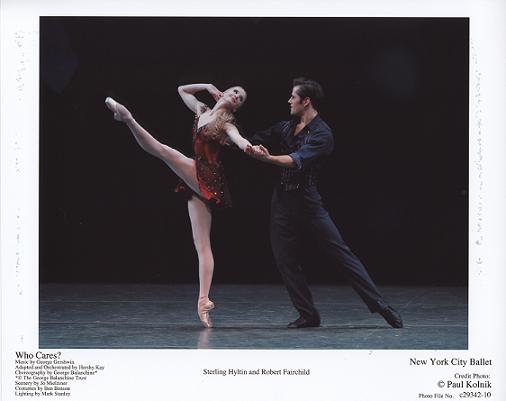
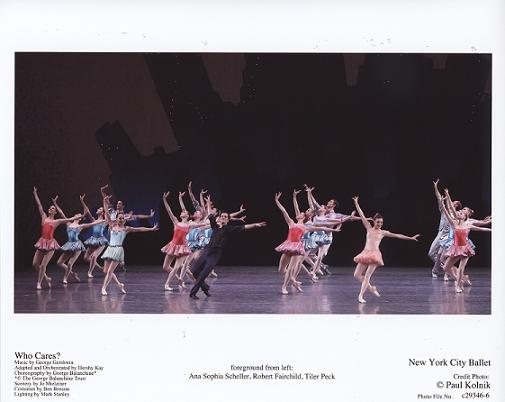
I LOVED Who Cares?! (photos above — of Robert Fairchild and Sterling Hyltin, and of the whole cast — by Paul Kolnik.) I’d only ever seen the pas de deux before and didn’t even realize the whole was comprised of a whole slew of Gershwin songs, some danced by the ensemble, some by only the women, others by only the men, with solos and pas de deux mixed in. I particularly loved Tiler Peck’s duet with Robbie Fairchild in The Man I Love. She has such a clean, beautiful line and she’s so expressive and so engaging. She can make a story out of anything. And of course Fairchild is always the perfect romantic male lead πŸ™‚ Crowd went wild over his and Ana Sophia Scheller’s duet to Embraceable You as well as Scheller’s My One and Only solo. Such a fun ballet — I’m going back for more this week.

Also shown in that program was Martins’s new Naive and Sentimental Music, set to John Adams’ score of the same name. I wrote about that ballet when it premiered here and posted pics of it here. Seeing it again evoked a bit of Balanchine’s Jewels, particularly the lovely lyrical white section (my favorite) and the sexy red.

One little thing I have to say: this ballet was created on and is danced only by principals but Adrian Danchig-Waring danced in last week’s production as well, and he is still a soloist (I think he may have been replacing Amar Ramasar, who must be injured because he was replaced a few times over the week…) Anyway, I realize NYCB is top heavy at the moment, but I think Danchig-Waring definitely needs to be next in line for a promotion!
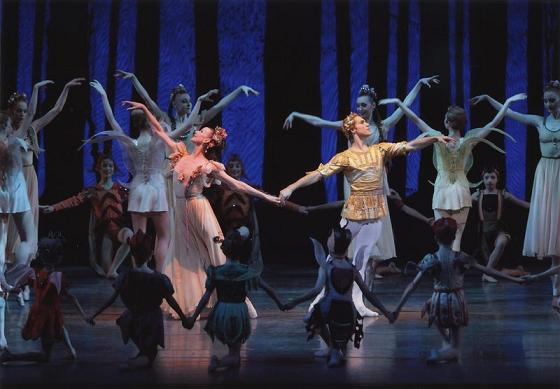
And earlier in the week I saw the best EVER cast ofΒ  Midsummer Night’s Dream. I finally got to see my Gonzalo Garcia as Oberon πŸ˜€ (photo above by Paul Kolnik, of Garcia as Oberon and Darci Kistler as Titania). I’d missed him in this role at the end of last season. He did very well – -not only with the dancing — particularly that crazy fast scherzo — but also, and less expected for me, with the acting. I thought he’d be a sweet, glowingly endearing Oberon, but, no, he was a pissy, demanding fairy king — just as much as Andrew Veyette last season (cutely pissy and demanding though!) He wanted Titania’s servant boy and he wasn’t letting her say no to him. Only thing regarding the dancing — his legs don’t seem to be as flexible as they once were. It seems like he may have injured an adductor muscle, or else he’s built up so much thigh muscle or something — but his legs when he jumps are not making perfect splits. But his upper body is so fluid and graceful and he exudes such charm that he’s still the perfect lyrical male dancer nonetheless.

Titania was the beautiful Sara Mearns (headshot by Paul Kolnik — a new headshot for her, right?)– and she was the best Titania I’ve personally seen. Oh she’s such a beautiful dancer! She throws herself so fully into every move she makes. If Garcia is the ideal male lyrical dancer she is the ideal female – they were so perfect together.

And I’m so glad Stephen Hanna is back at NYCB (still annoyed with the Billy Elliot directors for not making good enough use of him on Broadway). He was Titania’s cavalier and his pas de deux with Mearns was the best Titania / Cavalier pdd I’ve ever seen. He’s so big and strong — which certainly amps up the romance factor — and his numerous tour jetes just have so much power. Honestly I often get bored during that pdd and just want Oberon to return, but not with Hanna’s cavalier!

And new to the cast of human characters who get their hearts messed with by a mischievous Puck (Troy Schumacher) was Janie Taylor, as Helena. She is another one who excels at story dances, always delving into a character and making clear to the audience what’s going on in her mind. She’s pathetically, endearingly funny from the time she enters the stage all forlorn over Demetrius, to her being completely bewildered by Lysander’s sudden attraction to her, to her searching the forest madly for Demetrius, to her cat-fights with Hermia, etc. She really brought out the humor.

In the section where I was sitting, there were at least three large groups of people you could tell had never seen the ballet before — nor likely the play; they didn’t seem familiar with the story. But they were laughing hysterically throughout the whole thing and were really awed by the dancing, and by some of the tricks (like Puck’s being pulled up to the ceiling via harness at the end). That’s when you can tell with a story ballet that the cast really brought it to life, when the newcomers are enthralled.

NYCBALLET OPENING NIGHT: NEW MARTINS’ NAIVE & SENTIMENTAL MUSIC A SUCCESS!


New York City Ballet officially opened its 2009-10 winter season last night, with a performance and black tie gala dinner. The performance included Alexei Ratmansky’s Concerto DSCH (above photo of that ballet — dancers are Ana Sophia Scheller, Gonzalo Garcia, and Joaquin De Luz — by Paul Kolnik, taken from NYTimes), stars of the Paris Opera Ballet Aurelie Dupont and Mathias Heymann dancing the central pas de deux from Balanchine’s “Rubies,”


(photo taken from Kulturkompasset; Dupont is center, Heymann is holding the hand of another dancer).

And then the evening finished off with the world premiere of artistic director Peter Martins’ Naive and Sentimental Music, set to John Adams’ (brilliant) score of the same name (I’ll post photos when I receive them).

But first, there was a short film of the reconstruction of the inside of the Koch Theater (still can’t help but think of it as the State Theater…) while the orchestra played Tchaikovsky’s Sleeping Beauty overture (as it turned out, the perfect music to highlight the comically sped-up but ultimately awe-inducingly huge renovation process). Highlights of the renovated theater are — most importantly and coolly — the orchestra pit with a floor that can rise to stage-level (! — and this is how the orchestra played the overture), and two aisles now carved into the orchestra seating section. (Before, orchestra section had no aisles — so, though this is how Balanchine wanted it, apart from being extremely hard getting to a middle seat, it was a fire hazard).

Anyway, after the mandatory thank-you speeches by Peter Martins and David Koch (who funded the renovation), came theΒ  Ratmansky. The fun frolicking threesome in blue (top photo) were danced by Joaquin De Luz, Gonzalo Garcia and Ashley Bouder (all three brilliantly on, Bouder thankfully back from an injury), and the adagio couple in green were Benjamin Millepied and Wendy Whelan (photo below). I think this was danced better than I’ve ever seen it done before — it could have been because I was so excited to see Bouder return, or because the dancers are all beginning-of-season fresh… but this is by far Ratmansky’s best, imo — it’s got the most complex structure and original movement.


(photo by Paul Kolnik, taken from Danza Ballet)

Next were the POB couple, who danced “Rubies” brilliantly — not only with precision and clarity but with great exuberance as well. One thing I meant to say earlier about La Danse (the Wiseman film about the POB) and forgot, was that the POB dancers are all so trained to make meaning out of every little thing they do — every step, every gesture, no matter how small. You have to have some kind of thought in your mind whatever you do. (This is not what Balanchine taught his dancers; he taught them simply to do his steps and those would contain everything the audience needed to know.) I feel that this allows POB dancers to bring a certain passion and humanity to all of the works they do — I noticed that from performance footage from that film as well as from last night.

And third came the highlight — for me anyway — of the night: the new Peter Martins’ ballet. The John Adams music was absolutely gorgeous — rich, many-layered, complex, intense, varied and structured into many sections — some lighter, many heavier, evocative, etc. etc. Beautiful! Oftentimes music like that overpowers the dancing, but not here.

In a short film shown before the dance (methinks Martins is taking after Wheeldon here with these little introductory films), Adams says the title refers to the difference between musicians whose music was fresh and original (the “naive” composers — like Mozart, he says) and those whose music was meant to speak to the past, to convey a sense of history, music that kind of carried the weight of the world on its shoulders so to speak (the “sentimental” — which he considers Beethoven). You could really see that in the music — some of it lighter, much of it weightier. Martins said in the film he tried to evoke that visually through dance, and I think he did so successfully — there’s a lighter, adagio section with dancers dressed in pristine white, another light but fast section with dancers in red, and then the more intense, almost severe sections with dancers in blues and deep greens and black.

Though most sections are danced in ensemble, Martins created the ballet for the principals only. This created an interesting dynamic, because, except for the middle section with the three pairs of dancers in white, almost all roles had equal weight — and yet practically all of the dancers stood out. It was an overload of star power!

And, though some sections seemed a slight bit underrehearsed (or maybe it was just that the footwork was so difficult and fast), everyone shone since Martins highlighted each dancer’s strengths: Maria Kowroski and Sara Mearns as lyrical women in white, Sterling Hyltin and Teresa Reichlin as kind of sharp-edged, sassy women in fiery red, Andrew Veyette and Daniel Ulbrich at the high-jumping bravura guys in black, there were some jazzy moves for Amar Ramasar, etc. etc.

Oh and I just love Tyler Angle πŸ™‚ He partnered Yvonne Borree and I don’t think I’ve ever seen her so at ease and so fluid! She looked really beautiful. Nice also to see Stephen Hanna back from Billy Elliot! He partnered Darci Kistler in the white section.

It’s a rather long ballet but I was thoroughly engrossed and can’t wait to see it again. I hope they keep it in the rep.

Okay, that was the gala. Now onto the Nuts. Regular season begins in January.

PARIS OPERA BALLET STARS TO DANCE IN NYCBALLET OPENING NIGHT


How funny — I was just going on in my last post about how I fell in love with the Paris Opera Ballet through Frederick Wiseman’s currently-showing film La Danse, and now I receive news that two etoiles with that company — Aurelie Dupont (in photo above, taken from Bailarinas) and Mathias Heymann — will be performing with New York City Ballet in their opening night gala, on November 24th. In exchange, NYCB’s Ashley Bouder and Gonzalo Garcia (both SLSG faves) will perform with Paris Opera Ballet, on November 12th. Both couples will dance the “Rubies” section of Balanchine’s Jewels.

Additionally, NYCB’s opening night performance will include Alexei Ratmansky’s Concerto DSCH (my personal favorite of his) and a premiere by Peter Martins set to John Adams music and starring all of the company’s principal dancers.


Photo of DSCH by Paul Kolnik, from NYTimes.

NYCB’s Nutcracker season begins the Friday following opening night, November 27th. Visit the website for tix and info.

Most exciting though about the dancer exchange. I’ve never seen Heymann perform live and I’ve only seen Dupont dance Trisha Brown, not full-out ballet.

Here are a couple videos of Heymann I found on YouTube: first as Bluebird in Sleeping Beauty and second in a contemporary solo:

And here is Dupont as Kitri in Don Q:

Sorry, you guys, I’m just so into videos these days!

NEW YORK CITY BALLET PROMOTIONS


Practically all of SLSG’s NYCB favorites who were not already principal dancers in the company have just been promoted: the always magical Kathryn Morgan (above, with Seth Orza in Martins’ Romeo + Juliet), heartthrobs Robert Fairchild and Amar Ramasar, the always dramatically compelling Tiler Peck and Tyler Angle, and the statuesque Teresa Reichlen.

Here are Tiler Peck and Robert Fairchild rehearsing Robbins’ Afternoon of a Faun for the Vail International Dance Festival over the summer.

And here are Tiler Peck and Tyler Angle performing the adagio from Christopher Wheeldon’s Mercurial Manoeuvres at said festival:

All promos are from soloist to principal, except young ‘un Morgan who was moved up from corps member to soloist.

All of the new principals will make their debut as such at NYCB’s winter season opening night gala, on November 24th, in Peter Martins’s new ballet set to John Adams’s Naive and Sentimental Music, which will make its world premier that night.

Visit Oberon for more dancer pix and info.

Above photo by Paul Kolnik from Voice of Dance.

A SIMPLE SYMPHONY at New York City Ballet


Last night Ariel and I went to the premiere of a new ballet by Melissa Barak, A Simple Symphony, at NYCB. It was really lovely and not at all what I was expecting! The program they included it in was entitled “21st Century Movement” and it was an evening of abstract ballets with lots of sharp, angular motion. But Barak’s ballet was very beautifully Balanchine, very classical — or neo-classical — with the ballerinas dressed in pretty Romantic pink-skirted tutus with pink and white striped form-fitting bodices designed by Barak herself.

Suited to its title and set to music by Benjamin Britten, it was simple in a Balanchinian sense, generally storyless and without lots of drama, but with an underlying complexity in the steps and rhythms, and not at all without emotion. At one point, several men partner several women, all of them doing assisted pirouettes for a really beautiful visual effect, with all the skirts flying about in the same direction at the same time. There was lots of bouncing on pointe for the women, then the men would respond with turning jumps into the air, followed by bouncing on the landing foot, the other foot held back in arabesque.

The main couple was danced charmingly by Sara Mearns and Jared Angle. But as always, it’s Jared’s brother, Tyler, who blew me away. Everything he does is in such perfect form. Ditto for Robert Fairchild, who stole the show in the first piece, Jorma Elo’s Slice To Sharp.

Anyway, at the end, Barak came out onstage for a bow, as is customary with premieres. She looked so cute in this gorgeous white baby doll dress, empire-waisted with the area below the high waistline lined with fringe, and high-heeled silver Cinderella-like slipper-sandals. I wondered if she’d designed her outfit too!

Read Philip’s interview with Barak here.

The rest of the evening consisted of abstract very modern ballets that are not always to my liking πŸ™‚ On first was Slice To Sharp, as I mentioned, which does hold my attention with all its lightening-speed quick-footedness and high-jumping, fast-turning theatrics, mainly performed by Joaquin De Luz. I don’t know if I’ve never seen Robbie Fairchild before in this ballet or not, but he danced on a different level from everyone else, made me understand like never before the ballet’s title as his arms sliced propeller-like through the air with razor sharpness and exactitude.

Also shown were Peter Martins’s Hallelujah Junction, set to piano music by John Adams, played on two pianos. The stage was so wondrously lit I couldn’t think of much else besides those pianos. They were set up on a platform at the back of the stage, back to back, and the back of the stage was all dark except the golden light made by the lights over the sheet music. Some dancers were dressed all in white — including the main, angelic couple, Janie Taylor and Sebastien Marcovici — others all in black — including the kind of devilish fast-footed character danced by Andrew Veyette. I’d need to see it again for the themes, but the shades of light and the way Martins used color were really stunning.

The evening ended with Christopher Wheeldon’s Mercurial Manoeuvres, which I thought I’d seen before but hadn’t. I have to say, I’m not always on the same page as Wheeldon, but I was very pleasantly surprised and I’d love to see this one again. Like the others, and as its name suggests, it was full of quick-footed dancing and interesting visuals — bright red costumes on some combined with lush red curtains at various points, dancers weaving between them sinuously, Gonzalo Garcia kind of the main elfish character full of innocuous mischief.

I found the music really interesting as well — Dmitri Shostakovich’s Piano Concerto No. 1 in C minor, for a trumpet and piano, neither instrument secondary to the other, both fighting for prominence but in kind of a teasing way. At one point, the trumpet sounds very sexy, and the couple then dancing, Abi Stafford and Tyler Angle, give their partnering a kind of Argentine tango twist. Later the more calming, harmonious violins sweep in, and a female dancer is picked up by several men who carry her about the stage, raising, then dipping her romantically (or, if you prefer, pashmina-like, ala Kenneth MacMillan’s Manon, except here it’s sweet, not seductive).

Afterward, we ended up at P.J. Clarke’s. Again. This time we saw Timothy Hutton eating up front with several friends. I was excited but Ariel had no idea who he was! I tried to think of movies he was in but, ridiculously, all I could come up with was Taps, and something about a Snowman, which were two of his first. Don’t know why I thought first of those and not all the rest!