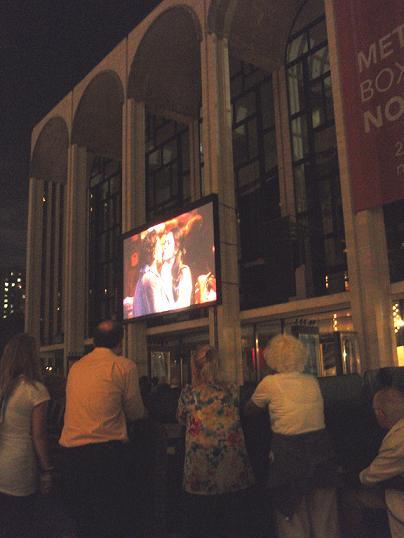
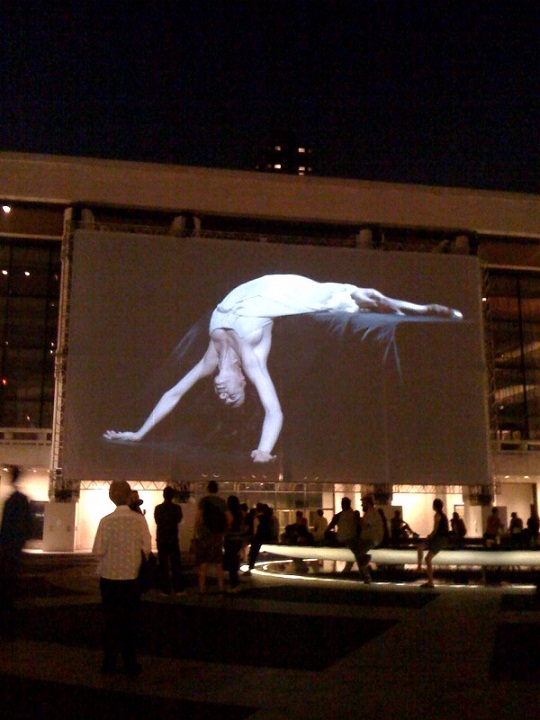
PORTRAITS IN DRAMATIC TIME on Lincoln Center Plaza

Here are some photos I took of David Michalek’s current installation, Portraits in Dramatic Time, shown nightly on the facade of the Koch Theater at Lincoln Center Plaza. Above is (SLSG favorite) ballerina Alessandra Ferri, apparently in the ending scene from Romeo and Juliet. Commissioned for the Lincoln Center Festival, Portraits is similar to Michalek’s earlier installation from a few summers ago, Slow Dancing, which I wrote about here.
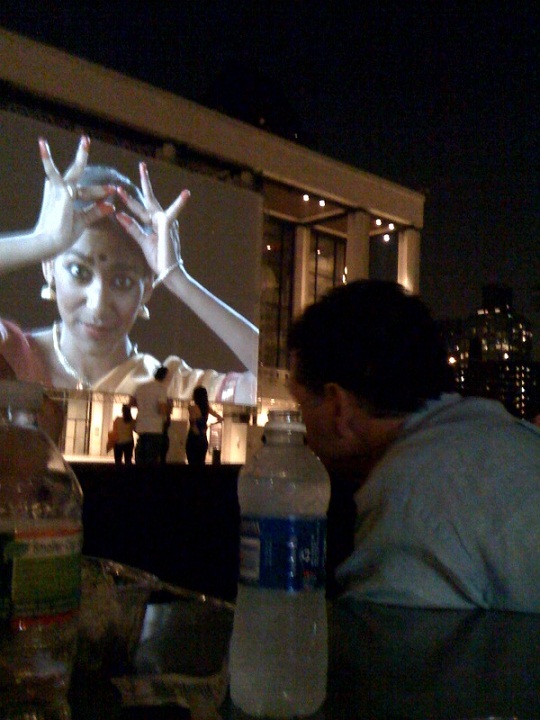
Unlike Slow Dancing, the only two dancers (at least that I’ve seen) in Portraits are Ferri and classical Indian dancer, Savitry Nair, above. To me, Nair was the most mesmerizing, I think because of the intricate (and to me exotic) movements she was making with her hands, but also because of the intensity of her eyes. Patti Lupone (below) was a close second.
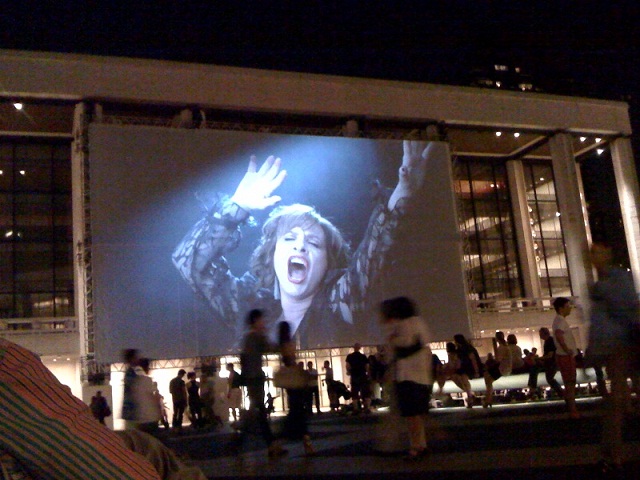
Besides the two dancers and one diva, the others seemed to be all theater actors. Like, Slow Dancing, Michalek filmed the actors in a short scene, then slowed the movement way way down for greater dramatic effect. At least that was the intent. I’ve only watched a couple times, and plan to go more, but, as with Slow Dancing, I have mixed feelings. I think Portraits may be able to attract a larger audience than Slow Dancing due to the greater fame of the stars filmed, and Michalek did for the most part choose dramatic scenes, such as the one below of Alan Rickman throwing a glass of water in anger.
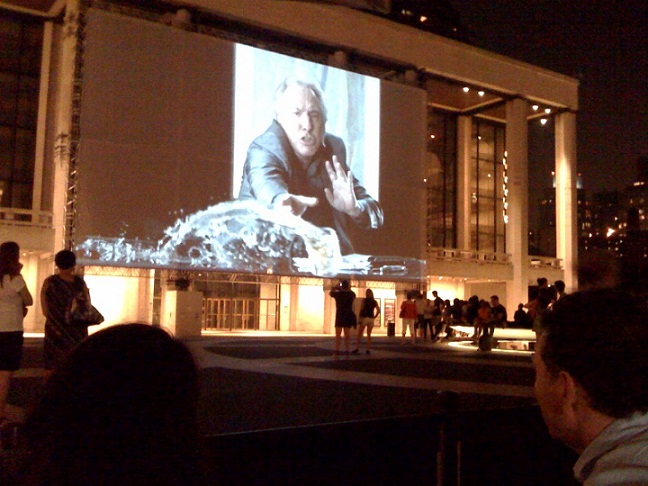
Not all of the scenes are quite as action-packed. You’re often looking more at the intricate changes in facial muscles as the actors go from one emotion to the next. I felt like watching Marianne Jean-Baptiste read a letter and Lili Taylor converse with her daughter provided real lessons in acting.

But in other scenes, even if there was some kind of drama, I didn’t always understand what it was about, or the characters’ relation to one another, and consequently I failed to be as captivated by the mini narrative as I would have liked.
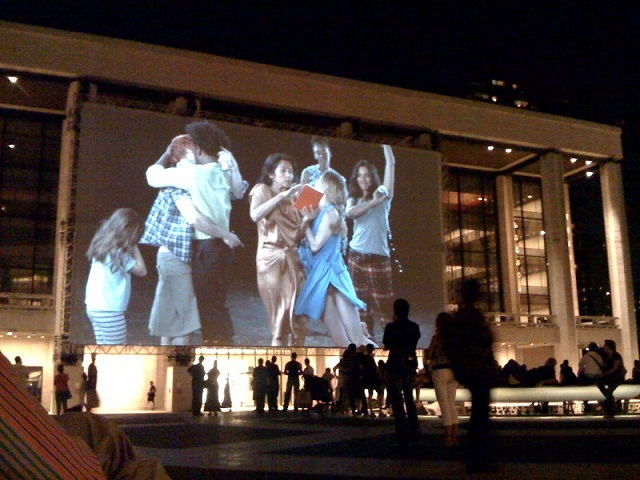
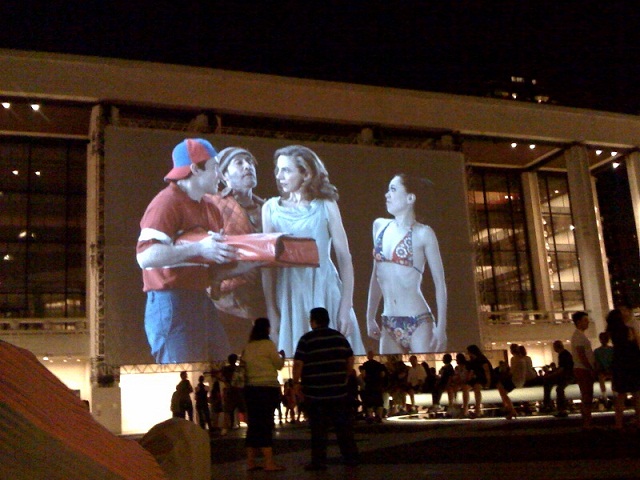
Watching and listening to others on the Plaza, I felt like I wasn’t alone in that thought. The big screen captures your attention but oftentimes fails to keep it. Of course I really wanted to shout at people who were only glancing at Alessandra before passing!

I said this with Slow Dancing, and I’m pretty sure these films are moving faster than the original Dancing films, but I still think they’re going just a bit too slowly. It would also provide variety to rotate more between performer-types – like dancer, actor, diva, dancer, actor diva, etc. But as I said, I saw mostly actors here. I also noticed, though, that there are many performers listed on the show’s website that I didn’t see, and I’ve gone on two different nights so far and have seen many repeats, so I don’t know if all of the listed performers are appearing right now…

Anyway, imperfections aside, it’s always wonderful to have something to go to Lincoln Center for and now that ballet season is over, it can be depressing around there. So I’m very thankful for this installation. Perfect for summertime, sitting near the fountain or at the little cafe in front of Avery Fisher Hall, sipping wine or eating Gelato. This is the best part of living in NYC, imo.

Portraits shows nightly through the end of July. For more info, go here and here.
This Week at New York City Ballet

I hope everyone had a nice holiday weekend, and happy belated Martin Luther King Day!

Tonight begins the Winter season at NYCB. Highlights for the season will be a world premiere by Susan Stroman on January 28th, and Peter Martins’ Swan Lake in February. I highly recommend seeing Sara Mearns as Odette / Odile (White Swan / Black Swan), especially if you are a new dance-goer in search of a good Swan Lake after seeing the Black Swan film. The Martins production is very modern, and very accessible to contemporary audiences, and Mearns is a beautiful dancer who manages to excel at both roles. Her swan queen is very human, with great emotional depth. She has a way, like ABT’s Veronika Part, of making you feel like you’re inside her character’s world, going through everything right along with her. She’s not just a great ballerina, but a compelling actress, in other words. And her black swan is a thrill. Here’s what I wrote about her last year. I’m not sure yet which days she’ll dance, but casting should be announced very soon. All of the ballerinas will be good (and I’ll need to see Ashley Bouder’s this year!), but try hard not to miss Mearns.

My recommendations for this week are:

January 18 (tonight), opening night, early 7:30 curtain
It’s a mixed rep program including Walpurgisnacht Ballet, Duo Concertant, Valse-Fantaisie, and one of Balanchine’s most revered works, The Four Temperaments.

Thursday night, January 20th, 8 p.m.
Another night of mixed rep: Mozartiana, Concerto DSCH, and Cortege Hongrois. The special things about this evening are that it’s another in the excellent See the Music series, and Millepied is dancing Ratmansky’s DSCH (one of my favorites of Ratmansky’s). Plus, will be interesting to see if there’s any kind of crowd increase for Millepied now after all the fanfare. Also SLSG favorite Tyler Angle is debuting in Mozartiana.

Friday night, January 21st 8 p.m.
Sara Mearns will debut in Concerto DSCH. Also showing are Robbins’ well-loved Dances at a Gathering, and Walpurgisnacht again.

Saturday, January 22nd, all day.
It’s an all-day celebration of George Balanchine, in honor of his birthday. In addition to the regular matinee and evening performances (all Balanchine of course), there’s a movie at 10:30 a.m., a studio talk in the afternoon, and a performance by students at the School of American Ballet at 6 p.m. The movie, studio talk and performance by SAB students are all free but require tickets. Everything takes place in the Koch Theater at Lincoln Center. For more info on the Saturday events, click on the link below.

Continue reading “This Week at New York City Ballet”

My Take on BLACK SWAN


I saw it over the weekend. Overall, I thought it was hilarious. Totally campy and just plain funny. Way too silly to be scary though. And I think Aronofksy was going for both. So, to me, it failed to that extent. But it may have just been me. Maybe I just have a dark sense of humor, because I went with two friends – one a ballet fan of the Gelsey Kirkland era, the other not. They both loved it and were on the edge of their seats throughout, although they also laughed quite a bit (particularly Gelsey Kirkland friend). Gelsey Kirkland friend said it reminded him of Dancing on My Grave. I must read that! I don’t know why I haven’t yet…

Anyway, so if you don’t know the story, it’s about this young ballerina who dances with a New York City ballet company housed in the Koch Theater. The artistic director (played by Vincent Cassel) is basically Peter Martins but with brown hair and a French accent.  Peter Martins guy tells the company that they are doing a new production of Swan Lake and to attract new audiences, they are going to cast a brand new ballerina, a new face. The old prima, Winona Ryder, is approaching menopause anyway. Never mind that she looks the same age she did in Reality Bites, at least to me. Apparently this company doesn’t have a system of principals and corps members because no one has any idea who the new face is going to be.

Peter Martins guy soon reveals that he favors Nina (Portman), but thinks she can only do the White Swan. He thinks she’ll have trouble with the Black Swan (he never uses the names Odette and Odile, which I know annoyed some ballet fans on Twitter, but I think it would have alienated non-ballet audiences had he used those names). He tries to seduce her (literally) in the name of getting her into the character of the Black Swan, which of course in the film is characterized as a sinister, conniving slut. But maybe he goes too far and unleashes the inner beast in Nina. She suddenly seems hell-bent on destroying herself (and she’s had problems in the past with self-mutilation and, it’s hinted at, anorexia). Or, maybe it’s that a new dancer from San Francisco (Mila Kunis) is trying to destroy her in order to take her place as the lead. My biggest problem with the movie is that it’s billed as a thriller but we never really find out the answer to that question. At the end, you’re still left wondering WFT was that about??? I mean, you’re left wondering that with many David Lynch films too, but with those, if you think long and hard enough, you can piece it all together. This, I don’t think so. I think it was just meant to be scary, sexy, creepy, gory camp.

For serious ballet fans, you have to suspend disbelief. Natalie Portman I thought did an excellent acting job, and her dancing is very very good for someone with very little training. I know Sarah Lane was supposedly her double, but you never really see any stunning dancing. The camera mostly focuses on Portman’s arms – and Benjamin Millepied did say he focused on the port de bras when training her and Kunis because you just can’t teach someone with no training to go on pointe and do the fouettes and pirouettes and all. So, you simply have to suspend disbelief that someone at Nina’s level would land the lead in the first place. And if you’re looking for thrilling dancing – the fouettes, the lightening-speed chaine turns, a beautiful pas de deux, etc., you’re not going to get it.

When we were all walking out, I did hear a couple people say now they wanted to see Swan Lake. Of course I hope it renews interest in the ballet, but it does worry me a bit that people will be disappointed, because the film makes it seem like the black swan pas de deux is a sex scene. The Peter Martins character keeps yelling at Nina to “seduce me, seduce me!” During a break he rhetorically asks Millepied (playing the role of Siegfried) if he would ever sleep with Nina (except he termed it differently). No one in the audience laughed but me. What am I the only New Yorker who reads the tabloids??? But in the ballet, the ballerina seduces both Siegfried and the audience with her allegro dancing, with her athletics. It’s more dance than theater; the seduction is in the dancing not the acting.

The whole thing had a Valley of the Dolls feel to it. Barbara Hershey is Portman’s mother, and she seems a bit off herself. You sometimes wonder if the mother (who never made it out of the corps, and who left ballet to have Nina) is trying to sabotage her daughter as well. There are some really funny (though I’m not sure if they were meant to be) screaming screeching cat-fight scenes between the two of them. But I think the funniest are between Winona Ryder as the aging ballet star forced into retirement and Nina, particularly those involving discussions of how to get ahead in the ballet company (guess; not by great dancing)… I miss Winona Ryder. I miss movies like Heathers

Anyway, I still don’t know how to feel about this movie. I’m happy that it’s put ballet on people’s minds again, but how misleading is it to what an actual ballet performance is all about? What do you guys think? It seems to have received fairly good reviews from the film critics.

Benjamin Millepied’s “Plainspoken”

Last Thursday was NYCB’s Fall gala, during which they presented the New York City premiere of Benjamin Millepied’s Plainspoken (photo at left, of Teresa Reichlen and Sebastien Marcovici, by Paul Kolnik; the ballet originally premiered in Wyoming this August), along with Robbins’ fabulous homage to Fred Astaire and Rita Hayworth, I’m Old Fashioned, and Balanchine’s Tarantella and Western Symphony.

The evening began with the orchestra pit rising and the always lively Faycal Karoui leading the orchestra in a rendition of Leonard Bernstein’s Candide Overture. I love that movable orchestra pit – best thing, in my opinion, about the recent renovations to the Koch Theater.

I was hoping there would be introductions and short speeches, including one by Sarah Jessica Parker, who served as honorary chair for the after-performance party. But no such luck – I guess because it wasn’t the beginning of the season, like galas usually are. I didn’t even get to see Parker come down the red carpet, there were so many paparazzi blocking my view. I certainly heard her though – or, rather, the paparazzi, as they screamed her name like she was the Messiah. I didn’t recognize anyone else. Lots of good-looking people perfectly coiffed and dressed in black tie but no one I recognized. I didn’t see Natalie Portman, though I heard she was there. I never recognize famous people, though. I’m really bad that way.

Anyway, I’m Old Fashioned was, as always, enjoyable, albeit too long. No dance-maker needed an editor more than Jerome Robbins in my opinion- and Tyler Angle stood out to me in his solos and duets with Maria Kowroski. But my favorite part of the evening was the second half of the post-intermission, when Ashley Bouder and Daniel Ulbrich just nailed Balanchine’s super fast-paced bravura-heavy duet, Tarantella (Ulbrich smacked the tambourine so hard one of the little metal things came flying off) and then Sara Mearns just astounded me in the last section of Western Symphony. How in the world does she stand on pointe, on her own unsupported by a male dancer, and lift her other leg in the air into a perfect split, into practically a six o’clock penchee? How how how? She and Charles Askegard really put on a show as tart-y saloon dancer and cowboy. She is really just unbelievable.

Okay, so onto Plainspoken. Well, sometimes I like Millepied, and sometimes the work just falls a bit flat to me. I didn’t much care for this one, though I’ve liked his last several ballets for ABT and NYCB. This was very abstract, no story that I could find, and I’m just not a fan of purely abstract ballets that I can’t find any story in whatsoever. It was a ballet for four couples: Sterling Hyltin and Tyler Angle, Teresa Reichlen and Amar Ramasar, Jennie Somogyi and Sebastien Marcovici, and Janie Taylor and Jared Angle (the last were generally my and my friend’s favorite pair – I think because Janie always brings something dark to her roles, there’s always something beneath the surface with her even if you can’t put your finger on what it is). The couples sometimes changed partners though, and there would be different-sized groupings.

The music was by Pulitzer prize-winning composer David Lang – it was a commissioned score – but to me the music here wasn’t nearly as rich as, for example, that used by Morphoses recently. This was mainly strings and piano and each section seemed emotionally the same. There didn’t seem to be a lot of contrast between the movements or a build-up toward the end. The sections were each differently lit – by a different color and a background curtain that would rise and lower to reveal more or less light than the section before. But the set was nothing very dramatic and the different colors didn’t, for me at least, evoke a different mood.

Movement-wise, there seemed to be a swimming theme. At various points the dancers would sit on the floor and make motions evocative of swimming – sweeping arms through the air, paddling legs – backward, then forward, then all dancers lying on their backs with their feet in the air like a synchronized swim team. At other points, the women would be carried somewhat Chaconne-like across the stage. I remember a slide characterizing Janie’s section, and she made it seem as if she was being taken by the men who slid her, against her will, across the floor.

I also have in my notes that the movement toward the beginning, in the first section, was a combination of robotic and more casual walks, kind of like the ensemble walking across the back of the stage in the second part of Robbins’s Glass Pieces. This kind of movement was interspersed with the swimming-like motions. In later sections, dancers seemed to run in place.

Oh, and during Janie’s section, there was a point where the men all picked her up and hoisted her high above them, like in MacMillan’s Manon or the Balanchine ballet where the woman is carried around the whole time by a group of men and the lone man on the floor keeps reaching up for her (sorry, can never remember the name of that ballet). My friend loved this part, and I did as well, but couldn’t really figure out how it played into the rest of that section.

In general, my first impressions of this ballet were: some interesting movement reminiscent of other ballets that didn’t seem to add up to much and didn’t really make me feel anything.

At the end, Millepied, Lang and the costume designer (Karen Young) and lighting designer (Penny Jacobus) took the stage for a bow. The applause seemed more polite than hearty (in contrast to the crazy applause Wheeldon always gets!), but that could just be me projecting my own thoughts onto everyone else.

What about you guys? I saw some mentions on Facebook of people liking it. Who else saw it and what did you think?

New York City Ballet’s First Fall Season Opening Night


Tuesday night, New York City Ballet opened its very first fall season with performances of Balanchine’s Serenade, Peter Martins’s Grazioso, and Jerome Robbins’s The Four Seasons. First, before the performance began, Peter Martins came out and introduced each of the principal dancers, who came out onstage one by one, and said this season would be a celebration of them. Tiler Peck in particular was wearing this really gorgeous silky fuchsia dress. Martins said all principals were there except for Benjamin Millepied, who was doing something movie-related “en France,” he said with a funny faux Euro accent. Everyone laughed and gave the dancers a huge round of applause. The house was packed and it was clear how thrilled the company’s many fans are with there being a fall season this year. Martins made fun of himself for being so into toasts and said that during intermission, we’d all be given be given free champagne to toast the principals. Which we were – very fun!

The part of the performance I was mainly looking forward to was Janie Taylor’s debut in Serenade (above headshot and Serenade photo by Paul Kolnik) as the main ballerina. As usual with her, she completely made the ballet her own. I thought the ballet had a somewhat dark element with her, that I’ve never seen before. When she first ran out onstage, late for class, instead of looking like she was all frantic about being late because she’d been held up by a boy, it looked like she was running from something – from him. That man was Charles Askegard and when he danced the middle waltz part with her, the huge size difference between them added to the sense of foreboding, that she was fragile, he was pushing her around, and she’d eventually be hurt by him. At certain parts, it was literally like he was pulling her along. When he lifted her and she raised her legs in a split, it looked almost like she was trying to get away from him. Sara Mearns was the angel and Ask La Cour was the man who I call “blind justice” who take care of Taylor when she falls, and it was interesting how much the two male leads and two female leads looked alike. I almost got Taylor and Mearns mixed up at parts, thinking they were taking on the other’s role. And the end when the men raise Taylor up like pallbearers and she is carried off by them, arching her back, arms outstretched  – so hauntingly beautiful. It reminded me a bit of Balanchine’s La Valse.

I was also looking forward to Martins’s Grazioso, in which three handsome men – Gonzalo Garcia, Andrew Veyette and Daniel Ulbrich – vie for Ashley Bouder’s attention with their bravura moves. I don’t think this ballet has been performed since it premiered a few seasons ago. And I loved it all over again. I love how each guy has his own personality – Garcia is the romantic, Veyette is the manly man one, and Ulbrich is the one with all the high jumping tricks. And Bouder really played the tart, looking at each of them up and down at points kind of lasciviously, really trying to choose. The guy next to me was really giggly over it.

And the evening ended with Robbins’ The Four Seasons, which itself ends with a lovely tribute to fall.

This whole season the Koch theater will open an hour early. The promenade overlooking Lincoln Center Plaza will be open for cocktails, the gift shop will be open, and, for the rest of this opening week, there will also be live jazz performed by the NYCB Orchestra one hour before performance time. They have the promenade and mezzanine area done up nicely, with big plush chairs. Also taking place the rest of this week will be a “meet the artists” session whereby, beginning at 6:45 p.m. in the first ring of the auditorium, the principals dancers will be available to chat with ticket holders. There’s also a photo exhibition of the dancers by photographer HenryLeutwyler on display in the theater throughout the season.

Tomorrow night will be the first of seven “See the Music” performances which will provide a look inside NYCB’s 62-piece orchestra. At the beginning of each performance, Peter Martins and musical director Faycal Karoui will briefly discuss the program’s music, followed by the orchestra performing an excerpt of one of the ballet scores. The subject of tomorrow night’s discussion will be Eduoard Lalo’s score for Ratmansky’s Namouna: A Grand Divertissement, which premiered last season. Additional “See the Music” programs are Sept. 26 matinee, January 20, Feb. 1, Feb. 19 matinee, May 25 and June 11.

WHY ARE OUTDOOR CROWDS SO MUCH MORE RESPECTFUL OF THE OPERA THAN DANCE?

p9032296

p9042301

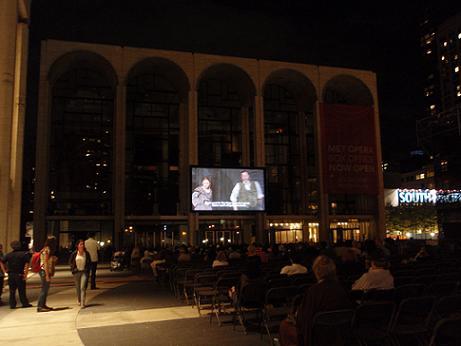
For the past few evenings I’ve been partaking of the Met Opera’s outdoor Summer HD Festival on Lincoln Center Plaza. The first night I went was Benjamin Britten’s Peter Grimes. It was on a week night and the plaza was about half full. I’d bought a sack pique-nique dinner from Bar Boulud across the street — which was delic by the way (chilled gazpacho soup, baguette of brie and fresh fig spread, waffle chips, bittersweet chocolate tart, and bottle of Pellegrino). But when I took a seat in the back and began to unwrap my brown bag I realized what a commotion I was making, how dead silent it was. I waited until a noisy helicopter buzzed around above us for a few seconds to tear into my sandwich. I absolutely loved the quiet, but figured it must be because this opera was so serious and esoteric — only true opera-manes would go.

But then last night, Puccini’s far more popular La Boheme was the same. Plaza was packed. I mean, every single seat was taken (both of the fold-out variety set up by the event organizers and make-shift seats like construction cones aligning Avery Fisher Hall), there was hardly a square foot of ground to stand on all the way to the street — people were even camped out atop the temporary Koch Theater ticket trailer (until police came around telling them to get down). But once the music began, there was the same dead silence. Everyone stared up and the screen, completely captivated. It was even quiet around the food and liquor stands, where people were basically whispering their orders. Children (the few that were there) behaved, dogs (the many that were there) behaved. Well, dogs usually behave in a crowd, actually… But even the little kids seemed to know it was important to try to concentrate on the screens.

The noisiest part of the evening was when South Pacific, showing next door at the Vivian Beaumont, let out. But once the theater-goers realized there was something important going on out on the Plaza, they shushed each other and ventured up to watch — in total silence — as well.

Such a complete contrast with some of the outdoor dance festivals — Lincoln Center Out of Doors, the Downtown Dance Festival, site-specific summertime events, sometimes SummerStage. I’ve heard from several people now that the Saratoga Performing Arts Center where NYCBallet has their summer season, is much the same, making me honestly not all that excited to go up there. I mean, kids are running around, parents yelling, people talking to their friends at the same pitch as if they were in a noisy bar, people unwrapping food, opening soda cans, popping gum.

So what gives? Do people just think opera is mainly about music and so to enjoy it everyone must be able to hear it above all else, whereas dance is more visual — so you can make all the noise want and not bother people because they can still see? Maybe it’s about the children — people are much less inclined to bring small kids to the opera, but they somehow think their two-year-old is going to have a deep appreciation of Balanchine or Karole Armitage or classical Indian dance. Maybe they equate outdoor dance performances with outdoor social dance events like Midsummer Night’s Swing, where you’re hardly going to disturb social dancers by talking. Or maybe there’s something about a big ole screen being up there.

I wonder if it would be different if ABT would have a summer HD festival and show outdoor broadcasts of some of the spring season’s ballets. Probably not… although the crowds were pretty quiet for the David Michalek Slow Dancing exhibit two years ago (once Midsummer Night Swing ended anyway)…

Anyway, tonight (Saturday) is Mark Morris’s Orfeo ed Euridice. I mean Gluck’s Orfeo ed Euridice but Morris produced and choreographed. We’ll see how it goes when there’s some dance involved… The Met outdoor HD festival continues through Monday night, ending with Anthony Minghella’s production of Puccini’s Madame Butterfly.