This past weekend marked the premiere of L.A. Dance Project at the Walt Disney Concert Hall in downtown LA. Of course this is the event – the full-evening debut of Benjamin Millepied’s new LA-based company – that all dance-going Angelenos have been eagerly awaiting. There were two performances: opening night was Saturday; I went to the Sunday matinee. According to reports of Saturday’s performance, Natalie Portman was present, fully decked out in Oscar attire. Robert Pattinson was also there. No report of what he thought though, other than that the evening made clear to him that he has no talent for dance. His words 🙂
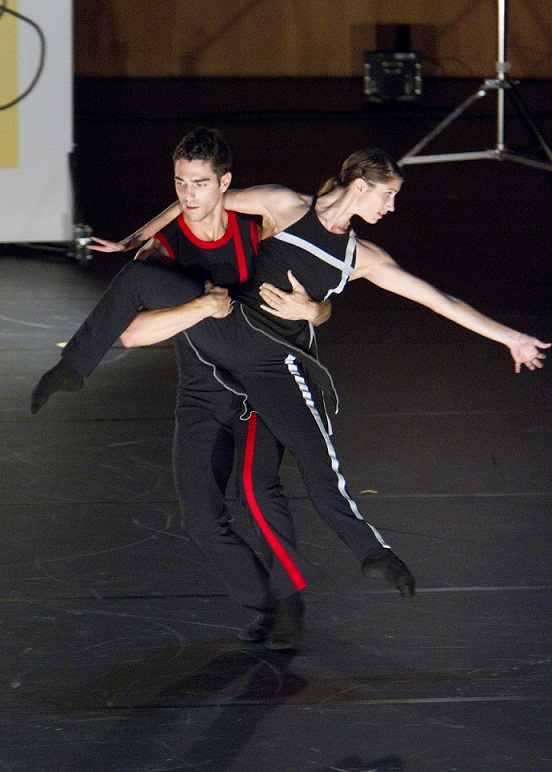
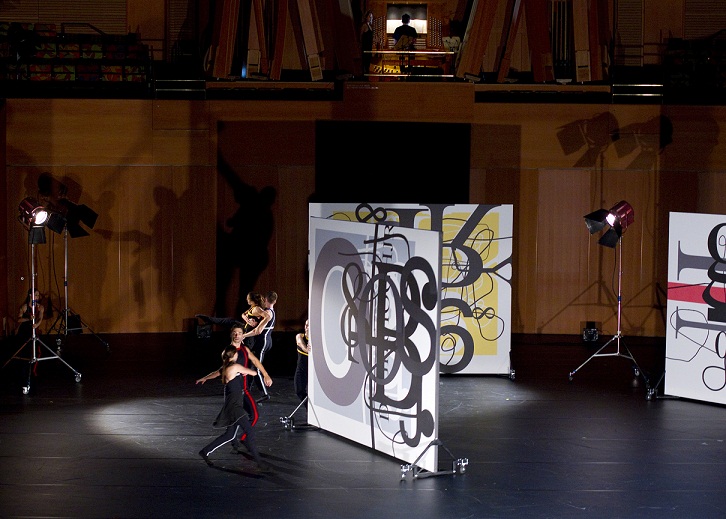
There were three pieces on the program: William Forsythe’s Quintett, from 1993; Merce Cunningham’s Winterbranch, from 1964; and the world premiere of a Millepied dance, Moving Parts (photo above, by Eric Politzer; all photos by Politzer).
By far the most astounding, confounding, spellbinding, brilliant piece on the program was the Cunningham. And for that reason alone L.A. Dance Project proved itself an invaluable asset to its new community. Every critic so far has said the same, so I know I’m not alone in thinking that. But I don’t know how much dance-going Angelenos would agree. During my performance, a woman sitting next to me angrily got up and walked to the back of the theater. Immediately after the dance ended, she cried out, “Thank God!” more than loudly enough for everyone in the entire theater to hear. Many showed their agreement with her as a chorus of loud boos started to emanate throughout the auditorium. This soon was countered by a chorus of cheers. For a moment there was a war going on. I have to say I’ve never ever seen that kind of visceral, dramatic reaction to any dance performance in New York. I’ve never seen that anywhere in response to dance; the only time I’ve ever seen a work of art booed was the Metropolitan Opera’s recent re-interpretation of Tosca.
I mean, part of me was excited that dance could evoke such strong feelings. But part of me was disappointed in the booing Angelenos for not being the least bit open-minded, for not giving the piece even a second’s consideration; for failing to think, “I’m going to go home and look up this Merce Cunningham person on the internet and find out what in the world that was all about.” Cunningham is obviously a master, and I don’t know as much about him as I should. This definitely made me want to know more. It also made me kind of sad that I wasn’t around in the 60s if that kind of art was going on. I wish Alastair Macaulay would have been in L.A. reviewing this for the NY Times. I’d like to know what he would’ve thought – of the piece, and the audience reaction, he loves Cunningham so.
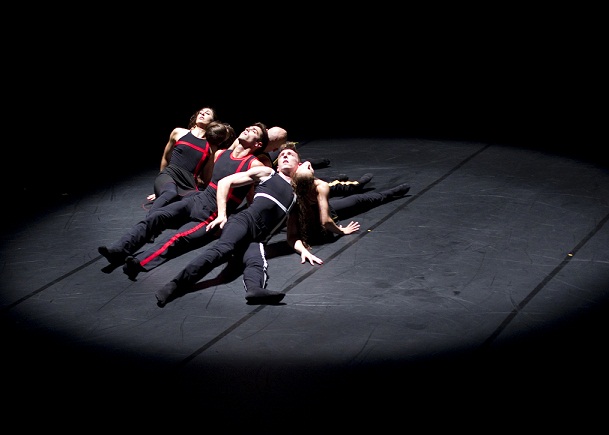
According to program notes, Winterbranch was taken out of the Cunningham repertoire not long after it premiered, so most people probably know nothing about it. It was a collaboration between Cunningham, Robert Rauschenberg, and sound artist La Monte Young. Rauschenberg designed the costumes (all six dancers are in black sweatsuits with smudges of black painted under their eyes) as well as the absolutely brilliant lighting (which was reconstructed for this stage by Beverly Emmons).
At the beginning one dancer (originally Merce himself) slithers across a dark stage carrying a flashlight. Following him, other dancers take the stage, and the piece is basically a meditation on the act of falling and and pulling yourself back up. Dancers sometimes fall quickly and violently, sometimes they fall slowly, as if they’re being crushed by some invisible psychological weight. Sometimes they have difficulty rising; they crawl over each other, they contort their bodies and crab-walk across stage. Meanwhile the stage is dark, except for that brilliant Rauschenberg lighting whereby a light will briefly flash, like a headlight, then fade, then reappear tunnel-like, growing stronger, again like the lights of an approaching car.
About half-way through the sound starts. And, yes, it’s very harsh. Young’s composition is called simply 2 Sounds and those two sounds are: the sound of “ashtrays scraped against a mirror;” and of “pieces of wood rubbed against a Chinese gong.”
Yes, the whole thing was very unsettling. It felt like being caught in headlights, perhaps in a tunnel, or on a dark street, with sound so shrill you couldn’t escape. It felt very industrial, urban, Los Angeles – probably why Millepied thought to bring it here.
Wasn’t Cunningham all about questioning what dance is? Do people really want it to be all about pretty girls doing sexy things? Don’t people want to be challenged? Believe me, the people doing the complaining (mainly about the sound from what I overheard) didn’t look like they’d never been to a rock concert before. And after this ended my eardrums were nowhere near numb.
I think Millepied took a real chance bringing such a piece to a place where perhaps many have only seen classical ballet and popular dance on television. And for that I respect him more than ever.
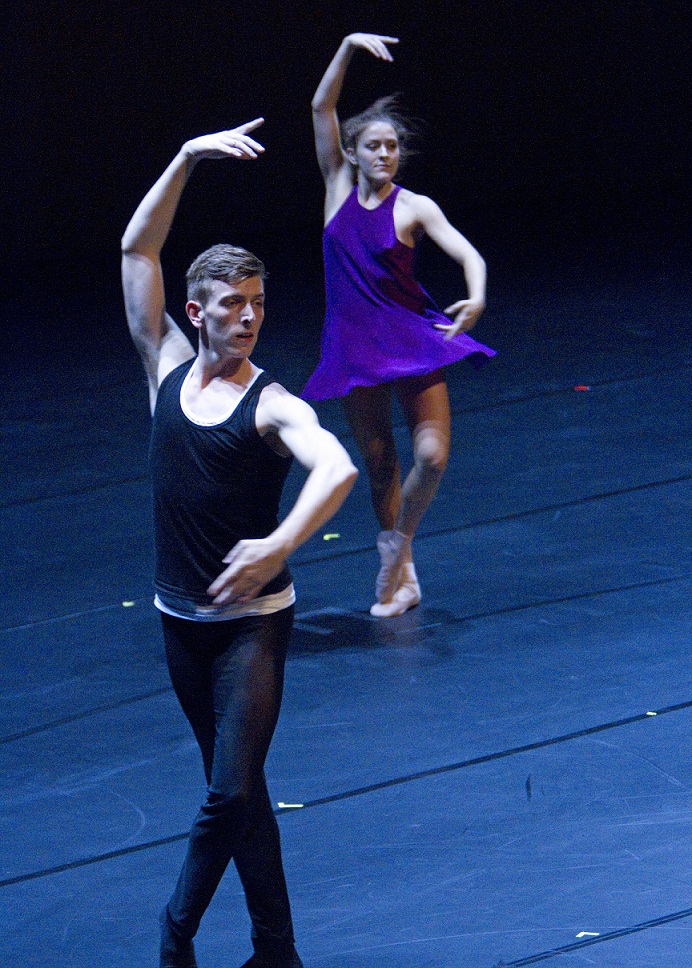
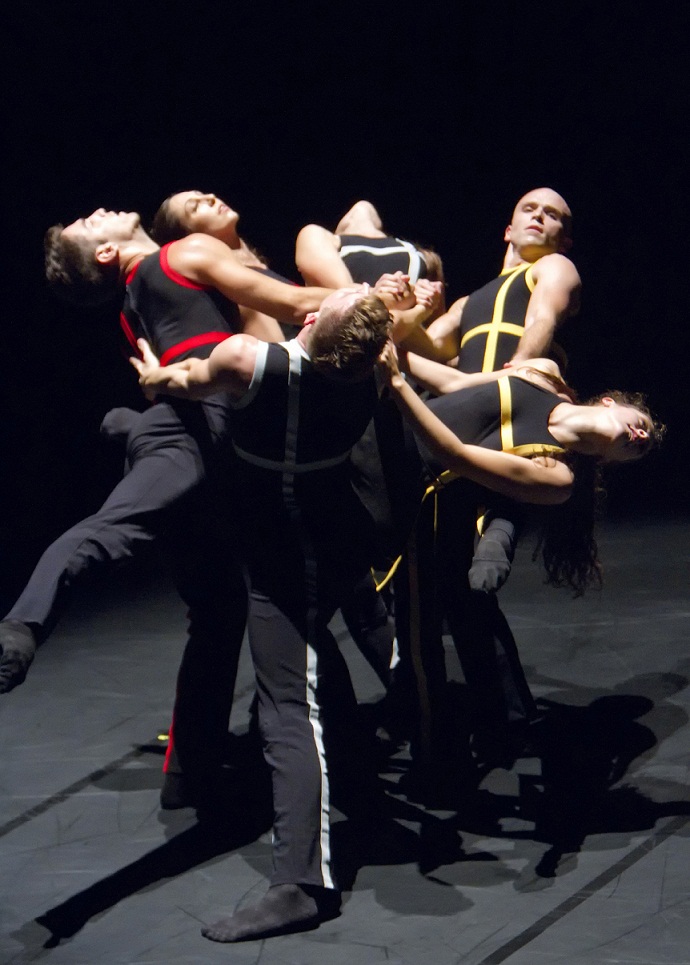
The other two pieces weren’t quite as strong. I think Forsythe’s Quintett (photo above) meant more if you knew about it, about him, and about his wife who died young of ovarian cancer. It’s a waltz but there are five people – three men and two women. So there’s a woman missing. The music is Gavin Bryars’s Jesus’ Blood Never Failed Me Yet, a sweet, folksy choral piece in which the singer keeps repeating that line over and over and over again. The dancing is mainly light and joyful, and the press notes state that he meant it to be a kind of tribute to her. Unfortunately the program notes don’t give out that information, so the audience was unaware.
I kept thinking of Forsythe’s intense, unforgettable installation piece, You Made Me a Monster, another take on the same thing, with a completely different mood, which showed in New York several years ago at the Baryshnikov Arts Center (and which I wrote about here). The dancer Charlie Hodges – my favorite of the six-person dance troupe – reminded me of a similar-looking dancer in Monster. His movement was the most expansive with every motion seemingly filled with intent. And he was the character who seemed to evoke the sole man, the man without the partner. Quintett had much more lightness and fluidity than Monster, and was far more hopeful than tragic, and it nearly made me cry. I’m just not sure if an audience who knew nothing about his wife and the work’s origins, and who’d never seen Monster, would have gotten the same out of it.
Third on was Millepied’s new Moving Parts, a collaboration with the always rousing Nico Muhly, costumers Kate and Laura Mulleavy of Rodarte, and visual artist Christopher Wool. I thought the most interesting parts of this collaboration were Muhly’s music – a bold, rich combination – at times mellifluous, at times slightly off-kilter a la Philip Glass – of violin, clarinet, and organ (played spectacularly on the magnificent, elevated organ at the top of the concert hall) and Wool’s artwork, consisting of three large canvasses bearing a combination of letters and numbers. One or two of the six dancers would push the paintings, on wheels, around the stage, the others dancing around them. The dancers wore basic black unitards; and were paired – male and female – by a same colored stripe running along the top of the costumes. Each painting also bore one of those colors. But this color-coordination didn’t seem to have much meaning.
The dancers were all very good – Hodges, Frances Chiaverini, Julia Eichten, Morgan Lugo, Nathan Makolandra, and Amanda Wells, but I didn’t find the choreography particularly intriguing or the dance as a whole to have much meaning. But I find Millepied to be like that – he’s either on or off. This time he was off, but next time he may well be very on.
Nevertheless, every time this company performs, I will always be there. That Cunningham revival made me trust that Millepied will always bring something significant.
Here are a few more photos of Moving Parts, courtesy of the Music Center.