Is Ballet A Dying Art?


I must confess I haven’t yet read Jennifer Homans’ acclaimed but controversial history of ballet, Apollo’s Angels. I’m working hard on my second novel and have been knee deep in prison and cop memoirs and haven’t had time for much outside reading. I hope to read it soon though.

In the meantime, I have read some of the reviews, including Laura Jacobs’ in the WSJ and Toni Bentley’s in the NY Times. The two reviews focus on very different aspects of the book so it’s interesting to read both of them. Bentley says Homans is best on Balanchine (both Bentley and Homans danced with him). But Jacobs find the earlier sections enlightening as well.

The controversial aspects of the book seem to be toward the end when Homans argues that, for various reason (but according to Bentley many of them being that Balanchine has passed and his legacy is not being kept alive), ballet is a dying art.

I don’t want to go on too much since I haven’t yet read the book, but I will say that ballet seems to be alive and well in many European and Latin American countries. I do notice a real influx of visitors to my blog whenever the big European stars perform with ABT. I don’t think Roberto Bolle, Alina Cojocaru and Natalia Osipova fans think ballet is dying and certainly not because Balanchine is no longer with us. Ballet may be less popular in this country since the Baryshnikov era passed though, and it remains to be seen whether movies like Mao’s Last Dancer and Black Swan can do anything to revive it. I’m doubtful but want to be hopeful. I think it’s more likely that Natalie Portman marrying Benjamin Millepied will draw audiences to ballet than the actual movie will.

But then I recently ran across this interview with Homans over at the Ballet Bag, a London blog. At the beginning of the post, the writers say audiences there have been dwindling a bit and they’re worried about the future of the art form as well. Which scares me.

Anyway, has anyone read the book?

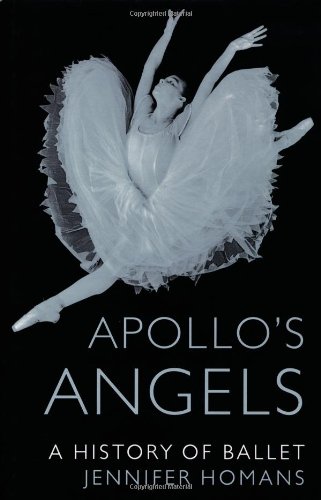
Another thing I wanted to call attention to is the book cover. The top one is the British cover, the second the American. Which do you guys like better, and think will sell more books? Just about every single time I see a European cover beside an American cover, I like the European better. But maybe it’s just me.

WEEKEND READING: BALANCHINE, DIAGHLEV AND WHAT'S WRONG WITH BALLET TODAY

I know it’s not the weekend yet – and I still have another post or two I need to get up before it happens – but I haven’t had time really to devour this article like I’ve wanted to and so wanted to link to it so you all can read it without waiting for me to become unbusy with never-ending book stuff. It’s from the New Criterion and is by Laura Jacobs. It’s about Diaghlev and all the excellent collaborations he engendered at his Ballets Russes – between Balanchine and all the brilliant artists who worked with BR – and it examines what might be different about today’s collaborations. I think it’s particularly compelling in light of all the new ballets being premiered this season at New York City Ballet, many of which just don’t seem to have the same substance as those Balanchine ballets despite the fact that there are some really brilliant visual artists and composers working with the choreographers. And I don’t think I’m the only one with those feelings.

Anyway, read the article and let me know what you think. I’m still trying to articulate my thoughts on the new Melissa Barak ballet that premiered last week. And, tonight is the second to last of the premieres – this one by Mauro Bigonzetti. We’ll see how that one fares…

JEWELS


Janie Taylor and Benjamin Millepied in “Rubies.” All photos are by Paul Kolnik.


Sterling Hyltin and Gonzalo Garcia in “Rubies.”


Jonathan Stafford and Sara Mearns in “Diamonds.”


Maria Kowroski and Charles Askegard and cast in “Diamonds.”


Abi Stafford and Jason Fowler in “Emeralds.”

So New York City Ballet ended its Winter season with Balanchine’s Jewels, his three-act abstract ballet in homage to three different styles of classical ballet: “Emeralds” set to Gabriel Faure in honor of the French style; “Rubies” set to Stravinsky in honor of the American jazzy / showgirl-y style; and “Diamonds” set to Romantic Tchaikovsky and in the imperial, celebratory Russian style.

“Diamonds” has long been my favorite part, but the more I see of the full-length ballet (“Rubies” is often performed apart from the rest, in mixed rep programs), the other two are growing on me, particularly “Emeralds” with its complex patterns, its subtlety and nuance. And of course I like “Rubies” because I think, through this part of the ballet, new audiences unfamiliar with Balanchine can best see how he created a certain kind of “Americanized” ballet for his adopted country.

There were several debuts in the various roles: Janie Taylor and Gonzalo Garcia in “Rubies,” and I think Sterling Hyltin in “Rubies” as well (it was my first time seeing her anyway). Janie was an absolute blast to watch. She doesn’t really have the proper hips for this heavily hip-jutting, hip-swaying role — she’s so tiny and waify — but she was putting everything she had into it, taking every single movement, every jump and stretch and supported penchee and pose as far as it could possibly go and you just couldn’t take your eyes off her. It was the best performance of that part that I’ve seen since Ashley Bouder debuted in it a couple years ago. What was also so stunning about Janie’s performance was her commitment to perfecting every little detail in making a certain shape — it reminded me of her absolutely captivating performance as the Novice in Robbins’ The Cage. Except this wasn’t a creepy male-devouring insect, but a fun flirty showgirl. And yet there was a certain darkness to it — I think there always is with her (Alastair Macaulay has noted the same), but that darkness somehow worked here. She made the role her own, which is what a great interpretive artist must always do.

Janie Taylor danced with Benjamin Millepied, who was very good as well — the most animated I’ve seen him lately, actually. Maybe Natalie Portman was in the audience? I didn’t see her though.

When Gonzalo debuted he danced with Sterling. Of course I always love Gonzalo and, as always, he was very animated and dramatic, making a little story out of every little interaction with Sterling. Which is what I always love about him and what I find so engaging. They did have a few kinks to work through though – -sometimes it seemed like they’d nearly missed hands in connecting, like they weren’t completely in sync with each other. But that was only physical and was likely something you might have only caught if you were sitting up close (as I was). Emotionally they connected perfectly — which to me is more important — unless of course a physical mis-connection results in a fall or something. Hyltin does have the hips for this role and she seemed like she was having a lot of fun with it too. She was really stunning.

Of course I loved Sara Mearns in “Diamonds,” which I knew I would. This was my first time seeing her in the role and she was perfect. It was just like Swan Lake all over again. Sir Alastair in his end of the season review calls her the best ballerina in NYCB and perhaps all of New York and I generally agree, especially regarding her adagio. I guess the perfect ballerina would be someone with her or Veronika Part’s adagio technique and Gillian Murphy or Paloma Herrera’s allegro — I would have preferred for Mearns, for example, to be a tiny bit more seductive with the fouettes in the SL Black Swan pdd — but I don’t know if that ballerina exists today. I don’t know if she’s existed ever. Maybe Gelsey Kirkland? I don’t know, I never saw her dance live, but judging by what I hear from those who did, and from my own video-watching, she seems to have had everything…

Anyway, “Emeralds”: I liked Abi Stafford in the solo; I liked her port de bras — very beautiful arms, very well-articulated gesturing. Her performance was sweet. I also liked Jenifer Ringer as the second girl who does what I call “the courtship walk” with the male dancer. Her performance was full of subtlety and charm; I sensed a kind ofย  sweet shyness as she tip-toed en pointe along with the boy, first going in his direction, then kind of changing direction and walking around him in circles, making him kind of follow her.

At my final performance of the season, I sat next to James Wolcott and Laura Jacobs, who introduced me to several Ballet Review people. Ballet Review seems like such an excellent publication and it’s really too bad the articles aren’t available online because Jacobs has a very interesting scholarly piece on this ballet, arguing that it’s more about Balanchine’s love of Suzanne Farrell than anything else. If you can get your hands on it, I highly recommend that article!

ED'S CHOWDER HOUSE IS THE NEW PJ CLARKE'S FOR AFTER-BALLET DRINKS AND DELICIOUS FOODY THINGS!

pb2823552

pb282357

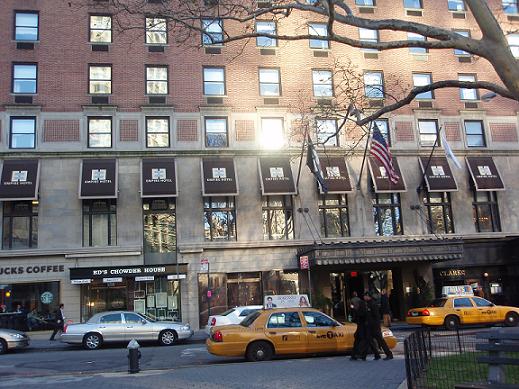
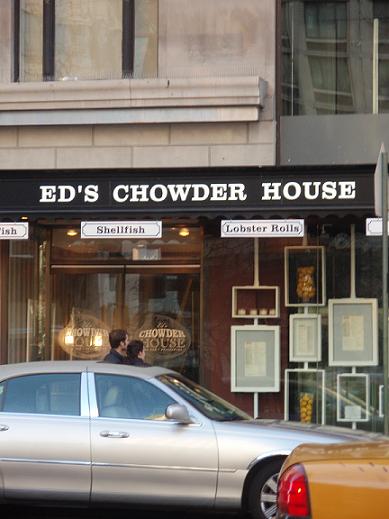
So, after NYCBallet’s Nutcracker Friday night (review coming soon), my friend Mika and I discovered a new place for after-ballet drinks and interesting foodie things — Ed’s Chowder House (located right across the street from Lincoln Center, two doors down from PJ Clarke’s and at the bottom of the Empire Hotel).

The dining area is nice, but the bar room (where you can get less expensive a la carte items — mostly fresh fish and chowders) is what really rocks. My friends and I always used to go to PJ Clarke’s, which is a bit cheaper, but it was always so crowded — both bar and resturant, the bar stools have no backs and are extremely uncomfortable, and the wait staff is always so pissy about seating you at a table if your party is not fully arrived or if you’re only getting appetizers or desserts — even if you get an expensive cocktail (or three) and a couple appetizers to share (which comes out to be far more money-wise than if you order one entree and a non-alcoholic drink). And then once you are seated the wait staff makes it their sole mission to get you out of there as soon as humanly possible, nearly opening your mouth for you and shoveling in the food. I once nearly had to smack a waiter on the hand for repeatedly trying to take my plate away… Plus, I was in there nearly every night last season, and could the hostess’s face ever register any recognition?…

Rosa Mexicano around the corner is lovely, but for me, it’s best in summer so you can sit outside. The bar is too cramped (though the chairs do have backs) and the restaurant area is not very interesting, imo, though the little swimmer guys diving down the waterfall-covered wall aligning the stairway are very dancerly and cute.

Anyway, we were extremely excited to find an excellent alternative in Ed’s! The bar area is spacious and there are multiple little tables behind the actual bar. Bar is made out of very cool material by the way — hard to describe — we weren’t sure if the objects underneath the glazed covering were sea shells, but they were very cool — do check it out! The restaurant area can get a bit pricey, but the bar serves really good a la carte items — oysters, various chowders, seafood appetizers like lobster rolls, scallop ravioli and mini crab cakes, and individually-ordered fish steaks and interesting sides like chili-glazed spinach and horseradish mashed potatoes. And they have a nice cocktail list and a pretty good wine selection. They made the best Tanqueray martini – which I now call the “Laura Jacobs martini” since she introduced me to it a few weeks ago when she and James Wolcott took us out for after-ABT dinner at Shun Lee — and it’s the best I’ve had since that evening.

And they have bowls full of chewy saltwater taffey on the way out ๐Ÿ™‚

ABT OPENING NIGHT GALA FALL 2009: THREE PREMIERES IN BLACK AND WHITE, AND WOOD


Photo of Veronika Part in The Dying Swan, taken from Vogue; photos of the three premieres coming as soon as I receive them.

After ABT‘s fall season opening night gala performance last night, the really wonderful James Wolcott and Laura Jacobs took friend Siobhan and me out for dinner at Shun Lee (I’d never been there — but wow, excellent excellent food!) and when Laura asked me if I was going to write about the performance, I kind of rolled my eyes and said, “I’ll try!” We all agreed that dance is absolutely the hardest art form to review, especially on seeing a dance for the first time. Let alone THREE dances seen for the first time. With visual art you can stand there all day and examine at it, with music you have recordings and scores, film critics generally see a movie several times before writing a review. With dance you have one chance — often one split mili-second — to remember a half an hour or so of movement, images, patterns, structure, costumes, music, lighting — everything. It’s impossible. Since starting this blog I have so much more respect for dance critics.

Anyway, there were three premieres last night: Seven Sonatas by Alexei Ratmansky, One of Three by Aszure Barton, and Everything Doesn’t Happen at Once by Benjamin Millepied. Also on the bill was a performance by Veronika Part of Fokine’s The Dying Swan. ABT performed, for the first time, in Lincoln Center’s Avery Fisher Hall, a concert hall not accustomed to housing dance performances. (ABT usually holds its fall season in City Center, but changed venues because of City Center’s renovation plans.)

I’m going to be seeing each premiere a couple more times this season and prefer to write after I’ve seen each more than once. But since the season is so short (it ends October 10, this Saturday), I’ll write something up front. These are only first impressions though, and I’ve found I see so many more things with repeated viewings.

Honestly, everything kind of blended together for me. Part of this was because of the sparseness of the Avery Fisher stage — there were no sets, no wings, no curtains — so dancers warmed up onstage before us, giving each piece a kind of Cabaret-like feel; and part of it was because costumes for each piece were all black and white. I remember lots of black, lots of white and the hardwood of that stage.

1) Ratmansky’s Seven Sonatas was performed to Domenico Scarlatti music by three male-female couples: David Hallberg and Julie Kent, Herman Cornejo and Xiomara Reyes, and Gennadi Saveliev and Stella Abrera. Costumes were all white — flowing dresses for the women, classical tights and 18th-Century tops for the men. The movement was a combination of classical and modern and, though the ballet was generally story-less, each couple seemed to have a little narrative: Cornejo and Reyes were the young, playful couple, Herman full of high jumps with many beats of the feet that really wowed the crowd and Xiomara dizzying rapid multiple turns. At one point Herman did this crazy turn in the air, landed on his back, and caught her. Crowd went wild.

Abrera and Saveliev seemed to be a more mature couple, perhaps in mourning. It seemed Abrera was a woman, possibly a mother, who’d lost a child or something — Saveliev seemed to be trying to console her and keep her from self-destructing. It seemed like she kept trying to break free of him and reach out to some invisible thing.

I’m not sure what Hallberg and Kent were meant to represent except maybe a modern couple — they seemed to have the most modern movement. David appeared to be trapped in a box and he kept pushing out; he had a lot of quick movement with fast stops in different directions and a lot of it in parallel — not turned-out — position. Julie had a lot of sharp, staccato movement. They could’ve also been a courting couple: at one point, David was on one knee and he invited Julie to run at him and jump on him. When she did, he took her into this lovely lift. It’s sweet and many in the audience lightly laughed.

The ballet was broken into duets and solos and bookended by two ensemble movements, the first pretty and lyrical, the latter more chaotic as they all perform their very different movement motifs at once, some trying on others’ movement styles — everyone does the staccato arm patterns for a while, etc. At the end, the women lay on the floor and the men wrapped their bodies over them.

One other thing: our David Hallberg is sporting longish hair these days ๐Ÿ™‚ I think it looks good, and fun for a change! Funny thing is, he’s so beautiful and glamorous, I tend to get jealous if him, even though he’s a man… which I guess should be kind of odd…

2) Barton’s One of Three was set to Maurice Ravel’s Violin Sonata in G and danced by a whole slew of tuxedoed men, and three women — Gillian Murphy, Misty Copeland, and Paloma Herrera. Why is it that women choreographers tend to use men so much more! (And female dance-writers tend to focus on male dancers ๐Ÿ™‚ — is this feminist?)

Anyway, the piece begins with Cory Stearns walking out dressed in a tux and black jazz shoes. He does a little solo and his movements are all modern, angular, which contrasted in an intriguing way with the tux. I don’t know if it was his being a bit weirded out by the curtainless stage (which forced him to walk out in the dark with all of us watching) or whether it was part of the character, but he seemed to have this loopy smile in the beginning, that was really rather endearing. I chatted with a friend during intermission and she felt just the same.

Anyway, soon Cory was joined by more tuxedoed men, and then by Gillian, who came prancing out in a long white cocktail gown with her radiant red hair tied back into a sleek twist. The men would kind of veer toward her, sideways, their bodies leading their heads in, to me, a rather amusing way. Gillian’s character was very haughty, very glam and posh and she acted like she was ordering the men around with her little finger. The men often seemed led by their bodies, moving first with the back, or at times one leg would take a step, the rest of the body reluctant to follow (I noticed that most with Jared Matthews, who I thought was dancing at his best last night). I found this a very interesting movement motif.

Misty Copeland was the lead character in the second movement. She wore a short black and white dress, her costume and character more flirty and wild. But same thing — she seemed to kind of taunt her tuxedoed men.

And third movement was led by Paloma, wearing a black lacey top and black pants. She smiled a lot more than Misty and Gillian, but she seemed to move in a slinky, sexually-empowered way, like a tanguera.

Now that I think about it, though there were many more men here, the women seemed to have all the power. Fun!

3) Next on was Part’s Dying Swan, which was really poignant, as I knew it would be. It’s a very short piece, but it’s funny how the ballerina can really do it however she wants to; I just saw Diana Vishneva perform this in the Fall For Dance Festival and her Dying Swan was very different. Whereas Diana spent most of the time on her toes, bourreeing, Veronika spent more time on the floor, one leg stretched out before her (like in above picture), then rising again to her toes for one more breath. Diana’s swan seemed to flutter about more, like she was fighting death, she lay down only at the very end. Veronika kept holding her arms up in front of her, her wrists bent and her hands cupped over, as if to foreshadow what would happen to her body. In general, Veronika’s swan accepted and approached death more gracefully or willingly, but Diana’s, with that broad wingspan, at times really looked strikingly birdlike. I don’t know if I can say I liked one interpretation better than the other — both were breathtaking and both very poignant.

Did anyone else see both swans?

4) And the program ended with Millepied’s Everything Doesn’t Happen at Once, set to David Lang music that was at times mellifluous and at times cacophonous or eerie. He used a large group of dancers but Marcelo Gomes, Isabella Boylston and Daniil Simkin had the main parts and so stood out the most (and Kristi Boone shone in a smaller role).

There was a lot going on here — both in the music and in the dance, and I felt that, unlike with Millepied’s earlier piece for ABT — From Here on Out — composed to music by Nico Muhly (who was in the audience) — in this one the movement kept up, didn’t let the music outshine it. The stage is set up to resemble — at least to me — a pool. Dancers would gather around it and watch the people dancing in the lit-up center. At the beginning there seemed to be a swimming motif, with large, rounded arm movements resembling breaststrokes. Movement is also evocative of birds as well though, and some of the same lifts were present as in Millepied’s recent work for NYCB, where the women are perched on the men’s shoulders, their arms outstretched sideways.

In the middle part, Marcelo and Isabella have a rather haunting solo. The ballet is generally story-less but as far as I could make out any narrative, it appeared she was sort of struggling against him. He seemed very careful and gentle with her (in sharp contrast to a later, more hostile duet he has with the super-strong Kristi Boone, who seemed to be either Isabella’s competitor or her double), but she — Isabella — nevertheless kept trying to push away from Marcelo as he held her. The duet ends with them walking toward the back of the stage holding hands, connected, but her body is lunging as far as possible away from his. A rather warped relationship.

Then there’s a rather amusing section where bravura dancer Daniil Simkin is struggling with a bunch of women. He tries to break free of them but then he keeps throwing himself into their arms, making them catch him in these rather breathtaking group lifts — one of them ending in a perfect split in the air. And he has a bunch of crazy multiple pirouettes that had the audience audibly gasping. It all went with his character though, who seemed rather crazed, like he may have just escaped from an asylum or something. I kept wondering who else was ever going to be able to perform that role…

I didn’t go to the gala party but in addition to Muhly, I saw Alessandra Ferri in the audience, one of the Billy Elliots, and apparently Natalie Portman was there.

Anyway, I’ll write more at the end of the season, when I’ve seen these new dances a few more times. Here is Haglund’s review.

LAURA JACOBS' THE BIRD CATCHER, AND WHY THOSE MARTHA GRAHAM MEN WEAR SUCH SKIMPY COSTUMES

_____

“Well I’ve only been twice,” Margret answered, realizing her mouth wasn’t working so well. “I mean, the one about Oedip … Oedipus.”

The wine was warping her consonants.

Night Journey,” he prompted.

“Is that the one? It was like an Assyrian,” she said slowly, “bas-relief. Those little palms and things in profile.”

Her face was hot. Why did he keep looking at her?

“What I want to know,” Emily said, pointing a pretty finger at Azam, “is why Graham men are always in such skimpy costumes? I mean, really, Azam, it’s jockstraps and loincloths. Do you guys ever, among yourselves, admit she was sexist?”

“Noooo.” He smiled lazily. “She just liked to see men’s bodies. You know the famous line?” He squared his shoulders. “Walk like you carry the seed.”

“What seed?” Nan called from the far end.

“Sperm,” Fred said.

“What are you talking about?” Ollie demanded.

Martha Graham,” Emily, Fred, and Azam said in unison.

______

Above text from The Bird Catcher, by Laura Jacobs.

Photo from Night Journey (with requisite male dancer in loincloth) by John Deane, taken from here.

I’d really liked dance critic Laura Jacobs’ first novel, Women About Town, so I was really excited for her second one to come out. She writes fiction like she writes about dance (for the New Criterion; she also has a collection of her dance writings): lyrically, beautifully, poetically.

The Bird Catcher is the story of Margret Snow, a young New York artist working as a window-dresser at Saks, and her attempts to overcome the grief caused by her husband’s untimely death. She and her late husband, Charles, a Columbia professor several years her elder, had loved to bird-watch together in Cape May, New Jersey. So one of the ways she salvages his memory and pulls herself back into life is to go down to lower Manhattan and collect various birds who, during their migration, were felled by the glass skyscrapers. She retrieves their bodies and performs taxidermy on them — and, really, I never knew how poetic this practice could be, how artistic! And this project of hers eventually figures, rather dangerously, into her job.

There are lighter moments in the novel as well, like the scene above, where she’s at a dinner party and meets this young, sexy Martha Graham dancer named, fittingly, Azam, who ends up figuring rather prominently into things as well.

It’s a really beautiful book. One of those you want to read slowly and really savor the language. And she has a way of making you really feel for her characters. It’s also rather educational. I didn’t know much about different bird species and their migration patterns, or the variety of bird-life passing through New York City and how dangerous those skyscrapers can be to them.

Anyway, Emdashes currently has a contest on, through which you can win a free copy of the book. You have to enter by this Friday. You can do that if you’re on Twitter by responding to @emdashes and giving the name of your favorite bird. If you don’t tweet, then visit James Wolcott’s blog for more details.

And if you don’t yet have a favorite bird (as I didn’t — I mean aside from the obvious), this site seems to be pretty informative.

MORE ON VERONIKA PART – THIS TIME IN THE PARK AT A LAURA JACOBS READING – AND SWANS AND SWAN DIVES

Thank you so much, you guys, for all the wonderful comments on my Veronika Part on Letterman post, and for the comments on all of my ABT and SYTYCD posts. I’ve been so busy at the Met I haven’t had time to respond to most of them but I really greatly appreciate them!

I am writing my review of the fabulous debut of Hee Seo and Cory Stearns as Romeo and Juliet. And, I also inadvertently snuck in (more on that soon) to see Herman Cornejo and Xiomara Reyes dance the leads last night and will write a bit about that too (they were both much better than the last time I saw them in these roles — Xiomara’s performance was very moving and I loved Herman’s unique interpretation of Romeo).

In the meantime, James Wolcott posts his thoughts on Veronika Part’s Letterman appearance. Also, he spotted her in Madison Square Park at his wife, Laura Jacobs’ reading of her latest novel, The Bird Catcher (which I’m reading now)! I keep missing these Jacobs readings! Probably because I’m too busy lately to read blogs and keep up with all of her appearances, and Barnes and Noble has for some reason taken me off of their events updates list. Anyway, in his post, James Wolcott also identifies the maker of Veronika’s gorgeous Letterman appearance dress, Christian Cota, which Haglund finds in Cota’s collection.

In light of all of my waxing on the swan dives, a contact of Marcelo sent me a photo of his:


I didn’t see Marcelo’s Siegfried this season (I was making a point of it to see people other than my regulars this time around), so it wasn’t fresh on my mind, but from this picture it looks — wow, breathtaking!

Finally, regarding not the swan dives per se but Swan Lake in general, a new ballet-going friend of mine, author Marie Mutsuki Mockett, has a very interesting post (with lots of videos) about the evolution of Odette. Ooh, and I see she now also has a post on Cory and Hee’s Romeo and Juliet (which I saw with her)!

Today’s the last day of ABT in NY. Sadness! Matinee is David Hallberg and Gillian Murphy and tonight is Roberto Bolle and Irina Dvorovenko. And then, they’re on to LA. for all the celebrity viewings… I hope there are bloggers out there?… I don’t know if Jen and Jolene have time for a trip down the coast.ย  Ooh, but look, they do have a video of Veronika on Letterman!