Doesn’t Dance, Like All Art, Come From the Soul?


Sunday evening I attended another Works & Process event at the Guggenheim. These programs are so fantastic — they’re designed to kind of make the average person an insider, to give you a behind-the-scenes view of how art or cultural programming is created. Anyway, this one was on female choreographers and American Ballet Theater. Unbenownst to me (and most I think), ABT in conjunction with Altria has set up the Women’s Choreography Project, whose mission is to encourage more young women to venture into choreography — an excellent aim given that there are so startlingly and inscrutably few female choreographers, at least in ballet.

The women participants whose work we saw were: Gemma Bond, Misty Copeland, Nicole Graniero, Elizabeth Mertz, and Xiomara Reyes — all ABT ballerinas, and all, except Xiomara and Misty, members of the corps de ballet. (Xiomara is a principal and Misty a soloist.) It’s not a given or a demand of course that these ballerinas will necessarily become choreographers, but the program, led by Stephen Pier, exists for them to explore their talents, ultimately decide whether choreography is for them. It will be interesting to see, if programs like these proliferate, if it leads to more women dancemakers.

Anyway, it was really interesting watching Pier work with the women, but, to be honest, a bit confusing. At the beginning, Pier defined choreography for the audience as the movement of bodies through time and space. “That’s all,” he said. Then, he had Gemma Bond demonstrate a phrase she’d been working on.  She walked to the middle of the stage, smiling bashfully, and did a short, abstract lyrical segment. Then, Pier told her to focus on the back wall, to look at the shape of three windows, the lights coming through them, their geometry, and some writing on the wall underneath them (which I think was something like a dedication to whoever funded the auditorium, in small letters).

Bond used her hand to shield her eyes from the stage lights, and squinted up toward the windows. We all turned around, followed her gaze to the back of the room. She then laughed, shrugged her shoulders, and gamely re-performed the phrase. “It’s the same thing,” said the woman next to me. But I didn’t think it was. I thought she used the stage a little more; the pattern was now more horizontal than vertical, which went along with the three, horizontally aligned windows. She did exactly what was asked of her, I thought. Then Pier asked her, “well, what are you going to do with that red light coming out from the middle window?” She looked back at the windows, focused for a moment on the middle one, then, seemingly concentrating hard, repeated the phrase again. This time it was the same horizontal pattern as before, but now she stepped forward in the middle, kind of punctuating the movement with a little dot, making both vertical and horizontal use of the stage. “Now, that’s different,” said the lady next to me.  I agreed, but thought this difference was far more subtle than the last.

It was really interesting, but I think we were all intrigued because we knew exactly what was going on, what the choreographer was using to guide her. If we didn’t, I think it would just have been three slightly different patterns with no real meaning.

Pier then gave the women a pair of opposites to work with: fast and slow, light and dark, sharp and soft. All chose sharp and soft, except for renegade Misty, who chose freedom and constraint — which wasn’t one of Pier’s categories! (At one point, he asked each what they found hardest about the project and Misty said it was keeping within the rules. I love her!) Anyway, I looked deeply at the dances, trying hard to concentrate, to see the contrasts, but couldn’t always find them.

But as I was watching this, I was thinking of what I’d seen earlier in the day — the rehearsal footage of Alvin Ailey choreographing on his dancer Donna Wood Sanders, which I wrote about here. How he told her, you’re a prisoner, you can’t escape, you’re struggling, trying, let me see that. And this dance, Masekela Langage, about a group of people living under systematized racial oppression, was obviously very close to his heart.

I realize Pier was only giving these women exercises, that he wasn’t saying this was all there was to choreography. At least I hope that’s what he meant. He had said choreography was only about the movement of bodies through time and space. Is that all? I couldn’t help but get the feeling that Ailey’s world was so different from that of a lot of contemporary ballet, where it’s all about geometric patterns, interesting shapes, use of space, use of different rhythms, and not so much about creating something from the heart. I mean, literary writers and artists have to create because they have something to tell the world, something they find deeply meaningful. Although this was obviously only a glimpse into their process, I didn’t get the sense that these women were being encouraged to explore their visions of the world and learn to make movement that emanates from that place. It makes me wonder how most contemporary choreographers work — if they’re just thinking of light and shadow and abstract oppositions and geometry; if they’re not concerned with trying to tell us something.

Anyway, I have to say Xiomara (photo up top) completely blew me away with her work. She danced a lyrical balletic piece, but it had a kind of hippy-ness to it, a kind of swaying Gyspy-like, Latin feel. She danced with so much emotion. Her facial expressions almost reminded me of a flamenco dancer’s. I’ve never seen her dance like that before. I feel like perhaps she’s someone who’s better at dancing her own work than classical ballet. And perhaps she’d be good at creating work for other contemporary ballet dancers like her. Maybe she’ll be our next female ballet choreographer?

They also showed pieces by women who’ve choreographed for ABT: Lauri Stallings (whose Citizen I wrote about here) and Aszure Barton, whose work I’d never seen before and really loved. ABT II (the studio company, comprised of teenaged dancers) performed her Barbara, a sweet ballet that didn’t really have one single linear narrative, but had a lot of little subplots involving cutely intriguing characters.


On an endnote, Irlan Silva  — whoa! Methinks he is going to be in the main company soon…
Alvin Ailey Day at Lincoln Center Film Society

p2011898

I spent most of my day yesterday at the Walter Reade theater at Lincoln Center watching films about Alvin Ailey: rare footage of interviews and rehearsals with the legendary choreographer, and of him as a young dancer in the 50s and early 60s dancing with the equally legendary Carmen de Lavallade, along with later coverage of Judith Jamison and others dancing, newer PBS specials on the company, and even a couple of panel discussions with filmmakers, collaborative artists, and dancers who worked with Ailey. What a treat! The all-day event was co-produced by the company (AAADT) and the Film Society of Lincoln Center in honor both of the company’s 50th anniversary and the start of Black History Month.

p2011897

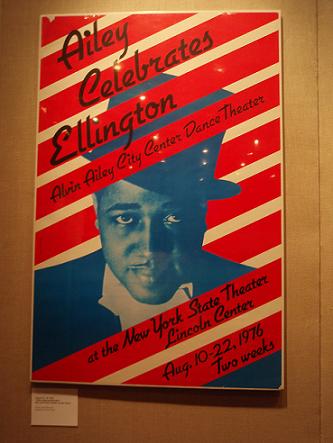
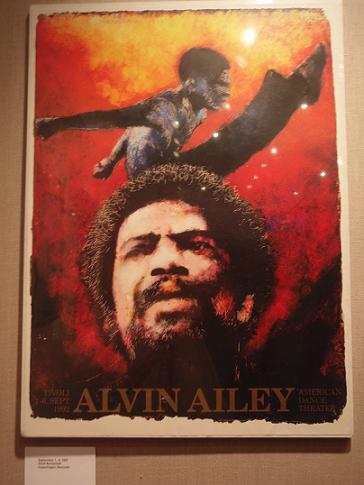
First off, there was a collection of vintage posters in the art gallery right across the hall from the theater. (top two pics above, taken by me.) There was also a little reception with complimentary wine. Complimentary strong wine (which, I hadn’t eaten much and, well, probably got carried away excitedly tweeting over seeing some of the dancers there — namely

Yannick Lebrun — wearing gold earrings in both ears and dressed very stylishly in one of those skinny scrunchy bubble-jackets, baggy jeans and bright red-soled sneakers — it’s always fun to see your favorite dancers outside of the theater, just dressed like ‘normal people’. Also there were  Renee Robinson, Matthew Rushing, Vernard Gilmore, and Hope Boykin, and choreographer Robert Battle. Renee and Yannick both showed up to the church event they had last year and I love that both the newest company member and the dancer who’s been there the longest show up to these kinds of things).

Anyway, the first set of films consisted of a movie directed by Orlando Bagwell made for PBS called “A Hymn for Ailey.” I’d never seen it before, but it was a filmed version of Judith Jamison’s dance / theater piece for the stage, Hymn, which she choreographed for the stage not long after Alvin Ailey died (of AIDS, in 1989). I’d never seen that either and I wish the company would stage it again. It was filmed mainly in the church where Ailey’s funeral was held, the magnificient Saint John the Divine. Dancers danced to a series of spoken word pieces recited by playwright / actor Anna Deavere Smith, who was, of course, a very powerful presence in the film. At times she’d stand next to the dancer — at one point Renee Robinson — and speak about body image, as Renee danced her words, and interacted with her at the same time, at one point seeming about to lash out on a negative thought, as if she were a mirror. At another, she spoke about Ailey’s artistry as an excellent male dancer who’s name I didn’t know belted out the movement with great passion. Or, one of the parts that stayed with me for a while — Smith took on the voice of an African woman talking about how much easier it is to be “real,” to be oneself, back in Africa; how here everyone has to wear a mask to survive. It kind of reminded me of Invisible Man. Both the performance and the words were very moving.

p2011893

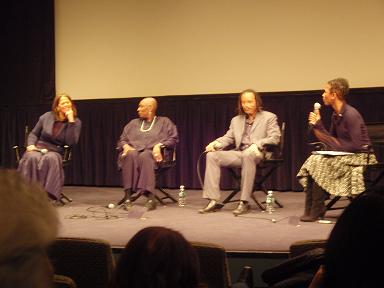
(there was a panel discussion after the Bagwell film, including from right to left, company rehearsal director Ronni Favors, filmmaker Bagwell, Jamison, and Deavere Smith). Judith Jamison is so charismatic, I’m sure it goes without saying. No matter what she’s talking about, you just want to hang on to her every word.

But the biggest highlight of that program — of the day for me — was footage of Alvin Ailey rehearsing a female dancer, Donna Wood Sanders, for her role in Masekela Langage (depicting denizens of a bar, set simultaneously in 1960s race-torn Chicago and apartheid-era South Africa, or anywhere oppression exists). I can’t tell you how much I got from this and I really really wish companies would do this more — would show audiences rehearsals and give us a glimpse into the artistic process. He was telling her, you’re an older woman, you’re stuck, trapped in this bar, in this place, you can’t escape and your life is dreary but that doesn’t mean you’re giving up. And, as she’d do certain things in the choreography, like push her arms out and step backward, he’d say to her, “let me see you in a prison, trying desperately to escape, but you can’t.” And she’d do the movement in such a way that that’s exactly what you saw. It was brilliant. And so powerful. I sometimes wonder how much is lost when a choreographer like that dies, if the entirety of his rehearsal and notes on direction are not kept. Dancers should of course add their own interpretations, but not without reviewing the master’s directions again for guidance. Now I want to see this ballet again.


Also included in the programs I saw were an interview Harry Belafonte conducted with Alvin Ailey, vintage footage of dancers Carmen de Lavallade, James Truitte, and Ailey performing classic works by Ailey’s mentor, Lester Horton. I particularly enjoyed The Beloved, depicting a relationship fraught with tension but compassion that kind of reminded me of some of Ulysses Dove’s work.  (A program later in the day included films of some of his dances, but unfortunately I couldn’t stay).

A final highlight of the day for me was watching vintage footage of Alvin dancing Porgy and Bess with Carmen de Lavallade. Learn about that story (originally an opera) and its history here. Ailey danced the part of the the man who threatens the crippled Porgy and seduces but mistreats Porgy’s beloved Bess. I’d never actually seen much of Alvin Ailey dancing and this was such a treat. As someone said in one of the films — I think it was Jamison but am not sure — “He WASN”T skinny!,” which made me laugh, but she’s right.


He was a meaty man. And he had hefty strength and ferocity to his dancing, a virility that was simultaneously sexy and threatening and that I totally didn’t expect since, by the way he speaks and from what I’ve read about him, he seems to have been such a soft, gentle man, and given that most of the male characters he created in his ballets seem like soft, gentle men as well, full of vulnerability and sympathy. Plus, with the possible exception of Glenn Allen Sims, no one  in the current company really dances like that. Not that that’s a bad thing – -just a different aesthetic.

I wish I could have stayed for the full day, but I went to ABT’s female choreographers program at the Guggenheim, which I’ll write about soon. This company always makes me so happy and inspired.

Masekela Langage and the Brilliance of Revelations


I managed to be sick for the last two weeks of December, so, horribly, I wasn’t able to go to as many Alvin Ailey performances as I usually do. Now, I’m depressed and feeling like I really missed out. Especially since I was just told how excellent the season finale was last night. Sob sob.

I did get to see all the major things though: the revivals (Blues Suite and Masekela Langage); the two premieres (Go in Grace and Festa Barocca), which I wrote about here and here and here; Suite Otis, a fun piece set to Otis Redding and comprised of jazzy all-male and all-female ensemble numbers and cute vignettes of couples in various stages of a relationship; and of course several Revelations.


Blues Suite was Mr. Ailey’s first major dance, made in 1958, when the company began. It’s a bluesy piece that takes place in a nightclub, based on The Dew Drop Inn, an African American hangout in his Texan hometown, and consists of a set of female cabaret dancers and jazzy dancing men, who mostly perform in groups for the audience but sometimes dance together as if we, the audience, are getting not a “performance” but are eavesdropping on what goes on in a real club. The latter were my favorite parts.

With Masekela Langage, my overall favorite of the season besides Revelations, we get just that: a glimpse into another world, a troubling world.


And that’s what I liked about it so much. It was described to me as a “political” work (a totally loaded term!) portraying racial violence and oppression both in the era of South African apartheid (it’s set to music by the South African trumpeteer Hugh Masekela) and in 1960s Chicago. So, I expected to see all these scenes of white farmers burning black farms, of bands of white police attacking black men on the streets, etc. But it wasn’t.

Continue reading “Masekela Langage and the Brilliance of Revelations”

Favorites of 2008

Okay, here’s my (late) list of favorites from 2008: (click on highlights to read what I wrote about each dance)

Favorite overall dance of the year:

Revelations by Alvin Ailey. Because the movement language — a unique blend of American Modern with African — is highly evocative, richly varied, and, because it’s set in a specific time and place recognizable to most if not all of us, it’s imbued with meaning and feeling accessible to everyone. And because it speaks to the human condition like no other dance I’ve ever seen. I’m still looking for something to top this and don’t know if I’ll ever find it.


Favorite new dances:

1) Nimrod Freed’s PeepDance in Central Park;


Continue reading “Favorites of 2008”

Still Here

I know you’re not ever supposed to start posts saying ‘I’m sorry for not posting in forever.’ But I normally write once or more per day, so, really, I’m sorry for not posting in forever! I’m just working on this ridiculously hard short story that really should be a novel (it’s 20,000 words right now and I’ve already cut out a bunch of stuff)– and hopefully it will be someday. Well, it will be, but I don’t know if it will ever be a published novel. The industry isn’t looking too good these days and I don’t know if I have the nerve to self-publish…

Anyway, I went to see Alvin Ailey on Sunday night (Blues Suite — my first time seeing it– liked but didn’t love it; Flowers, about Janis Joplin, which grew on me, especially the dream sequence with all the hilarious but uber sexy ’60’s  era bootie shorts and leg fringe; and Revelations, which I could honestly see about 30 times per season — basically every night they do it — and never tire of it). I still have to blog about the two Ailey works that were new to me this season — Blues Suite and Masekela Langage, the second of which I loved. More about that later.

I always get very depressed around this time of year and I think it has a lot to do with Alvin Ailey ending their City Center season. I always get depressed when dance company seasons end but more so with this group than any other.

I also need to write my end-of-the-year favorites list (probably going to go with Nimrod Freed’s PeepDance as my overall favorite and Craig Salstein’s Time for ABT for new choreography, ABT’s Tudor Centennial and Alvin Ailey’s 50th anniversary celebrations for events), but I want to do links, and I don’t have time to do that now. Also desperately trying to make myself well. I somehow caught a nasty cold, which I want to be gone by tomorrow night so I can go out with friends and have a reasonably good time.

So, will blog soon! In the meantime, please check out dance tweeters and their tweets (see previous post). And have a most festive New Year’s eve!