
Last Week at New York City Ballet


Last week I went to two performances of NYCB – opening night and Thursday night’s “See the Music” program – and to two of the free all-day Balanchine events on Saturday. First, I’ll talk about the last two since I found them so informative. The free studio talk on Saturday afternoon – Balanchine’s birthday – was moderated by Sean Lavery (former NYCB principal dancer, now ballet master), and included Sterling Hyltin (in Paul Kolnik photo above with Robert Fairchild), Chase Finlay, and Jenifer Ringer. Lavery asked the dancers to talk about their first Balanchine ballets, their favorites, and what drew them to NYCB. Hyltin named as her favorite Duo Concertant (pictured above) which I’d just seen her dance on opening night. She said she liked the syncopated movement, the he goes and I go kind of back and forth movement conversation with her partner, and with the musicians. I really liked it too. The violinist and pianist are onstage (the music is Stravinsky), and I like the interaction between the dancers and the musicians, and between the two dancers, and I like the sharp, angular movement. She seemed particularly animated when I saw it. I love Robert Fairchild and think he’s such a sharp, masculine mover with a presence that commands your attention without meaning to – he kind of reminds me of a less cocky Ethan Stiefel – but she seemed so happy to be dancing this piece that she stood out to me more. It was nice to hear her talk about it.

But what I really loved was the School of American Ballet class taught by Peter Martins. He interacted cutely with the students, particularly “Cyrus,” (at least I think that was his name…) a tall, long-limbed young man who I think will soon be in the company. Cyrus didn’t always do everything perfectly (at least in Martins’s eyes) but he had a charming presence and a great leading-man physique and you can tell he works hard.

Martins had the class demonstrate ballet basics – beginning with the five positions, and they showed us a perfect fifth position (with the toes of the front foot touching the heel of the other and vice versa). More interestingly, he had the class show us the difference between a Balanchine hand and a classical ballet hand. I’d always noticed there was a difference but couldn’t figure it out exactly. God gave us five fingers, Balanchine had said, so we shouldn’t hide two of them. The Balanchine hand shows all five fingers, the classical ballet one only three (with the ring finger and pinky held so that they are hidden from view behind the middle finger).

Martins also had the students show us how Balanchine’s fourth position differed from others’. In Balanchine’s the back leg is straight; in all others’ the back leg is bent. Martins didn’t go into any functional explanation for this – just said “here, we think it looks better.” But I thought about it and thought, wow, it must be hard to take off in a jump for example with the back leg straight. And then I realized that’s partly why Balanchine’s choreography always looks so fluid, like one step leading right into another, without a lot of stopping to build up to a big athletic feat – a big jump or series of turns. Other companies – like the Russians, like the Bolshoi – are all about preparing so that you can do something astounding. So they’re all about the building up.

This was mentioned in the studio talk as well. Lavery also talked about how fluid Balanchine’s movement was, and how, for example, in a lift, a guy would pick up a girl, then take two steps, and put her down rather than walk all over stage with her hoisted above his head. Balanchine wanted her to come up, then down right again, because that was more fluid, rather than have her head bobbing around up there while the guy was running all around with her.

Martins also demonstrated the bows. At City Ballet, he said, we just do them as such, and the girls did a little curtsy with the back leg slightly bent, without going down on one knee. Making fun of the dramatic Swan Lake bows, Martins went all the way down on one knee, exclaiming, “Yes, yes, I know I’m good!!!” while putting his head down, forehead nearly touching the floor, and raising his arms up in back of him like wings, fingers pointed toward the ceiling. It was hilarious.

Anyway, here are a couple more photos of opening night:


Above: Ashley Bouder in Valse-Fantaisie, and below, the cast, including Andrew Veyette, in the same (all photos by Paul Kolnik)


I liked Balanchine’s Valse-Fantaisie (Veyette replaced Joaquin DeLuz – but don’t know why because DeLuz danced Concerto DSCH two nights later) but I really loved the first of the evening, Walpurgisnacht Ballet. I’d never seen Walpurgisnacht before and it’s funny but I always seem to love the Balanchine ballets that are the least often performed. This was really beautiful. It’s from Gounod’s Faust, and features a group of women (and only one man – here Charles Askegard) in deep red dresses, their hair down in the second half as the music increases in tempo so that there’s almost kind of a hedonistic madness in the mood – and the footwork is so intensely complicated and fast fast fast. Wendy Whelan even made a tiny little flub, which I’ve never seen her do before. Crazy! And breathtaking!

And the evening ended with The Four Temperaments. I’ve said before and I’ll complain again that I still don’t understand why everyone goes on about how brilliant this one is. To me, there are supposed to be four temperaments, and the ballet is divided accordingly into four variations after the theme: melancholic, sanguinic, phlegmatic, and choleric. But they all seem to be the same to me. The dance seems one-note throughout so that after the first variation, I’m waiting for it to end. I’ll keep seeing it though, perhaps performed by a variety of companies if I have the chance, and will keep looking for the nuances…

“See the Music” night opened with Faycal Karoui’s discussion of Mozartiana, Tchaikovsky’s homage to / riff on Mozart, which made me appreciate Tchaikovsky even more. Then that piece was danced – by Maria Kowroski, Daniel Ulbricht, and Tyler Angle. Tyler stood out to me. As always, he dances with so much meaning, so much intention, and so much expansiveness. He’s a really beautiful dancer.

Then came Ratmansky’s Concerto DSCH, danced by Wendy Whelan, Ashley Bouder, Joaquin DeLuz, Andrew Veyette (replacing this time Gonzalo Garcia), and Benjamin Millepied. Oh, Natalie Portman was there, albeit late – she came in with a friend after Karoui’s lecture and right before Mozartiana was performed. Then, she left right after Concerto DSCH, after Millepied was done performing, and before the last piece. I thought it was a shame she missed Sara Mearns in the last dance, but a Twitter friend said she had a movie premiere that night, so I guess she needed to leave early for that.

Anyway, as usual, Millepied did not stand out to me, and I couldn’t stop thinking of seeing Tyler Angle in that role before and the way he lunges romantically toward the main girl, making it clear how much he yearns for her. Millepied’s knees nearly touch the ground in his deep steps toward her and it just looks like a dance step, not like anything evoking a specific emotion. As always I loved Bouder and DeLuz in the fast, playfully firtatious three-some part. I missed Garcia – where is he? I hope not injured! – but thought Veyette did a fine job in his stead.

And the evening ended brilliantly with Sara Mearns and Charles Askegard dancing the ballet leads in Balanchine’s Cortege Hongrois, while Rebecca Krohn and Sean Suozzi just as brilliantly danced the folksy Hungarian leads. I really love that dance and it made me all the more eager to see Mearns in Swan Lake!

On both nights, I went with my friend, author Maria Mutsuki Mockett. She writes an author blog but has been attending the ballet much more frequently and is now blogging a lot about ballet as well. She’s an excellent writer, so please check out her blog!
SARA MEARNS’ MOVING ODETTE, A TRIBUTE TO DARCI KISTLER, AND NEW ADAM HENDRICKSON BALLET


Photo of Sara Mearns in Swan Lake, by Paul Kolnik, taken from NY Times.

Last week was the first time I’d seen Peter Martins’ version of Swan Lake. Overall, I wasn’t in love with the production, but I was in love with the dancing, particularly Sara Mearns’ interpretation of Odette, which nearly moved me to tears, which just hardly ever happens with Swan Lake. She is the Veronika Part of New York City Ballet to me and I just love her. She inhabits whatever character she’s dancing with her entire being and she takes you to that place with her; she really creates another universe and she puts you right there and won’t let you leave it! I think here what I loved was that she humanized her Odette. So many ballerinas will focus on getting the fluttering foot just right, waving their arms about with just the proper fluidity that they look like actual wings, and of course totally nailing the chaines and fouettes in the second act. They make the White Swan all about the styling and the Black Swan all about the athletics. And they forget about the story.

But with Mearns — just the way she would wrap Prince Siegfried’s arms around her body, the way she’d nearly dive into an arabesque letting him catch her before turning her, or fall nearly to the floor and arch her back, wrapping herself around his kneeling knee — everything was about the tragic story, about Odette’s loving the prince and longing for him and her need for him, and then his inability to fulfill that need. I’ve honestly never been so moved before, and when she bourreed away from him at the end (there are no suicide swan dives into the lake here), leaving him, it just left me with such a emptiness. I couldn’t stop thinking about that — about her wrapping his arms around her in the pas de deux and then her sorrowful bourrees away from him at the end — for days; I still can’t get over it. I think those images will always be in my mind when I think of this ballet.

And she just had so much stage presence. Sometimes when all the swans are onstage together, I’ll lose Odette, but not with Mearns. I think that may partly be because she has a broad face, allowing her expressions to be more noticeable to the entire house. But of course she makes those expressions that not everyone does — her face, her body, she is always fully immersed in the role.

And Jared Angle was the absolute perfect partner. You can tell he’s a very strong guy and a very solid partner who’s easy to get along with. Because she’d really really throw herself into those arabesques and he’d catch her and she was so off her center of balance — she had to be in order to show the passion and emotion, and the full, expressive line – and he’d promenade her like that, and it was so incredible because you could tell he spent the better part of the ballet supporting a lot of her body weight.

And he acted it well too, and did perfectly on his solos. Very impressive performance by him!

The other cast I saw was on opening night with Maria Kowroski in the lead and Stephen Hanna making his debut as Siegfried. Hanna was very good — he’s a strong guy too, and that night, he performed a major save! Toward the beginning Kowroski went to jump into his arms, on her way into a shoulder-high lift, and she slipped before she ever got to him. He somehow reached out and caught her anyway, and took her up into that lift beautifully. The whole audience went “ahhhhhh”! I think it threw Kowroski a bit though because she seemed nervous and a bit shaky throughout the rest of the ballet. She might also have been a bit anxious because Hanna was debuting in the role, so they obviously hadn’t performed it together yet. At intermission, someone mentioned she might have been less nervous dancing with her usual Charles Askegard. Maybe that’s true. I thought Hanna did a very good job overall.

But I’m not in love with the production. Like Martins’ Romeo + Juliet, the sets are very modern, and the costumes for Siegfried and Benno and his friends are bright, color-coded, and basic with minimal embellishments. But the sets are the worst. In the beginning, you can’t even tell they’re in a palace. In the second act, the sets are not only minimal, but what’s there is so incredibly modern, just a few brown and beige slashes on some backboards. And yet, the people are dressed in Elizabethan costumes. Either set it in modern times completely or go with the historical thing, but don’t do half and half?…

And the production just moves way too fast, in my opinion. This worked for Sleeping Beauty (the paring down of all the miming and the boring court dances, in favor of getting right to the point and to those gorgeous variations), but it didn’t work here because there’s too much story up front missing. We see all these people dancing — we don’t know they’re in a palace, so we just see them all dance, and next thing we know, Siegfried’s all bouncing around with a bow and arrow. Then he runs offstage and a moment later, on comes Odette. Then Siegfried runs back out and they do a pas de deux, and after that’s over, Odette runs one way, Siegfried runs the other, and on come the swan ensemble. And — and maybe this is conductor Karoui’s doing — but you don’t even realize Odette’s run away from Siegfried because she’s afraid of Von Rothbart, and that now Siegfried is running around madly trying to find her. Instead, it just looks like a bunch of running. There should be pauses so that you know exactly what’s happening and why– the pacing is way way too fast. I never really did see Siegfried fall for her. I first realized there was something between them when Mearns’ Odette wrapped Siegfried’s arms around her in the White Swan pdd.

The other thing is the ending, which I both like and don’t like. In this ending, there is no suicide with the two lovers  ending up together in eternity. Instead, since Siegfried has betrayed Odette with Odile, they can’t be together. The problem is that Martins still has Von Rothbart die — he melts into a puddle and dies once he realizes their love is undying and real. But then, if he dies, the spell should be broken and Odette can resume human form. So, the ending then loses its mysticism and becomes a human ending — Odette leaves him because he’s betrayed her, and even though he’s horribly sorry, the damage is done and can’t be undone. So, basically she just can’t forgive him. But why not? It doesn’t really have the resonance to me that it should. I think Martins should just not have Von Rothbart die. That way the lovers can’t be together because of Siegfried’s betrayal. But she still loves him, so that when she bourrees away from him, letting go of him little by little, her arms still reaching out toward him as she disappears into the wings, it just makes you want to bawl your eyes out the same way as the Giselle ending.

One other thing: Martins has some children dance in the beginning courtly scene, which I love. It’s very Balanchine to put the children in, and they were very sweet. And I could tell the people around me thought the same.

Oh and one final other thing: there’s no real dancing for Von Rothbart — it’s really just a character part. But I missed the seductive Marcelo making all the women swoon with his sexy jumps, and then tossing his Odile all about!


Anyway — sorry, I’m behind on blogging and have to blog about these things all together — but earlier in the week, I attended a daytime tribute to retiring Balanchine ballerina Darci Kistler (above photo from the front of the program). She danced the Preghiera passage from Mozartiana beautifully, with some children from School of American Ballet, then the White Swan pas de deux with Jared Angle. And then Kathryn Morgan danced the Sleeping Beauty wedding pas de deux with Tyler Angle, which was sheer perfection. They also showed some excerpts of interviews with Kistler from a 1989 documentary, Dancing For Mr. B, and there was a short panel discussion where Bob Craft from the NYCB Board interviewed her. Later, the two were joined by Peter Martins, Philip Neal (who seems very polite and well-mannered), and the hilarious Albert Evans, who you can tell is the type of guy who puts everyone at ease. He got up there and immediately started reminiscing about a blue sweater Darci’d wear to rehearsals all the time and how much he wanted it (she ended up saying he could have it!) and some rather amusing (in retrospect) goof-ups they had together, and she just really burst into genuine laughter.

Oh and at the beginning, Kathryn Morgan presented Kaitlyn Gilliland with the 2010 Janice Levin Award (Morgan was the 2009 recipient). Both gave little speeches, and Gilliland (who seems like a natural speaker) prefaced hers by pronouncing Kathryn’s recent Sleeping Beauty debut “historical,” which nearly brought tears to my eyes. Can’t think of a more apt description!

And finally, earlier last week, I saw the debut of a new ballet by corps member Adam Hendrickson. It was presented in a small downstairs auditorium at Carnegie Hall and was part of a program featuring newly discovered Prokofiev music performed by students and faculty of Yale’s School of Music. Hendrickson’s ballet was set to his Music For Athletic Exercises, and it was fast, flirty, and fun. It was performed by three dancers — Matthew Renko (who is really a stand-out dancer — I kept wondering why he wasn’t with a major ballet company, and then realized later in the week he’s a corps member at NYCB), Elysia Dawn, and Colby Damon and one pianist — Boris Berman — and Hendrickson’s original, clever choreography had elements of Ratmansky’s Concerto DSCH as well as Jerome Robbins. At one point, Dawn’s feet are moving so fast and furiously, and the pianist just keeps at it and won’t let up, and she kind of stops and shoots him a look. It reminded me of Robbins’ Suite of Dances — it was cute and the crowd loved the joke. This is the second work I’ve seen of Hendrickson’s and I found both to be engaging and memorable. I think he may have a real future as a choreographer. Anyway, here is Philip’s account of the evening, and here is an article on the music.

I WANT TO DO FISH DIVES WITH MARCELO


So ABT is in the midst of its week-long Balanchine-Tchaikovsky program, which began last night, after Monday’s opening night gala. I’ve gone to both performances thus far, last night’s and this afternoon’s.

Last night I was seated next to Irlan Silva — ABT studio company dancer, and movie star! (actually, I’d noticed his dancing before the movie; I was only drawn to the movie because it was about Brazil, and only when I was sitting there during the Tribeca Film Festival did I realize I’d seen one of the documentary’s subjects before!) Anyway, he seemed really polite and quiet, but then he applauded and hooted loudly during dancer bows, so is obviously very supportive. I like seeing dancers at performances; Julio Bocca wasn’t right about everyone when he said young people are too into their cell phones these days to watch and learn. And, today I saw Ashley Bouder (of New York City ballet), sitting in the front orchestra.

Also last night, on the way in I saw Laura Jacobs. I wanted to thank her for sending me an advance copy of her new novel, but she appeared to be engaged in conversation and I didn’t want to interrupt. I didn’t see her husband, but I assume Mr. Wolcott was there at some point since this was Veronika Part’s first full performance of the season, and as principal ballerina!

Anyway, first on was Allegro Brillante, danced by Ethan Stiefel and Gillian Murphy. Today it was danced by Xiomara Reyes and Daniil Simkin. I noticed both in this and in the two Mozartianas that I saw that there seems to be a difference between the way Russians and Americans (Latin Americans included) dance Balanchine.

Continue reading “I WANT TO DO FISH DIVES WITH MARCELO”

AMERICAN BALLET THEATER OPENING NIGHT!

p5182145

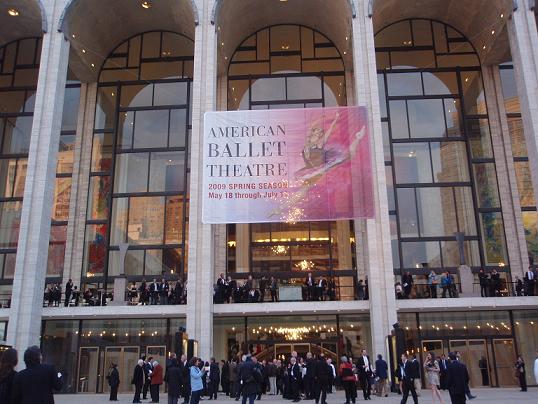
Yay, the season has offically begun! This picture was taken during intermission; that’s why it doesn’t look that crowded. I was sprinting in, nearly late, as usual, so didn’t have time to snap some pics before the performance but fortunately it was still light outside during intermission.

Anyway, Michelle Obama (who served as one of the gala’s honorary chairs) looked smashing in a sleek dark grey sleeveless, knee-length dress with tiny black ruffles lining the bottom. I’m sure there will be beaucoup des pictures seeing as how many blasted camera people there were; I’ll be sure to steal some when they’re posted on all the society websites 🙂 (Oh, look, here it is in the NYTimes already)


It was just about the craziest thing I’ve seen on the Met Opera stage: after Veronika Part’s mouthwatering Mozartiana opened the show, artistic director Kevin McKenzie came out and thanked everyone who needed thanked — all the donors, designer Caroline Herrera who funds the gala, etc., and Senator Chuck Schumer came out and gave a little talk about the importance of funding for the arts, etc. Then, Schumer disappeared behind the curtain and moments went by. Everyone kind of looked around at each other like “what’s going to happen next?!”

Soon, the curtain was pulled back to allow some people to carry out a podium with a banner “American Ballet Theater” draped over its front. The doors to the lobby opened and a flock of people bearing weapon-sized cameras blasted in. Several men dressed in black promptly rose from their aisle seats and followed the flock of weapon-camera-bearers to the front of the aisle, near the stage. Caroline Kennedy was announced. She came out, everyone applauded, and she mentioned that the school of ballet associated with ABT, the Jacqueline Kennedy Onassis School, would be performing on the Met Opera stage for the first time ever tonight. Everyone ooohed and aaahed. Then, she announced First Lady Michelle Obama.

The curtain pulled back again and out she came. Of course everyone gave a standing ovation. She smiled radiantly, then, after a moment, directed us to be seated. Then she gave a short speech. It was a little hard to focus on what she was saying with everyone — both professional photographers and audience members with cell phone and digital cameras alike — flashing away as they were, but she talked about the necessity of the Arts for a culture to flourish, the importance of arts education, etc. Then she introduced the Jacqueline Kennedy Onassis School students.

As soon as she disappeared behind the curtain, the auditorium remained still pending the exit of the flock of pro camera wielders. It’s funny because there were all these non-dance writers in the press section. You could hear the sighs of relief, the sinking down into the chairs, and the putting away of pens and paper — and cell phones, which they’d used to light their writing paper during Mrs. Obama’s speech, which would have been extremely annoying had it not been for all the flashing bulbs anyway. But it made me wonder how they’d ever survive as performing arts critics! I mean, who needs light to see to write!

Anyway, the students were excellent. They performed Le Defile (The Procession) by Raymond Lukens. There were three large groups of them, in three levels — the very little ones, a medium-age / level group, and the older, very advanced ones. The choreography was basically a showcase of classical ballet steps, much like a very advanced ballet class — jumps, jumps with changing feet, jumps with changing feet that went on forever performed by a set of advanced boys (which drove the audience to wild applause), jetes, chaine turns, multiple pirouettes, fouttes, etc., and then a bit of partnering. It gave the students a chance to show what they could do — and the advanced ones could do a great deal! Extremely impressive, and great fun.

Then on were Xiomara Reyes and Herman Cornejo doing an excerpt from August Bournonville’s La Sylphide. This was the most dramatic I think I’ve ever seen Xiomara. I was sitting in the back of the orchestra and she really projected. She was really sweet. And Herman as always amazed with his virtuosity, his jumps, his razer-sharp precision, his astounding clarity of line.

The corps in both this, La Sylphide, and Swan Lake, later in the evening, were absolutely amazing, by the way. Not a head arched back more than the others, not a leg raised higher. They were all so on. When they work together like that, in perfect unity; it’s really visually breathtaking.

Then was Balanchine’s Tchaikovsky Pas de Deux danced by Ethan Stiefel and Gillian Murphy. Ethan and his strutting around stage, taking his own good time after their duet and before beginning his solo, making the conductor wait for him! And his high jumps with all miraculously many beats of the feet. I wished my friend Alyssa could have come so she could see he’s not just Mr. Sexy; he’s a superb dancer. And Gillian was radiant, and a perfect foil with her speed-of-light chaine turns. They enjoyed a long, slow kiss during the curtain call. The audience went mad!

Then was the hunt scene from Sylvia danced by Michele Wiles followed by a piece d’occasion (the first of two of the night), by Alexei Ratmansky, for Nina Ananiashvili, called Waltz Masquerade. It was set to the Waltz from Aram Khachaturian’s Masquerade Suite and it was cute and comical. She was dressed in this long, red dramatic, Carmen-like dress with a sexy black lace overlay on the top. There were four tuxedoed men, each bearing a gold candlelabra, one at each corner of the stage. These men turned out to be: Jose Carreno at the front left corner; Marcelo Gomes, at back left; Angel Corella back right; and a blonde on the front right who I initially thought was David Hallberg (I was sitting FAR back from the stage!) until the fun began and he shook his head about like a sassy mop and I realized DH just does not have enough goofball in him to do such a thing, even if he tried. So, I decided it was either Ethan or Maxim Beloserkovky. Anyway, Nina’s character was supposed to be dancing about the stage in a melodramatic solo — but it was purposefully melodramatic, and so comical. Like a silly, cartoon version of an upcoming swan song, really, which, is of course, what’s coming up for her later in the season (and will be much more sobering when it does). At one point, she just passionately crashes to the ground and remains there, in a heap. Nothing happens. The men, obviously her servants, start looking at each other like, what now? They shrug, slowly walk over to her. Then, Marcelo starts imitating her melodramatic dance, but far more cartoonishly, and of course it’s hilarious. The others join in. Max (I think it was Max, not Ethan) does his thrashing hair thing. I couldn’t see facial expressions but I assume they were making fun of their master. Then she wakes up, catches them, and they’re sent back to their posts.

After intermission was the balcony pas de deux from MacMillan’s Romeo and Juliet, danced by Marcelo and Diana Vishneva. At first, Diana approaches her balcony with all the drama of a ballerina playing Juliet, rather than Juliet herself. I rolled my eyes. This is what I don’t like about her. She’s an excellent dancer but she’s all about the pomp and circumstance and not about the character. Maybe it’s a Russian thing, but I don’t see that in Veronika Part or Irina Dvorovenko. Anyway, she eventually lightened up, thankfully, and I felt like I was watching not a prima ballerina being a prima ballerina but Juliet herself, falling hopelessly in love. When she runs around him one foot solid on the ground, the other on pointe, it’s so girlish, so real yet so poetic. Those are the best — I don’t know what to call them — runs around kneeling Romeo — that I’ve ever seen — not even Alessandra Ferri’s were that sweet. Still, I felt some of the lifts lacked the beauty and magic of  those Marcelo and Julie Kent do together when they dance this scene. I don’t feel she dances that well with a partner; she’s more into herself. Marcelo’s leaps around the stage and big high passionate jumps were thrilling. He got some good bravos for those.

Then were Paloma Herrera and Max Beloserkovsky in the Act II pas de deux from Swan Lake. I was hoping it’d be the Black Swan pdd, but no. I guess the program was pretty bravura-heavy already. I don’t see him dance much, but Max is really quite good. He’s really a character and he’s the perfect Prince Siegfried, regal yet vulnerable and tragically in love. And he’s a good partner.

Then was the mad fun of Le Corsaire, with Irina Dvorovenko, David Hallberg as Conrad, and Angel Corella as Ali. Except something happened at the beginning and I hope David’s okay. The tallest guy in the entire opera house had to sit in front of me and I was trying to navigate my way around his enormous head just as a bunch of people up front went “Oooooooh!” When I was finally able to see the stage, Irina was standing in front of David, face toward the audience. She didn’t seem to have any particular expression on her face, but, then, I was light years away from her. Then David did an assisted pirouette with her and everyone applauded, so it must have been a lift that didn’t quite happen or something. Anyway, I hope he’s okay; I know his shoulder sometimes comes out of socket. Anyway, all seemed to be fine after that: all three were brilliant. Of course. Angel astounded, as always, and I started giggling during his first solo and couldn’t stop all the way through the second. I love Irina. She was radiant. She did those continuous turning kicks on pointe like they were nothing. She has the drama and the virtuosity when needed and the always beautiful, graceful lines. And David’s leaps all over the stage were magnificent. I could see this goofy ballet over and over and over again, as long as no one gets hurt 🙂 Angel did not leap out from behind the curtain during curtain call, sadly.

Then there was another piece d’occasion. Herbie Hancock played piano, onstage, while first Jose Carreno, then Stella Abrera, danced to his music. This was cute and comical as well, and kind of reminiscent of Jerome Robbins’s Other Dances or Suite of Dances, where the dancer(s) connect mainly with the musician. At one point, Hancock went nuts with the keys, obviously way too fast to be danceable, and Jose stopped in his tracks, looked over at him, and lifted his hands, like what gives, dude? He sat down near the base of the piano and just rested. The same happened with Stella. She danced, then stopped and gave Hancock a look when he began another little virtuoso section. She finally sat down beside him on the piano bench, and eventually, he ended on a romantic note, she snuggling next to him softly, sweetly.

The evening ended with the finale of Balanchine’s Theme and Variations. The leads were danced by Sarah Lane and Daniil Simkin. It was a nice way to end the program, but with the likes of Simkin, I wondered why they only did that group finale, where he and Sarah are basically leading a processional, instead of some of the earlier bravura parts with all the corkscrew turns for the man. An opening night gala performance is meant at least in part to showcase the dancers doing what they do best, and he is best at the bravura stuff, not leading processionals.

Anyway, the whole night, as usual, was magic. Saw Sigourney Weaver and Kelly Ripa in the audience.

Oh, for my Dancing With the Stars readers, I taped the show, but for lord knows what reason it was somehow muted. I have no idea how on earth I managed to do such a thing, but it was pretty amusing watching the show in pure silence — no words, no music. Needless to say, I’ll have to watch online tomorrow.

But now, dead tired, must sleep. Goodnight.