
Listen here.
Festa Barocca at Alvin Ailey
So Sir Alastair called Festa Barocca “rubbish”!
I didn’t really know what to think of it, to be honest (which is why it’s taken me so long to write about). I found it oddly intriguing and very different from his (choreographer Mauro Bigonzetti’s) other work that I’ve seen, Oltremare. That piece made perfect sense and was clear in what it was trying to express: the fear, sadness, and longing of poor immigrants bound for the New World. This wasn’t so clear.
The whole piece is set to Handel’s classical Baroque music, but the movement is extremely varied, encompassing ballet, Argentine Tango, African — a hodge-podge, and with styling that looked at times Asian (like the beautifully flexed wrists), Egyptian (the iconic “King Tut”-esque Cleopatra arms), and even some styling that reminded me of the movie Pulp Fiction (with the bandit eyes — where Uma Thurman and John Travolta are dancing, extending elbows outward, arms turned down, circling their eyes with their fingers — remember that?)
There was definitely a lot of humor, and Hope Boykin, whose enchanting solos frame the piece, smiles out at the audience a lot, kind of indicating she is taking us on a wild ride. I couldn’t really tell, though, if Bigonzetti was making fun of Baroque music, or if he was trying to expand our assumptions about how it could be used for dance. Don’t think I’d ever have thought of putting African to Handel. Or, if Baroque music is defined as representing the “perfect order” of the universe, of “avoiding trivialities as well as willful eccentricities,” then maybe he is playing with the definition of Baroque music itself.
By the way, Antonio Douthit (right in pic above) and Jamar Roberts I thought were the best in the ensemble parts. Jamar really threw himself into it full out and made the most of every little movement detail. And Antonio is one of those unbelievable dancers who seems to be able to excel at both ballet and African. Have I said that before here? Sorry if I have; I honestly forget what I’ve tweeted and what I’ve blogged. He has these gorgeously high extensions that he holds so well and he’s graceful and feathery, but then he can be so rhythmic with those beautifully snaky full body-undulations as well.
The dance is comprised of several ensemble parts, a couple of solos, and a couple duets that seemed by turns sexy, mysterious, and kind of violent. At points, it seemed like the men were casting a spell on the women, at other places it seemed the women became the mens’ puppeteers, like when the women would raise their legs to their partners’ faces or necks, gripping with their toes, kind of teasing them as they circled their feet about, head or throat attached, round and round, and then harshly pushing them away.
Macaulay seemed peeved because such movement (which he amusingly calls “acrobatic foot fetishism”) didn’t seem to fit the Italian lyrics of the Handel songs. I didn’t know those lyrics, but, assuming the translation in his article is correct, it is rather interesting how a husband’s singing “Where are you? Come, beloved, to console my spirit” to his wife (who doesn’t yet know he’s dead) correlates with a dancer throttling her partner’s throat with her foot. Either an unusual reinterpretation, or Bigonzetti is trying to throw in some comedy with the duets as well (which generally seemed more serious), or else he, like many choreographers, is more interested in putting movement to rhythms than actual words.
In the end I’m not sure what to make of it. I loved the dancers, as always. I’m not sure I could ever be dissatisfied watching them do anything. I’m interested to hear what others make of this piece though. They don’t yet have any of it up on YouTube, but let me know if you see it live.
Oh, and costumes (by Marc Happel) were gorgeous. Men and women both wore long, brightly-colored flowing skirts in the ensemble pieces, donning more form-fitting garb for the intricate pas de deux.
Travel music ii
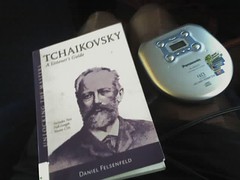
Originally uploaded by swan lake samba girl via mobile.
T-Mobile
Now listening to (and learning about) Tchaikovsky.
Travel music

Originally uploaded by swan lake samba girl via mobile.
T-Mobile
Listening to alvin ailey’s revelations & starting to get v excited about season – begins rt after holiday!
New Chamber Ballet
(iVery short on time, but just want to say I had a lovely little time last night at City Center’s studio 4.Philip invited me to see the New Chamber Ballet, which is choreographer and composer Miro Magloire’s small company (comprised of, besides the choreographer himself, four dancers, all women). There were four pieces on the program, one a solo, the others danced by all, two to Baroque music (I think — Karlheinz Stockhausen and Giacinto Scelsi-??), one to no music at all (or rather, the sounds made by the dancers — tongue clicking at times, at times whispering and chattering amongst each other), and the final ballet, having its world premiere, was “Romantic Pieces,” to the sweeping, expressive Romantic music of Anton Dvorak.
The space is small and intimate (so you can see the pointe work up and close, always a bit of a thrill for me!), the production pretty minimalist — no sets or elaborate costumes, and the dancing very abstract / movement-for-movement’s-sake, very music-made-visual. And that music — violin and piano — was played live! — thank you thank you, Mr. Magloire — and splendidly by Erik Carlson on violin and Victoria Tzotzkova on piano.
What was interesting to me was the at the beginning of each piece, Magloire would come out and introduce the work to the audience, but instead of talking about the dance, he’d talk all about the composer. I don’t have a huge background on classical music and I found this really interesting. For example, he’d told us that Giacinto Scelsi (who lived in the latter half of the 20th century) had a nervous breakdown in his thirties, and forever after that made rather monochrome music, concentrating an entire piece on a single note (interestingly, he also after that breakdown wouldn’t allow his picture to be taken). Anyway, though the Romantics are more melodious and aesthetically pleasing to my ear (and of course we’re all more used to seeing ballet performed to them — Tchaikovsky, Chopin, Dvorak), I found the Scelsi to be so intense, so mesmerizing, so insistent in its sharp staccato, repetitive strikes of the violin strings. And that fascination with the music turned into a fascination with the dancing, the equally sharp, staccato, repetitive steps performed by the lovely Madeline Deavenport, Emery LeCrone, and Emily SoRelle Adams (who, throughout the night, danced with beautiful fluidity and fullness and had gorgeous form).
Anyway, the piece of Scelsi’s that Magloire used was “Xnoybis for violin solo,” which unfortunately, I can’t find a video of on YouTube, but here’s something somewhat similar (at least in the beginning) performed with a guitar. Or this one as well. Try to imagine dance to that! — and the dance actually worked quite well.
Explore more of his music, if you like. And, here’s a longish piece on the composer by Alex Ross.
I thank Mr. Magloire for introducing me to such delectable music! (and the dancing is definitely nice too 🙂 )
This program shows for only one more day — tonight, 8 pm.; go here for info.
Complexions @ Joyce Chelsea & Foniadakis’s Rite of Spring @ Joyce SoHo
Sorry, am very behind again on my review posts — so busy with all manner of stuff to get done before Thanksgiving! Anyway, both of these two programs — Complexions Contemporary Ballet at the Joyce’s Chelsea theater, and Andonis Foniadakis’s new version of “Rite of Spring” at its SoHo location — were both danced brilliantly — big huge kudos to all of the dancers, but especially to Ioanna Toumpakari (below, in photo I swiped from Oberon’s Grove), who did what appeared to be an extremely emotionally intense and physically vigorous 40-minute solo in “Rite.”
I didn’t feel as strongly about the choreography of either though.
Complexions (I saw program A; there is also a program B) included five pieces, my favorite of which by far was “I Will Not Be Broken,” choreographed by Dwight Rhoden and having its world premiere this season. This ballet is on both programs, by the way. It began with S. Epatha Merkerson (an actor on Law & Order) first speaking the words of a poem, then breaking out into song — a set of slavery spirituals. Desmond Richardson — who is amazing beyond belief — sat on a bench at the front of the stage, body contorted, hunched over, then arms moving quickly, waving something off, brushing off shackles — binds not only physical but mental — then fanning himself with quick flicks of the wrists, like cooling himself down from being taken by the spirit. He’d lift his feet flexed-footed, as if tense, very alive, a body occupied by another force — then kick out violently, fall to the ground, jump up into an amazing flexed-footed split, come up for air. More jumps, then he’d sit on the bench again, cover his eyes, cradle himself.
While he rested, another couple — a man and woman sitting on another bench — danced a duet. But I just found myself unable to wait for Richardson to catch his breath, start up again. I’m not even sure what each specific movement meant or was intended to evoke, but overall I got the sense of a man being lifted out of himself, out of his pain, to freedom, letting the spirit free him — which is of course what slavery spirituals were all about. He brought the words Merkerson spoke and sang vividly and compellingly to life, to say the least.
The rest of the program was so-so choreographically, though danced very well. “Ave Maria” was performed by a couple — Hiroko Sakakibara and Simon Sliva — who lifted and wrapped their limbs around each other lovingly and with beautiful intensity; “Rise”, a set of dances set to U2 music; “Routines” a piece that started out with a group of dancers warming up, then donning exaggerated Forsythian ballet costumes — the women in saucer-like tutus, the men in short skirts danced to a collage of industrial music (with clanking bells, train whistles, etc.); and “Constructs for 4” a nice lyrical piece for three men and one woman to soft violin music by Bach.

I guess my main issue with Rhoden’s choreography (aside from “Broken”) is that the dancing, while very rhythmic and musical, doesn’t really amount to a discernible theme or create a specific feeling. For example, the “Rise” music was great fun, it was like traveling through time, remembering all those U2 songs from when I was in college. But the songs are all about something and that’s their genius — the sentiment they convey, not just that they’re danceable. For example, “I Still Haven’t Found What I’m Looking For” is in part about race relations and our society’s continual failure to achieve social justice. I didn’t see anything evoking that here — bodies moving rhythmically – jumping happily, skipping, running, doing brilliantly high battemants — but nothing that made the song’s lyrics, its spiritual rhythm, come alive. And it was that way with the rest as well — not only the piece danced to U2 songs, but Ave Maria, the one danced to the violins (though this one was choreographed by Igal Perry) — yes, the lifts were lovely, but neither created an atmosphere for me or told a story or made me really feel anything. Still, I have to say, Complexions is worth seeing for “Broken” alone. And for the dancers and their sculpted muscularity — some are quite built — and which they somehow spectacularly combine with hyper flexibility and an air of feathery lightness. And the other dances are fun — the music is great, and the dancing is rhythmic, just not evocative enough or emotionally all there to me.
And same with the Foniadakis. Actually, I was going to wait until I had some time to do research on the history of “Rite of Spring,” and watch some of the other versions (there are many!) but then my post wouldn’t go up until the run is long over. I know the original Stravinsky music and Nijinsky dance involve violence, sexuality, fertility rites, and depictions of young girls dancing themselves to death. And I know many versions — like that by Pina Bausch, and the Joffrey — are danced by an ensemble. This was danced by one woman — the seemingly indefatigable Toumpakari. She was dressed only in a tribal thong, a grassy-looking fabric lining the waist, with paint marks on her forearms, calves and forehead.
Before the music began, she walked around stage, with kind of a prancing limp, as if performing a tribal custom. When the Stravinksy began, she seemed on the verge of a sexual awakening, her hip-jutting, pelvis-rolling movements and facial expressions very sexually suggestive. Then, she began performing more of an African dance, throwing her arms and shoulder over her waist, kicking out with flexed feet. She began fighting an imaginary person, lashing out, scratching, growling at him. This was followed by more frenzied movement, until she worked herself up so she nearly collapsed. She fell to the floor, slowly rose, bent over deeply from the waist, looked at her hands, horrified — they appeared to be turning into claws before her eyes, she couldn’t control the fingers. Finally, she gained control over her body and began the African-like movement again, running around stage with the limp, starting the process anew. Each phase seemed to repeat several times until, finally, at the end, out of breath, she slowly looked over to the side of the room, where her street clothes lay, walked over very slowly and calmly, and changed from costume into jeans and white t.
I feel like I’d need to do more research on the dance history to form a better judgment of the choreography, but I was highly impressed by Toumpakari.
For other perspectives, here is Roslyn Sulcas and here Christopher Atamian on Complexions; here is Claudia La Rocco and here and here Oberon on Foniadakis.
Complexions shows through November 30; “Rite of Spring” through this Sunday.
John Ashbery and Charles Wuorinen at Guggenheim
I guess the Brokeback Mountain opera (to be made by composer Charles Wuorinen) is on hold for the moment (hopefully, it’ll still happen eventually). But mainly over curiosity over the Brokeback-composer-to-be, I went to the Guggenheim recently for a Works & Process event celebrating Wuorinen’s 70th birthday.
The first part of the program consisted of Sean Curran Dance Company dancing to Wuorinen’s The Mission of Virgil, a deeply tense, dramatic piece for two pianos that took as its inspiration Dante’s Inferno. The dancers appropriately thrashed about in frenzy, crawled around the floor looking animalistic and like creatures from a netherworld, and stomped in unison evoking Satanic wrath — all with immense expressiveness and very good precision of form.
But of course I’ve seen dance performed to classical or modern music before. I was most interested in the second part of the program — Ashberyana — in which Wuorinin had set to operatic music (baritone with four stringed instruments, a piano and trombone) four John Ashbery poems from the poet’s book Wakefulness.
I don’t know that much about music (yet; am learning through Tchaikovsky!) but from what I’ve heard thus far (John Adams, Wuorinen), modern opera music is so harsh, so severe, to me, and it all seems so low-keyed and monotone. With Adams’s Doctor Atomic, that made sense given the intellectually dense, emotionally heavy nature of the story, but the set of poems Wuorinen chose of Ashbery’s seemed not so much so, but instead, by turns humorous, playful with words and logic, dreamy, surreal, rhythmic. And yet it seemed the intensity of the music — violins sounding like slashes of a knife, the cello a blow to the head, and the baritone’s voice so virile, powerful, menacing, almost as if he were threatening with each word — didn’t ideally mesh with the poems.
I don’t know… judge for yourself if you like: go here to read at least one of the poems in the piece (“Dear Sir or Madam”) — scroll down; and go here to hear the poems set to music and song.
I wonder if a Brokeback opera will / would sound similarly furious and damning.
War Child A Must-See
I saw this movie yesterday and highly recommend it. I found it through Lauren Cerand’s weekly Smart Set column on Maud Newton’s blog. She often has very good suggestions for offbeat cultural things to do in NY. I wrote about the movie here.
Sunday Perusing
If you’re having a lazy Sunday afternoon, here’s some reading. Some of these links are a bit old; you may have read them already:
Joan Acocella on San Francisco Ballet (she likes at least two of the same dancers as I, and gives a good overview on the company and reasoning behind its repertoire);
Robert Gottlieb reviews a new book on Balanchine by Nancy Goldner (whose writing sounds comfortably accessible, almost bloggy!) in the NY Review of Books;
Apollinaire Scherr on how to view a Wheeldon ballet, and suggestions for Wheeldon’s future in this troubled economy;
James Wolcott, in his usual hilariously hyperbolical manner, recounts his experience with ABT’s new ballet Citizen;
Alex Ross explains what went wrong between the original Doctor Atomic and the Met’s version of the opera;
Claudia La Rocco laments Gerard Mortier’s decision not to take on the directorship of New York City Opera and wonders what will happen with the planned Brokeback Mountain opera (which I was really looking forward to);
Counter Critic reflects on the passage of Proposition 8 in California.
Happy Sunday, everyone. I’m off to cover my first dance class for Explore Dance. First, meaning, I’ve never written formally about a dance class before… Please wish me luck!
"Don't worry; we're not in bikinis!"

“don’t worry; we’re not in bikinis!”
Originally uploaded by swan lake samba girl via mobile.
T-Mobile
Delic appetizers @ upper east-side Brazilian restaurant Buzina Pop. Chi chi atmosphere that is also very comfy. Excellent music, of course! Slightly weird service though.
Update: I’d stopped here on my way to the Guggenheim for another Works & Process, this one on composer Charles Wuorinen. It’s his 70th birthday; he’s the composer commissioned to make the upcoming opera version of Brokeback Mountain. Anyway, choreographer Sean Curran‘s modern dance troupe was performing to one of Wuorinen’s pieces. Curran’s dancers and his choreography are excellent; Wuorinen’s music interesting — very severe and unsetting… more soon…
Slanted Tchaikovsky Bios
I’ve been doing some research on Tchaikovsky lately — mainly the period in the mid 1870s, which many of his biographers call the “crisis years,” when he was in his mid to late thirties composing Swan Lake among other masterpieces, marrying unsuccessfully, and having a subsequent nervous breakdown. Some biographers accuse others of trying to blacken his name and make him out to be “over-emotional” by “insinuating” that he was gay, which I find interesting that people consider such a suggestion an “insinuation” or an attempt to dirty a reputation, and assume that emotionalism and sexuality have anything to do with each other.
Anyway, here is a paragraph from a 1946 book on him and several other Russian composers by British writer Donald Brook that I find particularly amusing:
“There can be little doubt that if Tchaikovsky had married Desiree Artot (an opera singer who impassioned him), and if she had abandoned her travels and made him a good wife, he could have lived a normal sex-life, for there is every reason to believe that she did attract him physically. In the life of a homosexual there is often one woman who could bring the offender back to the paths of normality, though, alas! he is often unaware of the fact, or never ventures to make the experiment.”
Just shows you how unobjective nonfiction can be. Also, throughout the book, I don’t think I’ve seen so many exclamation points.
Dance Times Square Showcase, Etc.
I meant to write about this yesterday but took the day off from writing when I got a pleasantly unexpected invitation from Lucky Broadway Girl to see a play! Imagine that: words, actual words spoken on a stage! Hehe, I used to go to plays all the time but kind of stopped when I got so into dance — had no time. Anyway, we went to see Love Child, off-Broadway, at the 59East59 theater, which I’d never been to before.
Nice space, for lots of small theaters — kind of like some of those buildings on far west 42nd street. The play was good and the actors (Daniel Jenkins and Robert Stanton) excellent — these two men played several different characters and they had to change from one to another in a split nano-second. No time for line flubs! And there was a little choreographed movement — sometimes they had to do a little series of turns to show they were going from one character to another. So there was some dance after all 🙂 Anyway, so great to finally meet Lucky Bway Girl!
The Dance Times Square showcase I won’t say much about because I’m writing a review for Explore Dance which I’ll link to as soon as it’s up, but just briefly: wow, their best showcase yet, or at least one of their best. Sabra and Neil from SYTYCD were there, each danced two solos apiece. Excellent solos, obviously. Neil’s were both kind of Movin’ Out style, white t-shirt and jeans, the first more beautifully balletic with lots of whipping fouettes and multiple pirouettes and big leaping jetes. He has a really beautiful line. Somehow I’d kind of overlooked that on the show. His second solo was more gymnastic with a few fun tumbling passes, which I guess is what he’s known for (not only on the TV show but he was also in Tharp’s acrobatic Times Are A’ Changin’). I personally prefer the ballet, but the crowd went nuts when he went flying 🙂
And Sabra danced gorgeously. Her first was this kind of cutely sexy Bjork-esque number in a pink and white baby doll dress, and her second a more passionate contemporary of the style you’d see on the show, danced in a vibrant purple unitard. She moves so well, and she dances with such passion and emotion and her form is so perfect; she has perfect ballet turn-out. This was the most up-close I’ve seen her and she really is a miraculous dancer; I can clearly see how she won the crown.
Still, to me Eugene Katsevman and Maria Manusova stole the show with their three Latin combo routines. They are such a splendid partnership — they’re both very good dancers, both quick, sharp, and precise, and neither tries to outshine the other; they actually work as a team, which is unfortunately becoming increasingly rare in ballroom…
And Michael Choi (a DTS teacher) and his professional partner Becky Melton did a luxuriant ballroom combo to Andrea Bocelli’s rich, luscious Con Te Partiro, one of my favorite musical pieces period, but particularly for ballroom dance.
It was a tribute to the Helen Sawaya Fund — a group supporting breast cancer survivors, and they (the member survivors) did a little Broadway-esque / ballroom number, all dressed in dazzling bright red gowns, with the male pros at DTS, all in dapper black tuxes. Mercedes Ellington presented them, and opera star Aprile Millo sang. Gorgeous voice — and she sang without accompaniment. Philip told me some interesting stories about her — she has a cult following and there are even some exhibits in the Met opera house dedicated to her! No wonder it was so packed in the house — opera divas with cult followings, TV stars, stars of the Latin ballroom world… And this was the most diverse it’s ever been — a lot of the numbers were kind of Broadway dance or contemporary dance combined with Latin and ballroom. They weren’t one specific style. So, the studio is branching out!
All in all, it was a fabulous night. As always, the students are loads of fun to watch, and to cheer on — both advanced and beginner. Elaine (full disclosure: my friend), who often steals the student portion of the show, ended it (with teacher Michael Choi) with a disco tribute to Donna Summer, and had the crowd roaring to its feet. This biannual showcase is always such a blast. It’s not ABT, you know, but it’s just a huge blast!
Tonight and tomorrow night I have law events, so may be little late with my DWTS posts, but will definitely tape, watch, and blog! I’m excited — I think — to see the contestants dance with each other. That’s what they’re doing tonight, right?…