
New York City Ballet’s First “See the Music” Program

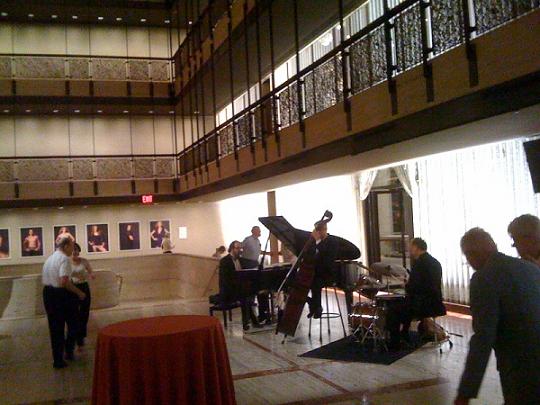
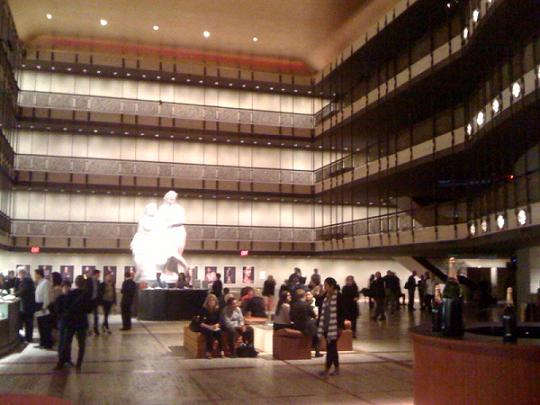
Friday night, my friends Hsien and Alyssa came with me to see the first program in NYCB’s “See the Music” series. First, we met for drinks on the promenade, which, as I mentioned, they’d opened an hour before showtime for the first week of this fall season. We watched members of the orchestra play some soft jazz music, which some patrons were dancing to. I know Hsien from my ballroom dancing days and we had to laugh because some of that music sounded straight out of Blackpool! (Blackpool’s one of the only – perhaps THE only – ballroom dance competition with live music.) (Above are a couple of my pictures of the promenade, about an hour before the performance, with people beginning to gather. My iPhone seems to take better photos outside…)

The two ballets performed were Ratmansky’s Namouna: A Grand Divertissement, which premiered last season, and Jerome Robbins’ The Four Seasons, which served for the first week of this first fall season as a tribute to fall.

Before the performance, Peter Martins came out and introduced the new series, explaining that it was inspired by Balanchine’s highly musical approach to dance, his belief that dance is music made visual, summarized by his words, “see the music, hear the dance.” Then the newly movable orchestra pit rose (as I knew it would!), and up came conductor Faycal Karoui with his crew, to explain a few things about Eduaord Lalo’s Namouna score. No one could give these talks but Karoui. He is hilarious, such a character!


Photo of Karoui by Paul Kolnik, taken from The Faster Times.

Karoui joked, in his thick French accent, that the music is very French, because of its … charm of course. Okay, then he became serious. The Lalo score is too long, of course, to talk about all of it, but Karoui focused on a few sections. One of the sections, he explained is characterized by its transparency of orchestration, meaning the harmonies don’t always  behave the way you expect them to; they are a surprise. He talked about how the beginning of the score had a nautical theme, and it opened with a sound like waves, but more German waves than French, he said, as the opening crescendo sounded more like Wagner’s The Flying Dutchman. He talked about the conversation between the harps and the strings, how Lalo plays with flexibility inside the tempos by following a quick tempo with a slower one, and he showed how Ratmansky had the dancers visualize part of that tempo by having the corps women at one point use cymbals onstage. After Karoui did a little dance himself while clapping the cymbals, he and Martins had the audience clap where the cymbals should be played to get us to internalize that rhythm a bit.

Karoui spoke at length about one of my favorite scenes in the ballet, where a group of smokers (led by Jenifer Ringer) really kind of tantalize the poor male lead, blowing smoke right into his yearning little face. It’s called “The Cigarette Waltz” believe it or not, and Karoui showed how the music really teases and tantalizes you into desperately wanting a cigarette, just like Ringer and her friends tantalize the poor sailor into wanting one of them. “Oooh, I really want one now,” Karoui cried after the orchestra demonstrated part of that waltz.

I liked Namouna much much better on seeing it a second time. I wrote about it earlier here (also, read Marina Harss’s fabulously detailed and in-depth description in Faster Times). It seemed less long this time, and each of the the parts seemed entertaining and compelling, each having its own theme and it own little storyline, however abstract the whole was. Maybe it was because of Karoui’s brief humorous explanations of the music, or maybe it’s just Ratmansky, because I always feel this way with his work – that nothing strikes me that much on first viewing, but that the more I see each ballet of his, the more I see in it, and the more entrancing I begin to find it.

That ballet was all the same, except this time Tyler Angle took over for Robert Fairchild as the main sailor guy. I’m told Robert is out for the moment with an injury. I loved Robert, but I really liked Tyler as well. Robert is so boyishly charming like Jose Carreno, and his dancing is more sharp and precise, hitting every count with spectacular flair and pizzaz, whereas Tyler’s more Romantic with his expression, with stretching port de bras and longing lunges, and he really draws out the music. They are such different dancers and it’s always nice to see another’s interpretation.

The next “See the Music” program will be this Sunday’s matinee.

NEW YORK CITY BALLET OPENING NIGHT GALA: NAMOUNA AND WHY AM I NOT WHERE YOU ARE


All photos by Paul Kolnik. Top two are of Benjamin Millepied’s new Why am I not where you are, and bottom two are from Alexei Ratmansky’s new Namouna: A Grand Divertissement.


Sorry I’m late with this post — I had serious internet problems over the weekend and they’d better not continue today or I may kill someone from Time Warner. Anyway, Thursday night was the opening night of New York City Ballet’s Spring / Summer season, and there were two world premieres: first Millepied’s Why am I not where you are, followed by Ratmansky’s Namouna, A Grand Divertissement.  I thought both were good and entertaining, if nothing earth shattering. And maybe it’s just that I’m getting to the point where I’ve seen so much ballet but it seems that everything is a combination of several other things, which isn’t bad. Millepied’s kept me more engrossed, only because Ratmansky’s was just too long.

Millepied’s reminded me by turns of Balanchine’s La Valse (which everyone seems to have thought), Robbins’s West Side Story, and even Balanchine’s version of Swan Lake, particularly where Siegfried frantically tries to find Odette through the swarm of swans who run around her in circles, frighteningly, creating a kind of hurricane.  It seemed there were also parts of the White Swan pas de deux between Sara Mearns (who danced gorgeously, as always), and her “love interest” Amar Ramasar. There even seemed thematically to be elements of Angelin Preljocaj.

The main character is Sean Suozzi who, wearing all white, seems to be a lost in time, or a human searching for other earthlings and who runs into this lot of ethereal creatures all dressed in colorful Romantic tutus. But instead of being beautifully beguilingly ethereal, they are more frightening, like aliens. There’s a very modern set by architect Santiago Calatrava (who collaborated with many of the choreographers who are premiering ballets this season and to whom the season is devoted — he was toasted by Peter Martins at the beginning of the evening), that to me gave the sense that someone — either Suozzi or the others — were from another place. Music, by Thierry Escaich, is unsettling as well. Suozzi falls for Kathryn Morgan, but in their initial pas de deux Morgan can’t see him. She seems to be blind to him. But he tries. The group of men do a kind of intense West Side Story dance, and eventually, Suozzi manages successfully to fit in, to become one of them, as is made clear by Ramasar’s giving him several articles of colorful clothing (a la La Valse) to don. Afterward, he dances again with Morgan but now it is he who cannot see her. Soon, the others swarm around her, violently plucking pieces of her tutu off. Eventually she’s the one wearing nothing but white undergarments, and she’s left devastated, alone and alienated. It was intense and enthralling and I definitely want to see it again, perhaps with Janie Taylor in the female lead (she withdrew due to injury).

Ratmansky’s reminded me of a cross between Branislava Nijinksa’s Les Biches and his own Concerto DSCH with elements of Balanchine’s Midsummer Night’s Dream thrown in. It’s harder to describe than the Millepied because there wasn’t much of a through story, just abstract portions combined with smaller stories that didn’t seem to merge into a larger whole. It’s set to really lovely music by Eduoard Lalo, which in places sounded like Glass’s In the Upper Room. I can’t remember the whole thing but Robert Fairchild is this guy dressed in white sailor garb. At one point, he happens upon some women dressed in 1930s beachy-seeming clothes and wearing hair caps and kind of taunting him with their humorously sexy cigarette smoking. Jenifer Ringer did a fabulous job of playing the main cigarette-bearing “taunter.” She’d puff in his face and he’d look enraptured but confused. Later, a group of people run toward him, carrying a passed-out Ringer and one man bows at Fairchild, as if for forgiveness. The other women haughtily puff on at the front of the stage. Everyone laughed. This cigarette girl part was my favorite. Then, there were some bravura parts for Daniel Ulbricht, dressed in kind of Puck-ish Midsummer Night‘s garb and doing the same high jumping, running through the air leaps as Puck. If I can remember correctly he was accompanied by some cutely impish female elfs, in the form of Abi Stafford and Megan Fairchild. There are sections where a lot of women in long yellow dresses do various port de bras and rather humorous (to me anyway) jumps in place a la Concerto DSCH, and toward the end Wendy Whelan emerges and is this kind of bride for Fairchild. They do a pas de deux filled with lots of classical ballet lifts and then they get married and supposedly live happily ever after.

I liked the Ratmansky and would be happy to see it again if it weren’t so blasted long! It felt like it went on for about an hour and a half! Before seeing it, I recommend taking a walk at intermission to stretch your legs, and go to the bathroom!