Where is he? I haven’t seen him in anything yet this season (okay, of the whole two performances I’ve seen). Seriously. I wanted to see him yesterday in Symphony in Three Movements (at least) and he was not there. I miss him!

Where is he? I haven’t seen him in anything yet this season (okay, of the whole two performances I’ve seen). Seriously. I wanted to see him yesterday in Symphony in Three Movements (at least) and he was not there. I miss him!
What is up with this show? Dancing With the Stars really made me mad this week. I’m kind of tired — have a big week (New York City Ballet begins, Stephen Petronio and Trisha Brown Dance Co’s open, and I have about 10,000 Tribeca Film Festival films to see, plus am trying to take computer skills classes since I virtually have none as well as schedule a visit to Bushwick, Brooklyn, where a new performance company which I’m a board member of — first time being a board member for me!!! — is trying to rent a space) — so please forgive me if I’m cranky. But when I got home from a full day of craziness and watched my tape of the show, a few things just got on the only remaining nerve I have left right now.
First, we’re told Melissa can’t compete because of a fractured rib, which we later learn she sustained doing a crazy lift / back flip over Tony’s entire, standing body. Then, we see Cheryl being short and nasty with Gilles over his inability to do a lift, which he’s having real problems with because of a shoulder injury. He forces himself to go along with her, does an insane aerial-filled Lindy Hop, and does okay (although there was a timing flub on the first somersault lift thing; the one she was yelling at him over in practice), but, to me, you could see the pain on his face. And his kicks, his Charleston, everything was just lacking energy, though he tried to hide it, like a pro. Then, since Melissa can’t dance because of the rib injury, they judge her based on a previous practice rehearsal at which she and Tony are mainly marking the routine. I can’t believe they even showed that on live TV! Of course it was awful.
Ugh. The problem is that these lift-filled routines are too blasted hard for non-pros. Even regular ballroom dancers aren’t used to doing them — and that is mainly who is training these competitors. I mean, I’m kind of torn between wanting the pros to take the contestants as far as they can possibly go so TV audiences can witness the thrill of really virtuosic dance, and just wishing they’d put some professional ballet or exhibition dancers on the show for that kind of stuff. Let audiences ooh and aaah over the real pros at this kind of thing. It’s way too much for people who’ve never danced before in their lives. It’s honestly really shocking to me that there aren’t more injuries. I mean, when I was dancing, I really wanted to be challenged too, but you have to stop and realize what you’re risking if you’re not a pro dancer; you have to take care of your body.
And in the real world, I’m sorry, but Melissa would be off. If you can’t compete in the Prix de Lausanne, at Blackpool, then, you know, the judges don’t go basing your score a rehearsal tape you send them. That’s ridiculous. If the show would have real rules, then maybe the pros, the producers — whoever’s making the dance decisions here — wouldn’t push non-dancers way the hell too far so that they risk serious injury in the first place.
Anyway, no one really blew me away tonight. Gilles was good but looked fatigued and nervous about the lifts, Ty and Shawn’s routines were meant primarily to showcase Chelsie and Mark respectively — and they did, but I didn’t watch the contestants at all. Chuck’s Cha Cha was okay but generally underwhelming compared to his excellent Samba last week. And Lil Kim — well, she was pretty good. I thought it was a bit more about the facial expressions at first, but she came through on the dancing and did really well. Overall, she was my favorite this week.
The group dances: The group Mambo was cute though; the ending goofy corny fun. The pros totally outshone the amateurs but I still liked it. I kind of wish they’d have used real Mambo music though. But Wow, the group Tango was Excellent! The amateurs here — Ty, Gilles and Lil Kim — were better than those in the Mambo. The choreography was gorgeous and everyone danced perfectly in sync when dancing together, and all three amateurs looked really good out there — almost like pros. Ty blew me away. Completely blew me away. His footwork was excellent, his posture perfect, his handhold absolutely right — he was so polished! He looked like a real dancer out there! Len is right — he nailed it.
Okay, so overall, my faves of the night were Lil Kim’s main dance, and Ty in the group Tango.
I have NO IDEA what’s going to happen tomorrow night.
I was in the bookstore the other day looking for literary magazines and somehow got caught up in the latest issue of Vogue Hommes International. I’ve been a fan of Keanu Reeves all the way back since River’s Edge (honestly) and I saw on the cover that there was an interview inside with Bret Easton Ellis (novelist, Less Than Zero, American Psycho, Glamorama, etc. etc.) Interview with BEE is pretty funny, actually, in a way it likely wasn’t intended to be. IE: interviewer: So, you were an icon in, like the 80’s. BEE: Yeah, it was hard being an icon. And confusing. Seriously. I’d get in a fight with my boyfriend and I’d be like, wait, you can’t criticize me; I’m an icon!” But my favorite BEE quote is here.
Anyway, I was flipping through and there are all these little mini interviews with and photos of writers (Stefan Merrill Block too!), architects, actors and filmmakers, of course designers and models.
But not a single dancer anywhere. Why not? They’d make such good models 🙂
(Sergey Surkov, my photo; Slavik Kryklyvyy from here)
(Arunas Bizokas, my photo; Linas Koreiva, from here and here)
Vogue Hommes should so hire me to compile a dancer spread! Fabrizio Ferri can do the pictures. Maybe Bruce Weber, though he can get kind of cliched and corny… No, Fabrizio.
Then, yesterday, I saw Valentino: The Last Emperor, which was pretty good. The Dolce Vita-esque scenes were the best 🙂 And it reminded me of Fashion Week’s being moved from Bryant Square to Lincoln Center, and I thought how excellent (and fitting of course) it would be to have NYCB and ABT ballerinas as the models, an idea Kristin Sloan had proposed on the Winger a while back. Ballerinas generally have far better bodies than models. Come on!
Over the weekend I saw the French film, Un Baiser S’il Vous Plait, or Shall We Kiss (I don’t much like the English title translation, sounds too much like Shall We Dance and “A Kiss Please” is just cuter). I guess I’d call the movie a sweet romantic comedy albeit not without a bit of tragedy. Problem for me was, soundtrack is comprised mainly of Tchaikovsky ballet music — largely The Nutcracker and Swan Lake, and I learned something about myself: I can’t watch a movie with subtitles and focus on the subtitles when my favorite ballet music is playing in the background — I keep seeing the dancers instead of the little words at the bottom of the screen. I do wonder if I were fluent in French how the music would have affected me — whether I’d likewise have been unable to listen to the words over the notes– but I do know for sure I can’t concentrate simultaneously on three visuals (actors on screen, words on screen, and dancer-visions in my head).
It also made me think how enduring music is. There’s one little scene where a woman is cutely and “innocently” flirting with a man — although the whole film is about how destructive one supposedly simple little kiss can be, what it can lead to — and in the background is playing the Dance of the Four Cygnets from SL. And it’s actually very dulcet, although if you listen carefully, you can see how the music could be interpreted as somewhat threatening in its seductive charm. It ends up being perfect for this story where flirtatious behavior can destroy a relationship. And yet, that’s not what’s really going through your mind during that dance in the ballet. At least I don’t think it’s what’s supposed to be going through your mind? As I’m watching, anyway, I’m not thinking how dangerously seductive are those cute little swans; it’s just a difficult part for four dancers doing challenging steps perfectly in sync. But it made me think how Tchaikovsky’s ingenious music can be used to add insight and emotion to other stories besides that for which it was created. Maybe music has a longer-lasting life than dance, sadly… Although I love that filmmakers are using it — perhaps it will make watchers curious about the music’s origins…
Anyway, I never wrote about Balanchine’s Swan Lake, which I saw at NYCB last season, so now seems like as good a time as any… if I can remember it all.
Balanchine, I guess predictably, makes it all about the ballerinas — his “butterflies”. Prince Siegfried hardly figures – -there’s no ball at which he’s to pick a wife, no mental reflection in the forest, no “bird hunting,” no Odile, no Black Swan pas de deux where Odette’s human imposter seduces him leading to tragedy… Just Siegfried meeting Odette at the lake, falling for her, having her taken away from him by the evil von Rothbart and his flock of black swans.
I feel like the focus on the pretty ballerinas eviscerated the story. Prince Siegfried is the protagonist. It’s his story, his inner conflict, his unmet needs, his all too human weakness of character that you identify with, and that leads to tragedy. The story opens with Prince Siegfried at the first of a series of balls, at which he, having just turned 21, is to choose a wife. Beautiful princesses from all over Europe are being presented to him — what a choice! What more could a prince want! But he’s not at peace, for some reason. He’s just not into any of them. Why, he’s not sure, but something’s just not right. So, he decides to leave the first evening’s party early, go out into the woods, near the lake where he often reflects. His friends want to come with him, but no, he’d rather be alone. And then he’s lying by the lake, thinking, reflecting, perhaps having fallen asleep and dreaming, and he sees a beautiful swan. He takes aim with his bow and arrow when suddenly this magnificient creature turns into a woman before his very eyes. He of course becomes mesmerized with her. She — this fanstasy creature — he knows immediately, is his soul-mate.
She sees him, she’s afraid but he tosses the bow and arrow down, tells her not to worry, she tells him what happened to her — that von Rothbart cast a spell on her so that she’s a swan during the day, and can only be human — her true self — at night out by the lake. But the spell can be broken if someone — a sexual innocent, such as himself — pledges eternal love to her and then remains faithful. Of course Siegfried vows that he can do that, right before von Rothbart, who’s been listening in on their conversation, reclaims her for the evening, turning her back into a swan.
The next night at the ball, von Rothbart casts a spell on his daughter, Odile, so that she’ll look just like Odette. They show up at the ball and Sig is completely taken with Odile (in some versions he actually thinks she is Odette, the likeness is so close; in others he just falls for her, human frailty being what it is). A seduction ensues with all those ten thousand fouettes and gigantic, stage-traversing jetes as the climax, and then Odette appears, making it clear either Sig’s been deceived into cheating on her or making him remember his oath of faithfulness, which, either way, he’s now broken, therefore forcing her to live in eternity as a swan and making their love in this life impossible. They go back to the lake, do a tragically beautiful pas de deux and then — in most versions — she kills herself by throwing herself into the water, he follows suit, vR tears his hair out in agony and then we’re shown a vision of Siegfried and Odette together in the afterlife. (In some Kirov and Bolshoi versions Siegfried slays von Rothbart, and the story ends happily, which I find appalingly cheesy).
So, it’s a story of not being able to love who you truly love because of societal constraints — arranged marriage, familial circumstances, governmentally enforced heterosexuality — what have you, along with themes of deception, unfaithfulness, inconstancy, human fallibility, and deep abiding love eventually conquering all those worldly limitations. But Balanchine makes it about this man caught up in this world of ethereal beauties — which is really a ballet cliche.
There are some really beautiful scenes though. Apollinaire Scherr, who I sat next to the night I saw it (and who likes it much more than I), describes well how in the end, the flock of black swans overtakes Odette, tragically separating her from Siegfried. It’s really visually stunning, horrifying — almost like she’s drowning in the tidal wave they create — and you just want to hold your hand up to block it out. Balanchine does get to the action quickly, and he uses the Tchaikovsky score to its fullest — beginning and ending with the familiar competing von Rothbart and Siegfried / Odette themes, while toy swans slide by in a background lake, showing, at the beginning what Odette has been and in the end what she’s been returned to. I do like the sliding toy swans better than ABT’s version, where von Rothbart, in swamp creature form, is shown grabbing human Odette, taking her behind a curtain, then emerging with a swan stuffed animal. There are other commendable things about Balanchine’s version, but I still think truncating Siegfried’s story the way he does turns it into a ballet cliche and deprives it of its power to speak to the human condition. I know people will disagree with me, but those are my thoughts.
I finally got around to seeing Billy Elliot on Broadway. I’d resisted for a while since I’m not a fan of musical theater — at all — but my friend Mika had an extra ticket and talked me into going with her (by telling me there was a lot of dancing) 🙂 And she was right — there was. Unbelievably, I actually liked it!
It follows the movie pretty closely, is the story of a boy from a working-class town in Northeast England who, amidst a miners strike his father and older brother are involved in, falls in love with ballet after mistakenly happening in on a dance class — he’s only supposed to be returning some boxing mitts to their proper place but the teacher sees him and asks him to join class, which he does begrudgingly. Once he realizes he’s pretty good at the turns, etc., he’s a goner. Of course his father believes that ballet is for pansies and, besides, the family doesn’t have the money for expensive lessons and admission to the Royal Ballet Academy and all that, but of course it all works itself out throughout the course of the play.
There was a lot of dancing — not only in obvious places like the dance classes and audition, but in the scenes between the striking miners and their clashes with police — in full riot gear, present to protect Scabs — and the ballet students, and Billy. It was really well orchestrated. Go here to see some great performance photos.
I also loved the actor who played Billy’s father, Gregory Jbara. He’s of course the most dynamic character in the whole thing since he’s got a lot of gender prejudices and class issues to overcome, and when he does finally begin to change, to support his son, he really makes you want to cry.
There are three Billy’s — the one on my night was Trent Kowalik, who was pretty good as well. As a dancer he excels at turns. But of course what I was waiting for the whole time was Stephen Hanna, (former) New York City Ballet principal dancer, who plays the older Billy. I was a bit disappointed in the way they used him though. The film ends with the grown-up Billy doing a portion of Matthew Bourne’s Swan Lake, so I was expecting that. But they completely cut it! And I was so upset! I waited all night to see Stephen Hanna do that! Instead they had this rather corny scene in the middle (pictured above) where the little Billy is having a dream and he dances with the image of who he will become — Stephen Hanna. At first it’s nice — they both do some turns and jumps in tandem, and eventually some partnering with Stephen lifting Kowalik into some lovely little fish dives. But then Hanna straps Kowalik into a harness and for about the final third of the piece, the damn harness carries Kowalik all around stage — it’s like circus tricks, not dance!
After that I kept waiting and waiting for more Stephen, but the only other time we see him is in a non-dance scene with the father. It’s actually a pretty funny scene and Hanna’s able to utilize his acting skills — and he’s pretty good, except that he falls back into an American accent at the end of his last line 🙂 . It’s at the Royal Ballet Academy where Billy is about to try out. Billy’s gone back to change and the father’s left in the hallway alone — still trying to get over his homophobia / fear of male ballet dancers, when along comes Hanna (and then you knew why they needed such a big, muscly dancer), for a smoke. Hanna’s dressed in a blousy 18th Century-style top and tights, so when he takes out a smoke and strikes a nonchalant pose it’s rather funny. Then he starts doing some developpes (slow lift of one leg, with bent knee, into full extension of that leg), lifting his leg right in Jbara’s direction, exposing his crotch. Jbara looks like he’s going to have a heart attack and the audience is cracking up. It ends with Hanna warning Jbara to support his son lest he may lose him to his dream, and the father listens.
But no dancing in that scene. So, I was waiting and waiting until the end, and then, curtain call after curtain call, and dance-within-curtain-call after dance-within-curtain-call and it just never happened. Hanna also plays one of the regular strikers and so is dressed for the final dance scene in his construction boots and all, so I’m thinking maybe he just didn’t have time to do a costume change. But then just have another actor / dancer do those scenes — you certainly don’t need a NYCB principal-caliber dancer for that! — and leave Hanna to the ballet! Argh! I realize Hanna took the role knowing what it would entail, but they really could have used him to much better effect, showing audiences what male ballet dancers are really capable of, and what the future Billy will be like.
Anyway, overall I did enjoy it — for those very well choreographed dance scenes I mentioned above and for the actors, particularly Jbara. It’s worth seeing if you get the chance.
Now that Sebastien and Roberto and cohorts have, evilly, fled New York City for Washington DC, poor SLSG has had no choice but to look elsewhere for worthy crush objects. Quite happily, she has found one in this new Paul Taylor guy!
Seriously, I noticed this one right away in the first piece on Saturday’s program, Mercuric Tidings, a fun, flighty, pure movement / music-made-visual dance set to Franz Schubert. Apuzzo was sprightly and precise and had great form, but was also very animated and theatrical.
I nearly burst out laughing when I looked at his bio in the program because I always go for the dramatic types!
Continue reading “SEASON CRUSH: PAUL TAYLOR’S MICHAEL APUZZO”
So, Sunday marked the end of New York City Ballet’s winter season. I was honestly in a blue funk all day yesterday, which shows, I guess, that I am really beginning to love this company since I’ve normally only gotten so sad over ABT and Alvin Ailey.
Sunday was a one-day only program, the All-American Season Finale, which included Robbins’s Glass Pieces, Martins’s Hallelujah Junction, and Balanchine’s Tarantella and Stars and Stripes. Tarantella (this is the only time it showed this season) is always fun, with its cute Neapolitan peasant boy-tries-to-get-girl caricatures, lightening-charged footwork, and series of bravura solos for both man and woman, all performed with a tambourine. I was completely out of breath after watching Joaquin de Luz fly across the stage and ultimately steal a kiss from Megan Fairchild. Joaquin is not just a dancing virtuoso but a dramatist as well and his characters are always these virile, sexed-up, but charming, innocuous men. I really love him.
Glass Pieces and Hallelujah Junction also really grew on me. I don’t know if it was Maria Kowroski or what, but the slower, more adagio section of Glass Pieces was very compelling this time, and it really spiced up the last man-centric, drum-beating, section as well. At first I wasn’t a huge fan of Maria Kowroski, but either she has improved or she has really grown on me. I always thought she had an excellent dancer body, but now she is using it in a much more expressive way, really to say something. The only thing I’m not in love with choreography-wise in Glass Pieces is in the last section, how the men come jogging out, hands powerfully punching the air, doing their ‘man things’ to the booming drums, and then the women daintily slink in to the sound of the flutes. Corny.
I was able to watch more than just the mesmerizing lighting in Hallelujah Junction this time. I love the movement theme –toward the beginning — of the landing a jump or phrase on releve and then swiftly lowering the ankle to the floor. On Andrew Veyette it looked kind of teasing but in a sinister way, like the slicing of a knife. There is something very sinister in general about Andrew Veyette, very virile in a threatening way, which makes him perfect for the devious man dressed in black here.
And I love how Sebastien Marcovici, the man in white, kind of Janie Taylor’s saviour, would powerfully jete across stage after him, threatening him, banishing him. Sebastien and Janie are such the romantic couple, in part because they work so well together and in part because of their respective sizes. Someone very knowledgeable in the dance world told me they thought he’d been working out a lot, trying to build muscle. I do think he seems to have become more muscular lately, especially his legs. Building muscle often decreases the muscle’s flexibility and he doesn’t seem to make a perfect split on a jete like some of the others, but I still think it’s so romantic that he’s so much larger than little Janie; he can just sweep her off the floor and scoop her up into his arms — aw 🙂
The program notes state that Stars and Stripes, the somewhat cheesily patriotic but excellently danced Balanchine ballet, was shown at presidential tributes, like that of Kennedy and Johnson, and at Nelson Rockefeller’s NY gubernatorial inauguration. It’s so weird to me to think of that, though I could see it performed back then. But now? At President Obama’s inauguration? It just doesn’t seem like it would fit. It would seem kind of anachronistic, sadly…
Anyway, the talk of the ballet world lately has been Sir Alastair’s New York Times season wrap-up.
Taylor Gordon, my friend and fellow blogger / dance writer, says, “whether you agree with him or not, it boggles me that one person has the power to say these things in basically the one print medium dance criticism has left. Ouch.”
Macaulay basically takes the women of NYCB to task, saying none of them really command authority like true ballerinas,
Continue reading “New York City Ballet Season Finale and Wrap Up With Response to Sir A”
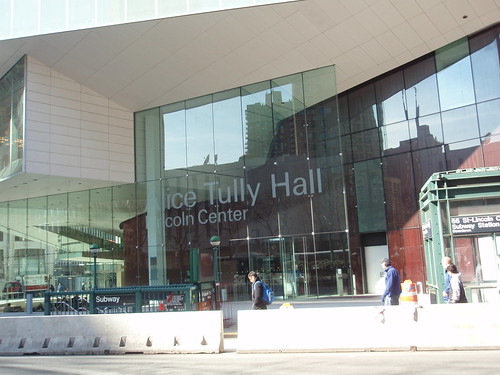
Yesterday, Ariel invited me to a rehearsal at New York City Ballet. I love watching rehearsals! Especially with performers you really like; you kind of get to know their personalities a bit more. I don’t think we’re supposed to talk about anything in detail, but can I just say, methinks Tyler Angle must be every girl’s Dream partner 😀
Anyway, afterward, Ariel told me about the new cafe at Alice Tully Hall, the northernmost building of Lincoln Center, that houses mainly music concerts. She’d heard the restaurant portion (apparently the mac ‘n cheese) got some negative reviews, but I thought their coffee was rich and the American cheesecake we had, which was creamy and topped with little swirls of white chocolate, was delic. The spacious cafe is on the bottom floor and, encased in glass, it lets a lot of sunlight in and gives you an excellent view of the surrounding area.
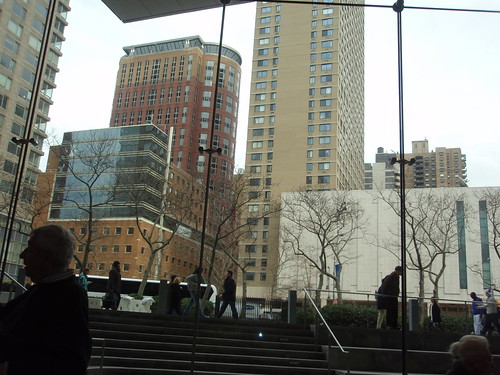
(this is facing east).
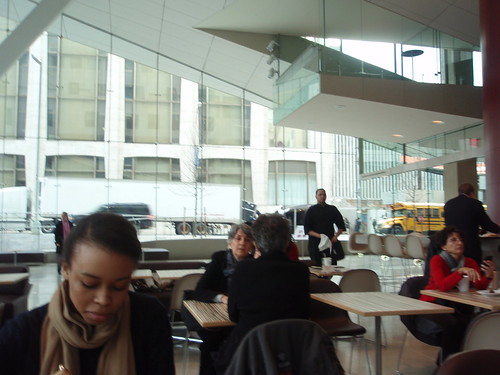
(and this south, toward the rest of Lincoln Center. Ariel picking delicately at her cheesecake in foreground 🙂 )
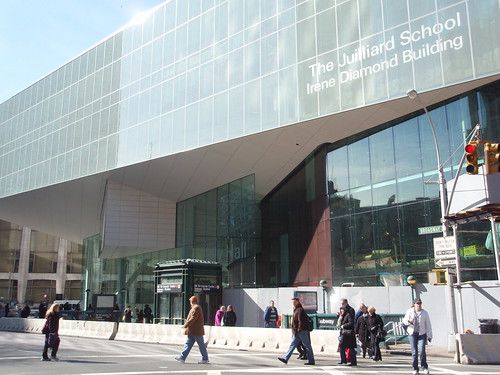
(the renovated Juilliard School aka Irene Diamond Building atop Alice Tully Hall).
Lincoln Center’s been under construction forever, so it’s nice to finally see some of the building facades begin to crawl out from under their shells.
Also, last night I went to a very intriguing performance at Dance Theater Workshop, called Kisaeng becomes you by experimental dance-makers Dean Moss and Yoon Jin Kim. It’s on for one night more — tonight — and I highly recommend it if you’re in New York. I went to see it as part of Claudia La Rocco’s WNYC performance club. I found it to be powerful but subtle, and at least in part about the commodification of Asian women in contemporary society, although club members, who discussed the performance a bit afterward at a nearby French restaurant, saw different things. Review coming soon! In the meantime, here’s Gia Kourlas’s NYTimes write-up.
Say that five times in a row 🙂 (
Last Wednesday, my friend Judy and I went to NYCB for their Founding Choreographers II program, which included two by Balanchine — Ballo della Regina, and Robert Schumann’s Davidsbundlertanze (it’ll be a miracle if I don’t misspell it at some point), and Jerome Robbins’s Glass Pieces.
My favorite was the middle one (whose name translates to “Dances of the League of David” — Schumann’s imaginary society of artists organized to combat Philistinism), and it’s becoming one of my favorites of Balanchine’s in general, though many people can’t stand it and think it moves way too slowly. Made in 1980 and one of Balanchine’s last works, it’s meant to depict the mid-19th Century composer Schumann’s relationship with his wife, a pianist named Clara Wieck, and his ensuing mental breakdown, which led to a suicide attempt, followed by institutionalization.
There are four couples who seem to me to depict various stages of the same relationship — one is older and more mature, another is young, hot-headed and full of passion, another frolicking and playful, and the last and most pathos-ridden somewhere in between, full of loving and longing but pockmarked with fateful misunderstandings and missed connections, generally standing I think for the tragic impossibility of true human connection.
Last night Ariel and I went to the premiere of a new ballet by Melissa Barak, A Simple Symphony, at NYCB. It was really lovely and not at all what I was expecting! The program they included it in was entitled “21st Century Movement” and it was an evening of abstract ballets with lots of sharp, angular motion. But Barak’s ballet was very beautifully Balanchine, very classical — or neo-classical — with the ballerinas dressed in pretty Romantic pink-skirted tutus with pink and white striped form-fitting bodices designed by Barak herself.
Suited to its title and set to music by Benjamin Britten, it was simple in a Balanchinian sense, generally storyless and without lots of drama, but with an underlying complexity in the steps and rhythms, and not at all without emotion. At one point, several men partner several women, all of them doing assisted pirouettes for a really beautiful visual effect, with all the skirts flying about in the same direction at the same time. There was lots of bouncing on pointe for the women, then the men would respond with turning jumps into the air, followed by bouncing on the landing foot, the other foot held back in arabesque.
The main couple was danced charmingly by Sara Mearns and Jared Angle. But as always, it’s Jared’s brother, Tyler, who blew me away. Everything he does is in such perfect form. Ditto for Robert Fairchild, who stole the show in the first piece, Jorma Elo’s Slice To Sharp.
Anyway, at the end, Barak came out onstage for a bow, as is customary with premieres. She looked so cute in this gorgeous white baby doll dress, empire-waisted with the area below the high waistline lined with fringe, and high-heeled silver Cinderella-like slipper-sandals. I wondered if she’d designed her outfit too!
Read Philip’s interview with Barak here.
The rest of the evening consisted of abstract very modern ballets that are not always to my liking 🙂 On first was Slice To Sharp, as I mentioned, which does hold my attention with all its lightening-speed quick-footedness and high-jumping, fast-turning theatrics, mainly performed by Joaquin De Luz. I don’t know if I’ve never seen Robbie Fairchild before in this ballet or not, but he danced on a different level from everyone else, made me understand like never before the ballet’s title as his arms sliced propeller-like through the air with razor sharpness and exactitude.
Also shown were Peter Martins’s Hallelujah Junction, set to piano music by John Adams, played on two pianos. The stage was so wondrously lit I couldn’t think of much else besides those pianos. They were set up on a platform at the back of the stage, back to back, and the back of the stage was all dark except the golden light made by the lights over the sheet music. Some dancers were dressed all in white — including the main, angelic couple, Janie Taylor and Sebastien Marcovici — others all in black — including the kind of devilish fast-footed character danced by Andrew Veyette. I’d need to see it again for the themes, but the shades of light and the way Martins used color were really stunning.
The evening ended with Christopher Wheeldon’s Mercurial Manoeuvres, which I thought I’d seen before but hadn’t. I have to say, I’m not always on the same page as Wheeldon, but I was very pleasantly surprised and I’d love to see this one again. Like the others, and as its name suggests, it was full of quick-footed dancing and interesting visuals — bright red costumes on some combined with lush red curtains at various points, dancers weaving between them sinuously, Gonzalo Garcia kind of the main elfish character full of innocuous mischief.
I found the music really interesting as well — Dmitri Shostakovich’s Piano Concerto No. 1 in C minor, for a trumpet and piano, neither instrument secondary to the other, both fighting for prominence but in kind of a teasing way. At one point, the trumpet sounds very sexy, and the couple then dancing, Abi Stafford and Tyler Angle, give their partnering a kind of Argentine tango twist. Later the more calming, harmonious violins sweep in, and a female dancer is picked up by several men who carry her about the stage, raising, then dipping her romantically (or, if you prefer, pashmina-like, ala Kenneth MacMillan’s Manon, except here it’s sweet, not seductive).
Afterward, we ended up at P.J. Clarke’s. Again. This time we saw Timothy Hutton eating up front with several friends. I was excited but Ariel had no idea who he was! I tried to think of movies he was in but, ridiculously, all I could come up with was Taps, and something about a Snowman, which were two of his first. Don’t know why I thought first of those and not all the rest!
On Friday, Judy and I went to see New York City Ballet’s “Tradition and Innovation” program. I know, I really should just move into Lincoln Center…
On the bill were Balanchine’s Concerto Barocco, Mauro Bigonzetti’s Oltremare, and Balanchine’s Tschaikovsky Suite No. 3 (I’m using their spelling of Tschaikovsky, with the first “s”; I often see it spelled without).
Concerto Barocco is one of Balanchine’s leotard ballets that makes music visual (the two ballerinas — here Wendy Whelan and Rachel Rutherford — almost become the double violins of Bach’s Double Violin Concerto in D Minor) and, according to Terry Teachout, is one of Balanchine’s most definitive. It’s funny. I’ve seen it before and really liked it then, but I think in contrast to the similar Stravinsky Violin Concerto, that I saw on Wednesday, it didn’t fascinate me as much. There didn’t seem to be as many interesting little flourishes. I still enjoyed it though — especially where the groups of women all hop repeatedly on pointe — it’s so sweet — and the way the dancers nearly become the violins is always fascinating.
Oltremare is one of my favorites this season. I’ve written about it before. It’s an expressionistic piece with some brilliant lifts, some high-charged jumps, at times the mood rather haunting, about immigrants coming to the New World, dejected about all they are leaving behind and fearful of what may lie ahead. My favorite part is always Andrew Veyette’s bravura turn. See a great video here of him talking about that role and the ballet in general, along with scenes from the ballet. (you may have to scroll down for it; I don’t know if the link will go directly to that video — but do scroll down, it’s worth watching!)
And my favorite of the night was Tschaikovsky Suite No. 3. It’s divided really into two parts, and I’ve seen the second — Theme and Variations (pictured above, Sterling Hyltin and Benjamin Millepied in the leads) — before a few times. (I wrote about a small bit about it here when ABT did it). I hadn’t realized though until now that there even was a first part.
Well, the first section is really beautiful (pictured at top), and kind of reminded me of La Valse. The ballet begins behind a black netted scrim, and takes place in a kind of Romantic dreamscape. A man, Ask La Cour, searches for his beloved, his ideal, represented by the poetic Sara Mearns, who kind of gets lost in all the women, all dressed in long, floating lavender gowns. Interestingly, no one was on pointe; everyone was barefoot, which would seem to undermine the women’s ethereal quality. And yet it gave the whole a kind of softness and lightness. They were almost like ghosts floating through the air.
The next part of this section was a soft, melancholic waltz performed by a duo — Rebecca Krohn and Jared Angle, which was juxtaposed with a fast, sprightly “Scherzo” by a really impressively quick-footed Tiler Peck (don’t think I’ve ever seen her like that before!) and the always high-jumping Daniel Ulbricht.
And then the curtain went down and when it lifted again, we were in a courtly ballroom in imperial Russia, no scrim in sight, the chandeliers shining brightly. Beautiful as the first Romantic, part with Sara Mearns, was, I still love this courtly celebration the best with the Tchaikovsky music swelling to a climax, the floor flooded with dancers, all performing the extremely fast combinations, the big huge twisty jumps for the men — my favorite. I first saw my favorite dancer dance this part, so it’s hard for me to judge fairly anyone else, but Benjamin Millepied did very well with that first set of continuous jumping turns that seem wondrously to go on and on and on, and then, in the end, when the music starts to go at the speed of light, because he is so much smaller than Marcelo, he seemed to keep up with it a little more. Marcelo is still more leading-manly though 🙂 And Sterling Hyltin was the perfect princess. Funny, but when I see ABT perform, I tend to miss the women because the men so stand out to me. Not so with NYCB; they’re more equal. I kind of feel like I saw Sterling’s part for the first time.
Wednesday night was one of the most enjoyable nights I’ve had at New York City Ballet. I’m totally in love with Balanchine’s La Valse. I wrote about it here when Miami City Ballet performed it and it grew on me immensely when I saw it on NYCB. My friend, Judy, fell head over heels for it too — I think she was the first person in the whole theater to begin clapping (when the curtain began going down admist the swirling Viennese waltzing couples, the group of men carrying Janie Taylor’s limp body high above their heads, pall-bearer-like).
It’s such an intoxicating ballet, with the gorgeously bedazzling, mid-calf-length tulle (which fashion industry person Judy tells me is called “tea length” or is it “t-length” or “tee-length”?) — deep maroon for the waltzing women, bride-white for main character Janie. Janie and Sebastien (who played the leads, pictured in top photo) and Tyler Angle all gave the whole thing such a tragic pathos. When Janie was waltzing with the “devil-character” — a frightening Philip Neal (just about the most intensely captivating I’ve ever seen him) and getting swirled and whirled and tossed madly about, she did these gorgeously elaborate back kicks on the fast third step, when he lifted her high into the air, almost tossing her like a rag doll. It added greatly to the crazed momentum.
It was really Tyler Angle who blew me away though. (See Times article on him by Claudia La Rocco here). He danced one of the waltzing men, prone to romanticism, who gets swept away by the seductive atmosphere, kind of a foreshadowing of what will happen to Janie’s character. At one point, he falls to the floor, and just sits in the middle of the stage, unable to lift himself of out this dream, but doing this fabulously expansive port de bras, waving his arms all about dreamily all the time kneeling, while the women twirl around him, their skirts flying, and couples whiz by him, through him actually, almost ghost-like as they separate their waltzing bodies from one another just enough pass their connected arms right over his head. Somehow his swan-like arms narrowly manage to miss them. It’s really brilliant.
I was sitting really close to the stage this time (third row!) and picked up on so many things like this that I’d missed before, when I was just taking in the whole spectacle. Such a beautiful ballet.
Also on was Jerome Robbins’ West Side Story Suite, which is always a load of fun and I’m always floored by Andrew Veyette’s booming but melodious voice as the leader of the Jets, and Georgina Pazcoguin as the sexy salsera Anita. I love how Robbins uses dance style to separate the gangs from one another and identify each’s prevailing ethos: the Jets wear white and are Swingers performing crazy aerials, the Sharks wear red and are fast-dancing, hip-swaying Saleros.
Also performed was Balanchine’s Stravinsky Violin Concerto, a story-less leotard ballet. I love how sitting so close up you can see the dancers’ facial expressions, as well Balanchine’s delectably intricate choreography. At one point, while a main couple is dancing, several women line the back of the stage and stand in place, but they don’t stand still; they flex their wrists and splay their fingers and turn their hands back and forth to the beat. It creates a kind of twinkling star-like effect on the main couple. At another point, the men stand to the sides of the main dancers and simply do port de bras. It creates kind of a fluid, beatific effect, like they’re blessing the couple. I feel like a lesser choreographer wouldn’t have done anything with them, would just have had them standing around while the soloists dance. But Balanchine adds these little details that really make the dance.
Wendy Whelan was, again, very intense and striking (and we saw her and her husband, photographer and filmmaker David Michalek, after the performance, at P.J. Clarke’s, which was fun!) And Robert Fairchild: just, all I can say is show-stealer, naughty little show-stealer!!
“That’s Romeo,” I said to Judy.


