
KINGS OF THE DANCE SHOWS HOW DANCER-RICH BUT CHOREOGRAPHY-IMPOVERISHED BALLET IS IN THE BALANCHINE-INUNDATED U.S.


Photo of Desmond Richardson by Andrea Mohin, taken from NYTimes.

So, “Kings of the Dance” made the New York stop of its international tour this weekend at City Center. I was there Friday night. The last time this show toured here several years ago (it is produced by Russian dance promoter Sergei Danilian) there were only four male dancers — Angel Corella, Ethan Stiefel (both of American Ballet Theater), Johan Kobborg of the Royal Ballet in England, and Nikolay Tsiskaridze of the Bolshoi. This year, there were many more dancers and Tsiskaridze was the only one who returned (and, funny, but I totally didn’t recognize him). The others were: David Hallberg, Marcelo Gomes and Jose Manuel Carreno from ABT, Joaquin De Luz from NYCB, Guillaume Cote from Canada, Denis Matvienko from Ukraine, and Desmond Richardson from NY-based Complexions Contemporary Ballet (So You Think You Can Dance fans may recognize his photo above, since he has guest performed on the show a couple times).

What I liked about this program the last time it toured here was that there were fewer dancers, and that way you kind of “got to know” them better, by seeing them each perform several different pieces. Here, you basically only saw many dancers once, and a few twice. If you weren’t familiar with them (as my two friends who came with me weren’t), you could easily get them confused. They played a short movie at the beginning where each dancer (besides Desmond Richardson; I think he may have been a late addition to the American tour) talked a bit and you saw them dance. Jose’s cute Cuban accent seems to have gotten more pronounced 🙂 — I think he did it on purpose, knowing how many female fans would be in the audience! David’s voice somehow sounded a bit deeper than it does in person. Matvienko (who, for ballroom dancers, looks A LOT like former US champ Andrei Gavriline) and Tsiskaridze spoke in Russian and their words were translated.

What I loved about this program though was that there were so many solos that exposed us to so many different choreographers whose work I’d never seen (and some of whom I’d never even heard of) before. Every company in this country is obsessed with Balanchine, so it’s a wonderful wonderful change when we actually get a taste of something else. But more on that in a moment.

As with every Danilian production, there were lots and lots of Russians in the audience, and I think Desmond Richardson and Joaquin De Luz in particular grew a new fan base. Poor Joaquin — well, maybe: after the performance and during intermission I kept hearing, “That little guy was great!”, “That little guy was just incredible,” “Where can I see that little guy dance?” So, Joaquin is the great “little guy” whom everyone is seeking out now. And everyone went wild after Richardson’s solo, Lament, choreographed of course by Dwight Rhoden, an absolute master at presenting his friend’s spellbinding combination of gracefulness and masculinity. My friends were floored, along with the rest of the audience judging by the exclamations.

After the movie, they opened with Christopher Wheeldon’s For 4, for four dancers, which is a carry-over from the last performance. On the night I went it was performed by Matvienko, Carreno, De Luz, and Cote (but the cast varied each night). It’s an adagio lyrical piece, as with the vast majority of Wheeldon’s work, and I wished there would have been some more allegro parts with bravura solos. But that’s just not Wheeldon’s thing.

Then, after intermission, we saw a solo performed by each man, ending with a drop dead gorgeous duet danced by Cote and Gomes choreographed by French choreographer Roland Petit, from his Proust ou les Intermittances du Coeur. The men were dressed in skin-toned unitards, which almost made them look naked, and the duet to me seemed to be about a man obsessed with his reflection, or another side of himself, as each’s movement was mainly a reaction to the other’s. But at some points there was some really beautiful partnering, some really beautiful lifts and it seemed like a man dancing with his soul. Breathtaking!

Anyway, other highlights of the solo section were: a really beautiful solo for Marcelo choreographed by Adam Hougland, called Small Steps, which was like lyrical iron-pumping — a series of beautiful poses showing off his musculature interspersed with flowing lyrical movement; a beautiful, lyrical piece danced by David Hallberg from Frederick Ashton’s Dance of the Blessed Spirits; a fast, fun, more virtuosity-heavy solo by David Fernandez for Joaquin De Luz called Five Variations on a Theme; Jose Carreno dancing a gorgeous adagio to Ave Maria — a modern version — by Igal Perry (which I’d seen before and fell in love with it all over again); and Rhoden’s Lament for Richardson, which, like Marcelo’s solo, reminded me of lyrical iron-pumping (which I mean in a good way of course) highlighting as it did that seemingly incongruous combination of male elegance and virility.

The only ones that didn’t really work for me well were Boris Eifman’s Fallen Angel danced by Tsiskaridze, which I think just didn’t have enough context, and Vestris by Leonid Jakobson danced by Matvienko, which was by turns a comical and bravura piece first danced by Baryshnikov in 1969. I thought Matvienko was a lovely dancer with really beautiful lines who could really deliver on the jumps and especially turns, but I just think it needed to be better acted because there were some places where it almost seemed like he made a mistake, and then you realized it wasn’t a mistake by the dancer; it was supposed to be the character who humorously screwed up. I heard Baryshnikov was excellent and I wish I could see a video of that.

Then, we saw Spanish choreographer Nacho Duato’s Remanso, which I’d never seen live before, but saw in a video performed by ABT. It involves a wall with three dancers interacting with each other around it, climbing over it, looking around it. It’s sweet, flirtatious in places, and loving and romantic. The night I saw it it was danced by Gomes, Cote, and Hallberg, though this cast alternated each night as well.

The program ended with a bravura “Grand Finale” with each dancer coming out and doing jumps and turns, and all the big fancy “male things” of classical ballet.

But the thing I kept thinking throughout was, wow, that’s really cool choreography, who’s that choreographer? Oh,  I’ve never heard of him, or, oh I’ve heard of him, how cool that I finally got to see something by him! I mean: Roland Petit, Igal Perry, David Fernandez, Adam Hougland, Nacho Duato, Leonid Jakobson. We NEVER get to see choreography by these people here. Petit is a major choreographer. As is Duato (we really see his choreography only when his own company tours here, infrequently), ditto for Eifman, and the others I’ve never even heard of. Why don’t we see more variety here? Why don’t we see more Mats Ek and Pina Bausch and John Cranko? Why do we have to drown in Balanchine over and over and over again? Why do dance companies think that we want to see Balanchine? Why do they think Americans are into this man? As far as I’m concerned, his only truly great work is Jewels. The rest, okay, his footwork is more intricate and there are certain subtle little embellishments in the variations, but really, what was so great about his ballets in their entirety? What was so great that we have to be so completely inundated with him here in the US? I mean, it makes sense that NYCB does his work because they were founded by him but every other major company in the US is likewise obsessed – San Francisco Ballet, Miami City, Boston, Pennsylvania, even the Kirov and POB when they tour here they think we want more of this crap. And whenever ABT doesn’t do classical, there seems to be an overload of Balanchine. Does anyone consider that maybe, just maybe, we might get bored? That he doesn’t speak to younger generations of Americans AT ALL? Did someone tell POB and Kirov that Americans only understand Balanchine so you have to do Balanchine when you come here? I think ballet is dying in this country because of every artistic director’s completely inscrutable obsession with this boring boring man.

Anyway, I greatly thank Mr. Danilian for allowing Americans to see something else for a change.

For a completely different perspective, see Macaulay’s review.
SARA MEARNS’ MOVING ODETTE, A TRIBUTE TO DARCI KISTLER, AND NEW ADAM HENDRICKSON BALLET


Photo of Sara Mearns in Swan Lake, by Paul Kolnik, taken from NY Times.

Last week was the first time I’d seen Peter Martins’ version of Swan Lake. Overall, I wasn’t in love with the production, but I was in love with the dancing, particularly Sara Mearns’ interpretation of Odette, which nearly moved me to tears, which just hardly ever happens with Swan Lake. She is the Veronika Part of New York City Ballet to me and I just love her. She inhabits whatever character she’s dancing with her entire being and she takes you to that place with her; she really creates another universe and she puts you right there and won’t let you leave it! I think here what I loved was that she humanized her Odette. So many ballerinas will focus on getting the fluttering foot just right, waving their arms about with just the proper fluidity that they look like actual wings, and of course totally nailing the chaines and fouettes in the second act. They make the White Swan all about the styling and the Black Swan all about the athletics. And they forget about the story.

But with Mearns — just the way she would wrap Prince Siegfried’s arms around her body, the way she’d nearly dive into an arabesque letting him catch her before turning her, or fall nearly to the floor and arch her back, wrapping herself around his kneeling knee — everything was about the tragic story, about Odette’s loving the prince and longing for him and her need for him, and then his inability to fulfill that need. I’ve honestly never been so moved before, and when she bourreed away from him at the end (there are no suicide swan dives into the lake here), leaving him, it just left me with such a emptiness. I couldn’t stop thinking about that — about her wrapping his arms around her in the pas de deux and then her sorrowful bourrees away from him at the end — for days; I still can’t get over it. I think those images will always be in my mind when I think of this ballet.

And she just had so much stage presence. Sometimes when all the swans are onstage together, I’ll lose Odette, but not with Mearns. I think that may partly be because she has a broad face, allowing her expressions to be more noticeable to the entire house. But of course she makes those expressions that not everyone does — her face, her body, she is always fully immersed in the role.

And Jared Angle was the absolute perfect partner. You can tell he’s a very strong guy and a very solid partner who’s easy to get along with. Because she’d really really throw herself into those arabesques and he’d catch her and she was so off her center of balance — she had to be in order to show the passion and emotion, and the full, expressive line – and he’d promenade her like that, and it was so incredible because you could tell he spent the better part of the ballet supporting a lot of her body weight.

And he acted it well too, and did perfectly on his solos. Very impressive performance by him!

The other cast I saw was on opening night with Maria Kowroski in the lead and Stephen Hanna making his debut as Siegfried. Hanna was very good — he’s a strong guy too, and that night, he performed a major save! Toward the beginning Kowroski went to jump into his arms, on her way into a shoulder-high lift, and she slipped before she ever got to him. He somehow reached out and caught her anyway, and took her up into that lift beautifully. The whole audience went “ahhhhhh”! I think it threw Kowroski a bit though because she seemed nervous and a bit shaky throughout the rest of the ballet. She might also have been a bit anxious because Hanna was debuting in the role, so they obviously hadn’t performed it together yet. At intermission, someone mentioned she might have been less nervous dancing with her usual Charles Askegard. Maybe that’s true. I thought Hanna did a very good job overall.

But I’m not in love with the production. Like Martins’ Romeo + Juliet, the sets are very modern, and the costumes for Siegfried and Benno and his friends are bright, color-coded, and basic with minimal embellishments. But the sets are the worst. In the beginning, you can’t even tell they’re in a palace. In the second act, the sets are not only minimal, but what’s there is so incredibly modern, just a few brown and beige slashes on some backboards. And yet, the people are dressed in Elizabethan costumes. Either set it in modern times completely or go with the historical thing, but don’t do half and half?…

And the production just moves way too fast, in my opinion. This worked for Sleeping Beauty (the paring down of all the miming and the boring court dances, in favor of getting right to the point and to those gorgeous variations), but it didn’t work here because there’s too much story up front missing. We see all these people dancing — we don’t know they’re in a palace, so we just see them all dance, and next thing we know, Siegfried’s all bouncing around with a bow and arrow. Then he runs offstage and a moment later, on comes Odette. Then Siegfried runs back out and they do a pas de deux, and after that’s over, Odette runs one way, Siegfried runs the other, and on come the swan ensemble. And — and maybe this is conductor Karoui’s doing — but you don’t even realize Odette’s run away from Siegfried because she’s afraid of Von Rothbart, and that now Siegfried is running around madly trying to find her. Instead, it just looks like a bunch of running. There should be pauses so that you know exactly what’s happening and why– the pacing is way way too fast. I never really did see Siegfried fall for her. I first realized there was something between them when Mearns’ Odette wrapped Siegfried’s arms around her in the White Swan pdd.

The other thing is the ending, which I both like and don’t like. In this ending, there is no suicide with the two lovers  ending up together in eternity. Instead, since Siegfried has betrayed Odette with Odile, they can’t be together. The problem is that Martins still has Von Rothbart die — he melts into a puddle and dies once he realizes their love is undying and real. But then, if he dies, the spell should be broken and Odette can resume human form. So, the ending then loses its mysticism and becomes a human ending — Odette leaves him because he’s betrayed her, and even though he’s horribly sorry, the damage is done and can’t be undone. So, basically she just can’t forgive him. But why not? It doesn’t really have the resonance to me that it should. I think Martins should just not have Von Rothbart die. That way the lovers can’t be together because of Siegfried’s betrayal. But she still loves him, so that when she bourrees away from him, letting go of him little by little, her arms still reaching out toward him as she disappears into the wings, it just makes you want to bawl your eyes out the same way as the Giselle ending.

One other thing: Martins has some children dance in the beginning courtly scene, which I love. It’s very Balanchine to put the children in, and they were very sweet. And I could tell the people around me thought the same.

Oh and one final other thing: there’s no real dancing for Von Rothbart — it’s really just a character part. But I missed the seductive Marcelo making all the women swoon with his sexy jumps, and then tossing his Odile all about!


Anyway — sorry, I’m behind on blogging and have to blog about these things all together — but earlier in the week, I attended a daytime tribute to retiring Balanchine ballerina Darci Kistler (above photo from the front of the program). She danced the Preghiera passage from Mozartiana beautifully, with some children from School of American Ballet, then the White Swan pas de deux with Jared Angle. And then Kathryn Morgan danced the Sleeping Beauty wedding pas de deux with Tyler Angle, which was sheer perfection. They also showed some excerpts of interviews with Kistler from a 1989 documentary, Dancing For Mr. B, and there was a short panel discussion where Bob Craft from the NYCB Board interviewed her. Later, the two were joined by Peter Martins, Philip Neal (who seems very polite and well-mannered), and the hilarious Albert Evans, who you can tell is the type of guy who puts everyone at ease. He got up there and immediately started reminiscing about a blue sweater Darci’d wear to rehearsals all the time and how much he wanted it (she ended up saying he could have it!) and some rather amusing (in retrospect) goof-ups they had together, and she just really burst into genuine laughter.

Oh and at the beginning, Kathryn Morgan presented Kaitlyn Gilliland with the 2010 Janice Levin Award (Morgan was the 2009 recipient). Both gave little speeches, and Gilliland (who seems like a natural speaker) prefaced hers by pronouncing Kathryn’s recent Sleeping Beauty debut “historical,” which nearly brought tears to my eyes. Can’t think of a more apt description!

And finally, earlier last week, I saw the debut of a new ballet by corps member Adam Hendrickson. It was presented in a small downstairs auditorium at Carnegie Hall and was part of a program featuring newly discovered Prokofiev music performed by students and faculty of Yale’s School of Music. Hendrickson’s ballet was set to his Music For Athletic Exercises, and it was fast, flirty, and fun. It was performed by three dancers — Matthew Renko (who is really a stand-out dancer — I kept wondering why he wasn’t with a major ballet company, and then realized later in the week he’s a corps member at NYCB), Elysia Dawn, and Colby Damon and one pianist — Boris Berman — and Hendrickson’s original, clever choreography had elements of Ratmansky’s Concerto DSCH as well as Jerome Robbins. At one point, Dawn’s feet are moving so fast and furiously, and the pianist just keeps at it and won’t let up, and she kind of stops and shoots him a look. It reminded me of Robbins’ Suite of Dances — it was cute and the crowd loved the joke. This is the second work I’ve seen of Hendrickson’s and I found both to be engaging and memorable. I think he may have a real future as a choreographer. Anyway, here is Philip’s account of the evening, and here is an article on the music.

MORE BEAUTIES


So, toward the end of last week I saw two more casts of Sleeping Beauty in New York City Ballet’s production. Above are the beautiful Kathryn Morgan as Aurora and Tyler Angle as her Prince Desire (Paul Kolnik is the photographer). Below are some photos of the other couple I saw, Tiler Peck (both she and Kathryn were making their Aurora debuts), with Gonzalo Garcia, albeit not from this ballet.


(in Four Bagatelles, photo by Paul Kolnik)


(and in the Christopher Wheeldon / Martha Wainwright collaboration over the summer, photo from NYTimes by Andrea Mohin; I like this photo because I think it shows each of their personalities well).

And then last week, I saw Ashley Bouder and Andrew Veyette.

I’ve been thinking about who I thought was best in what role but it’s actually really hard to do that. I honestly ended up liking everyone, though there were definite differences.

I do have a lot to say about Gonzalo Garcia though. I LOVED him as Prince Desire — he really melted me, he really completely stole the show that night and I feel like I’m not ever going to like anyone quite as well in that role now. I mean, you just have to see him in a classical ballet, as the romantic lead, and you realize why San Francisco audiences were so upset when he left SFB for NYCB a couple years ago. Some of those SFBallet fans were really devastated when he left. And I think it’s been such a puzzle to those fans that New Yorkers haven’t really fallen for him the same way. And I think it’s because he hasn’t had the chance to shine because NYCB is so Balanchine-heavy. He needs roles where he can act and become a character. He’s such the quintessential romantic prince.

You can really tell how differently he’s trained than the other NYCB dancers, who’ve nearly all come from SAB and been trained on Balanchine’s non-actable abstract ballets. I felt like with Gonzalo I was seeing someone from ABT — mainly Angel Corella (in terms of the body type, dramatic style and boyishly handsome face). The way he’d hold onto the music, draw it out while it crescendos, by for example in the vision scene holding out a finger to the princess and then leaning back, then looking out to the audience — not AT the audience but in the audience’s direction — to show how enthralled he is, how much he wants to catch her, all before then turning and running toward her. The other two — Tyler and Andrew — they didn’t do all that. They just kind of looked toward her standing more and more toward the tips of the toes, ready to run toward her when the music told them to. Gonzalo’s way was so much more Petipa and Tchaikovsky and Bolshoi and Romantic Russian and all that, and it might all seem overly melodramatic to audiences who aren’t used to that. But that’s what I’m used to with ABT — and that kind of stuff makes me swoon!– so that’s why I think I loved him so much. But I’m wondering what others who saw this cast thought?

And Gonzalo just knows what’s expected of him, as the prince. Later, when he went to do that crazy series of jetes, he was rested up and ready and he nailed them like I’ve never seen him nail anything. I’ve never seen his legs straighter, in perfect splits, and the whole way around the perimeter of the stage, without tiring. And it’s like he knew that was a very important part, and he had to do them perfectly because that’s just what the romantic hero does — that’s the way he shows his love for the princess, and that he’s worthy of her. The other two obviously took them seriously (because they’re crazy hard, you have to take them seriously), but it just was more of a difficult feat, instead of having the same meaning. You know what I mean? Like he looked out all across the stage wistfully, and then he just took off flying around it. It gave it a different meaning than just flying around.

It makes me wonder though if contemporary audiences understand that, or appreciate it. Or whether they prefer for the emotion to look more “natural”? I’m not saying Gonzalo was better than the other two, just different.

I wonder what Joaquin De Luz was like, since he’s not SAB trained either. Did anyone see him?

As far as partnerships, Kathryn and Tyler were my favorites. Tyler had a few flubs on some of his solo variations (but I still love him!), but he was always the perfect partner, he was always solid when supporting her. And the series of fish dives in the wedding pas de deux were some of the most breathtaking I’ve ever seen. Her legs were pointing completely up toward the ceiling! Magnificent! And the final hands-free fish dive was picture perfect.

I liked all of the Aurora interpretations, but they were different too. Kathryn was the most princess-like, the most regal, though that may just be the way she looks. She just kind of looks like royalty! Ashley and Tiler seemed more “real girlish”  – all smiles and sweetness and awe at the world and their cute suitors.

The rose adagios were all near perfect. (ABT’s Sarah Lane is still the queen of the balances to me — it seems like she could hold them for hours.) Kathryn had the most absolutely gorgeous extensions. Do I have to giggle every time Robert Fairchild comes out leading the cavalcade of suitors? I loved Craig Hall as the “African prince,” – I don’t know what exactly stood out about him but something did. And even though it wasn’t a dancing role, I loved Henry Seth as the King; he acted it really well. Chase Finlay was lovely as Gold in the wedding scene – -he’s a really beautiful dancer with exquisite lines. Everyone’s talking about him being the next romantic lead. I loved tiny Erica Pereira as the fairy of eloquence and Ana Sophia Scheller as the fairy of courage, thought Faye Arthurs and Adrian Danchig-Waring were brilliant as The White Cat and Puss in Boots, and Daniel Ulbricht is the quintessential gymnastic court jester.

And there’s NEVER been a better Carabosse than Georgina Pazcoguin! Nor has there ever been (or, perhaps, could there be) a better Lilac Fairy than Sara Mearns. I love how she arches her back so luxuriously and opens up her chest. And the rich, full-out port de bras. Such beautiful expansiveness, that, with her beatific face, makes her perfect for this angelic role. She reminds me of Veronika Part.

Okay, that’s all I can think of, for now!

This week begins the Swan Lakes. I’ve never seen Peter Martins’ version, so I’m really excited. In particular, I’ve heard wonderful things about Maria Kowroski as Odette and I’m psyched for Stephen Hanna’s debut as Prince Siegfried!

NEW YORK CITY BALLET’S SLEEPING BEAUTY IS THOROUGHLY CAPTIVATING FROM START TO FINISH


This past week, New York City Ballet began its two-week run of Sleeping Beauties. I saw the opening night performance, with Ashley Bouder (above with Damian Woetzel, in Paul Kolnik photo) in the lead. She danced opposite Andrew Veyette, as Prince Desire. Both did really, a near-perfect job (just because nothing’s ever completely perfect!). Really, I don’t know what more you could ask for, although I’m waiting to write my full review on the production until later this week, after I’ve seen two more casts: Kathryn Morgan as Aurora and Tyler Angle as PD (with Janie Taylor as the Lilac Fairy!), and then Tiler Peck and Gonzalo Garcia as the leads.

I love NYCB’s production — a lot more than ABT’s — and I can’t really figure out why. In NYCB’s there’s really never a dull moment — there’s no boring court dancing, just all the wondrous ballet, the very intricate and complicately awe-inducing variations for the various faeries (Sara Mearns was gorgeous as Lilac Fairy — in photo below by Paul Kolnik, as were Amanda Hankes, Lauren King, Rebecca Krohn, Erica Pereira, and especially Ana Sophia Scheller as Fairies of Tenderness, Vivacity, Generosity, Eloquence, and Courage respectively), the fun “wedding scene” with all the cute virtuosity-driven duets for the fairy tale characters (once again, loved Sean Suozzi last week — here as Puss in Boots, and Stephanie Zungre as his partner the White Cat; loved Tiler Peck and Daniel Ulbricht as Bluebird and Princess Florine, loved Henry Seth as the Wolf but not sure why they had a little girl dance Little Red Riding Hood…), the “jewels” starring Stephen Hanna :), and of course the beatific Grand Wedding Pas De Deux between Bouder and Veyette.

I don’t know, there’s just never a dull moment: you go from the Rose Adagio with all the virtuosic balances for Aurora (and the handsome cavaliers), to the richly choreographed fairy variations (that seemed to me more Balanchine than Petipa), to the drama of Carabosse’s arrival with her creepy minions and the frightening spell she casts, to the sweet Vision scene, to the quick Awakening (nothing in this production is long and drawn out; each scene gets right to the point), to the Wedding with the entertaining guests, and ending with the beautiful pas de deux between Beauty and the Prince.

I can’t figure out what exactly is different between this version and the others I’ve seen before, but honestly, this hasn’t been one of my favorite story ballets. So I was just really floored by how captivating NYCB’s production was. I can’t wait to see a few more this week. NYCB is good at story ballets! If you’re in NY and you can make it sometime this week, do go!


BOOK BREAK

Just FYI, I’ve finally managed to reduce my novel’s Amazon price from $17.99 to $14.99. That’s the print price; the Kindle is $9.99. The endlessly wonderful James Wolcott has given me yet another shout-out — thank you Mr. Wolcott! And how sweet is this, and this!

I haven’t participated in a meme for a long time and so thought I’d take the one posted by Laurel-Rain in her Seasons blog (the last link above). The rules are to find the book nearest you, turn to page 56 and write the 5th sentence (and maybe a sentence or two after that for context, if you like). For me, that book is

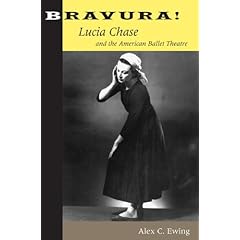
Bravura! Lucia Chase and the American Ballet Theatre by Alex C. Ewing (Chase’s son), which I received for review purposes. I’m about a quarter of the way through; so review coming soon. Here’s the passage:

“Lucia would have had to be blind not to see that Mordkin was being pushed out of the picture. Yet she was most decidedly not the author of the early plans for Ballet Theatre, nor was she calling the critical shots. Other than providing the seed money for Pleasant to proceed with his grand design, Lucia had made a strict and unequivocal effort to stay out of management.”

So far, my favorite parts have been more about Lucia’s personal life than the details of setting up the company — such as her relationship with her husband, who died tragically young, when the couple’s two children were still babies. For years after his death, she would write him notes, telling him what she was doing, thinking, about her life. A way of keeping him around, I guess. So heartbreaking. Right now I’m reading about her love / hate relationship with Agnes de Mille — delicious fun!

That’s nonfiction. Here is a novel, Picking Bones From Ash, that was just about the same distance away from me. It’s by my friend, Marie Mutsuki Mockett, and I recently finished it and wrote a review of it on Goodreads. I absolutely loved it; I learned so much — about Japanese culture, European culture, Japan itself, Buddhism, classical music, historical artifacts, how to discern the period in which a piece of art was made — just read it, it’s filled with such beautiful detail and the story is so suspenseful you really won’t be able to put it down after a certain point. Anyway, here is page 56’s fifth sentence:

“We continued to spend time together on the weekends and during the holidays when I was home in Hachinohe. In the middle of my second year of college, however, Masayoshi began to act a little bit strange again. It all started when his father had a small stroke around the same time that I was caught up in preparing for the annual Messiah concert.”

One other book I just received in the mail and am currently reading is this:

Anatolia and Other Stories is a collection of short stories by Anis Shivani, whose work I became familiar with in the literary journal Boulevard. According to a quote by award-winning novelist Laila Halaby on the inside cover, the collection “takes us around the globe in stories that juxtapose old and new, east and west, with characters that do their best to navigate the generational / religious / cultural / socioeconomic tensions inherent in our global economy. Shivani’s observations are dead-on, especially when dealing with themes of loss, family dynamics, and subtleties of power.”

Finally, here’s another book related to dance that I didn’t have time to review, but that is getting good reviews.

The Sugarless Plum, by Zippora Karz, details the New York City Ballet dancer’s struggles coping with the dangerous  and life-altering Type 1 Diabetes, which she was diagnosed with at age 21, while still a corps member in the company. Despite the disease she nevertheless managed to rise through the ranks and enjoy a solid, 16-year ballet career.

If anyone wants to participate in the meme, just link back to this post on your blog, or, if you don’t have a blog, you can write the book’s passage in a comment here.

NATALIE PORTMAN: "HOMEWRECKER"??

Apparently the New York Post’s Page Six people have found out about Benjamin Millepied’s prior relationship with ABT’s Isabella Boylston (and are finding it newsworthy) because they’re now depicting Natalie Portman as a “homewrecker” who tore the two apart. (Doesn’t that term usually apply to someone who splits a family apart?) They’re saying Millepied and Boylston were together for three years, lived together before Portman moved in on him, and were thinking of marriage. Really? Wasn’t he dating Saskia Beskow until pretty recently? And isn’t Boylston rather young — were they really together for that long? And marriage??? Celeb bloggers are picking the story up as well.

Isn’t it so surreal though that Page Six is interested in this at all? I guess I’ve repeatedly bemoaned that we haven’t had a famous dancer since Baryshnikov — and I think Millepied may be the first since him to date a celebrity. I wonder if more people will actually turn up at NYCB when he’s dancing, or at ABT to see Boylston?

PASHMINA LIFTS AND LITTLE DOGS WHO STEAL SHOWS: ALEXEY MIROSHNICHENKO’S "THE LADY WITH THE LITTLE DOG"


Last night at New York City Ballet was the world premiere of a new ballet by Alexey Miroschnichenko, The Lady with the Little Dog (photo above, of Sterling Hyltin and Andrew Veyette, by Paul Kolnik). The ballet is based on the short story by Anton Chekhov of the same name (which I haven’t read but now wish I had). Miroshnichenko made the ballet in honor of the 150th anniversary of Chekhov’s birth and he dedicated it to Maya Plisetskaya in honor of her 85th birthday.

I really liked the ballet — really enjoyed the whole evening. Though I didn’t know the story, The Lady with the Little Dog was very Chekhovian, very full of angst-ridden characters (danced by Hyltin and Veyette), along to a score by Rodion Shchedrin that went along well with the drama.

It began with Sterling Hyltin dressed in a gorgeous deep purple dress with a plush velvety top and romantic tutu, walking a little dog on its leash across stage. Veyette was in the back, bespectacled, and wearing a white suit, looking like a 19th Century Russian businessman. (The splendid costumes were by Tatiana Noginova). There were also several male dancers dressed in grey bodysuits writhing around onstage. I originally thought they were a kind of chorus that would echo or foretell the action of the “play” but then they had some very dog-like movements – holding their hands up, bent at the wrists, kind of like dog paws, lying on the ground and playfully kicking their feet in the air, rolling over. But the program called them “angels.” It soon became clear that their function was to control the events — get the lady and the gentleman to meet, sleep together, then tear them apart — perhaps one of them died? — then bring them in the end together again as they walked along a path toward heavenly light.

Anyway, back to the beginning: well, as Sterling walked that little dog across the stage (I’m not good with dog breeds, but he was small and fluffy, with straight shaggy hair), he kind of initially stole the show. He kept looking out at the audience, into the darkness, but he looked intrigued, not scared. Then, Sterling would lift her leg and he’d turn and look at her like she was a bit off her nut. Then a grey guy came up and wiggled around and the dog would take a step back, then try to go around him, but the leash preventing him from getting too far. It was too much. Finally, Sterling stopped, frozen in time, and a grey man took the leash and led the dog offstage. Right before he went into the wings, he took another inquisitive look out at the audience. There were several giggles. It was too cute and I was reminded of Melanie LaPatin once saying no performer ever wants to follow an act involving children or animals.

Anyway, fortunately the dog didn’t return (although I secretly kept wanting him to). It took a few seconds for the audience to calm down and re-focus, but eventually we did. They grey people set up what looked like a long rubber mat which separated Sterling and Andrew. Each principal danced separately, then with the grey men, then the grey men eventually brought them toward each other and they danced together. The only odd thing to me was the background set (along with that rubber mat; set designs were by Philipp Dontsov). The back wall looked very abstract, which seemed kind of out of place in a period drama, although maybe it was meant to universalize the emotion. It looked to me like the middle of an airplane, with slanted airplane-like windows lining the back wall. As the action unfolded, the windows got smaller and smaller until they eventually disappeared.

Anyway, in the second movement, Hyltin and Veyette danced this really gorgeous MacMillan-esque pas de deux with lots of beautiful sweeping overhead pashmina-esque lifts — which of course I’m always a sucker for! So that was my favorite part. Then, the grey men returned and helped the two principals out of their clothing, and they danced a rather beautiful sex scene in skin-toned underwear. I have to say, as I was watching I couldn’t help but think of a similar scene from Pascal Rioult’s Views of the Fleeting World, which was so slow and serpentine and tantalizing, yet beatific. This wasn’t the same; it was a little more frantic and angst-ridden, which I guess is more Chekhovian (I will have to the read that story).

Then, the grey people direct them to get back into their clothes, and soon we see Veyette doing a kind of mad dance, eventually running across the stage and disappearing into the wings, Hyltin running after him, but unable to catch him. Then she does a rather sorrowful solo.

Eventually Veyette returns, they dance together again. But this time it’s a more mature love, not as Romeo and Juliet balcony scene as the first. Eventually, they take off their clothes again, the mat is laid vertically across stage, running front the front of the stage to the back, and the two hold hands and walk together down the path, toward the back of the stage, toward a bright, golden light. The end. I wasn’t sure if Veyette died and they were coming together again in the afterlife, or if they just had a fight and this final scene represented them kind of going off into the sunset.

Of course Miroshnichenko came out for a bow during the curtain calls — and unbelievably, though the vast majority of the audience applauded, there were a few audible boos. It’s like some people were getting opera confused with the ballet. I mean, seriously, this wasn’t a new, iconoclastic production of Tosca; it was a brand new ballet…

Anyway, I liked it and would like to see it again.

The other two ballets of the night were Balanchine’s Agon, an abstract black and white leotard ballet set to Stravinsky’s unsettling score. The choreography was really brilliant, very original, and there were lots of pretzel-shapes in the duets (the main one danced by the hyper flexible Wendy Whelan, with Albert Evans), and it made me realize where Christopher Wheeldon gets his inspiration from 🙂

The evening ended with Cortege Hongrois, basically Balanchine’s wonderful one-act version of Raymonda, which I’ve been going on about after seeing ABT II perform part of it at the Guggenheim recently. Sean Suozzi danced what I’m now calling the Irlan Silva part — the virile, folksy Hungarian lead — along with Rebecca Krohn. I haven’t noticed Suozzi much before this season, but he is really standing out to me. He danced the lead in this, one of the duets in Agon, and he did a lot of dancing in Who Cares? last week. He is really good! And Maria Kowroski and Jonathan Stafford danced the balletic leads and made me badly want to see Diamonds” again.

ROBERT FAIRCHILD DEBUTS IN FANCY FREE (BUT TILER PECK GLOWS!)


Over the weekend, SLSG favorite Robert Fairchild had his debut in Robbins’ Fancy Free at New York City Ballet. This is one of my favorite short ballets: three sailors on shore-leave try to pick up women in a bar, but, there being only two women, they kind of get into a little competition, dance-off-style of course. Fairchild danced the role of the Latin guy, Tyler Angle the more head-in-the-clouds romantic one, and Daniel Ulbricht, the short Swing-y one with all the toe-to-finger splits jumps off the bar. The first woman was Georgina Pazcoguin and the one in purple who for a moment falls for the romantic one was Tiler Peck.

(photo above by Paul Kolnik, taken from Ballet.co, of, l-r Amanda Hankes, Tiler Peck, Damian Woetzel, Tyler Angle and Daniel Ulbricht)

Ah, Tiler Peck was so lovely! She dances that role so well — she really inhabits it, and when romantic guy cartwheels her over his head it just makes me swoon! I like her even better than the ABT ballerinas who dance this role – Gillian Murphy and Julie Kent. Peck brings the most to it I think — the dreamy girl who allows herself to get swept off her feet, at least until the guys get out of control. Pazcoguin and Kaitlyn Gilliland – who debuted in the ballet as well, as the third girl who comes on at the very end — did well too, although I thought Gilliland looked a slight bit unbalanced in the high heels.


(Robert Fairchild headshot by Paul Kolnik)

Ulbricht was perfect as the high-flying guy with his bag of tricks, and Tyler Angle was fine as the dreamy balletic one — the best role for him in this ballet, although I don’t really think this ballet suits him that well. I would really have preferred to see Robert Fairchild in his role though, rather than as the Latin sailor with bravado galore. I don’t think he has enough of the cocky shithead in him to quite pull it off. Of course I couldn’t stop thinking of Jose Manuel Carreno in the role — how he always cracks me up when he struts around with the lady’s purse after playfully snatching it, how he tries to please the ladies with those rumba basics that he thinks are oh so sexy but are really just silly the way he does them. I’m sorry Robert, I just couldn’t get Jose out of my head!

Also on was Prodigal Son, starring Joaquin De Luz (who I imagine really excels at the Latin sailor) and Maria Kowroski as the Siren. Joaquin is my very favorite Prodigal Son — including the ABT dancers I’ve seen (I never got a chance to see Daniil Simkin when ABT did it last Met season). De Luz’s jumps at the beginning perfectly emanate youthful restless angst without being too much about the acrobatics. And he acts it brilliantly. He really takes you on that journey with him from restless youth anxious to see the world, to seduction at the hands of the ruthless Siren, to beaten and begging his family for forgiveness.

Watch a tape of him performing and talking about the role here.


And last was Firebird starring the inimitable Ashley Bouder (photo above by Paul Kolnik from NYCB site). My favorite Firebird by far. I love the quick-changing shapes she makes during the pas de deux where she’s trying to break free of Prince Ivan’s (Jonathan Stafford) grip — her being caught by but also intrigued by him. And her liquid fluid arms with lush wingspan are so beautiful. And of course no one does the jetes around the perimeter of the stage like she does!

This program repeats a few times this week, alternating with Martins’ Romeo + Juliet and another program — which begins tomorrow night — and includes the world premiere of a ballet by Alexey Miroshnichenko.

PACIFIC NORTHWEST BALLET MAKES ITS JOYCE DEBUT (and Marco Goecke Steals the Show IMO)


Tuesday night, the Pacific Northwest Ballet opened its 5-day run at the Joyce. This was my first time seeing this company, and it has a reputation as one of the most prestigious in the U.S. Helmed by Peter Boal, a former dancer with New York City Ballet, the company is already familiar to many NYCB fans, but not yet to me.

I really wish they could have brought the whole company and danced at City Center, a more suitable stage for ballet. The Joyce is small and known for modern dance and so they could only bring a small portion of the company. And, the small stage limited their choice of choreography and prevented the dancers from dancing full-out. So I felt it lacked a certain balletic grandeur, although I still greatly enjoyed the evening.

For one thing, I was thrilled to finally be able to see Brazilian ballerina Carla Korbes dance, after being introduced to her on the Winger. She had a part in just about every ballet and she did not disappoint — she has great charisma and dances with great dramatic intention.

I was also happy to be able to see Seth Orza again 😀 (Everyone who’s read this blog for a while knows how downright devastated I was when he left NYCB…) He’s so sharp and precise, and so strong — I think he definitely needs to be promoted to principal (he’s now a soloist, as he was when he left NYCB).

So, there were four pieces on the program: Opus 111 by Twyla Tharp, Fur Alina by Edwaard Liang, Mopey by Marco Goecke (my favorite, and pictured above, James Moore dancing), and 3 Movements by Benjamin Millepied.

I’ll start with my favorite — Mopey, by Goecke, danced very intensely by Moore.


I’d always been curious about this young German choreographer ever since this little exchange (the “Evan M.” being Evan McKie, a principal with Stuttgart Ballet).

Anyway, Mopey is hard to describe — basically just a solo for a man who by turns twists and contorts his body into awkward shapes, bounces up and down, makes muscle-man poses, waves his arms about gracefully, appears to be possessed and struggling to control his limbs — his fingers bent and curved down somewhat grotesquely, almost monster-like. It was short but really engrossing.   Here’s a YouTube clip of a dancer from Stuttgart dancing an excerpt from the piece. Unlike in the clip, which is danced only to one piece of music, Moore danced first to silence, then to Bach, then to pop punk by The Cramps.

I also liked Millepied’s 3 Movements, pictured below (dancers are James Moore and Lucien Postlewaite).


All photos by Angela Sterling, by the way.

It was abstract but I thought I detected a bit of a men versus women showdown (I think this is a recurring theme of his — at least in his recent works). It was set to rather unsettling Steve Reich music and filled with original movement, the way the groups of men and women would go at each other at times, almost like they were from separate clans. But the costumes were contemporary: almost casual work attire for the men and little flirty dresses for the women. Costumes were designed by Millepied’s girlfriend, Isabella Boylston, corps dancer at ABT.

I also liked Fur Alina by Liang. It was a man woman pas de deux danced by Carla Korbes and Karel Cruz and it seemed to be the somber story of two lovers slowly deciding to part. It was set to Arvo Part (who it seems, understandably, is becoming the most used composer for contemporary ballet these days — at least for these despairing pas de deux).

Oddly, the Tharp was my least favorite (below: dancers in front are Korbes and Batkhurel Bold).


I’ve never seen Opus 111 before and this one (set to Brahms) didn’t seem to have any of Tharp’s signature comical character roles or her theme of ballet versus other kind of dance (fill in the blank: American social —  like in Deuce Coupe, Scottish folk, hip hoppy aerobics —  like in Upper Room) or her crazy, almost death-defying lifts. It was pretty and lyrical and the dancers lightly flew around the stage, at times coupling off. But sweet as it was, it just seemed to lack something. Might have been the small stage though and they just couldn’t dance it full-out?… Sir Alastair saw something more in it though.

I hope the company comes to NY again — to City Center.

ERICA PEREIRA PROMOTED TO SOLOIST AT NYCB


Photos by Paul Kolnik.

I’m a little late on this news, but for NYers who haven’t heard, Erica Pereira was recently promoted from corps member to soloist at New York City Ballet. I first noticed her in 2006 when she was the youngest Juliet cast in Peter Martins’ Romeo + Juliet (she was still then only an apprentice with the company). I knew how special she was then, and so I think this promotion is very well deserved.

Getting so excited for NYCB’s Winter season to begin! Nutcracker shows through Sunday, January 3rd, then the regular season begins the following Tuesday, January 5th, when the new Peter Martins will show, along with Balanchine’s Who Cares?

Ballet preceded by cadillac margaritas and duck tortilla pie at Rosa Mexicano, then followed with Ed’s Chowder House martinis and scallop ravioli:) Or maybe Honoo & green tea martinis at the A-Rod / Wallace Shawn bar… Ballet season: yum!