Originally uploaded by swan lake samba girl via mobile.
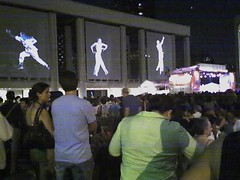
Friday night and there are seats!


Samba & michalek – perfect combo 🙂
Originally uploaded by swan lake samba girl via mobile.
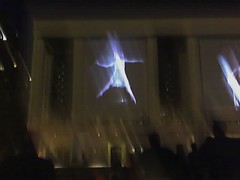
… and Desmond Richardson of course (in the background)! I swear they seemed to be moving faster tonight — the Michalek dancers I mean! Maybe it was just an effect of the fast, fun Samba of the Midsummer Night Swing event, or maybe it really was sped up a bit, especially in some of the middle parts?… Hmmm… Maybe it’s just that I’ve seen the exhibit so many times now that I have no perspective anymore! Anyway, something about it made it especially spectacular tonight, and it’s definitely growing on me more and more each time.
And then I got home just in time for the horrible results on STYTCD. I’m so upset about Anya. She is a really beautiful, rhythmic dancer and I’m really going to miss her on the show. I don’t know how the other two female contestants performed tonight, but I do know that as far as ballroom goes, Anya Garnis is one of the very best in this country. Oh well, what can you do? Good news is that Pasha and Danny will be touring 🙂 🙂 🙂
Okay, I’ll have everyone know that it is currently between the hours of 9 pm and 1 am and I am NOT, I repeat NOT, on Lincoln Center Plaza!!! This is a huge step forward for me; yes, I feel that I am steadily on my way to overcoming my addiction…
Here are some pictures from last night, Sunday, when I attended “Slow Dancing” for my fourth time in, yes, the mere four days the exhibit has shown, this time with my fellow blogger, Oberon. It was a “schmoozing with the artists” night for us:

Oberon cutely peeking over his shoulder at me. And, in the background is Michalek (in red bandana) talking to the filmed dancer on crutches, whose name I now know (thanks to the playbills near the State Theater entrance 🙂 ) to be Bill Shannon, or “Crutchmaster.”
And here is Philip with his favorite ballerina, the spectacularly amazing, and, given her enormous status, almost ridiculously nice and personable, Wendy Whelan:

Sorry to be going on about it ad nauseam now, but I’m just so excited about this exhibit because I feel like it has so much potential to be really powerful. It’s like ballet for the masses, and I LOVE it.
Interesting thing about last night was, unlike the previous ones, there was no Midsummer Night Swing. So it was shown in stunningly dead silence. At first Philip and I were thinking, hmmm, this is going to be odd without music, maybe they could have classical or something?… But then after it began we agreed it was really quite beautiful, really poetic this way. Actually, it was more like a regular concert dance performance, like being at the ballet, but outside. And in this poetic silence, I feel like my previous suggestion of having the dancers’ names on the screens, would be as ludicrous as having an announcer yell out names, SuperBowl style, during a Met performance. But then, I still think it would make good sense to post the names prominently during the MNS crowd, because those people are not going to go running up to the State Theater to pick up a brochure or search for a poster; in that context, it needs to be easier.
Anyway, the lack of raucous crowd enables you really to focus on the odd beauty of the movement; I saw many things I’d missed before. Of course I had Philip and Wendy as guides. Wendy told us to watch for Allegra Kent, a former prima ballerina who danced many a performance, with the New York City Ballet, right inside that State Theater. At the start of her routine, she briefly turns her back to you, the viewer here, in order to face her beloved theater, and, inside, her audiences past. She raises her arms up high, in eternal gratitude to them, to what happened beyond those doors, now long ago. It’s such a poignant gesture of reverance to those fans, to the past, and, given who she is, to ballet history in general, and you just want to cry.
And I guess that’s why I want there to be a way of spreading that message to everyone; if you don’t know who she is, I fear she may just look like some weird lady casting a spell or something, you know? And that would be just a travesty.
When Janie Taylor came on, Philip squealed, grabbed my arm and galloped, dragging me along behind, over to the far right of the plaza, beyond the Midsummer Stage, where we could have a full view — something that definitely wouldn’t have been possible if it was a social dance night.
“Oooh, her hair, look at her hair, look at her hair!” he screamed, flailing about so wildly he really could’ve knocked me out had I been a little closer. Funny, but that flying mane did look cooly like a waterfall this time. Philip should be a professional laugher, or whatever those people are called who get paid to fire up the audience.
So, I dunno; I feel like my perception of the event, of the spectacle, varies on the context. There was still a congregation, but of course nowhere near the size of that on a Midsummer Night. It was a night for the true diehards. I’m glad I saw it when it was quiet and I could really concentrate (and meet Wendy!), but I still love watching with the Swingers, seeing what they see. (Thanks, by the way, to Michele, who commented on my last post, giving her view from that salsa mosh pit!) I have seen many of the social dancers, taking breaks, stand back and gaze up, and try to imitate some of the moves. You develop a dance aesthetic as a watcher / participant and it’s fun to try to mirror those screen giants, so long as no one gets hurt with some crazy over-the-head leg extension… 🙂
Hehe, my friend, Ariel Davis, a young journalist currently in NYC for an internship with a big magazine, emailed me bright and early yesterday morning to tell me that we were quoted in the NYTimes! Of course I immediately scoured the article. Well, we weren’t actually quoted, in that our names weren’t listed, but we were the ones exclaiming, “he looks like a god,” the top quote in Claudia LaRocco’s write-up of the opening night of the Slow Dancing films I’ve been mobile-blogging about for about the past fifty posts now. (I promise to stop soon with the cell phone blogging; it’s just so exciting, in its own way). Anyway, the “god” Ariel and I were speaking of was Herman Cornejo of course 🙂

Anyway, I’m going to see it several more times before it leaves NY, but so far my thoughts are that the project is a great idea that has some real kinks to work out.
For starters, Lincoln Center is really annoying me and if I was Michalek I would be pissed. Slow Dancing starts at 9 p.m and continues until 1:00 in the morning; Midsummer Night Swing ends at 10:00 p.m. But after the MNS band stops playing, Lincoln Center really shuts down: the alcohol and snack bars all close shop, making it impossible to enjoy a drink with friends while watching the films, and, more seriously, a very noisy cleanup begins. The Aquafina guy noisily dismembers his metal booth then hauls it all, bit by bit, to a huge garbage-like truck waiting, motor running, in the nearby taxi cab lane; the bar guys clinkily clear bottles and glasses from their shelves; garbage collectors noisily bag trash and load it onto little trucks, which they drive dangerously through the crowd darting in and out and around groups of people, sometimes even honking if you don’t see them coming — how’s the audience supposed to focus on the film with all this crap going on? You feel like Lincoln Center’s telling you it’s time to go home now, show’s over, you’re out past your bedtime. Until July 29th, when this exhibit ends, could they possible re-arrange clean-up schedules? It’s hugely disrespectful to the artist and his audience.
As for the project itself, I think it’s a great idea and it seemed to work well when I saw it indoors at the earlier Works & Process event at the Guggenheim Museum, but for some reason, it’s not as exciting outdoors on the huge Plaza. I think part of my being so captivated at Guggenheim stemmed from the fact that I know and love all three dancers who were showcased that night: Wendy Whelan (ballerina of New York City Ballet), Herman Cornejo (American Ballet Theater), and Desmond Richardson (Complexions). But the vast majority of the dancers participating in the whole project I don’t know, or at least don’t recognize.

As LaRocco alludes to in her article, not a lot of the people on the Plaza for Midsummer Night Swing paid much attention to the films, unfortunately. Several heads did turn when the screens first lit up, and people watched for the first couple of minutes, but when they couldn’t see very much happening, they returned to their own fun. LaRocco bemoans that these social dancers, themselves participating in Dance, are ignorant of those on the screens, many of them the greats of ballet and modern dance.
Well, why should those dancers, having such a blast learning to dance themselves, stop what they’re doing in order to worship these people on the screens, whom they don’t know? Might someone, perhaps, tell them who they are?
From what I’ve seen so far, here are my critiques of the project:
1) No one knows who the dancers are and no one is bothering to tell them. If they’re not going to have easily available pamplets listing the names and credentials of the dancers, with pictures, could they run the names and a brief word about who they are somewhere prominent on the screen, at least at the start of each performance? Names humanize people. I’ve noticed this watching people watching filmed ballroom dance competitions — people who aren’t really seriously into the art of ballroom just kind of glance at the screen and look away after all of a minute — there are far too many people out there on the floor at once, it’s too much to take in, it’s confusing and nonsensical.
But once names are placed over the dancers (briefly, not for the entire time the camera’s focused on them of course), people pay much more attention, even if they’ve never heard the name before (which is highly likely). You think, ‘oh that couple’s obviously from Russia with huge names like that,’ ‘oh a Japanese couple,’ ‘wow, another Russian; a lot of Russians in ballroom, who knew…’ ‘oh wow, those are the national champions, yeah, they are really good,’ etc. etc. Names humanize. A little bit of info goes a long way.
Update: I went again tonight (Sunday), with Oberon, and found that there are little Lincoln Center playbills near the entrance to the State Theater, along with a poster, both giving the names and a brief background of each dancer next to his or her picture. I still like the idea of printing the names somewhere on the screens though! Also, I met Wendy Whelan tonight — she’s a very sweet person! Here is a picture of her and Oberon. Awww 🙂
2) There are either too many of the same types of dancers or there’s not enough variety and spontaneity in the rotations. At several points, there are two to three dancers shown all at once who are all doing modern. This is boring and reductive. Also, can everyone not be dressed exactly the same? Wendy Whelan and Janie Taylor are ballerinas but they’re both dressed in the same silky flowing gowny things as about ninety percent of all the women. To someone who doesn’t know dance, it could be confused with yet more modern. Couldn’t at least one be in a tutu and on pointe. And, could someone do a fouette or multiple pirouettes? The movement is too much the same. It would be much more interesting if there was, say, in the middle a classical ballerina on pointe in a tutu doing fouettes, then say the African dancer guy on one end, and maybe William Forsythe doing his modern on the other end; then shift in the next sequence to the bellydancer, adjacent to the head-spinning break dancer, and sandwiched in between, the drag queen; then next sequence, say the guy on the crutches, the pregnant woman, another ballerina; or have a ballerina surrounded by a strong ballet guy and one of the modern women. Just make sure there’s variety in every sequence of three. That makes it interesting and it’s more of a celebration of Dance, in its rich variety.
3) I realize the point of the project is to show movement in extreme slow motion, but I feel that it is too slow. At points you can’t even see the dancers moving at all. This actually may be a glitch in the film, because at some points I think the films have actually stopped for a while — sometimes even for as much as a full minute. This is confusing to the audience, who is already perplexed enough trying to figure out, as LaRocco illustrated with one couple’s conversation, if there actually is movement. Possible technical problems aside, though, the movement is generally still too slow. Instead of people admiring every detail of the body in motion, every ripple of a muscle, the audience just gets bored, especially if the dancer isn’t “flashy” enough. These past couple days I’ve become most fascinated with Glem Rumsey, who dances here as his flamboyant drag persona “Shasta Cola.” I find myself waiting for him to come on because I know I’m going to be most entertained. In contrast, one of the dancers I was most excited to watch was Janie Taylor. Yet, I find myself getting unexpectedly bored when she’s on here. She does nothing really over-the-top; no spectacular balletic feats. Even that crazy hair flip that generated a lot of press talk pre-show opening — it’s nothing; I almost missed it. There’s no appreciation for subtlety when the movement is this weighted down. The guy on crutches is initially intriguing because you’re wondering what he’s going to do, but you get bored and stop watching when he takes so long to get going. All of a sudden you look back and him and he’s in the air. You think, ‘oh wow,’ but it still doesn’t hold your attention for long because it takes a number of minutes for the guy to do one rotation. You lose interest. Same thing with the Whirling Dervish. Slow-mo can have a very dramatic effect, but not when it’s this slow.

My own personal favorites are Herman Cornejo, Desmond Richardson, William Forsythe, and the aforementioned Rumsey, all of whom, excepting Rumsey, I’m pretty sure I like simply because they’re already so familiar to me. I’m bringing a bunch of friends to the show over the next couple weeks, many non-dance-goers, so will be interested to hear what they think, who their favorites, if any, are. Will most definitely report back!

In the meantime, I’ve started an album on the photo page; I expect to add more pictures, but here are the first few.
Originally uploaded by swan lake samba girl via mobile.
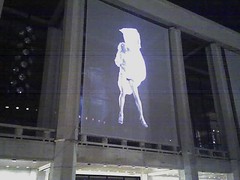
Was wrong; they are not alternating sequence of dancers – they should; would be far more interesting! I am really enjoying this drag queen guy, Glen Rumsey, or “Shasta Cola.”
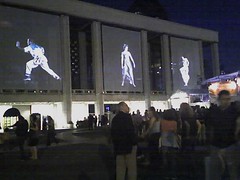
Originally uploaded by swan lake samba girl via mobile.
Tonight they started on time – 9 pm. Are also alternating sequence of dancers for variety and surprise, tango music of midsummer night swing better accompaniment than last night’s swing.
Originally uploaded by swan lake samba girl via mobile.
It’s way too late… 12:30 a.m. to be exact. Michalek has finally emerged from his cubbyhole and is watching with the crowd. I guess not everyone in New York City Ballet is up in Saratoga for their summer season right now… Janie Taylor, Sebastien Marcovici, and Wendy Whelan are all here.
Originally uploaded by swan lake samba girl via mobile.
A favorite choreographer / dancer of mine on the far right screen.

Originally uploaded by swan lake samba girl via mobile.
Doug chatting with Tony. It’s nearly 10:00 p.m. Where is Michalek?!