Maira Kalman at the Jewish Museum

Last week my friend, Alyssa, who’s an independent art curator, invited me to an art / law celebration at the Jewish Museum. The Jewish Museum really knows how to put on a party! They had the most splendid array of hors d’oeuvres, two big carving and sushi stations, and a full bar (not just wine and champagne). I hadn’t been to the Jewish Museum since I saw a Marc Chagall exhibit there I don’t know how many years ago. So, in between nibbling on mini Tuscan pizzettes and sipping Glenmorangie, I wandered into the main exhibit, which is currently featuring the work of Maira Kalman.

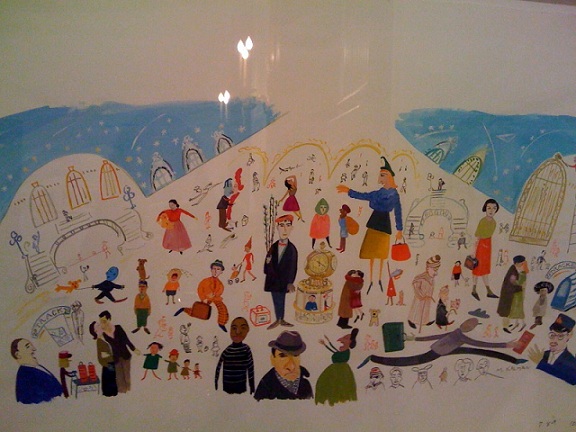
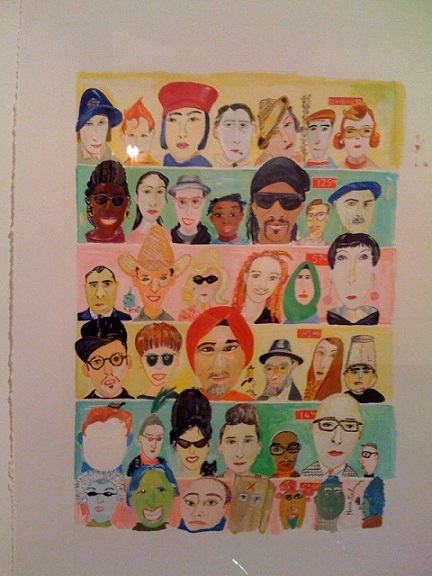
Kalman’s mainly a painter and illustrator but is also an essayist and performance artist; kind of an artist at large. She illustrates a lot for the New Yorker. The top picture is from an illustration from that mag.

I really love this one, though. It’s called Grand Central Station. I love it because it evokes the kind of sentiment I was going for in the closing line of Swallow (which I’m not giving away 🙂 )

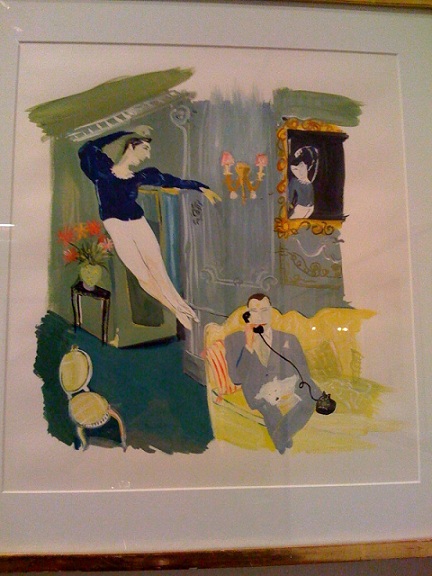
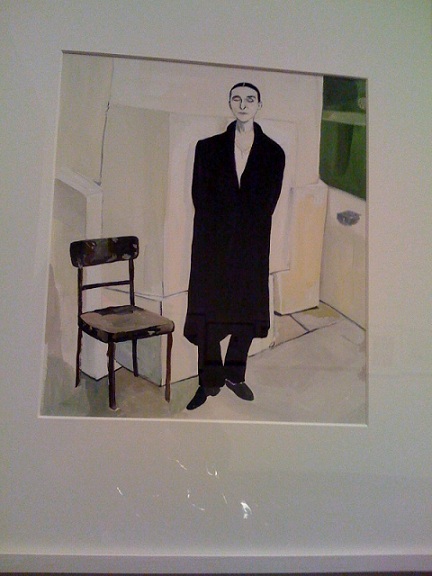
Then I came across a couple of illustrations of dancers, which of course excited me.

I don’t know who the dancer in the first illustration is, but the bottom is of Pina Bausch. The little explanatory caption below the illustration said that Kalman had a deep admiration for Bausch, got along well with her, and, before Bausch’s death, had wanted to collaborate with her on a dance.

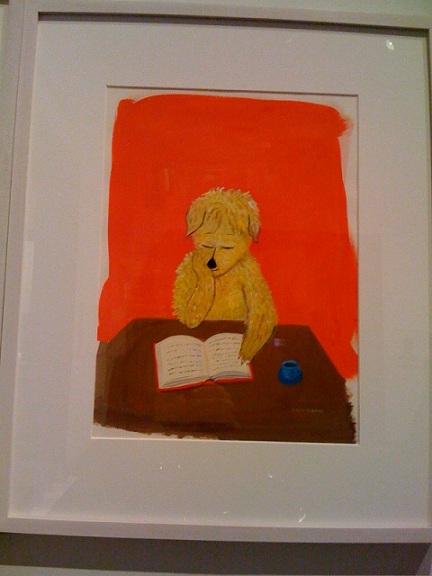
As I walked through the exhibit, I happened upon a couple of sets of videos. In one Kalman, who seems to be quite a character, was collaborating on a performance piece with Nico Muhly and an opera star (whose name I forgot). Muhly was his usual slightly whacked self. Fun! Kalman’s also been involved in a lot of social projects, such as helping to design and create art work for a new library in Harlem. And, much of her work features her dog (below).

Hehe, I was so excited when I saw this. I actually have this picture, clipped from a old New Yorker copy, hanging above one of my bookcases at home. That’ll teach me to look at the name of the illustrator more often!

Anyway, it’s a very good exhibit, and I recommend it. It’s at the Jewish Museum through the end of July.

ABT OPENING NIGHT GALA FALL 2009: THREE PREMIERES IN BLACK AND WHITE, AND WOOD


Photo of Veronika Part in The Dying Swan, taken from Vogue; photos of the three premieres coming as soon as I receive them.

After ABT‘s fall season opening night gala performance last night, the really wonderful James Wolcott and Laura Jacobs took friend Siobhan and me out for dinner at Shun Lee (I’d never been there — but wow, excellent excellent food!) and when Laura asked me if I was going to write about the performance, I kind of rolled my eyes and said, “I’ll try!” We all agreed that dance is absolutely the hardest art form to review, especially on seeing a dance for the first time. Let alone THREE dances seen for the first time. With visual art you can stand there all day and examine at it, with music you have recordings and scores, film critics generally see a movie several times before writing a review. With dance you have one chance — often one split mili-second — to remember a half an hour or so of movement, images, patterns, structure, costumes, music, lighting — everything. It’s impossible. Since starting this blog I have so much more respect for dance critics.

Anyway, there were three premieres last night: Seven Sonatas by Alexei Ratmansky, One of Three by Aszure Barton, and Everything Doesn’t Happen at Once by Benjamin Millepied. Also on the bill was a performance by Veronika Part of Fokine’s The Dying Swan. ABT performed, for the first time, in Lincoln Center’s Avery Fisher Hall, a concert hall not accustomed to housing dance performances. (ABT usually holds its fall season in City Center, but changed venues because of City Center’s renovation plans.)

I’m going to be seeing each premiere a couple more times this season and prefer to write after I’ve seen each more than once. But since the season is so short (it ends October 10, this Saturday), I’ll write something up front. These are only first impressions though, and I’ve found I see so many more things with repeated viewings.

Honestly, everything kind of blended together for me. Part of this was because of the sparseness of the Avery Fisher stage — there were no sets, no wings, no curtains — so dancers warmed up onstage before us, giving each piece a kind of Cabaret-like feel; and part of it was because costumes for each piece were all black and white. I remember lots of black, lots of white and the hardwood of that stage.

1) Ratmansky’s Seven Sonatas was performed to Domenico Scarlatti music by three male-female couples: David Hallberg and Julie Kent, Herman Cornejo and Xiomara Reyes, and Gennadi Saveliev and Stella Abrera. Costumes were all white — flowing dresses for the women, classical tights and 18th-Century tops for the men. The movement was a combination of classical and modern and, though the ballet was generally story-less, each couple seemed to have a little narrative: Cornejo and Reyes were the young, playful couple, Herman full of high jumps with many beats of the feet that really wowed the crowd and Xiomara dizzying rapid multiple turns. At one point Herman did this crazy turn in the air, landed on his back, and caught her. Crowd went wild.

Abrera and Saveliev seemed to be a more mature couple, perhaps in mourning. It seemed Abrera was a woman, possibly a mother, who’d lost a child or something — Saveliev seemed to be trying to console her and keep her from self-destructing. It seemed like she kept trying to break free of him and reach out to some invisible thing.

I’m not sure what Hallberg and Kent were meant to represent except maybe a modern couple — they seemed to have the most modern movement. David appeared to be trapped in a box and he kept pushing out; he had a lot of quick movement with fast stops in different directions and a lot of it in parallel — not turned-out — position. Julie had a lot of sharp, staccato movement. They could’ve also been a courting couple: at one point, David was on one knee and he invited Julie to run at him and jump on him. When she did, he took her into this lovely lift. It’s sweet and many in the audience lightly laughed.

The ballet was broken into duets and solos and bookended by two ensemble movements, the first pretty and lyrical, the latter more chaotic as they all perform their very different movement motifs at once, some trying on others’ movement styles — everyone does the staccato arm patterns for a while, etc. At the end, the women lay on the floor and the men wrapped their bodies over them.

One other thing: our David Hallberg is sporting longish hair these days 🙂 I think it looks good, and fun for a change! Funny thing is, he’s so beautiful and glamorous, I tend to get jealous if him, even though he’s a man… which I guess should be kind of odd…

2) Barton’s One of Three was set to Maurice Ravel’s Violin Sonata in G and danced by a whole slew of tuxedoed men, and three women — Gillian Murphy, Misty Copeland, and Paloma Herrera. Why is it that women choreographers tend to use men so much more! (And female dance-writers tend to focus on male dancers 🙂 — is this feminist?)

Anyway, the piece begins with Cory Stearns walking out dressed in a tux and black jazz shoes. He does a little solo and his movements are all modern, angular, which contrasted in an intriguing way with the tux. I don’t know if it was his being a bit weirded out by the curtainless stage (which forced him to walk out in the dark with all of us watching) or whether it was part of the character, but he seemed to have this loopy smile in the beginning, that was really rather endearing. I chatted with a friend during intermission and she felt just the same.

Anyway, soon Cory was joined by more tuxedoed men, and then by Gillian, who came prancing out in a long white cocktail gown with her radiant red hair tied back into a sleek twist. The men would kind of veer toward her, sideways, their bodies leading their heads in, to me, a rather amusing way. Gillian’s character was very haughty, very glam and posh and she acted like she was ordering the men around with her little finger. The men often seemed led by their bodies, moving first with the back, or at times one leg would take a step, the rest of the body reluctant to follow (I noticed that most with Jared Matthews, who I thought was dancing at his best last night). I found this a very interesting movement motif.

Misty Copeland was the lead character in the second movement. She wore a short black and white dress, her costume and character more flirty and wild. But same thing — she seemed to kind of taunt her tuxedoed men.

And third movement was led by Paloma, wearing a black lacey top and black pants. She smiled a lot more than Misty and Gillian, but she seemed to move in a slinky, sexually-empowered way, like a tanguera.

Now that I think about it, though there were many more men here, the women seemed to have all the power. Fun!

3) Next on was Part’s Dying Swan, which was really poignant, as I knew it would be. It’s a very short piece, but it’s funny how the ballerina can really do it however she wants to; I just saw Diana Vishneva perform this in the Fall For Dance Festival and her Dying Swan was very different. Whereas Diana spent most of the time on her toes, bourreeing, Veronika spent more time on the floor, one leg stretched out before her (like in above picture), then rising again to her toes for one more breath. Diana’s swan seemed to flutter about more, like she was fighting death, she lay down only at the very end. Veronika kept holding her arms up in front of her, her wrists bent and her hands cupped over, as if to foreshadow what would happen to her body. In general, Veronika’s swan accepted and approached death more gracefully or willingly, but Diana’s, with that broad wingspan, at times really looked strikingly birdlike. I don’t know if I can say I liked one interpretation better than the other — both were breathtaking and both very poignant.

Did anyone else see both swans?

4) And the program ended with Millepied’s Everything Doesn’t Happen at Once, set to David Lang music that was at times mellifluous and at times cacophonous or eerie. He used a large group of dancers but Marcelo Gomes, Isabella Boylston and Daniil Simkin had the main parts and so stood out the most (and Kristi Boone shone in a smaller role).

There was a lot going on here — both in the music and in the dance, and I felt that, unlike with Millepied’s earlier piece for ABT — From Here on Out — composed to music by Nico Muhly (who was in the audience) — in this one the movement kept up, didn’t let the music outshine it. The stage is set up to resemble — at least to me — a pool. Dancers would gather around it and watch the people dancing in the lit-up center. At the beginning there seemed to be a swimming motif, with large, rounded arm movements resembling breaststrokes. Movement is also evocative of birds as well though, and some of the same lifts were present as in Millepied’s recent work for NYCB, where the women are perched on the men’s shoulders, their arms outstretched sideways.

In the middle part, Marcelo and Isabella have a rather haunting solo. The ballet is generally story-less but as far as I could make out any narrative, it appeared she was sort of struggling against him. He seemed very careful and gentle with her (in sharp contrast to a later, more hostile duet he has with the super-strong Kristi Boone, who seemed to be either Isabella’s competitor or her double), but she — Isabella — nevertheless kept trying to push away from Marcelo as he held her. The duet ends with them walking toward the back of the stage holding hands, connected, but her body is lunging as far as possible away from his. A rather warped relationship.

Then there’s a rather amusing section where bravura dancer Daniil Simkin is struggling with a bunch of women. He tries to break free of them but then he keeps throwing himself into their arms, making them catch him in these rather breathtaking group lifts — one of them ending in a perfect split in the air. And he has a bunch of crazy multiple pirouettes that had the audience audibly gasping. It all went with his character though, who seemed rather crazed, like he may have just escaped from an asylum or something. I kept wondering who else was ever going to be able to perform that role…

I didn’t go to the gala party but in addition to Muhly, I saw Alessandra Ferri in the audience, one of the Billy Elliots, and apparently Natalie Portman was there.

Anyway, I’ll write more at the end of the season, when I’ve seen these new dances a few more times. Here is Haglund’s review.

I NEED MORE CHAOS!

p6022193

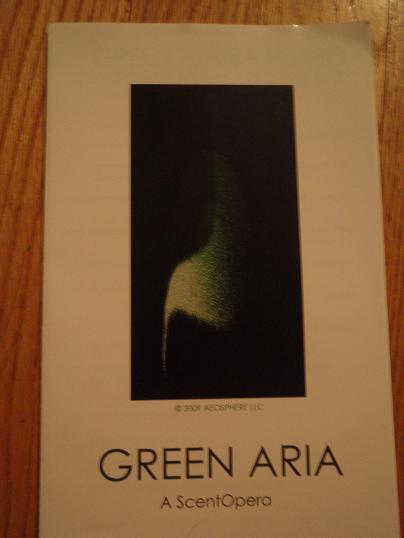
On Monday afternoon, I went to this novel opera, Green Aria: A Scent Opera, at the Guggenheim. It was their last Works & Process program of the season. Going in, I had no idea what to expect, knowing only that there was no singing, only scents (by Christophe Laudamiel) and music (by Valgeir Sigurdsson and that fabulously crazy Nico Muhly) and that the opera’s characters were various smells. It was really so interesting and I wish they would expand it (this one is only half an hour long) and show it in more venues so that more people could see it.

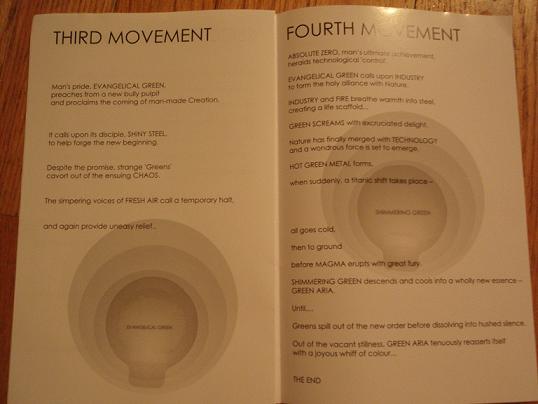
The basic story (by Stewart Matthew) is: nature is corrupted by industrialism and technology must find a way to save it, to create new fresh air. The five basic elements (Earth, Air, Fire, Water, and Base Metal) are the core characters, with other characters named things like Funky Green Impostor, Green Metal, Evangelical Green, Screaming Green, Shimmering Green, Chaos, Absolute Zero, etc. Here’s a full list of the Dramatis Personae from the back of the little Playbill they made:

p6022197

In the auditorium they set up little tubes (which looked like microphones) at each seat. You could adjust your tube, but they blasted in enough scented air that you really didn’t need to be sitting too close to it. They told us to breathe normally, not to sniff like a police dog (which of course most of us were inclined to do anyway). The tubes at each seat were necessary, Laudamiel told us, because if scented air was just blown into the auditorium in whole, it could take up to 50 seconds for the scents to spread to everyone. It would be impossible then to coordinate the scents with the music, or for everyone to have the same experience at the same time.

p6012187

p6012183

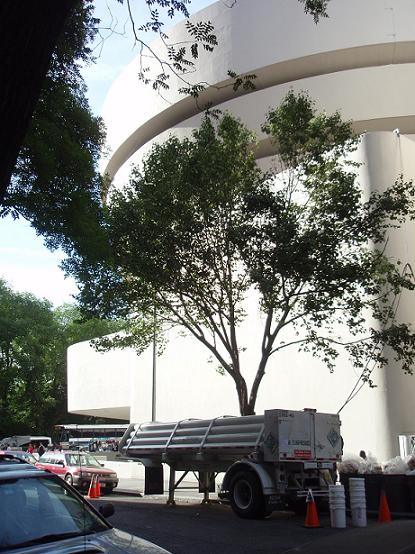
The scents were “stored” in this gigantic compression tank parked outside of the Guggenheim.

I thought since I have chronic sinus issues and a deviated septum and all, I might not get the same effect as everyone else, but it wasn’t a problem for me at all. Laudamiel’s scents (he’s worked as a perfumer for Ralph Lauren and other designers) were all very strong. They were mainly earthy because of the nature of the opera: Earth smelled like freshly mowed grass, Green Aria was like a dewy field, Evangelical Green was like grass mixed with sweet perfume, Shimmering Green yet sweeter. The sweetness and the grassiness didn’t always mix well, I think intentionally — Evangelical and Shimmering Greens were meant to be overly preachy, a surfeit, an excess, not authentic.

And you’d think the way people perceive smell would be subjective, but I think everyone pretty much despised / was horrified by Funky Green Impostor, who smelled very gassy, very foul, like gas combined with rotten eggs. Others I disliked were Fire, who smelled like 9/11 to me and Shiny Steel, who smelled very metallic but with a sweetness that just didn’t mix right.

By far my favorite somehow (besides simple Earth, and Green Aria) was Chaos. Chaos, according to the Playbill, was supposed to create “strange greens” which would  make Chaos seem bad. But Chaos was not the least bit foul-smelling to me! To me Chaos smelled like tropical fruit punch, or bubble gum. It was the only non-earthy scent. The Playbills they gave us had various sample scents, but Chaos was not there! I want my Chaos!

p6022195

p6022196

I’d said earlier that Muhly was the ideal composer for scent, but now that I’m remembing the whole opera, I’m realizing that that music, those sounds, were a large part of how I interpreted the scents. You knew when Funky Green Impostor was on his way by the sounding of harsh notes — at first faint, like he was just approaching — and then you knew when you’d be hit with some very threatening whiffs by the swelling of those chords. And you also knew when sweet, sunshine-y scents would be on their way when the music became mellifluous and Mozart-like. There’d be a fight, you’d smell the characters duking it out, the scents all mixed but at various points one or another rising above the rest — stinky, then perfume-like, then the freshly mowed grass, more sweet surfeit, etc. — and you knew when good had triumphed when it sounded like the end of a Tchaikovsky ballet followed by the dewy fields. I honestly never realized how strong my auditory senses were, what powerful effect sound could have, until I heard Muhly’s work.

Read Anthony Tommasini’s NYTimes review for far better descriptions of the music than I can provide 🙂

This was a fascinating experience, what I live in NY for.

DAY OF THE UNEXPECTED: AN OPERA WHOSE CHARACTERS ARE SMELLS & A TUDOR-ESQUE STORY BALLET BY RATMANSKY


I had a crazy day. This afternoon I went to the Guggenheim to see this new ScentOpera — an opera told entirely through music and smell (each seat had a little microphone that blew the scents into your face) — which I’ll write about soon. Suffice it to say it was very interesting and I think Nico Muhly has found his niche: composing for smell — because, unlike with dance, his music most definitely did not overpower these whiffs at all, at least not as created by perfumier Christophe Laudamiel. I nearly passed out from “Funky Green Impostor.”

Anyway, more about that soon.

Tonight was the premiere of ABT‘s new resident artist Alexei Ratmansky’s first ballet for the company — a night for which many have been waiting ever so eagerly. For those not up on the ballet-world gossip: Mr. Ratmansky (from the Ukraine, and former artistic director of the Bolshoi) initially was rumored to be contemplating taking the resident choreographer position at NYCB. Then he didn’t and everyone was depressed because Christopher Wheeldon was leaving to start his own company and everyone really liked Ratmansky and wanted to see more of his work stateside. Then, next thing everyone hears is that he’s accepted the same from ABT, making everyone happy but confused — NYCB is known for being more daring and contemporary in its repertoire; ABT sticks more to the traditional classical story ballets. Ratmansky,who was leaving the Bolshoi because he wanted more of a challenge (the Bolshoi’s rep is akin to ABT’s), seemed a better fit for NYCB.

Anyway, I was expecting tonight something along the lines of Concerto DSCH or something he’s done for NYCB (which is all that I’ve seen by him): a contemporary Balanchine-esque ballet without a linear narrative but with a discernible theme and with original, clever, thought-provoking choreography. Instead, On the Dnieper (the Dnieper is a river in the Ukraine), set to Prokofiev’s music of the same name, is a story ballet that I found to be about three parts Tudor, one part Robbins (with some of the fight scenes).

It’s the story of Sergei (danced by Marcelo Gomes), a young soldier who returns home, after war, to his fiance Natalia (Veronika Part), only to realize he no longer loves her but is attracted to Olga (Paloma Herrera), a flighty, flirtatious local girl who is betrothed to another man (David Hallberg). After a brief encounter, Olga falls for Sergei and begins to doubt her love for her fiance. One evening at a party, Olga dances with her fiance and Sergei becomes jealous and challenges the fiance to a fight. Sergei is felled, and Natalia rescues him — picks him up, cleans him off. But soon Olga is back. Natalia, after trying desperately and unsuccessfully to win Sergei back, heartbroken, does what she knows she must for the man she loves — helps him escape with Olga.

It reminded me of Antony Tudor because there’s a lot of drama — albeit without all the heavy psychology — a lot of hurt, wounded tragic characters with broken dreams, unrequited love, painful sadness that just reverberates through the whole auditorium. And the characters each seem to have a way of moving unique to them: Marcelo’s Sergei jumps back and forth a lot with lots of beats of the feet — as if he can’t decide whom to choose, what to do, as if he’s torn.

David Hallberg’s fiance is rather borderline psychopathic, highly impassioned (to make an understatement) but almost frighteningly controlling of Paloma’s Olga. After the way David had described his character on the Winger, I was expecting a reprisal of his “friend” in Tudor’s Pillar of Fire or his R&J Paris – -vulnerable and hurt but proud and trying to bear his pain noblely in a way that made me want Juliet to leave Romeo for him. That’s not what we got at all! Our first viewing of him is slicing madly through the air at Paloma and her friends as if to say, stop everything, I’m here. Besides the jumps and aggressive arms, he has a lot of crazy fast footwork throughout. At one point, when his jealousy is getting the better of him, he starts shuffling his feet so fast, he actually looks down at them, stunned, like he really can’t control them. A way out-of-control Fred Astaire.

Paloma is all about the fickle, flirtatious girlish jumps. And Veronika is more adagio, and she keeps extending her arms both to one side, then laying her head on that shoulder as if an expression of her loyalty and devotion to Sergei. Later, when she realizes he’s drawn to another woman, this movement looks more like a prayer that he’ll return to her. Veronika is heartbreaking and she’s the emotional centerpiece to the ballet. You really want to cry for her at the end.

I think it’s a good ballet — a little slow in places, but generally compelling and with meaningful movement that echos the characters’ desires and actions. It just surprised me that it wasn’t what I’m used to from him. I think after seeing so much NYCB, I’m becoming so enamored of Balanchine and non-narrative contemporary rep of the kind he’s done on that company. I hope that not all of the work he’ll do for ABT will be story ballets. I hope he will do some Concerto  DSCH and Russian Seasons and Dreams of Japan-like ballets for ABT as well. ABT’s dancers are so brilliant; it’s fascinating watching what they can do with those kinds of movement-heavy, dramatically open-ended kinds of dances.

Also on the program — which I’ll write more about after seeing the other casts — were Balanchine’s Prodigal Son (danced tonight by Herman Cornejo, replacing Ethan Stiefel, who’s still out with an injury), and James Kudelka’s Desir. Desir is about several different relationships — mostly couples — about sexual angst, romance, fighting, etc. I liked parts of it but not all (I’ll write more about it after more viewings), but what really floored me was a beautifully romantic pas de deux with sweeping lift after sweeping lift performed by Cory Stearns and Isabella Boylston. I’ve never really seen Isabella before and Cory I have but not much, and he’s definitely never stood out as much as he did tonight. Those lifts looked hard and he didn’t tire one bit. He was the ideal strong male partner, showing her off, making her look beautiful, giving her such gorgeous height, sweeping her up through the air, without being the least bit show-off-y himself. He was all about her and they both shone. They were breathtaking. And I’m definitely not the only one who thought so. The audience went wild with applause when they took their bows. They got even more applause than Gillian Murphy and Blaine Hoven! (who were excellent as the angst-ridden couple who eventually gets it together in the end). I’m glad Kevin McKenzie gives young dancers these kinds of chances to stand out.

More soon on the rest of the ballets, and hopefully some pictures as well.

TWO WORLD PREMIERES — QUASI UNA FANTASIA AND TOCCATA — AT NEW YORK CITY BALLET GALA


Last night I went to New York City Ballet’s Spring season gala. I always love galas but they’re especially exciting when they showcase world premiere dances. In this case, there were two such premieres, along with the world premiere of a new piece of music set to one of the ballets.

First things first: I missed most of the red carpet events, unfortunately, since the program began early (so as to make time for the after-show dinner, which I am far too poor to attend). And shame on me for mismanaging time like that — that Waiting For Godot experience from two years ago was too much fun. I did get there just in time to see the paparazzi flashing away at (Sex & the City author) Candace Bushnell and (NYCB principal) Charles Askegard. Sweet Charles soon stepped aside to let his wife bask in the glory all on her own. She looked radiant. I was jealous.

Continue reading “TWO WORLD PREMIERES — QUASI UNA FANTASIA AND TOCCATA — AT NEW YORK CITY BALLET GALA”