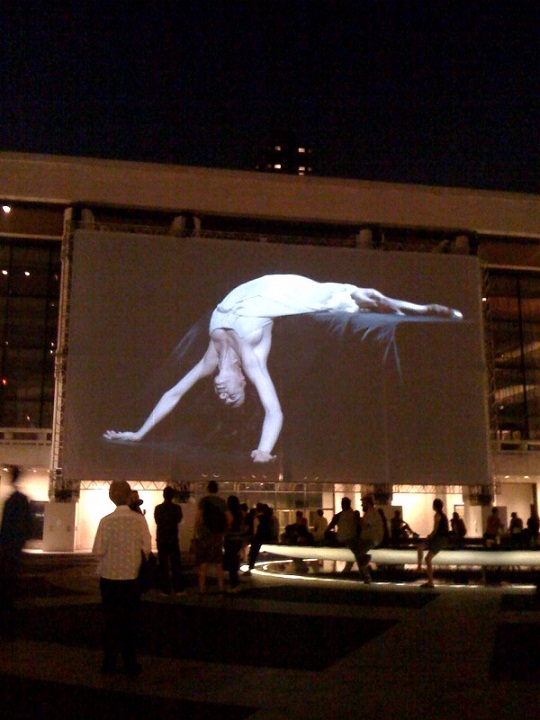
PORTRAITS IN DRAMATIC TIME on Lincoln Center Plaza

Here are some photos I took of David Michalek’s current installation, Portraits in Dramatic Time, shown nightly on the facade of the Koch Theater at Lincoln Center Plaza. Above is (SLSG favorite) ballerina Alessandra Ferri, apparently in the ending scene from Romeo and Juliet. Commissioned for the Lincoln Center Festival, Portraits is similar to Michalek’s earlier installation from a few summers ago, Slow Dancing, which I wrote about here.
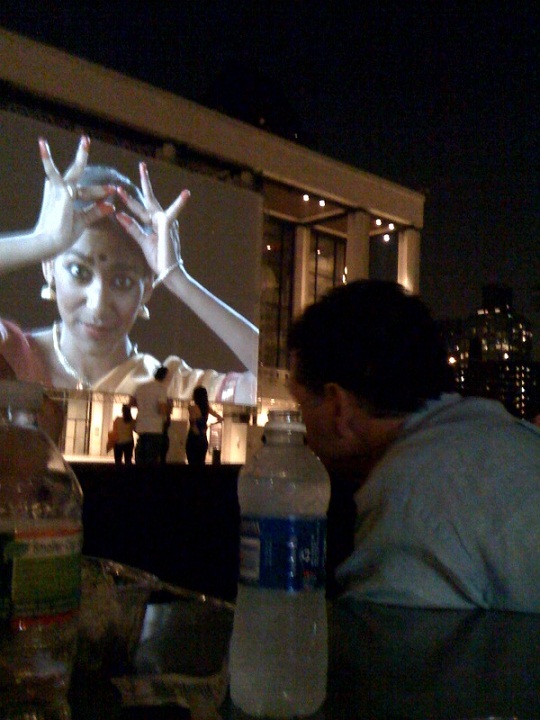
Unlike Slow Dancing, the only two dancers (at least that I’ve seen) in Portraits are Ferri and classical Indian dancer, Savitry Nair, above. To me, Nair was the most mesmerizing, I think because of the intricate (and to me exotic) movements she was making with her hands, but also because of the intensity of her eyes. Patti Lupone (below) was a close second.
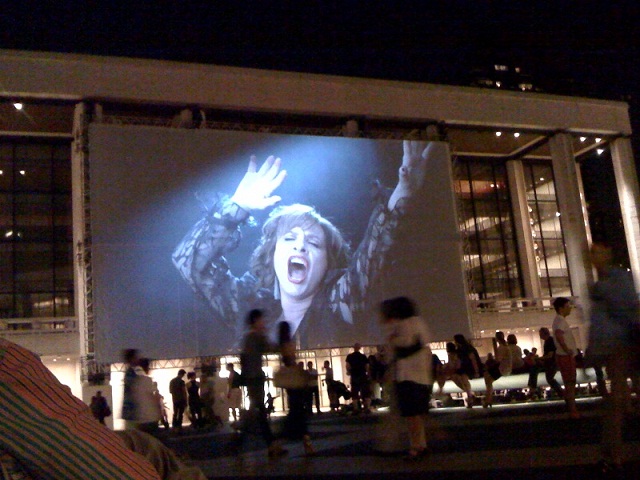
Besides the two dancers and one diva, the others seemed to be all theater actors. Like, Slow Dancing, Michalek filmed the actors in a short scene, then slowed the movement way way down for greater dramatic effect. At least that was the intent. I’ve only watched a couple times, and plan to go more, but, as with Slow Dancing, I have mixed feelings. I think Portraits may be able to attract a larger audience than Slow Dancing due to the greater fame of the stars filmed, and Michalek did for the most part choose dramatic scenes, such as the one below of Alan Rickman throwing a glass of water in anger.
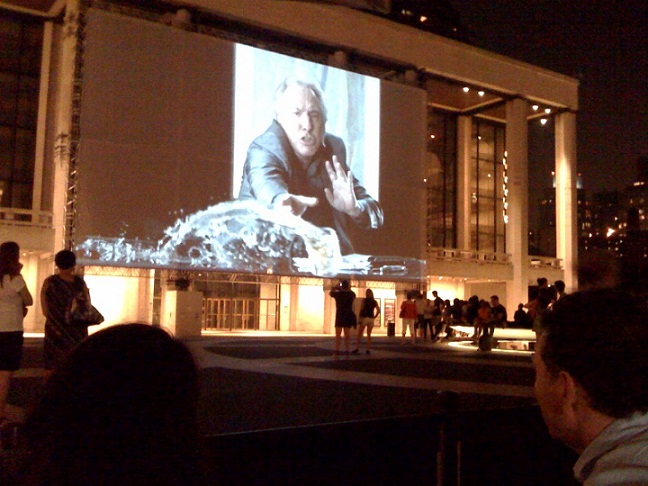
Not all of the scenes are quite as action-packed. You’re often looking more at the intricate changes in facial muscles as the actors go from one emotion to the next. I felt like watching Marianne Jean-Baptiste read a letter and Lili Taylor converse with her daughter provided real lessons in acting.

But in other scenes, even if there was some kind of drama, I didn’t always understand what it was about, or the characters’ relation to one another, and consequently I failed to be as captivated by the mini narrative as I would have liked.
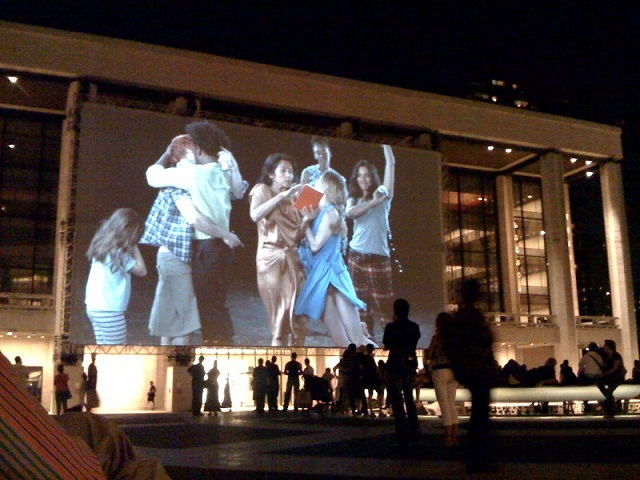
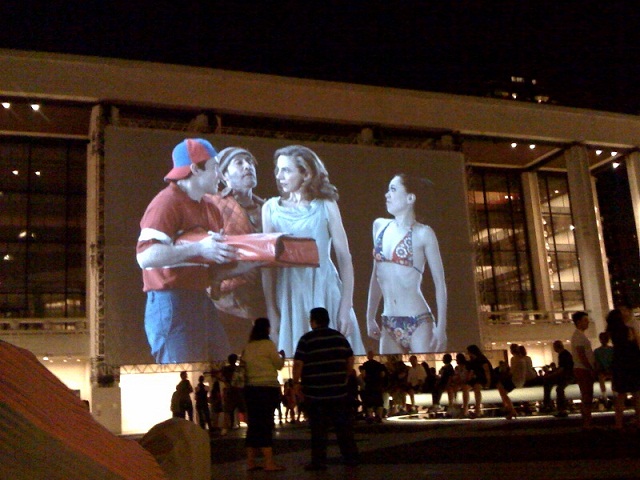
Watching and listening to others on the Plaza, I felt like I wasn’t alone in that thought. The big screen captures your attention but oftentimes fails to keep it. Of course I really wanted to shout at people who were only glancing at Alessandra before passing!

I said this with Slow Dancing, and I’m pretty sure these films are moving faster than the original Dancing films, but I still think they’re going just a bit too slowly. It would also provide variety to rotate more between performer-types – like dancer, actor, diva, dancer, actor diva, etc. But as I said, I saw mostly actors here. I also noticed, though, that there are many performers listed on the show’s website that I didn’t see, and I’ve gone on two different nights so far and have seen many repeats, so I don’t know if all of the listed performers are appearing right now…

Anyway, imperfections aside, it’s always wonderful to have something to go to Lincoln Center for and now that ballet season is over, it can be depressing around there. So I’m very thankful for this installation. Perfect for summertime, sitting near the fountain or at the little cafe in front of Avery Fisher Hall, sipping wine or eating Gelato. This is the best part of living in NYC, imo.

Portraits shows nightly through the end of July. For more info, go here and here.
NYCB Spring Gala with SEVEN DEADLY SINS Premiere

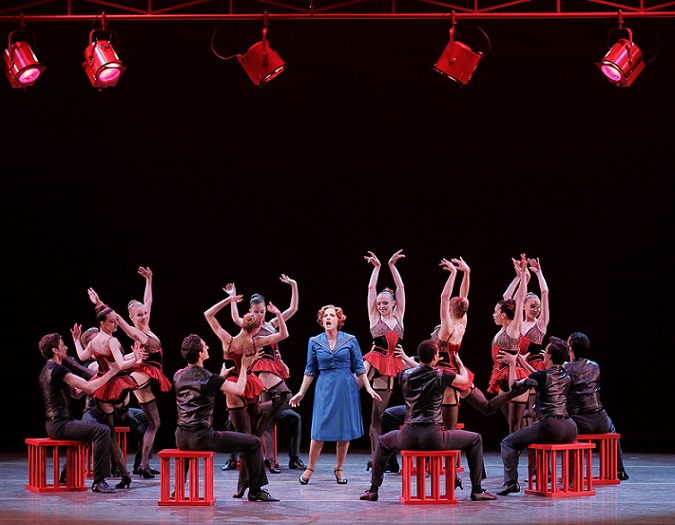
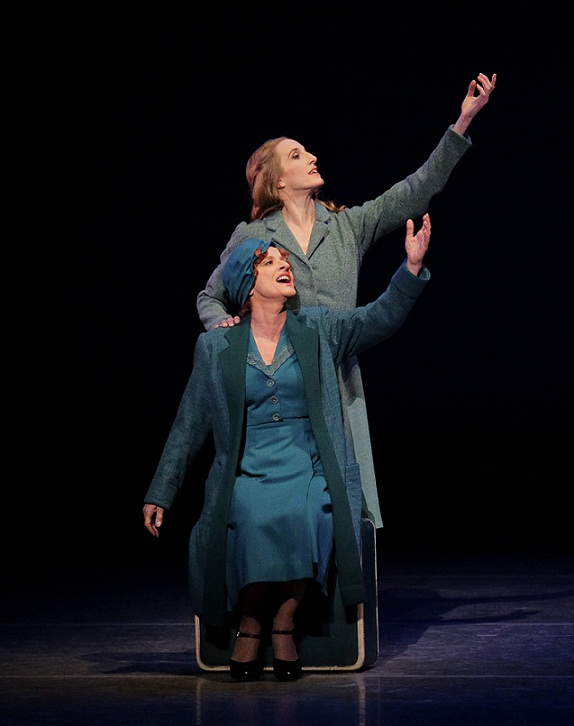
Here are some photos, all by Paul Kolnik, of Lynne Taylor-Corbett’s play-ballet, The Seven Deadly Sins, which premiered last night at New York City Ballet’s Spring gala performance. Above is Patti LuPone, who guest-starred with the company (performing the singing role of course!) and Wendy Whelan, who danced the lead. The top photo is from the “Prologue” of the play-ballet (or ballet chante as the program calls it).

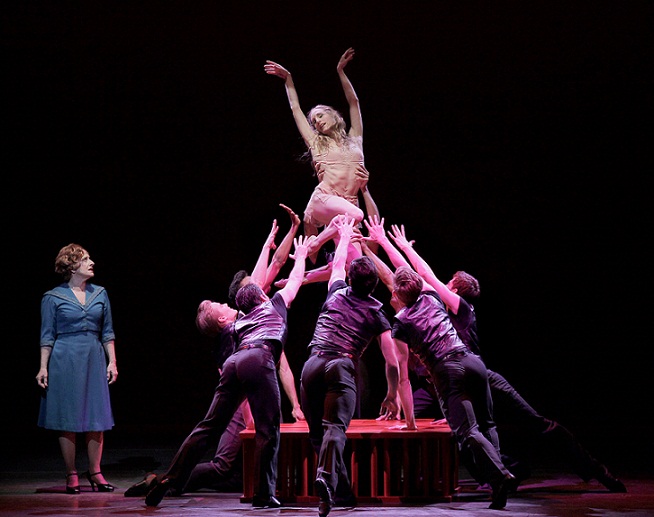
This is from the second part: “Pride”: Patti LuPone and cabaret dancer ensemble.

Also from “Pride.” Wendy Whelan is in the middle.

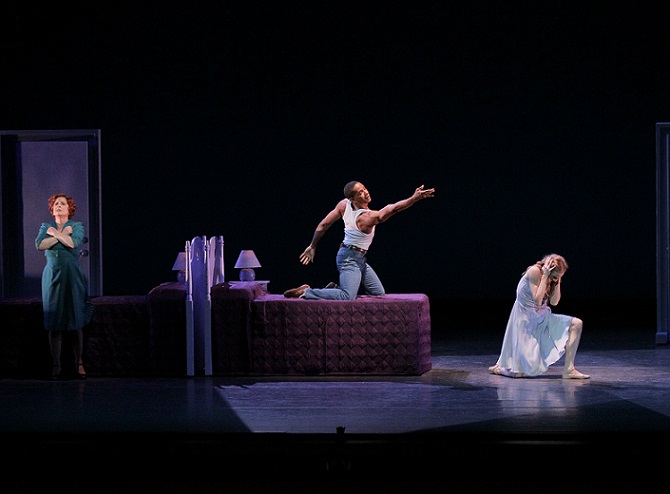
And this is from sixth part, “Lust,” probably my favorite over all. Craig Hall and Wendy Whelan are the dancers in the photo. Craig Hall and Sara Mearns (who danced the role of “Latina Diva” in the “Anger” section, and who I don’t have a picture of unfortunately), most stood out to me, as well as Vincent Paradiso as the Count in the “Greed” section. I think those dancers most stood out – at least Mearns and Paradiso – because they seem to have some kind of acting training. Maybe they don’t, maybe they’re just natural actor-types, but the more actor-ly you are, I think the easier this kind of role would be. Wendy Whelan said in an interview with Roslyn Sulcas in the New York Times that she was used to expressing herself with her body and her lines, that she was used to Balanchine’s dictum “don’t act, don’t think, just dance,” and that she found this kind of role challenging. As much of a NYCB star as she is, and as stunning as she is in Wheeldon and Balanchine’s more modern, angular-lined ballets, I just wonder if she was mis-cast for something like this.

Which isn’t to say that she didn’t dance very well last night. She danced a really beautiful pas de deux with Craig Hall, which is what made “Lust” my favorite section. And LuPone sang in a gorgeously powerful voice. The dancing was all superb. But something just didn’t work to me.

Balanchine choreographed the original Seven Deadly Sins, set to libretto and score by Bertolt Brecht and Kurt Weill, in 1933. The Balanchine version was revived in 1958. According to the Times article linked to above, both the original version and revivals received very good reviews. Since the Balanchine version appears to be largely lost now, and Peter Martins wanted to revive the ballet, he commissioned new choreography from Taylor-Corbett.

Maybe it was that the new choreography didn’t really express the story, which follows Anna, a woman whose various life experiences each represent one of the sins. It wasn’t really a full story, but one composed of scenes, each of which dramatized a sin (and LuPone and Whelan portray different aspects of Anna). But, I didn’t feel the scenes always worked well at doing that. For example, in my favorite section, “Lust,” I thought the Hall/Whelan bedroom scene was really beautiful, very romantic, but nothing said lust, as in sinful lust, to me. I almost felt like Whelan’s Anna had a loveless relationship with her husband, danced by Allen Peiffer, and she was really in love with Hall, and her leaving her husband and running into Hall’s arms was an urgently needed escape.

In my other favorite section, “Anger,” Sara Mearns is a kind of sexy, but rather humorously so, Copacabana dancer. She gets angry at Whelan’s Anna for something – I’m not quite sure what – maybe Anna stole her lover or took over Mearns’ role as head diva, drawing too much attention to herself…  Anyway, Mearns twists her face into a look of utter anger, then points at Whelan, who runs off crying and is then stripped down to her underwear by a group of men. But I thought it was done rather cartoonishly. So it was more funny and cute to me than a dramatic representation of the tragic consequences of anger.

In the “Greed” section, a count and a senator vie for something and end up in a duel, both of them getting killed. But it didn’t have any tragedy or pathos to me. Instead, it felt a bit like Balanchine’s Slaughter on Tenth, which made me want to giggle – probably the fact that it was Paradiso playing the role of the Count.

I don’t know. I guess I was expecting something with more tragedy and pathos and weight, and I felt like I saw a version of Slaughter on Tenth but without a through story-line. Maybe that was the intent. I’m going to see it again over the weekend, and maybe my opinion will change.

Did anyone else see it yet? I’m interested to hear what others think. Has anyone seen the Balanchine version?

After intermission,

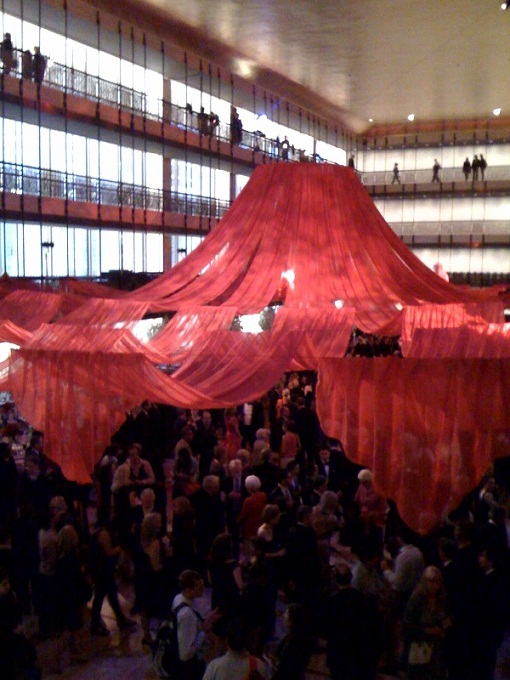
— here’s my photo of the promenade – Balanchine’s Vienna Waltzes was performed beautifully.

Photo by Paul Kolnik.

All of the dancers were very good, but I particularly liked Megan Fairchild and Joaquin DeLuz in the fast-footed, playful scene in the forest, “Fruhlingsstimmen,” and Maria Kowroski and Charles Askegard in the last, beautifully ballroom-y section, “Der Rosenkavalier.”

NYCB Opens its Spring 2011 Season with “Balanchine: Black & White”


Photo from 2004 of Wendy Whelan and Jock Soto in Balanchine’s Agon, by Paul Kolnik.

Last night New York City Ballet opened its Spring season with three Balanchine “leotard” or “black and white” ballets (so-called because of the costumes). I have very little time to write because I’m off for a short trip to Phoenix later today. But I’ll just say, all the dancers looked very refreshed, in tiptop shape, and everyone danced very well and with lots of expression.

First on – and the highlight of the evening to me – was Square Dance, which I haven’t seen a huge number of times but which is really growing on me. The leads were Megan Fairchild and Anthony Huxley, who is really growing on me as well. He reminds me a bit of Alex Wong, except he’s more lyrical and it’s a little less about the stunning feats with him, though he is a very good dancer and I’m sure can do the stunning feats! His difficult-looking often flexed-footed solo was mesmerizing. He was even mesmerizing when he just stood off-center and watched Fairchild do her solo, the way he’d look at her, at times longingly, at times in awe. Megan danced with a lot of joy as well – all dancers were very emotionally compelling in this. And I’m not the only one who thought so – the audience really went crazy with applause after this dance.


Next on was Agon. The main couples were Wendy Whelan and Sebastien Marcovici, Teresa Reichlen and Andrew Veyette, Ashley Laracey and Amar Ramasar, and Amanda Hankes and Craig Hall. Andrew Veyette (above, photo by Paul Kolnik) really stood out to me in this. I think he is well-suited to all the angular lines so pronounced in these leotard ballets. Wendy Whelan and Sebastien Marcovici had a couple very minor flubs. During intermission, the little group of balletomanes I hang out with were reminiscing about how stunning she was when she used to dance this part with Jock Soto (which is why I posted the top picture). I really wish I could have seen that. It looks stunning from the picture.

The evening ended with Stravinsky Violin Concerto; leads were Maria Kowroski and Amar Ramasar, and Sterling Hyltin and Ask LaCour.  I always like this ballet and I always look for my favorite part – where, in the third section, Aria II, the man stands over the woman and turns her around and around, like a barrel. I think I’ve seen Robert Fairchild do it only once, but it was the first time I ever saw the ballet and now, to me, he owns that role and no one can do it like him. I thought of that when my intermission friends were reminiscing about their favorite dancers from the past and how differently they looked doing these black and white ballets – how much more precision there used to be – and it’s funny because Robert Fairchild is obviously not the first dancer to dance my favorite part but he’ll always define it to me. The first dancer, or the first set of dancers, that you see in a role or a dance will definitely leave an indelible impression. But someday I still very much would like to see the original Balanchine dancers in these ballets.

Anyway, this was opening night, but there was no red carpet since NYCB has their gala next week, on Wednesday – when the Patti LuPone collaboration will premiere!

Okay, I’m off to the land of lizards and gila monsters and sun and 99-degree temperatures! Assuming I’m able to finish packing…

PATTI LUPONE WILL MAKE NEW YORK CITY BALLET DEBUT NEXT YEAR


According to Playbill, Broadway legend Patti LuPone will make her NYCB debut next year, in the company’s Spring 2011 season. She’ll act in a new production, by Lynne Taylor-Corbett, of The Seven Deadly Sins, a Kurt Weill ballet with libretto by Bertolt Brecht. Balanchine choreographed the original version of that ballet, which is about a character depicted both by an actress and a dancer.

I’ve never seen the ballet but I love LuPone. Something definitely to look forward to. For a little more about the history of that ballet, see the NYTimes ArtsBeat blog’s post.

Above image of LuPone in Gypsy, taken from PaperMag.