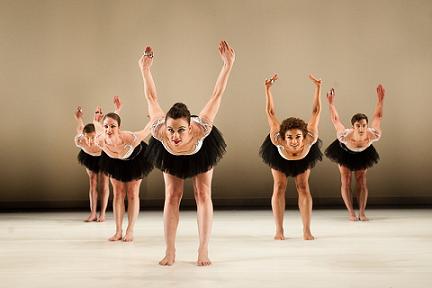
PHOTOS OF DEMA DANCE COMPANY’S FIRST SEASON

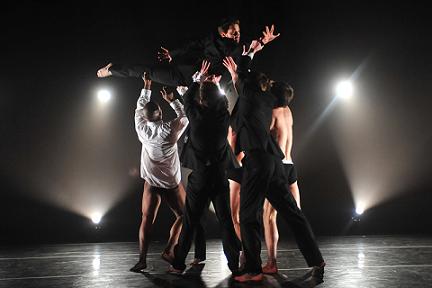
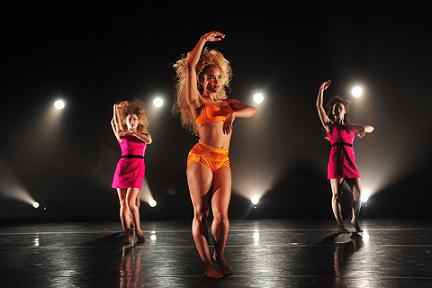
Here are some photos, all by Kim Max, of DeMa Dance Company‘s recent debut season, at the Alvin Ailey Citigroup Theater. There were six dances — three choreographed by the company’s founding sisters — Despina and Matina Simegiatos, and three by visiting choreographers TOKYO + TOKYO the company, Yesid Lopez, and of course So You Think You Can Dance‘s Sonya Tayeh. My favorite piece was Zaloggos, by the Simegiatos sisters, which depicted the true story of a group of Greek women, who, during the Greek Revolution in 1803, trapped by the enemy and refusing to yield to slavery, danced then threw themselves off a cliff. It was harrowing but beautiful and the movement was kind of a combination of Martha Graham and Greek folk dance. Very original, and very meaningful. Like Alvin Ailey’s work, you could tell it came from the heart. (The Simegiatos sisters are Greek-American and they told us at the beginning of the program that DeMa refers both to the beginnings of their first names and to a Greek word that means a parcel holding something very precious). My second favorite piece was When the Love Enters, the Light Shines, by Tayeh, set to Bjork music, and whose central duo was performed by Billy Bell and Jaqlin Medlock.

Anyway, here are the photos:

The first two are from Zaloggos:


These are from the Tayeh piece:


These are from The Feminine, by TOKYO + TOKYO, which was a lyrical dance with upbeat music that seemed to be about a different kind of love and reminded me in places of Matthew Bourne’s Swan Lake:


This is from Laser, by the Simegiatos sisters, a thrilling, very modern piece set to percussive music that was at times slightly unsettling (music by Craig Armstrong) in which the dancers kind of zig-zagged between two red electrical “wires”. DeMa has a very good set of dancers by the way; they’re especially strong with modern movement.


This is from Methods by the Simegiatos sisters, set to Philip Glass music, which consisted of both modern movement and balletic pointe work, and was by turns lyrical and rather intense, almost threatening at times. It was abstract but seemed to be about the group versus the individual.


And these are from the last piece, Yes, I Do, a sweet, funny, at times almost Chaplinesque story of a wedding by Yesid Lopez.


It was a very good program — lots of variety, original movement and themes, and excellent dancing. DeMa is small but I think this is definitely a company to watch for.

NEW YORK CITY BALLET OPENING NIGHT GALA: NAMOUNA AND WHY AM I NOT WHERE YOU ARE


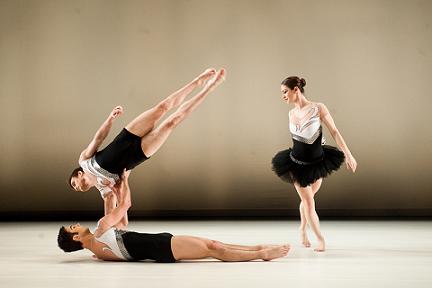
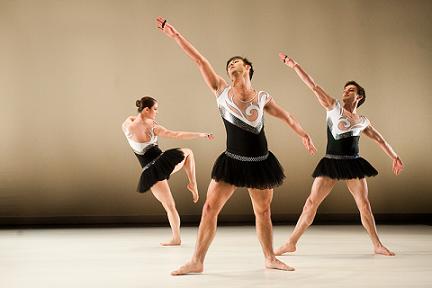
All photos by Paul Kolnik. Top two are of Benjamin Millepied’s new Why am I not where you are, and bottom two are from Alexei Ratmansky’s new Namouna: A Grand Divertissement.


Sorry I’m late with this post — I had serious internet problems over the weekend and they’d better not continue today or I may kill someone from Time Warner. Anyway, Thursday night was the opening night of New York City Ballet’s Spring / Summer season, and there were two world premieres: first Millepied’s Why am I not where you are, followed by Ratmansky’s Namouna, A Grand Divertissement.  I thought both were good and entertaining, if nothing earth shattering. And maybe it’s just that I’m getting to the point where I’ve seen so much ballet but it seems that everything is a combination of several other things, which isn’t bad. Millepied’s kept me more engrossed, only because Ratmansky’s was just too long.

Millepied’s reminded me by turns of Balanchine’s La Valse (which everyone seems to have thought), Robbins’s West Side Story, and even Balanchine’s version of Swan Lake, particularly where Siegfried frantically tries to find Odette through the swarm of swans who run around her in circles, frighteningly, creating a kind of hurricane.  It seemed there were also parts of the White Swan pas de deux between Sara Mearns (who danced gorgeously, as always), and her “love interest” Amar Ramasar. There even seemed thematically to be elements of Angelin Preljocaj.

The main character is Sean Suozzi who, wearing all white, seems to be a lost in time, or a human searching for other earthlings and who runs into this lot of ethereal creatures all dressed in colorful Romantic tutus. But instead of being beautifully beguilingly ethereal, they are more frightening, like aliens. There’s a very modern set by architect Santiago Calatrava (who collaborated with many of the choreographers who are premiering ballets this season and to whom the season is devoted — he was toasted by Peter Martins at the beginning of the evening), that to me gave the sense that someone — either Suozzi or the others — were from another place. Music, by Thierry Escaich, is unsettling as well. Suozzi falls for Kathryn Morgan, but in their initial pas de deux Morgan can’t see him. She seems to be blind to him. But he tries. The group of men do a kind of intense West Side Story dance, and eventually, Suozzi manages successfully to fit in, to become one of them, as is made clear by Ramasar’s giving him several articles of colorful clothing (a la La Valse) to don. Afterward, he dances again with Morgan but now it is he who cannot see her. Soon, the others swarm around her, violently plucking pieces of her tutu off. Eventually she’s the one wearing nothing but white undergarments, and she’s left devastated, alone and alienated. It was intense and enthralling and I definitely want to see it again, perhaps with Janie Taylor in the female lead (she withdrew due to injury).

Ratmansky’s reminded me of a cross between Branislava Nijinksa’s Les Biches and his own Concerto DSCH with elements of Balanchine’s Midsummer Night’s Dream thrown in. It’s harder to describe than the Millepied because there wasn’t much of a through story, just abstract portions combined with smaller stories that didn’t seem to merge into a larger whole. It’s set to really lovely music by Eduoard Lalo, which in places sounded like Glass’s In the Upper Room. I can’t remember the whole thing but Robert Fairchild is this guy dressed in white sailor garb. At one point, he happens upon some women dressed in 1930s beachy-seeming clothes and wearing hair caps and kind of taunting him with their humorously sexy cigarette smoking. Jenifer Ringer did a fabulous job of playing the main cigarette-bearing “taunter.” She’d puff in his face and he’d look enraptured but confused. Later, a group of people run toward him, carrying a passed-out Ringer and one man bows at Fairchild, as if for forgiveness. The other women haughtily puff on at the front of the stage. Everyone laughed. This cigarette girl part was my favorite. Then, there were some bravura parts for Daniel Ulbricht, dressed in kind of Puck-ish Midsummer Night‘s garb and doing the same high jumping, running through the air leaps as Puck. If I can remember correctly he was accompanied by some cutely impish female elfs, in the form of Abi Stafford and Megan Fairchild. There are sections where a lot of women in long yellow dresses do various port de bras and rather humorous (to me anyway) jumps in place a la Concerto DSCH, and toward the end Wendy Whelan emerges and is this kind of bride for Fairchild. They do a pas de deux filled with lots of classical ballet lifts and then they get married and supposedly live happily ever after.

I liked the Ratmansky and would be happy to see it again if it weren’t so blasted long! It felt like it went on for about an hour and a half! Before seeing it, I recommend taking a walk at intermission to stretch your legs, and go to the bathroom!

KEIGWIN + COMPANY'S CAPTIVATING "RUNAWAY"

Here are some photos of Keigwin + Company’s recent season at the Joyce in Chelsea. Above is Larry Keigwin’s absolutely stunning Runaway, which I loved, and below is his Bird Watching, which had its premiere at the start of the season. All photos by Christopher Duggan.

My friend and I were blown away by Runaway. It began with a woman onstage wearing a 60s-style dress and a huge bouffant hairdo, checking herself in a mirror held by two male tecchies. The program had advertised that there was to be a “scene change” between the former piece and this one, and it was soon made clear this “scene change” was part of the performance. As stage guys ripped up the floor matting and the back wall drop and laid new ones, this woman primped and posed in the handheld mirror, while men came onstage dressed in briefs, and began climbing into their black suits.

At one point a half-dressed woman ran across the stage, followed by a half-dressed man, running the other way. It was funny; everyone cracked up.

Then, the lights went down, and as the high-energy music (Jonathan Melville Pratt’s Thirteen) began to pump, several men dressed in suits began to walk quickly  across stage. The woman with the bouffant hairdo began to dance, her body making sharp angular movements. Soon several woman dressed like her joined the men, walking back and forth across the stage.As the music grew faster, the walking became more urgent, at times turning into a run, a sprint even. Then they began walking into the audience, using the aisles like catwalks.

Soon, they were joined by men who were dressed only in black briefs and women in colored underwear and bras, their hairdos also ratted beehives. The stage was aflutter with people walking or running back and forth, some stopping to dance in the middle, mimicking the first woman’s sharp angular movement. Throughout the whole, everyone had these straight-ahead stares, like zombies. Their walks meant business but their stares were vacant. It was like runaways on a runway. Very cool and not a dull moment! My friend, an emerging choreographer, was so inspired!

James Wolcott, equally fascinated and calling Runaway “what Nine should have been”, wrote about the piece here, and Oberon here. And you can see part of the action in their promo video, which I embedded in my earlier post, here.

Bird Watching was interesting though it didn’t sustain my attention the way Runaway did. It was more lyrical, set to classical music (Hayden’s Symphony No. 6 in D Major). I liked but didn’t love it I think mainly because I couldn’t tell the extent to which it was kind of riffing on certain classical motifs and meant as a funny commentary on them, and the extent to which it was meant to be taken seriously and on its own. Everyone — men included — were dressed in white tops and black tutus, and at one point I could see some movement patterns very similar to Swan Lake‘s White Swan pdd — performed by the men. It wasn’t so funny, though, as it was pretty, which was perhaps the point: that anyone can do anything without it being some kind of statement. I feel like I need to see it again though, and concentrate harder!

Also on the program were Mattress Suite, which I really liked. It was comprised of six vignettes, all involving a mattress, each set to different music and danced by a different set of characters. The story was the progress of a relationship: woman (the brilliant Nicole Wolcott) dancing around in her wedding dress elated and excited but slightly apprehensive, man (Keigwin, who, as a dancer, is often very funny, always charming) in his tux looking excited and lustful but a bit worried, then they’re together on the mattress, then they fight and she lifts the mattress erecting it between them like a barrier, she leaves, he has a fling — with two guys — the mattress getting a bit cramped there toward the end, and then she returns and is alone, struggling with her aloneness on the mattress. It’s by turns humorous, cute, sad, bittersweet. What I love about Keigwin is that his choreography is evocative of human behavior without being obvious or unoriginal. His movement is evocative but original and clever, in other words. And there’s plenty of room for the dancers to act their own drama.

And opening was the high-energy Caffeinated, from 2007, set to Philip Glass’s percussive Akhnaten, which I’ve seen before and is always fun.

But Runaway really blew me away. If you ever get the chance to see it, or his Bolero, or his lamentation in honor of Martha Graham, or anything by him really, go! Their Joyce season was short and is now over, but they’re always around.

GONZALO GARCIA IS A ROCK STAR AND JANIE TAYLOR A GRACEFUL MURDERER


Those are my friend, Judy’s terms in the title, by the way! Friday night at New York City Ballet was one of the most exciting in recent memory. The dancers were all excellent, the ballets fun, the audience pumped (okay, a little over-pumped in places!) It was just one of those nights to remember. It was an all-Robbins program, consisting of four of his most diverse, but liveliest dances: Glass Pieces, The Cage, Other Dances, and The Concert.

First, of all, Wendy Whelan appears to be out with a minor injury, so it was announced before curtain rose that Janie Taylor would be dancing the lead in The Cage. If anyone heard some psycho girl shout “Yay!!!” — sorry. Didn’t mean for it to echo like that… 🙂

Glass Pieces is always enjoyable with that rhythmic music, especially in the first and last sections with the intense strings and pulsating drums respectively, the dancers in the first walking across stage as “normal people,” every once in a while a “dancer” appearing and turning and /or jumping ‘dancer-like’ across stage — the most visible of whom is Tyler Angle. I can watch this ballet endless times just to see him in that first section. He’s beautiful in that golden unitard, and always breathtaking no matter what he’s doing.


The second, adagio section, was danced by Maria Kowroski and Philip Neal. Maria nailed this section like I’ve never seen anyone do before. Her body is of course so long and thin and she’s got such spidery limbs, she can really make wicked lines. I don’t know what the dance means, but every form she made was so pronounced and so full of intent, she was just mesmerizing.


Then, Janie’s Cage! Sometimes you just know that no matter who’s done the role in the past — Tanaquil Le Clercq — whoever — this is just the best; no one’s ever going to outdo that and no one no how has done better before. That’s how I felt Friday night watching Janie. It’s like this role was made for her, even though literally it wasn’t. It’s like she’s very mindful of how each shape she’s making is going to look from every vantage point in the house. You can tell how much she worked at this and thought about it. Maybe it comes from being a visual artist as well (she’s a cartoonist and a costume designer).

Anyway, The Cage is the heartwarming (not) story of a colony of female ants – or some kind of insect — who, like black widows, kill their male counterparts, after mating. (Where did Robbins get the idea? Ballet’s from 1951. Hmmm.) Janie was absolute wicked splendid perfection; she just looked like a spidery-limbed little arachnid as her tiny waify body descended on poor big muscly Sebastien, digging her tentacles into his sides, slapping and clawing him all about. And the way she’d flick her wrists and make those insect-like shapes with her hands at such speed and with such perfect definition, it looked like she was metamorphosing into some creaturely other right before your eyes. It was really rather terrifying.

At one point — either she’s on top of him or him on her, I think it’s the former since she’s killing him — their bodies each curve out from the other to make this big hollow O shape, and it looks like one of those human limb-eating plants (what’s the name?…) Crazy beautifully creepy! Of course the drama is that Janie’s the “novice” here and she doesn’t want to eat this man because she kind of falls for him, but she has to for group acceptance. The way she shows that, wanting to reject the rites, by caving in from her center, collapsing into herself, then rolling herself into a ball and letting the male bug hold her — is stunning as well.

Teresa Reichlin is the ideal Madame of the colony, or whatever you want to call her. Her long legs just beat the air on those battemants, like she is the queen and you don’t question her. I can’t find many pictures, but here is Wendy Whelan talking about the ballet, with some clips of it.


Then was Other Dances, starring (really, a very apt word) Tiler Peck and Gonzalo Garcia. This is a gorgeous ballet, full of sweetness and romance and virtuosic dancing with high leaps and jumps and spins and all, originally made for Baryshnikov and Natalia Makarova. I can’t imagine this one being done better either. Both dancers have such endearing stage presences. Tiler Peck is really growing on me — her obvious love for the music, her playful phrasing, her sweetness and freshness and innocent charm. She was beautiful on those overhead lifts where she lay on her side, her arm behind her head, looking down at him. And Gonzalo’s in love with his audience, and you can tell. He says in this article that he’s naturally shy, but he’s also a natural performer. As I said on Twitter, at the beginning of his second solo, two girls screamed “I love you!” Very very unusual for NYCB! “What is he, a rock star?” Judy asked me. Apparently. Gonzalo is turning NYCB into ABT 🙂 What is it about these Spanish men?…


Tiler and Gonzalo work very well together. There was some weirdness between him and Ana Sophia Scheller, but these two are a very good partnership. I think they’re friends too — I see them together on the street sometimes. They danced the virtuosic leads in Donizetti Variations two days earlier and were equally stellar. I’m told he had a big fan base in San Francisco, where he came from. Well, he’s won me over. Ariel, who came with me on Donizetti day (and who comes with me to NYCB rather frequently), took one look at the program and said, “Wow, they have Gonzalo dancing a lot these days.” I said, “Yeah, particularly when I happen to have tickets. Funny that.”

And the evening ended with the comical The Concert, which Judy loved, as I knew she would. It’s cute and funny and no one does up the humor like Sterling Hyltin as the sweetly goofy music lover who can’t dance her way out of a paper bag, and Andrew Veyette and Gwyneth Muller as the cutely warring husband and wife. Andrew even took curtain calls with his ‘obnoxious husband’s’ pipe gripped firmly between his teeth.

The other highlight of the week to me was Balanchine’s Stravinsky Violin Concerto, danced spectacularly by Robert Fairchild, who I’m positive I will never ever tire of seeing. He’s got to be one of the hardest working young men in ballet these days and it really shows. He’s becoming a real David Hallberg. His movements are so precise and everything is so well-articulated. He bends from the waist more than anyone else (that I can see) and that gives him so much breadth and expansiveness. And he’s always making some sort of statement, even in abstract ballets, particularly in abstract ballets.

I love this Stravinsky choreography as well. There are so many stand-out moments, you just can’t mention them all. I love the part where the man of the first couple (here, the aforesaid Robert the spectacular) stands over the ballerina and turns her, or rolls her. She bends underneath him so he looks like her shadow. If this is the same ballet, I felt like Robert leaned in closer to her before and held his arms around her waist, held her more closely, and almost put his head on her back, and it looked so romantic, so tender and loving. It just melted me. He didn’t do that either night I saw him dance this this week. He still turned (or rolled her — don’t know what to call it) brilliantly, but I feel like someone told him not to lean in and make it tender like that. But I want him to do that again! Unless it’s another ballet I’m thinking of … is it? Does anyone know what I’m talking about??

I also love the rather acrobatic choreography for the second couple — first night I saw it danced by Maria Kowroski and Sebastien Marcovici, second night by Amar Ramasar and Kaitlyn Gilliland (filling in — and doing very well — for Wendy Whelan and Albert Evans). I love how she does backbends and handstands over and around him and he just looks at her with amazement, and follows.

Finally, I really liked Liebslieder Walzer earlier this week, which I wrote shortly about here. I know some think it’s slow, and it wasn’t very popular when Balanchine first showed it in 1960, but I really prefer the choreography here to that in his more popular Vienna Waltzes, which is mainly straight ballroom. The choreography is more complex here, and revealing of character. One man (the night I saw it, it was Jared Angle –who looked sharper and more gentlemanly than ever to me) circles around his lady and she circles the opposite way on the inside of him. It’s a lovely effect and I think it shows they are going in opposite directions, not meeting mentally. The couple danced by Sebastien and Janie seemed the most romantic, at one point approaching one another while making expansive circles with their arms as they entered into an embrace. I do agree with Sir Alastair, though, that the couples need to work on their differentiation from one another in order to amp up the drama. It’s choreographically beautiful though and I hope they keep doing it in future seasons – -maybe not with the equally slow and somber Les Noces though!

(By the way, that program — Liebeslieder and Noces — program 8 — is showing twice more this week and I found it not really to be a program for newcomers to ballet. I brought my friend, Jonathan (who I haven’t seen since law school, don’t want to say how many years ago now 🙂 ) and if he wasn’t an opera fan who could latch onto the chorals (which feature heavily in both dances on the program), I fear he might have been bored. I think you have to really be into the intricacies of choreography to appreciate it. If you’re new to ballet, or bringing someone new, see Programs 9 and 10 this week — both containing more dramatic, lively dances.)

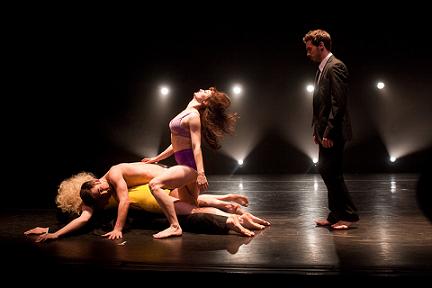
TWO WORLD PREMIERES — QUASI UNA FANTASIA AND TOCCATA — AT NEW YORK CITY BALLET GALA


Last night I went to New York City Ballet’s Spring season gala. I always love galas but they’re especially exciting when they showcase world premiere dances. In this case, there were two such premieres, along with the world premiere of a new piece of music set to one of the ballets.

First things first: I missed most of the red carpet events, unfortunately, since the program began early (so as to make time for the after-show dinner, which I am far too poor to attend). And shame on me for mismanaging time like that — that Waiting For Godot experience from two years ago was too much fun. I did get there just in time to see the paparazzi flashing away at (Sex & the City author) Candace Bushnell and (NYCB principal) Charles Askegard. Sweet Charles soon stepped aside to let his wife bask in the glory all on her own. She looked radiant. I was jealous.

Continue reading “TWO WORLD PREMIERES — QUASI UNA FANTASIA AND TOCCATA — AT NEW YORK CITY BALLET GALA”

ALVIN AILEY II: THE EXTERNAL KNOT


I don’t have much time to write– this week is beyond crazy, but last week I went back for more Alvin Ailey II (Ailey’s studio company) to see their program of repertory favorites, my favorite of which was Troy Powell’s The External Knot. See a video of excerpts from that here.

What I found intriguing about this piece was Mr. Powell’s use of music. He set the dance mainly to Philip Glass (with some Robert Schumann thrown in), to sections of In the Upper Room and Glass Pieces (the section from the latter was from Akhnaten, that fun, bouncy, drum-laden section). I’d only ever seen set to that music Twyla Tharp’s In the Upper Room and Jerome Robbins’ Glass Pieces, and I’d only ever seen Balanchine ballets to Schumann, so it was interesting to me to see how another choreographer visualized the music.

The External Knot is the story of this young man who seeks individuality, to set himself apart from the crowd and go off on his own. But there is a certain loneliness in doing that. But then, being a conformist is not very challenging and there ends up being a certain loneliness in being part of a group as well. The movement, along with the Upper Room and Schumann music conveyed that well. Upper Room is one of my favorite pieces — both the dance and the music alone — particularly that middle section where the piano keys sound like raindrops — it’s somehow simultaneously peaceful yet sad. I always envision this solitary person stuck in a cell — either a prison or a mental institution. Then, towards the end, the orchestral music swells and there’s a choral part indicating there’s a light at the end of the tunnel and I then think of the confined person as on a journey toward that light. I’ve often wondered when listening to the music where in the world Tharp got her ideas for the dance, because I don’t see any of that unsettling isolation and confinement in her ballet. But then, that is part of the fun of Tharp — you can often get the unexpected. And then Balanchine has used Schumann to convey madness. But here, that music perfectly suited the theme as the young man dances on his own, kicking up and out, jumping, lunging, reaching, doing a lengthy painful-looking shoulder stand, his legs bent awkwardly in the air, his legs slowly spreading into an arc, then a full split, his body finally rolling over onto to the ground, while the group dances on in the background — either moving in sync as an ensemble, or fragmenting into duos or trios, all movement seeming to express a longing for something.

At one point, the man is very indecisive: he can’t figure out whether to lead, follow, or leave the group. The group follows him, he looks over his shoulder as if to ensure they’re there, then they turn and leave him behind. He seems upset, he follows them, as if to harken them back. When they turn again and come at him, he turns back around, goes on hurredly forward whether they’re behind him or not.

And then in the last section, instead of using the choral music from Upper Room, Powell switches to the exciting,  rhythmic Akhnaten, where the dancers perform expansive movements in the background — large bends forward from the waist, big, far-reaching port de bras, while the man jumps, twists and turns up front, seemingly more upbeat, at peace with himself whether he is one with the group or not.

Miami City Ballet


I spent practically the whole weekend at Miami City Ballet (at City Center). Wow, what a great, world-class company! They presented two programs of almost all Balanchine (one Tharp) and they really brought Balanchine to life for me. The company’s director is Edward Villella, who performed with Balanchine and was a very renowned dancer in the fifties and sixties, still considered by many to be the greatest American male dancer ever. He was there of course and took bows with the dancers. Twyla Tharp was also there for the program showing her In The Upper Room, bouncing around  during the curtain calls in jeans and sneakers with her gray hair tied back into a pony tail, and of course her signature glasses. What fun!

Anyway, program one was: the excellent Symphony in Three Movements (my first time seeing it), La Valse (also my first time — gorgeous ballet), and Tharp’s Room; program two was: Square Dance, “Rubies” (the second section of Jewels), and Symphony in C.

My favorites were mostly from the first program.

Continue reading “Miami City Ballet”