
Photos above courtesy of the Guggenheim Museum.
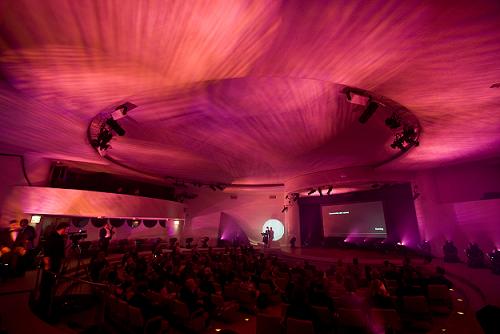
Over the weekend, I went to see a spoken word / light performance by Mexican artist Rafael Lozano-Hemmer called Levels of Nothingness, at the Guggenheim, as part of their Works & Process series. The work was inspired by Kandinsky’s Yellow Sound. (There is currently a large Kandinsky exhibit in the Guggenheim, in celebration of the museum’s 50th anniversary). Wassily Kandinsky is considered the father of abstract art, he used color extensively to evoke inner states, and he believed in the convergence of all art forms — painting, sound, movement. Yellow Sound is basically a compilation of his notes describing his ideas for an theatrical piece or an opera in which color and lighting played a large role.
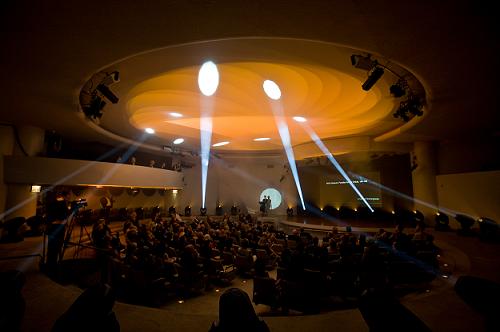
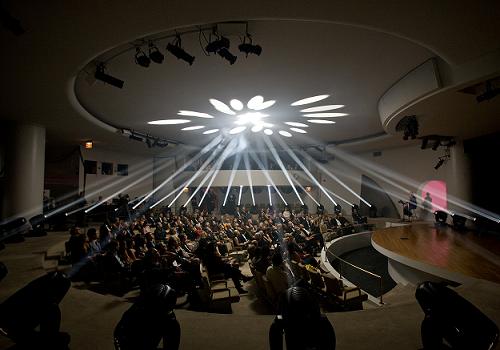
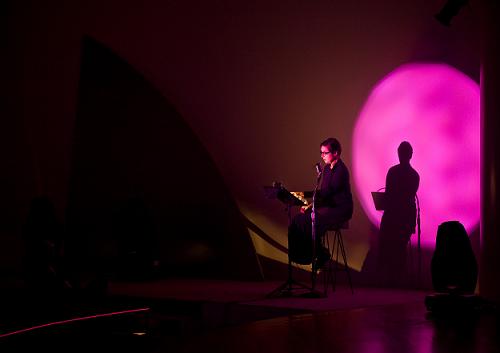
So, starting from that idea, Lozano-Hemmer (and co-writer Brian Massumi) constructed an interactive installation in which a system of lights would respond to spoken words. Actress Isabella Rossellini read the words, which were quotes from various philosophical texts about perception and color (interestingly, all texts were by non-Newtonian thinkers, who believed, in contrast to Newton, that one’s perception of color was subjective.) Basically, a computerized microphone analyzed Rossellini’s voice, taking into account her: pitch, wavelength, amplitude, intensity, speed, accent, intonation, and speech patterns. That information triggered robotic lights (these rather cute little R2D2-looking guys which were set up to surround the stage and perimeter of the auditorium) to create various light effect, such as those used in a rock concert — fly-aways, bump cues, color chases, ballyhoos, builds and flash-throughs — I don’t know what all of those things are but figure there may be theater-people reading who do!
Anyway, the effect was interesting but not really what I was expecting. Go here to see a clip of it; scroll down about halfway through the article until you see the video on the left side — on the video, you can click on the little box in the right-hand corner to enlarge the video to fit your entire computer screen.
It’s very cool to be sure, but it seemed more orchestrated than I was expecting. For example, every time Rossellini began on a new piece of text, she’d wait a few seconds for the machines to all re-adjust and prepare for that segment. So with each text there would be a specific light pattern: a white-based kaleidoscope one on the ceiling, a yellow-based one, a red light would light up behind her and go off and on as her voice stopped and started, sometimes there would be a multiplicity of lights all shining up at the ceiling making circles of light in multiple colors, etc. But they weren’t all happening at once. Each quote was set up to show one kind of pattern and then the lights would blink on and off or move around in the kaleidoscope according to her voice. It’s hard to explain, but watch that video if you want to see what I mean.
Afterward, the audience got to test it, which was fun. The host walked around with a microphone and let various people speak into it, reading from text projected on the back wall. Everyone was behaved and no one did crazy voices or spoke really loudly or anything so the lights were kind of mild as well. What I (and another woman, who asked) really wanted was for several different people to say the exact words side by side to see how the lighting design was different for each voice. But the system wasn’t set up to do that. At one point, Lozano-Hemmer re-read the same text an audience member had just read, and there did seem to be a subtle different in the lights, but I needed to see more of that to compare.
Anyway, after the performances, the Guggenheim hosts these little cocktail hours where you can meet the artists.
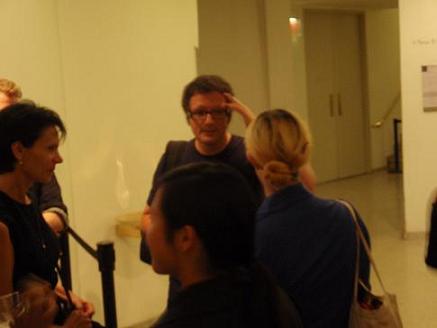
Here is Lozano-Hemmer speaking with some of the attendees. I couldn’t find Rossellini. Sorry so blurry — I hate flashing in people’s faces.
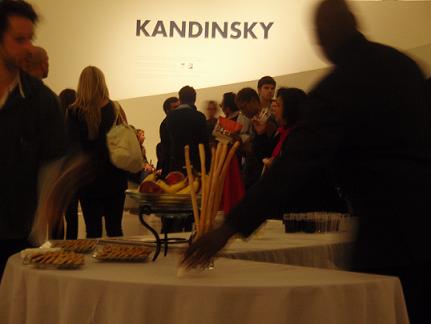
Well, anyway, the Guggenheim seems to have replaced their tray-loads of mini sandwiches with these rather long bread sticks. Probably a wise idea to get rid of the mini sandwiches because, as James Wolcott has noted, people go downright mad for those things, nearly killing each other in the stampede toward the food tables. You’d think none of these people eat for a month before a Guggenheim Works & Process event just so they can load up on “free” (if you subtract the $30 you paid for the ticket) little cucumber and mayonnaise squares. Could never figure out what gives with that?
Anyway, the bread sticks are tasty, and surprisingly filling, but when I went to put one to my mouth I realized how blasted long they were — it was like eating a baton. You had to really hold the end of the breadstick out quite a distance from your mouth. It was rather amusing watching all these people standing around with a glass of wine in one hand, holding a bread stick up in the air with another! For a moment they looked like cigarette holders and the whole scene looked a bit Breakfast at Tiffany’s.