Ratmansky’s Fantastically Funny, Tim Burton-Esque New FIREBIRD

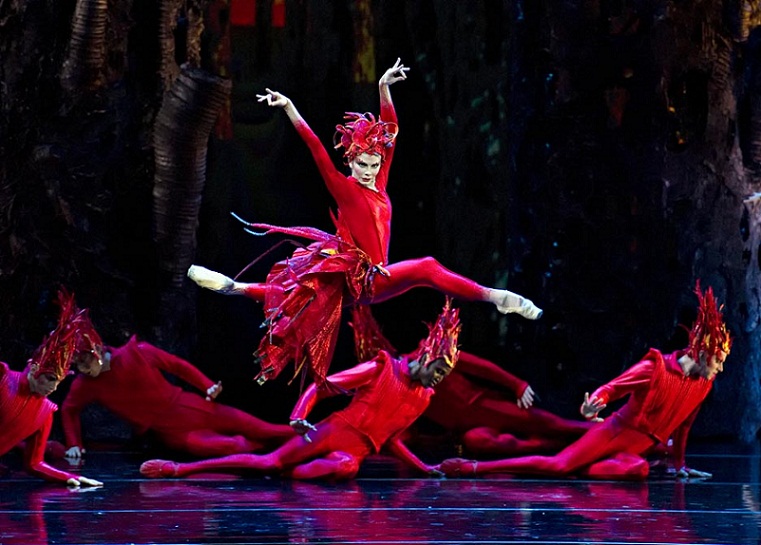
Thursday night I went down to Costa Mesa for ABT’s premiere of Ratmansky’s FIREBIRD at the Segerstrom Center for the Arts. I’m so glad I braved the nearly three hour drive (with traffic; without about fifty minutes) from west L.A. because it was an excellent evening. This is I think Ratmansky’s most theatrical, spectacular ballet – certainly of those he’s done for ABT – and I loved it. (Photo above of Natalia Osipova in the lead role, by Gene Schiavone, courtesy of Segerstrom.)

The curtain opened onto this magnificent set. The prince is supposed to be in a forest searching for his lost beloved, and so strewn about the stage were these fantastically creepy dead tree-trunks with spindly branches that magically sprouted blood red blossoms. I was so enchanted with those tree trunks, which to me resembled a witch’s hand, and the crimson blossoms bright red fingernails. It all had a very fantastical Tim Burton feel.

Then behind a scrim we see the prince, Marcelo Gomes, dressed all in white, searching about frantically for his lost maiden. At one point, he bumps his head into a branch on one of the creepy witch-hand trees. The audience seemed really to appreciate the humor in this; they laughed at this, and laughed pretty frequently throughout.

Soon, a flock of red birds devoured the stage, and Natalia Osipova emerged as their leader, or the most remarkable one, whom the prince became taken with. This was the one problematic part for me. It makes sense to have a flock of birds with a leader rather than one bird, as in I think most versions of this ballet – but the stage here was really too small. Natalia went to take one of her famous leaps but then seemed to hesitate and took it down several notches. There were too many birds, and as she turned to run to one side of the stage, she almost smacked into one of them. I think that set the note for the rest of her performance, because unfortunately, she just seemed to be holding back throughout the whole thing – not only in her solos but also in her pas de deux with Marcelo after her firebird is captured by his prince. I didn’t really see her struggling to be set free, and when she gave him her magical feather, it seemed more an afterthought than in barter for her freedom. Marcelo is ABT’s most dramatic male principal and he kept up the act well, being enthralled with the firebird, but ultimately feeling sympathy for her and setting her free, but you could tell he was also concentrating on making his dance partner feel as assured as possible. I’m sure as they iron out the kinks, Natalia will be perfect though.

Simone Messmer actually stole the show to me. Well, she shared it with David Hallberg (who, judging by the cheers, has quite the fan base in L.A!) Simone danced the role of the maiden who captures the prince’s attention, and she danced it with a really wonderful sense of humor, as she alternated between being controlled puppet-like by a sorcerer’s spell, being annoyed by the prince’s intrusion, then falling for him, then being fought over by him and the sorcerer, who keeps trying to retain his spell on her.

Ditto for David, who danced the part of the sorcerer set on keeping the prince and maiden apart. We first see David’s wicked magician in shadow form, from the back of the stage, which looked both malevolent and funny at the same time. When David emerged, he sported this big green bouffant, and Ratmansky had him chasing the maidens about the stage in this bent-legged run (almost like a Russian folk dancer). He was really both creepy and funny at the same time.

The comedy continued when the firebird returned (after the prince, threatened by the sorcerer, summoned her protection) and compelled everyone to dance themselves silly. It was particularly interesting to watch David here. Ratmansky gave him these rather crazed lightning fast steps danced in place that reminded me of a sequence he danced as the mentally unstable boyfriend in Ratmansky’s earlier ballet, On the Dnieper. There they were meant to convey extreme anger and were frightening because it meant the character was about to become unhinged and violent; but here they’re more funny than scary, and I think that’s what Ratmansky intended. I think Ratmansky is making an actor out of David Hallberg πŸ™‚ He certainly got a great brilliant comedic performance out of Simone.

I wasn’t really a fan of the ending. Prince and maiden danced, sorcerer and firebird, then they switched partners, but the sorcerer tried to reclaim the maiden. Finally the firebird shattered the egg containing the sorcerer’s power and prince and maiden were sweetly reunited. The last scene is of the firebird being held up high by a group of men, in a group lift, heroizing her. I don’t remember the firebird appearing at the very end of other productions, and it felt a little too cutesy to me, or a little too ‘good triumphs over evil.’ I realize that’s the theme of a lot of ballets but I was expecting a bit of a twist here since the whole was more comical and different in tone than other versions.

Other dancers appearing as the firebird later this week are Misty Copeland and Isabella Boylston. I can’t make the trek to Orange County again this weekend unfortunately, but will be really interested to hear what others think of the other casts.

The other two dances performed were Christopher Wheeldon’s Thirteen Diversions and Merce Cunningham’s Duets. At first I’d forgotten I’d seen Thirteen Diversions – it premiered during ABT’s Met season last year. I was charmed by it all over again; definitely one of my favorite Wheeldon ballets. Misty Copeland, Stella Abrera, and Craig Salstein stood out to me. Misty really made that ballet she was so spellbinding as the girl who seems to struggle with herself and her partner. What I like about this Wheeldon dance is that he really allows the dancers to create characters; it’s not just about musicality and creative patterns (although that’s there as well). Craig Salstein was sweetly funny as he kind of flicked his partner off stage and into the wings, so he and his male cohort could have the stage all to themselves.

Duets was first on the program, and it was new to me. It got off to a slow start. It seemed the first two couples were stiff and nervous and just going through the steps without giving them much meaning. But the fourth couple – Xiomara Reyes and Arron Scott – changed the tone when they took one look at each other, as if to say, “let’s go, let’s do it!” and took off on a quick paced, very precisely and charmingly danced sequence of steps. After that, everyone else seemed to unwind and perform more full out and with intention. I’m really beginning to like Xiomara. She and Arron were my favorite couple, but Julie Kent and Jared Matthews got the most applause. At the end of the whole program, David got the most applause – people really love him there.

This was my first time at Segerstrom Center for the Arts. The building is so interesting. The orchestra is on the right half of the theater (if you’re facing the stage) and the mezzanine is a raised portion on the left half. And then the balcony is up above. It’s definitely not as big as the Lincoln Center stages or City Center, but it was packed full of a very enthusiastic audience. It made me wonder if most lived around there or if people often drive down from L.A. I’m sorry, I’m still this stunned New York expat unable to fathom how people can drive three hours a day in gridlock and not go insane!

It was kind of unsettling seeing my favorite N.Y.-based dancers in L.A. I looked around the press section thinking there must be some N.Y. critics there to cover a premiere, but I didn’t recognize anyone and a Facebook friend later told me Macaulay was with her at a N.Y. performance Thursday night. And the one L.A. critic friend I have wasn’t there either. It made me sad. I really miss spotting the writers in the audience, wondering who’s going to write a review, who’s covering for the Times, who’s thinking what, who’ll write what. And most dearly I miss hanging out with my N.Y. dance-goer friends on the Koch Theater promenade during intermissions, or at Ed’s Chowder House or Fiorello’s afterward to discuss a performance, especially a premiere. I guess I’ll eventually make those friends here…
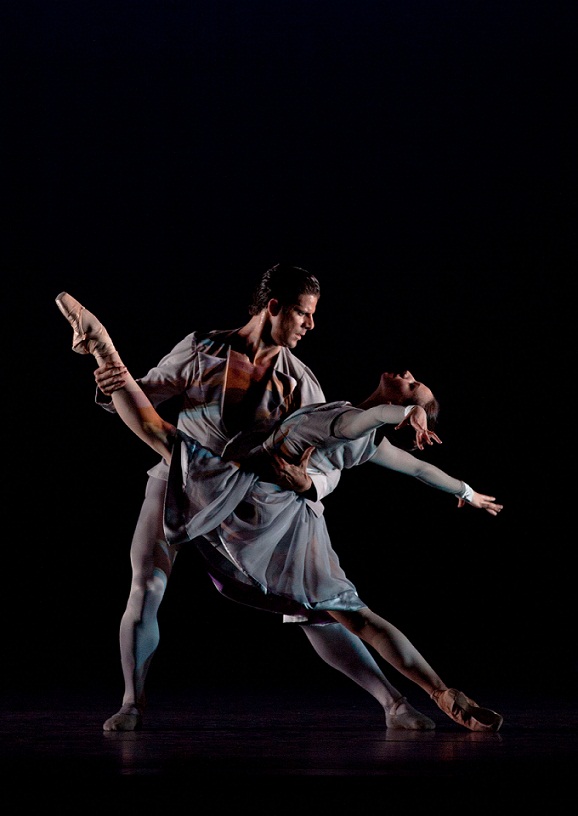
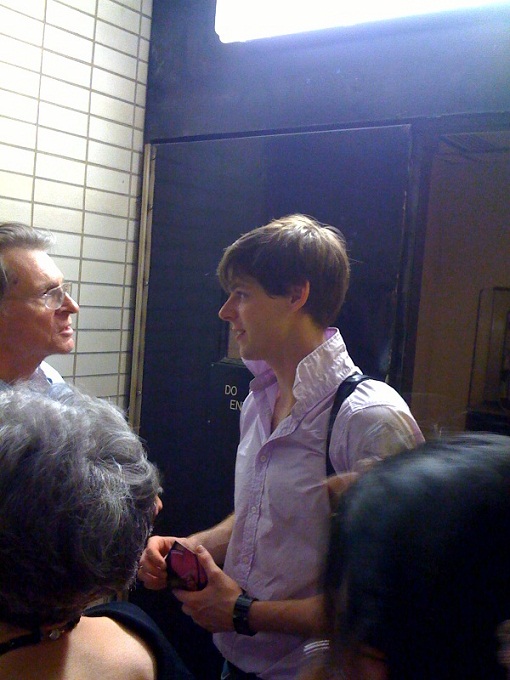
ABT is Coming to Orange County with Ratmansky’s New FIREBIRD

How excited am I! This Thursday through Sunday, my beloved ABT will be performing at the Segerstrom Center for the Arts in Orange County. They’re premiering Ratmansky’s new Firebird – and none other than SLSG faves Marcelo Gomes and Natalia Osipova are scheduled to star! (David Hallberg and Simone Messmer are co-starring.) The two other dances on the bill are Wheeldon’s Thirteen Diversions (photo above, by Rosalie O’Connor, of Marcelo with Isabella Boylston) and Merce Cunningham’s Duets. The latter two I haven’t seen yet since I missed the company’s City Center season last year.

Read a preview of Firebird by Joseph Carman here.

This will be my first time at Segerstrom / Orange County. If any of my Angeleno or former Angeleno readers would like to give me advice on the best way to get down there from Century City on a weeknight, I’d be most thankful πŸ™‚ I will most definitely report back, particularly on the new Firebird!


Los Angeles Ballet’s NUTCRACKER, and More Settling Into LA Angst


Last night was the opening of Los Angeles Ballet‘s Nutcracker. Above photo – of my favorite dance – taken from LA Mommy Poppins.) It had its premiere at the Alex Theater in Glendale, and will be showing again there tonight. Then, it’ll travel to UCLA’s Royce Hall in mid December, and will end at the Redondo Beach Performing Arts Center at the end of the month. I find it interesting how the productions here seem to travel around the city, in contrast to those of the NY companies.

Anyway, my new Twitter friend, the wonderful Christopher McDaniel, a dancer in the company, generously invited me. And I’m so glad he did because I was worried I would miss getting my Nutz fix this year. The production was fun. This company is much smaller and you can tell has far less of a budget than the two big New York companies. So no live music, no ginormous trees magically shooting through the roof, no Stella McCarthy-designed costumes. But it was a sweet production, and the theater was really packed – mainly with families, I assume from the suburbs. And the audience really seemed to enjoy it. This ballet is all about pleasing children anyway.

The Alex Theater is quite small and every seat is pretty close to the stage, which is nice for a change from the huge NY houses. I think that up close feeling, the feeling that you’re part of the action compensates for theatrics like NYCB’s magic tree.


Here is my extremely crappy night-taken iphone photo of the entrance, which I loved and found gloriously West Coast with its Art Deco-y design and bright sparkling lights noticeable from quite far away πŸ˜€

The choreography (by artistic directors Thordal Christensen and Colleen Neary) wasn’t as clever and intricately detailed as Ratmansky’s but it was still very lovely classical ballet. My favorite overall was the Arabian (pictured above). The couple entered the stage with the man holding the woman high above his head in a beautifully snaky overhead lift. The female dancer, Julia Cinquemani, was really flexible and long-limbed and she did an excellent job with the part. She also had terrific stage presence, and I’m not the only one who thought so – they got huge applause at the end.

Of course I loved the Russian dance, as I always do. And Christopher was in that one so it was all the more special! There was no Tea / Chinese dance, which I found refreshing because that one always seems to end up embarrassing me with its ridiculous stereotypes.

I found the mouse costumes splendidly creepy – it’s just that those tails reminded me of an appendage to a costume that I saw recently on an episode of the HBO series Bored to Death and, well, eeeek. And when the mice died they did so with their little legs bent and up in air – so real looking, it made me laugh! Mother Ginger was danced by a man, as in NYCB’s, but here he wore an actual gingerbread house as a costume, his head coming up through the chimney. And little children came out of the house and danced. They were very popular, those kids! I think they had lots of family members in the audience πŸ™‚ No ornery little mouse, as in Ratmasky’s.

My friend was impressed with the boy who played Clara’s little brother, Fritz – Aidan Merchel-Zoric. She thought he was a very good young actor.

All in all, I really enjoyed the production and am so glad I went.

But I think for a while going out is going to be a bit fraught with angst for me, until I get used to things more… So, the performance began at 7:30. At 5:00 my friend who I’d invited, who lives in a beach city, called on her cell phone. She sounded a bit frantic. “Tonya?!” she said when I answered.

“Uh huh?” I answered.

“Um, I’m really sorry and I don’t understand this at all and I really don’t know what’s going on, but I’m in my car and I’m getting ready to leave, and I just typed the address of the theater into the GPS, and it’s telling me my estimated arrival time is 8:20 pm?!”

“Three and a half hours? What?” I was as astonished as she. “I’d think you’d be in Palm Springs in three and a half hours.”

“I’d think I’d be in Arizona in three and a half hours!” she shrieked.

Glendale is in northeastern LA, up over the Hollywood Hills, and so on the reverse edge of town from the beach cities. But come on, it’s like 25 miles. It really shouldn’t have surprised me that much. I spent several days this week driving to UCLA, which is diagonally across town for me, and is about 20 miles away, and I’ve spent about three to four hours per day in my car going to and from. Anyway, she told me she’d try to be there as soon as possible, she’d go on back roads and avoid freeways to save time, but she’d perhaps have to pick up her ticket during intermission. I said no worries, but did worry about her sanity after spending a total of seven hours in her car in one day – which is longer than it takes me to get to Phoenix…

Anyway, she drove through town, avoiding the freeways, and got there in two hours, thankfully.

Then, afterward, we had planned to go to a newish cocktail lounge nearby with this supposedly up and coming mixologist. The cocktail lounge was close but not close enough to walk to. But when we looked it up online it seemed like there was only street parking, which may have been a real pain. We’d each be in our separate cars and it might take me a while to get out of the crowded garage near the theater that I’d parked in, and what if there were no parking spaces there, and I didn’t have any quarters for the meters anyway, etc. etc. We ended up deciding to go to the bar of a chain restaurant down the street, that we could easily walk to. And that bar was all nice and good, and we ended up meeting some movie industry people (I’m starting to realize you meet them everywhere) and discussing various flavored ciders and new caloric menu listings now required by law and how horrid it was for the government to require restaurants to shove in our faces just how much we were consuming, and all manner of interesting things … But it still bothered me that parking angst prevented us from going where we’d originally planned to go – the more interesting, newish place with the supposedly brilliant cocktail mixologist, rather than the chain. That never would have happened in New York (my friend happens to be from NY as well, though she’s been here a lot longer than I have).

We were chatting so, we forgot the time and soon it was well after midnight. When we left the restaurant the street was deserted. We agreed to walk together to the parking garage she’d parked in, then she’d drive me to my car in the garage I’d parked in because I was freaking out a bit about walking through a dark garage alone. It all came out okay, but it made me think, what if each of us were covering the performance on our own – or the opening of the new cocktail bar with a supposedly brilliant mixologist – and had to be out late and had to go to our cars alone…

I don’t know, I guess it’ll take me a while to get used to this new life…

Vladimir Shklyarov: the Marcelo Gomes of the Mariinsky?

I’m usually not a stage door person, but Friday night, after the Mariinsky Ballet’s second-to-last night performing in New York, I decided to follow some friends down into the bowels of the Met. Actually, now that construction has finished down there, it’s not a maze like before; you just take the elevator in front of the gift shop down and you exit onto an open street; mid-way down is the stage door.

I didn’t actually go to the Friday night performance. I watched the David Michalek slow motion films out on Lincoln Center Plaza (more about that later). But I’d planned to meet ballet-goer friends anyway for late dinner. At the stage door, several of the dancers came out – including our Diana Vishneva, who danced Carmen that night – but everyone (a mix of women, men and teenagers of both sexes) seemed to be waiting for someone in particular. Finally, at the tail end of the string of exiting dancers, he arrived. Vladimir Shklyarov. I knew he was the one everyone was waiting for by the outburst of giggles was followed by a mob-like rushing of the poor guy. Since I hadn’t gone to the performance, I wondered what was so great about him. He seemed like an ordinary guy. He seemed very American. He was wearing his hair in that kind of mussed-up style that is trendy here right now. And he was wearing American style jeans with the low-pockets, suede loafers, and a button-up shirt with the collar up at the top, preppy-like. And when he spoke (at least as much as I heard him),Β  he seemed to have only a trace of a Russian accent. Seemed like a very nice guy.

The next night I saw him in Balanchine’s Symphony in C, and immediately understood why everyone was going to gaga over him the night before. He only had a small part in the third movement but he stood out so much, he really made that ballet. His jumps are enormous and, more, his personality – that endearing combination of cocky and charming- really shone through, even in the mere ten minutes I saw him dance. How much did I wish I’d seen more of his while the Mariinsky was here??? Well, I’ll know for next time…

Anyway, I found a couple YouTube videos of him:

Other reflections on the Mariinsky’s NY tour: also fell in love with Alina Somova, who danced the Saturday matinee lead in The Little Humpbacked Horse, a fantastical Ratmansky ballet based on a Pyotr Yershov tale. I’ve heard people express dislike of her, but I don’t know what they’re talking about. I absolutely loved her. She’s very flexible and very fast and fluid, so perhaps she can sometimes look a bit like a rubberband. But I loved her lines, and her speed, and her playfulness, and her sweet personality. She made that ballet for me. During lunch after the performance, my friend Art said it depends on what she’s cast in – and this, he thought, was her best. Everyone agreed it suited her. (So fun hanging out between performances with Art, critic Marina Harss, and Emilia from The Ballet Bag! Emilia is originally from Brazil, which I didn’t know πŸ˜€ ) Anyway, I’ll have to see Somova in other things, because from what I saw, I can’t imagine not liking her.

Here’s a video:

And here’s a video of her in Humpbacked, for which, apparently she won an award.

I also found myself smitten with Yevgenia Obraztsova, who seemed really sweet at the stage door as well, and who danced with Shklyarov in Symphony in C. She’s a tiny powerhouse who I imagine would dance well with our Daniil Simkin. She’s very lyrical as well.

I didn’t care much for Ratmansky’s Anna Karenina. (A big thank you to Marie Mockett for giving me her ticket to that by the way!) I have to agree with Sir Alastair on this one. There were some impressive stage theatrics – particularly a rotating train that you see from both outside and in, and some moving images on a background screen that were used to interesting effect – but overall the production didn’t really convey the story. It was more like a series of tableaux than a narrative, which has worked in other productions (a San Francisco Ballet production of an Ibsen play comes to mind) but didn’t work here – maybe because thematically and mood-wise, it was all so one-note: suicide, encroaching death, the aftermath of death, actions leading up to death, etc. But also, I really didn’t find the choreography interesting at all. It was really basic. I mean, many of the lifts were lifts I learned in the ballroom studio for my cabaret routines. You learn all the very basic lifts: the t-lift, the shoulder-sit, the fish, etc. etc. I’d get so annoyed with my teachers for not being more artistic, for not being able to come up with creative partnering that was more evocative of the story or mood we were trying to convey. That’s one reason I left ballroom – I got bored. So I feel like when I see those same basic lifts in ballets created by supposed choreographic greats and produced all over the world, I feel like I’m in the Twilight Zone. This is why I love MacMillan so. None of his partnering is something you’d learn in a studio lesson – it’s specific to the story and characters.

I also wasn’t too enthralled with the Mariinsky’s Carmen Suite, choreographed by Alberto Alonso. There was a big round mat in the middle of the stage where the dancing – most of it by Carmen alone, some of her dancing duets with men – took place. There were chairs setting on a raised platform that encircled the mat, and the men sat on the chairs and watched her. My Carmen was Ulyana Lopatkina (who was also my Anna Karenina), and her dancing to me looked, in Carmen, very gymnastic. But I think it was the way the stage was set up – it looked like a gymnastic mat – and she kept doing these standing poses that reminded me of a gymnast about to take off in a tumbling pass during a floor routine. It was another ballet that didn’t focus so much on recounting a narrative than creating a feeling, a tone, through vignettes. It worked a little better here than in Karenina, maybe because it was a shorter piece, but I think the gymnastic thing, and the overall creepiness of the men sitting in their chairs just watching her, didn’t really work for me.

Favorites were definitely Little Humpbacked Horse and Symphony in C.

Here are a few more stage door photos:

Yevgenia Obraztsova.

Yuri Smekalov.

Danila Korsuntsev.

And princess Diana, who is even more beautiful up close than she appears onstage.

Wish now I’d have gone every night. Trip to St. Petersburg… πŸ™‚

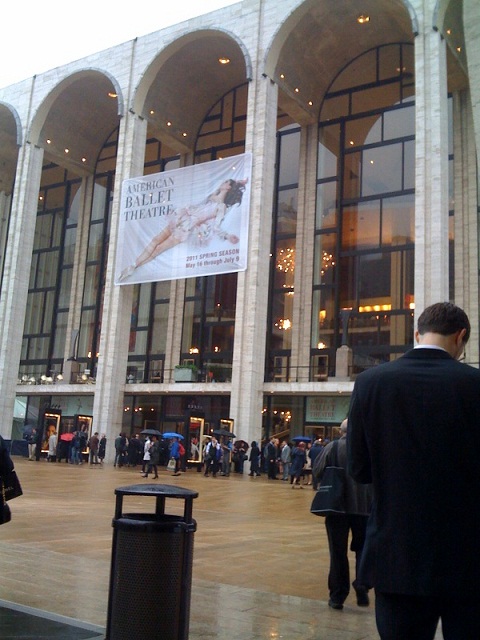
American Ballet Theater Spring 2011 Opening Night Gala

Last night was ABT’s Spring 2011 opening night gala. Dreary, rainy night … but what else is new for New York these days?

Once inside, I really enjoyed the show though. (I’m hoping to receive photos soon, which I’ll post). The program began with a short preview of Ratmansky’s The Bright Stream, which I’m excited to see next week. Seems to have a lot of humor, some bravura dancing, a cute storyline.


(Photo: The Bolshoi’s production of Bright Stream; Natalia Osipova is jete-ing).

Then, there were introductions by Rachel Moore, executive director of ABT, wearing a beautiful green dress, and Kevin McKenzie (AD), followed by Caroline Kennedy, who introduced the students of the Jacqueline Kennedy Onassis School of American Ballet as they danced a world premiere, Karelia March, by Raymond Lukens. The program says the students are Level 7, which must be the highest level, because some of those dancers looked like ABT principals. I’m not kidding, I swear. They really amazed me. That school is doing incredible things!

Next was Balanchine’s Tchaikovsky Pas de Deux, danced by David Hallberg and Gillian Murphy. Everytime I see David dance I think he must be the most perfect male dancer in the world. Gillian was stunning too.

Then came the Grand Pas de Deux from Ratmansky’s new Nutcracker, danced by Marcelo Gomes and Veronika Part. (No, they’re not performing that ballet during the Met season, but there seemed to be a few excerpts in the program from ballets they’re not performing). I missed seeing this couple – overall still my favorite – when the company premiered Ratmansky’s version in December. They were so sweet. Veronika danced with such wonderment in her eyes, such joy. And Marcelo was her perfect, adoring cavalier, all eyes on her. I don’t have kids, but I’d think they’re the perfect wedding couple to wow very young audiences.

Then came Majisimo, a classical ballet piece with Spanish flourishes created by Georges Garcia for the Ballet Nacional de Cuba in 1965 and set to Jules Massenet’s Le Cid. This piece was mainly meant to highlight Jose Manuel Carreno, who of course retires from ABT later this season. But it was really a dance for eight couples, and he danced only the male part of one of them – there were very few solos. He danced with Paloma Herrera. Xiomara Reyes was paired with Reyneris Reyes, guesting from Miami City Ballet. The other couples were comprised of Cuban dancers guesting from other companies as well: Lorena Feijoo and Joan Boada from San Francisco Ballet, and Lorna Feijoo and Nelson Madrigal from Boston Ballet. The dancers were spectacular, but I didn’t think that much of the choreography, which reminded me of a more bland version of an ensemble scene from Don Quixote. Jose had a series of turning jumps, and a really beautiful multiple pirouette that wowed the audience – drawing those turns out are what he’s most known for. And Xiomara really took my breath away with this crazy fast series of traveling turns in a diagonal down the stage. I’ve never seen her dance like that!


(Photo: Jose Carreno dancing with Polina Semionova in Diana e Acteon)

After intermission came two pas de deux from Swan Lake. A Twitter follower asked me why they needed to perform two scenes from the same ballet. I think that ABT, same as everyone else, is just trying to benefit from the Black Swan craze. They should have had Sarah Lane dance one of the pdd though! πŸ˜€ Anyway, first pas de deux – White Swan- was Paloma Herrera and Alexandre Hammoudi, which was good. But the second – the Black Swan – I found surprisingly magnificent! It was danced by Michele Wiles and Cory Stearns. There have been so many guest stars from Europe lately gracing ABT’s stage, I’d forgotten how perfect an Odile Michele Wiles is. And Cory really impressed me as well. Whatever he may lack in dance ability (I can’t imagine he’ll ever be a David Hallberg or Marcelo Gomes), he more than makes up for in acting and stage presence. He’s really good at bringing you into the world of the ballet and creating a character you can sympathize with.

Sandwiched in between the two SLs was Jessica Lang’s Splendid Isolation III, danced by Irina Dvorovenko and Maxim Beloserkovsky. I joked on Twitter that Max earned the hot guy of the night award for that, but seriously – he did! Irina was really beautiful as well. And her party dress, which she came out in for the final stage bow, was, as usual, gorgeous. She has such impeccable fashion taste, imo.


Following that was the highlight of the night, for me – Diana Vishneva and Marcelo Gomes in the Act I pdd from Manon. Such a perfectly choreographed pas de deux – beautifully romantic and full of love / lust but with so many breathtaking but capriciously executed, dangerous-looking lifts you sense something out of control. As beautiful as it is, this story isn’t going to have a happy ending. I am liking Diana Vishneva more and more. I’ve always thought she was a great dancer but she always seemed to play too much to the audience for the story ballets. She didn’t take me into the world of the character as much as I want an actor to. But the last two seasons she’s been doing just that: really developing the character and dancing to her partner – Marcelo here and in Lady of the Camellias last season, which is the first time she really blew me away – instead of the audience. This – the Manon pdd – was the audience favorite last night as well. The two got a storm of whoots and bravos at their curtain call, and practically had a standing ovation the audience was so loud in their applause. “So beautiful,” exclaimed the woman beside me. “Okay, we can go home now,” she joked.


(Couldn’t find a photo of Diana and Marcelo, but here is Diana dancing Manon with Manuel Legris. With all photos I post now, I’m linking to the original site via a click on the photo.)

Here are Marcelo and Diana in Lady of the Camellias:


Then, Alina Cojocaru, one of the European guest artists this season, danced the Rose Adagio from Sleeping Beauty. I’m not a huge fan of this ballet in general, but she was lovely. Patrick Ogle replaced Sascha Radetsky as one of the cavaliers.

Second to last was the Act II pdd from Lady of the Camellias danced by Julie Kent and Cory Stearns. Again, Cory did a very good acting job – and physically he fits the character perfectly, as Julie does hers, but I think some of those lifts are so difficult-looking… I just worry about the dancers. Isn’t that how Roberto Bolle got hurt last season – performing this role?

And the evening ended with another ensemble excerpt from Ratmansky’s Bright Stream. People who stood out most to me were Daniil Simkin and, again, Xiomara Reyes. I really am excited to see this ballet.

Tonight Don Quixote begins and runs through the beginning of next week. I’m excited to see Alina Cojocaru dance with Jose Carreno on Friday night, and Russian ballerina Polina Semionova guesting in the Saturday matinee with David Hallberg.

American Ballet Theater’s “On To Act II” at the Guggenheim

Did you guys watch the live-stream last night or tonight? If you missed it, you can watch the video now archived on the Guggenheim’s ustream channel.

It feels weird to review a program that everyone can easily watch online, but I’ll just say my favorite moments last night were: the ABT II dancers in excerpts from Jessica Lang’s Vivace Motifs, which I thought looked like a lovely ballet; Hee Seo in the prayer scene from Coppelia; Susan Jaffe coaching Sarah Lane in another scene from that same ballet; and Jose Manuel Carreno’s interview by Wes Chapman.

I wasn’t really in love with the dance Carreno performed with Melanie Hamrick – Ronald Savkovic’s Transparante. I thought there was a bit too much falling down and standing up again, and, though some of the partnering and lifts were beautiful they were pretty basic and didn’t reveal much about the relationship of the characters and the dramatic action. But I loved hearing him talk – love how he still has that thick accent! Love that he said “oh shit” in reference to all the Don Quixotes he’s cast in during week one of ABT’s Met season! He doesn’t seem to have a plan for the future, but said he’d still do some freelance dancing for the next few years, and said he’s interested in exploring more contemporary work, other forms of dance. I think that’s why he wanted to dance Transparante instead of something from ABT’s season.

I liked Martine van Hamel’s discussion and performance of some of the character roles she continues to do – the wicked stepmother, always either drunk or hung-over, in Kudelka’s comical version of Cinderella, and the wicked fairy Carabosse in Petipa’s Sleeping Beauty. But they left out the Dacha Dweller from Ratmansky’s Bright Stream, which was on the program! None of us have seen that ballet yet and I was eagerly awaiting that excerpt … and then she said she wouldn’t do it because she couldn’t get something in it quite right yet. Well, I guess we’ll see it soon enough.

I really did like the excerpt from Jessica Lang’s Vivace Motifs. The ABT II dancers are always very good, especially Irlan Silva. Every time I see him dance I get annoyed that ABT hasn’t yet brought him into the main company. I don’t understand what they’re waiting for. He stands out so much to me. He seems better than most of ABT’s soloists and even some principals. And he’s not even in the corps yet. I really really really don’t get it.

Anyway, I’ll conclude this post with an excerpt of Carreno and Susan Jaffe dancing the Black Swan pdd from an earlier documentary about ABT:


And footage of Silva from the documentary, Only When I Dance:


For the Love of Duke


On Friday night Susan Stroman’s For the Love of Duke premiered at NYCB. Photos above by Paul Kolnik. Top: Tiler Peck, Sara Mearns, and Amar Ramasar; bottom: Mearns and Ramasar. Stroman is primarily a Broadway choreographer (I think her most famous work is probably Contact), and it shows both in her ballets’ strengths and limitations.

For the Love of Duke is divided into two parts. In the first, entitled “Frankie and Johnny … and Rose,” Tiler Peck and Amar Ramasar are Johnny and Rose, a couple in love. They perform a lovely lyrical pas de deux. Then along struts Sara Mearns – Frankie – and Johnny’s attentions are completely lost on her, to the disappointment of Rose. Johnny and Rose are snuggling on a bench together, and when Frankie comes prancing along, Johnny pushes Rose right off the bench, behind it, as if to hide her. Then he does a snazzier dance with Mearns / Frankie, she disappears, and he’s back with Rose … until Frankie comes strutting along again. And so on. At one point, Rose becomes the seductress, and Johnny pushes Frankie off the back of the bench. It was cute, and everyone danced spectacularly, but it got a bit old to me after a while.

The second part – “Blossom Got Kissed” – Stroman had actually choreographed before, creating it for NYCB in 1999. I liked this one better. Both parts, by the way, are choreographed to Duke Ellington and Billy Strayhorn, which is where the title of the whole comes from. Anyway, “Blossom” begins with a bunch of girls all dressed in sassy, jazzy red sitting on a bench tapping their feet to Ellington’s rhythm. Along comes Savannah Lowery as Blossom, dressed in a frilly ballet tutu. She sits alongside them on the bench and tries to tap with them. But she has no rhythm and is horribly off. Then they stand and do a jazzy dance, and, again, she tries to join, but just can’t get the hang of it. She is simply too classical ballet. Lowery was hilarious though and it was funny to see her continually try to get the rhythm and technique of jazz dance right by taking a foot and pounding it down flat on the floor. Then, a group of tux-clad men come along and do some swing dancing with the red-clad women. Blossom again tries hard to fit in but just can’t. Finally, a musician in the band (which was onstage), in the person of Robert Fairchild, comes out from the back of the stage, orders the music changed, and does a sweet lyrical ballet pas de deux with her.

I feel like I’ve seen “Blossom” before because Lowery’s hilarious flat-footedness looked familiar. I liked it better than the first part because to me it was funnier, and the story went a little further.

I think Stroman is very good at creating a story through dance, and that’s what I like about her. You can tell she’s not really a ballet choreographer though. Compared to the first two pieces of the night – Ratmansky’s Concerto DSCH and Wheeldon’s Polyphonia – the actual dance just wasn’t that rich. Still, I think she complemented the program well. It can never hurt to include in an evening of ballet a cute narrative dance with music that’s not usual ballet fare.

As always, I loved Concerto DSCH. Ratmansky was in the audience. I felt the music was played a bit too fast though (conductor was Ryan McAdams, Elaine Chelton the pianist). It looked like Ashley Bouder had a slight mishap, though I’m not sure because I was busy watching Joaquin DeLuz do a sequence of crazy fast steps into a somersault at the speed of light. Andrew Veyette again replaced Gonzalo Garcia, who I am really missing. I hope he’s okay. Veyette is doing a fine job as one of the two playful guys in blue, but there’s this repeating series of throws – where they each kind of propel the other into the air, and I love how Garcia always gets such height when he bounces off the other two.

Tyler Angle replaced Benjamin Millepied, and did wonderfully. I always notice things with Tyler that I haven’t noticed before – like how when he and the girl in green (Wendy Whelan) make their entrance, he’s spinning her around and around, and she looks like she’s hanging on to him for dear life. It kind of sets the tone of their relationship. I always notice the music much more when he dances as well.

Christopher Wheeldon’s Polyphonia is definitely one of my favorites of his. I love the musicality of it, and the originality of the combinations. It’s set to ten piano pieces by Ligeti, who, the program notes, developed micropolyphony – a type of music involving sustained dissonant chords that shift slowly over time. You can really see that “micropolyphony” in the dancing, as the sets of dancers (eight all together, divided into four pairs) begin dancing together in a line but each pair doing something completely different. Then, they eventually come together and dance in unison, but then they drift apart again later. There’s some very clever, almost humorous partnering throughout, but particularly in the second movement, Arc-en-ciel, Etudes pour piano, danced by Maria Kowroski and Jared Angle. I haven’t seen this ballet as often as I would like to. I was going to say I wish he’d include this one more often in Morphoses programs, and then I remembered

Last Week at New York City Ballet


Last week I went to two performances of NYCB – opening night and Thursday night’s “See the Music” program – and to two of the free all-day Balanchine events on Saturday. First, I’ll talk about the last two since I found them so informative. The free studio talk on Saturday afternoon – Balanchine’s birthday – was moderated by Sean Lavery (former NYCB principal dancer, now ballet master), and included Sterling Hyltin (in Paul Kolnik photo above with Robert Fairchild), Chase Finlay, and Jenifer Ringer. Lavery asked the dancers to talk about their first Balanchine ballets, their favorites, and what drew them to NYCB. Hyltin named as her favorite Duo Concertant (pictured above) which I’d just seen her dance on opening night. She said she liked the syncopated movement, the he goes and I go kind of back and forth movement conversation with her partner, and with the musicians. I really liked it too. The violinist and pianist are onstage (the music is Stravinsky), and I like the interaction between the dancers and the musicians, and between the two dancers, and I like the sharp, angular movement. She seemed particularly animated when I saw it. I love Robert Fairchild and think he’s such a sharp, masculine mover with a presence that commands your attention without meaning to – he kind of reminds me of a less cocky Ethan Stiefel – but she seemed so happy to be dancing this piece that she stood out to me more. It was nice to hear her talk about it.

But what I really loved was the School of American Ballet class taught by Peter Martins. He interacted cutely with the students, particularly “Cyrus,” (at least I think that was his name…) a tall, long-limbed young man who I think will soon be in the company. Cyrus didn’t always do everything perfectly (at least in Martins’s eyes) but he had a charming presence and a great leading-man physique and you can tell he works hard.

Martins had the class demonstrate ballet basics – beginning with the five positions, and they showed us a perfect fifth position (with the toes of the front foot touching the heel of the other and vice versa). More interestingly, he had the class show us the difference between a Balanchine hand and a classical ballet hand. I’d always noticed there was a difference but couldn’t figure it out exactly. God gave us five fingers, Balanchine had said, so we shouldn’t hide two of them. The Balanchine hand shows all five fingers, the classical ballet one only three (with the ring finger and pinky held so that they are hidden from view behind the middle finger).

Martins also had the students show us how Balanchine’s fourth position differed from others’. In Balanchine’s the back leg is straight; in all others’ the back leg is bent. Martins didn’t go into any functional explanation for this – just said “here, we think it looks better.” But I thought about it and thought, wow, it must be hard to take off in a jump for example with the back leg straight. And then I realized that’s partly why Balanchine’s choreography always looks so fluid, like one step leading right into another, without a lot of stopping to build up to a big athletic feat – a big jump or series of turns. Other companies – like the Russians, like the Bolshoi – are all about preparing so that you can do something astounding. So they’re all about the building up.

This was mentioned in the studio talk as well. Lavery also talked about how fluid Balanchine’s movement was, and how, for example, in a lift, a guy would pick up a girl, then take two steps, and put her down rather than walk all over stage with her hoisted above his head. Balanchine wanted her to come up, then down right again, because that was more fluid, rather than have her head bobbing around up there while the guy was running all around with her.

Martins also demonstrated the bows. At City Ballet, he said, we just do them as such, and the girls did a little curtsy with the back leg slightly bent, without going down on one knee. Making fun of the dramatic Swan Lake bows, Martins went all the way down on one knee, exclaiming, “Yes, yes, I know I’m good!!!” while putting his head down, forehead nearly touching the floor, and raising his arms up in back of him like wings, fingers pointed toward the ceiling. It was hilarious.

Anyway, here are a couple more photos of opening night:


Above: Ashley Bouder in Valse-Fantaisie, and below, the cast, including Andrew Veyette, in the same (all photos by Paul Kolnik)


I liked Balanchine’s Valse-Fantaisie (Veyette replaced Joaquin DeLuz – but don’t know why because DeLuz danced Concerto DSCH two nights later) but I really loved the first of the evening, Walpurgisnacht Ballet. I’d never seen Walpurgisnacht before and it’s funny but I always seem to love the Balanchine ballets that are the least often performed. This was really beautiful. It’s from Gounod’s Faust, and features a group of women (and only one man – here Charles Askegard) in deep red dresses, their hair down in the second half as the music increases in tempo so that there’s almost kind of a hedonistic madness in the mood – and the footwork is so intensely complicated and fast fast fast. Wendy Whelan even made a tiny little flub, which I’ve never seen her do before. Crazy! And breathtaking!

And the evening ended with The Four Temperaments. I’ve said before and I’ll complain again that I still don’t understand why everyone goes on about how brilliant this one is. To me, there are supposed to be four temperaments, and the ballet is divided accordingly into four variations after the theme: melancholic, sanguinic, phlegmatic, and choleric. But they all seem to be the same to me. The dance seems one-note throughout so that after the first variation, I’m waiting for it to end. I’ll keep seeing it though, perhaps performed by a variety of companies if I have the chance, and will keep looking for the nuances…

“See the Music” night opened with Faycal Karoui’s discussion of Mozartiana, Tchaikovsky’s homage to / riff on Mozart, which made me appreciate Tchaikovsky even more. Then that piece was danced – by Maria Kowroski, Daniel Ulbricht, and Tyler Angle. Tyler stood out to me. As always, he dances with so much meaning, so much intention, and so much expansiveness. He’s a really beautiful dancer.

Then came Ratmansky’s Concerto DSCH, danced by Wendy Whelan, Ashley Bouder, Joaquin DeLuz, Andrew Veyette (replacing this time Gonzalo Garcia), and Benjamin Millepied. Oh, Natalie Portman was there, albeit late – she came in with a friend after Karoui’s lecture and right before Mozartiana was performed. Then, she left right after Concerto DSCH, after Millepied was done performing, and before the last piece. I thought it was a shame she missed Sara Mearns in the last dance, but a Twitter friend said she had a movie premiere that night, so I guess she needed to leave early for that.

Anyway, as usual, Millepied did not stand out to me, and I couldn’t stop thinking of seeing Tyler Angle in that role before and the way he lunges romantically toward the main girl, making it clear how much he yearns for her. Millepied’s knees nearly touch the ground in his deep steps toward her and it just looks like a dance step, not like anything evoking a specific emotion. As always I loved Bouder and DeLuz in the fast, playfully firtatious three-some part. I missed Garcia – where is he? I hope not injured! – but thought Veyette did a fine job in his stead.

And the evening ended brilliantly with Sara Mearns and Charles Askegard dancing the ballet leads in Balanchine’s Cortege Hongrois, while Rebecca Krohn and Sean Suozzi just as brilliantly danced the folksy Hungarian leads. I really love that dance and it made me all the more eager to see Mearns in Swan Lake!

On both nights, I went with my friend, author Maria Mutsuki Mockett. She writes an author blog but has been attending the ballet much more frequently and is now blogging a lot about ballet as well. She’s an excellent writer, so please check out her blog!

This Week at New York City Ballet

I hope everyone had a nice holiday weekend, and happy belated Martin Luther King Day!

Tonight begins the Winter season at NYCB. Highlights for the season will be a world premiere by Susan Stroman on January 28th, and Peter Martins’ Swan Lake in February. I highly recommend seeing Sara Mearns as Odette / Odile (White Swan / Black Swan), especially if you are a new dance-goer in search of a good Swan Lake after seeing the Black Swan film. The Martins production is very modern, and very accessible to contemporary audiences, and Mearns is a beautiful dancer who manages to excel at both roles. Her swan queen is very human, with great emotional depth. She has a way, like ABT’s Veronika Part, of making you feel like you’re inside her character’s world, going through everything right along with her. She’s not just a great ballerina, but a compelling actress, in other words. And her black swan is a thrill. Here’s what I wrote about her last year. I’m not sure yet which days she’ll dance, but casting should be announced very soon. All of the ballerinas will be good (and I’ll need to see Ashley Bouder’s this year!), but try hard not to miss Mearns.

My recommendations for this week are:

January 18 (tonight), opening night, early 7:30 curtain
It’s a mixed rep program including Walpurgisnacht Ballet, Duo Concertant, Valse-Fantaisie, and one of Balanchine’s most revered works, The Four Temperaments.

Thursday night, January 20th, 8 p.m.
Another night of mixed rep: Mozartiana, Concerto DSCH, and Cortege Hongrois. The special things about this evening are that it’s another in the excellent See the Music series, and Millepied is dancing Ratmansky’s DSCH (one of my favorites of Ratmansky’s). Plus, will be interesting to see if there’s any kind of crowd increase for Millepied now after all the fanfare. Also SLSG favorite Tyler Angle is debuting in Mozartiana.

Friday night, January 21st 8 p.m.
Sara Mearns will debut in Concerto DSCH. Also showing are Robbins’ well-loved Dances at a Gathering, and Walpurgisnacht again.

Saturday, January 22nd, all day.
It’s an all-day celebration of George Balanchine, in honor of his birthday. In addition to the regular matinee and evening performances (all Balanchine of course), there’s a movie at 10:30 a.m., a studio talk in the afternoon, and a performance by students at the School of American Ballet at 6 p.m. The movie, studio talk and performance by SAB students are all free but require tickets. Everything takes place in the Koch Theater at Lincoln Center. For more info on the Saturday events, click on the link below.

Continue reading “This Week at New York City Ballet”

Photos of ABT’s New Nutcracker

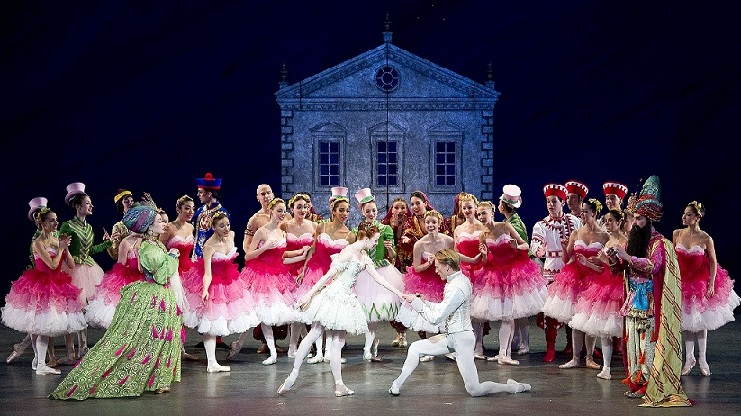
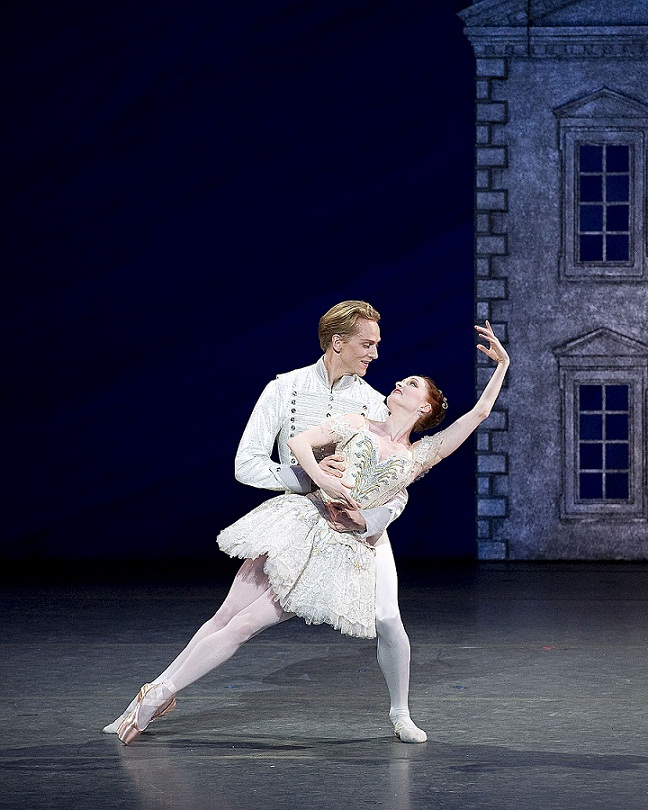
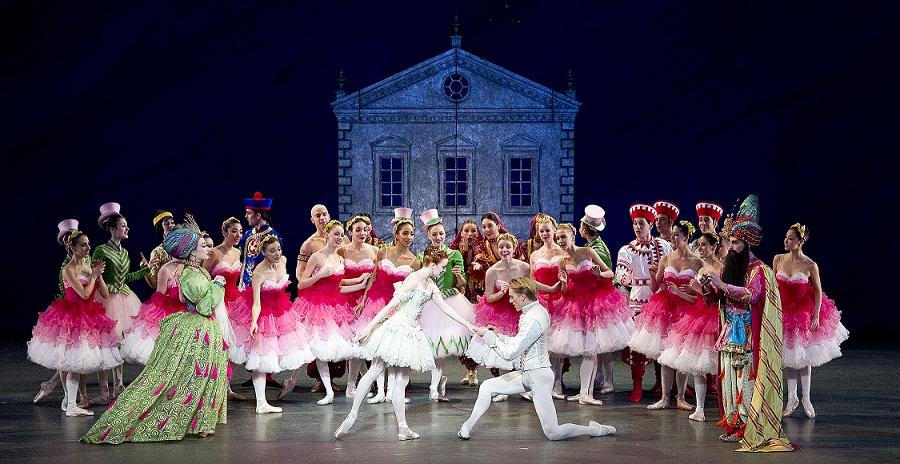
As promised, here are some photos of Ratmansky’s new Nutcracker for ABT.

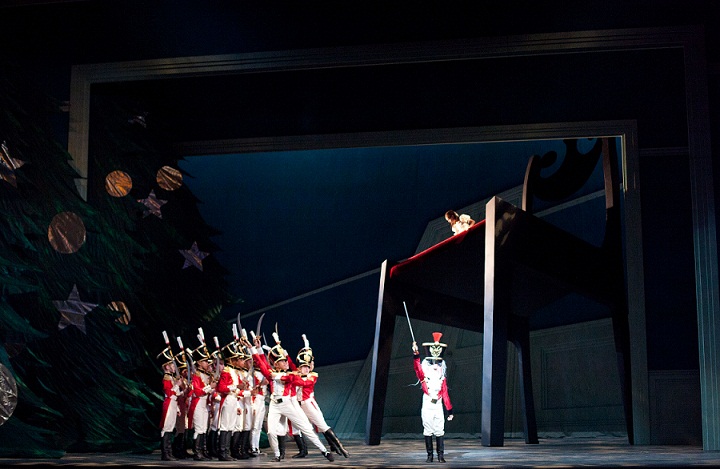
I forgot to mention in my last post how much I loved the Alice in Wonderland-like high chair for Clara to sit atop to watch the mice / nutcracker & soldier battle scene. Really brilliant sets. Richard Hudson is a genius.

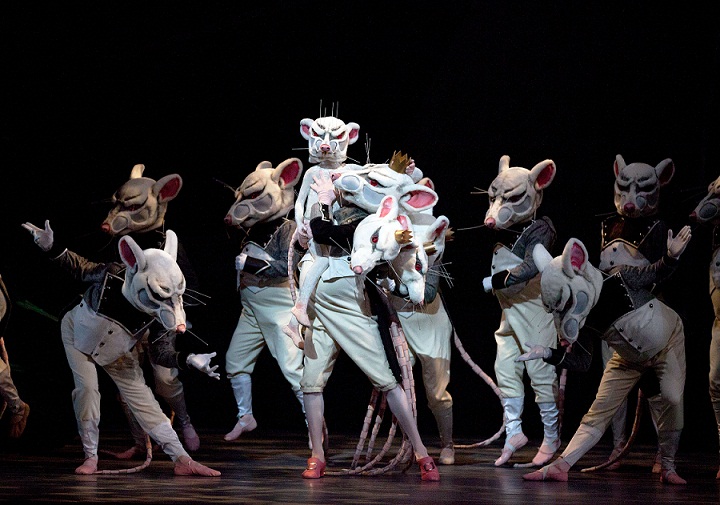
The battle scene and the many-headed mouse king.

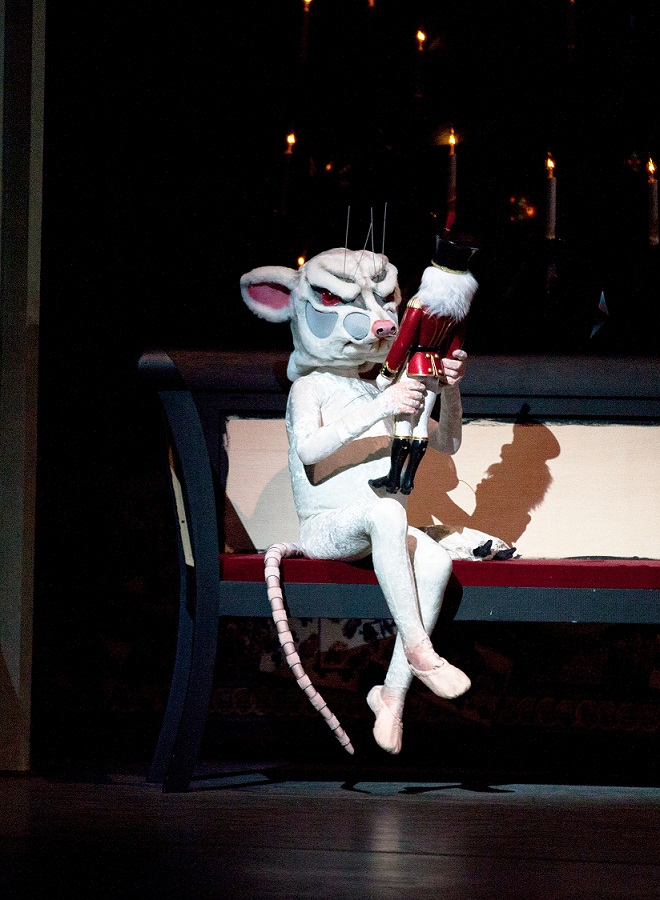
The mischievous little mouse (Justin Souriau-Levine) holds the nutcracker doll.


David Hallberg and Gillian Murphy as the Nutcracker Prince and grown-up Clara. I forgot to mention that they do get married in this version.

David and Gillian in the final pas de deux.

Top four photos byΒ  Rosalie O’Connor; bottom two by Gene Schiavone, courtesy of ABT.

American Ballet Theater’s Original New Nutcracker


More photos coming soon. This one (of Gillian Murphy and Catherine Hurlin as the two versions of Clara) is taken from culture.wnyc.org.

Last night was the official opening of ABT’s much awaited new Ratmansky-choreographed Nutcracker at BAM. I loved almost every single second of it. I’ve only seen about six different versions of this ballet, but this one to me seems most original. It’s very entertaining, very humorous at points, and can somehow maintain the attentions of small children while being clever and witty – and beautiful – for adults. It’s very theatrical and it’s not as “dancy” as the one I just saw from the Bolshoi (Grigorovich’s version)- there’s more non-balletic jumping and playing around in Act I at the party, but there’s plenty of beautifully choreographed classical ballet during the grown Clara and Nutcracker Prince pas de deux and the ensemble snow scene and waltz of the flowers.

It opens with the cooks and maids in the kitchen preparing Christmas dinner. They’re going about their merry preparations when suddenly their space is invaded by mice. The mice completely take over, chase out the cooks, jump up on the tables and grab for the hanging meats. Adorable and hilarious. There’s one very cutely mischievous little mouse who appears throughout.

Then the party scene happens and Drosselmeyer (a non-dance role here) presents the children with two sets of life-sized dolls. The dancing was very good, but there were no sharp, stunted staccato movements as in the Bolshoi’s, so the dancers didn’t look like real dolls to me. I loved the costumes for Harlequin and Columbine though. They looked the most commedia dell’arte that I’ve seen. All costumes were brilliant – one of the most excellent things about ABT’s production. They, and the equally brilliant sets, were made by Richard Hudson, of Lion King fame.

When the dolls are ordered to return to their boxes, the children do a group dance that looks more like fitful stomping than anything balletic. But it’s still musical and evocative and cute, and it got a lot of laughs. The nutcracker that Drosselmeyer then gives Clara (danced brilliantly by Catherine Hurlin) is half-doll, half-human. He’s danced by a boy (Tyler Maloney) but he has a full nutcracker head, so he can’t do as much as the Bolshoi’s human nutcracker doll – his movements are much more limited. Once Clara’s dream begins, the boy removes his doll head before escorting her off to the Kingdom of the Sweets. I have to say, I really liked the boy who danced Clara’s bratty brother, Fritz – Kai Monroe. He was very entertaining, did a good job with both the acting and the dancing (high jumps!), and I think he will be one to watch for.

The Battle scene between the mice and the nutcracker and his soldiers was good, and, again, the costume for the mouse king (Thomas Forster) was fantabulous. I couldn’t even count the heads he had there were so many. I think of all battle scenes, I like Balanchine’s the best. I love how a mouse will scurry ominously across the floor right in time with a flute chord. Then the mice begin to gather and organize right in time with the flute ensemble so that it seems like the mice are talking. And Balanchine’s battle scene seems the most theatrical. Balanchine’s growing tree is also magnificent. Here, the tree only grows a bit, but soon they multiply and trees begin to eat up the wings, which was also spectacular.

The snow scene was really beautiful and this is where we first meet the grown-up Clara and her nutcracker prince (last night they were Gillian Murphy and David Hallberg, but there are many casts – see James Wolcott’s review of a preview starring Veronika Part and Marcelo Gomes here). Their first pas de deux is a beautiful waltz, and it’s made very clear that this is Clara’s grown-up vision of herself and her prince. The child Clara and Nutcracker boy waltz alongside Gillian and David until the classical ballet steps takes over, and the children stop dancing and gaze longingly at their grown-up selves as they finish the pas de deux. There’s a really beautiful Viennese waltz-type of lift where he spins around with her perched on his shoulders.

The Kingdom of the Sweets is really different from other versions. The “Sugar Plum Fairy” or “Nanny” as she is alternately called here, is not a dance role, but more of an escort through this kind of tour of It’s a Small World. She dons an absolutely gorgeous ancient Indian costume, as does her male companion. The dancer representatives from various countries are not dolls; they are real, but most of the dances are very different. The Arabians, for example, are danced by one man (last night, Sascha Radetsky) and four women, and the women are all cutely chasing the one very wickedly flirtatious man. It reminded me a bit of Kevin McKenzie’s von Rothbart deviously flirting with all the court women at the beginning of the Black Swan pas de deux. At the end of this dance, though, the tables are turned and the women come into their own and no longer need him. Now of course, he’s not very happy about that. It’s great fun and I loved this dance the best.

The Russians (Mikhail Ilyin, Craig Salstein and Arron Scott) were more folksy than bravura ballet, which was fine, because they later did a circle of barrel turns as their part of the final ensemble dance.

And we see Mother Ginger again (or who, as a child, I called The Fat Lady with the big skirt). I haven’t seen her since Balanchine! And there’s an added element of hilarity here involving the mischievous little mouse from the kitchen!

The only dance I didn’t really care for was the Chinese. As I’d expected, these roles were danced by Daniil Simkin and Sarah Lane. But Ratmansky didn’t really use them for what they are known for and the dance is very tame compared to this dance in the other Nut versions. I really wanted to see Daniil go flying around the stage in those crazy million times-overrotated turning leaps that he’s known for. There weren’t even any high jumps. It’s just that I look to the Russian and Chinese dances for the bravura parts and it’s okay if they’re lacking in one dance, but not both! The Chinese weren’t as goofily portrayed though as in other versions, so I appreciated that.

And I loved the waltz of the flowers. Included here are some very charming bees, but they’re not used in a slapstick way at all, which I thought they would be when I initially saw them. They dance is very classical and there’s a beautiful part where the four male bees toss the red and pink-clad ballerinas into each others’ arms in a circular rotation. That received a lot of audience applause.

And then is the ending pas de deux again between Gillian and David. I’d written before, when I saw an excerpt at the Guggenheim, that it looked more modern lyrical than classical, but last night it looked very classical to me. Ratmansky used my favorite lift from the Grigorovich Bolshoi version where the prince lifts and holds Clara up by one lower leg and carries her all around stage like that. The solo variations were nice. David didn’t seem to have the height he normally does on his jetes (I was told later at dinner though, by a dancer – not from ABT – that that choreography was crazy hard) but he made up for it in a series of spins. I know in ballet they’re called turns, but he was going so fast they looked more like ice-skating spins to me!

The only thing I found bothersome was the acoustics in the BAM opera house. Maybe I’ve just never heard live music played there but it just seemed like the orchestra was playing so softly. The sounds of the toe shoe-clad feet and the sounds of children coughing dominated.

Oh, one final thing: when David Koch, who financed a good part of the production, gave his opening speech, he accidentally called Kevin McKenzie “Peter.” Got a lot of ooooohs from the audience. I couldn’t hear through the ooooohs what he said after that – I assume it was an apology – but whatever it was it elicited even more ooooooohs. Funny.

Overall it’s a brilliant new ballet, a very original new production. Definitely get out to BAM if you can! Go here for the rest of the schedule.

The Bolshoi’s Nutcracker

So of course I went yesterday to see the Bolshoi’s Nutcracker, live-streamed into movie theaters all over the world, though, judging by the opening remarks made by announcers and intermission interviews, I think most of the audience was in France. Anyway, there was a pretty good turn-out at the Big Cinema in Manhattan – bigger than turn-outs for the two recorded Emerging Pictures ballet films I saw earlier (the Royal Ballet’s Nutcracker and the Bolshoi’s Flames of Paris). Still, the theater wasn’t packed, as it should have been.

Anyway, this was the best Nutcracker I’ve seen so far. I really loved it. I don’t think anyone puts on a show, makes ballet into theater, quite like the Bolshoi. And their dancers have got to be among the most talented in the world. The things they can do… I think every single woman had a point like Veronika Part and every man like David Hallberg.

This production, by Yuri Grigorovich, had no Sugar Plum Fairy, but instead the grand pas de deux was danced by Marie (so-called here instead of Clara), and her nutcracker, turned into a prince in her dream. I like it so much better this way than having a Sugar Plum Fairy. It just makes more sense in the story to have the young girl imagining herself as a grown-up princess. It makes that final pas de deux so much sweeter. And here, they actually get married, Marie and her prince.


The same ballerina – the exquisite Nina Kaptsova (who I remembered immediately from her role in Flames of Paris as the delicate and sympathetic Marquis’s daughter; photo above from dance.net) – danced both the young and grown-up princess versions of Marie and she was surprisingly believable as both. You’d have to have a small dancer with a very youthful physique to be able to dance both parts. (San Francisco Ballet has grown-up Clara dancing the final pdd too, but two different dancers dance the young and older Clara). Kaptsova’s prince was Artem Ovcharenko, who was also very good though he didn’t stand out quite as much as she. For ABT fans, he reminded me a lot of Maxim Beloserkovsky.

What I really, really loved about this Grigorovich production, though, was all of the dancing. It begins with the guests en route to the party, and they dance across the stage. There are really no non-dance moments as there are in most Nutcrackers I’ve seen, where you have the party with children scurrying about and the grown-ups chasing after them and chatting with each other, and Clara and her brother fighting over the little nutcracker, who is actually a doll. Here, the children aren’t really children but dancers in the company (one reason why there’s so much more dancing), and, magnificently, the “toys” are all dancers as well! I don’t think I’ve ever seen a real dancer play the little nutcracker doll. And s/he (not sure which gender, as unfortunately the name isn’t listed in the program) was brilliantΒ  – one of the best parts of the first Act. A shame there’s no name – unless it’s Anna Proskurnina, who’s listed as Marie’s brother? I’ll have to look it up.

The other two toys in the first Act – Harlequin and Columbine – were danced brilliantly as well, by Vyacheslav Lopatin and Anna Tikhomirova. Those dancers were the most doll-like dolls – with their stunted, sharp staccato movements – that I’ve ever seen.

After the snow scene, Marie and her Nutcracker (now, in his human version, danced by Ovcharenko) didn’t really go to a Land of Sweets but more like a land of toys, as male / female pairs of dolls from various parts of the world entertain them. I went to the performance with my a Chinese friend and of course I was really embarrassed by the Chinese dolls. He thought they were funny though, and we both agreed they were danced very well, by Svetlana Pavlova and Denis Medvedev. I can really see Daniil Simkin dancing this role in ABT’s production, if Ratmansky does it the same way. ( I know Simkin will also have a turn as the Nutcracker Prince / Cavalier at ABT). I also hope Ratmansky doesn’t resort to stereotypes in creating these roles, as virtually every other choreographer has.

As the Indian dolls, Victoria Osipova (relation to Natalia?) and Andrei Bolotin had a bit of a slip and she fell, but I didn’t think it was that big of a deal. She got up immediately and there was no sign of injury. This is usually the dance most of us in the US know as “coffee” or the Arabian part, but here the costumes are very different – more classical, no bare midriff and tiny top – and the dancing more conservative.

I loved the grand pas de deux. It was both sweet and innocent (like you’d expect of a young girl’s dream of her older self being swept off her feet by a handsome prince), and stunning in its athleticism. Some of those lifts are the most breathtaking I’ve ever seen. At one point, he held her up by her calf and she’s upright, and he carried her all over the stage that way. There are many overhead lifts where he’s holding only her waist, with her legs in the air, feet delicately crossed, and she looks down at him, crossing her hands beatifically. And at the end of the wedding, he carries her off in a cradle lift. So sweet. The solo variations for each were equally breathtaking. Kaptsova had a series of super-fast chaine turns but with all kinds of additional footwork thrown in. Watching her dance, at points I couldn’t believe my eyes.

Oh and also Drosselmeyer was much more of a dance part than most other Drosselmeyers I’ve seen. He was danced very well by Denis Savin.

Overall brilliant production. I feel spoiled now, like I’m never going to be able to see another Nutcracker again. But I will this Thursday – when Ratmansky’s opens at BAM!