
Last Week at New York City Ballet


Last week I went to two performances of NYCB – opening night and Thursday night’s “See the Music” program – and to two of the free all-day Balanchine events on Saturday. First, I’ll talk about the last two since I found them so informative. The free studio talk on Saturday afternoon – Balanchine’s birthday – was moderated by Sean Lavery (former NYCB principal dancer, now ballet master), and included Sterling Hyltin (in Paul Kolnik photo above with Robert Fairchild), Chase Finlay, and Jenifer Ringer. Lavery asked the dancers to talk about their first Balanchine ballets, their favorites, and what drew them to NYCB. Hyltin named as her favorite Duo Concertant (pictured above) which I’d just seen her dance on opening night. She said she liked the syncopated movement, the he goes and I go kind of back and forth movement conversation with her partner, and with the musicians. I really liked it too. The violinist and pianist are onstage (the music is Stravinsky), and I like the interaction between the dancers and the musicians, and between the two dancers, and I like the sharp, angular movement. She seemed particularly animated when I saw it. I love Robert Fairchild and think he’s such a sharp, masculine mover with a presence that commands your attention without meaning to – he kind of reminds me of a less cocky Ethan Stiefel – but she seemed so happy to be dancing this piece that she stood out to me more. It was nice to hear her talk about it.

But what I really loved was the School of American Ballet class taught by Peter Martins. He interacted cutely with the students, particularly “Cyrus,” (at least I think that was his name…) a tall, long-limbed young man who I think will soon be in the company. Cyrus didn’t always do everything perfectly (at least in Martins’s eyes) but he had a charming presence and a great leading-man physique and you can tell he works hard.

Martins had the class demonstrate ballet basics – beginning with the five positions, and they showed us a perfect fifth position (with the toes of the front foot touching the heel of the other and vice versa). More interestingly, he had the class show us the difference between a Balanchine hand and a classical ballet hand. I’d always noticed there was a difference but couldn’t figure it out exactly. God gave us five fingers, Balanchine had said, so we shouldn’t hide two of them. The Balanchine hand shows all five fingers, the classical ballet one only three (with the ring finger and pinky held so that they are hidden from view behind the middle finger).

Martins also had the students show us how Balanchine’s fourth position differed from others’. In Balanchine’s the back leg is straight; in all others’ the back leg is bent. Martins didn’t go into any functional explanation for this – just said “here, we think it looks better.” But I thought about it and thought, wow, it must be hard to take off in a jump for example with the back leg straight. And then I realized that’s partly why Balanchine’s choreography always looks so fluid, like one step leading right into another, without a lot of stopping to build up to a big athletic feat – a big jump or series of turns. Other companies – like the Russians, like the Bolshoi – are all about preparing so that you can do something astounding. So they’re all about the building up.

This was mentioned in the studio talk as well. Lavery also talked about how fluid Balanchine’s movement was, and how, for example, in a lift, a guy would pick up a girl, then take two steps, and put her down rather than walk all over stage with her hoisted above his head. Balanchine wanted her to come up, then down right again, because that was more fluid, rather than have her head bobbing around up there while the guy was running all around with her.

Martins also demonstrated the bows. At City Ballet, he said, we just do them as such, and the girls did a little curtsy with the back leg slightly bent, without going down on one knee. Making fun of the dramatic Swan Lake bows, Martins went all the way down on one knee, exclaiming, “Yes, yes, I know I’m good!!!” while putting his head down, forehead nearly touching the floor, and raising his arms up in back of him like wings, fingers pointed toward the ceiling. It was hilarious.

Anyway, here are a couple more photos of opening night:


Above: Ashley Bouder in Valse-Fantaisie, and below, the cast, including Andrew Veyette, in the same (all photos by Paul Kolnik)


I liked Balanchine’s Valse-Fantaisie (Veyette replaced Joaquin DeLuz – but don’t know why because DeLuz danced Concerto DSCH two nights later) but I really loved the first of the evening, Walpurgisnacht Ballet. I’d never seen Walpurgisnacht before and it’s funny but I always seem to love the Balanchine ballets that are the least often performed. This was really beautiful. It’s from Gounod’s Faust, and features a group of women (and only one man – here Charles Askegard) in deep red dresses, their hair down in the second half as the music increases in tempo so that there’s almost kind of a hedonistic madness in the mood – and the footwork is so intensely complicated and fast fast fast. Wendy Whelan even made a tiny little flub, which I’ve never seen her do before. Crazy! And breathtaking!

And the evening ended with The Four Temperaments. I’ve said before and I’ll complain again that I still don’t understand why everyone goes on about how brilliant this one is. To me, there are supposed to be four temperaments, and the ballet is divided accordingly into four variations after the theme: melancholic, sanguinic, phlegmatic, and choleric. But they all seem to be the same to me. The dance seems one-note throughout so that after the first variation, I’m waiting for it to end. I’ll keep seeing it though, perhaps performed by a variety of companies if I have the chance, and will keep looking for the nuances…

“See the Music” night opened with Faycal Karoui’s discussion of Mozartiana, Tchaikovsky’s homage to / riff on Mozart, which made me appreciate Tchaikovsky even more. Then that piece was danced – by Maria Kowroski, Daniel Ulbricht, and Tyler Angle. Tyler stood out to me. As always, he dances with so much meaning, so much intention, and so much expansiveness. He’s a really beautiful dancer.

Then came Ratmansky’s Concerto DSCH, danced by Wendy Whelan, Ashley Bouder, Joaquin DeLuz, Andrew Veyette (replacing this time Gonzalo Garcia), and Benjamin Millepied. Oh, Natalie Portman was there, albeit late – she came in with a friend after Karoui’s lecture and right before Mozartiana was performed. Then, she left right after Concerto DSCH, after Millepied was done performing, and before the last piece. I thought it was a shame she missed Sara Mearns in the last dance, but a Twitter friend said she had a movie premiere that night, so I guess she needed to leave early for that.

Anyway, as usual, Millepied did not stand out to me, and I couldn’t stop thinking of seeing Tyler Angle in that role before and the way he lunges romantically toward the main girl, making it clear how much he yearns for her. Millepied’s knees nearly touch the ground in his deep steps toward her and it just looks like a dance step, not like anything evoking a specific emotion. As always I loved Bouder and DeLuz in the fast, playfully firtatious three-some part. I missed Garcia – where is he? I hope not injured! – but thought Veyette did a fine job in his stead.

And the evening ended brilliantly with Sara Mearns and Charles Askegard dancing the ballet leads in Balanchine’s Cortege Hongrois, while Rebecca Krohn and Sean Suozzi just as brilliantly danced the folksy Hungarian leads. I really love that dance and it made me all the more eager to see Mearns in Swan Lake!

On both nights, I went with my friend, author Maria Mutsuki Mockett. She writes an author blog but has been attending the ballet much more frequently and is now blogging a lot about ballet as well. She’s an excellent writer, so please check out her blog!
Janie Taylor Debuts in Millepied’s “Why Am I Not Where You Are” Etc.

I’ve been remiss in my New York City Ballet posts! Last week I saw two programs: one featuring three dances to three different violin concertos – Peter Martins’s Barber Violin Concerto, Robbins’ Opus 19 / The Dreamer, and Balanchine’s Stravinsky Violin Concerto. And the other program was another in the “See the Music” series but was also dedicated to Santiago Calatrava, who designed sets for all three of the ballets performed – Benjamin Millepied’s Why Am I Not Where You Are (pictured above, photo by Paul Kolnik), Christopher Wheeldon’s Estancia (pictured below, photo also by Kolnik), and Mauro Bigonzetti’s Luce Nascosta, all of which premiered last season and which I wrote about here, here, and here.

Calatrava was in the theater, and after encouragement by Peter Martins, he rose and took a bow.

Then, as with the first “See the Music” program, before the performance began, the orchestra pit rose and conductor Faycal Karoui gave a humorous little explanation of various parts of the Thierry Escaich score from Millepied’s Why, the first ballet performed.

These explanations are really interesting to me, I have to say. I only took one classical music class in college and now wish I’d taken more. Karoui talked about how there were four main parts to the score: a waltz, a tango, a disco, and a final climactic part, and he talked about the differences in tempo between them, and between them and a typical waltz, tango, etc.. He also talked about how the ballet has a central male character (danced very well by Sean Suozzi – in top picture, being carried by the group of men), and how you can hear that central character’s theme – or voice – throughout each section of the music. But the voice changes with each section: at first, he’s shy and mysterious (and his voice in the first section is portrayed by a violin solo), then as the orchestra grows sharper and stronger in the second, tango, section, so did the character, etc.

When we got to the “disco” section (it sounded nothing like disco to me but just slightly more mechanical and percussive than the preceding sections), Karoui really began rocking out as he led the orchestra. It was like he was actually dancing in a disco, and I nearly cracked up. I’m not sure if that’s what he normally does down in that pit – if he regularly starts to embody the music literally like that, or if he was just being a goof for the audience. He didn’t seem to be hamming it up at that point, though – oddly – so who knows. Anyway, he is very entertaining and I find his musical explanations very educational as well. What more can you ask than to be both entertained and educated, right?

Anyway, Janie Taylor debuted in the Millepied. She was supposed to have debuted when the ballet did last season but she was out with injury and so Kathryn Morgan had filled in. Character-wise I thought she played it the same as Morgan. Except with Morgan it seemed to have a West Side Story feel to it; with Janie it was darker and more La Valse-like. Both were tragic, but in a different way; Kathryn’s character seemed more innocent. Anyway, this was my second time seeing the ballet and it grew on me. It’s very dramatic, not a dull moment in the whole thing, and you’re really on the edge of your seat, both because of the intensity of the music – maintained throughout each section – and the dramatic story of the poor innocent guy who’s drawn into another world by his enchantment by this ethereal creature, only to get trapped and ultimately destroyed, along with her.

To me, Sara Mearns and Amar Ramasar, with their bravura roles, largely stole the show – I think I remember thinking the same last time. She with those crazy fast chaine turns all around stage that almost make you sickly dizzy, and he with his virtuosic leap sequence – they are kind of the sinister characters, seducing Suozzi but also the audience.

Then came Estancia, and it was my first time seeing Ana Sophia Scheller and Adrian Danchig-Waring (pictured above) in the leads. I’m not a huge fan of this ballet – well, I like the ensemble sections, particularly the dancing and taming of the “horses” – but I nearly fall asleep during the middle, romance part, where city boy wins country girl over. I think it’s just the choreography in that middle section (that I found relatively bland) that slows it down – along with the music – but I liked Scheller and Danchig-Waring just as much as the first pair of leads – Tiler Peck and Tyler Angle. In fact, they seemed to fit the roles a bit more. Scheller reminded me of the main character of Agnes de Mille’s Rodeo and there was something more sweetly, playfully tomboyish about her look than Peck’s. And Danchig-Waring perfectly suited the city boy trying to woo her. He acted his part very well. And his movement is always very sharp. Andrew Veyette and Georgina Pazcoquin as the horses who are eventually tamed, were fabulously entertaining.

And lastly was Bigonzetti’s Luce Nascosta (picture at left by Kolnik), which I’ve seen now three times and which I like but think is too long. I missed seeing Craig Hall in the middle section that seems to be softer and looser than the other sections, where the movement is more marked by those extreme shapes with the flexed hands, splayed fingers, and angular balances and slides on pointe. Hall seems to have the ability to move in a more undulating, kind of serpentine way than most of the others and it seems to me to suit that middle section well.

In the previous program, I loved Megan Fairchild again as the “modern” dancer in Barber Violin Concerto, and, as always, Gonzalo Garcia as “the dreamer” in Robbins’ Opus 19!

New York City Ballet’s First “See the Music” Program

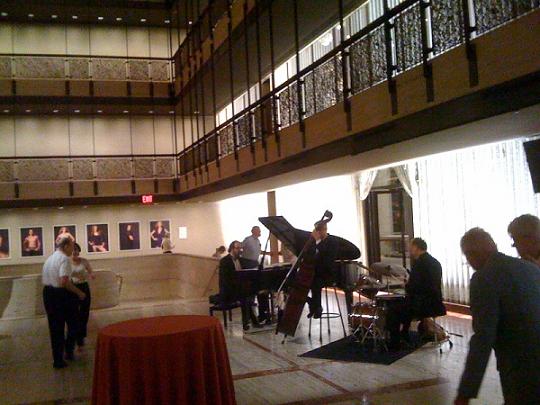
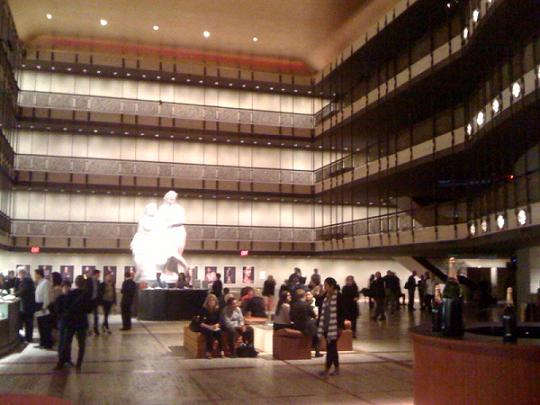
Friday night, my friends Hsien and Alyssa came with me to see the first program in NYCB’s “See the Music” series. First, we met for drinks on the promenade, which, as I mentioned, they’d opened an hour before showtime for the first week of this fall season. We watched members of the orchestra play some soft jazz music, which some patrons were dancing to. I know Hsien from my ballroom dancing days and we had to laugh because some of that music sounded straight out of Blackpool! (Blackpool’s one of the only – perhaps THE only – ballroom dance competition with live music.) (Above are a couple of my pictures of the promenade, about an hour before the performance, with people beginning to gather. My iPhone seems to take better photos outside…)

The two ballets performed were Ratmansky’s Namouna: A Grand Divertissement, which premiered last season, and Jerome Robbins’ The Four Seasons, which served for the first week of this first fall season as a tribute to fall.

Before the performance, Peter Martins came out and introduced the new series, explaining that it was inspired by Balanchine’s highly musical approach to dance, his belief that dance is music made visual, summarized by his words, “see the music, hear the dance.” Then the newly movable orchestra pit rose (as I knew it would!), and up came conductor Faycal Karoui with his crew, to explain a few things about Eduaord Lalo’s Namouna score. No one could give these talks but Karoui. He is hilarious, such a character!


Photo of Karoui by Paul Kolnik, taken from The Faster Times.

Karoui joked, in his thick French accent, that the music is very French, because of its … charm of course. Okay, then he became serious. The Lalo score is too long, of course, to talk about all of it, but Karoui focused on a few sections. One of the sections, he explained is characterized by its transparency of orchestration, meaning the harmonies don’t always  behave the way you expect them to; they are a surprise. He talked about how the beginning of the score had a nautical theme, and it opened with a sound like waves, but more German waves than French, he said, as the opening crescendo sounded more like Wagner’s The Flying Dutchman. He talked about the conversation between the harps and the strings, how Lalo plays with flexibility inside the tempos by following a quick tempo with a slower one, and he showed how Ratmansky had the dancers visualize part of that tempo by having the corps women at one point use cymbals onstage. After Karoui did a little dance himself while clapping the cymbals, he and Martins had the audience clap where the cymbals should be played to get us to internalize that rhythm a bit.

Karoui spoke at length about one of my favorite scenes in the ballet, where a group of smokers (led by Jenifer Ringer) really kind of tantalize the poor male lead, blowing smoke right into his yearning little face. It’s called “The Cigarette Waltz” believe it or not, and Karoui showed how the music really teases and tantalizes you into desperately wanting a cigarette, just like Ringer and her friends tantalize the poor sailor into wanting one of them. “Oooh, I really want one now,” Karoui cried after the orchestra demonstrated part of that waltz.

I liked Namouna much much better on seeing it a second time. I wrote about it earlier here (also, read Marina Harss’s fabulously detailed and in-depth description in Faster Times). It seemed less long this time, and each of the the parts seemed entertaining and compelling, each having its own theme and it own little storyline, however abstract the whole was. Maybe it was because of Karoui’s brief humorous explanations of the music, or maybe it’s just Ratmansky, because I always feel this way with his work – that nothing strikes me that much on first viewing, but that the more I see each ballet of his, the more I see in it, and the more entrancing I begin to find it.

That ballet was all the same, except this time Tyler Angle took over for Robert Fairchild as the main sailor guy. I’m told Robert is out for the moment with an injury. I loved Robert, but I really liked Tyler as well. Robert is so boyishly charming like Jose Carreno, and his dancing is more sharp and precise, hitting every count with spectacular flair and pizzaz, whereas Tyler’s more Romantic with his expression, with stretching port de bras and longing lunges, and he really draws out the music. They are such different dancers and it’s always nice to see another’s interpretation.

The next “See the Music” program will be this Sunday’s matinee.

New York City Ballet’s First Fall Season Opening Night


Tuesday night, New York City Ballet opened its very first fall season with performances of Balanchine’s Serenade, Peter Martins’s Grazioso, and Jerome Robbins’s The Four Seasons. First, before the performance began, Peter Martins came out and introduced each of the principal dancers, who came out onstage one by one, and said this season would be a celebration of them. Tiler Peck in particular was wearing this really gorgeous silky fuchsia dress. Martins said all principals were there except for Benjamin Millepied, who was doing something movie-related “en France,” he said with a funny faux Euro accent. Everyone laughed and gave the dancers a huge round of applause. The house was packed and it was clear how thrilled the company’s many fans are with there being a fall season this year. Martins made fun of himself for being so into toasts and said that during intermission, we’d all be given be given free champagne to toast the principals. Which we were – very fun!

The part of the performance I was mainly looking forward to was Janie Taylor’s debut in Serenade (above headshot and Serenade photo by Paul Kolnik) as the main ballerina. As usual with her, she completely made the ballet her own. I thought the ballet had a somewhat dark element with her, that I’ve never seen before. When she first ran out onstage, late for class, instead of looking like she was all frantic about being late because she’d been held up by a boy, it looked like she was running from something – from him. That man was Charles Askegard and when he danced the middle waltz part with her, the huge size difference between them added to the sense of foreboding, that she was fragile, he was pushing her around, and she’d eventually be hurt by him. At certain parts, it was literally like he was pulling her along. When he lifted her and she raised her legs in a split, it looked almost like she was trying to get away from him. Sara Mearns was the angel and Ask La Cour was the man who I call “blind justice” who take care of Taylor when she falls, and it was interesting how much the two male leads and two female leads looked alike. I almost got Taylor and Mearns mixed up at parts, thinking they were taking on the other’s role. And the end when the men raise Taylor up like pallbearers and she is carried off by them, arching her back, arms outstretched  – so hauntingly beautiful. It reminded me a bit of Balanchine’s La Valse.

I was also looking forward to Martins’s Grazioso, in which three handsome men – Gonzalo Garcia, Andrew Veyette and Daniel Ulbrich – vie for Ashley Bouder’s attention with their bravura moves. I don’t think this ballet has been performed since it premiered a few seasons ago. And I loved it all over again. I love how each guy has his own personality – Garcia is the romantic, Veyette is the manly man one, and Ulbrich is the one with all the high jumping tricks. And Bouder really played the tart, looking at each of them up and down at points kind of lasciviously, really trying to choose. The guy next to me was really giggly over it.

And the evening ended with Robbins’ The Four Seasons, which itself ends with a lovely tribute to fall.

This whole season the Koch theater will open an hour early. The promenade overlooking Lincoln Center Plaza will be open for cocktails, the gift shop will be open, and, for the rest of this opening week, there will also be live jazz performed by the NYCB Orchestra one hour before performance time. They have the promenade and mezzanine area done up nicely, with big plush chairs. Also taking place the rest of this week will be a “meet the artists” session whereby, beginning at 6:45 p.m. in the first ring of the auditorium, the principals dancers will be available to chat with ticket holders. There’s also a photo exhibition of the dancers by photographer HenryLeutwyler on display in the theater throughout the season.

Tomorrow night will be the first of seven “See the Music” performances which will provide a look inside NYCB’s 62-piece orchestra. At the beginning of each performance, Peter Martins and musical director Faycal Karoui will briefly discuss the program’s music, followed by the orchestra performing an excerpt of one of the ballet scores. The subject of tomorrow night’s discussion will be Eduoard Lalo’s score for Ratmansky’s Namouna: A Grand Divertissement, which premiered last season. Additional “See the Music” programs are Sept. 26 matinee, January 20, Feb. 1, Feb. 19 matinee, May 25 and June 11.