My friend Erin Gilbreth recently started her own theater company here in New York called American Bard Theater Company. They specialize in putting on Shakespeare plays. Tonight, they open Measure For Measure at the Roy Arias Theater Center on 43rd Street. See their website for more info. And watch the promo video below. So excited!
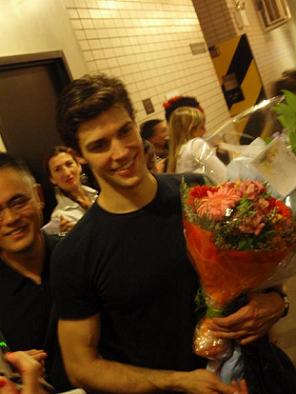
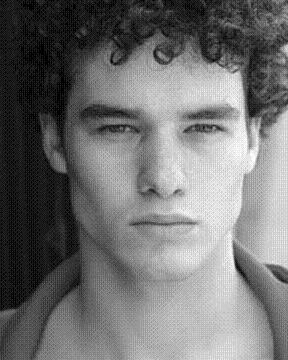
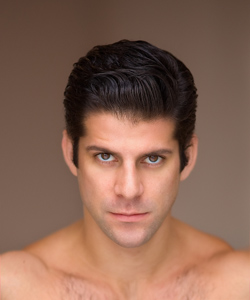
Haha, I don’t even think this book has been optioned yet for film! It should be though – it’s very cinematic. All throughout reading it, I kept “seeing” Romeo – and always as one of my favorite male dancers who’s danced the role. Roberto (top left) is of course the natural choice since he’s Italian and the book’s set largely in Italy. But I feel he may not have enough of the delicious cockiness in him; Roberto’s too nice, at least onstage. Ditto for Cory (top right). Marcelo of course would probably be best … although I don’t know if he has acting skills required for a speaking role in a film. He’s definitely a good stage dancer/actor.
I’m being goofy. I’m sure they would cast Andrew Garfield or Louis Garrel or someone.
Anyway, Anne Fortier’s Juliet, which I recently finished, is a really interesting read, especially for fans of Kenneth MacMillan, and I guess … Shakespeare 🙂
It’s part historical fiction, part romance, and part mystery / suspense and it shifts back and forth between the present day and the Siena, Italy of 1340, when the two people Shakespeare based his characters on – Romeo Marescotti and Giulietta Tomolei – actually lived. Of course in Shakespeare’s version, the lovers were from Verona, but according to this book, early stories – and there were many tales of Romeo and Juliet; Shakespeare’s was only one of many – had all the action happen in Siena.
The novel starts when 24-year-old American Julie Jacobs receives an inheritance after the death of her great aunt Rose, who raised her after her mother and father were suspiciously killed when she was a child. The inheritance is simply a key to a safe deposit box in Siena, which her mother had originally left with the aunt. Julie is told by her aunt’s butler and his lawyer that it contains a treasure, which she must go to Italy to find. So she sets off for Siena. There she encounters other, less savory types, who are equally interested in her treasure, and so begins the suspense part of the novel.
Julie soon discovers that at the time her mother died, she’d been researching the history of Romeo and Juliet, or Romeo and Giulietta. Julie’s mother’s last name was Tolomei, and it turns out Julie is related to the original Giulietta. I don’t want to give too much away, but the contemporary part of the story consists of the suspense and romance of finding the treasure – which is related to R&J – as well finding Romeo’s descendant.
Julie finds in her mother’s belongings in Italy the earliest version of the story of Romeo and Giulietta, and her reading of that accounts for the historical half of the novel, which was the most compelling and poignant to me. It’s different from the version we all know through Shakespeare. The warring families are the Tolomeis and the Salimbenis, with the Salimbenis being far more vicious and far more financially powerful. At the beginning of the historical story, the Salimbenis have just raided Giulietta’s house and murdered everyone but her. (She was in church at the time.) In a nutshell, Friar Lorenzo is able to sneak Giulietta out to her uncle Tolomei’s estate. Romeo, who is a Marescotti – a historically highly respected military family with connections to Charlemagne but who currently has no financial power – is a hopeless playboy. But once he sets eyes on Giulietta’s portrait, while he is having his own Marescotti-family portrait done, he is in love.
The artist tells Romeo that Giulietta resides at the Tolomei castle. He goes to a ball there in search of her, finds her (she’s a Helen of Troy type and stands far out from the crowd), and follows her into her chamber. She’s still traumatized by what’s happened to her family and so is immune to his flirting. She does tell him though that he can have anything he wants from her if he brings her the heart (or was it the head?…) of the master of the Salimbeni family, who ordered the execution. Romeo’s a bit taken aback, but tells her he’ll do anything.
The next day Friar Lorenzo brings Giulietta to the Marescotti estate and she tells Romeo she doesn’t know what came over her the other day to ask such violence of him; she doesn’t want him to get hurt. He kind of plays with her a bit, she softens, and over the course of this and several other meetings, they fall in love.
Romeo talks his father into asking Tolomei for her hand in marriage. For Romeo I mean. The father is reluctant because he doesn’t want to be seen as “getting involved” in the Tolomei / Salimbeni feud. But seeing how in love his son is, he agrees.
But just as he goes to approach Tolomei that night, old Salimbeni, smitten with Giulietta whom he spies in the distance, reveals that he wants her for himself. This will end the violence between the families once and for all, he claims. The whole crowd gasps, since Salimbeni is old enough practically to be her grandfather, not to mention married (although everyone also knows his wife will soon be dead, as he is starving her, as he’s done to prior wives… Medieval society must have been so lovely…) Of course Tolomei has no choice but to say yes – the Salimbenis are far more powerful – both physically and financially. Saying no to Salimbeni would be family suicide.
Poor Giulietta nearly collapses upon hearing she’s to be the wife of the man who slaughtered her family, and she begs Tolomei not to let the marriage happen. Tolomei refuses. Romeo declares that he will beat Nico, Salimbeni’s son, in the Palio (a Medieval-style horse race that continues to this day), and, if he does, he will win Giulietta’s hand.
At the Palio the following day, Romeo does win, but during the course of the race, Nico kills Tebaldo, Tolomei’s son, but with Romeo’s dagger, making it look like Romeo is the murderer. This is how Romeo gets banished. Although Romeo sneaks back to town with Friar Lorenzo and marries Giulietta in the back of the church where she is at worship, Salimbeni finds them and, well, things don’t go too well for Romeo… Salimbeni’s wife finally starves and he marries Giulietta, then keeps her a prisoner in his country castle.
I should stop there! But the story goes on and there are all kinds of twists and turns. It’s a fascinating narrative and you can see all the same – or many of the same – elements Shakespeare included. But the theme in Shakespeare is the warring families or factions, gangs, what have you – and how innocent individuals get unfairly, tragically caught up in the fighting. In the original, it’s more about the viciousness of one evil, all-powerful man. I found it interesting to see how a great writer manipulated facts to craft a story with themes that would reach far beyond the time and place in which the story was set. I mean, Shakespeare’s version also contained beautiful poetry of course, but his basic story is more powerful and far-reaching than the original. The original does give you a sense of how violent and how absolutely awful Medieval society was for women though.
Anyway, the novel’s very good – at least the historical part. I highly recommend it for that. The contemporary part is cute romance-wise, and definitely suspenseful, but in my opinion not nearly as powerful from a literary perspective as the historical.
Funny, I didn’t really think of who would play Julie / Giulietta. Diana Vishneva or Veronika Part would be good – she has to be Helen of Troy beautiful! But they both have Russian accents and I don’t know if that would work… Hmmm, who else?…
(Photos above, clockwise from top left: Roberto Bolle, taken by me; Cory Stearns, from ABT’s website; and Marcelo Gomes, from ABT’s website.)
Yesterday was stressful. Had to make a hard hard choice: whether to spend the matinee at New York City Ballet watching three of my favorite dancers — Gonzalo Garcia, Tyler Angle, and Janie Taylor — make their debuts in Midsummer Night’s Dream, or at American Ballet Theater seeing Hee Seo debut as the title character in La Sylphide, with one of my favorite ABT dancers, David Hallberg opposite her. (Review coming very soon, along with earlier Sylphide cast, and two Midsummer casts — yes, I’m behind behind behind!)
I’d actually contemplated running back and forth across the Plaza, like I know some have done in times past, but the running times for the first acts were totally different and there was no way I was going to be able to see Gonzalo’s Oberon in Midsummer and then make it to the Met in time for David and Hee in the first act of Sylphide. So, I chose my David, and the lovely debuting Hee. Ever so thankfully I talked my friend, author Michael Northrop, into covering the goings on across the Plaza.
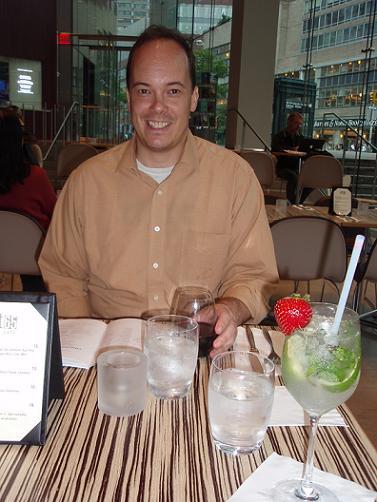
Afterwards, over drinks and food at the Alice Tully Hall Cafe (they have half-priced specialty drinks from 3-6 pm! And not watered-down at all! I nearly passed out after two sips of that mojito in front of me 🙂 ), he told me that Gonzalo did just fine with that crazy high-flying scherzo for Oberon in the first act (I knew he would!), and that he really liked Teresa Reichlin as Titania and Janie and Tyler in the second act divertissement, which received a lot of applause, which I can just imagine! He also agreed to write a little review, which I’ll post in a minute. (If you don’t know the story of Midsummer, read about it here — Balanchine pretty closely follows the Shakespeare).
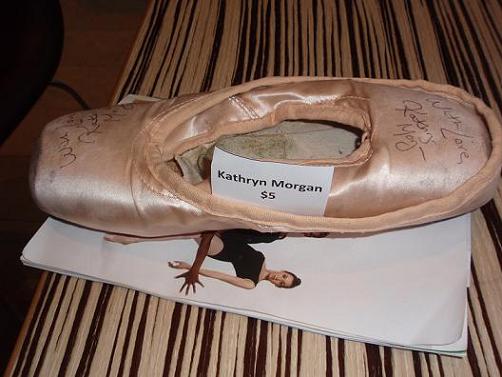
But first, it being Michael’s last day at NYCB this season, he browsed the gift shop, and ended up with a pair of Kathryn Morgan toe shoes. He told me (and, apparently the amused gift shop attendant) he figured she wasn’t going to be $5 for much longer 🙂 I guess their shoes cost a certain amount according to their status: principal ballerina shoes are $30, soloists are $15 and corps members $5. I didn’t know all this. I’ve never wandered over to the toe shoes section. I initially wondered why, then realized, oh, my favorite dancers don’t usually wear toe shoes. Sorry to be lewd, honestly, but I then couldn’t help but wonder — just because of that crazy strong mojito that nearly put me on the floor — why they don’t sell other kinds of used dancewear that my favorites *do* wear, alongside the toe shoes. Sorry! But can you imagine? Total alternate universe.
Anyway, here is Michael’s review:
At Dunkin’ Donuts, they sell munchkins 25 at a time. That’s about how many you get at New York City Ballet’s A Midsummer Night’s Dream, as well. The squadron of young dancers from SAB added a nice dose of fun and energy to a matinee that already had plenty of both on Saturday.
Daniel Ulbricht didn’t dance the role of Puck, so instead of gravity-defying antics, we just got antics. Corps member Troy Schumacher was announced as a late sub for soloist Sean Suozzi in the role, and there were some disappointed Ohhs around me. The thought: We’re getting the third string. Schumacher did an excellent job, though. He moved with an appropriately sprightly energy and showed a nice touch with the comedic moments. When he realized his magical matchmaking mistake, you could almost hear the “D’oh!”
Teresa Reichlen was fantastic as Titania, displaying just the right balance of regal, playful, and otherworldly for a fairy queen. And Robert Fairchild, a very busy man this season, excelled in yet another role (albeit in a ridiculous Prince Valiant costume) as Lysander. His put-upon love interest was once again Sterling Hyltin. The leads from NYCB’s Romeo + Juliet both showed they can handle Shakespeare’s comedy as well as his tragedy. Hyltin, for example, dialed up a slightly manic quality to great effect.
And Balanchine’s choreography tells the entire story in Act I, leaving Act II free for the divertissement. A quick wedding march and then Janie Taylor and Tyler Angle were center stage. They brought down the house.
Angle is a strong presence, but he defers so gracefully and lifts so effortlessly that he never soaks up more than his share of the spotlight. I noticed that when he partnered Tiler Peck in Mercurial Manoeuvres, and again on Saturday. Janie Taylor was both a delicate vision and a physical wonder, sometimes in turns, sometimes simultaneously. It’s a complete oxymoron in print, but she pulled it off onstage. Amazing.
The final scene was especially poignant for me, because I knew this was the last performance I’d see this season. Fireflies flickered around Puck against the dark backdrop of, yes, a midsummer night. It was the kind of night you don’t want to end, and the kind of season.
And here is Oberon’s (I mean Philip’s) review of the same cast.
And this just in! Another review (I’m interested in what he says of Gonzalo Garcia) — the one (by a pro critic who doesn’t say things are good when they’re not, and with great detail and specificity) that I’ve been waiting for 🙂 I knew Gonzalo’d nail it! I knew he’d be brilliant! I knew it!