Highlights of Program 2, which I saw last night, were Morphoses and Tangueros Del Sur.
I was wandering around the lounge beforehand and ran into a couple of old friends from my first ballroom studio, Paul Pellicoro’s Dancesport. Always fun to catch up with old friends — especially since one of them belonged to my swing team and I shared with her my first ever lovely competition experience. Anyway, little did we know then, but one of our former tango teachers was in the show! Ivan Terrazas! I was so proud; he was absolutely electrifying (along with the rest of the Tangueros)!
Sir Alastair had gone on and on about this troupe — led by Natalia Hills and Gabriel Misse — when he saw them at the Vail Dance festival recently, and rightly so! Oh my gosh, that was the most astounding tango I’ve ever seen! The piece was called Romper el Piso and was mainly tango but with some footwork and rhythms from other Latin dances like Samba and a little bit of Cha Cha thrown in — but all danced with tango aesthetics. There were duos and trios, both mixed-sex and same-sex. The choreography was original and enlightening and the dancing so polished, precise, lightning fast, sharp, passionate, everything you can imagine in a tango, in a dance. I really hope some of you can see them tonight.
Afterward, my friend Alyssa and I hung out in the lounge. When we left we were a little tipsy (c’mon, the wine is $2!) and I kind of tripped over nothing on the way out, causing us to both burst out laughing. One of the cute tango guys said to us, “tranquilo, tranquilo!” but very flirtatiously 🙂
All photos above by Carlos Furman, courtesy of City Center.
The other knockout performance of the night — for me — was Softly As I Leave You, choreographed by Lightfoot Leon and performed by the stunning Drew Jacoby, who is now one of my favorite female dancers (Alyssa’s as well) and Rubinald Pronk, performing on behalf of Morphoses. Christopher Wheeldon was in the audience and he got mobbed during intermission 🙂
It was the best thing I have ever seen by Morphoses — more Lightfoot Leon, Mr. Wheeldon, please please!
It’s set to a combo of music by Bach and Arvo Part (including the Part section all New Yorkers are now so familiar with, from Wheeldon’s After the Rain pdd), and begins with the statuesque Ms. Jacoby standing inside a box opening out to the audience, contorting herself to fit within its confines, struggling to break free, making the most mesmerizing shapes with her body. Then, in the second movement, Mr. Pronk comes out and they dance an, at times somber, at times peaceful, duet. Then, in the third (with the After the Rain music), they continue dancing together, but now come to a closure; he ends up in the box, she slowly walks behind it, disappearing offstage.
To me, this was about the human need for connection or the struggle between wanting to be alone and wanting to be with another. Alyssa saw it as someone being held back by something and struggling to overcome that; she was moved by the change of positions between the two dancers. Or, as the title suggests, I guess it can be about a woman leaving a man. The most compelling of these abstract duets Wheeldon is known for (either choreographing himself or including in his Morphoses programs) I think allow for that kind of interpretative range, while giving the viewer enough that they can really latch onto something and let their imaginations go with it.
The above photo of Jacoby and Pronk, by Erin Baiano (courtesy of City Center), is not from this piece.
Also on Program 2 was Martha Graham’s sweet ode to spiritual and human love, Diversion of Angels. Nice to see some of the Graham dancers, who are beginning to become familiar to me, again.
And closing the program was Noces by Dutch choreographer Stijn Celis, performed by Les Grand Ballets Canadiens de Montreal.
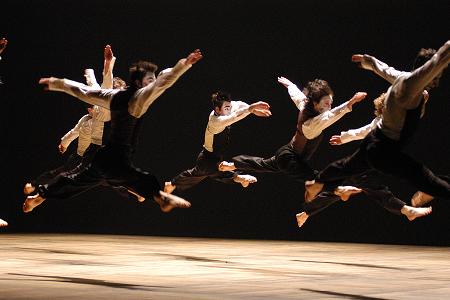
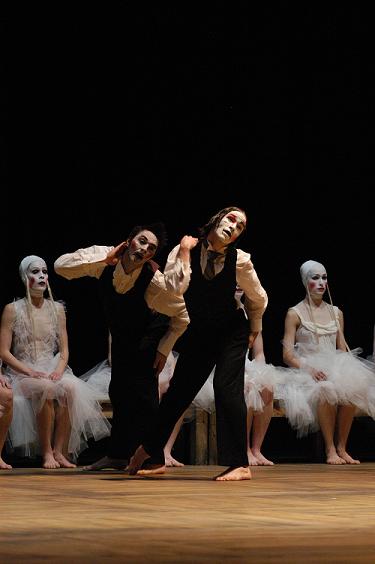
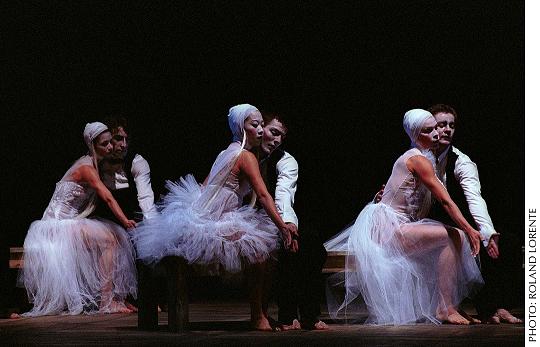
This was Program 2’s tribute to Ballets Russes. Branislava choreographed the original Les Noces, and there have been several versions since (Jerome Robbins’, Pascal Rioult’s). It was danced to Stravinsky’s choral score (which he created for Ballets Russes), but with some remixing too (I think). The music seemed to be longer, and there seemed to be some German language in the score, which sounded like it was from a Broadway show like Cabaret (but not Cabaret exactly). The program doesn’t seem to note any addition to the Stravinsky though so I may well have been hallucinating.
The dance (and the Stravinsky music) depicts a Russian peasant wedding and it’s very Rite of Spring-like — more focused on the sexual rite of passage, the consummation, and the rather forced marriage rituals than love or anything weddings evoke for us today. In the Celis (as well as Rioult) version, there isn’t a single man and woman but a group of men and women undergoing the marriage ceremony. The women here are dressed in sexy white bridesgowns, the skirts short and much of the material see-through mesh. The women have white-powdered, very made-up faces that look almost clownish, as do the men, who are dressed in tuxes. Alyssa thought their make-up looked zombie-like, like they’re walking dead. The movement is very frenetic, with lots of thrashing about, and the group consummation scene would have been comical, as the women bounced around on the men’s laps, if it wasn’t so violent.
I’ll be interested to see what the critics and other viewers say of this –whether it gets dismissed as gaudy “Eurotrash” or whether people take it more seriously as a commentary on ritual (or something else). I do think it worked as an homage to Ballets Russes because from what I know of that legendary company, they seemed to have been very cutting-edge, going far out to push ballet to its extremes, even if it induced a lot of eye rolling.
Big kudos to the dancers though for performing that long, near-continuous frenetic movement.
Photos of Les Grands Ballets Canadiens de Montreal courtesy of City Center.
