
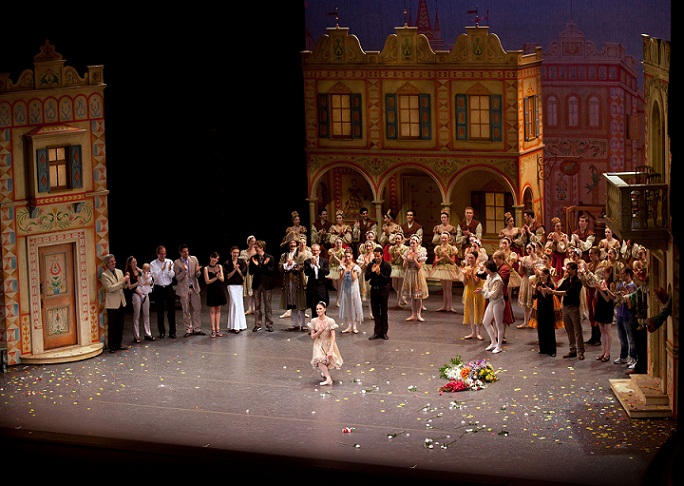
Paloma Herrera Celebrates 20 Years with ABT

Photo by Rosalie O’Connor.

On Saturday night, Paloma Herrera celebrated twenty years with ABT. Her celebratory performance was Coppelia, which she danced with Angel Corella, in one of the only performances he’ll be seen in at ABT this season, sadly. I realized how much I missed him Saturday night. He’s got to be one of the most endearing, charming, downright lovable dancers ABT has ever had. I hope he dances more often next year. And he can still deliver, particularly on the turns – the fouettes, and particularly on partnering. He polished off a one-handed lift with Paloma no problem. And he’s not a big guy. “That’s pure technique,” said the critic sitting next to me.

Paloma danced really beautifully too, and I realized Saturday night what a remarkable dancer she is. She did some beautiful balances, seemingly without shaking one iota. And she did an amazing sequence of fouettes where she didn’t bring her non-standing leg all the way around but kept it barely bent and at her side, making those whipping turns so much harder. She got loads of applause. She’s particularly suited to a role like this, and like Kitri in Don Quixote. The pair could easily have danced that one too since they’re pretty much known for DQ. They used to be THE couple at ABT years ago, and now she’s celebrating 20 years with the company and he’s off in Spain starting his own. And all the young ones have taken over 🙂

And the night before I saw two of those young ones: Natalia Osipova and Daniil Simkin (pictures hopefully coming soon!) My friend (who’d seen the Bolshoi’s Nutcracker via Emerging Pictures with me) and I agreed that the Russians can just do those extremely sharp, staccato doll-like movements better than anyone. Of course they just seem to know how to put on a show in general better than anyone. Ballet to them isn’t just about technique and perfect dancing, it’s above all a show.

Anyway, Natalia is superhuman. She really is. No one can jete like her, and I think I’m going to have to include men here. Daniil was absolutely superb in his solos, and he’s known for being a jumper, but I swear when she jumped and he followed her with a jump, hers were higher. I almost fell out of my seat. And her “doll-come-to-life” in the second act – I’ve never seen anyone genuinely look so toy-like. Even the children in the audience were enthralled; you could hear a few actually laughing themselves silly throughout the entire second act. When do small children maintain interest throughout an entire act of a ballet? Maybe the parents were Russians and knew Osipova would pull it off 🙂

Osipova’s definitely not perfect and she was going so fast in a series of spins across stage she had a little stumble on one. But who cares? I’d so much rather someone put everything they have into a performance than play it so safe it just fades away. Seeing Herrera in the role after Osipova made me realize that Osipova’s just always going to do things more stunningly than others (at least for the most part). Not necessarily with better technique or more beautifully but more stunningly. That’s the kind of dancer she is. But that definitely doesn’t mean that no one else has anything to offer.

Anyway, back to Paloma. So, during the bows, each of the principals came up on stage and gave her a bouquet, which was followed by a confetti shower. She and Angel got several curtain calls, not surprisingly. I think all serious, longtime ABT fans miss Angel and their performance together was a bittersweet reminder of this kind of “changing of the guard” that’s going on at ABT. Afterward, I went with a group of friends to Fiorello’s, across from Lincoln Center, for drinks and dessert, and she came in with two people who I assume were her parents and sat down at the booth next to us. Our ballet gossip promptly ended but what a special end to a fabulous evening for us.

Giselle: The Royal Versus the Bolshoi

Last Wednesday I went to see the Royal Ballet’s Giselle live-streamed direct from London. Today, I saw the Bolshoi’s live-streamed from Moscow, both via Emerging Pictures’ excellent Ballet in Cinema series. I have to say I think this new series is one of the most exciting things happening in ballet right now, if not the most exciting. You can see the world’s greatest ballet companies perform live in your hometown via your local movie theater (if, of course, you’re lucky enough to have a local cinema that’s participating – and hopefully you are!). Not only do you get to see the live performance, but the camera also takes you behind the scenes to see things even those in the theater can’t see – to the makeup rooms, the rehearsal areas where the dancers are warming up, getting dressed, and sewing their shoes, etc., behind the curtain during and after the performance where you see the dancers prepare for curtain calls, and down into the orchestra pit where camera focuses on the conductor and members of the orchestra. You also get a good view of the theater – from inside the auditorium to the lounge areas, even to the outside front. You really feel like you’re there. And knowing it’s in real time makes it all the more fun. I kept wanting to wave out to the audience members as they took their seats, some looking at the camera. But of course they couldn’t see us…

Anyway, it’s such an experience, and hopefully everyone will be able to have it at some point soon.

So, the Royal’s Giselle: the dancers were Marianela Nunez in the lead, Rupert Pennefather as Albrecht, Gary Avis and Hilarion, and Helen Crawford as Myrtha. Also, one dancer who wasn’t a lead but who I was just really captivated by was Yuhue Choe, who danced the female peasant in the peasant pas de deux.

Overall, I liked but didn’t love this production. My biggest problem was Pennefather, who I just didn’t find at all compelling – either in his dancing or his acting. He was definitely good-looking and had a regal bearing so I understand why they cast him, but his dancing was just nowhere near the level of someone like David Hallberg’s. In the second act in the would-be dance-to-death scene where he went to do his high jumps with the many braided entrechats, they just didn’t look polished or sharp enough. They almost looked fake – like he wasn’t really weaving his feet backward and foreword. I’m sure he was, it just looked sloppy. And as a character his Albrecht didn’t make much sense. At the beginning, when his servant helps him change into his peasant costume, he looks down at the costume, and smiles to himself, pleased. Then, he has fun dancing with Giselle, tricking her with the altered flower, etc. Later, when he’s found out and his betrothed asks him why on earth he’s dressed as a peasant, he immediately laughs it off, and practically runs toward her, kissing her hand. It’s never clear what he hopes to accomplish by pretending to be a peasant and seducing the unknowing peasant girl; what his motivation is for doing any of it. But he didn’t seem particularly dumb or playboy-like either. It just seemed like a role that wasn’t thought-out.

I did like Nunez. I thought she was a tremendous dancer, and she acted very well too. Her mad scene was real, completely believable, not at all overdone, with depth, one of the best I’ve seen. Of course it helps that the camera’s so focused up close on her face! You can easily see the emotions. The only thing was that body-wise she didn’t seem like a Giselle to me. She didn’t seem weak and delicate and fragile. And that strength came through in her dancing too. Her performance reminded me a little of Paloma Herrera’s Giselle. I thought Herrera was terribly miscast. I thought Nunez was such a remarkable dancer though that I was able for the most part to suspend disbelief, more so than with Herrera.

I thought Gary Avis was a really hot, hunky Hilarion 🙂 He’s a very good actor too. I think he was actually the best actor in the whole production. I really believed his love for Giselle, his urgent need to keep Albrecht away from her, and his devastation over what ended up happening to her. And ditto for the Bolshoi’s Hilarion (or Hans as he’s called there), Vitaly Biktimirov – at least in the hot & hunky department. He was a good dancer, but less of a good actor than Avis. I was talking with a friend and fellow blogger, Art, during intermission, and he said he thought the British were simply just trained to be actors as well as dancers, probably because of their history. The Russians weren’t so trained. And I agree with him. The Russians seem to do everything in a very melodramatic, somewhat phony way. I mean, not Veronika Part, not the Russians who come here. But when you see a production by a Russian company it just seems like everything is very performance-y, not natural.

I really loved Choe in the Royal’s peasant pdd and found myself wondering what type of Giselle she’d make. She looked perfect for the part. I thought her dancing was lovely, but I’m not sure if, had she danced Giselle, it would have been at the level of Nunez’s. Has anyone seen more of Choe? She’s a beautiful dancer.

Interestingly, Helen Crawford, who danced Myrtha, was a tiny little thing. Very pretty, very fine features, very delicate-looking. She also had the appearance of a Giselle. She did a superb job though acting the controlling, sometimes damning Queen of the Wilis. It was just interesting casting, though, because all of our Myrthas are the larger, more physically-imposing ballerinas.

I hate to say it, but I really didn’t like the Bolshoi’s very much. But I LOVED their performance of The Class Concert, a one-act that preceded their Giselle. The Class Concert was created in 1960, by Asaf Messerer,  and it’s one of those storyless ballets that takes place in a classroom and that are meant to highlight the magnificence of ballet, from beginning at the barre, and ending with the grand jumps and high overhead lifts of center-work. Kind of like Harald Lander’s Etudes or Christopher Wheeldon’s Scenes de Ballet. Anyway, those dancers are incredible. I mean, I was almost on the floor I was so in awe. From the small children to the young adults doing all the lifts and crazy chaine turns and high jumps – every hip was completely perfectly turned-out, every tendu perfectly pointed, every single body’s form was absolute perfection. They weren’t always moving in unison, but just the perfection of each of them individually made me not care that they weren’t always in sync. It was amazingly beautiful, but in a way, it was also slightly creepy. I mean, to attain that kind of miraculous perfection, you realize these children must do nothing but eat, sleep and ballet every day from the time they’re 2 years old foreword. Talk about Tiger Mothers. It’s a whole Tiger State.

Anyway, their Giselle I felt was lacking. I loved their Albrecht – Dmitry Gudanov. He had everything Pennyfather lacked – at least in the acting. Gudanov had definitely thought through his motivations for the character. Gudanov’s Albrecht was in love with Giselle. His servant tried to tell him he was going to hurt her, but he just blew his servant off. He was reckless but his heart was with Giselle. Later, when the princess, his betrothed, sees him in the peasant costume, at first he doesn’t know what to do, how to act. Then he slowly, begrudgingly takes her hand. But it’s clear he’s not in love with her and he really wants Giselle. He remains torn between her and Giselle even after he realizes he must chose his betrothed – at least for the time being. And then he’s shocked when Giselle reacts so badly. And then he’s devastated along with Hilarion, even going after him with a sword, when she dies. I still wasn’t in love with his dancing, though. Actually, he did everything very very well. He was a very good dancer. What I wasn’t in love with was Grigorovich’s choreography for him. I didn’t feel that the dance to death scene was in any way a seriously dangerous dance. It looked rather lyrical. There were no brises or jumps with the entrechats; instead there was a series of tour jetes back and forth, and they weren’t done particularly fast. It looked like he was flying gracefully through the air not like he was exhausting himself to the verge of death. And when he’d “collapse” he’d go down so lightly, it was like he was going to sleep, like Sleeping Beauty. No crashing to the floor in sheer exasperation ala Marcelo Gomes at all.

But who I really didn’t like was Svetlana Lunkina as Giselle. I’ve heard so many good things about her and my hopes were so high, but now I can’t understand the big deal at all. She seemed really really wooden to me. She really didn’t act at all. Her face was devoid of emotion throughout. And, unlike Nunez or Osipova, or any other dancer I’ve ever seen in the role, her dancing was nothing to write home about at all. She was adequate but she looked like a corps dancer to me. What am I missing? Maybe she was really just having a bad night, because during the wilis scene when she had those several slow turns on one leg, her balance looked very off. I really thought she might actually lose her balance and fall. So maybe it was just the pressure of the cameras and knowing so many people were watching.

Again, I really liked the ballerina who danced the peasant pas de deux – here, Chinara Alizade – and wondered what she would have looked like as Giselle.

Oh, and speaking of the peasant dances: hehe, these were the absolute fanciest peasant costumes I’ve ever seen! Art joked that these were peasants flown in from Paris for the occasion!

I had a blast though. And the Sunday performances are so nice because there are so many more people. I met two new dance fans who regularly read my blog! I felt kind of half-dead today – probably because of a late night last night – but I’m always so flattered when people recognize me and come up and talk to me. I’m always so thrilled to find that people like this blog and find it valuable and my viewpoints interesting and all! So thank you!

Emerging Pictures’ Ballet in Cinema Series

Here’s an addendum to my earlier post on Emerging Pictures’ exciting new Ballet in Cinema series.

All of the showings on the schedule I posted are at the BIG Manhattan Cinema except for the December 19th Nutcracker, performed by the Bolshoi. That one is at the Kew Gardens Cinema in Queens.

There is one additional performance:

The Nutcracker, performed by the Royal Ballet, December 26th, 3:00 p.m., at Symphony Space (this one is recorded).

For other performances in the series, and for people outside of New York, you can consult the Ballet in Cinema website for further showings. You can search for showings by typing in your zip code. I am told you should check the website frequently as it is updated often.

I’m very excited about this, as you can probably tell 🙂 The Metropolitan Opera has been very successful with their in-cinema showings, really brought opera to younger audiences by making it more affordable and engaging in this way, and has increased opera’s popularity. I hope this series will do the same for ballet.

The Flames of Paris, and Emerging Pictures’ Ballet in Cinema Series


Yesterday, I was invited to a preview of a filmed recording of the Bolshoi’s The Flames of Paris. The film will begin showing in New York at the BIG Cinemas Manhattan on November 2nd and will be broadcast nationally in over 30 locations starting on that day as well.

This film is the first in Emerging PicturesBallet in Cinema series, which, like the Met Opera’s high definition series, is a series of live (or recorded, but most are live) ballet performances that will be broadcast in various movie theaters. I’m psyched about this, especially since I’d bemoaned that ballet didn’t have such a thing when the Met Opera first started their film series.

Flames, by the Bolshoi, is the first ballet, and, as I said, it begins showing on November 2nd. That performance is recorded. Here is the rest of the schedule:

The Nutcracker, performed by the Royal Ballet (London), December 1, 2010 (Recorded)
The Nutcracker, performed by the Bolshoi, Sunday, December 19, 2010, 11 a.m. EST (Live)
Giselle, Royal Ballet (London), January 19, 2011, 2:30 p.m. EST (Live)
The Class Concert and Giselle, by the Bolshoi, January 23, 2011 11 a.m. EST (Live)
Caligula, Paris Opera Ballet, February 8, 2011, 1:30 p.m. EST (Live)
Don Quixote, Bolshoi, March 6, 2011, 11 a.m. EST (Live)
Coppelia, Paris Opera Ballet, March 28, 2011, 11 a.m. EST (Live)
Coppelia, Bolshoi, May 29, 2011, 11 a.m. EST (Live)
Children of Paradise, Paris Opera Ballet, July 9, 2011, 1:30 p.m. EST (Live)

At this point I’m not sure of all the locations or the time on the top date, but will let you know more specifics when I know. For now, for more info, visit their website or Facebook page.

Anyway, on to The Flames of Paris. This production is from March of this year, in Moscow, and stars Natalia Osipova, Denis Savin, and Ivan Vasiliev (as excellent a dancer as Osipova). It was originally choreographed by Vasily Vaynonen and performed in 1934, but Alexei Ratmansky has reconstructed it. Music is by Boris Vladimirovich Asafiev, a Russian and Soviet composer, and is based on songs of the French Revolution. Interestingly, it was Stalin’s favorite ballet, which confuses me, unless Ratmansky substantially re-worked things, but I’ll get to that in a minute.

It’s set during the French Revolution and tells the story of a pair of brother and sister peasants, Jeanne and Jerome (Osipova and Savin), a Marseillais (revolutionary fighter) named Phillipe (Vasiliev), and Adeline (danced by Nina Kaptsova), the daughter of the local Marquis. Jeanne and Jerome are young, energetic free spirits at the beginning of the ballet but, upon meeting Phillipe (whom Jeanne eventually falls in love with) become revolutionaries too. Adeline, bored at one of her father’s aristocratic parties (and perhaps jilted by a man there as well – I couldn’t really tell), wanders off, and eventually finds herself in the camp of the Marseillais. She hooks up with Jerome and they fall in love.

Eventually, as well all know, revolutionary fervor leads to the deaths of King Louis XVI and Marie Antoinette. During the last scene, Adeline sees her father, the Marquis, dragged toward the guillotine. She becomes hysterical and begins rushing toward him, trying to save him. Jeanne and Jerome try to hold her back – Jerome out of love for her and Jeanne seemingly out of now hysterical patriotism, demanding the Marquis’ death along with the other Marseillais. But Adeline won’t leave the executioners alone, and when they discover who she is, she is put up on the platform, under the guillotine as well. The ballet ends with her crying and looking terrified as the guillotine comes down on her head.

Jerome keels over crying and Jeanne comforts him, but then, as he is given Adeline’s head wrapped in some kind of gauze, Jeanne is lifted and off she goes with the other Marseillais fist pumping in the air, French flag overhead, with the creepiest most possessed, horror movie-esque look in her eyes I may have ever seen.

When I left the theater I felt very unsettled and more than a little scared of revolutions in general and the uncontrolled murderous mob activity they can lead to. Unless Ratmansky completed changed the ending, I don’t see how this was a piece of propaganda, glorifying the French Revolution and likening it to the equally glorious Russian. I thought Ratmansky had been criticized for bringing back two Soviet-era propaganda ballets – this one and Bright Stream – during his time at the Bolshoi. I feel like either I missed something, or he changed things. New Yorkers will be able to see Bright Stream at ABT next summer.

Anyway, the dancing was tremendous, and Natalia Osipova is just as spellbinding on screen as she is onstage. She just moves so fast and with such precision and power and impeccable technique; when she’s done you feel like you can’t believe what you just saw. I can’t imagine there’s going to be another dancer quite like her. She’s also a very good actress. She had the tomboyish, peasant-like gait down solid here; there was no flirty Kitri anywhere in this performance. She also, as I said, perfectly embodied the almost crazed Marseillais, sad for her brother but too hateful toward the Marquis to feel much for Adeline.

Vasiliev is also an excellent dancer, and his final final pas de deux with Osipova was fantastic. Crowd went wild, of course. And Russian crowds are a bit more fun than American 🙂 They clap in unison, all clapping on the same beat, as if they’re cheering the dancers on to do an encore to the rhythms they’re making. But there were no encores, just bizillions of bows. I realized that the ABT production of the pas de deux, during their City Center season a couple years ago, was altered probably to suit the strengths of Daniil Simkin. Vasiliev did none of those crazy over-rotated barrel turns that Daniil in known for and I thought I remembered a no-hands fish at the end of the ABT performance?… It wasn’t here. Also, they remained dressed in their regular street clothes; no fancy princess tutu for Natalia.

I thought Savin, tall and wiry, was a bit out of control in his dancing in parts, but maybe that was just part of the character. I think the Russians try to move the audience, to tell the ballet’s story, with their acting just as much as with their dancing, which is somewhat different than American-trained dancers, who seem to focus more on technique and movement quality than characterization. I thought Nina Kaptsova was a beautiful dancer. And she was perfect for the part of vulnerable Adeline. But I’m sorry, I can’t help but feel for anyone who has to share the stage with Osipova!

I loved the camera work – it panned in and out, just like in the Met’s HD films, homing in on various characters at certain points in order to make it more cinematic.

I’m really looking forward to the other performances. We don’t otherwise see much of the Bolshoi, the Royal and the POB here and, if the other films are as well-made as this one, I feel like you do get a very full experience.

Above photo (of Osipova, Savin, and Vasiliev) taken from here.

NATALIA OSIPOVA AND HERMAN CORNEJO’S LA SYLPHIDE


Monday night, I saw the Bolshoi’s Natalia Osipova guest-star with ABT in their production of La Sylphide. I wrote a little about her and more about Herman Cornejo, at the bottom of my prior post. Just to reiterate, if you ever want to see pure excellence, do see Herman Cornejo in something — anything. He is just pure, unmitigated, supreme, excellence!


August Bournonville’s La Sylphide is the story of a Scotsman, James (Cornejo), who is engaged to be married to a woman named Effie, but is seduced by a sylph (Osipova), who no one but he can see. Gurn, a young man in love with Effie, sees James talking and dancing to the air, and tries to warn everyone that he thinks James has gone mad. But people ignore him. An old witch-like lady, Madge (think MacBeth) prophesies that Gurn will marry Effie. Later, when the wedding party guests perform a fun Scottish folk dance, James continues to be taunted / haunted by the sylph who flies through the air. James chases her but she flies out the window. Later, James is on the verge of marrying Effie, even holding up to her the wedding ring, when the sylph plucks it right from his hand and flies out the window. He chases after her into the forest, her lair. Effie collapses into tears and Gurn leads the groomsmen in search of the missing groom.

The second Act takes place in the forest. The sylph seduces James with food, drink, and dance, but every time he tries to touch her she flies away. James wanders the forest, upset about the sylph’s elusiveness. He happens upon Madge and her mates who are concocting a poisonous brew in which they are soaking a scarf. He tells Madge of his troubles and she tells him the scarf is magic; if he wraps it around the sylph’s wings, he can have her. James takes it. When he next sees the sylph, he seduces her with the scarf’s beauty. She flies toward it, delighted and excited, as he waves it around. But once he wraps it around her wings, she slowly dies.

James, brokenhearted, falls into unconsciousness, as the wedding procession of Gurn and Effie is heard in the distance and the sister sylphs carry the sylphide to heaven.

Neither the story nor choreography are as grand and memorable as Giselle, and I’d written before that I was stunned by Osipova’s athletic prowess but not really moved by her Giselle. Here, I thought that, though I didn’t like the choreography as much, her playful, sky-high jumps made much more sense in this story. Here, she’s not human, she’s not of this world. She’s both a faery and a figure in a man’s dream. So, her unearthly high springing jumps went along with that; they were believable within the story. She is a really beautiful dancer and can certainly jump like no one’s business, but I wished she would have been a bit more tantalizing and playfully vexing, the way Janie Taylor was in Robbins’ The Dreamer. Not like a vixen or an evil spirit; I just mean more forcefully refusing to leave him alone, making him realize what a dull life he’s leading; how he longs for something more. Just like in Giselle, she seemed to be dancing on her own, not really working opposite a partner. It’s probably really hard, though, when there are language barriers, and I think both times either she or her partner (David Hallberg, and Herman) filled in for someone else last minute.

I thought Herman did an excellent job of showing how tormented he was by her, and how confused he was about what to do, how frustrated he was about his life. And his super-charged solo variation expressed that. No one jumps like him. No one. No one turns like Angel Corella and no one jumps like Herman Cornejo. He opened that variation with the best tour jete I’ve ever seen, and I knew — the whole audience knew judging by the gasps — we were in for something huge. Then onto all the high jumps with the fluttering beats of the feet. Everything he does is marked by sheer perfection — perfect sharpness, perfect precision, perfect control, perfect line, perfect clarity, perfect enunciation, beyond perfect height, beyond human height. He’s a god!

My problem with this choreography is that there’s not enough for him to do. And I got really frustrated. I didn’t want that variation to end. Nor did I want Daniil Simkin’s (as Gurn) solo variation to end. There wasn’t enough for him to shine in his either. He had a few kicking jumps, but I need for him to do so much more; Daniil’s too great of a dancer as well! Daniil was hilarious, though, when he imitated to the guests James’s bizarre actions, his weird dancing to the air. In addition to being a superb bravura dancer, he’s a very lively actor too.

On before La Sylphide was Paul Taylor’s light, lyrical Airs. I’m going to write about this more after I’ve seen it a couple more times this weekend, but I love watching ABT dancers do Paul Taylor! I hope no one takes offense and I love Paul Taylor’s dancers, but ABT just brings so much more to “modern dance” than a modern dance company. They bring poetry. Paul Taylor is American modern, and when his dancers dance him it looks celebratory, celebratory of humankind and of the dancing spirit, like something you’d like to get up on stage and do with them. It’s participatory, inviting. Of course you know if you’ve ever tried how hard, how impossible it actually is to dance like them without loads of training. But when you see ABT dancers dance that’s obvious from the get-go. It’s not celebratory and participatory, it’s elevated, awe-inducing dance, dance as an art. You know what I mean? All of the dancers were excellent — particularly Kristi Boone and Misty Copeland, but I loved Arron Scott the most because he so exemplified what I said above: outwardly he looked just like a Paul Taylor dancer, but he starts to move and he’s just so much more!