More VIENNA WALTZES


Here are some photos of the most recent cast of Balanchine’s Vienna Waltzes that debuted at New York City Ballet last week. Top photo is of the radiant Sara Mearns, who had the main role in the final part of the ballet – “Der Rosenkavalier” – as the girl sweetly lost in her dreams during a moment alone in the ballroom. Bottom photo is of fairy-tale princely Tyler Angle dancing with Teresa Reichlen, from the first part of the ballet, the two young lovers waltz-frolicking in the woods. Both photos are by Paul Kolnik.


NYCB Spring Gala with SEVEN DEADLY SINS Premiere

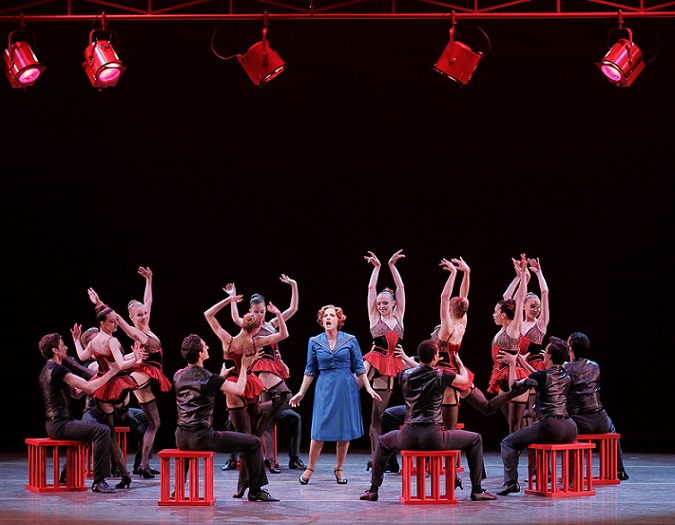
Here are some photos, all by Paul Kolnik, of Lynne Taylor-Corbett’s play-ballet, The Seven Deadly Sins, which premiered last night at New York City Ballet’s Spring gala performance. Above is Patti LuPone, who guest-starred with the company (performing the singing role of course!) and Wendy Whelan, who danced the lead. The top photo is from the “Prologue” of the play-ballet (or ballet chante as the program calls it).

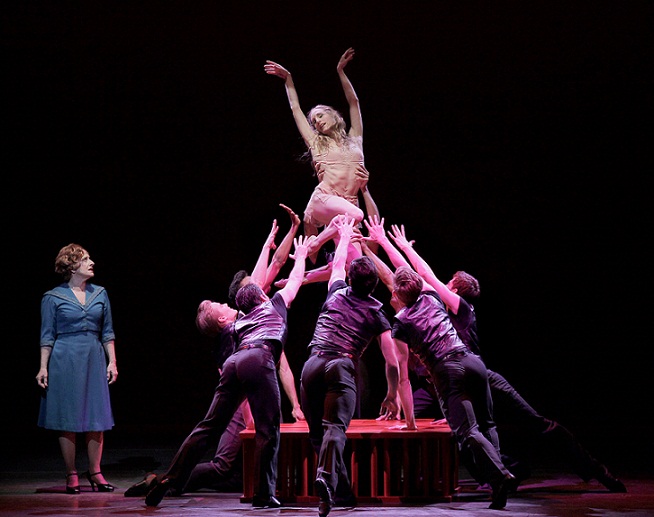
This is from the second part: “Pride”: Patti LuPone and cabaret dancer ensemble.

Also from “Pride.” Wendy Whelan is in the middle.

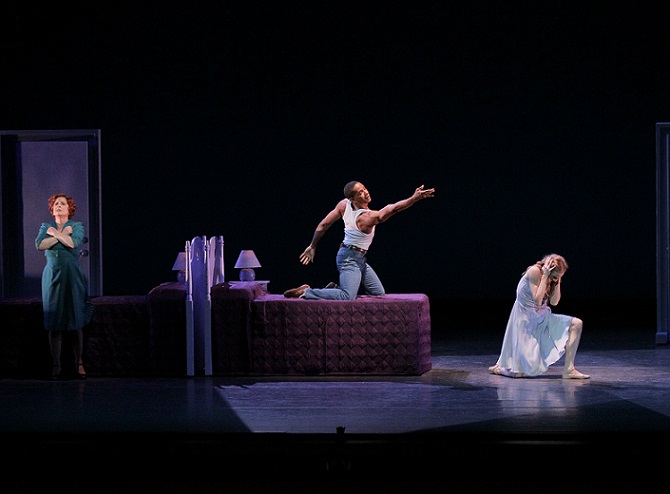
And this is from sixth part, “Lust,” probably my favorite over all. Craig Hall and Wendy Whelan are the dancers in the photo. Craig Hall and Sara Mearns (who danced the role of “Latina Diva” in the “Anger” section, and who I don’t have a picture of unfortunately), most stood out to me, as well as Vincent Paradiso as the Count in the “Greed” section. I think those dancers most stood out – at least Mearns and Paradiso – because they seem to have some kind of acting training. Maybe they don’t, maybe they’re just natural actor-types, but the more actor-ly you are, I think the easier this kind of role would be. Wendy Whelan said in an interview with Roslyn Sulcas in the New York Times that she was used to expressing herself with her body and her lines, that she was used to Balanchine’s dictum “don’t act, don’t think, just dance,” and that she found this kind of role challenging. As much of a NYCB star as she is, and as stunning as she is in Wheeldon and Balanchine’s more modern, angular-lined ballets, I just wonder if she was mis-cast for something like this.

Which isn’t to say that she didn’t dance very well last night. She danced a really beautiful pas de deux with Craig Hall, which is what made “Lust” my favorite section. And LuPone sang in a gorgeously powerful voice. The dancing was all superb. But something just didn’t work to me.

Balanchine choreographed the original Seven Deadly Sins, set to libretto and score by Bertolt Brecht and Kurt Weill, in 1933. The Balanchine version was revived in 1958. According to the Times article linked to above, both the original version and revivals received very good reviews. Since the Balanchine version appears to be largely lost now, and Peter Martins wanted to revive the ballet, he commissioned new choreography from Taylor-Corbett.

Maybe it was that the new choreography didn’t really express the story, which follows Anna, a woman whose various life experiences each represent one of the sins. It wasn’t really a full story, but one composed of scenes, each of which dramatized a sin (and LuPone and Whelan portray different aspects of Anna). But, I didn’t feel the scenes always worked well at doing that. For example, in my favorite section, “Lust,” I thought the Hall/Whelan bedroom scene was really beautiful, very romantic, but nothing said lust, as in sinful lust, to me. I almost felt like Whelan’s Anna had a loveless relationship with her husband, danced by Allen Peiffer, and she was really in love with Hall, and her leaving her husband and running into Hall’s arms was an urgently needed escape.

In my other favorite section, “Anger,” Sara Mearns is a kind of sexy, but rather humorously so, Copacabana dancer. She gets angry at Whelan’s Anna for something – I’m not quite sure what – maybe Anna stole her lover or took over Mearns’ role as head diva, drawing too much attention to herself…  Anyway, Mearns twists her face into a look of utter anger, then points at Whelan, who runs off crying and is then stripped down to her underwear by a group of men. But I thought it was done rather cartoonishly. So it was more funny and cute to me than a dramatic representation of the tragic consequences of anger.

In the “Greed” section, a count and a senator vie for something and end up in a duel, both of them getting killed. But it didn’t have any tragedy or pathos to me. Instead, it felt a bit like Balanchine’s Slaughter on Tenth, which made me want to giggle – probably the fact that it was Paradiso playing the role of the Count.

I don’t know. I guess I was expecting something with more tragedy and pathos and weight, and I felt like I saw a version of Slaughter on Tenth but without a through story-line. Maybe that was the intent. I’m going to see it again over the weekend, and maybe my opinion will change.

Did anyone else see it yet? I’m interested to hear what others think. Has anyone seen the Balanchine version?

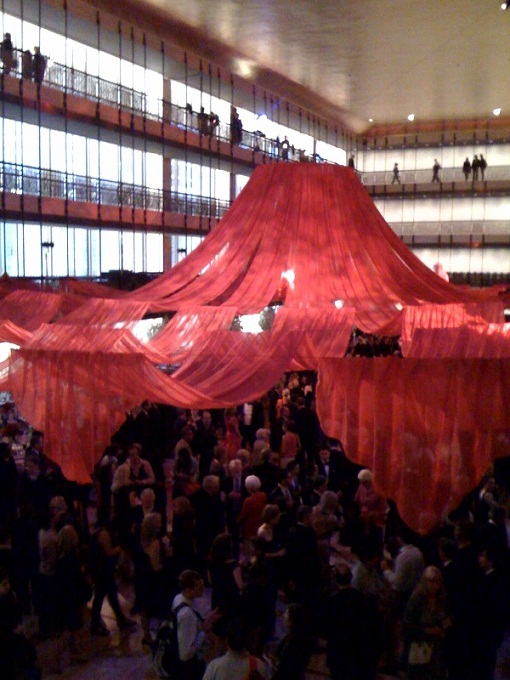
After intermission,

— here’s my photo of the promenade – Balanchine’s Vienna Waltzes was performed beautifully.

Photo by Paul Kolnik.

All of the dancers were very good, but I particularly liked Megan Fairchild and Joaquin DeLuz in the fast-footed, playful scene in the forest, “Fruhlingsstimmen,” and Maria Kowroski and Charles Askegard in the last, beautifully ballroom-y section, “Der Rosenkavalier.”

GONZALO GARCIA IS A ROCK STAR AND JANIE TAYLOR A GRACEFUL MURDERER


Those are my friend, Judy’s terms in the title, by the way! Friday night at New York City Ballet was one of the most exciting in recent memory. The dancers were all excellent, the ballets fun, the audience pumped (okay, a little over-pumped in places!) It was just one of those nights to remember. It was an all-Robbins program, consisting of four of his most diverse, but liveliest dances: Glass Pieces, The Cage, Other Dances, and The Concert.

First, of all, Wendy Whelan appears to be out with a minor injury, so it was announced before curtain rose that Janie Taylor would be dancing the lead in The Cage. If anyone heard some psycho girl shout “Yay!!!” — sorry. Didn’t mean for it to echo like that… 🙂

Glass Pieces is always enjoyable with that rhythmic music, especially in the first and last sections with the intense strings and pulsating drums respectively, the dancers in the first walking across stage as “normal people,” every once in a while a “dancer” appearing and turning and /or jumping ‘dancer-like’ across stage — the most visible of whom is Tyler Angle. I can watch this ballet endless times just to see him in that first section. He’s beautiful in that golden unitard, and always breathtaking no matter what he’s doing.


The second, adagio section, was danced by Maria Kowroski and Philip Neal. Maria nailed this section like I’ve never seen anyone do before. Her body is of course so long and thin and she’s got such spidery limbs, she can really make wicked lines. I don’t know what the dance means, but every form she made was so pronounced and so full of intent, she was just mesmerizing.


Then, Janie’s Cage! Sometimes you just know that no matter who’s done the role in the past — Tanaquil Le Clercq — whoever — this is just the best; no one’s ever going to outdo that and no one no how has done better before. That’s how I felt Friday night watching Janie. It’s like this role was made for her, even though literally it wasn’t. It’s like she’s very mindful of how each shape she’s making is going to look from every vantage point in the house. You can tell how much she worked at this and thought about it. Maybe it comes from being a visual artist as well (she’s a cartoonist and a costume designer).

Anyway, The Cage is the heartwarming (not) story of a colony of female ants – or some kind of insect — who, like black widows, kill their male counterparts, after mating. (Where did Robbins get the idea? Ballet’s from 1951. Hmmm.) Janie was absolute wicked splendid perfection; she just looked like a spidery-limbed little arachnid as her tiny waify body descended on poor big muscly Sebastien, digging her tentacles into his sides, slapping and clawing him all about. And the way she’d flick her wrists and make those insect-like shapes with her hands at such speed and with such perfect definition, it looked like she was metamorphosing into some creaturely other right before your eyes. It was really rather terrifying.

At one point — either she’s on top of him or him on her, I think it’s the former since she’s killing him — their bodies each curve out from the other to make this big hollow O shape, and it looks like one of those human limb-eating plants (what’s the name?…) Crazy beautifully creepy! Of course the drama is that Janie’s the “novice” here and she doesn’t want to eat this man because she kind of falls for him, but she has to for group acceptance. The way she shows that, wanting to reject the rites, by caving in from her center, collapsing into herself, then rolling herself into a ball and letting the male bug hold her — is stunning as well.

Teresa Reichlin is the ideal Madame of the colony, or whatever you want to call her. Her long legs just beat the air on those battemants, like she is the queen and you don’t question her. I can’t find many pictures, but here is Wendy Whelan talking about the ballet, with some clips of it.


Then was Other Dances, starring (really, a very apt word) Tiler Peck and Gonzalo Garcia. This is a gorgeous ballet, full of sweetness and romance and virtuosic dancing with high leaps and jumps and spins and all, originally made for Baryshnikov and Natalia Makarova. I can’t imagine this one being done better either. Both dancers have such endearing stage presences. Tiler Peck is really growing on me — her obvious love for the music, her playful phrasing, her sweetness and freshness and innocent charm. She was beautiful on those overhead lifts where she lay on her side, her arm behind her head, looking down at him. And Gonzalo’s in love with his audience, and you can tell. He says in this article that he’s naturally shy, but he’s also a natural performer. As I said on Twitter, at the beginning of his second solo, two girls screamed “I love you!” Very very unusual for NYCB! “What is he, a rock star?” Judy asked me. Apparently. Gonzalo is turning NYCB into ABT 🙂 What is it about these Spanish men?…


Tiler and Gonzalo work very well together. There was some weirdness between him and Ana Sophia Scheller, but these two are a very good partnership. I think they’re friends too — I see them together on the street sometimes. They danced the virtuosic leads in Donizetti Variations two days earlier and were equally stellar. I’m told he had a big fan base in San Francisco, where he came from. Well, he’s won me over. Ariel, who came with me on Donizetti day (and who comes with me to NYCB rather frequently), took one look at the program and said, “Wow, they have Gonzalo dancing a lot these days.” I said, “Yeah, particularly when I happen to have tickets. Funny that.”

And the evening ended with the comical The Concert, which Judy loved, as I knew she would. It’s cute and funny and no one does up the humor like Sterling Hyltin as the sweetly goofy music lover who can’t dance her way out of a paper bag, and Andrew Veyette and Gwyneth Muller as the cutely warring husband and wife. Andrew even took curtain calls with his ‘obnoxious husband’s’ pipe gripped firmly between his teeth.

The other highlight of the week to me was Balanchine’s Stravinsky Violin Concerto, danced spectacularly by Robert Fairchild, who I’m positive I will never ever tire of seeing. He’s got to be one of the hardest working young men in ballet these days and it really shows. He’s becoming a real David Hallberg. His movements are so precise and everything is so well-articulated. He bends from the waist more than anyone else (that I can see) and that gives him so much breadth and expansiveness. And he’s always making some sort of statement, even in abstract ballets, particularly in abstract ballets.

I love this Stravinsky choreography as well. There are so many stand-out moments, you just can’t mention them all. I love the part where the man of the first couple (here, the aforesaid Robert the spectacular) stands over the ballerina and turns her, or rolls her. She bends underneath him so he looks like her shadow. If this is the same ballet, I felt like Robert leaned in closer to her before and held his arms around her waist, held her more closely, and almost put his head on her back, and it looked so romantic, so tender and loving. It just melted me. He didn’t do that either night I saw him dance this this week. He still turned (or rolled her — don’t know what to call it) brilliantly, but I feel like someone told him not to lean in and make it tender like that. But I want him to do that again! Unless it’s another ballet I’m thinking of … is it? Does anyone know what I’m talking about??

I also love the rather acrobatic choreography for the second couple — first night I saw it danced by Maria Kowroski and Sebastien Marcovici, second night by Amar Ramasar and Kaitlyn Gilliland (filling in — and doing very well — for Wendy Whelan and Albert Evans). I love how she does backbends and handstands over and around him and he just looks at her with amazement, and follows.

Finally, I really liked Liebslieder Walzer earlier this week, which I wrote shortly about here. I know some think it’s slow, and it wasn’t very popular when Balanchine first showed it in 1960, but I really prefer the choreography here to that in his more popular Vienna Waltzes, which is mainly straight ballroom. The choreography is more complex here, and revealing of character. One man (the night I saw it, it was Jared Angle –who looked sharper and more gentlemanly than ever to me) circles around his lady and she circles the opposite way on the inside of him. It’s a lovely effect and I think it shows they are going in opposite directions, not meeting mentally. The couple danced by Sebastien and Janie seemed the most romantic, at one point approaching one another while making expansive circles with their arms as they entered into an embrace. I do agree with Sir Alastair, though, that the couples need to work on their differentiation from one another in order to amp up the drama. It’s choreographically beautiful though and I hope they keep doing it in future seasons – -maybe not with the equally slow and somber Les Noces though!

(By the way, that program — Liebeslieder and Noces — program 8 — is showing twice more this week and I found it not really to be a program for newcomers to ballet. I brought my friend, Jonathan (who I haven’t seen since law school, don’t want to say how many years ago now 🙂 ) and if he wasn’t an opera fan who could latch onto the chorals (which feature heavily in both dances on the program), I fear he might have been bored. I think you have to really be into the intricacies of choreography to appreciate it. If you’re new to ballet, or bringing someone new, see Programs 9 and 10 this week — both containing more dramatic, lively dances.)

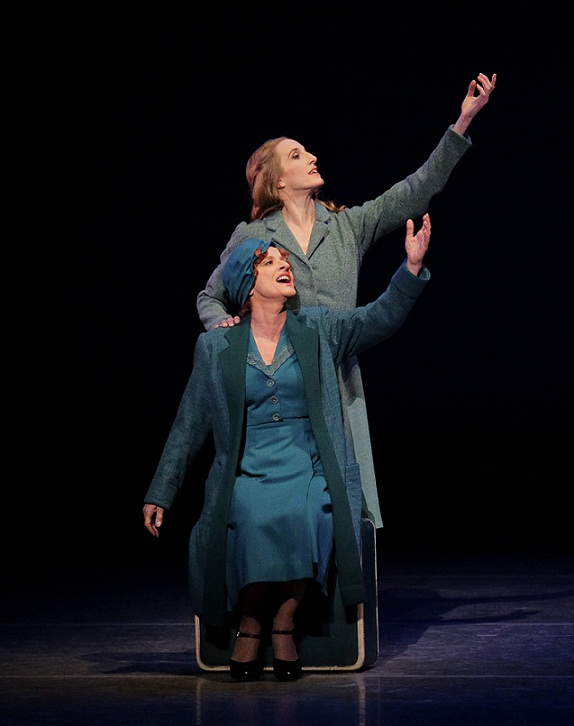
LIEBESLIEDER WALZER


I’m pooped! After a week of writing about scent operas, ABT, new ballets, and SYTYCD dramas, I really need to spend the rest of the weekend working on my novel. I’ve spent the latter part of this week at New York City Ballet and promise to write about those performances soon. In the meantime, please enjoy this Paul Kolnik photo of my favorites, Janie Taylor and Sebastien Marcovici in Balanchine’s Liebeslieder Walzer (which I enjoyed much more than Vienna Waltzes although the latter was far more popular in its day and the former was in fact taken out of the NYCB rep for some time! More on that later…)

NYCB: A DIFFERENT DREAMER, A BRILLIANT HALLELUJAH JUNCTION AND A SWAN LAKE DEBUT


I spent all of Saturday at New York City Ballet, watching both matinee and evening performances like the obsessive I am 🙂 Highlight of the daytime performance was Jerome Robbins’s 1979 ballet, Opus 19 / The Dreamer in which Robert Fairchild and Janie Taylor made their NYC debuts in the lead roles. This is only my second time seeing this ballet — the first was a season or two ago when the main parts were danced by Gonzalo Garcia and Wendy Whelan. (Robbins created the ballet on Baryshnikov and Patricia McBride). My research has revealed that critics don’t consider this to be a major Robbins ballet; Arlene Croce seems not to have written a word about it. Audiences seem to adore it though, me included.

Funny but the first time I saw it, I thought the main male character was a “dreamer” in the sense of being an idealist. Wendy seemed to represent Gonzalo’s ideal. And there often seems to be a kind of charmingly airy, carefree, “head in the clouds” quality to Gonzalo’s dance persona.

Robert was more solid and sharp and weighty than Gonzalo. In his beginning solo, he’d slice through the air with his arms and legs, stretch an arm out, hand bent up, as if to be pushing out against something, or stopping something from getting too close to him. What that something is isn’t entirely clear. It seemed more like he was a literal dreamer, someone lost in a dream that was neither entirely pleasant nor unpleasant, something he kind of wanted to escape from but was drawn to as well. And Janie — I love her! — was all tantalizing, bewitching, taunting little mischief-maker haunting his subconscious, not leaving his psyche a moment’s peace. Whenever she was onstage, she completely captivated — both him and us. Even when she’d collapse in his arms, he’d struggle to straighten her up again. He’d lovingly wrap his arms around her; she’d be out of them in a split second. It was very different from the way Wendy danced, if I remember correctly. I wonder how Patricia McBride did it.

I read a review of a dancer who performed the male lead in the 80s. The writer — Jack Anderson — said the dancer — Jeffrey Edwards — looked like a thinker, very introspective. I always love watching Robert — I think he is one of the most fascinating movers around. I’m not sure if what I saw here was introspection or more like inner turmoil. He was definitely lost in himself — he doesn’t even seem to notice all the lavender-clothed dancers flitting about him, didn’t seem to notice anyone until Janie came darting by and commanded his attention. I guess it seemed more like he was lost in his own angst, haunted by his dreams, than lost in his thoughts or his art. But it would be hard, I’d think, to embody introspection.

They don’t seem to be performing this ballet a lot, but I’d love to see Tyler Angle dance the part as well.

Also during the day was Chaconne, which I’m growing to love more and more — particularly the first pas de deux where the man lifts the ballerina and she has her arms out to the sides and does these large, sweeping steps forward, every few beats lightly tickling the floor with one toe shoe, and it looks like she is flying — and Vienna Waltzes, which, probably ridiculously for me since I’m a ballroom dancer, honestly just kind of bores me. The choreography’s not very intricate or compelling (odd for Balanchine) — it’s mostly straight-forward waltzing, which I can only watch for so long. There’s a middle section composed of high-energy allegro ballet which was danced very theatrically by Yvonne Borree and Benjamin Millepied. That section seriously kept me from falling asleep.

Highlights from the evening program were Peter Martins’s Hallelujah Junction, Joaquin De Luz in Donizetti Variations, and Sebastien Marcovici’s debut as Prince Siegfried in Balanchine’s Swan Lake. I hadn’t seen this cast of Hallelujah before — it was Sterling Hyltin, Gonzalo Garcia, and Daniel Ulbricht. This cast wasn’t so dramatic, so romantic, so intent on telling a little story, as other I saw (Marcovici, Taylor, Veyette), but seemed more focused on simply making the music visual — and they did so to fascinating effect. I greatly enjoyed just sitting back and watching all that brilliantly fast-paced, razor-sharp movement — Gonzalo with his sexy impish bouyancy (he’s not really a small man but somehow he seems like he’s always airborne; I think he’d make a great Sleeping Beauty Bluebird), Sterling with her Russian ballerina-high extensions that she does with incredible speed, and Daniel for his intense precision. This is the best I think I’ve ever liked Daniel Ulbrich before. He didn’t just jump inhumanly high; he really nailed very difficult-looking, intricate footwork and he did so with such sharpness and tautness. If he’d only be given more than just jumping guys parts, he can show that he can actually dance extremely well.

Sebastien danced Siegfried with great passion, expectedly. Balanchine really eviscerated the man’s part in his version of the ballet but Sebastien went as far as he possibly could with it. At one point, one of the corps swans in the back row fell and of course the audience had to go “ooooooohhhhhhh,” but he didn’t let it faze him as his Siegfried searched desperately among the swans for his beloved Odette. He had a minor flub on one of the many traveling turn jump thingys but no big deal. It was heartbreaking when Wendy bourreed back away from him and he reached out to her like she was taking his life with him as she went. Also, I love the black and white plastic swans swimming in the little stream at the beginning and end, but the people working them should just make sure the white swan appears at the right time! One time Wendy wasn’t fully into the wings yet when her swan form began sailing across the stage and Charles Askegard’s Prince Sig didn’t know where to run — the swan or Wendy. This time it was a little late and Sebastien kind of had to go searching upstream for her 🙂

Balanchine’s Donizetti Variations was danced brilliantly by Joaquin De Luz and Megan Fairchild. But what I really love about Joaquin isn’t his bravura dancing but his dramatic abilities — how he interacts with the other dancers. Even when dancing a storyless ballet, he’ll look at the others as they do their thing, shoot them a cocky grin — or a genuine smile — and do his thing, his steps a clever or comical response to theirs.

Also on this program was the newish ballet by Melissa Barak, A Simple Symphony – -my second viewing of that. She does borrow from Balanchine, but her choreography also has its own wit, which you notice on multiple viewings. Like Balanchine, the drama is in the actual choreography — every little flex or softening of the wrist meaning something. At one point, the ensemble of ballerinas all turn their hands and flex their wrists, and it looks like they’re cutely shrugging their shoulders. It’s such a pretty ballet with such mellifluous music though, sometimes you don’t want to focus on the choreography; you just want to sit back and enjoy the loveliness of it all.