
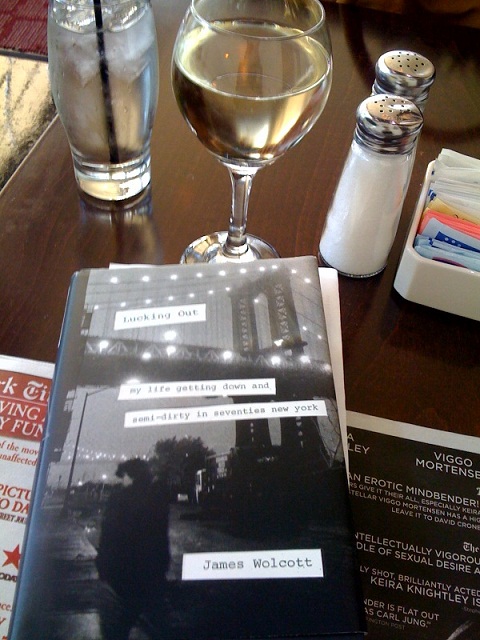
I’ve been reading James Wolcott’s memoir, Lucking Out: My Life Getting Down and Semi-Dirty in Seventies New York (photo above taken at the ArcLight Hollywood Cafe). It’s about his life as a writer in New York and his years working at the Village Voice in the magazine’s early days. (He got a job there after sending Norman Mailer a copy of an essay he wrote about Mailer’s appearance on a TV show for his school newspaper and Mailer went wild over it. It’s so hard to believe there was a time in NY when careers were based on talent and not on pedigree and Ivy League schools…)
Anyway, at the beginning, Wolcott describes several of the writers who worked at the Voice back then. Of course I was very intrigued by his words about the magazine’s now legendary dance critic:
“The dance critic Deborah Jowitt had the fine-boned fortitude of a frontier settler with eyes forever fixed on future horizons; her merciful consideration of even the most flailing effort and her descriptive set pieces suitable for framing set her apart from the tomahawk throwers.”
Apart from his brilliant writing (those metaphors, and adjectives!) I found this interesting because it seems that the “tomahawk throwing” form of criticism is so in vogue these days. I guess because in the internet age, incendiary writing begets comments which beget more readers, or ROI or what have you… I’ve had several people (mostly writers) tell me the problem with my blog has always been that I’m not critical enough – I could never be a “real” critic because I’m too nice, and forgiving of crappy art. Those same people are also critical of other, professional critics for the same. But what’s wrong with “merciful consideration” and rich description? Sometimes it’s far harder to try and find the value in something – to try to figure out what exactly the artist is trying to do and to place that attempt in context and describe why it’s worthy than it is to ridicule it or tear it apart. And description – especially of a largely abstract art form – is damn hard.
I feel Wolcott’s words describe Edwin Denby as well, and when I read his small pieces about dance in the forties and fifties, read together in book form one article right after the other, it’s like they tell a story of that era. I wonder if that sense of narrative would be lost in writing that focuses more on attack than on giving the reader an overall picture of what happened.
Anyway, it’s a really good book – Wolcott’s that is – and makes me miss New York – even though that’s not the New York I know, unfortunately.
Now off to a Michael Connelly reading at a Barnes and Noble that is thankfully more centrally located than blasted Santa Monica (even though I love Santa Monica). I still have to drive though. Am still so not used to driving everywhere. Every time I go out I’m still so inclined to walk or take the subway or bus. You just can’t though. They run infrequently or not at all at night and walking is impossible unless the event you’re going to happens to be right in the same neighborhood – and then you still may be walking a mile or so.