
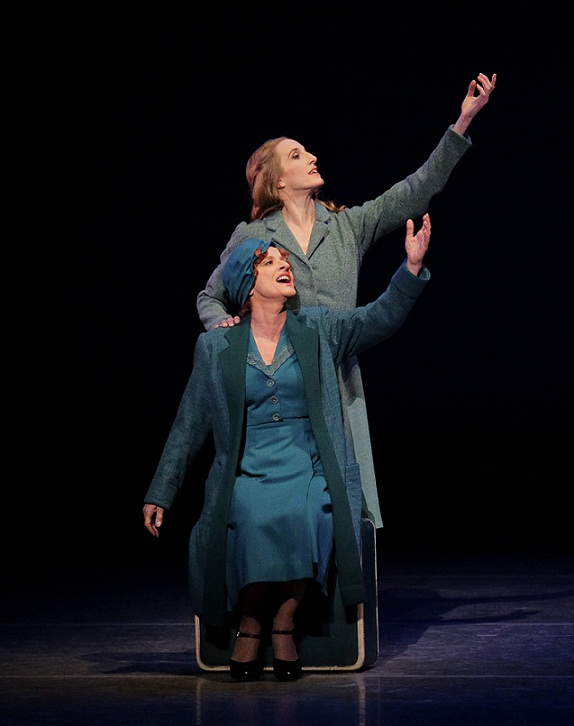
NYCB Spring Gala with SEVEN DEADLY SINS Premiere

Here are some photos, all by Paul Kolnik, of Lynne Taylor-Corbett’s play-ballet, The Seven Deadly Sins, which premiered last night at New York City Ballet’s Spring gala performance. Above is Patti LuPone, who guest-starred with the company (performing the singing role of course!) and Wendy Whelan, who danced the lead. The top photo is from the “Prologue” of the play-ballet (or ballet chante as the program calls it).
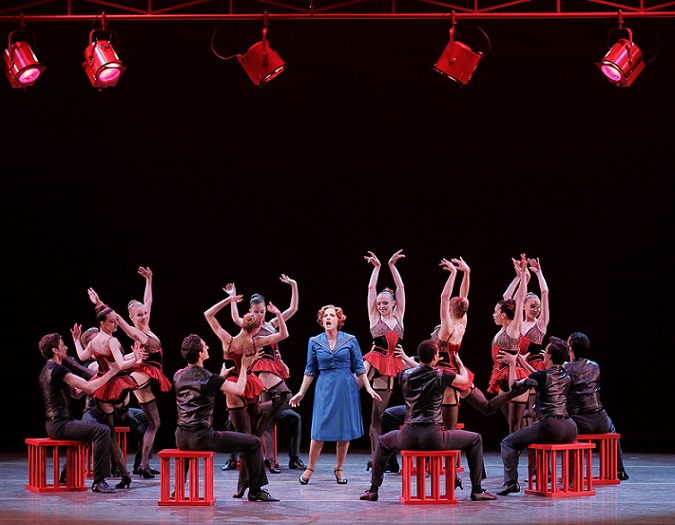
This is from the second part: “Pride”: Patti LuPone and cabaret dancer ensemble.
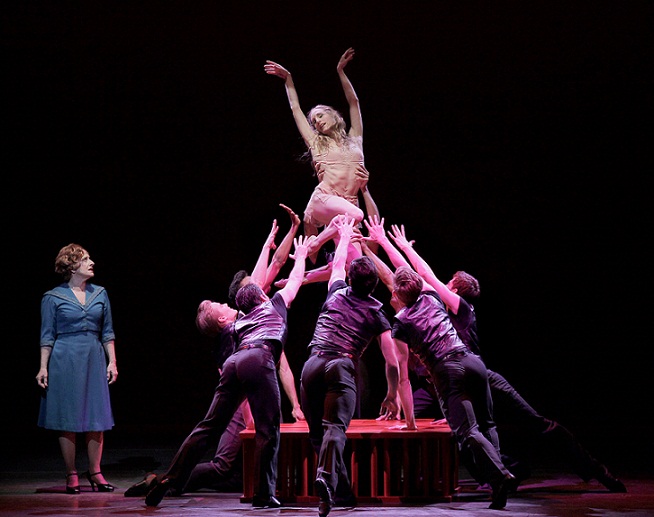
Also from “Pride.” Wendy Whelan is in the middle.
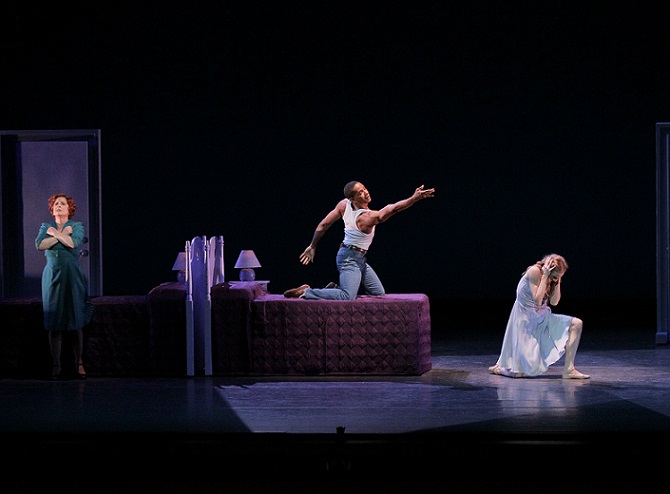
And this is from sixth part, “Lust,” probably my favorite over all. Craig Hall and Wendy Whelan are the dancers in the photo. Craig Hall and Sara Mearns (who danced the role of “Latina Diva” in the “Anger” section, and who I don’t have a picture of unfortunately), most stood out to me, as well as Vincent Paradiso as the Count in the “Greed” section. I think those dancers most stood out – at least Mearns and Paradiso – because they seem to have some kind of acting training. Maybe they don’t, maybe they’re just natural actor-types, but the more actor-ly you are, I think the easier this kind of role would be. Wendy Whelan said in an interview with Roslyn Sulcas in the New York Times that she was used to expressing herself with her body and her lines, that she was used to Balanchine’s dictum “don’t act, don’t think, just dance,” and that she found this kind of role challenging. As much of a NYCB star as she is, and as stunning as she is in Wheeldon and Balanchine’s more modern, angular-lined ballets, I just wonder if she was mis-cast for something like this.

Which isn’t to say that she didn’t dance very well last night. She danced a really beautiful pas de deux with Craig Hall, which is what made “Lust” my favorite section. And LuPone sang in a gorgeously powerful voice. The dancing was all superb. But something just didn’t work to me.

Balanchine choreographed the original Seven Deadly Sins, set to libretto and score by Bertolt Brecht and Kurt Weill, in 1933. The Balanchine version was revived in 1958. According to the Times article linked to above, both the original version and revivals received very good reviews. Since the Balanchine version appears to be largely lost now, and Peter Martins wanted to revive the ballet, he commissioned new choreography from Taylor-Corbett.

Maybe it was that the new choreography didn’t really express the story, which follows Anna, a woman whose various life experiences each represent one of the sins. It wasn’t really a full story, but one composed of scenes, each of which dramatized a sin (and LuPone and Whelan portray different aspects of Anna). But, I didn’t feel the scenes always worked well at doing that. For example, in my favorite section, “Lust,” I thought the Hall/Whelan bedroom scene was really beautiful, very romantic, but nothing said lust, as in sinful lust, to me. I almost felt like Whelan’s Anna had a loveless relationship with her husband, danced by Allen Peiffer, and she was really in love with Hall, and her leaving her husband and running into Hall’s arms was an urgently needed escape.

In my other favorite section, “Anger,” Sara Mearns is a kind of sexy, but rather humorously so, Copacabana dancer. She gets angry at Whelan’s Anna for something – I’m not quite sure what – maybe Anna stole her lover or took over Mearns’ role as head diva, drawing too much attention to herself…  Anyway, Mearns twists her face into a look of utter anger, then points at Whelan, who runs off crying and is then stripped down to her underwear by a group of men. But I thought it was done rather cartoonishly. So it was more funny and cute to me than a dramatic representation of the tragic consequences of anger.

In the “Greed” section, a count and a senator vie for something and end up in a duel, both of them getting killed. But it didn’t have any tragedy or pathos to me. Instead, it felt a bit like Balanchine’s Slaughter on Tenth, which made me want to giggle – probably the fact that it was Paradiso playing the role of the Count.

I don’t know. I guess I was expecting something with more tragedy and pathos and weight, and I felt like I saw a version of Slaughter on Tenth but without a through story-line. Maybe that was the intent. I’m going to see it again over the weekend, and maybe my opinion will change.

Did anyone else see it yet? I’m interested to hear what others think. Has anyone seen the Balanchine version?

After intermission,
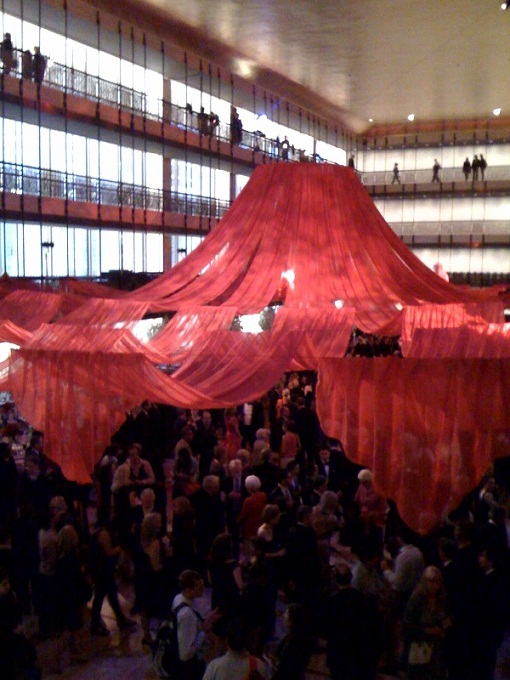
— here’s my photo of the promenade – Balanchine’s Vienna Waltzes was performed beautifully.

Photo by Paul Kolnik.

All of the dancers were very good, but I particularly liked Megan Fairchild and Joaquin DeLuz in the fast-footed, playful scene in the forest, “Fruhlingsstimmen,” and Maria Kowroski and Charles Askegard in the last, beautifully ballroom-y section, “Der Rosenkavalier.”

TWO MORE NYCB PREMIERES: "LUCE NASCOSTA" AND "CALL ME BEN"


It’s been a season of new ballets and principal dancer farewells at New York City Ballet, and, between that and all the goings-on at ABT, it’s hard to keep up! I realized when meeting a blog reader yesterday at Philip Neal’s farewell performance (so nice to meet you, Vanessa!) that I hadn’t yet written about the last two premieres and people were waiting. I was going to wait until I’d seen each once again, but at least with one of them I won’t get that chance since there was a programming change.


Anyway, Maura Bigonzetti’s Luce Nascosta (two photos above, cast in top, Teresa Reichlen and Adrian Danchig-Waring directly above. All photos by Paul Kolnik): I really don’t know what to think of it. The title is translated in the program notes as “Unseen Light”. The stage was very dark except for a Santiago Calatrava moon-like disc, which throughout the course of the ballet expanded into multiple discs. Everyone was in black (costumes by Marc Happel), the men in flare-legged pants and the women in tight black tops and big ruffled skirts that resembled trendy Latin ballroom costumes from a couple years back.

The dancing was at times in ensemble, at times in pairs, but the partnerships changed. It seemed that Tiler Peck and whoever she was partnered by were kind of the leaders, and Maria Kowroski and whoever was partnering her at the moment, kind of concluded the action, with everyone else in between.

The music was gorgeous – by Bruno Moretti, but I didn’t think it accompanied the choreography well at all. The music was like something you’d see in an action-packed movie, like Mission Impossible, at times dark and eerie, at times melodramatic with crescendos like you’d hear when the hero’s coming to save the day. Seriously, perfect for a big summer blockbuster. Here … dunno? And weird because they collaborated closely, the choreographer and the composer…

I thought there were some interesting moments and some original movement, but overall I didn’t feel it added up to much of a whole. My favorite part of the choreography was when all the men were dancing in ensemble. Craig Hall began this rather African-looking movement sequence, then Sean Suozzi joined him, making the movement look more balletically lyrical than African, which made it all the more interesting to me – how the same movement looked on different bodies. Then, other men began to join until it looked ritualistic and celebratory. The women had less interesting movement — one recurring theme was when the women went on pointe, their legs splayed intentionally awkwardly, and they’d hold the balance on pointe while the men kind of darted around them, like the women were frozen. In another recurring theme toward the end, the women went sliding across stage into the men’s arms. The several times Tiler Peck slid like this into Gonzalo Garcia it made a loud, slapping sound. But that didn’t happen with any of the others. I didn’t know if that was intentional or not. The whole thing had a kind of threatening vibe. At times it seemed the women were the threat to the men, at other times the opposite.

The whole thing made me think black widows in the moonlight…

I’m interested to know what others thought of this one. Any thoughts? Critics seem genuinely divided, which I find exciting – often they all hate or all love the same thing.

And the premiere before Luce was Melissa Barak’s Call Me Ben, a story ballet about Benjamin “Bugsy” Siegel, the gangster, and his founding of the Flamingo, the first Vegas nightclub.


Robert Fairchild played / danced the part of Bugsy or Ben – the ballet sought to humanize him, focusing on the person and his ideals rather than the gangster, and it did so simply by having endearingly sympathetic Fairchild play the lead! Jenifer Ringer, who looked like a true Hollywood leading lady throughout, played his girlfriend, the one who swindles him, making other gangsters think he’s taken the money himself and fled, eventually leading them to kill him.

I thought the duets were really beautiful. Robert and Jenifer looked really good together, like a leading romantic couple in a movie. And the ballroom-y period costumes (by J. Mendel) were absolutely gorgeous. I really liked the sets, again by Calatrava, as well. More than his sets for any of the premiere ballets I’ve seen thus far this season (well, with the exception of Wheeldon’s Estancia), these seemed particularly suited for this ballet, evoking warm starry nights, palm trees, the Vegas-y climate, basically.


I think where the ballet fell apart for me was with all the speaking. Barak has said in interviews that she didn’t think she could tell the story purely through dance so she used spoken word as well. But there was too much spoken word, and the dancers were often so out of breath from dancing it took them a while to begin their lines. And that didn’t look natural. Something like this would work in a movie, obviously, where there are separate takes of each scene, but onstage with seriously exhilarating dancing, it took away from the realism. Plus, besides Vincent Paradiso, none of the male dancers really evoked gangster. Tyler Angle and Daniel Ulbricht, great as they are as dancers, just did not convince me that they were hit men. And at the end, when Ulbricht came out for his bow, it was funny but it seemed like people began their usual hearty applause then let up when they realized they didn’t really see Daniel Ulbricht. He didn’t do Daniel Ulbricht things.

And that makes me think maybe she didn’t need to have any talking. Why couldn’t Ulbricht have done his usual pyrotechnics as his expression of his character’s murderous nature?

It seems from interviews Barak has given, that she was given a score (by Jay Greenberg) that she really didn’t know what to do with, and since the score had already been commissioned she had to come up with something in a short period of time. It’s interesting how these ballets are being commissioned because when I heard Benjamin Millepied speak about his new ballet at a Guggenheim Works & Process event recently, he mentioned that he and his composer, Thierry Escaich, worked together, talking about what the music evoked and how that would be visualized, but that Calatrava designed his set for that ballet independently. So, all throughout Why Am I Not Where You Are, I was wondering whether Millepied meant for his color-clad dancers to be hailing from another world, mainly because of that space-like object of Calatrava’s. But Millepied hadn’t meant for that at all — it was just the set he got, which had nothing really to do with his ballet.

Is this how collaborations used to work in Diaghlev’s day though? I just assumed Stravinsky and Balanchine and Chagall all worked together to create a work of performance art. I mean, how else could Firebird have been created?

TONIGHT AT NEW YORK CITY BALLET


Top to bottom: Ashley Bouder and Robert Fairchild in Lifecasting, Tiler Peck in Mercurial Manoeuvres, and Maria Kowroski and Philip Neal in Slaughter on 10th. All photos by Paul Kolnik, courtesy of NYCB.

My friend Michael (whose novel is reviewed in the New York Times Book Review this Sunday, woo hoo!!!) and I saw this program Wednesday night. It was one of my favorites at NYCB and I think his as well. (Well, he loves Ashley and I love Mr. F. so it was a given we’d be melted into our seats by the end of Lifecasting).

But we were also both blown away for the first time by Wheeldon’s Mercurial Manoeuvres, I think because Tyler Angle plus Tiler Peck equals serious magic… Oh my gosh, Tiler Peck really made that ballet. I can’t wait to see her again tonight. She was just everything and more. Unfortunately Tyler won’t be partnering her (he’s my favorite male partner, along with Marcelo Gomes at ABT); she’ll be partnered instead by Adrian Danchig-Waring, a dancer who I am not all that familiar with but am excited to see. Also, heinously, my love Gonzalo Garcia (who owns the lead in this) is not dancing tonight; instead it’s Joaquin De Luz, who, yes yes, I’m sure will be spectacular as well 🙂 It will be interesting to compare, as I so love to do…

Casts are the same for Lifecasting with the aforesaid mesmerizing Robert Fairchild and Ashley Bouder, and Slaughter on 10th, starring Maria Kowroski and her legs, Philip Neal and his tap shoes, and Vincent Paradiso and his gangster persona! I’ll write more about this program after I see it again tonight.