American Ballet Theater’s “On To Act II” at the Guggenheim

Did you guys watch the live-stream last night or tonight? If you missed it, you can watch the video now archived on the Guggenheim’s ustream channel.

It feels weird to review a program that everyone can easily watch online, but I’ll just say my favorite moments last night were: the ABT II dancers in excerpts from Jessica Lang’s Vivace Motifs, which I thought looked like a lovely ballet; Hee Seo in the prayer scene from Coppelia; Susan Jaffe coaching Sarah Lane in another scene from that same ballet; and Jose Manuel Carreno’s interview by Wes Chapman.

I wasn’t really in love with the dance Carreno performed with Melanie Hamrick – Ronald Savkovic’s Transparante. I thought there was a bit too much falling down and standing up again, and, though some of the partnering and lifts were beautiful they were pretty basic and didn’t reveal much about the relationship of the characters and the dramatic action. But I loved hearing him talk – love how he still has that thick accent! Love that he said “oh shit” in reference to all the Don Quixotes he’s cast in during week one of ABT’s Met season! He doesn’t seem to have a plan for the future, but said he’d still do some freelance dancing for the next few years, and said he’s interested in exploring more contemporary work, other forms of dance. I think that’s why he wanted to dance Transparante instead of something from ABT’s season.

I liked Martine van Hamel’s discussion and performance of some of the character roles she continues to do – the wicked stepmother, always either drunk or hung-over, in Kudelka’s comical version of Cinderella, and the wicked fairy Carabosse in Petipa’s Sleeping Beauty. But they left out the Dacha Dweller from Ratmansky’s Bright Stream, which was on the program! None of us have seen that ballet yet and I was eagerly awaiting that excerpt … and then she said she wouldn’t do it because she couldn’t get something in it quite right yet. Well, I guess we’ll see it soon enough.

I really did like the excerpt from Jessica Lang’s Vivace Motifs. The ABT II dancers are always very good, especially Irlan Silva. Every time I see him dance I get annoyed that ABT hasn’t yet brought him into the main company. I don’t understand what they’re waiting for. He stands out so much to me. He seems better than most of ABT’s soloists and even some principals. And he’s not even in the corps yet. I really really really don’t get it.

Anyway, I’ll conclude this post with an excerpt of Carreno and Susan Jaffe dancing the Black Swan pdd from an earlier documentary about ABT:


And footage of Silva from the documentary, Only When I Dance:
 

Jose Carreno and ABT Live-Streamed from the Guggenheim this Sunday and Monday


The Guggenheim’s Works and Process event this coming Sunday and Monday nights (May 1st and 2nd) is entitled “ABT: On to Act II” and focuses on what awaits a principal ballet dancer upon retirement from an illustrious career. The focus of course is on Jose Manuel Carreno, who will retire in June during the company’s Met season, and who’s long been one of my personal favorites in ABT and in the world. I remember when Julio Bocca gave his farewell performance I thought how upset I’d be when it was Jose Carreno doing the same. That day in late June is not going to be a happy one for me…

The W&P panel will consist of Carreno, Susan Jaffee, Frederic Franklin, and several ABT administrators, and there will be excerpts from the company’s upcoming Met season performed. (It hasn’t yet been announced who the dancers will be.) There will also be a slide show of the photography of Rosalie O’Connor, who successfully transitioned from ABT dancer to company photographer (and who took the above picture of Carreno in Don Quixote).

As with all of the Guggenheim’s W&P events of late, this one will be live-streamed on the Guggenheim’s ustream channel. So even though the event is sold out, we all get free admission 😀 Just tune in at 7:30 p.m. ET either night, and again, you can also participate in the live-chat which takes place on that channel alongside the live video.

Don’t Forget Royal Danish’s Live-Stream Via Guggenheim

Hey you guys,

I’m on a legal assignment with some really crazy hours, so sorry I’ve kind of had to drop off the face of the earth for a while! Anyway, just wanted to remind you all that the Guggenheim is live-streaming their Works and Process with the Royal Danish Ballet this Sunday and Monday nights, at 7:30 p.m. I’ll be working and not watching, but the good thing about the live-streams is that they’re archived 🙂 See my prior post for the Guggenheim’s ustream website.

Hope to have time soon to blog and respond to all your excellent comments on my post about NYCB and Twitter!

Two Live-Streams This Sunday: Natalia Osipova in Bolshoi’s Don Q, and Guggenheim’s YAGP Judging Panel Program


Live-streaming, either over the internet or into movie theaters, seems to be the in thing these days, fortunately, for those of us who can’t travel the world to see top companies perform and / or afford to attend all of these panel discussions and performances.

This Sunday, March 6th, there are two live-streamed ballet events. The first, at 11:00 a.m. ET is the Bolshoi’s production of Don Quixote starring Natalia Osipova and Ivan Vasiliev, which will be live-streamed from Moscow into theaters all over the world. I wrote a little about that at the bottom of this post.

As I said before, if you haven’t seen Osipova, this is your chance. She’s one of the most athletically astounding ballerinas around right now, she’s a huge star in Europe, and this is THE role that she’s most known for (since it really showcases such athletics). In Manhattan, the performance will be shown at the Big Cinema at 59th Street between 1st and 2nd Avenues, and I think it costs $25. Check the Emerging Pictures’ Ballet in Cinema website to search for showplaces and showtimes in your area.

Above image of Osipova and Vasiliev by Genaro Molina from Danza Ballet.

Then, later in the evening, at 7:30 ET, the Guggenheim will live-stream online via their ustream channel their Works & Process program on judging in the important Youth America Grand Prix. This program is free, and, again, you can participate in the live chat online on that channel.

For more info on the Guggenheim’s program and participants, click below to see the full press release:

Continue reading “Two Live-Streams This Sunday: Natalia Osipova in Bolshoi’s Don Q, and Guggenheim’s YAGP Judging Panel Program”

Guggenheim to Live-Stream “Giselle Revisited” January 9th

Super cool! The Guggenheim has just announced it is going to live-stream its upcoming January 9th Works & Process program, Giselle Revisited, a discussion with Pacific Northwest Ballet artistic director Peter Boal and others from PNB about the company’s new production of Giselle. Of course excerpts will be performed, by principal dancers Carla Korbes, Carrie Imler, SLSG fave Seth Orza, and soloist James Moore (who I also remember liking the last time PNB performed here).

The discussion / performance will be live-streamed direct from the Guggenheim beginning at 7:30 p.m. on Sunday, January 9th, at this web channel: http://www.ustream.tv/channel/worksandprocess. The Winger‘s Candice Thompson will lead an online discussion, so people watching via the live-stream will be able to chat with each other in real time.

Click on the link below to see the full press release.

Continue reading “Guggenheim to Live-Stream “Giselle Revisited” January 9th”

Guggenheim Announces its 2011 Works & Process Season

And it looks like there are several good dance events, including the Royal Danish Ballet with Nikolaj Hubbe, a program on how judges judge the big ballet competitions like the Youth America Grand Prix, a sneak peek at Pacific Northwest Ballet’s new Giselle production, a night of Robert Wilson-curated choreography and performance art, and more ABT.

Click on the link below for their press release, containing the full dance event schedule.

Continue reading “Guggenheim Announces its 2011 Works & Process Season”

Sneak Peek of ABT’s New Nutcracker

The Guggenheim just sent me the above video, which is of their Works & Process event a few weeks ago that I’d attended and written about a bit here, featuring excerpts of ABT’s upcoming Nutcracker at BAM. It starts December 22nd – getting excited!

Also, yesterday I attended a screening of the Royal Ballet’s Nutcracker, as part of Emerging Pictures’ Ballet in Cinema High Definition film series in theaters across the country. I’ll write about it soon. They put on a very good, very different Nutcracker!

LEVELS OF NOTHINGNESS STARRING ISABELLA ROSSELLINI

levels-of-nothingness-exh_ph01

levels-of-nothingness-exh_ph02

levels-of-nothingness-exh_ph03

levels-of-nothingness-exh_ph04

Photos above courtesy of the Guggenheim Museum.

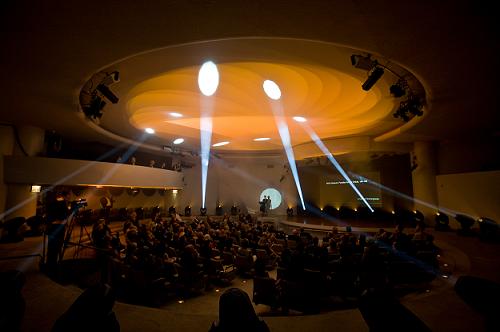
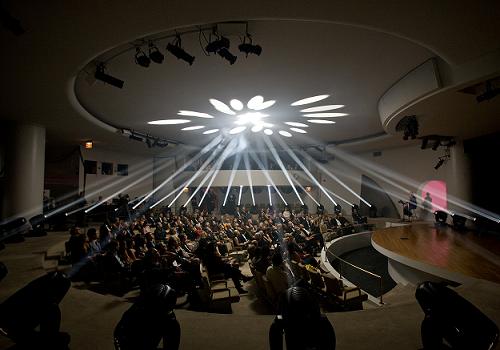
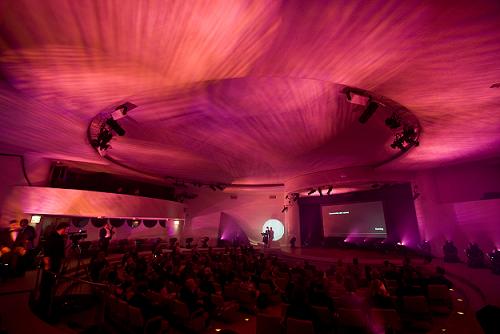
Over the weekend, I went to see a spoken word / light performance by Mexican artist Rafael Lozano-Hemmer called Levels of Nothingness, at the Guggenheim, as part of their Works & Process series. The work was inspired by Kandinsky’s Yellow Sound. (There is currently a large Kandinsky exhibit in the Guggenheim, in celebration of the museum’s 50th anniversary). Wassily Kandinsky is considered the father of abstract art, he used color extensively to evoke inner states, and he believed in the convergence of all art forms — painting, sound, movement. Yellow Sound is basically a compilation of his notes describing his ideas for an theatrical piece or an opera in which color and lighting played a large role.

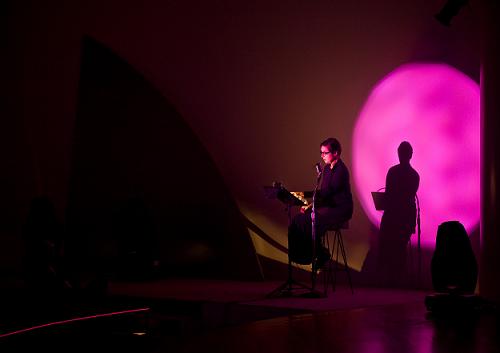
So, starting from that idea, Lozano-Hemmer (and co-writer Brian Massumi) constructed an interactive installation in which a system of lights would respond to spoken words. Actress Isabella Rossellini read the words, which were quotes from various philosophical texts about perception and color (interestingly, all texts were by non-Newtonian thinkers, who believed, in contrast to Newton, that one’s perception of color was subjective.) Basically, a computerized microphone analyzed Rossellini’s voice, taking into account her: pitch, wavelength, amplitude, intensity, speed, accent, intonation, and speech patterns. That information triggered robotic lights (these rather cute little R2D2-looking guys which were set up to surround the stage and perimeter of the auditorium) to create various light effect, such as those used in a rock concert — fly-aways, bump cues, color chases, ballyhoos, builds and flash-throughs — I don’t know what all of those things are but figure there may be theater-people reading who do!

Anyway, the effect was interesting but not really what I was expecting. Go here to see a clip of it; scroll down about halfway through the article until you see the video on the left side — on the video, you can click on the little box in the right-hand corner to enlarge the video to fit your entire computer screen.

It’s very cool to be sure, but it seemed more orchestrated than I was expecting. For example, every time Rossellini began on a new piece of text, she’d wait a few seconds for the machines to all re-adjust and prepare for that segment. So with each text there would be a specific light pattern: a white-based kaleidoscope one on the ceiling, a yellow-based one, a red light would light up behind her and go off and on as her voice stopped and started, sometimes there would be a multiplicity of lights all shining up at the ceiling making circles of light in multiple colors, etc. But they weren’t all happening at once. Each quote was set up to show one kind of pattern and then the lights would blink on and off or move around in the kaleidoscope according to her voice. It’s hard to explain, but watch that video if you want to see what I mean.

Afterward, the audience got to test it, which was fun. The host walked around with a microphone and let various people speak into it, reading from text projected on the back wall. Everyone was behaved and no one did crazy voices or spoke really loudly or anything so the lights were kind of mild as well. What I (and another woman, who asked) really wanted was for several different people to say the exact words side by side to see how the lighting design was different for each voice. But the system wasn’t set up to do that. At one point, Lozano-Hemmer re-read the same text an audience member had just read, and there did seem to be a subtle different in the lights, but I needed to see more of that to compare.

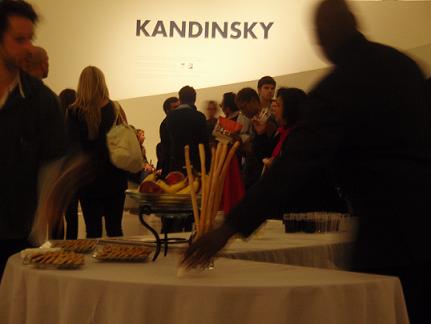
Anyway, after the performances, the Guggenheim hosts these little cocktail hours where you can meet the artists.

p9202312

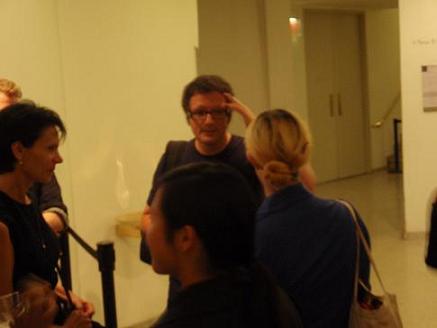
Here is Lozano-Hemmer speaking with some of the attendees. I couldn’t find Rossellini. Sorry so blurry — I hate flashing in people’s faces.

p9202308

Well, anyway, the Guggenheim seems to have replaced their tray-loads of mini sandwiches with these rather long bread sticks. Probably a wise idea to get rid of the mini sandwiches because, as James Wolcott has noted, people go downright mad for those things, nearly killing each other in the stampede toward the food tables. You’d think none of these people eat for a month before a Guggenheim Works & Process event just so they can load up on “free” (if you subtract the $30 you paid for the ticket) little cucumber and mayonnaise squares. Could never figure out what gives with that?

Anyway, the bread sticks are tasty, and surprisingly filling, but when I went to put one to my mouth I realized how blasted long they were — it was like eating a baton. You had to really hold the end of the breadstick out quite a distance from your mouth. It was rather amusing watching all these people standing around with a glass of wine in one hand, holding a bread stick up in the air with another! For a moment they looked like cigarette holders and the whole scene looked a bit Breakfast at Tiffany’s.

ABT, LARRY KEIGWIN, AND DANCES INSPIRED BY KANDINSKY AT GUGGENHEIM THIS FALL


The Guggenheim Museum has just released its Works & Process events schedule for the fall and there’s some good stuff coming up.

On October 11 and 12 ABT will give a program, entitled, The Art of Adaptation, in which dancers will perform portions of the company’s upcoming contemporary season, held this year at Avery Fisher Hall, and panelists will discuss how they’re adapting work for a non-dance venue. (The company is performing at Avery Fisher this year because City Center, where they usually have their fall season, is going to be temporarily closed for remodelling). It hasn’t yet been revealled who the dancers or moderators will be, but I’ll let you know when I do!

On September 23 and 25 there will be a new dance / music commission inspired by artist Vasily Kandinsky’s Blue Rider Almanac of 1912, performed at the Miller Theater at Columbia University. Music is by the Brentano String Quartet, soprano Susan Naruki, and pianist Sarah Rothenberg; the dancing will be by Armitage Gone! Dance. This, along with a couple of art installations in the museum and another music piece, is commissioned in conjuction with a Kandinsky retrospective to show in the main museum.

On September 11 and 12, young choreographers Larry Keigwin and Peter Quanz are each showing a piece they’ve made to Steve Reich’s Pulitzer-winning Double Sextet. Dancers will be from Keigwin + Company and the Royal Winnipeg Ballet. Reich will participate in the panel discussion on the 12th.

And, finally, on October 24 and 25, Shen Wei Dance Arts will perform in celebration of the company’s 10th anniversary and Shen Wei will discuss his creative process.

There are other, non-dance events as well, including a talk on “Sex Stress and Music,” a world premiere by composer Charles Wuorinen, and a spoken word performance inspired by Kandinsky’s Yellow Sound (1912) in which actress Isabella Rossellini will read and Mexican artist Rafael Lozano-Hemmer will generate an array of colors from the sound of her voice. Very cool-sounding!

The schedule’s not yet on line but it’ll be here when it is.