Why No Contemporary Nureyevs?

So, I thought the documentary last night on PBS was rather so-so; it was okay I guess as far as PBS documentaries go 🙂 First 40 minutes dragged, but second half was far better, mainly because it was about his defection. I remember reading an interview with Baryshnikov years ago — I now have no idea where or when it was — but he was asked why he decided to defect and he basically said, “mmm, dunno, seemed like the thing to do?” I was so disappointed. I’m sure he just couldn’t talk about it, but how could you not have some kind of answer for something like that? Even if you just say, “I really don’t want to talk about it.” So I’m very happy that here they focused on Nureyev’s defection, even using his French friend who witnessed it to re-enact the whole thing.

I love how the filmmakers dwelt on the aftermath too — the KGB’s plan to try to break poor Rudik’s legs, their attempts to destroy his first performance in the West by screaming and shouting and throwing dangerous objects at him onstage. Wow. And how he had to go into hiding. And how the government wholly erased his presence in Russia, preventing information about him leaking into the country through the newspapers, destroying the careers of his friends and family. How some friends missed him dearly — one said he was “the bright spot” in her life, such a thing coming only once a lifetime, and even that if one is lucky. How others felt he was hugely dishonorable (for leaving the country that made him, as if it was the country and not he himself), an abandoner of his family and friends. The film doesn’t make it obvious, but he had to live with all of that. Some journalists have argued that the documentary only shows Nureyev in maturity, on his good days, neglecting to show the occasional nastier side of him. If you were constantly made to feel like a horrible person for turning your back on your country, your ill mother, wreaking destruction on your friends and family, all for wanting to live an honest life, you’d probably have some anger inside of you too.

Anyway, the first part is too slow I think mainly because there are too many interviews. It’s confusing who all of the people are, and many are not that animated (unlike most of the funny characters in the very good documentary Les Ballets Russes). Perhaps they could have filmed in more meaningful places, like with the French guy in the airport? Just having them sit there yapping away was a bit boring. I found his school chum entertaining though — the white-haired guy who talked about all the times Rudik would make him practice, would make him do the parts of the ballerina so he could practice lifts 🙂 For those who somehow can’t tell from his dancing alone, such anecdotes reveal that this was someone who ate, breathed, and slept his art.

By far the best parts of the film are all the footage of the great one in action — both that amateurly taken in his youth by his German friend, the ever intriguing Teja Krempke (could we please hear how he died — I know it was “under mysterious circumstances,” but where was he found, etc.?), and formal footage taken of his later performances with his “soul mate” Margot Fonteyn. For people who missed the film (it’ll be shown again late Saturday night), it’s definitely worth getting through the boring interview segments to get to that footage.

But watching him dance, I can’t help but get upset that there’s no one even remotely like him today. He danced with such fierce, inflamed passion, with such glorious recklessness, with such hunger — forget those insanely fast chaine turns and crazy high barrel turns that don’t look humanly possible — just look at the intensity in his eyes that permeates his entire body, even in those small pieces from Pierrot Lunaire and Giselle. I feel that there’s no one today who comes even close, who has the courage to do something novel like dance on demi-pointe like he did (and now everyone does). I think you have to have starved to have that kind of hunger. And today’s young ballet dancers — I feel like many of them don’t know the meaning of those words. And, forget art, their greatest ambitions are to construct the perfect MySpace page so they can engage in childish chatter with each other.

Dancing With Stars Season Five Contestants Announced

So, as everyone likely already knows, the next season of contestants on DWTS has been announced. They are:

Spice Girl Melanie Brown, paired with Max Chmerkovskiy;

Musical recording artist Sabrina Bryan, paired with newcomer Mark Ballas (hmmm, any relation to Belle of the Ballroom World, Dame Shirley???);

Indianapolis 500 champ Helio Castroneves, paired with young champ Juliana Hough, a favorite of mine from last season. Helio is from Brazil, fun fun 🙂 ;

Basketball team owner Mark Cuban, paired with Kym Johnson;

Actress Jennie Garth from 90210 (hmmm, don’t remember her?), paired with Derek Hough newcomer to the show and brother of the marvelous Juliana;

Model Josie Maran, paired with Alec Mazo (winner from season one);

Soap opera actor Cameron Mathison, paired with Edyta Sliwinska;

Boxing champ Floyd Mayweather, paired with my idol, Ms. goddess Karina Smirnoff 😀 ;

Vegas legend Wayne Newton, paired with the amazing and talented genius of a dance teacher, Cheryl Burke;

Marie Osmond (aww!), paired with cutie, Jonathan Roberts;

Model Albert Reed, paired with Jonathan’s lovely wife, Anna Trebunskaya, who has been doing quite well in pro Latin competition lately; and

longtime actress Jane Seymour, paired with former American Rhythm champion, Tony Dovolani.

Season premiere is scheduled for September 24th, and looks like it’s to last for three days. Will begin with a battle of the sexes group comp, with male contestants going at it en groupe against female.

Maria at A Time to Dance has a rather funny little list of why she so strongly prefers SYTYCD to DWTS. I don’t think the two shows are comparable though. I think the latter is about turning normal people (well, not normal or they’d be complete nobodies like me — they have to be celebrities on some level to draw an audience — but people who are not natural-born dancers) into the best ballroom dancers they can be. The former is about people who already have talent in a certain dance form honing that ability and learning to be versatile and to work well with partners and choreographers. Okay, at least theoretically, and IMO anyway. I like the former show because the dancers are often so amazing (especially this last season :D); I like the latter because I can often relate to the challenges faced by the amateurs. Learning to dance as an adult is damn hard!

My biggest problem with DWTS is that it seems that the pro dancers aren’t given enough due for their very difficult work, a thought shared by at least one professional dance critic as well. After Pasha was booted from SYTYCD, one of his fans on his Television Without Pity thread, suggested maybe he could be on DWTS so that his fans wouldn’t miss him too much. I think it’s actually a sweet idea. Pasha’s a great teacher, and, if an already famous dancer is on the show, perhaps it’ll create more appreciation for the pros.

Anyway, hopefully it’ll be a decent season. We’ll see…
P.S.: don’t forget to watch Nureyev tonight 🙂

Remember Remember Remember!!!!

to watch tonight, Wenesday, PBS at 9 pm. DO NOT MISS IT! Under any circumstances! This is the greatest dancer EVER. Plain and simply. Unarguably. In the world. EVER.

If you wish to do some advance reading, everyone but everyone on the web is talking:

Apollinaire in Newsday

Apollinaire’s blog

James Wolcott from Vanity Fair (scroll down to last couple paragraphs; he also quotes extensively New York Sun’s Joel Lobenthal on some important things the production left out)

journalist and author Tobi Tobias

New York Times

the inscrutably angry LA Times’s Lewis Segal (what in the ballet world has made that man so mad? By the way, are people just ignorning him these days? Am I the only idiot letting him get to me?)

New Yorker’s Joan Acocella

My fellow blogger Art (through whom I found the blasted Segal article that nearly made me cry — thanks a lot, Art 😉 )

Ballet Talk talkers (focusing mostly on Nureyev’s gorgeous, cat-like demi-pointe that Segal has such issues with)

and I’m sure many many others who escaped my limited web-surfing attention span :S

Please please watch the program. No matter how deficient the documentary may be, this man’s life was so uber fascinating and his dancing so sublime you’re bound to be completely enthralled, there’s simply no way around it! This film covers his early years before he became hugely famous in the West — so, while he was in the Kirov Ballet up through his decision to defect. So basically, lots of footage of Russia 😀

C’mon, he was the original Pasha 🙂 I know, I know, I’ve offended everyone and their dog with that … I simply mean of course that for people who have fallen in love with dance through SYTYCD, there’s a whole lot more where that came from 🙂

Okay?! Wednesday night 9 p.m. PBS. Discussion to follow!


Postmodern Dance Can Be Fun!: "States and Resemblance" Near the East River Piers

Last night I went to see the second in the three-work series “Sitelines” — site-specific dance performances organized by the Lower Manhattan Cultural Council, taking place at various downtown locales. This one, entitled “States & Resemblance,” was choreographed by Dean Moss and Japanese video artist Ryutaro Mishima, and took place on a nice little elevated park overlooking the East River that I hadn’t even known existed.

Above is a picture of the scene. Painted on the ground was an ambiguous grey splotch dotted with several large black spots that spilled out of the grey and all around the park’s winding paths. One such path led to a larger grassy lawn, where they are apparently showing a series of several old films shot in NY as part of the River to River festival (all these fun outdoor festivals in NYC during the summer!)

Well, I’m not entirely sure what to make of the piece, so I’ll describe it. The performance began in the lawn area, with Moss and Mishima running and jumping around playfully. I’d seen an earlier draft of this at the Nothing Festival at Dance Theater Workshop a few months ago, and there the men were naked. Here, they were nearly so, wearing only resplendent white dance belts, which, because of their sheen, were actually rather beautiful.

After cavorting around the lawn with each other for a few minutes, an Asian woman (whom the program notes is Indonesian mask artist Restu Imansari Kusumaningrum) dressed in shiny skirt and top, emerged from the park and walked to the edge of the lawn ringing a bell. That signaled for the men to walk into the park, where, in the center atop the dots, they slowly and soberly put on pants and button-down shirts — casual work clothes. The woman wandered around the park for a while, ringing the bell every so often while the men, after dressing, stood on the main grey area, first doing a series of poses during which their hands then arms would slowly begin to quiver, then a series of balances on one foot.

Suddenly, Mishima turned on Moss, attacking him. The men fought, jumping at and bouncing off each other, struggling with each other, with Moss trying to make peace with Mishima but Mishima resisting. While this happened, Kusumaningrum found a place in the grass to sit peacefully, where she donned a face mask.

Mishima eventually broke free from Moss and walked to the outer edges of the sidewalk, to where the crowd was sitting, and began laughing and singing at us aggressively and haughtily, momentarily a bit frightening. Kusumaningrum, disrupting the crowd by moving to various areas of the park, tried on a series of masks. Moss, now walking very slowly and hunched over like an old man, approached Mishima, who picked up a television set whose screen bore a close-up of an elderly person grinning widely, many teeth missing, and confrontationally thrust the screen out at the crowd.

Eventually, the two men went into a back area of the park and sat down in the high grass, hiding themselves from the audience. Kusumaningrum walked out to the center area, lay down and thrashed about on the ground, donning another mask. Eventually she stopped and pointed to the area where Moss and Mishima were sitting. The men slowly rose. Over each of their faces was taped a large black dot, the same as were spotting the ground.

So what does all this mean? Well, the little blurb on the Sitelines flier tells us that it is intended to be “a meditation on the pain, beauty, and inevitability of how things, people, and experience pass away … reflect(ing) on the process of aging as one of the most binding aspects of our existence.”

I could definitely see the aging in the way the men acted boyishly, playfully on the lawn, near naked, in an innocent beatific state, then as if called by their mother, or by time, to grow up and don career clothes. I could see Mishima’s attempt to defy the passage of time by lashing out against Moss, who nevertheless eventually grew into an old man, taking Mishima with him. At the end, the large black dots covering their faces suggests ashes to ashes, dust to dust, our bodies do eventually become part of the earth, part of the environment, and thus timeless. I didn’t completely get the significance of the masks, unless they were meant to convey in another way how we try to evade and hide, pretend, develop facades?

I’m sure there are plenty of other interpretations as well. In general, I find this kind of postmodern / experimental dance intriguing and fun so long as there’s enough there for you really to cull something from it all and come up with various analyses. I definitely felt like there was enough here to do that. Here’s a write-up on the piece by Gia Kourlas in TONY. It’s showing a few more times this week and next; go here for the schedule.

Brief Snapshots From Downtown Dance Festival

I’m exhausted from spending the weekend down at the lower tip of the island watching other people dance (how does that happen?), so this is going to be short (word-wise at least). The Downtown Dance Festival took place during lunch hour each day last week at Chase Manhattan Plaza in the Financial District, then moved for the weekend to a nice little outdoor amphitheater in Battery Park. I wasn’t able to see all of the dance companies (nearly 20 in all), but here are some highlights from what I did see.

First, sorry, but I simply must bombard people with just a couple more photos of Quorum Ballet, who performed again Saturday in Battery Park. They were really so lovely… so, just, HOT for lack of a better word 🙂


I wrote in my last post on them that their lifts looked a bit “trick-happy” and on watching again I think that might be in part because the lead female dancer, Theresa da Silva, would often look out into the audience and choose someone to flirt with, which seemed to happen most often while she was airborne. Very interesting, and something I haven’t really seen in concert dance before, only in ballroom comps and some club acts. Anyway, their next performance in NY will be February 13th at the Tribeca Performing Arts Center. I urge everyone in the city to check them out!


I also liked the Ashley Browne / Kinetic Project. Some very sweet duets with fun, pop music from Jill Scott, Mos Def, and Fiona Apple.


Ms. Bne is a choreographer I could really see working on SYTYCD. I really wish they would open the show up to other choreographers besides the same ole Mia Michaels and Wade Robeson. I mean, keep them, but instead of having them choreograph something practically every week, let the country see some of this other awesome talent!


Another favorite, Vissi Dance Theater. I loved them! Their mission statement reads, “Vissi is committed to art that explores moral and social issues… Vissi seeks to speak to the human condition, lift the spirit, ask questions, celebrate the joy of life and reflect the truths of human nature.” I felt they did that splendidly. This piece above, danced by four women, reminded me a bit of Alvin Ailey’s Cry with its upbeat celebration of womanhood, and was kind of a combo of modern dance with disco / hustle, to music by Macy Gray and Jocelyn Brown.


Their second piece, named “Melbabcd,” was a combo of all kinds of stuff — modern, hustle, hip hop, Latin, African, you name it. Great fun, as dance that makes you think and has social relevance can often be 🙂 This one kind of reminded me of Bill T. Jones with its very colorful cast of characters. I’d love to see more full-length work by this company.

The choreographer, Courtney Ffrench, by the way, is another whom I can really see peppering up SYTYCD with some romping group numbers. C’mon Nigel, expand those horizons!

Another highlight:


Gallim Dance Group. This piece is from “Snow” based on the novel by Orhan Pamuk and choreographed by Andrea Miller (yet another who could inject that aforesaid pop-fest with a blast of brain power). This was a haunting piece, like I imagine the book to be (okay, admitting I haven’t read it here!). The women bent their bodies every which way, inched forward, ran backward — the movement was beautiful but juxtaposed with musical lyrics like “question democracy…” became chilling. A Juilliard grad formerly with Ohad Naharin’s Batseva, which I’ve enthusiastically blogged about before, Miller’s mission is to “explore issues such as feminity, power, community and solitude.” Gallim will be performing at Dance Theater Workshop in Chelsea in September. See them there if you can.

On Sunday, we were treated to Darshana Jhaveri Manipuri Dance who came all the way from India, and who specialize in bringing the classical Indian dance, Manipuri, to contemporary audiences. So sweet, so lovely, and so educational.

This guy BLEW ME AWAY. He had this amazingly intense look of concentration the whole time. Sometimes when a performer has that look in his or her eyes, you’re almost mesmerized just by the face. He beat the hell out of this double sided drum, as well as another that required a stick, later on. Not only did he play those drums, he danced while playing. And not only did he dance, he did these continuous barrel turns at whiplash speed. The entire audience sat there open-mouthed.


And here he is barrelling all over stage with the other, larger drum. Between turns, he made beautifully intricate gestures with that drumstick. At one point, he put the drum down on the center of the stage and did repeated turns around it, beating it with the stick after each rotation, and managing somehow to hit the stick on the drum right in time with the lightening-fast music. Talk about the necessity of great speed and precision on those turns — if a turn was off, you wouldn’t just see it, you’d hear it. It was breathtaking, and I can’t tell you how much respect I now have for this classical Indian dance form.

Okay, I can’t write anymore. I do have a few more pictures of the whole festival, along with the Sitelines performance series, in my photoalbum, here.

Speaking of Sitelines, Apollinaire and Eva Yaa Asantewaa are having a very interesting discussion of the Macaulay NYTimes review of the Reggie Wilson / Andreya Ouamba work I wrote of earlier. Eva’s review of the piece puts me to shame — she saw all kinds of things I hadn’t thought of — do read it! I do have thoughts on the subject of socio-cultural meaning in dance and whether the choreographic duo’s mission statement should have been confined to grant application writing, as Macaulay argues, but am far too exhausted to formulate them now…

In The Company of Beautiful People: Quorum Ballet At the Downtown Dance Festival


Nice thing about New York in August is that there are lots of outdoor art festivals offering free viewings. I of course have been attending as many of the little dance performances as I can. Many are by very small companies, and the works are brief. Here’s a troupe that caught my eye yesterday, Quorum Ballet from Lisbon, Portugal, who performed at Chase Plaza as part of the Downtown Dance Festival organized by Battery Dance Company.


Their movement style was what I’d call contemporary ballet mixed with modern — no toe shoes but some lovely balletic lifts — and in one piece I saw a smidgeon of Flamenco. Music was mainly poppy with a fun, solid beat.


Beautifully sexy movement, and I don’t think I’ve ever seen such a gorgeous group of dancers! It’s a small, very new company founded only in 2005, by choreographer and dancer Daniel Cardoso,


(how much does he look like Herman or Joaquin 🙂 — jumps not unlike them too!), who, along with lead dancer Theresa da Silva, was previously affiliated with seminal modern dance company Martha Graham. (The two are pictured above and below, in “Kismet,” my favorite, and the piece that, at least in its solo parts, reminded me of a balletic flamenco).


Here are some more pics from their other pieces:


My only qualm was that some of their lifts looked a bit too “trick-y” as in, you kind of felt like drum rolls should be preceeding them, similar to what I’ve seen at many of the exhibition dancesport competitions I’ve been to. Suits some people’s tastes but not mine, and I don’t think this company really intended for them to be that way, although maybe they felt they were playing to an audience unaccustomed to dance and felt like they should play up the showy aspects. And some of the lifts seemed a bit out of sync with the style. For example, the “bluebird” lift above (where da Silva is balancing on Cardoso’s shoulder, back arched), a typical ballet lift, seemed to me a bit at odds with the flamenco-y flavor of that dance. I would rather have seen more original parterning, specific to the dance style, such as that employed by Mimulus, which I wrote about earlier. But the solo and ensemble work were just gorgeous.

Cardoso had some beautiful pelvic and ribcage isolations going on. Very Latin 🙂


Okay, that’s all for now. Will likely be more to come depending on whatever else strikes my fancy in the next few days … 🙂

At the Doors of U.S. Customs

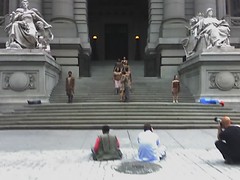
As promised, here are a bunch of pics I took of yesterday’s first peek at the collaboration between Brooklyn-based choreographer Reggie Wilson, and Andreya Ouamba (originally from Congo but now residing in Senegal), entitled, intriguingly, “Accounting For Customs.” The work is part of the Lower Manhattan Cultural Council’s “Sitelines” project — comprised of dances that are created specifically for a certain site, outdoors, free and open to the public 🙂

This dance took place on the steps of the U.S. Customs House, which the dancemakers assured was significant. I honestly had to stop and think of what the Customs House represented. I have no background, or interest, in economics and actually almost got lost trying to find the place, since I think of this building as The Museum of the American Indian (which it now is; in 1973 Customs was moved to the WTC, don’t know where it is now…). Well, I guess the work that goes on in an official Customs Building is the setting of tariffs U.S. citizens have to pay on goods over a certain amount that they purchased abroad, right? So, a customs house deals with the price one pays for bringing something “foreign” into one’s own culture. A custom is also of course a cultural tradition.

Wilson has said (see Kourlas article linked to above) that one of his interests is to examine the intersection between “traditional” (by which I assume, in the African context, he means traditional African dance) and “contemporary” (by which I assume he means, in the American context, modern, hip hop, jazz, etc.). How do people react to contemporary dance containing traditional movement, he asks. Do they see the contemporary movement “evolving” the traditional, or “bastardizing” it. And how does innovation happen in this context — which force is credited with being “innovative?”

Thought-provoking questions no doubt. I’m not sure I can answer them, but I did really like what he and Ouamba came up with here. It was short but evocative and fun. The dancers began in a horizontal line on a low step, then two by two they paired off, greeted and hugged each other, then, holding hands, ran up the stairs, both together and apart, as they were separated by a central hand rail. Some dancers fell and lay down on a middle step, forcing others to find a way around them. Soon all dancers had fallen and lay down on a step, some atop each other. After a short silence, a loud bang emanated from the speakers (was it a car’s backfire, a gunshot?…), and the dancers then began rolling up the steps, eventually manoevering themselves to a crouched position, and crawled downstairs. All then stood up and danced, each his or her own way, up and down and all around those steps — at times fighting each other, at times being playful, at times embracing, helping each other up or down, carrying each other, stopping on a step to do a pose — a pretty arabesque evoking flight / freedom, a more urban, hip-hoppish stance — at times they would crash up against the side pillars, pushing and shoving against them, at times holding onto them for dear life while another tried to pry them off. All the while a woman dressed in traditional African costume sat off to the side, under a pillar, making crafts and from time to time looking over at the dancers — the children of the diaspora… her children. The music (not live, but played over loudspeakers that in my opinion were not amped up enough for outdoors) varied between what I assume was Senegalese music, poppy tunes with pulsating drums, folksy guitars playing a melody that sounded like a patriotic American song, and silence. At one point the woman on the side hummed a spiritual.

Anyway, great thing about outdoor performances is that you can take many pics!


I really liked these two guys. At one point they kind of hustled each other down the steps — rather playfully aggressive, each throwing the other down a few notches in a funky little turn. I think I’d be too scared to do that on narrow stairs. According to the articles, they only had two weeks of rehearsal!

In places the scene as a whole was even a little Rent-esque. Very urban. The photographer in the front with the long dreadlocks and the colorful outfit — he must work for some major publication around here because I see him practically everywhere!

Here’s the woman making her crafts and humming spirituals off to the right.


I loved this guy in the front … obviously — I kept taking pictures of him!


As I said, it was short and not entirely fleshed out, but their larger project together is to take place in 2009 at the Brooklyn Academy of Music. I’ll definitely be excited to see what they come up with given more time!

If you’re in New York, to see this work, about 20 minutes in length, just go down to the Customs House, at Bowling Green station, at either 12:30 or 1:30 today and tomorrow.

NOOOOOOOOO!!!!!


I’m so upset. Last night in the mail I received my New York City Ballet brochure announcing the company’s Winter / Spring season and noticed right off that the photo of Carousel featured not the usual Seth Orza (my favorite NYCB dancer!!!) and Kathryn Morgan (together below, in photo by Paul Kolnick, taken from Explore Dance.com), but instead Damian Woetzel and Tiler Peck. In fact there were no pictures anywhere of Seth! Unheard of! I frantically searched the roster and his name was nowhere to be found!@#&^%! Philip had told me earlier that word had it Seth was leaving NYCB for Pacific Northwest Ballet in Seattle, but I told Philip to shut up and stop spreading base lies! Ohhh, now it appears he was right… I don’t get it. Seth was just promoted to soloist. And he was a favorite of all the critics — New Yorker’s Joan Acocella and even Alastair Macaulay from the Times who likes hardly anyone. You don’t leave New York under those circumstances! You just don’t! And he and Kathryn look so adorable together. Just look at them in the two pics below. (bottom one is taken from New Yorker, accompanying Acocella article). Who’s Kathryn going to dance with now? And who’s going to be Swan Lake Samba Girl’s favorite now?! Come on man! I was just starting to really love NYCB because of him. It’s not fair! Release him, Peter Boal!


In slightly less devastating news, Ms. Acocella writes in this week’s New Yorker that PBS will broadcast a bio-documentary on Rudolf Nureyev, to air in NY on August 29th. I should be excited, given that he’s my favorite dancer of all time. But it’s hard to work up sufficient enthusiasm when I’m just so sad sad sad I’ll never see my favorite NYCBer dance live again, at least on a regular basis.