ExploreDance Kickstarter Campaign!

exploredancefeetlogo


Hey everyone,

ExploreDance.com has a new Kickstarter campaign to help with costs of running the magazine and paying writers. This is an excellent online magazine, and it’s one I used to write for, and hope to contribute to again 🙂 What makes it so wonderful is that it covers all kinds of dance anywhere in the world (where there are reviewers of course!) It doesn’t discriminate against or favor any kind of dance. They let me review ballet performance in New York, big ballroom dance competitions in England and Florida, and small studio-run dance showcases. I even reviewed some ballroom dance classes. They cover anything and everything dance related. But they need help to continue running the magazine.

So if you want to support good, critical writing about this most important and amazing dance form, please consider making a small contribution!


James Wolcott on Deborah Jowitt in the Seventies

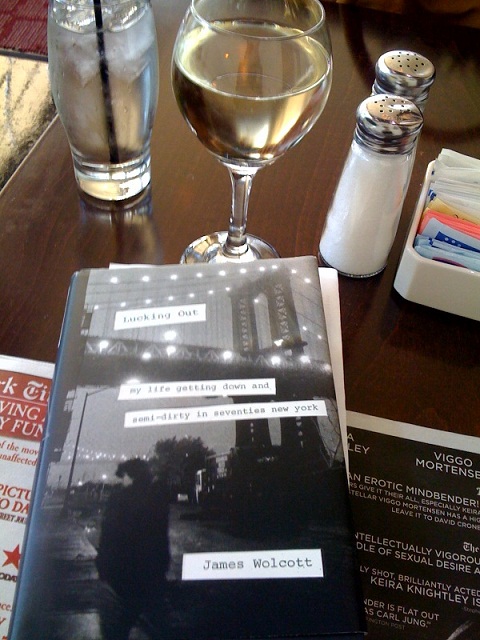
I’ve been reading James Wolcott’s memoir, Lucking Out: My Life Getting Down and Semi-Dirty in Seventies New York (photo above taken at the ArcLight Hollywood Cafe). It’s about his life as a writer in New York and his years working at the Village Voice in the magazine’s early days. (He got a job there after sending Norman Mailer a copy of an essay he wrote about Mailer’s appearance on a TV show for his school newspaper and Mailer went wild over it. It’s so hard to believe there was a time in NY when careers were based on talent and not on pedigree and Ivy League schools…)

Anyway, at the beginning, Wolcott describes several of the writers who worked at the Voice back then. Of course I was very intrigued by his words about the magazine’s now legendary dance critic:

“The dance critic Deborah Jowitt had the fine-boned fortitude of a frontier settler with eyes forever fixed on future horizons; her merciful consideration of even the most flailing effort and her descriptive set pieces suitable for framing set her apart from the tomahawk throwers.”

Apart from his brilliant writing (those metaphors, and adjectives!) I found this interesting because it seems that the “tomahawk throwing” form of criticism is so in vogue these days. I guess because in the internet age, incendiary writing begets comments which beget more readers, or ROI or what have you… I’ve had several people (mostly writers) tell me the problem with my blog has always been that I’m not critical enough – I could never be a “real” critic because I’m too nice, and forgiving of crappy art. Those same people are also critical of other, professional critics for the same. But what’s wrong with “merciful consideration” and rich description? Sometimes it’s far harder to try and find the value in something – to try to figure out what exactly the artist is trying to do and to place that attempt in context and describe why it’s worthy than it is to ridicule it or tear it apart. And description – especially of a largely abstract art form – is damn hard.

I feel Wolcott’s words describe Edwin Denby as well, and when I read his small pieces about dance in the forties and fifties, read together in book form one article right after the other, it’s like they tell a story of that era. I wonder if that sense of narrative would be lost in writing that focuses more on attack than on giving the reader an overall picture of what happened.

Anyway, it’s a really good book – Wolcott’s that is – and makes me miss New York – even though that’s not the New York I know, unfortunately.

Now off to a Michael Connelly reading at a Barnes and Noble that is thankfully more centrally located than blasted Santa Monica (even though I love Santa Monica). I still have to drive though. Am still so not used to driving everywhere. Every time I go out I’m still so inclined to walk or take the subway or bus. You just can’t though. They run infrequently or not at all at night and walking is impossible unless the event you’re going to happens to be right in the same neighborhood – and then you still may be walking a mile or so.

NYCB Wants To Monitor Its Dancers’ Social Media Posts

The dance twittersphere is currently aflutter over this Wall Street Journal article. It seems to have started with some tweets by NYCB corps dancer, Devin Alberda, gently poking fun at NYCB benefactor David Koch, at A.D. Peter Martins’ recent drunk driving arrest, and mock-criticizing one of the yellow-face characters in Martins’ Magic Flute for its racial connotations. I’ve seen some of Alberda’s blog and twitter posts and have often found him to be clever and funny but have also sometimes wondered, hmmm, is that going too far? Actually, I’ve seen blog posts (other than Alberda’s) and thought, wow, I wonder what such and such artistic director would think if he saw that. But then I don’t think any less of the company, maybe just the dancer. And since I don’t want to know more, I don’t return to that blog. So, really, no harm done there.

Anyway, NYCB is now in negotiations with the dancers’ union to attain the ability to monitor the dancers’ tweets and Facebook and other social media posts. If the union gives them the right to do so, according to the article, they’ll be one of the first performing arts organizations to have that power.

It’s an interesting issue because, on one hand, it’s never smart to publicly criticize your boss of course, but what about when arguing that a certain stereotype in a certain ballet carries racist connotations is tantamount to such a criticism? In part, it’s a free speech issue, which somehow makes the issue seem especially problematic for an arts organization. I mean, in interviews artists will sometimes speak openly about something deemed offensive in a piece they perform (opera, a play, a ballet, etc.), though usually not as snidely as Alberda. But some on Twitter are also saying companies have the right to control their “brand”  and many companies do such monitoring.

Others are saying Twitter and blogs are good for ballet because it’s such a rarefied, insular art form, it can only help for the public to have greater access to dancers’ daily lives via these popular platforms. But if the blogs and tweets are monitored, then it seems like they’re controlled, and not authentic. I’ve read dancer blogs before where it’s obvious a dancer is just a PR spokesperson for the company, and I don’t take them seriously at all. I usually read once or twice then never return. And it also makes me think the company’s using the dancer. So, maybe, if the posts are going to be heavily monitored, it would have the same effect on the public as not allowing them at all.

And what about dancers attacking critics? And what about the whole system of patronage, which ballet largely operates under? What if a dancer says something that has the potential to anger a patron?

Very complicated issue. Any thoughts? It’s a good article.

Alice in Wonderland and Twitterland


Photo of Lauren Cuthbertson as Alice, by Johan Persson of the Royal Ballet, taken from here.

Christopher Wheeldon’s Alice in Wonderland premiered tonight at the Royal Ballet in London. BalletNews has already posted a detailed review. And the Ballet Bag ladies live-tweeted the event on behalf of the Royal. They had backstage privileges and were privy to all kinds of insider info so definitely check out the hashtag they tweeted under, #AliceInWonderland – they’ve got pictures, reviews, etc. etc. I was also told NYCB’s Maria Kowroski was in attendance. I’m currently searching the hashtag tweets for the photo of her.

I’ve been really excited about this ballet since I first heard about it. Can’t wait for it to tour!

Misty Copeland on Tavis Smiley


Apropos of our recent discussion on race and ballet, ABT’s Misty Copeland was recently on the Tavis Smiley show. She talks about race, ballet, elitism, her training, her recent appearance onstage with Prince, the immense difficulty of ballet, and of course, Black Swan. She’s very well spoken. Go Misty!

Also, speaking of Black Swan, here’s an essay by former NYCB dancer Toni Bentley in the Daily Beast. Bentley has more guts than anyone else in the industry, that’s for damn sure. Go Toni!

Above photo of Copeland taken from Martini Pink.

Aesha Ash’s “Black Swan Diaries”


In my last post, on NYCB’s Swan Lake, I railed against what I saw as race-based casting, which led to a good discussion on race in ballet thanks to some very smart commenters! Marie mentioned the ballerina who’d been with NYCB and it made me nuts that I’d momentarily forgotten her name. So, I did an internet search and found her – Aesha Ash – via Eva Yaa Asantewaa. It turns out she’s just started her own blog, Black Swan Diaries. She has some really good posts up already, about dancing Arabian in NYCB’s Nutcracker, and about touring Brazil, amongst other things. So another addition to your blog reading!

Photo above from here.

Is Benjamin Millepied a Better Fund-Raiser Than Choreographer?

Thank you to Jeff, who comments frequently here, for pointing me to this article in the NY Times, which most of you have probably already seen. The first page is all gloss and generalities and isn’t of much interest to a serious dance audience. I did think it was interesting that this writer, Joshua David Stein, called Millepied a “superstar in the insular world of ballet.” Does anyone really consider him a superstar? He’s known as being a choreographer who gets lots of commissions, but a superstar? I have to agree that unfortunately the ballet world has become really insular. And it hasn’t always been that way, right? What happened? Well, that’s the subject for another post.

What I found most interesting about this article (as did Jeff, who emailed me about it) is on the second and third pages where Stein gets into the business of ballet a bit. I’ve always wondered how Millepied gets so many blasted commissions. I’ve thought much of his choreography is good and interesting, but much of it is not, and I’ve thought that that is because he’s just working so much. How can you be creative on command like that, creating one ballet after the other every few months? According to this article, Millepied is a master of getting commissions because he’s a master of getting people with the means to fund them.

From the article:

His fund-raising prowess owes a debt to the enduring legacy of Mr. Robbins. The Jerome Robbins Trust and Foundation, which is led by Christopher Pennington, underwrites much of Mr. Millepied’s work and his inner circle of donors include Robbins-era philanthropic titans like Anne Bass and Arlene Cooper.

But credit should also be given to Mr. Millepied’s own assiduous cultivation of donors. William H. Wright II, chairman of the New Combinations Fund at the New York City Ballet, a group of 75 donors who dole out $2 million annually for new works, counts Mr. Millepied as a personal friend. Ira Statfeld, the home furnishings guru and a major dance supporter who met Mr. Millepied at a dinner in East Hampton in 2003, said he would “consider Benjamin a member of our family.”

Michele Pesner and her husband, Steven, who is the vice chairman of the Joyce Theater, said they have supported Mr. Millepied “from the very beginning.”

The article goes on quote others whom Millepied has wooed, and then quotes dance historians on the history of patronage in ballet:

To be fair, charming patrons is an integral part of ballet, a genre that grew out of court cultures of 16th-century France and Italy. By the 19th century, the backstage of the Paris Opera was a “privileged venue for sexual assignation” between dancers and season ticket holders, wrote Judith Lynne Hanna, a dance historian, in her book, “Dance, Sex and Gender.”

Interesting…

And then the article goes on to quote dance insiders who think this is how he gets so many commissions – more because of his ability to charm than actually choreograph.

Over the weekend, I was talking to a friend who’s a doctor and also a young patron of ballet, and he brought up the article as well. He said much of medical research is funded the same way – diseases that get the most research are those that are able to attract the wealthiest donors.

I just find it all very interesting…

New San Francisco-Based Ballet Blog, Odette’s Ordeal, Launching

Here’s a new ballet blog to add to your list of daily reads. It’s written by Teri McCollum, who’s a dedicated San Francisco Ballet-goer, so it’s largely based on that company and other dance goings on in San Fran. I’ve been subscribing to Ms. McCollum’s pre-launch emails for a while and can say she’s an excellent writer who comes up with lots of interesting stories. So, welcome to the ballet blogosphere, “Odette”!

British Ballet Stars on “Black Swan”


“You can tell they did some research. Some of the smaller details, like the broken toenails and the way Nina works on her ballet shoes [scoring the soles, breaking down the blocked toes], were accurate. And I’ve seen dancers get paranoid, just like Nina, when they miss a rehearsal and find someone else has been standing in for them – although obviously not to the point where they smash the rival dancer in the mirror and drag her into the toilet by the ankles.”

Haha!

Black Swan hasn’t yet opened in the U.K. (it will in about two weeks, according to this post) but The Guardian’s Judith Mackrell invited several top dancers from the Royal Ballet and the English National Ballet to accompany her to a press preview.

They’re all, like Gillian Murphy, pretty critical of the film, calling it exaggerated and cliched. I wonder how the British public will react.

Jenifer Ringer Talks About Her Weight on the Today Show

If you guys haven’t seen this yet, Jenifer Ringer was on the Today Show talking about Sir Alastair’s criticism of her weight, her past eating disorder, and the struggle to be thin for ballerinas in general. I hadn’t known, but Natalie Portman lost 20 pounds for Black Swan!

Poor Jared Angle! He hasn’t gotten anything out of this – and he supposedly sampled half the damn Sweet Realm!

Oh also, it’s interesting to look at the comments in the Huffington Post post; quite different from those on Jennifer Edwards’ earlier post in which many commenters supported Macaulay.

Does a Ballerina’s Weight Affect the Quality of a Performance?


So, if you haven’t heard, the New York dance world is all up in arms over NY Times chief dance critic Alastair Macaulay’s review of New York City Ballet’s Nutcracker. The full review, which is here, I think is generally pretty good. But then he begins his concluding paragraph with this:

“This didn’t feel, however, like an opening night. Jenifer Ringer, as the Sugar Plum Fairy, looked as if she’d eaten one sugar plum too many; and Jared Angle, as the Cavalier, seems to have been sampling half the Sweet realm. They’re among the few City Ballet principals that dance like adults, but without adult depth or complexity.” (Ringer and Angle are pictured above, in that production. Photo by Paul Kolnik.)

Angry reactions have abounded: here are a couple on Huffington Post. In the second piece, Jennifer Edwards, quoting critic Eva Yaa Asantewaa (a friend of mine), notes that Ringer has had an eating disorder in the past and argues that this sentence was disrespectful, reckless, and irrelevant. Edwards also quotes an earlier reflection of Macaulay’s on his role as dance critic:

“My job is to be a professional aesthete with serious criteria; and I share my perceptions and my values with the reader as best I can.”

Edwards concludes by posing two questions:

“1. Do you read the Times dance reviews? Has this changed over time?

2. Do you feel reviews of this nature are of use to venues, arts organizations, audience members, aspiring young dancers, and artists?”

I wrote a little comment on HuffPo but thought I’d elaborate a bit here because I think it’s an interesting, and complicated, issue.

I definitely don’t think a dancer’s weight affects the quality of a performance unless the dancer really can’t dance. I’ve seen Ringer dance pretty recently and she is a tiny thing with no weight problem whatsoever. I didn’t see this performance but I’ve always thought she was technically a very good dancer with a lot of charisma, particularly in roles like the one Melissa Barak recently gave her where she can act as well as dance. And I think Jared Angle is one of the best male partners – if not THE best – City Ballet has.  I think Macaulay just wanted to be snarky – that’s part of his critic’s voice. I think he thinks he’s being funny. Maybe snark and sarcasm in critical reviews are partly a British thing? I see a lot of it though in reviews these days.

I think Macaulay knows a lot about dance history and I get the most out of his reviews when he focuses on that – on the history of a production, how this compares to others’ or past productions, the history of the performers, the artists, etc. I generally like his Nutcracker review, most of which focuses on Balanchine’s unique take on Tchaikovsky. The serious parts of it are very illuminating and show why this production is important and thus why a reader of his review might want to go see it. So the snarky part about Ringer’s weight seems really out of place. I actually re-read the sentence and that directly following it a few times, thinking maybe he meant that Ringer and Angle were dizzy, dancing with childish abandon when they usually dance like adults. But, no, I think he has to mean that they were both plumper than usual – the same as everyone else’s interpretation.

In response to Edwards’s question 1 above: I do remember former chief critic John Rockwell making references to dancers’ bodies, albeit not with the same snarky voice. In particular I remember him likening Marcelo Gomes’s legs to “tree trunks,” which offended some dance-goers. But it also seemed that he really loved Gomes and he’d lauded his dancing in the same review. So then it didn’t seem like he was making a value judgment, just a description.

It is tricky, because it’s hard not to talk about bodies since they’re kind of inherent in this art form. I offended readers (mainly on Facebook) once in my review of Burn the Floor on Broadway by saying that the tiny Broadway stage looked way too crowded during the ensemble numbers with all of those dancers and the band sharing it. I said it looked particularly crowded when Maks Chmerkovskiy and Karina Smirnoff were the leads, as opposed to Pasha Kovalev and Anya Garnis, since the former two – Maks in particular – were so large. I didn’t at all mean it as a criticism of him, but of the staging (and I suggested they take the band off of the stage, like in Tharp’s Movin’ Out). And, everyone who’s read my blog for any length of time knows that I often prefer larger dancers (Veronika Part, Marcelo, Roberto Bolle, Vaidotas Skimelis – come on!) But I was still attacked and even told if I didn’t remove it, those people would never read my blog again.

Also, sometimes a partnership just doesn’t work right when one dancer is too large for the other. Sometimes certain movement, certain styles look better on one dancer because of that dancer’s physique. I think those are valid criteria for judging the quality of a performance. But it can still get out of control – as in So You Think You Can Dance when the judges just start talking about the dancers’ bodies. How many times did they have to remark on Josh Allen’s butt? I always felt embarrassed for the whole show whenever that happened but everyone else seemed to think it was funny. But of course New York Times is not a corny TV show.

What is the purpose of a newspaper review anyway? To let your audience know from your educated perspective what is good and bad about a performance, and whether or not they should spend their money and go see it. I don’t really like Edwards’s second question because I don’t think the purpose of a review is to be of use to venues, artists, aspiring dancers, and arts organizations. The critic’s duty is to his readership – a general audience of potential dance-goers trying to decide whether to spend their money on a certain show. The critic has to be honest about what she thinks did and didn’t work in the show and why. And I also think for the presumably well-educated NY Times audience it’s nice when the critic goes into the history of a production, of a dance, the way Macaulay often does. But the critic can’t be protecting the artist from hurt and also serving his readership of potential dance-goers. Otherwise, he’s going to end up lying to someone.

Which gets back to the issue of whether a dancer’s weight gain or loss is a serious criterion in judging the quality of a performance. I think it’s ridiculous that someone would think it is, but what do you guys think? Why are we, as a culture, so hung up on weight anyway? People are always criticizing certain dancers for being too thin as well…


So You Think You Can Dance: Is the Show’s New Format to Blame for the Loss of Viewers?

Someone at The Daily Beast sent me this post and I thought I’d pass it on to you guys. The author, Andy Dehnart, provides statistics saying the show has lost a good deal of viewers this season and argues that it’s the new (and constantly changing) format that’s to blame. What do you guys think? I personally think it’s just that the dancers aren’t as spectacular as in seasons past, particularly in ballroom and hip hop. There were too many contemporary dancers this season, and once Alex was out and then Billy knocked off, I thought it got boring. I mean, I’ll definitely watch tonight and tomorrow night since they’re the season finale, but I don’t think I’m going to invest my time in future seasons if I feel this bored by them early on again. Anyway, what did you guys think of this season?