ROBERTO BOLLE IN THE LA TIMES


Here’s an article in the L.A. Times by NY writer Susan Reiter. It’s focused on Roberto Bolle, in anticipation of his debut there, in ABT’s season kick-off, which happened last night. There’s a sweet little interview with him that she conducted back here, in the Met. Aw, he pronounces “ballet” with the final “t”! My Argentinian tango teacher used to do that too.

But some of the words that most struck me in the article were:

“He admits to being stunned by the intensity of ABT’s eight-shows-a-week schedule during the eight-week Met season. He is accustomed to the less intense pace of the opera-house ballet companies of Europe, which share the theater with the opera, performing throughout a long season, but fewer times per week.”

I think that may be one reason why ballet is generally more popular in Europe than here; opera is popular in both places and in Europe it’s more integrated with ballet. With longer seasons, there would definitely be a bigger audience throughout — though ABT was pretty packed this season. Actually, VERY packed. But they would have that packed house all throughout the year, and there would be a “trickle down” effect on other ballet companies. Oh can’t you work something out with Peter Gelb, Mr. McKenzie? Please please.

CORY STEARNS AND ISABELLA BOYLSTON IN DESIR


This was the couple I was going on about so in James Kudelka’s Desir; a photo wasn’t available earlier. I found it in Tobi Tobias’s just-posted blog entry, summing up ABT’s eventful season, which is definitely read-worthy. She talks about the two above (like me, she loved Boylston); Alexei Ratmansky’s On the Dneiper; Natalia Osipova guesting (she felt just about the same as I about the Bolshoi ballerina); and Nina Ananiashvili’s farewell performance. I am working on my review of that; in the meantime, see my album. And do read Tobias!

ADRIAN DANCHIG-WARING AND REBECCA KROHN MAKE IT HIGH ON NY MAG’S APPROVAL MATRIX


Just skimming this week’s New York Magazine and saw this — look at top right corner! It’s the exact pose from Robbins’ In G Major that I was going on about in my Dancers’ Choice post! I loved that piece and loved Danchig-Waring and Krohn in it. I thought no one else would really like it since it was a bit slower-paced and less flashy than some of the other pieces performed that night, but someone else apparently did!

ARE THE 'BUZZIEST' CHOREOGRAPHERS MALE IN THE US AS WELL AS UK? AND DO CRITICS IN THE UK HAVE MORE POWER?

There’s currently a debate raging in London over Sadler’s Wells (the most important venue there for contemporary dance) and its new season lineup showcasing the work almost entirely of male choreographers. Thanks to Pinballpeople for pointing me to it!

See Guardian posts by dance and culture writers Judith Mackrell and Charlotte Higgins here, here, and here (and read the comments section in that last link; some are by choreographers and are very astute.)

Alistair Spalding, the artistic director of Sadler’s Wells, has apparently responded that he realizes there’s an imbalance but can’t do anything about it; he has to choose the works he thinks best. Spalding posits one reason for the lack of female choreographers as being that women are perhaps not as “assertive” as men, but it’s unclear to me what exactly he means.

Continue reading “ARE THE 'BUZZIEST' CHOREOGRAPHERS MALE IN THE US AS WELL AS UK? AND DO CRITICS IN THE UK HAVE MORE POWER?”

GELSEY KIRKLAND ON THE COVER OF TIME MAGAZINE


I was recently reunited with an old friend on Facebook and, on realizing I was now a bit of a dance fanatic (I know him from my lawyer life), he asked me what I thought of Gelsey Kirkland. Unfortunately, by the time I moved to New York all the major stars of yesteryear had retired. So I never got to see her or Nureyev or Baryshnikov or Makarova or any of the others dance live. He said Kirkland was his favorite, “pure magic.”

I love so many of today’s dancers of course, and, from what I’ve seen from videos of yesterday’s stars, many of today’s seem every bit as good. But of course they are nowhere near as famous.

I mean, when my friend told me Kirkland was on the cover of Time, I couldn’t believe it! A dancer on the cover of a major magazine, could it be? So, he sent me the cover article. Wow.

He also sent some videos: here is her Nutcracker, and here with Baryshnikov in Quebra Nozes (which I’ve never seen before; it is really beautiful), here her Don Quixote (also with Barysh). And here, her Juliet (MacMillan’s!, with Sir Anthony Dowell). Have also been ordered to read Dancing on my Grave, which looks rather fascinating and is next on my list.

MERCE AT 90


So, this weekend marked choreographer Merce Cunningham‘s 90th birthday, with celebrations and performances of his latest work — Nearly Ninety at BAM. Unfortunately I was unable to go — and Apollinaire reminds me just how much I missed — but I decided to compile a list of some reviews since this was such a momentous occasion (many consider Cunningham to be the greatest living choreographer, or the greatest living American choreographer; some consider him to be the last left of the greats):

Macaulay goes even farther and calls Cunningham “the greatest living artist since the death of Samuel Beckett”;

Tobi Tobias hails the choreographer, but critiques Nearly Ninety as well as the decision to let famed dancer Holley Farmer go;

Leigh Witchel describes Nearly Ninety as “dreamlike” in the NY Post;

Blogger Evan Namerow of Dancing Perfectly Free talks about the role of chance operations in NN;

Aynsley Vandenbrouke says NN is Merce’s “ode to his dancers”;

Jordan Hruska calls NN “Bionic Theater” in the Times Magazine’s blog;

New York Magazine’s Daily Intel blog blurbs mainly on the wheelchair-bound curtain call, etc.;

WWDLifestyle has a short list of some celebs who attended the post-performance party on Thursday night;

and here’s a YouTube performance clip from ArtRavels;

And, here are a couple of pre-performance overviews, from NYTimes and NY Magazine.

Apparently, NN will now travel to Madrid.

UPDATE: Also, here is Apollinaire Scherr’s review in the Financial Times. (I’m very happy to see, by the way, that she is now the dance critic for FT!) And here are more of her thoughts on the program and the Cunningham dancers on her Foot in Mouth blog.

And Eva Yaa Asantewaa in Dance Magazine.

Please let me know if I missed anyone.

BARYSHNIKOV TALK GOOD BUT I AM PISSED AT BARNES & NOBLE

P3101957

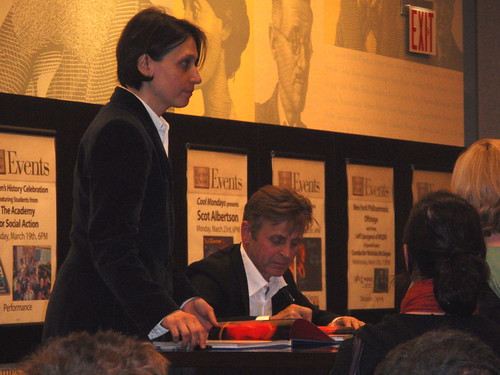
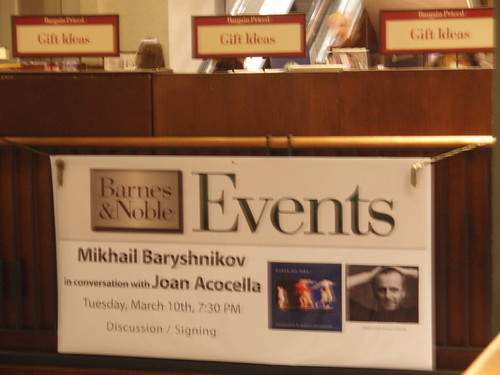
Last night at Barnes & Noble, Lincoln Square, Mikhail Baryshnikov talked briefly with New Yorker dance critic Joan Acocella about his new book of photos of the Merce Cunningham Dance Company, Merce My Way. (I love the title, by the way).

The talk was brief (about half an hour) but pretty good. But, honestly, I had a very hard time getting over my anger at Barnes & Noble. I arrived early in order to get a good seat up front, knowing (hoping at least) it would be crowded. But on my way in, I was stopped by a B&N employee. She said they were giving “preference” to people who purchased his book, which cost $36. She pointed me to the cash register, set up, conveniently, right next to the entrance.

I was so mad. There was such a crowd already, it was pretty clear “preference” meant that unless you were buying a book, you weren’t getting in. And in this economy, $40 is a lot to spend when you’re not expecting it. Honestly, I found it a really sleazy, unfair corporate practice to take advantage of his fame like that to sell books. A lot of people must have come from a ways away to see him, and you’re not really going to walk away if you’ve traveled. People were standing around looking like they didn’t know what to do, hesitantly withdrawing their wallets and picking up a book. “We’re a couple, can we get in on one book?” I heard someone ask the people at the door.

P3101951

I mean, this was advertised as a regular talk / author reading event, which are always free. Nothing in the adverts (at least the ones I saw) said anything about having to purchase a book. As Ron Hogan (of the pub / book blogs Galley Cat and Beatrice) tweeted me (and damn, was I a mad tweeter last night), “seriously. if bookstores want to pull that crap, let them charge $40 IN ADVANCE and include the book w/admission.”

Just as I was getting mad about missing Bill T. Jones (who was giving a talk downtown) for this b.s., I saw my friend Monica Wellington (who I met through Philip). They’d agreed to let her buy the Joan Acocella book instead, which was less expensive. She told them at the door we were together, so they let me in. Thank you thank you, Monica!!

Anyway, the talk was pretty good, albeit short (about half an hour). I’d never heard him speak before, other than giving a brief sound byte on a pre-recorded interview. He is, as expected, charming and smart, though he talks very slowly, thinks hard about his words as if he’s always too far ahead of himself, struggles with English, and digresses frequently. None of which were a big deal, and his digressions often led to entertaining little tidbits.

Continue reading “BARYSHNIKOV TALK GOOD BUT I AM PISSED AT BARNES & NOBLE”

BARYSHNIKOV, JOAN ACOCELLA, BILL T. JONES

P3081949

Please excuse the blurry photo; I took it on the escalator last night at Barnes and Noble, where I went after Paul Taylor (review soon!) Thankfully I decided to visit the bookstore; I hadn’t known about this, even though I’m on B&N’s events mailing list…

So, this Tuesday, March 10th, Joan Acocella (New Yorker dance critic) will be in conversation with Mikhail Baryshnikov at Barnes & Noble, Lincoln Square (66th and Broadway) to discuss Baryshnikov’s new book of photos of the Merce Cunningham Dance Company, Merce My Way.


But same night same time, Bill T. Jones is giving a talk at Skirball. Now what?

New York City Ballet Season Finale and Wrap Up With Response to Sir A


So, Sunday marked the end of New York  City Ballet’s winter season. I was honestly in a blue funk all day yesterday, which shows, I guess, that I am really beginning to love this company since I’ve normally only gotten so sad over ABT and Alvin Ailey.

Sunday was a one-day only program, the All-American Season Finale, which included Robbins’s Glass Pieces, Martins’s Hallelujah Junction, and Balanchine’s Tarantella and Stars and Stripes. Tarantella (this is the only time it showed this season) is always fun, with its cute Neapolitan peasant boy-tries-to-get-girl caricatures, lightening-charged footwork, and series of bravura solos for both man and woman, all performed with a tambourine. I was completely out of breath after watching Joaquin de Luz fly across the stage and ultimately steal a kiss from Megan Fairchild. Joaquin is not just a dancing virtuoso but a dramatist as well and his characters are always these virile, sexed-up, but charming, innocuous men. I really love him.

Glass Pieces and Hallelujah Junction also really grew on me. I don’t know if it was Maria Kowroski or what, but the  slower, more adagio section of Glass Pieces was very compelling this time, and it really spiced up the last man-centric, drum-beating, section as well. At first I wasn’t a huge fan of Maria Kowroski, but either she has improved or she has really grown on me. I always thought she had an excellent dancer body, but now she is using it in a much more expressive way, really to say something. The only thing I’m not in love with choreography-wise in Glass Pieces is in the last section, how the men come jogging out, hands powerfully punching the air, doing their ‘man things’ to the booming drums, and then the women daintily slink in to the sound of the flutes. Corny.

I was able to watch more than just the mesmerizing lighting in Hallelujah Junction this time. I love the movement theme –toward the beginning — of the landing a jump or phrase on releve and then swiftly lowering the ankle to the floor. On Andrew Veyette it looked kind of teasing but in a sinister way, like the slicing of a knife. There is something very sinister in general about Andrew Veyette, very virile in a threatening way, which makes him perfect for the devious man dressed in black here.

And I love how Sebastien Marcovici, the man in white, kind of Janie Taylor’s saviour, would powerfully jete across stage after him, threatening him, banishing him. Sebastien and Janie are such the romantic couple, in part because they work so well together and in part because of their respective sizes. Someone very knowledgeable in the dance world told me they thought he’d been working out a lot, trying to build muscle. I do think he seems to have become more muscular lately, especially his legs. Building muscle often decreases the muscle’s flexibility and he doesn’t seem to make a perfect split on a jete like some of the others, but I still think it’s so romantic that he’s so much larger than little Janie; he can just sweep her off the floor and scoop her up into his arms — aw 🙂

The program notes state that Stars and Stripes, the somewhat cheesily patriotic but excellently danced Balanchine ballet, was shown at presidential tributes, like that of Kennedy and Johnson, and at Nelson Rockefeller’s NY gubernatorial inauguration. It’s so weird to me to think of that, though I could see it performed back then. But now? At President Obama’s inauguration? It just doesn’t seem like it would fit. It would seem kind of anachronistic, sadly…

Anyway, the talk of the ballet world lately has been Sir Alastair’s New York Times season wrap-up.

Taylor Gordon, my friend and fellow blogger / dance writer, says, “whether you agree with him or not, it boggles me that one person has the power to say these things in basically the one print medium dance criticism has left. Ouch.”

Macaulay basically takes the women of NYCB to task, saying none of them really command authority like true ballerinas,

Continue reading “New York City Ballet Season Finale and Wrap Up With Response to Sir A”

Doesn’t Dance, Like All Art, Come From the Soul?


Sunday evening I attended another Works & Process event at the Guggenheim. These programs are so fantastic — they’re designed to kind of make the average person an insider, to give you a behind-the-scenes view of how art or cultural programming is created. Anyway, this one was on female choreographers and American Ballet Theater. Unbenownst to me (and most I think), ABT in conjunction with Altria has set up the Women’s Choreography Project, whose mission is to encourage more young women to venture into choreography — an excellent aim given that there are so startlingly and inscrutably few female choreographers, at least in ballet.

The women participants whose work we saw were: Gemma Bond, Misty Copeland, Nicole Graniero, Elizabeth Mertz, and Xiomara Reyes — all ABT ballerinas, and all, except Xiomara and Misty, members of the corps de ballet. (Xiomara is a principal and Misty a soloist.) It’s not a given or a demand of course that these ballerinas will necessarily become choreographers, but the program, led by Stephen Pier, exists for them to explore their talents, ultimately decide whether choreography is for them. It will be interesting to see, if programs like these proliferate, if it leads to more women dancemakers.

Anyway, it was really interesting watching Pier work with the women, but, to be honest, a bit confusing. At the beginning, Pier defined choreography for the audience as the movement of bodies through time and space. “That’s all,” he said. Then, he had Gemma Bond demonstrate a phrase she’d been working on.  She walked to the middle of the stage, smiling bashfully, and did a short, abstract lyrical segment. Then, Pier told her to focus on the back wall, to look at the shape of three windows, the lights coming through them, their geometry, and some writing on the wall underneath them (which I think was something like a dedication to whoever funded the auditorium, in small letters).

Bond used her hand to shield her eyes from the stage lights, and squinted up toward the windows. We all turned around, followed her gaze to the back of the room. She then laughed, shrugged her shoulders, and gamely re-performed the phrase. “It’s the same thing,” said the woman next to me. But I didn’t think it was. I thought she used the stage a little more; the pattern was now more horizontal than vertical, which went along with the three, horizontally aligned windows. She did exactly what was asked of her, I thought. Then Pier asked her, “well, what are you going to do with that red light coming out from the middle window?” She looked back at the windows, focused for a moment on the middle one, then, seemingly concentrating hard, repeated the phrase again. This time it was the same horizontal pattern as before, but now she stepped forward in the middle, kind of punctuating the movement with a little dot, making both vertical and horizontal use of the stage. “Now, that’s different,” said the lady next to me.  I agreed, but thought this difference was far more subtle than the last.

It was really interesting, but I think we were all intrigued because we knew exactly what was going on, what the choreographer was using to guide her. If we didn’t, I think it would just have been three slightly different patterns with no real meaning.

Pier then gave the women a pair of opposites to work with: fast and slow, light and dark, sharp and soft. All chose sharp and soft, except for renegade Misty, who chose freedom and constraint — which wasn’t one of Pier’s categories! (At one point, he asked each what they found hardest about the project and Misty said it was keeping within the rules. I love her!) Anyway, I looked deeply at the dances, trying hard to concentrate, to see the contrasts, but couldn’t always find them.

But as I was watching this, I was thinking of what I’d seen earlier in the day — the rehearsal footage of Alvin Ailey choreographing on his dancer Donna Wood Sanders, which I wrote about here. How he told her, you’re a prisoner, you can’t escape, you’re struggling, trying, let me see that. And this dance, Masekela Langage, about a group of people living under systematized racial oppression, was obviously very close to his heart.

I realize Pier was only giving these women exercises, that he wasn’t saying this was all there was to choreography. At least I hope that’s what he meant. He had said choreography was only about the movement of bodies through time and space. Is that all? I couldn’t help but get the feeling that Ailey’s world was so different from that of a lot of contemporary ballet, where it’s all about geometric patterns, interesting shapes, use of space, use of different rhythms, and not so much about creating something from the heart. I mean, literary writers and artists have to create because they have something to tell the world, something they find deeply meaningful. Although this was obviously only a glimpse into their process, I didn’t get the sense that these women were being encouraged to explore their visions of the world and learn to make movement that emanates from that place. It makes me wonder how most contemporary choreographers work — if they’re just thinking of light and shadow and abstract oppositions and geometry; if they’re not concerned with trying to tell us something.

Anyway, I have to say Xiomara (photo up top) completely blew me away with her work. She danced a lyrical balletic piece, but it had a kind of hippy-ness to it, a kind of swaying Gyspy-like, Latin feel. She danced with so much emotion. Her facial expressions almost reminded me of a flamenco dancer’s. I’ve never seen her dance like that before. I feel like perhaps she’s someone who’s better at dancing her own work than classical ballet. And perhaps she’d be good at creating work for other contemporary ballet dancers like her. Maybe she’ll be our next female ballet choreographer?

They also showed pieces by women who’ve choreographed for ABT: Lauri Stallings (whose Citizen I wrote about here) and Aszure Barton, whose work I’d never seen before and really loved. ABT II (the studio company, comprised of teenaged dancers) performed her Barbara, a sweet ballet that didn’t really have one single linear narrative, but had a lot of little subplots involving cutely intriguing characters.


On an endnote, Irlan Silva  — whoa! Methinks he is going to be in the main company soon…

Facebook Causes Self-Reflection

By posing questions like, “how old am I?” And, “who am I?”

Karina Smirnoff, Blackpool 2006, photo by Tonya Plank

Regarding the first: apparently 10 years old, as I just became ridiculously giddy on Facebook’s pronouncement: “Tonya is now friends with Karina Smirnoff.” My longtime Latin ballroom IDOL 🙂

Regarding second question:  one of my new FB friends asked me, “Hey, what’s up with all this Miami City Ballet stuff? Are you a dance critic?” (My status updates lately have been about going to see Miami City Ballet, where I spent the past two days).

So, hmmm. I honestly don’t know. Do bloggers = amateur (or in some cases pro) critics in this new media world? I guess it depends on the blogger and how s/he defines him/herself.  I guess I want to be taken seriously as someone who gives her honest opinions and assessments of things and certainly don’t want to be seen as a lackey to any dance company, but I also try to make my connection with dance personal in a way that a newspaper critic really can’t. Ie: writing in a bit of a persona, calling dancers I really like by their first names, etc. Makes it more interesting albeit less “objective” I think.

I also want to try to avoid being too hard on an artist. I have been and it’s really upset a couple of them. As someone who’s really trying to segue from a career in law to a career as a writer — and especially a writer of fiction — I can relate to and have a deep respect for how difficult the artistic process is and how much you are really putting yourself out there when you subject yourself to public scrutiny. But then again, we all need to have thick skin if we are doing that. And writers do have to keep in mind that our readers are relying on us for our honest opinions; we’re not writing for the artists but for other dance-goers. I do make a distinction between creators who it seems are primarily interested in entertaining and maximizing profit above all else. That’s why I don’t feel badly about being harsh on the TV show producers 🙂

Oscar Wilde says a critic is a kind of artist.

So, I basically didn’t answer my the second question at all… Anyway, any other thoughts on the roles of blogger vs. critic in the age of new media, or on critic as artist?