Originally uploaded by swan lake samba girl via mobile.
T-Mobile


Originally uploaded by swan lake samba girl via mobile.
But not for criminal court – no! For a ballroom dance competition located behind the courthouse in the brooklyn marriott. It’s the manhattan dancesport championship – largest local comp and since it was my first ever, my favorite.
I got so upset and angry when I read his review of Cinderella in the Times yesterday, which is rather funny for me since not too long ago, I screamed at everyone at Oberon’s Grove (a very New York City Ballet fan-centric blog) for not letting a critic be critical and obsessing over those who harp on NYCB’s artistic director, Peter Martins 🙂 And now that Macaulay’s ripping on my beloved American Ballet Theater, I know how they feel! Seriously though, obviously I stick to my guns that in a democratic system a critic can and should be critical, should never be silenced, and should offer opinions based in knowledge, education, insight, and love and passion for his/her chosen field. So, I value Macaulay’s opinions, and I respectfully disagree with him. The problem with dance criticism I feel, and the reason why fans get so upset, is that (unlike, say, film criticism or theater criticism), there aren’t enough critical voices out there offering different perspectives, leaving one person’s opinion to have HUGE repercussions, especially when that one person writes for the New York Times.
Anyway, I’ll return to my thoughts on dance criticism in a minute, but first I just want to say how much I LOVE the version of Cinderella that ABT is doing right now. (That’s dreamy David Hallberg, as Prince Charming, and fabulous Gillian Murphy, as Cinderella in that pic above, by the way). This version, a recent one by Canadian choreographer James Kudelka, sets the action in the Roaring Twenties, the women donning wavy bobs, the men suits (that means no tights, for straight men who freak out over such things — more on that subject in a later post…), replete with Art Deco sets and very fun, colorful costumes. The dance style is not classical, but rather modernist, ballet, and, set in the Jazz Age, the movements have a swingy, jazzy, hip-jutting, flirty component that’s rather fun and sexy if you ask me. In the Ball scenes, the women slink around on point, walking like they’re on a catwalk. It looks ten times cooler than it would in high heels, and makes me wanna go out and buy a pair of toe shoes, just to walk like that! No, it’s not “classical” ballet, but it’s a lot of mad crazy fun — can ballet please be fun for once? Is there a rule that says it always has to be serious and that everything ABT does has to be “classical”?? Almost everything ABT does during its Met season is classical. I’m so happy they gave us Kudelka’s Cinderella, and Lar Lubovitch’s Othello for a change. Classical ballet is sublime and it must be preserved and its beauty shown to younger audiences, but there must also be a good amount of the new for ballet to maintain a fresh focus and have a future. ABT is “America’s National Ballet Company” and it should have something for everyone, younger and older. We don’t need more (classical) Frederick Ashton, as Macaulay wants; we need more James Kudelka for the younger generation!!! Okay, enough of that rampage, back to Cinderella.
Everyone knows the basic Cinderella story, so I don’t need to repeat it, but here, Kudelka has gone all out on the humor and kept the wickedness to a minimum. Cindy’s stepmom is a nutty, silly drunk; her stepsisters consist of a bespectacled dork who nevertheless seems to smack into everything in (her poor) sight and confuse the prince with his assistants, and a would-be vixen who’s far too much of a sweetly geeky screwball to actually be seductive. Since this is a ballet, the stepmom hires a dance instructor (danced gorgeously by my wonderful — and tall — Vitali!) to teach the stepdaughters and their equally looney paid escorts to the Ball, how to dance. Of course the sisters hilariously fall all over each other and their paid men. Macaulay finds these characters all unfunny. I couldn’t disagree more. The audience was laughing hysterically and the ballerinas who danced the sisters, who took curtain call bows in character, all got tremendous rounds of applause, so I think the audience was largely with me on this.
I love the way the pointe shoes are used: in contrast to the sisters who don the shoes throughout, in the beginning Cinderella dances barefoot, echoing her life of poverty. Part of her Ball costume, as bestowed by the Fairy Godmother, consists of the beautiful toe slippers, one of which comes off during the mad midnight rush to get her back to her stepmom via her theatrical Pumpkin-mobile. (By the way, regarding all these fun props, etc., Apollinaire Scherr in her Newsday review likens Kudelka to film director Tim Burton. I LOVE that comparison! Please, Mr. McKenzie, spice things up more often at ABT; more ‘Tim Burton’!!!) Anyway, once Cindy gets home, she dances, one foot on pointe, the other flat — one foot in the land of fairy-tale, the other in that of her drab sad life. To me, it’s a perfect poetic illustration of the power of ballet to transport you to another world.
Okay, as for the dancers: Marcelo as P. Charming 🙂 🙂 🙂 Marcelo’s like a movie star who somehow ended up on a ballet stage. He’s such a great actor, and he just has this face that says it all without even trying. When the dorky myopic stepsister puts on her glasses to see she has just been flirting with the wrong man and turns around to lay all her “charms” on Marcelo’s poor Prince, all he has to do is shift his facial muscles ever so slightly to widen his eyes and it’s the perfect understated reaction. You just can’t stop laughing. He’s like a Rupert Everett or a Hugh Grant or something; he doesn’t need to do much onstage; he’s a natural. I love the fact that he dances in NY, where I can see him up close several weeks per year, and would never ever want him to leave, but I do wonder if he could make that Baryshnikovian transition from stage to screen… And Julie Kent was beautiful. She dances so well with him; they’re such a perfect match. The pas de deux, which Apollinaire’s more advanced dance vocabulary can far better describe than I, were so sweet I wanted to cry.
David, on the other hand, is the quintessential ballet dancer. Just one look at him and you can tell he was born to dance ballet. He’s like a throwback to the great ballet men of yore. Marcelo is the consummate ‘leading man’; David the ‘danseur noble.’
And Gillian is such a spectacular ballerina, and, with her warmth and glow, so perfect as the fairy-tale heroine. Julie is a perfect partner — when I think of her I think of a beautiful, dreamy pas de deux; when I think of Gillian I think of crazy fast fouettes and pirouettes — she definitely brings to life the solo bravura parts of any choreography. People say Gillian is shy in real life — I can’t believe that! She seems so outgoing onstage!
The others: Carmen Corella!
I absolutely LOVE her would-be-a sexpot-if-she-wasn’t-such-a-klutz stepsister. (She danced in the first, Marcelo / Julie cast.) I know a lot of people long to play the principal roles, but the ‘sidekick’ parts are crucial, the main roles in contrast can often be a bore. She really brings those parts to life and often makes the ballet with her crafty, unique, often hilarious interpretations of them. Kristi Boone, who played that character in the second cast, was good, but I just really think Carmen owns that role — she should dance it every night. Marian Butler was expectedly cute as the bespectacled dork sister, but Maria Riccetto surprised me with her raucous rendition as well. (I still miss Erica Cornejo, who owned that role last year before she left ABT for Boston!).
He did this absolutely scream-out-loud pelvic gyration while Carmen’s stepsister was trying to fit her fat foot into the tiny toe shoe. It went along perfectly with the beats of the music and it was so funny I’m sorry to say I giggled all throughout the beautiful (and very serious) ending pas de deux between Cindy and the Prince, just remembering Craig.
Adrienne Schulte made my night Tuesday as the hilariously drunken stepmom. She completely commanded my attention everytime she was onstage. She is a Carmen-to-be 🙂
I left out a bunch of fun stuff, like the wildly bouncing pumpkin men, the ever-amusing Twenties-style world-wide search for the girl who fits the shoe, including the bumpy “car ride,” the independent-woman Amelia Earhart who could give a crap about some prince and his toe shoe, and the photographer with his blindingly flashy camera and the vanity of the new media with all its ‘poseurs.’ It’s so much fun, and is playing now through Saturday night. Don’t listen to Macaulay! Go!
Okay, if you’re not a dance-industry person or just some crazy person like me who really really really cares about dance, please stop reading now (because this next section will bore the pants off of you). Just get a ticket and go see Cinderella. Hurry, you only have a couple of days left. Go here for tix.
Now for a few stray thoughts on dance criticism: Apollinaire Scherr has a very interesting post today about her thoughts on Alastair Macaulay’s reign as the New York Times chief dance critic thus far (he replaced outgoing chief John Rockwell earlier this year; go here for Apollinaire’s earlier (and very controversial!) writings on that). As the chief dance critic of the New York Times, she believes he has the most important role of all press people in the dance world. I both agree and disagree with that. I think the Times speaks to the audience that is most likely to go to a ballet performance, and so, I think whoever has an article in that newspaper is going to have a lot of power. I think it’s we people in the dance world – the writers, the dance-makers, the administrators, the dancers, the fans — who pay attention to bylines; I think the average newspaper or magazine reader has no idea who wrote what article; they just remember the writing and opinion expressed within as “the Times article,” as in “The Times said, this,” or “The Times thought that,” about a performance.
That said, while I often disagree, yet sometimes agree, with Macaulay’s interpretation of or opinion on something, I appreciate that it’s there. BUT, I think it’s ESSENTIAL that other voices abound and are heard. Apollinaire (I’m sorry, I tend to call dancers and writers who I “know” –either personally or through their stage presence — by their first names! — it’s a sign of familiarity not disrespect, but I’ll try to remember to call people by last names!!) — anyway, Ms. Scherr made a reference to Macaulay not being that much of an “old fart” like some of his predecessors (ie: Rockwell, who I thought had some good ideas toward the end of his tenure which I’ll get to in a minute). I kind of disagree with her on that. I think some of the views he’s expressed have been that of an older generation, and, in particular, an older male generation, such as his piece on the retiring ballerinas, in which he made some kind of reference (sorry the permalink to the article has expired or I’d link to it) to ballerinas as being the most important part of ballet. As a younger woman, I, like several younger women I know, go to see the men, so that does not ring true with us. For example, it was lamented recently by one such younger woman that ABT’s 2007 calendar contained ballerinas. And, a look at some of the posts on the Winger message board, for example, replete with pics of Hallberg posing for a catalog in a dance belt, and you can see who is going to the ballet and for what reason. Anyway, I felt completely alienated from that review of Macaulay. BUT, I am also glad to have read a review with an alternate opinion from my own and, now I know why ballet is so important to an older generation, and particularly a male one. And I can use it to fight with my straight male friends who insist that no straight men ever go to the ballet unless they have homosexual tendencies (but more about that later…) Also, this Cinderella review, I felt, came from an older perspective — one that wanted all the classics back and was not open to the new.
I’m relatively new to dance, but I’ve noticed that there’s a lot of real anger and animosity and even rather crazy intense hatred in the dance world between writers / media and fans and media and administrators and dancers, sometimes even between media people. There seems to be more fighting in the dance world even than amongst lawyers 🙂
I don’t know if this is normal in the arts, but I recently attended two panel discussions that really floored me. The first was The Nothing Festival, which I blogged about earlier, and which was organized by choreographer Tere O’Connor and was supposed to deal with the creative process and the process of grant application writing. Instead, it very quickly devolved into a discussion, all choreographers both on the panel and in the audience in agreement, of how much the press basically sucks — how horrible the writers are, how they don’t know what to look for in a dance performance, how dance is totally devalued in the Times and on TV, how there are no good dance critics like (film critic) Pauline Kael, how dance criticism is awful compared to other arts criticism, etc. etc. etc. It was really actually very interesting for me as a newcomer to the dance scene, and I’m very glad I attended, and, toward the end of the four hours, we were actually beginning to get somewhere productive, but then it ended.
I then attended a panel discussion at NYCB with the main R+J dancers (Hyltin, deLuz, and R. Fairchild) right after the opening of Martins’ Romeo + Juliet. One of the first questions the moderator posed to the dancers was, “how did you deal with all of that criticism?” Mumbles of annoyance abounded in the audience. “Oh, it’s very hard; I don’t look at reviews anymore until after the run is over,” Hyltin said, a very upset tone in her voice. “One very nasty review really affected my performance one time,” she said, dejected. DeLuz, older and more experienced, was more cynical: “I gave up paying attention,” he laughed with a shrug. “They’re gonna say what they’re gonna say — they know beforehand, before they even see it.” A woman audience member then raised her hand: “Oh I just got so mad at that one critic; I just wanted to wring her neck… I just … well … I should have written in,” said, shaking her fist in the air. “Yes, you should have,” the audience practically said in unison. And just on my blog and on Philip’s blog, some of the comments we get, there’s so much anger at the dance writers.
All of that anger upsets me because, after being forced to take a break from dancing myself and now turning to blog about these dance performances that I see, I can say, of all the things I’ve done: law school, heinous bar exam, writing a novel and actually getting an agent to represent me, learning to dance as an adult — writing meaningfully, forget beautifully just meaningfully (!) about dance, about something so visual and so amazingly beautiful and so compelling, is just about the most challenging thing I’ve ever done. So, it greatly bothers me that dance people have so little respect for the incredibly difficult (and often very underpaid) work that dance writers do.
But what really confused me was why, why all the anger. I regularly attend book readings (where authors read from their work), independent film festivals (where the filmmakers are on hand to discuss their film), art openings (ditto for the artist), and I’ve never heard anyone ask, “how on earth do you deal with all the criticism?” And it’s not like criticism doesn’t abound in those fields — particularly film and book reviews. I think it’s at least partly due to the fact that there are so few writers, so few voices, which make those few existing voices incredibly important to the success of the production, or the reputation of the dancer. Scherr also criticised Macaulay for his sometimes sarcastic tone, in particular with respect to Irina Dvorovenko, and how damaging it can be to a dancer. I agree. Sarcasm in reviews is nothing new though — Gia Kourlas and Robert Gottlieb have done the same, as have Pauline Kael and, one of my overall favorite critics, Anthony Lane, whose reviews I often find to be works of art in themselves. And sarcasm is oftentimes very funny and it works well to make a point. But, I think that kind of thing just operates differently in film criticism — there must be tens of thousands of film critics all over the country. If a dance critic does the same thing, it could have a profound effect, since that one voice is often the only one that’s heard on a certain production or dancer. Tuesday night in the ladies room I overheard one woman to another: “How are you liking it?”
“Oh, I really like it?! I do!”
“I know, so do I?!”
“I can’t believe it, it got bad reviews, but it’s really actually good!”
People take these reviews very seriously.
I honestly got so upset over Macaulay’s Cinderella review, I’m embarrassed to say I nearly cried! I always get weird though at the end of the season; after all I’m not going to be able to see my favorites again for several months, and then only for a tiny three-week run at City Center. I guess I just worry that audiences aren’t going to see Cinderella because “The Times” didn’t like it, and then Kevin McKenzie’s not going to put it on again, and I really really really think that if ballet audiences are going to grow there needs to be more contemporary work performed, a combination of the classical with the modern, like McKenzie kind of did this season. I personally want to see them do more of it: more Mark Morris, and some Matthew Bourne and William Forsythe and Neuemier’s “Death in Venice,” etc., etc., but I well know I’m not going to get all that! Just some, though, would be nice, and the Kudelka is a huge start 🙂
I’m glad Macaulay’s given Gia Kourlas some good assignments (she got to write the Othello review and the Alessandra Ferri farewell review), and she kind of represents a different, younger-generation voice, so that’s good. But there’s still only one review of each thing, and so little space is given… And of course there are other papers and magazines but they often get overlooked by the general public, and then their review space is so limited too. And half the time, the reviews come at the END of the run (what was that Joan Acocella article on the two Romeo and Juliets doing in last week’s New Yorker; it’s been like 10 years since Martins’ R+J premiered now??) Dance critics and writers are hugely important, as they bring dance to the public with their insight, their vast knowledge, their poetic descriptions, their expressions of passion for their art, they create excitement for dance, they create dancer personalities with interviews and profiles. There needs to be more!
I also think sometimes dance critics are SO knowledgeable that they get bogged down in their own ken and forget who their audience is. As Scherr pointed out, in his review of Sleeping Beauty, Macaulay went on and on about the differences between McKenzie’s version of the ballet and the others, for example, the one the Royal Ballet puts on. I know it’s hard not to do this when there’s a brand new version that’s being shown and you have all these prior productions that you feel are superior, but what is the average ballet-goer supposed to do with a review like that? So, he thinks the Royal’s version is better; the Royal’s not performing in New York right now, so what am I supposed to do, buy a plane ticket and head to London, petition McKenzie to change versions for next year? Should I go see ABT or not — that’s all I want to know as a Times reader. Maybe this is completely contraditory, but I did like, however, his first couple of reviews, of the beginning of NYCB’s season and their Balanchine programs, particularly of Kyra Nichols’s performance compared to the others’. I’d blogged about it here. I thought those early reviews hinted at (and only hinted unfortunately, presumably because of space limitations) what made Kyra so great, what made Balanchine great, what perhaps could be missing from NYCB, from the other dancers, in terms of presenting Balanchine. Not that such reviews told the average reader whether or not to go to NYCB, but I guess it gave me a small sense of what to look for in Kyra, what to look for in Balanchine, how to look more closely at a Balanchine ballet and what to appreciate about it. And it got some people, for a short while, talking. So I guess good dance writing should also make people think, or compel them to look more closely, or give them a sense of what to look for, or just get people talking. His Beauty review didn’t do this, unless I don’t know the Times audience at all and everyone really does want to know which version is the best. How do you know who your audience is anyway?
Oh, and the thing I was going to say about Rockwell: I thought, “fuddy duddy” though he may have been, that he made a great suggestion toward the end of his tenure, and that was to rotate the productions during ABT’s Met season, as the opera does. I know one reason why newspapers and mags don’t give a lot of space to dance is because the runs of a certain performance are so short and a paper gets the review out and readers have about five minutes to get a ticket before the thing closes. I think getting rid of the block programming would give the media a chance to create buzz about something (through either positive or negative reviews) well before it closes. I realize this does nothing for the smaller companies who can only afford to have very short runs… It’s like dance isn’t that popular because there’s so little press and there’s so little press because dance is not popular… Ugh. Sorry for all the random, haphazardly expressed thoughts. Apollinaire just got me thinking!
Originally uploaded by swan lake samba girl via mobile.
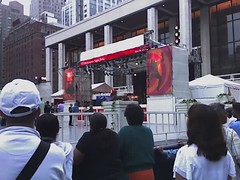
Where melanie lapatin and tony meredith are giving a salsa demo – pretty good crowd given the rain!
Don’t have time to do my write-up right now, but definitely definitely definitely don’t miss Cinderella! It’s one of my favorites — so much mad Modernist fun with those crazy popping pumpkin-guys, big colorful Art Deco-y sets and costumes that make you feel like you’re in the Roaring Twenties, and all the zany humor, the beautiful pas de deux… It’s just a blast!
So, Saturday afternoon I saw my third, and probably overall favorite, Swan Lake at ABT. As I mentioned in my last post, I had gone hoping to see Veronika Part in the lead role but, sadly, she was unable to perform due to an injury. I MUST see her perform this role at some point! Next year…
The Trouble With Favorites
So, taking her place were Irina Dvorovenko, as the White Swan, Princess Odette / Black Swan, Odile, and her husband and frequent partner, Max Beloserkovksy, as the Prince. Seeing Irina, whose performances I used to go to much more often, made me realize what I miss by having my favorites and only going to see them. Not that it’s unimportant to have favorites — I think it’s a huge part of what draws you to a certain company and then, in turn, to ballet or dance, in general. And, my two are of course him and most definitely him 🙂 🙂 . The problem for me is, it means missing out on ballerinas like Irina, who, for some odd reason, doesn’t ever dance with these two guys. And I ended up getting everything from Irina that I had complained about not getting from the two previous ballerinas I’d seen!
Backtracking for a sec, I first saw Diana Vishneva and First Favorite Man 🙂 , and, as I had blogged earlier, wasn’t very moved by Diana, mainly because she seemed to have no connection with Marcelo’s Prince Siegfried; her Odette (White Swan / Princess), as I said, existed in a completely separate world from him.
Then, Friday night I had my second SWAN viewing, with Second Favorite Man 🙂 ) and Michele Wiles in the leads. To this one, I brought a friend, and one who has never, at least to her recollection, seen a live ballet performance. She’s familiar with classical music though, and with Tschiakovsky, and was interested in going because of that.
Classical, Story Ballets Involve Dramatic Action
It’s always fun to introduce a new person to ballet to see what they think, what their initial reaction is: whether they found the love of their life, were bored to tears, were completely stupefied, were completely mesmerized, or, by turns, were actually all of the above. I guess my friend was pretty much the last: in the end, she said she found Ballet intriguing enough to try another, but concluded that Swan Lake really was just not going to be her favorite. I’m a relative newcomer to the scene too, having been going for a couple years, and I pretty much shared her issues with this cast / production, which were the same as with the Diana / Marcelo one: a fun, flirtatious, overall good Black Swan who made the second half of the production a little more lively than the first, but a too ethereal White Swan who couldn’t garner audience sympathy, forcing the first half to be long and boring, and overall preventing the audience from connecting to the characters, story, and action. My friend said she thought the second ballerina (in the black) was better than the first: she didn’t know they were the same!
My feelings about Michele are a repeat of Diana: at the beginning, David’s Prince spots the Swan at the lake, prepares to shoot her with his crossbow, until he sees her transform into the beautiful girl Odette, then hides in the bushes and watches, transfixed by her beauty. Odette is supposed to spot him, and began fearfully to flutter away until he convinces her he means no harm. She then supposedly tells him her tragic story of being turned into a bird by the evil von Rothbart; mesmerized, he listens attentively, falls deeply in love. She falls for him too, and her plight is caught up in their love, as only his pure love can break the spell, allowing her to become a girl again.
Diana’s and Michele’s Odettes, however, are completely unmoved by, even unaware of, their princes. They danced beautifully as swans (Diana had more feathery, watery arms than Michele, though Michele blew me away at the tail end of the scene as her arms turned airy and liquidy and she nearly flew on pointe into the wings– don’t know why she couldn’t have done that throughout), their princes come out of hiding, toss their crossbows away, shake their heads to say, “no, I’m not going to hurt you,” and run to the girls. The girls are supposed to tell their princes the story of the spell, through that beautiful pas de deux. But Diana and Michele don’t even so much as look at the men throughout this entire scene. So, the men are basically having a conversation with themselves, an internal conflict over this creature, while she dances about in her own world. “Wait, when did she tell him the story?” my friend asked at intermission, frowning down at her Playbill. “I feel like I missed all of this,” she said pointing to the synopsis. She did; she missed everything because it didn’t happen.
Diana and Michele were better in the second half (where von Rothbart casts his daughter, Odile — the false Odette — in Odette’s likeness to trick and seduce the Prince), but still weren’t ideal. Their dancing was spectacular, all those crazy fast fouettes and pirouettes and jumps were thrilling, but, apart from the dancing, there was no drama: they still weren’t connecting to their princes, so the seduction and flirtation wasn’t there.
In other words, a drama happens when two or more people interact with each other. One character wants something from another and there is a conflict, leading to a dramatic situation. I realize that a ballet is not exactly the same as a play. A ballet involves, obviously, movement, part of which tells the story. But story-ballets (and, to me, even shorter, more abstract ones, as I’ll talk about later) are dramas and they need full, three-dimensional characters who bounce off of each other.
Irina understood this. Irina’s gorgeous Swan is dancing beautifully center stage, arms aflutter, in her own tragic world, just turning from swan to girl, when Max’s Prince, overtaken by her beauty, rushes toward her bow and arrow still in hand. Irina’s girl actually looks at him, realizes she’s in danger, holds her arms up to her face, shielding herself, and begins bourreing quickly backward. He tosses the bow and arrow aside and runs toward her, gesturing that he won’t hurt her. She then performs the beautiful pas de deux with him, perfectly conveying to him her sad story of the spell. Obviously, she can’t say anything in words (and the words are in the Playbill so it doesn’t matter), but, I mean, she tells him everything with her body and her facial expressions. She’s not in her own world; she’s “talking” to him. Even when her body is turned away from him, and she can’t look at him, she registers his presence with closed eyes, head tilted back ever so slightly, subtely, toward him. And his body language and facial expressions convey that he listens, hears, and understands. The whole story was perfectly, compellingly HERE. When von Rothbart enters from the back of the stage to claim her his Swan, taking her from the Prince, and the Prince retrieves his bow and arrow, Irina quickly bourres backward to von Roth., shielding his body entirely with hers, her head turned dramatically up, as if even to protect even his head from a blow. She even shakes her head “no” at the Prince. Irina’s Odette makes it all too clear that the Prince can’t kill v. Roth or she will die as well.
I know critics don’t often like Irina, and I’m not entirely certain as to why, but I’ve heard it’s partly because she “overacts.”And I seem to remember hearing specific complaints about those turned-up chins of hers. Well, all I can say is that I felt that she made more dramatic sense of this story than anyone else I’ve seen, and I wished my friend would have seen her Swan.
The Men, And What Makes Hallberg So Sexy?
As for the men: I’m not a huge fan of Max — he doesn’t seem to have the technical prowess or the stage personality of either of my favorite guys — his jumps are not as high and his legs don’t fully straighten out into splits when he does them, unlike with the other two, and doesn’t have Marcelo’s humanity and relatability or David’s brainy sensitivity or either man’s inherent sexiness of movement (can I just ask, for a minute, WHAT IS IT ABOUT THE WAY DAVID WALKS across stage? He has this way of settling into his hip socket, or maybe it’s that he lifts his pronounced, pointed foot entirely off the floor with each step, or maybe his weight is a slight bit more foreward, like in Rhumba walks — whatever it is, the way he moves about stage when he’s not leaping or pirouetting is so crazy sexy and so unlike anyone else’s movement. Since he’s practically the only American man in ABT, I wonder, is it an American thing — something in his training? Maybe it’s nothing more than that he simply has longer legs than most). And it’s definitely not something he does on purpose. Joan Acocella recently noted that he doesn’t seem to know he’s a star. He doesn’t seem to know how hot he is either 🙂 !!– I hope it stays that way. I don’t want him to become a pompous ass!
But back to Max: regardless of the above, I thought he did a very good job with this character. He showed the growth of the Prince, noble but immature at the start, into a man transformed by love. He was princely, yet human and real. And, as I said, he worked very well with Irina’s Odette, listening to her story, reacting to it, using his body and face.
Miming Doesn’t Work
I met up with Delirium Tremens afterward and we chatted a bit. She has a big ballet background, having studied ballet at School of American Ballet and Joffrey, and she gave me this brief lesson in mime in case I missed something. It was really interesting, but some of the miming gestures looked to me nothing like what they actually are. Like, making fists with both hands and crossing your arms at the wrist is supposed to symbolize “death.” I thought when I saw the various ballerinas doing that, it meant “no” or was somehow intended to convey some sort of angst. But I didn’t know it meant, “if you do this it will result in death.” I’d have to see them again, but it made me wonder if perhaps the first two ballerinas I saw relied very heavily on mime to convey their stories, and that’s why I couldn’t understand? I know Irina did a little, but she backed it up with generally understood facial expression and body movement. If the choreographers and stage directors are going to rely on mime to tell a story, which I don’t think is a good idea, they need to somehow make everyone aware of what everything means, so that not only people with dance background can enjoy the performance!
Dancers Are Smaller Than They Appear!
I ended up hanging around Lincoln Center for much of Saturday afternoon since I was to meet Apollinaire at the Library of the Performing Arts (adjacent to the Met Opera House) later in the day for an evening performance. I ran into several dancers on their way to work– Adrienne Schulte, Herman Cornejo, and Jared Matthews on his way away from work (he performed yesterday as the Prince’s sidekick, and he was excellent by the way! Sky-high jumps, very agile and quick-footed dancing with a lot of precision and clarity. His prince sidekick was almost as good as the athletically spectacular Sascha Radetsky‘s — not quite as clean but almost, almost. Jared is working super hard, as is Sascha. Anyway, it’s so amazing to me how much smaller they all are up close when you see them on the street!
Vitali Krauchenka’s Awesome Swampy von Rothbart
And, one more little note on SL: can I please please please see more of this guy:
His swamp-creature-y von Rothbart was compelling beyond words. The ballet ends with him, dying after Odette’s death has taken the life from him. I’m not a fan of pure evil; but rather prefer nuance and complexity, and, not to sound cheesy,but his performance honestly almost brought me to tears.
His von Rothbart loved Odette and is just in so much pain in that last scene after she’s committed suicide. He makes me feel so much sympathy for him, even though he’s supposed to be “the bad guy.” And with that intense, oh so familiar music building to a dramatic crescendo, he makes the tragic ending so moving. Please, Kevin, more Vitali!
Taye Diggs
Okay, Taye Diggs: Very briefly, since this post is now bordering on 100,000 words — Saturday night, Apollinaire invited me to go with her to see Taye Diggs’ newish modern dance company, Dre Dance, at the Joyce in SoHo. I know Diggs only for his role in the movie GO, but he was a star of the original Broadway show, Rent, and acted in the movie version as well. He has other Broadway credits, but who knew he was a modern dance choreographer!
It was a lot of fun. I sat next to Diggs himself during the first half, then his co-choreographer, Andrew Palermo, during the second. Diggs is a much smaller man in real life too! I guess that is kind of the rule in the performing arts: everyone looks larger than life on stage or screen… The dancing was very interesting, very dramatic. They gave us press packets including a DVD of rehearsal and I’m going to look over everything and perhaps write more later, but for now, my initial reaction was that I thought it was, just, really cool. Choreography was original and involved a lot of emotional intensity and was set to mostly contemporary, very rhythmic music with a strong, fun beat — kind of poppy but not recognizably so, except for a little Rufus Wainright. The program was a compilation of pieces they’ve choreographed over the past two years, with the exception of one new piece, so the performance as a whole didn’t have a single narrative or theme. But, storyless though the whole was, with each piece the dancers themselves, through interactions with each other, told a kind of mini story — angry and fighting one another at times, at points hungry for attention from each other, needily begging each other for compassion (one dancer tried to climb atop another, hugging her, the other pushing her away). Each dancer very intensely wanted something from another, from the others as a unit; it was full of drama, which is Diggs’ thing after all. During the last piece, a woman came out in a business suit, hair tied in a bun. In a moment of anger, she ripped off the suit jacket, ripped the knot out of her hair and shook and shook and shook, first body then hair. Then, she calmed herself, took a deep breath, and slowly put her suit jacket back on and hair up. I found this such a short, yet powerful statement about the necessity of composing yourself for work, for life, of taming the inner self in order to get along in society. All of the pieces were this way: small vignettes containing characters who desperately wanted something from each other, creating intriguing, compelling sitations that made you desperately want to know the fuller story. The complete antithesis of my first two SWANS.
Fun, Reader Survey!
One last thing: there’s a really fun discussion underway on the Foot in Mouth blog. Apollinaire Scherr and I were discussing the never-ending question of why ballet is not as highly revered right now as it once was, and I had posed the question of why opera and some other of the “high arts” are currently more popular. San Fransisco dance critic Paul Parish surmised that it’s because opera is better recorded and therefore more accessible to the public. As someone who became an avid balletomane initially through a video not a live performance, I disagreed, and responded here.
This is a really fun discussion, and please, all of you Ballet fans out there, do participate! What initially drew you to ballet? Was it a film / video or a live performance? Was it “Center Stage” or another ballet movie? What are your favorite videos? Is a live performance better than a video? Why or why not? And do you agree that ballet is not well-recorded and thus cannot reach as large an audience as opera? Why do you think other arts or other dance forms are more popular right now than ballet? And, what can be done to better promote ballet? To add your two cents to this debate, please go to Foot in Mouth and add your comment, either here or here.
So, I was at ABT tonight (or, seeing as how it’s now 1:00 in the morning, last night) watching David Hallberg and Michele Wiles perform Swan Lake, and was told, as some seem to have heard already (like Susan), the bad news: that Veronika Part is unfortunately injured and will be unable to perform tomorrow’s matinee. So, she and Marcelo have been replaced.
The good news is that Max Beloserkovsky and Irina Dvorovenko will now be dancing. At first I was upset because I had so wanted to see Veronika, whose Swan Lake I’ve heard so much about (and whose Bayadere I was simply blown away by) and of course I’m always upset when my favorite man is suddenly replaced! But on re-thinking it, I’m actually really excited about seeing Irina and Max. I’ve never seen them perform this ballet before and Irina is so gorgeous, I’m sure it’s going to be really stunning. So, I will be there and will be blogging about it afterward! And will also blog about my thoughts on David and Michele then as well. In general, I liked but didn’t love D & M. LOVED David, but think all the women I’ve seen so far need seriously to work on their Odettes (ie: the beautiful, pure White Swans). The Odiles (ie: the cunningly, naughtily seductive Black Swans) are all magnetically beguiling, blow me away with those 10,000 fouettes, totally fantabulous. But the Odettes need MAJOR work. Odettes live on passion and romance and love and heart. Odile without Odette = one-sided, sexed-up but passionless, overall non-compelling Swan Lake. My friend, who’s never been to a ballet before thought exactly the same. But more later after I see Max and Irinia tomorrow… Also, I hope Veronika’s okay and this is only a temporary problem…
First, thank you, Mr. Wolcott!!
Second,
I saw this one
 and this one
 earlier tonight walking down a busy upper west-side street. Carmen is so beautiful, even without any makeup whatsoever! But I have no idea what I was on thinking I could fit into her costumes — she is tiny! Tall but tiny! Like a human barbie doll … And Herman is such a cutie — recognizable from a mile away! They were walking and talking to an older couple who apparently had recognized them. Sweet 🙂
Who saw it last night!!!!! I was DYING! They have studio socials once a month at Dance Times Square (the studio Tony Meredith and Melanie LaPatin own) and for part of the party, they’ll have the professional dancers / teachers take the floor and give a little performance. I swear, Melanie has to be begged and cajoled and pleaded with and begged some more to get her out on that dance floor just to do a teensy tiny little seconds-long routine with Tony (her former championship dance partner — they were the National Latin Champs in 1995). And now to see her have to dance on national TV with Pasha!!!!!
If you didn’t see it (SO YOU THINK YOU CAN DANCE that is), what happened was Jesse, Pasha’s partner, became very ill (she actually fainted) yesterday morning and couldn’t perform with him last night. So, in order for Pasha to remain in the competition, Melanie (whom the announcer called Tony’s “Assistant”!!!!!! — I’m sure she just LOVES that title 🙂 🙂 🙂 ) sweetly took Jesse’s place and danced with him! On national TV! Oh good lord, I was screaming, literally screaming at the TV! Did you see it, Parker? Where are you, Parker??? When they did that lift, I had to hold my hand up to the TV! And scream some more! And then cover my mouth so I’d stop screaming… I’m surprised my neighbors didn’t knock to see if something was wrong (or tell me to shut up).
Anyway, if you didn’t see it, my friend Michele sent me this link from SYTYCD website– to see Pasha and Melanie (just scroll down to Pasha). Thanks, Michele!
Aw, Melanie came through for him 🙂 And Pasha was so cute! He’s just so, he’s just such a great Latin dancer, especially Cha Cha! And his smile is so infectious! I just love him 🙂
I hope Jesse’s okay though. They said she had some kind of “heart abnormality” I think is the way (judge) Nigel put it? That doesn’t sound good at all…
So, last night I went to see ABT‘s Swan Lake, starring my favorite (Marcelo Gomes OF COURSE), and the Russian ballerina ALL the critics are talking about, Diana Vishneva, who divides her time between the Kirov Ballet, in St. Petersberg, and ABT. I was really looking forward to seeing these two together, and particularly to Ms. Vishneva, since I’ve seen so little of her.
I just WANT so badly to love her. She just didn’t really do it for me here. I do think she’s a great ballerina capable of really taking your breath away at points. In the third Act of the ballet (the famous black swan pas de deux), she whipped around those fouettes around like I’ve never seen anyone do before — I’m not a counter but I swear it seemed they numbered in the triple digits, and she was spinning so fast I felt my own head spin just watching her. She looked pleased with herself, for once (I think she’s very, very hard on herself). But artistically, and I almost feel badly criticizing her for this because I feel kind of like it’s a Russian thing, but I feel that she’s a great solo dancer, a great prima ballerina, but one who works magic on her own, not with a partner.
In fact, she wasn’t working with my Marcelo at all! Near the beginning, Marcelo’s Prince Siegfried has just been given a crossbow at his coming-of-age party and now is out in the woods dealing with the fact that he’s about to become king and must get over his childishness and pick a bride. He sees the beautiful swan and of course, like a dumb boy, starts to take aim, when she suddenly transforms into the beautiful girl, Odette, that she is (pre-spell cast by the evil von Rothbert). When she does so, he is stunned, immediately taken with her, and quietly watches her. She soon spots him and is afraid, and he makes clear he’s not going to harm her; to the contrary, he’s mesmerized. She then tells him her sorrowful story of the spell and what must be done to relieve it.
So, I feel like I only saw this story from Marcelo’s point of view. When he shows her he’s not going to harm her, his feelings are so clear; he acts it perfectly. But she hasn’t seemed fearful, so I’m totally confused. And I don’t see her transforming from swan to girl, back to swan — I see something lovely and ethereal, but that’s all, no story and no dual character. And then when they do the pas de deux (in which she’s supposed to tell him her sad story), I see a prima ballerina dancing gorgeously as a beautiful swan, but NOT a swan — a prima ballerina dancing as a swan. And, I don’t see her communicating in the least with him. It’s like the man is just a human elevator, just there to lift her ballerina / swan into the air so that she can shine up there, half way to the ceiling, gloriously. And I know there are those to whom this is what Ballet is: the man is not supposed to be seen; he’s just there to carry the ballerina all over the stage and keep her from falling during her turns and arabesques so that the illusion that she’s this ethereal being who can float in the air unsupported can be maintained.
But that’s not Ballet for me. The man is essential to me. He’s part of the story, and he’s an important character, and he’s not just a human transporter of ethereal ballerinas. He’s the man, he’s Marcelo, and he should be seen, dammit! 🙂
Okay, back to that third Act, the black swan pas de deux where she does the spectacular fouettes: Diana is now playing the evil von Rothbert’s daughter, Odile, whose mission is to seduce him so that he will not be able to save Odette from her swan fate. I felt this duet worked ever so slightly better since she’s now supposed to be kind of wickedly, meanly, seductively playing with his feelings, but it still wasn’t what it would have been if theirs was a true partnership. It was too much about her; she was still too aloof to be seductive.
Weird as this may sound, what I actually DO kind of like about her is what she brings culturally to ABT. She so Russian, the way she takes her mid-performance bows and then curtain calls in the end. It’s actually kind of fun to see that on an American stage — all of that slow, drawn-out melodrama and extreme seriousness. Russian ballet dancers take themselves and their art with all the seriousness in the world. And what I love so much about Marcelo is that he’s such a great partner, such a great guy, such a great overall human 🙂 that he just goes along with whatever his ballerina is doing. So, with her, he kind of became “Russian” too — standing in back of her and presenting her as if she’s absolute Royalty, all intense seriousness and melodrama right along with her.
My ballet universe just would not be the same without Marcelo 🙂 He tells the story for me and makes everything real and human and relatable. Even just the way he sits on his throne watching all the would-be brides, taking it all in, humored by some of them at points, then thinking he sees Odette, remembering her, realizing how devastated he is, the way he first sees the swan and boyishly wants to take aim, then is overtaken by her transformation, the way he “talks” to her… Like I said, he just tells the whole story with his face and his actions. And even outside of the world of the story, the way you can see the dancerly concentration on his face, making sure he’s being a perfect support for the ballerina, just taking care of her onstage — it’s so endearing; makes him seem like a real guy and not a “dancer” — I guess the complete antithesis to her.
One other thing about her: I saw this posted on Ballet Talk. It’s her website and she has a page where fans can interact with her. One fan recently told her they were excited about coming to see her perform here, said they were really looking forward to seeing marvelous dancing. Her response: “good luck.” Hehe. She obviously has a fun sense of humor, another thing that makes me want to like her… Not like personality is a substitute for knock-out dancing, but it’s definitely not unimportant either… I will definitely keep going to her performances; there is something very intriguing about her; she has a real mystique, even if she hasn’t blown me away yet 🙂
Anyway, intermissions were fun-filled as well. I saw Anna Kisselgoff, former New York Times chief dance critic, in the ladies room. Then, I ran into Apollinaire in the lobby! She took me to the press office to get press packets — there’s a lot of very interesting info in these little packets: in-depth history and synopsis of the ballet, info on the choreography, the scenery and costumes, the music and the score broken down to each tiny piece of the ballet, all kinds of cool details. And there’s a whole little universe over there on the lower left side of the house, orchestra level — all these little nooks and crannies, little rooms and offices! Who knew?!
AND, while we were lounging outside of the press office, in the hallway, who should come blazing through the back door but the illustrious Roberto! I tried to stay all calm and act nonchalant and pretend I had no idea who he was, but, as they rounded the corner, his friend caught me staring at him all doe-eyed from behind. Oh well…
One last thing: here is Vitali Krauchenka, a corps dancer who danced von Rothbert:
Philip and I saw him at the gift shop at New York City Ballet a few days ago (albeit looking not like the pic above but like this :)) during the final performance there. Very strong stage presence! I really like him.
I have just received word that Tony Meredith and Melanie LaPatin, from my old studio, are going to appear as guest choreographers on tonight’s SO YOU THINK YOU CAN DANCE (Fox, 8 p.m. est). Melanie can be quite the character so this should be a lot o’ fun 🙂