Originally uploaded by swan lake samba girl via mobile.
For cranking out briefs.

Tonight I’m seeing Swan Lake performed by these two above — my favorite Marcelo Gomes and the ballerina EVERYONE’S talking about, Diana Vishneva. I’m so excited — my first time seeing them dance together 🙂
Also, I’m so excited about this. During their upcoming Fall season, American Ballet Theater will be premiering a brand new ballet by Finnish choreographer Jorma Elo set to Philip Glass’s piece “A Musical Portrait of Chuck Close,” with set designs by that oh so iconic artist. I just love Chuck Close and I’ve loved everything I’ve seen so far by Elo, and of course Philip Glass is Philip Glass — this is going to be a HUGE collaboration between three spectacular artists from three different fields and is one I just can’t wait to see!
They’ve also got a bunch of other very fabulous stuff on the Fall agenda, including another premiere choreographed by NYCBallet dancer Benjamin Millepied, an ABT premiere of another Balanchine I haven’t seen, and revivals of some of my favorites, including Tharp’s Sinatra Suite 🙂 Robbins’s Fancy Free 🙂 Stanton Welch’s Clear and Lar Lubovitch’s Meadow. Go here to see it all.
Okay, this has to be short and sweet because I have about five briefs to write before I go to bed tonight, but I just got back from seeing my second production of “Jewels” at NYCBallet— go here for my post on seeing this wonderful ballet for the first time. (By the way, I just started flipping through Terry Teachout‘s book on Balanchine and noticed he signed it and wrote, “To Tonya, in honor of her first Jewels.” Aw!!) This was my first time seeing ballerina Ashley Bouder in the main role in “Rubies,” as her debut in the part took place just last night (which explains what Alastair Macaulay was doing sprinting back and forth across Lincoln Plaza last night — if you don’t know what I’m talking about, go here, for my post on last night. Hehe, I hope I’m not revealing anything I shouldn’t be 🙂 — Arlene Croce said she used to do the same thing… and it does show how happening the NY dance scene is right now if the critics are running all around like mad people trying to see everything at once.) Anyway, as I said, Macaulay did not seem to have been successful in getting into Jewels last night, so I do hope he went back today because Ashley Bouder IS NOT TO BE MISSED IN THIS ROLE!!!! Oh my gosh, she completely knocked me out! She is such a powerhouse, just wizzing around stage in those turns this way and that, traveling at lightning speed and changing directions like there’s nothing to it. But she is not just an athletic, virtuostic marvel — she is known for that after all — artistically she was brilliant as well; she really brought to this role exactly what Balanchine must have had in mind when he created it. She perfectly exemplified the sexy, jazzy, sassy, flirty American with showgirly flair. She really brought Rubies to life for me, in other words. I can’t help but still love Diamonds best — just watching all of that beautiful partnering, the stage filled with couples at the end, the gorgeous pas de deux and the Tschiakovsky music… it just makes me nearly cry — but Ashley’s performance today almost made me reconsider my favorite “jewel.” It’s really too bad that today marked the end of the NYCB season (a lot of endings this weekend), but when they bring it back, you MUST go see this one in Rubies! You must!
I loved Emeralds just the same — it’s probably my least favorite of the “stones” but I think it’s slowly growing on me. And I’m loving Rachel Rutherford — last time I went on and on about her beautifully expressive wrists, this time I couldn’t get over her lovely en pointe tiny-stepped pas de bouree couru turns. Is she dancing the role that Balanchine originally choreographed on Violette Verdy I wonder? I’d love to see what Verdy looked like, not to compare, but just because the former history grad student in me wants to know. Philip, who accompanied me today, handed me his binoculars when Robert Fairchild took the stage! (He knows how much I like him 🙂 ) We were sitting near the front of the orchestra!! I said, I don’t think I need them to see him that close up! And Maria Kowroski was stunning again in Diamonds, as was her very leading-manly partner Charles Askegard (who I forgot to mention last time). Oh dear, I almost called him Charles Bushnell… Speaking of which, Candace Bushnell (his wife, and “Sex and the City” lady), was right when she told him he was tall for a ballet dancer. I usually sit in the fourth ring, where everyone looks a lot shorter, but sitting up front, as I have been lately, you can really see people’s real sizes!
Oh, also, Philip and I met up with some of his friends, Monica Wellington and her beautiful daughter Lydia (who is currently a student at the School of American Ballet, run by NYCB), and, at intermission, they took us to the patron club, called The Green Room. This was the first time I’ve been in there and it’s really lovely. It looks just The Green Room at the Victoria and Albert Museum in London, so called after 19th Century artist / designer / writer / philosopher William Morris. It looked like it was perhaps decorated with his wallpaper designs… Beautiful!
Oh, last note, happy Gay Pride day, everyone 🙂

Last night was Alessandra Ferri‘s last night performing with ABT; she is now retired. Horribly sad night. I don’t even know what to say other than that I am very sad right now.

(Here she is with her two little girls).
But I have to say, the blow was lessened by Roberto Bolle, who played her Romeo. When I first heard she was bringing in someone from La Scala (Italy’s national ballet company) to dance the male lead in her final performance, I was so upset. Why wouldn’t she dance with an ABT dancer — why not Jose Carreno, who partnered her frequently? Actually, I was secretly hoping they’d bring back Julio Bocca (who was known as her long-time ABT partner and who retired last year), but no such luck. Why someone from outside, I thought? She said it was her gift to him (Bolle) — to let the world see him. Now I can see what she was talking about!

Seeing someone new, and with such promise(!!!), made you focus on a beginning, not an ending. And, oooooh, he was so amazing last night as Romeo; words cannot even describe! He was overall the best Romeo I’ve seen at ABT (excluding the aforementioned Jose, who I think all ABT fans know in their heart of hearts is going to be going soon) — he acted the part perfectly, he danced it spectacularly. And he is oh so gorgeous — such a beautiful beautiful man. He needs to come to ABT permanently! WE NEED HIM AT ABT!!!!! What is La Scala anyway? New York’s where it’s all at, right!! We so need a tall, dark and handsome romantic male lead. Of course there’s Marcelo, my love, but he is not enough. And, well, he is just different anyway. He’s like the down-to-earth college football-player boyfriend. Roberto is tall, dark, and foreign. (I mean, Marcelo’s from Brazil, but he just looks so American, and he’s been here since he was 13 so he basically is American). Anyway, we need Roberto!!! Oh please please please please please, Kevin, make him an offer he can’t resist! Puleeeease!

(I am really sorry my pictures are so crappy — I was sad and my hand was shaking and people were bumping me right and left, so they’re blurry as hell, but, still, I have GOT to get a new camera!)


Of course there were 10,000 curtain calls. Here are a few more pics:

(Picking up her bizillions of bouquets, the conductor behind her)

The dancers came out one by one (just like with Julio’s farewell), to hug her. Of course I had to get a shot of Marcelo in the action!

Here comes Paloma in the flowing red skirt. David is behind Alessandra, diagonally and to her left. He was the first one out.

Aw, Kevin McKenzie (ABT Director) hugging her.

It’s raining confetti!


It goes without saying, the house was PACKED.

They had these enormous, blown-up photographs of her, taken by her husband, photographer Fabrizio Ferri, lining the walls of the lobbies.

There wasn’t as much curtain-call insanity as when Julio retired last year: no taking out a beer, letting it explode all over the stage, pouring it on yourself, then letting the crowd watch you slowly enjoy your beer, then letting David and Marcelo hoist you high over their heads and carry you all over stage, then coming out in your underwear at the end… but then again Julio is Julio… 🙂
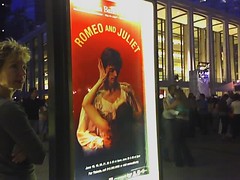
About the two previous pics, taken with my cell phone: in the second one down, the poster is of Angel Corella and I think Diana Vishneva posing for Romeo and Juliet, not Roberto and Alessandra — it was just the only thing I could think of to take a picture of on the spot during intermission so I could gush on and on about how in love with Roberto I was!!!
And top pic below, I tried to take a picture of the Fabrizio Ferri photographs in the lobby with my cell phone, but, as you can see, it didn’t come out so well! I was very excited because I was sitting in orchestra, and this couple came down to the front and was looking for a pair of free seats (like there were going to be any on this night of all nights). I heard the guy behind me say, “Are you looking for seats? Well, the seat next to me will be free but only for the second act. My friend, who’s from the New York Times has gone over to NYCB to watch Jewels for this act, but he’s coming back over here for the final act.” Oh wow, I thought, I wonder who it is. The woman looking for a seat sat down. Then, a couple of minutes later, I hear, “Oh, sorry, the seat’s not available after all. Alastair is back.” Apparently the Jewels idea didn’t work out. Of course I whiplashed my head around. He didn’t look very old! Not that The Times is going to hire as their new chief dance critic an 80-year-old to replace the retiring 80-year-old, but still — he looked REALLY young. Of course I didn’t sit there and stare, but … he looked so normal! I just expected a chief critic to look like … the conductor in my picture above, or Gorbachev or something, big and hefty and aged and distinguished ha ha! And, also, he looked American — he was wearing a Polo-type t-shirt… (Macaulay is a Londoner). Maybe that guy was just goofing with everyone, trying to impress by pretending to know Alastair Macaulay and it wasn’t him at all, haha!
Anyway, ugh, it was obviously an unforgettable night and I am really really going to miss her. I think I included in this post practically all of the pictures I took, but in case I didn’t, here’s the album on my photo page.
Originally uploaded by swan lake samba girl via mobile.
Alastair macaulay is sitting right behind me!
Last night marked the final performance of Kyra Nichols, the second-to-last still-performing ballerina to have worked directly with George Balanchine, and thus widely considered to be of the last of “the Balanchine ballerinas.” (The other Balanchine ballerina is Darci Kistler, also of NYCB). I’m relatively new to ballet and especially New York City Ballet, so I haven’t had many chances to see her dance, and I’m really feeling sad now, as I felt when I recently saw the legend Gelsey Kirkland perform (in a non-dance role) in American Ballet Theater‘s Sleeping Beauty, that I’ve missed out on an era. Ms. Nichols danced brilliantly last night; I was so overwhelmed and I wish so much I would have seen more of her over the years. Since I don’t know a huge amount about her, here’s an interview she gave recently to Gia Kourlas of Time Out NY, and here is Joel Lobenthal’s article in The Sun (I remember NYTimes’s Alastair Macaulay also wrote an article on the several retiring ballerinas but it’s impossible to link to because they only allow paying subscribers to access articles). Also, here is long-time NYCB fan Oberon’s review of last night.
Last night was breathtaking. Peter Martins (NYCB Director) put together a gorgeous program for her. First on was Serenade, what to me seems to be classic Balanchine — involving oodles of beautiful ballerinas in gorgeous flowing baby blue chiffon, and one or two men overwhelmed by them all! (which is largely, it seems, Balanchine’s take on ballet 🙂 ) It was mostly abstract but with a slight narrative in which Nichols poignantly danced the main character. (I will definitely be reading more on this splendid ballet in Terry Teachout’s book on Balanchine, but more about that in a minute…) Second was Balanchine’s “ballroomy” piece for four couples set to Robert Schumann’s “Davidsbundlertanze” (try saying that several times in a row!), which I’ve seen before and loved, and set to lovely onstage piano music. And, my favorite of the night (can’t help it, I’m a ballroom dancer!), “Der Rosenkavalier” from Balanchine’s Vienna Waltzes, a shortish piece in which the stage is overtaken with waltzing couples — the men in elegant black long-tailed tuxes and the women in long lavish white gowns — one of the most exquisite sights I think I’ve ever seen on a stage, and one that rekindled the passion I felt for Standard Ballroom upon attending my first competition. Not that several couples waltzing their own routine on a ballroom floor could look anything like this (even if those couples are at the level of Mirko Gozzoli and Alessia Betti or Jonathan Wilkins and Katusha Demidova…) — it takes a genius choreographer, not just a few great dancers, to create such a sublime spectacle. And one thing I love about ballroom is how it seems to convert little boys into mature gentlemen — Robert Fairchild and Tyler Angle looked so dapper whisking their ladies all around the floor — so charming! It just takes you to another time and place, to a fairytale land…
Anyway, although it was the end of an era in the ballet world, for me it was a time of new beginnings, of meeting new people and making new friendships. I met up with critic and writer extraordinare Apollinaire Scherr, who introduced me to the illustrious critic and writer and author of several books, Terry Teachout, who gave me a copy of his biography of Balanchine!!
The three of us met up during intermissions, then all went out afterward and chatted all about the ballet world, and the dance critic world — so very interesting for newcomer me! Mr. Teachout is so brilliant. He’s a former jazz musician and has been writing for so long about the worlds of classical music, ballet, and now theater, he’s just like a walking encyclopedia of the New York arts scene. It’s so amazing. I can’t wait to start reading his book — which I’m going to begin this afternoon (in between trying to finish two briefs for work by the end of the month — I’m going to get it all done I swear…) Meeting him was so fun, and so educational, and I’m sure his book is going to open up a new world to me (and, he even said he liked my blog 🙂 :)) — thanks so much, Apollinaire!
There was so much going on last night, every ballet fan in the universe (or at least those lucky enough to have got tickets) must have been there — but somehow I was also able finally to meet Sarah, who frequently comments on The Winger as well as Philip‘s and my blogs, and Bob, who comments a lot on our blogs as well! That was fun, and I’m completely amazed that in that massive crowd people were actually able to recognize each other. I sat next to Susan, who also is a big blog and Ballet-Talk-commenter (and met her nice husband), and Philip and Wei (who I also met beforehand at the stage door and hung out with. Philip is great fun to lurk around the stage door with because he knows everyone and everything at NYCB … he should be a tour guide, if there was such a thing!) We all looked for Carbro at Ballet Talk, but couldn’t find her.
Anyway, it was a really amazing night, amazing experience. Oh, we also spotted Kristin Sloan onstage filming — so her video’s going to be a lot of fun to watch when she finishes it. I think it’s so magnificent that we now have this technology that enables us to preserve these monumental events in this way. First those excellent “Tragic Love” videos documenting Martins’s new Romeo + Juliet and now this — NYCB is just going to HAVE to expand it’s website’s broadband to make room for all these awesome videos Kristin’s making!
Okay, time for rest and relaxation (and brief-writing) until tonight … when a ballerina whose career I HAVE followed and whom I love, retires as well — there were many teary eyes in last night’s audience; tonight is going to be my night for being a hysterial wreck…
Originally uploaded by swan lake samba girl via mobile.
Last oral argument of the season! Yay! Happy beginning of summer everyone!
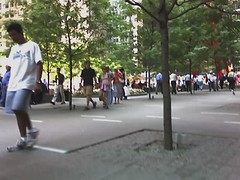
Originally uploaded by swan lake samba girl via mobile.
Maybe i’m weird but i love new york in summer. Late lunch al fresco in the financial district.
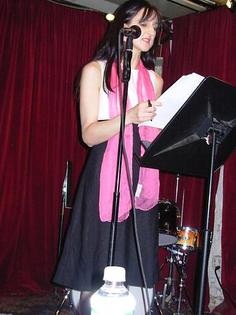
Hahahahhaha — I look SO intense!
Tonight I had my first ever public reading of my novel at the Cornelia Street Cafe. I read as part of the Writers Room Member Reading series, which takes place there every third Tuesday of the month from September through June.
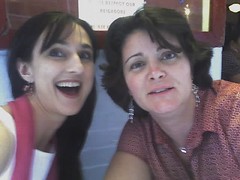
Hehe, so much fun. I was so nervous, but once I got started, I was fine… at least that’s what my wonderful friend, Evangelina, told me 🙂

Here I am with Evangelina, my good old trustworthy friend from my writing class days. She’s known (main character) Sophie and all of her nutty problems since her inception so it was PERFECT to have her in the audience! I would have invited more people, but I was really nervous going into it and didn’t know how well I’d do, so I wanted to minimize the number of people to see me screw up!
But as it turned out, it went fine, and now of course I can’t wait to do it again. When I do, I promise to invite everyone I know in the NYC area 🙂

Here’s playwright and Writer’s Room Reading Series host, the hilarious Stan Richardson, about to introduce me.

Hehehe, I’m such a goof. I actually wrote out my intro to my piece that I was reading. I always do such silly things — whenever I give an oral argument in court, I absolutely MUST write at the top of my outline the words, “May it please the court. I am Tonya Plank and I represent (client’s name)” … my friends like to make fun of me — because what, am I going to forget my name?? — but I’m always so nervous approaching a podium, I just must have those words on my paper in order for me to get myself actually talking.
All in all it went really well. Like I said, I was very nervous and shaky-voiced at the beginning — which I felt and Evangelina confirmed — but after I got into it, it got much better. After I read, Stan said my reading made him think and there were a lot of things that he really wanted to talk about but there was no time — how sweet! And then later, he made a couple of jokes about Freud and everything in this post-Freudian universe being sexual, which was a riff on my first couple of lines 🙂
Then, after all readings were over, a writer, Jim Story, approached me and told me he thought I did well and my work sounded interesting but that I read way too fast and needed to slow down. Evangelina agreed, but said I only read how I talk (which is way too fast!). She also said that I need to learn proper comic timing — when I have a funny line, I need to PAUSE afterward to give the audience time to get it and respond. I know, I know, I know, but eeek, I just feel so weird doing that; I feel like I am begging for laughs, basically telling the audience I want them to think this is funny and to laugh by pausing in certain places — no??? I guess maybe just reading slower in general would do the trick…
Hehehe, also Stan asks everyone a question or two when introducing them. For mine, he asked me what I liked best about my website. I was thinking he was going to ask something like when did you join the Writers Room and / or why, what publishing house would you like to publish your book (questions he’s asked others), but instead I got this one and I couldn’t think quickly. I said the first thing that came to mind which was the graphic! I do really like the graphic designer my web builder, Gregory Tomlinson, hired, and those couple of little outlines he did of me and Pasha dancing in my first showcase, one on the main blog, and one on the home page. And then I started vomiting on (when I’m nervous I just start blabbing incessantly; it’s really just BAD), about how I used to take ballroom and, oh can you believe the guy in my graphic, my former dance teacher, is now on “So You Think You Can Dance” and woo-hoo a famous person on my blog, who knew Pasha would make it so big, and how awesome, and blah blah blah… have no idea what else I said; it’s just a blur now! Well, Stan had no idea what I was talking about — he’s like, So You Think You Can Dance, is that American!? I’m such a goof, I have to remember not everyone is as obsessed with dance as I am … And, hello, what kind of writer says their favorite thing about their website is the graphic!!!!!!!
Anyway, it was all so much fun and such a great experience and I so want to do it again. I could totally get used to this writer life 🙂 Thanks to Stan for being his humorous self and easing my nerves, along with my two co-readers tonight Dan Klein and Lauren Yaffe, and Evangelina, friend extraordinaire for her never-ending support :), and to Cornelia Street Cafe and the Writers Room (the most awesome of all urban writers colonies!) — as well as the Jerome Foundation, NYC Department of Culture, and National Endowment of the Arts for underwriting the WR Reading Series — all for giving new writers such a wonderful opportunity to be heard and to engage in the writing life in this way. Happy night!

Front of Cornelia Street Cafe, where Evangelina and I had dinner and caught up with each other after the reading. And, across the street, we noticed this very happening restaurant, Petra or something like that? Hmmm, will have to check it out someday…

Originally uploaded by swan lake samba girl via mobile.
My first ever reading from my novel! Thank you sooo much writers room for awesome opportunity! And thanks to great great friend evangelina for support!
Whew, am so busy with work (law work, that is), writing stuff, and ballet-going, I’m badly behind on blogging… I’ve seen so many things over the past few days at New York City Ballet — after suddenly realizing that, between ABT‘s Met season and the Blackpool Dance Festival, NYCB’s spring season is practically over and I’ve seen hardly anything but Martins’s ROMEO AND JULIET, so am trying to make up for lost time… I plan to blog on everything I’ve seen as soon as I can catch up, but for now, I’ll start with JEWELS, the most breathtaking ballet I’ve seen in a while, and one that really drove home to me like nothing else George Balanchine’s magic. This was my first time seeing it and as a result I now want to devour everything written about that man, and plan, as soon as I get time, to run to the store for the biographies by Terry Teachout and Robert Gottlieb.
JEWELS is divided into three “acts,” or parts, each one representing a specific period and style of classical ballet. Of course the ballet’s not literally about precious stones; the jewels are a metaphor for each period, each of which, near and dear to Balanchine’s heart, is its own unique kind of gem. Premiering in 1967, the ballet was considered a radical departure from the long-dominant big story ballets and is recognized as the first full-length abstract (ie: narrative-less) ballet.
Part I, Emeralds, is Balanchine’s celebration of French classical dance, and is choreographed to Gabriel Faure’s concert suites from 1889, used in that year to accompany French adaptations of Shakespeare plays. This first piece is, to me, characterized by quietness (at least in contrast to the latter two!), fluidity, elegance, the beauty and charm of simplicity, and by subtle expressiveness. Rachel Rutherford captured my attention with her gorgeously expressive wrists. (She also captivated me yesterday in CONCERTO BAROCCO, but more on that in a later post…) With those beautiful wrists — ahhh, I wanna see HER do BAYADERE now! Also entrancing me was a certain R. Fairchild … Robert Fairchild aka “Romeo” Fairchild 🙂 Seriously, where did this kid come from? Was he seen onstage before Martins cast him earlier this season for the world premiere of his R&J? He’s spectacular — everything he does — turns, jumps, everything is marked with amazing precision. And he has that extra something that is undefinable that makes him stand far out in a crowd. (I saw him yesterday in BRANDENBERG and TRIBUTE looking very charmingly James Dean-esque … but more on that later… methinks he may be the Angel Corella of NYCB?…) Well, Peter Martins surely has a knack for uncovering talent, of that I am sure!
As Philip rightly noted, (and part of the charm and the fun of this ballet is, I think) everyone has their favorite part. Philip’s is this first part, and I can why with its soft, elegant beauty and quiet, subtle charm.
Going into the ballet and knowing as little as I did about it, I was sure the second part, Rubies, would be my favorite. This is Balanchine’s panegyric to America, his adopted country. Choreographed to lively, late 1920s piano music by Igor Stravinsky and using spicy red short-skirted costumes, this is Balanchine’s vision of what American dance, of what America, the New World, is — high-spirited, fast and energetic, jazzy with jutting hips, showy, full of zest and flavor, fun, cheery, endlessly upbeat, overflowing with youthful optimism. This part is the one most often performed when companies use it in mixed repertories, and you can see why — it is the most “Balanchine-esque” — this vision of America, this combination of classical ballet with what we already had here, with what was uniquely American, was the stylistic hallmark of his oeuvre, and, since he is the father of American ballet, it is in turn our national style…
Yvonne Borree, looking, to me, physically not like herself (has she perhaps dyed her hair darker?), was super fun to watch– she was cute, sassy, charming — she was PERFECT for the American part! As was Theresa Reichlen, who looked very Firebird-y. And is there any NYCB male dancer more perfectly suited for the all-American guy-role than Mr. AMERICAN IN PARIS, Damian Woetzel?!
I was so excited by Rubies, I thought the third section, Diamonds, would bore me in contrast. Boy was I wrong. It completely blew me away to such an extent I almost cried at the end, which I haven’t done since nearly a year ago when Jose Manuel Carreno‘s Romeo woke up thinking Alessandra Ferri‘s Juliet dead at the Met… Diamonds is Balanchine’s homage to his homeland, to the grand, sweeping, large-scaled classical tradition of the Russian Ballet. Returning to 1875 and using Tschiakovsky’s Symphony No. 3 in D Major — anyone who has ever been to the ballet more than once instantly recognizes Tschiakovsky music, even if they’ve never heard the exact score before, as THE quintessential classical ballet music. The choreography here, a tribute to the great Russian story ballets of the 19th Century, with its dramatic lifts accompanying the orchestra as the music builds to a climax, the many men dashingly courting their ballerinas around the stage at once narrowly missing sideswiping each other as their paths criss-cross, the large ensemble dancing in perfect unison, the gorgeous pas de deux and the solos for that most pristine and celebrated of creatures — the Russian ballerina, is equally instantly recognizable.
This is actually what confuses me about my own reaction to the ballet: I’m really not a Petipa-head — I don’t really go for those huge-scale, five-hour-long ballets like SWAN LAKE and SLEEPING BEAUTY just drenched with pomp and circumstance so overwrought you can’t enjoy the basic beauty of the actual dancing. But then, I had to remind myself that this is Balanchine’s version of Petipa, of the grand tradition of Russian ballet — scaled down and with all of the elements he didn’t care for so much taken out, with only what he truly loved left in. Oftentimes the tribute shines far brighter than the original. And this is a most endearing encomium, a diamond obviously being the most valuable of all stones and that enjoying never-ending life…
Ballerina Maria Kowroski (who danced the principal female role in Diamonds the night I went) wrote a little blurb in the Playbill about the ballet:
“Jewels is undoubtedly one of Balanchine’s greatest masterpieces, and, during my career, I’ve been lucky enough to dance in each of the ballet’s parts…
“The first of the ballets I danced was Emeralds. This ballet has a very specific quality, a real perfume, and it has a fluid and effortless style…
“When I saw Rubies for the first time, I knew right away I wanted to do the soloist part. It’s so daring and fast — its flashiness appealed to me…
“But Diamonds is my favorite. I don’t even know how to describe it, except to say that it’s heavenly. First of all, that costume, with the beautiful headpiece, makes you feel like a million bucks. Then the ballet starts off very slowly, with a beautiful pas de deux, and the music takes you to a different place, as if you’re just floating along. When I dance Diamonds, I feel like royalty, like I’m in a beautiful palace of music and movement. Near the end, there’s a thrilling moment when the music slows down almost to a stop, and then it starts up again for the big finish, with the stage filled with dancers all moving in unison — I always get chills, and sometimes, I come close to crying. It’s just so gorgeous.”
I can assure you, it feels the same exact way watching it! The season is, horribly, nearly over, but hopefully, hopefully please please NYCB will perform this gem again, many times — and not just the Rubies section, but the ballet in its entirety. I feel that each section informs the others and that each part reveals its true beauty and magic only in contrast to the others, so I strongly feel the ballet should be put on in whole and not split up. You have only a few more opportunitities to see this masterpiece next week — on Thursday, Saturday night and next Sunday’s matinee, when NYCB will end its season with it. Visit their website for tickets. Do not miss it!!!