Where is he? I haven’t seen him in anything yet this season (okay, of the whole two performances I’ve seen). Seriously. I wanted to see him yesterday in Symphony in Three Movements (at least) and he was not there. I miss him!

Where is he? I haven’t seen him in anything yet this season (okay, of the whole two performances I’ve seen). Seriously. I wanted to see him yesterday in Symphony in Three Movements (at least) and he was not there. I miss him!
I don’t have much time to write– this week is beyond crazy, but last week I went back for more Alvin Ailey II (Ailey’s studio company) to see their program of repertory favorites, my favorite of which was Troy Powell’s The External Knot. See a video of excerpts from that here.
What I found intriguing about this piece was Mr. Powell’s use of music. He set the dance mainly to Philip Glass (with some Robert Schumann thrown in), to sections of In the Upper Room and Glass Pieces (the section from the latter was from Akhnaten, that fun, bouncy, drum-laden section). I’d only ever seen set to that music Twyla Tharp’s In the Upper Room and Jerome Robbins’ Glass Pieces, and I’d only ever seen Balanchine ballets to Schumann, so it was interesting to me to see how another choreographer visualized the music.
The External Knot is the story of this young man who seeks individuality, to set himself apart from the crowd and go off on his own. But there is a certain loneliness in doing that. But then, being a conformist is not very challenging and there ends up being a certain loneliness in being part of a group as well. The movement, along with the Upper Room and Schumann music conveyed that well. Upper Room is one of my favorite pieces — both the dance and the music alone — particularly that middle section where the piano keys sound like raindrops — it’s somehow simultaneously peaceful yet sad. I always envision this solitary person stuck in a cell — either a prison or a mental institution. Then, towards the end, the orchestral music swells and there’s a choral part indicating there’s a light at the end of the tunnel and I then think of the confined person as on a journey toward that light. I’ve often wondered when listening to the music where in the world Tharp got her ideas for the dance, because I don’t see any of that unsettling isolation and confinement in her ballet. But then, that is part of the fun of Tharp — you can often get the unexpected. And then Balanchine has used Schumann to convey madness. But here, that music perfectly suited the theme as the young man dances on his own, kicking up and out, jumping, lunging, reaching, doing a lengthy painful-looking shoulder stand, his legs bent awkwardly in the air, his legs slowly spreading into an arc, then a full split, his body finally rolling over onto to the ground, while the group dances on in the background — either moving in sync as an ensemble, or fragmenting into duos or trios, all movement seeming to express a longing for something.
At one point, the man is very indecisive: he can’t figure out whether to lead, follow, or leave the group. The group follows him, he looks over his shoulder as if to ensure they’re there, then they turn and leave him behind. He seems upset, he follows them, as if to harken them back. When they turn again and come at him, he turns back around, goes on hurredly forward whether they’re behind him or not.
And then in the last section, instead of using the choral music from Upper Room, Powell switches to the exciting,ย rhythmic Akhnaten, where the dancers perform expansive movements in the background — large bends forward from the waist, big, far-reaching port de bras, while the man jumps, twists and turns up front, seemingly more upbeat, at peace with himself whether he is one with the group or not.
What is up with this show? Dancing With the Stars really made me mad this week. I’m kind of tired — have a big week (New York City Ballet begins, Stephen Petronio and Trisha Brown Dance Co’s open, and I have about 10,000 Tribeca Film Festival films to see, plus am trying to take computer skills classes since I virtually have none as well as schedule a visit to Bushwick, Brooklyn, where a new performance company which I’m a board member ofย — first time being a board member for me!!! — is trying to rent a space) — so please forgive me if I’m cranky. But when I got home from a full day of craziness and watched my tape of the show, a few things just got on the only remaining nerve I have left right now.
First, we’re told Melissa can’t compete because of a fractured rib, which we later learn she sustained doing a crazy lift / back flip over Tony’s entire, standing body. Then, we see Cheryl being short and nasty with Gilles over his inability to do a lift, which he’s having real problems with because of a shoulder injury. He forces himself to go along with her, does an insane aerial-filled Lindy Hop, and does okay (although there was a timing flub on the first somersault lift thing; the one she was yelling at him over in practice), but, to me, you could see the pain on his face. And his kicks, his Charleston, everything was just lacking energy, though he tried to hide it, like a pro. Then, since Melissa can’t dance because of the rib injury, they judge her based on a previous practice rehearsal at which she and Tony are mainly marking the routine. I can’t believe they even showed that on live TV! Of course it was awful.
Ugh. The problem is that these lift-filled routines are too blasted hard for non-pros. Even regular ballroom dancers aren’t used to doing them — and that is mainly who is training these competitors. I mean, I’m kind of torn between wanting the pros to take the contestants as far as they can possibly go so TV audiences can witness the thrill of really virtuosic dance, and just wishing they’d put some professional ballet or exhibition dancers on the show for that kind of stuff. Let audiences ooh and aaah over the real pros at this kind of thing. It’s way too much for people who’ve never danced before in their lives. It’s honestly really shocking to me that there aren’t more injuries. I mean, when I was dancing, I really wanted to be challenged too, but you have to stop and realize what you’re risking if you’re not a pro dancer; you have to take care of your body.
And in the real world, I’m sorry, but Melissa would be off. If you can’t compete in the Prix de Lausanne, at Blackpool, then, you know, the judges don’t go basing your score a rehearsal tape you send them. That’s ridiculous. If the show would have real rules, then maybe the pros, the producers — whoever’s making the dance decisions here — wouldn’t push non-dancers way the hell too far so that they risk serious injury in the first place.
Anyway, no one really blew me away tonight. Gilles was good but looked fatigued and nervous about the lifts, Ty and Shawn’s routines were meant primarily to showcase Chelsie and Mark respectively — and they did, but I didn’t watch the contestants at all. Chuck’s Cha Cha was okay but generally underwhelming compared to his excellent Samba last week. And Lil Kim — well, she was pretty good. I thought it was a bit more about the facial expressions at first, but she came through on the dancing and did really well. Overall, she was my favorite this week.
The group dances: The group Mambo was cute though; the ending goofy corny fun. The pros totally outshone the amateurs but I still liked it. I kind of wish they’d have used real Mambo music though. But Wow, the group Tango was Excellent! The amateurs here — Ty, Gilles and Lil Kim — were better than those in the Mambo. The choreography was gorgeous and everyone danced perfectly in sync when dancing together, and all three amateurs looked really good out there — almost like pros. Ty blew me away. Completely blew me away. His footwork was excellent, his posture perfect, his handhold absolutely right — he was so polished! He looked like a real dancer out there! Len is right — he nailed it.
Okay, so overall, my faves of the night were Lil Kim’s main dance, and Ty in the group Tango.
I have NO IDEA what’s going to happen tomorrow night.

BalletMet Columbus, based in Columbus Ohio, is currently putting on a ballet version of the F. Scott Fitzgerald classic.
Says 35-year-old choreographer Jimmy Orrante: ” The story has parallels with today, with the cycle repeating of people going to parties, being careless with overspending and going into debt. The parties were big and the spending was big — without any question of how much things cost.”
Says artistic director Gerard Charles: “The era is a good one to portray in dance but there are certainly challenges to it because of the literary style of the writing.”
I’ll say! I love modern story ballets; should be interesting. It appears it’s showing this weekend and next. Anyone in Ohio?
Via Mr. Elegant.
This weekend I finally made it to MoMA for the Martin Kippenberger exhibit, which I highly recommend if you’re in New York. It ends May 11th. I remember being really struck by one of Kippenberger’s gigantic installations, The Happy End of Franz Kafka’s Amerika, when I’d first seen it in Sweden when I was there in 1998. It was at a special exhibition called Memento of the Metropolis that was part of European Culture Capital, which was in Stockholm that year. (Every summer a different European city is chosen as the Capital of Culture; they have a bunch of art exhibitions, special music, theater and dance performances, etc. all summer long).
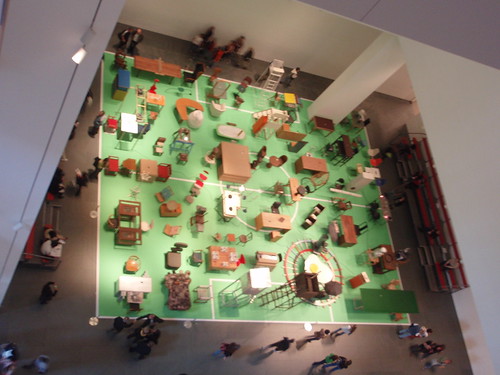
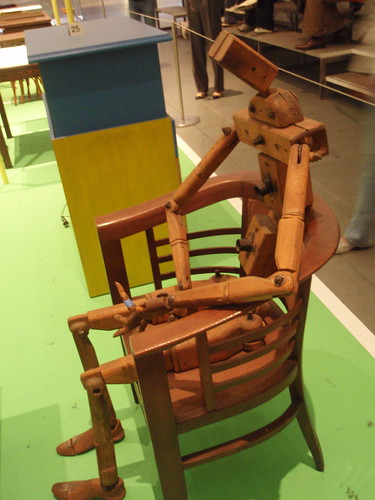
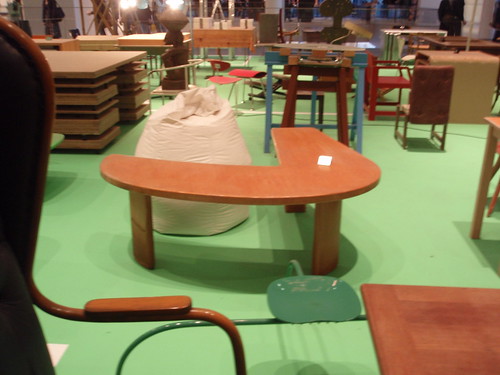
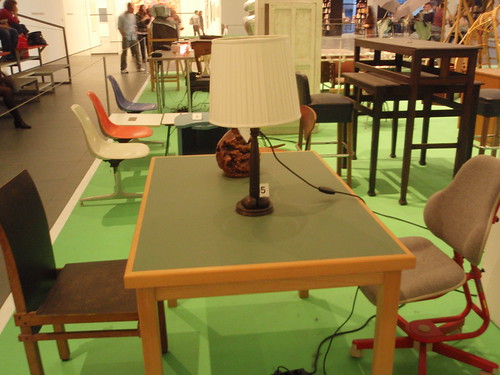
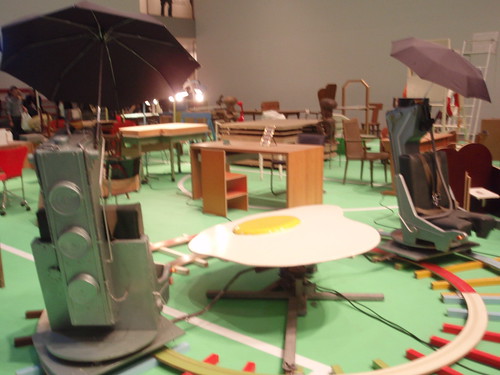
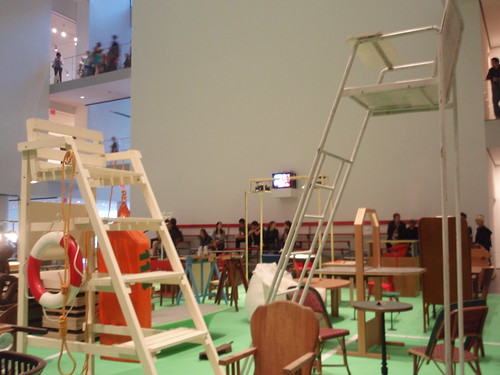
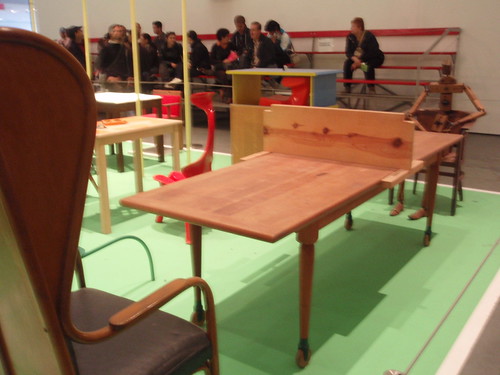
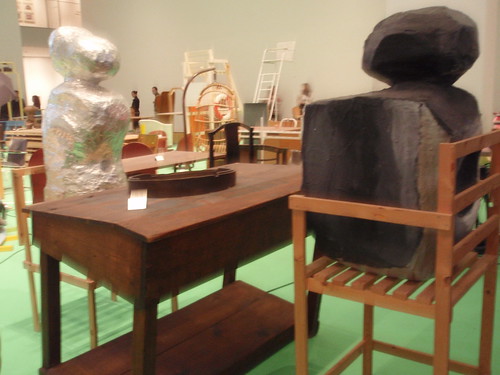
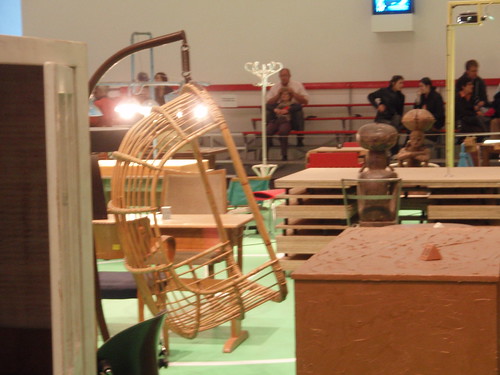
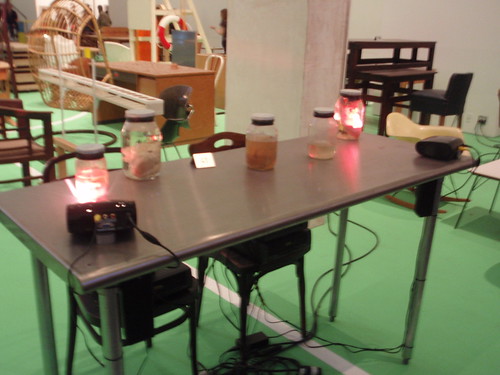
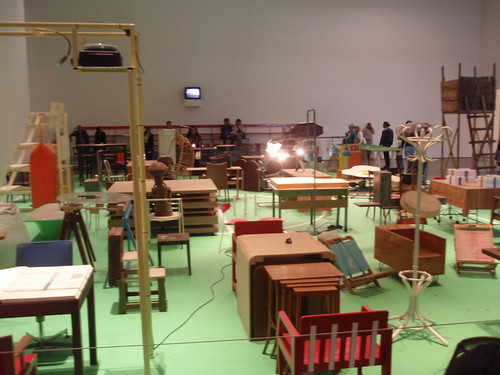
Anyway, toward the end of Kafka’s unfinished novel, Amerika (also called The Man Who Disappeared) (which I, embarrassingly, haven’t yet read), the young man goes for a job interview in Oklahoma, not knowing that the corporation is corrupt and the whole thing is a scam. In Kippenberger’s installation piece, numerous pairs of chairs each separated by a table are all set up on a soccer field, bleachers aligning each side of it.ย So, it’s like a job fair with numerous interviews ongoing at the same time. Except here, the chairs are rather ridiculously funny — two gigantic lifeguard stands sit opposite one another; two amusement-park-ride seats with umbrellas circle on a piece of roller coaster track continuously around a table that looks like a fried egg; two big arm-chairs are separated by a table on which sets a light hooked up to a brain, etc. At times the chairs actually resemble people: a big bean bag sits opposite an art deco stool with long spindly legs, making the interviewer look like a giant potato-head, the interviewee a tiny frightened spider.
Amazingly, they let us take pictures (the only part of the Kippenberger exhibit where we could):
And that the whole thing sits on a soccer field surrounded by bleachers makes it seem like the modern job interview is just one big spectacle.
Also news that is now a few days old (and thanks to my new Pointe friend from last night for pointing me to it): President and Mrs. Obama will be the honorary chairpersons at ABT’s opening night spring gala on May 18th, along with Caroline Kennedy, Carolina Herrera, Blaine Trump, and Renee Zellweger.
Highlights of the pre-dinner performance that evening: in honor of Nina Ananiashvili’s approaching retirement, Alexei Ratmansky has created a piece d’occasion for her set to the waltz from Aram Khachaturian’s Masquerade Suite; and a performance by Herbie Hancock.
Ooh, how I wish I could afford the dinner. Do hope to be at the performance though.
This may be old news, but I just found out last night when I went to a friend’s book launch party and met a writer from Pointe magazine (how small is this world!) Anyway, wow! Hooray for Sabra; hooray for Cedar Lake; hooray for New York audiences!
UPDATE: I have been told by a representative of Cedar Lake that Sabra is no longer with the company, unfortunately. This is as of August 2009. I will definitely let you all know when I hear anything further about.
Oooh, there IS going to be an American version of Diet on the Dance Floor.
Marissa Jaret Winokur (from Broadway’s Hairspray, who was also on Dancing With the Stars a couple of seasons ago) will host the Oxygen network show.
I was recently reunited with an old friend on Facebook and, on realizing I was now a bit of a dance fanatic (I know him from my lawyer life), he asked me what I thought of Gelsey Kirkland. Unfortunately, by the time I moved to New York all the major stars of yesteryear had retired. So I never got to see her or Nureyev or Baryshnikov or Makarova or any of the others dance live. He said Kirkland was his favorite, “pure magic.”
I love so many of today’s dancers of course, and, from what I’ve seen from videos of yesterday’s stars, many of today’s seem every bit as good. But of course they are nowhere near as famous.
I mean, when my friend told me Kirkland was on the cover of Time, I couldn’t believe it! A dancer on the cover of a major magazine, could it be? So, he sent me the cover article. Wow.
He also sent some videos: here is her Nutcracker, and here with Baryshnikov in Quebra Nozes (which I’ve never seen before; it is really beautiful), here her Don Quixote (also with Barysh). And here, her Juliet (MacMillan’s!, with Sir Anthony Dowell). Have also been ordered to read Dancing on my Grave, which looks rather fascinating and is next on my list.
So the contestants have designed the costumes this time. For the most part, they look better. I really like Julianne’s snazzy red fringe — her boyfriend dresses her well ๐ And I love Edyta’s floor-length robe, although I’m sure it’s going to come off at some point…
Tony and Melissa’s Argentine Tango: That was really quite nice. There was a lot of basic dancing with a lot of intricate footwork, and a few flashy lifts thrown in here and there, but it wasn’t about the lifts. And she had excellent leg lines on those lifts. And I like how Tony varied those lines — the first had a clean split, the second both legs in attitude. Very good choreography and very good dancing.
Lawrence and Edyta’s Waltz: Aw, I love Journey’s Open Arms!
So, this weekend marked choreographer Merce Cunningham‘s 90th birthday, with celebrations and performances of his latest work — Nearly Ninety— at BAM. Unfortunately I was unable to go — and Apollinaire reminds me just how much I missed — but I decided to compile a list of some reviews since this was such a momentous occasion (many consider Cunningham to be the greatest living choreographer, or the greatest living American choreographer; some consider him to be the last left of the greats):
Macaulay goes even farther and calls Cunningham “the greatest living artist since the death of Samuel Beckett”;
Tobi Tobias hails the choreographer, but critiques Nearly Ninety as well as the decision to let famed dancer Holley Farmer go;
Leigh Witchel describes Nearly Ninety as “dreamlike” in the NY Post;
Blogger Evan Namerow of Dancing Perfectly Free talks about the role of chance operations in NN;
Aynsley Vandenbrouke says NN is Merce’s “ode to his dancers”;
Jordan Hruska calls NN “Bionic Theater” in the Times Magazine’s blog;
New York Magazine’s Daily Intel blog blurbs mainly on the wheelchair-bound curtain call, etc.;
WWDLifestyle has a short list of some celebs who attended the post-performance party on Thursday night;
and here’s a YouTube performance clip from ArtRavels;
And, here are a couple of pre-performance overviews, from NYTimes and NY Magazine.
Apparently, NN will now travel to Madrid.
UPDATE: Also, here is Apollinaire Scherr’s review in the Financial Times. (I’m very happy to see, by the way, that she is now the dance critic for FT!) And here are more of her thoughts on the program and the Cunningham dancers on her Foot in Mouth blog.
And Eva Yaa Asantewaa in Dance Magazine.
Please let me know if I missed anyone.
On Friday night I saw Dances Patrelle, who is celebrating its 20th anniversary, to see their Murder at the Masque: The Casebook of Edgar Allan Poe, a world premiere, and Come Rain / Come Shine, a revival from 1986, both choreographed by artistic director Francis Patrelle. Funny, it’s the first time I’ve ever seen anyone besides Dance Times Square perform at the Danny Kaye Playhouse at Hunter College, so, I was a slight bit confused throughout the evening because of that. I couldn’t figure out what Marcelo was doing on the stage instead of Pasha and what people were doing in pointe shoes instead of Latin stilettos… I guess it’s fitting I brought with me my ballroom friend, Mika.
And I’m so glad I did. She had a blast. Said it was some of the best ballet she’d ever seen. AS I KNEW IT WOULD BE!!! Said Marcelo was very Slavik (as in Kryklyvyy, as in man drama queen total show-off show-stealer, as in I’m totally predictable in my taste in male dancers whether it be ballet, ballroom, or whatever style. Oh well…)
Anyway, Murder, on first, was a dramatic ballet murder mystery that was interestingly told. The figure of Poe seemed to be writing the story as we were seeing it, from afront a scrim, and it seemed to me he was changing things throughout. I’m still not sure who committed the murder in the end (but that may well be because I was so excited about the second piece of the night). It had an air of Balanchine’s La Sonnambula about it — unsettling, foreshadowing tragedy, and set at a ball and in the same period — and Patrick Soluri’s music set that tone perfectly. Matthew Dibble, guest starring with the company (he’s danced with Twyla Tharp’s company), danced the lead very well, expectedly.
Second on was Come Rain / Come Shine, Patrelle’s longish but lovely set of dances for three couples set to a group of Judy Garland songs. Sorry I’ve posted that picture above about 10,000 times on this blog; it’s the only one I have of that dance ๐ All six dancers in that ballet were guesting from ABT: Roman Zhurbin (ballet god) and Gemma Bond danced the first, youngish, romantic couple; Isaac Stappas and Kristi Boone (who BLEW ME AWAY) danced the second, more mature, argumentative couple; and Marcelo Gomes and Maria Riccetto danced the third couple, consisting of cocky, taunting, teasing, out-of-control man and the poor woman whom he’s got his eyes on. Of course Marcelo had to have the cocky part, and his role, which was very “That’s Life” from Tharp’s Sinatra Songs, consisted of him flying all about and around her, doing every trick in the book — ginormous jetes, Balanchinian continuous twisty jumps, turns and turns and jumps jumps jumps galore — which of course I love ๐ Oh, and Maria’s tiny, so he did a bunch of the one-handed assisted pirouettes he often does with Julie Kent that drove the audience here WILD. The guy behind me was seriously orgasmic. Mika and I were giggling throughout, and finally, on the last assisted pirouette, I just burst out laughing.
What would the world be like with no Marcelos? Ballet would just not be fun. To say the least.
Roman was Roman — not doing a thing wrong, everything perfect, perfect form, perfect precision, perfect acting, just sheer perfection.
Gemma was likewise perfect and Isaac was strong and Maria sweet.
(But it was Kristi who really blew me away. Where did she come from?! I guess I’ve never really seen her up close before … well, I did notice her before — in Tudor’s Jardin des Lilacs, which ABT put on in their Tudor centennial celebration last season — she danced the role of the lover of the man betrothed to another and she danced with such longing for him and anger at the situation and beautiful composure in the face of despair. But time got away from me and I never had time to write about that performance… Well, she had a similar character here: a woman fighting with her man, seemingly not able to fully trust him, not wanting to give herself completely to him for that reason, but unable to stop loving him nonetheless. She and Isaac (who happen to be real-life husband and wife) are really the emotional centerpiece of this ballet and she acted it with such intense emotion. She made me feel everything her character was feeling, really took me to that place. And she made such amazing shapes with her body! Isaac kept throwing her into these overhead and waist-high fish positions and she’d raise her arms up and curve them over, turning her head to face the floor. At times it looked like she was letting him lift her but was also rejecting him, couldn’t bear to look at him. At other times, she kind of looked like a dove, and in a way she was trying to make peace, so the image made sense. So she didn’t just make original, remarkable shapes; she made shapes that had meaning, and were also original and cool.
And also, her feet and legs — such strength! Her feet were almost like Veronika Part’s her points were so pronounced!ย If I was a ballerina I’d want people to notice that — strong feet and legs. I wouldn’t want to look like I was floating through the air like a feather, I’d want to look more strong and toned and powerful, like my legs were carrying me through the world. Anyway, I am a new Kristi Boone fan, needless to say.
It was an intoxicatingly rich evening and I felt like I always feel when I leave the Kaye Playhouse after seeing divine dancing: deliriously high, and then kind of sad…