GO SEE RIOULT!


Over the past week, Rioult (formerly called Pascal Rioult Dance Theater) has become one of my favorite modern dance companies. Artistic director and choreographer Pascal Rioult’s work is like a visual opera, or an opera told all in dance (since opera is already visual). It’s so breathtaking. And his movement style is like a combination of Balanchine and Martha Graham (he danced with Martha Graham’s company). His dances are very expressionistic and full of drama and intensity and his dancers, most of whom are excellent movers, know how to convey that drama by dancing with a real sense of urgency and specificity of purpose. Every movement they make, there seems to be a specific thought behind it. If only all dancers would dance like this…

I saw four pieces over the past week at the Joyce (Chelsea): the world premiere of The Great Mass, set to Mozart’s Great Mass in C Minor; and three of Rioult’s classics: Views of the Fleeting World, Les Noces, and Wien. I loved all of them.

The Great Mass, Rioult’s only full-length evening work, is dedicated to Marguerite Rioult, Rioult’s mother, who passed away this year. She was a musician — a piano teacher and choir director, and a lover of Mozart. It’s so much harder to describe works that you really like than works that you don’t, particularly when they’re abstract, but suffice it to say this was really beautiful, and, again, very operatic. I don’t know much about Mozart unfortunately, but the music is choral, and known as his greatest Mass (go here to listen to the “Kyrie” section), and the dance included all sections of the music: Kyrie, Gloria, Credo, Sanctus, Benedictus, and Hosanna. Through much of it dancers wore richly embroidered white bodices with white tulle skirts and danced as if taken by the spirit, in passionate praise and glory.

But my favorite part was the darkest, a middle section from Gloria in which the dancers wore skin-toned leotards and appeared to be either spirits in hell reaching desperately upward toward a light shining brightly from above, or else humans still on earth praying desperately for salvation. They looked almost animalistic, serpentine, as they writhed around on the ground, then crawled about each other, trying to lift themselves upward toward the light. In the following section, three of my favorite dancers in the troupe — Robert Robinson (who looks like a smaller version of Clifton Brown), Jane Sato and Marianna Tsartolia — danced a pas de trois, each woman wrapping her arms and legs snake-like around Robinson, as if they were by turns trying to tempt him and hold onto him for dear life, as if he’d lead the way to salvation. Tsartolia had a more tormented look on her face, and seemed more desperate, while Sato gave her movement a more tempting and seductive feel. Robinson looked like he was trying to retain inner strength. That’s what I loved about these dancers — everyone was so specific in their movement and intent, like they were always playing character.

The second program began with Views of the Fleeting World (pictured above), a long piece set to Bach’s The Art of Fugue, that consisted of many different sections: Orchard (shown above, with the dancers in the gorgeous red skirts), Gathering Storm, Wild Horses, Dusk, Sudden Rain, Night Ride, Summer Wind, Moonlight, and Flowing River. Each section had a different theme and mood and each was accompanied by a different background impressionistic painting. My favorite section was Moonlight, when the magnificient Penelope Gonzalez danced a very sexy, almost entirely floor-bound duet with Brian Flynn. When I was reading up on the company, I read a lot about Gonzalez, and I see why so many critics love her. She is a tiny powerhouse, one of the most remarkable movers I’ve ever seen.


My friend Mika and I were mesmerized by the way they snaked their limbs in, out, over and around each other’s bodies, sometimes a flexed foot, sometimes a pointed toe, how they lifted themselves up from the ground, upper body, then lower body, touching the floor at times only with one small part of their back (talk about a work-out!), how they’d dramatically arch their backs, how she’d slowly climb onto him, he’d lift her with his arms, on his back (that’s hard work too). I was so blown away; this is one of the most brilliantly choreographed, mesmerizingly, tantalizing, beautiful “sex scenes” I’ve ever seen in dance.

Then was Les Noces, Mika’s favorite of the night. It’s set, just like Jerome Robbins’ ballet of the same name, to Stravinsky’s Les Noces, and, like Robbins’, depicts the marriage rite of passage. Whereas Robbins’ (which I wrote about here, near the end) depicted a Russian peasant wedding set about a century ago, Rioult’s is contemporary, and the curtain opens on four women dressed in bras and underwear dancing intensely atop a set of four chairs, kind of Mein Herr-like, the emotion they convey by turns fearful and seductive. After they dance, they help each other into a pair of bloomers and a corset-like waistband. The lights then dim on them and turn to a set of four men, dressed only in underwear, who dance atop four chairs of their own, the emotion similar but more masculine, more angry (perhaps some don’t want to get married, feel like they’re being pressured) At the end of their dance, then don black, tuxedo-like pants. The two groups then turn chairs toward each other, break into four separate male / female pairs, and each pair really goes at each other, an intense battle of the sexes. The consummation scene begins, as in Robbins’, fraught with fear and trepidation and is rather horrifying, but eventually softens and grows sensual. The couples have overcome the storm.

And the evening ended with Wien (Vienna), set to Maurice Ravel’s La Valse (which was originally titled Wien), which has become one of my favorite pieces of music, the same that Balanchine used for his La Valse (which I wrote about here). Rioult’s version carries the same dark themes as Balanchine’s — beauty turned bad, encroaching tragedy, social refinement embodied in the Viennese Waltz disintegrating in the face of human violence and destruction. But here, a small group of several huddle around each other, walking to the waltz in small steps, one right after the other, almost mechanically, or Charlie Chaplin-like. There is something inhuman and distorted about their movement, their need to huddle in a group, and follow the others. As the music swells, they move faster, but they’re moving so quickly, and in circles, thatΒ  they can’t retain their balance. One in the group will try to reach up to the sky, only to go crashing to the floor. The others, far from helping the fallen one up, simply walk over him or her, making an effort not to trip, but to keep their steps — it’s like they’re in a militaristic march and they can’t step out of line. At points they waltz with each other — men with women, women with women and men with men — but it’s a very grotesque kind of waltzing. The women often look like rag dolls, dead; the men viciously throw them about. The movement is very different from Balanchine’s, but the piece has that same intensely haunting, world-gone-mad quality.

I strongly recommend this company! They’re at the Joyce through the 19th. Go here for info and to see an excerpt from Views of the Fleeting World.

ALVIN AILEY II


Last night for the first time I saw Alvin Ailey II, Alvin Ailey’s studio company comprised mainly of young dancers. Wow! The dancers were so remarkable — all of them! I couldn’t believe it. Usually when you see the studio company the dancers are up and coming, not quite as good as the ones in the full touring company, but these dancers truly amazed me. No wonder so many go on to join the main troupe.

There were four pieces: three modern and one jazzy, classical Ailey (which I really loved). First was Valse (pictured above), by a young, highly accomplished choreographer, Sidra Bell, with modern music that had lots of percussion (which I liked) by Dennis Bell. This piece reminded me a bit of Jorma Elo with a lot of movement alternating between sharp and staccato and more flowing, and lots of jagged shapes and rather intensely-thrust lines created in part by hyperextended arms and legs (which I like, but realize is very modern and not to everyone’s tastes).

Josh Johnson in particular stood out to me. He’s a tall dancer with long long lines, like Antonio Douthit and Yannick Lebrun and Amos Machanic in Alvin Ailey. Maybe because of his long lines I noticed him more here, but he’d reach up skyward with one arm, then grab it with the other hand and bring it back down, as if the arm was out of control and he needed to bring it back in line. This kind of mechanical movement, like the body struggling to break free from robotic-like movements imposed on it, is what reminded me of Elo. Costumes were also intriguingly incongruous: male dancers wore black tops with high necklines and puffed sleeves that looked king-ly, along with spandex biking-shorts; women wore corset-looking tops with ballet-like tulle skirts. It was an interesting dance, definitely with a dark undercurrent, like Balanchine’s Valse.

Second was “The Calling”, a short section from Jessica Lang’s Splendid Isolation II. Fana Fraser danced this solo beautifully. She wore a white gown with a long long train that spread out in all directions across the floor, nearly taking up the stage. She began with her back toward the audience, but turned somehow under that dress without disturbing the intricate fan-like pattern made by the flared skirt on the floor, and lowered and raised her legs so that it looked like she was melting into the ground, then rising up from it. The rest of the dance consisted of lovely arm movement while her feet remained stationery.

Next was Hope (The Final Rise) by AAII artistic director Troy Powell.


This was one of my favorites, but it’s hard to explain why! The piece was full of energy and there was a lot of very difficult movement, with fast kicks and whizzing spins going into difficult-looking lifts. I felt like this was the artistic director’s test for the dancers, and they came through with flying colors πŸ™‚ The music, by David Chesky, had a strong, powerful, even militant feel to it, with a voice chanting, “Rise up, children, right now.”

And then, the evening ended with my favorite piece of the night, the very well-liked George Faison’s Movin’ On.


This was a jazzy balletic piece — a combination of both classical ballet and jazz steps — that was wonderfully reminiscent of classic Alvin Ailey. It takes place in a night club, much like Night Creature and Blues Suite, and consists of a set of unique and endearing characters just hanging out, playing music, flirting with each other, dancing the night away, playing starlet, having a good time. There are three men — members of the jazz band — who jump atop chairs and move just like the instruments. There’s a sweetly arrogant Night Creature-like woman who fancies herself a jazz starlet, and struts and glides and jetes across the stage just like one. And there’s a ballerina who becomes attracted to the street boy. I loved the two who danced the latter couple in particular. Both — Megan Jakel and Jarvis McKinley–Β  stood out to me all night. McKinley moves very well, especially in the more jazzy movements. And I thought Jakel, along with Fana Fraser, were very charismatic. They just had that something that drew your eye to them. And Josh Johnson, who danced one of the musicians, has such a fluidity. The way his arms waved about, they were like water. At one point, Faison himself read (offstage) a Langston Hughes poem, Harlem, which gave the whole thing a rather sobering feel. Like all the fun and frolic was masking a deeper tragedy. Judging by the mass of applause, the rest of the audience loved this dance as well.

I noticed in the program that S. Epatha Merkerson from Law and Order helped to underwrite the costumes for the production. I remember she’d read a poem (onstage) in a recent Complexions piece that I loved. Who knew she was so involved in dance!

GENTLEMEN


Today my friend, Michael Northrop‘s, debut novel, Gentlemen, officially comes out!

Published by Scholastic, it’s classified as a Young Adult book, which means it’s geared mainly toward a teenage audience.

I have to admit I never read much YA even when I was that age (was too busy reading books like Valley of the Dolls and Peyton Place and thinking I was ooooh so sophisticated — big laugh, of course πŸ™‚ ) Anyway, I have flipped through a few recently to see what’s out there and it seems that many of them are kind of about teenage girls and the whole popularity thing, about fitting in, some more serious and about eating disorders and multicultural issues, etc., but many are about girls and by women authors. So, Michael’s is a bit different in that it focuses on boys from a rather tough, working-class background, and is a bit darker. My kind of book! And one of my favorite novels, Dostoevsky’s Crime and Punishment, is at its center. Honestly, I read it quickly and really really liked it. It should be widely available, as of today. Yay πŸ™‚

DANCING WITH THE STARS, WEEK WHATEVER: JIVE AND RUMBA — Update With Marcelo Photos

Sorry, I think I’m a little off on the weeks! Probably because of the double elimination week.

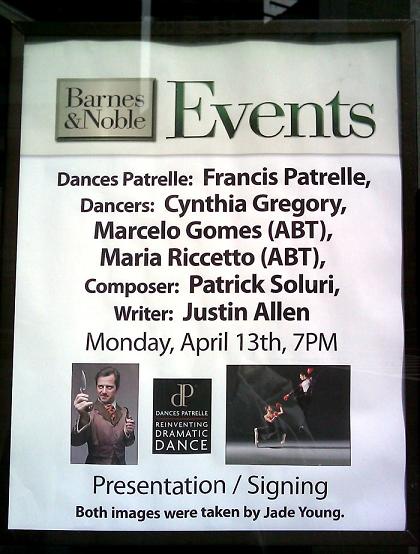
I’m late with my post tonight because I went to an event at Barnes & Noble. Francis Patrelle is a SWEETHEART! I can’t wait to see his company later this week now; such an endearing personality. Seriously, one of the most personable choreographers I’ve heard speak!

bn1

(I wasn’t able to take any pictures because my camera battery went dead, but Scott Schlexer, Marcelo’s representative, who was also there, kindly sent me some of his!)

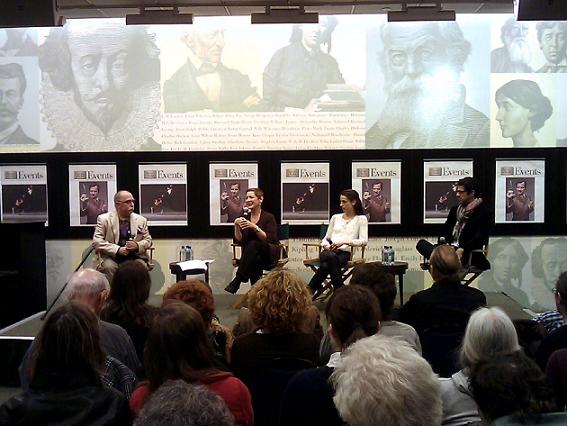
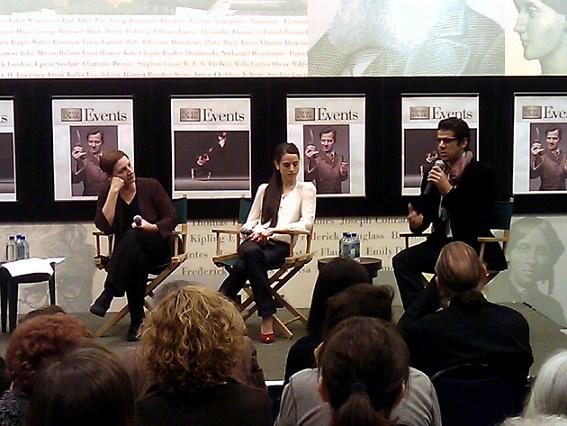
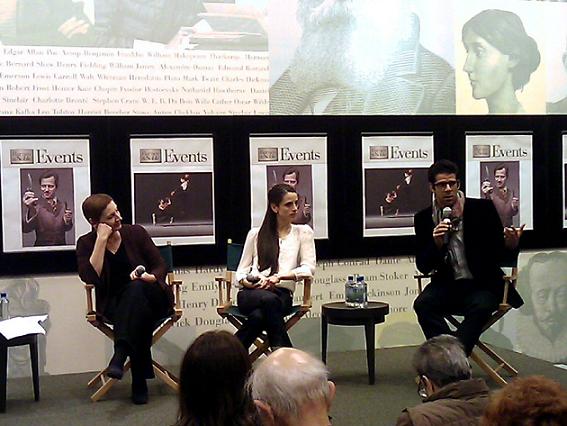
Marcelo was there, Maria Riccetto, Cynthia Gregory — looking very regal! — I love how she holds herself — and several Dances Patrelle dancers and people involved in the upcoming production at Danny Kaye Playhouse. Writers of books dances are based on, composers, and even the songwriter of the Judy Garland song that Come Rain / Come Shine is danced to. He even played piano and sang, and he was very good!


Marcelo didn’t talk much, but when he did I could hardly focus on what he was saying because … who told me he had no accent! Haha, he TOTALLY has an accent! And his voice is a bit higher-pitched than I expected. He actually kind of sounds like Pasha, except with a Latin, not Russian accent. Not an American accent! Anyway, I remember him saying he liked dancing with Maria — that she’s very light. Oh gawd, Francis Patrelle introduced Marcelo by saying he dances with all these huge ABT women! At first I thought he meant in stature, and then he made it clear he meant in size! I was dying, though no one else seemed to be. Patrelle is a total joker anyway — he says he loves to joke around in rehearsal, and it’s clear. So, he said, Marcelo’s used to dancing with all these large women, so I gave him tiny Maria, and he really throws her around that stage with ease — something to that effect. So then Marcelo nicely said something about how wonderful Maria was to dance with. Aw.

bn5

(from right to left: Marcelo, Maria, Cynthia, and Francis Patrelle)

Marcelo also said his favorite ballet is Giselle. I know he really meant to say Romeo and Juliet though, and Swan Lake. Not Giselle! No, again Patrelle set him up for it by introducing him as just having guest danced in St. Petersburg with the Kirov, dancing Giselle with Diana Vishneva πŸ™‚

Maria seemed rather soft-spoken. But very sweet. And definitely tinier than Veronika Part and Stella Abrera and Michele Wiles and most of the other larger-than-life ABT ballerinas. Funny she doesn’t look that tiny onstage though.

And Cynthia Gregory (retired ABT prima ballerina, who staged the piece Marcelo and Maria are performing with DP this weekend), sat in the middle of the group, exhibiting excellent ballerina posture and stately demeanor πŸ™‚ I want to be Cynthia Gregory.

bn6

(Marcelo saying something very important πŸ™‚ )

bn7

bn3

(Marcelo and Maria “waiting in the wings” while children dance and others have the stage. Thanks again to Scott for the photos!)

Okay, on to Dancing With the Stars. Anyway, this will be a bit out of order because I started watching during Derek and Lil Kim’s Jive. So:

Derek and Lil Kim Jive: Hmm. That song: Elvis’s Jailhouse Rock; when I first heard it, I thought, that’s the hardest song to Jive to — it’s way the hell fast for an amateur; is he nuts? But now I see why it worked: Len’s right — they didn’t dance a lot of Jive! A lot of posing and posturing, a lot of too grounded step kicks with no proper snap and jump — they hardly came off the floor! But that opening set of pivot spins was gorgeous. Those are hard and she deserves major kudos for doing those perfectly!

Continue reading “DANCING WITH THE STARS, WEEK WHATEVER: JIVE AND RUMBA — Update With Marcelo Photos”

NORA IS A GORGEOUS FILM!


So, NORA, which I wrote a little about here, ended up being an absolutely gorgeous film — totally inventive, wholly original, told completely through dance. Honestly, I see A LOT of films and this was one of the most brilliant. It’s not long — only about half the length of a regular film (it’s showing at the NYAfrican Film Festival along with two other shortish films), and I so wish the filmmakers (Alla Kovgan and David Hinton) would have gone farther to tell more of her life. Hopefully they will someday.

Dancer Nora Chipaumire was born and raised in Zimbabwe (then Rhodesia), and moved to the U.S. in 1989, at age 24. Through the film she reenacts solely through movement (along with, silent-film-style, a few intermittent words on a black screen) her childhood — her dear father of whom she has few memories who was banished from the family via court order by her mother’s divorce petition, difficulties with her overbearing mother who didn’t shy away from physical abuse, her first sexual experience, falling in love, being the victim of an attempted rape, becoming involved in revolutionary activities during college, etc. She dances all parts — including that of her father and other men. (A male dancer, Souleymane Badolo, brilliantly dances the part of the court marshal with his marching legs, lifted high at the knee, coming to banish the father from the family, in one of my favorite scenes.)

The story is, obviously, very expressionistic, and Chipaumire can be quite humorous when she wants to be. In another of my favorite parts, the between-scene words on the black screen tell us that when Chipaumire was a child, her mother got a job working for a British export company. Her mother soon became smitten with all things White — white soap, white clothes, white culture basically. In the following scene, Chipaumire plays an English school teacher. To her class of Zimbabwean children, she holds up a tube of bright white Colgate toothpaste. “Colgate,” she pronounces, proudly enunciating each syllable. “Colgate,” her students say all in unison, equally proud to learn. Then, everyone squirts stark white paste out of their tubes, begins scrubbing their teeth, merrily merrily merrily. White suds roll down their chins, the white making a stark contrast with their skin. Messy as they’re getting, everyone is thrilled to be dressed in this gooey white paste. Everyone then spits bright white, milk-like liquid into their little bins and flashes to the camera their shiny white sparkling teeth, silly, hilariously phony smiles pasted over their little faces.

Immediately following this, Chipaumire transforms from her mother to her adult self — maybe, or maybe it is still her mother, but in the form of her authentic self — and stands in the school hallway, breaking into a version of the dance, Dark Swan, that I saw her do at Jacob’s Pillow (keep clicking ‘next,’ to see more pics), where she she scrubs her head, face, and upper body furiously, as if trying to get something off of her, before performing her own, beautiful African-based adagio to Saint Saens Dying Swan.


I’d loved the dance when I saw it at JP and loved it more seeing it in the context of the movie.

I think the film was made between the US, the UK, and Mozambique, rather than Zimbabwe, but the scenes of Africa are gorgeous. So rich and full of color — the clothing, the land, the dirt, the trees, the buildings, everything. Chipaumire is such a stunning presence, kind of like Grace Jones but far more artistic. She is such a beautiful, strong, powerful woman. And her dancing and choreography are astounding. The audience went wild with applause during the credits when the words “all choreography by Nora Chipaumire” rolled down the screen. Someone shouted, “Bravo.” And others echoed, “Yes, yes!” I got the sense most of the crowd was not a dance audience (where were all the dance on camera peeps, I wondered????) I wanted to shout out to these people, “Yes, see, dance is really really cool. If only you all would come to a couple performances!”

If you’re in New York, you have another chance to see it: Tuesday, April 14th at 2:40 pm at the Walter Reade Theater at Lincoln Center. Go here for more details on the festival, and here to read more about this gorgeous film and to see some clips. It looks like it’s playing as part of other African film festivals, so hopefully more people around the country and around the world will have the chance to see it.

WHO WOULD MAKE A BETTER MODEL THAN A DANCER?


I was in the bookstore the other day looking for literary magazines and somehow got caught up in the latest issue of Vogue Hommes International. I’ve been a fan of Keanu Reeves all the way back since River’s Edge (honestly) and I saw on the cover that there was an interview inside with Bret Easton Ellis (novelist, Less Than Zero, American Psycho, Glamorama, etc. etc.) Interview with BEE is pretty funny, actually, in a way it likely wasn’t intended to be. IE: interviewer: So, you were an icon in, like the 80’s. BEE: Yeah, it was hard being an icon. And confusing. Seriously. I’d get in a fight with my boyfriend and I’d be like, wait, you can’t criticize me; I’m an icon!” But my favorite BEE quote is here.

Anyway, I was flipping through and there are all these little mini interviews with and photos of writers (Stefan Merrill Block too!), architects, actors and filmmakers, of course designers and models.


But not a single dancer anywhere. Why not? They’d make such good models πŸ™‚


(Sergey Surkov, my photo; Slavik Kryklyvyy from here)


(Arunas Bizokas, my photo; Linas Koreiva, from here and here)

Vogue Hommes should so hire me to compile a dancer spread! Fabrizio Ferri can do the pictures. Maybe Bruce Weber, though he can get kind of cliched and corny… No, Fabrizio.

Then, yesterday, I saw Valentino: The Last Emperor, which was pretty good. The Dolce Vita-esque scenes were the best πŸ™‚Β  And it reminded me of Fashion Week’s being moved from Bryant Square to Lincoln Center, and I thought how excellent (and fitting of course) it would be to have NYCB and ABT ballerinas as the models, an idea Kristin Sloan had proposed on the Winger a while back. Ballerinas generally have far better bodies than models. Come on!


AFRICA AND CATALONIA IN NEW YORK


Today begins the New York African Film Festival, at the Walter Reade Theater at Lincoln Center. I love New York for things like this — particularly the Walter Reade, which most often hosts the foreign film festivals here. There are loads of intriguing-looking films showing as part of the NYAFF — comedies, tragedies, tragicomedies, political, historical, documentary — you name it. One, in particular, caught my dancing eye: Nora, about Nora Chipaumire of Urban Bush Women. I’d seen her dance at Jacob’s Pillow two years ago and she really blew me away. The film is about her return to her native Zimbabwe, where she remembers her youth. According to the description, the film “brings her history to life through performance, dance, sound, and image” and “includes a multitude of local performers and dancers of all ages.” Famed Zimbabwean musician Thomas Mapfumo composed the music. It’s showing together with another film, Coming of Age, about Kenya’s road to democracy as seen through the eyes of a young girl. There are so many films. The festival runs at the Walter Reade through the 14th, then travels to Columbia University and then Brooklyn Academy of Music. Visit their website for the full schedule.

Then, April 15th begins the Catalan Days Festival, a NYC-wide celebration of all things from Catalonia and the Balearic Islands. This festival includes free food samplings, plays, film, music, literature, and of course dance. The Baryshnikov Arts Center is the main host of the dance events. Visit BAC for a dance schedule, and the Catalan Days website for the full lineup. Happily, this festival runs all the way through mid-May.

DANCING W/ STARS S8,W4: VIENNESE WALTZ AND PASO DOBLE

Well, I love Viennese Waltz and I actually like Paso Doble but just hate watching the latter on this show for some reason. Probably because they usually completely destroy the Latin flavor and set it to heavy metal music or something ridic. Anyway, here goes:

Chuck and Julianne’s VW: Aw, sweet! Love how it ended with him on one knee before her πŸ™‚ I guess lifts are now allowed?

Continue reading “DANCING W/ STARS S8,W4: VIENNESE WALTZ AND PASO DOBLE”

UN BAISER AND SWAN LAKE


Over the weekend I saw the French film, Un Baiser S’il Vous Plait, or Shall We Kiss (I don’t much like the English title translation, sounds too much like Shall We Dance and “A Kiss Please” is just cuter). I guess I’d call the movie a sweet romantic comedy albeit not without a bit of tragedy. Problem for me was, soundtrack is comprised mainly of Tchaikovsky ballet music — largely The Nutcracker and Swan Lake, and I learned something about myself: I can’t watch a movie with subtitles and focus on the subtitles when my favorite ballet music is playing in the background — I keep seeing the dancers instead of the little words at the bottom of the screen. I do wonder if I were fluent in French how the music would have affected me — whether I’d likewise have been unable to listen to the words over the notes– but I do know for sure I can’t concentrate simultaneously on three visuals (actors on screen, words on screen, and dancer-visions in my head).

It also made me think how enduring music is. There’s one little scene where a woman is cutely and “innocently” flirting with a man — although the whole film is about how destructive one supposedly simple little kiss can be, what it can lead to — and in the background is playing the Dance of the Four Cygnets from SL. And it’s actually very dulcet, although if you listen carefully, you can see how the music could be interpreted as somewhat threatening in its seductive charm. It ends up being perfect for this story where flirtatious behavior can destroy a relationship. And yet, that’s not what’s really going through your mind during that dance in the ballet. At least I don’t think it’s what’s supposed to be going through your mind? As I’m watching, anyway, I’m not thinking how dangerously seductive are those cute little swans; it’s just a difficult part for four dancers doing challenging steps perfectly in sync. But it made me think how Tchaikovsky’s ingenious music can be used to add insight and emotion to other stories besides that for which it was created. Maybe music has a longer-lasting life than dance, sadly… Although I love that filmmakers are using it — perhaps it will make watchers curious about the music’s origins…


Anyway, I never wrote about Balanchine’s Swan Lake, which I saw at NYCB last season, so now seems like as good a time as any… if I can remember it all.

Balanchine, I guess predictably, makes it all about the ballerinas — his “butterflies”. Prince Siegfried hardly figures – -there’s no ball at which he’s to pick a wife, no mental reflection in the forest, no “bird hunting,” no Odile, no Black Swan pas de deux where Odette’s human imposter seduces him leading to tragedy… Just Siegfried meeting Odette at the lake, falling for her, having her taken away from him by the evil von Rothbart and his flock of black swans.

I feel like the focus on the pretty ballerinas eviscerated the story. Prince Siegfried is the protagonist. It’s his story, his inner conflict, his unmet needs, his all too human weakness of character that you identify with, and that leads to tragedy. The story opens with Prince Siegfried at the first of a series of balls, at which he, having just turned 21, is to choose a wife. Beautiful princesses from all over Europe are being presented to him — what a choice! What more could a prince want! But he’s not at peace, for some reason. He’s just not into any of them. Why, he’s not sure, but something’s just not right. So, he decides to leave the first evening’s party early, go out into the woods, near the lake where he often reflects. His friends want to come with him, but no, he’d rather be alone. And then he’s lying by the lake, thinking, reflecting, perhaps having fallen asleep and dreaming, and he sees a beautiful swan. He takes aim with his bow and arrow when suddenly this magnificient creature turns into a woman before his very eyes. He of course becomes mesmerized with her. She — this fanstasy creature — he knows immediately, is his soul-mate.

She sees him, she’s afraid but he tosses the bow and arrow down, tells her not to worry, she tells him what happened to her — that von Rothbart cast a spell on her so that she’s a swan during the day, and can only be human — her true self — at night out by the lake. But the spell can be broken if someone — a sexual innocent, such as himself — pledges eternal love to her and then remains faithful. Of course Siegfried vows that he can do that, right before von Rothbart, who’s been listening in on their conversation, reclaims her for the evening, turning her back into a swan.

The next night at the ball, von Rothbart casts a spell on his daughter, Odile, so that she’ll look just like Odette. They show up at the ball and Sig is completely taken with Odile (in some versions he actually thinks she is Odette, the likeness is so close; in others he just falls for her, human frailty being what it is). A seduction ensues with all those ten thousand fouettes and gigantic, stage-traversing jetes as the climax, and then Odette appears, making it clear either Sig’s been deceived into cheating on her or making him remember his oath of faithfulness, which, either way, he’s now broken, therefore forcing her to live in eternity as a swan and making their love in this life impossible. They go back to the lake, do a tragically beautiful pas de deux and then — in most versions — she kills herself by throwing herself into the water, he follows suit, vR tears his hair out in agony and then we’re shown a vision of Siegfried and Odette together in the afterlife. (In some Kirov and Bolshoi versions Siegfried slays von Rothbart, and the story ends happily, which I find appalingly cheesy).

So, it’s a story of not being able to love who you truly love because of societal constraints — arranged marriage, familial circumstances, governmentally enforced heterosexuality — what have you, along with themes of deception, unfaithfulness, inconstancy, human fallibility, and deep abiding love eventually conquering all those worldly limitations. But Balanchine makes it about this man caught up in this world of ethereal beauties — which is really a ballet cliche.

There are some really beautiful scenes though. Apollinaire Scherr, who I sat next to the night I saw it (and who likes it much more than I), describes well how in the end, the flock of black swans overtakes Odette, tragically separating her from Siegfried. It’s really visually stunning, horrifying — almost like she’s drowning in the tidal wave they create — and you just want to hold your hand up to block it out. Balanchine does get to the action quickly, and he uses the Tchaikovsky score to its fullest — beginning and ending with the familiar competing von Rothbart and Siegfried / Odette themes, while toy swans slide by in a background lake, showing, at the beginning what Odette has been and in the end what she’s been returned to. I do like the sliding toy swans better than ABT’s version, where von Rothbart, in swamp creature form, is shown grabbing human Odette, taking her behind a curtain, then emerging with a swan stuffed animal. There are other commendable things about Balanchine’s version, but I still think truncating Siegfried’s story the way he does turns it into a ballet cliche and deprives it of its power to speak to the human condition. I know people will disagree with me, but those are my thoughts.

PASCAL RIOULT DANCE THEATER REHEARSAL


Today I, along with several other bloggers, was invited to a studio rehearsal of Pascal Rioult’s The Great Mass, which will premiere at the Joyce Chelsea in two weeks. Set to Mozart’s Mass in C Minor, it looks like it will be really glorious. Today all the dancers were in workout clothes, and Rioult (who is from France, and a former Martha Graham dancer) gave them instructions, but I can’t wait to see the fully costumed final product onstage.

I really like these rehearsals and am so glad dance companies are inviting us to view the process. First to begin inviting (that I know of anyway) was Cedar Lake Contemporary Dance, then TAKE Dance, Elisa Monte Dance Co., now Rioult, and perhaps Dances Patrelle, upcoming in two weeks as well. The process of dance-making is, I feel, unlike the creation of any other art because of its collaborative nature, and I feel like being allowed into the process a bit allows me to understand the art form better. I wish choreographers would let us to watch even earlier on, when they’re very first conceiving a work! As long as my schedule is flexible, I love coming to these things. I feel like Edwin Denby watching Balanchine! πŸ™‚

Anyway, more to come on Rioult as soon as their season begins in two weeks. In the meantime, visit their website for info and a video of his dance set to Maurice Ravel music.