Ballet Arizona’s SLEEPING BEAUTY, and Phoenix Society For the Arts Reads SWALLOW!

I feel so badly that I haven’t had time to write very much here lately. Writing doesn’t come close to paying the bills right now (will it ever??) so I do legal contract work, and I have a really time-consuming assignment right now. When I’m between assignments, I’ll try to write as much as I can, but otherwise it’s going to be slow going, sadly…

Anyway, I spent last weekend in Phoenix. I was a guest of the Phoenix Society for the Arts book club whose February read was Swallow! I was so honored, and it was such a wonderful experience. People asked all kinds of interesting questions, and they pointed to specific scenes and characters in the novel that they found particularly entertaining or related to well. One of my early writing instructors – the illustrious James Conrad šŸ™‚Ā  – once told me that you can tell if people are really into your book if they talk about specifics; if they just say general things – even nice things like “I really liked it,” or “I thought it was really good” – they are probably just b.s.ing. So it made me so happy that people were remarking on how horrible the sister and her nephews were or how wicked Alana was or how they couldn’t believe what Sophie did with the wedding dress or how the judges behaved in the courtroom.

They also asked me a lot of questions about how real everything was – how autobiographical the novel really was. I found that so hard to respond to because the inciting incident – Sophie’s globus hystericus – came from a very real experience, and yet I don’t think there’s a single scene in the book that actually happened, from start to finish. Most of the characters are combinations of so many people I’ve known and then added onto that they’re virtually made up. In order to make something dramatic and interesting that will keep readers’ attention, you really have to work with climax and character arcs and creating a twisting turning plot that will surprise and maybe even shock. You have to make stuff up, and a lot of it or the book just won’t compel readers to turn pages. And then at a certain point you get so carried away with your characters, they start to have a life of their own. And then that removes it further from “reality.” Yet everything is true with that proverbial capital T, you know. Anyway, I got very tongue twisted trying to explain that.

It was such a wonderful experience, though, and I’ll be forever thankful to the Phoenix Society for the Arts for having me, and for giving me such an engaged, inquisitive, alive audience of extremely thorough readers. It was one of the very best experiences I’ve had yet as a writer šŸ™‚

That Saturday, my dad took me to downtown Phoenix to see Ballet Arizona’s production of Sleeping Beauty. (This was also with Phoenix Society for the Arts). I was so happily surprised by how excellent the company is! I really didn’t know what to expect, because once you see dancers like Alina Cojocaru and Veronika Part and David Hallberg and Marcelo Gomes in all the main roles, you really don’t know if you’re going to be able to have a favorable response to anyone else. I thought the company very much resembled New York City Ballet, which isn’t surprising since the director, Ib Andersen, was a Balanchine protege and a dancer with NYCB. He really has a wonderful little company of dancers. The principals stand out with their charisma, their very strong dance technique, and their good acting, but without being flashy and star-like – just like NYCB.


I especially loved Astrit Zejnati (above, click on photos for original source) as Prince Desire and Natalia Magnicaballi as the Lilac Fairy. And I thought Tzu-Chia Huang was a very sweet Aurora who acted each of the three acts very well. She and Zejnati got loads of applause in the third act, not surprisingly, for their gorgeous fish dives – and her legs were straight up in the air, like Cojocaru’s. Some of the best fish dives I’ve seen! Her Rose Adagio balances were good – not the best I’ve seen – but she held onto them long enough for the audience really to applaud her. Zejnati is small – he reminded me a bit of NYCB’s Joaquin De Luz – but with a very commanding presence. He was a true prince. And he had the ever so engaging expressiveness of Gonzalo Garcia, and everyone knows how I feel about him šŸ˜€ It’s so hard for me not to think of dancers back home when I write about dance now – sorry if that’s annoying!


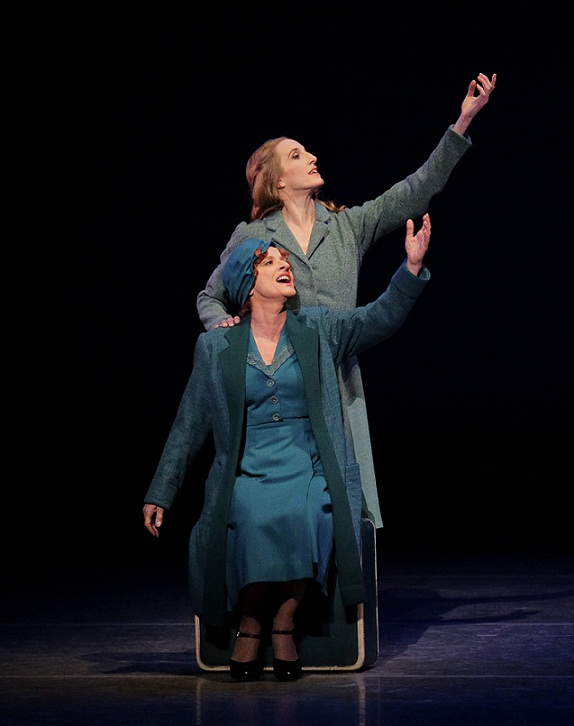
Magnicaballi (above, second photo of Swan Lake, with Zejnati) was one of the most magical, larger than life Lilac Fairies I’ve seen. She reminds me a bit of San Francisco Ballet’s Maria Kochetkova. She was the perfect embodiment of the “fairy godmother” as she blessed baby Aurora with her beautifully eloquent port de bras, countered Carabosse (Nancy Crowley) with a swift but elegant flick of her arm, and she captivated the audience along with the Prince at the end of the Vision scene as she whisked him off to the real Sleeping Beauty.

Ib Andersen has a wonderful company. It’s too bad they don’t have a very long season – they seem only to perform for two or three days every two or three months. They do mainly classical ballet and Balanchine, with some Robbins, and some of Andersen’s own work, which I now really want to see. Fans of NYCB would definitely love this company.

Palm Springs Film Festival, With a Stop at Cabazon

I spent this past weekend with my dad in Palm Springs. He came down with a group and invited me to meet them, which, now that I’m in L.A., was pretty easy. It was the last weekend of the two week-long film festival there, so we caught a few movies. Unfortunately, I wasn’t able to see either of the two dance films showing. One was Pina, by German filmmaker Wim Wenders, a biopic – in 3D – about Pina Bausch, which I know is coming to L.A. and which I definitely plan to see. The other was a Russian movie called My Father Baryshnikov, about a Soviet era student at a strict Russian dance academy who pretends that his father is Baryshnikov. It looks like that one toured the arthouse film circuit in N.Y. in October, but that was my moving month, so no wonder I missed it. Did anyone see it?

But I did see a film that involved dance – namely Allegra Kent. Bert Stern: the Original Madman is a pretty good documentary of the photographer, who is most known for having taken the last pictures ever shot of Marilyn Monroe (for Vogue). He photographed numerous famous women, like Audrey Hepburn, Elizabeth Taylor, Kate Moss, Twiggy – the list goes on and on and on… and Allegra Kent, to whom he was married for a time and with whom he has three children (two of whom were interviewed in the film, along with Kent). He is also, I guess somewhat infamously, known for taking those Marilyn Monroe-esque photos of Lindsey Lohan for New York Magazine a few years ago. Finally – and most interesting to me – he’s also known as a great innovator in advertising for some now iconic photos he took for Smirnoff Vodka, mainly of the Egyptian pyramids, very coolly reflected upside down through a martini glass.

I guess it’s no surprise that Allegra Kent was attracted to him – he came across in the film as a huge womanizer, much like Balanchine. He calls women saints and man their slave. How Balanchine is that! And his womanizing is of course what led to their divorce… He says in the movie that the moment he saw Kent, he thought she would make a wonderful mother, and she did indeed become the mother of his only children. But he didn’t really want the children, he later admits. He didn’t know what to do with children.

He also admits he was greatly drawn to the beauty of the women he photographed, and wanted to have sex with (or “make out with” as he called it) the vast majority of them. But he admits he seldom wanted anything more; he never wanted to marry them, or be more to them than a lover. This is what, he says, made him the photographer he was.

It’s a very honest film. A very straight depiction of a man who seems very shallow emotionally, but was an artistic genius.

Anyway, I tweeted a bit about the film, and one of my friends, who’s a dancer, said he’s reading Allegra Kent’s biography and, according to it, Stern is a horror. I can believe he must have been a horror as a husband. But interestingly Kent says only nice things about him in the film.

It’s really Stern who makes himself look bad regarding Kent. When she confronted him about his relationships with other women, he remembers, he threw it back on her saying she let men (in the form of dancers) touch her all day. When she finally asked for a divorce, he thought how dare she; she couldn’t do that to him.

Their oldest daughter tells the filmmaker (Shannah Laumeister, formerly one of Stern’sĀ  models as well) that she is really a daddy’s girl, and her daughters – still small children – echo her, giggling that they are grandpa’s girls too. But the younger daughter, who also seems very genuine, and a bit more shy than the other daughter, tells Laumeister she never really got along well with her father. She had a bit of a weight problem, though I still thought she was a lovely young woman. But I wonder if that has something to do with her father not getting along well with her, given the way he seemed to think about women.

Anyway, very interesting film and definitely worth seeing if you have the chance. I found Stern to be annoying, shallow, and very unlikeable as a person, and still a genius, an artist and an innovator.

I also saw Haywire, Steven Soderberg’s latest, starring Gina Carano, Ewan McGregor, Michael Douglas, Antonio Banderas, Michael Fassbender, and Channing Tatum. This was almost the complete antithesis of the Bert Stern film. Women here are all powerful but not because of their looks. I loved loved loved this movie! Finally, a female James Bond! And Ms. Carano supposedly did all her own stunts! But I don’t think I will ever stop loving Ewan McGregor, even when he plays the “bad guy.” šŸ™‚ This one’s opening all over the U.S. very soon.

Finally, I saw a Belgian film called The Invader, by visual artist Nicolas Provost. I joked on Twitter that it was one of those European films filled with gratuitous nudity, gorgeous cinematography and no plot whatsoever. A friend from graduate school promptly reminded me via Twitter that those were exactly the kinds of films I used to love (and would make her watch ad nauseam with me). I do still love them! It’s kind of funny though because now that I’m a writer (or trying to become a writer or whatever) I wonder how one pitches that kind of thing…

Seriously, I really enjoyed The Invader – about an African immigrant trying to create a new life for himself in Belgium, and meeting women, and having fantasies (I think) and getting into fights with men who were trying to manipulate him (the outcomes of which may or may not have been fantasies), etc. Beautifully shot, which I guess makes sense since Provost is a visual artist. And the actor playing the main character, Issaka Sawadogo, is absolutely captivating.

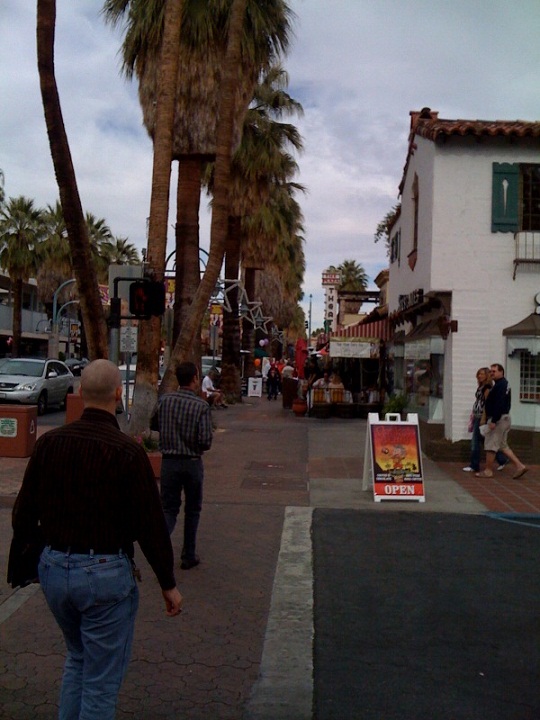
Anyway, Palm Springs itself was really lovely – it was the first time I’ve actually been there, though I’ve driven by many many times on Interstate 10. Here are some photos (it was a bit overcast, so they didn’t come out all that well):

A very popular diner called Sherman’s near the main theater and festival center.

The main street – Palm Canyon Drive.

I was very attracted to this cute little smiley face atop a yogurt restaurant.

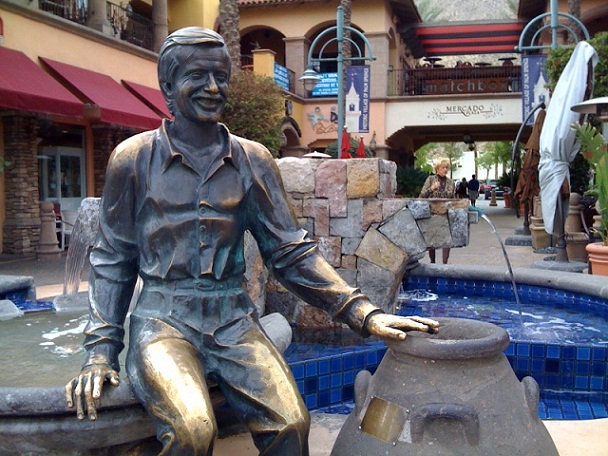
Sonny Bono was the major of Palm Springs. Here is a statue of him on Palm Canyon Drive.

You can tell you’re getting close to Palm Springs when driving on I-10 because you begin to see these modern windmills.

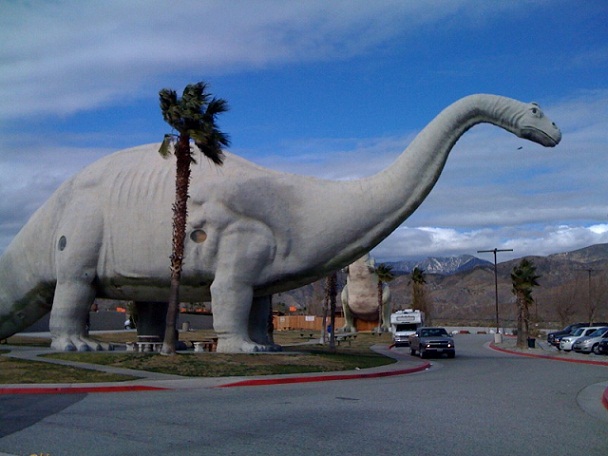
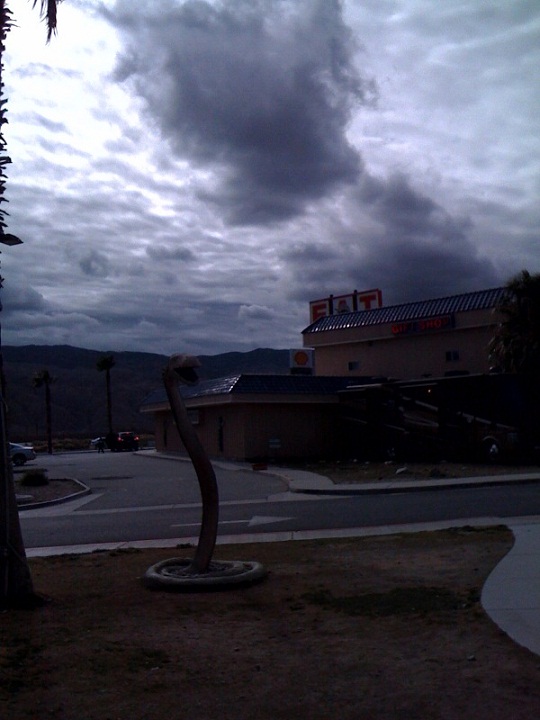
On my way back to L.A., I couldn’t help stopping at Cabazon, a town just west of Palm Springs that boasts the largest dinosaur replicas in the world, designed by Knotts Berry Farm sculptor Claude Bell. I remember Dinny, the apotosaurus above, so fondly as a child. We took many vacations to L.A., Anaheim, or San Diego, and on the drive over from Phoenix, I’d always be on the lookout for him. Whenever I saw him, I knew we were almost there.

Inside Dinny’s belly there’s a little gift shop.

Mr. Rex was built years later, so I don’t remember him. I think he might have scared the wits out of me as a child though.

When I tweeted photos of the dinosaurs, a friend told me they were featured in the movie PeeWee’s Big Adventure, which I haven’t seen.

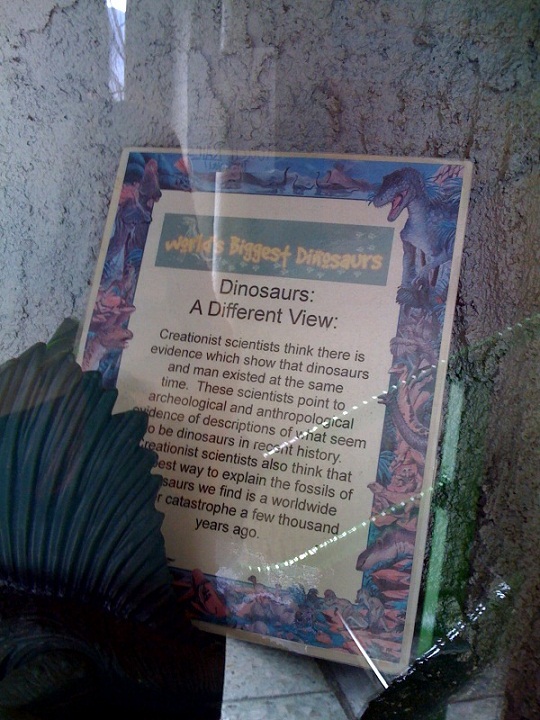
There’s also a creationist museum off to Mr. Rex’s side, which I didn’t have time to visit. A strand of creationism postulates that dinosaurs co-existed with humans.

And there’s a little place to eat in front of Dinny. Ominous-looking clouds, huh? Unbelievably, I didn’t hit any rainstorms on the way back to L.A.

Vladimir Shklyarov: the Marcelo Gomes of the Mariinsky?

I’m usually not a stage door person, but Friday night, after the Mariinsky Ballet’s second-to-last night performing in New York, I decided to follow some friends down into the bowels of the Met. Actually, now that construction has finished down there, it’s not a maze like before; you just take the elevator in front of the gift shop down and you exit onto an open street; mid-way down is the stage door.

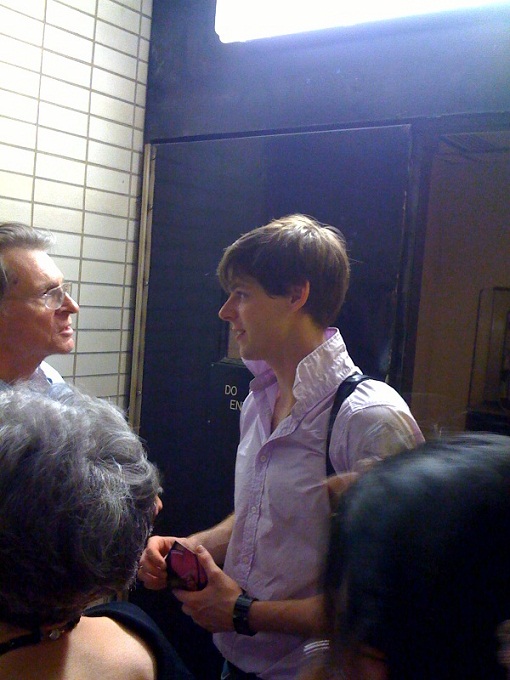
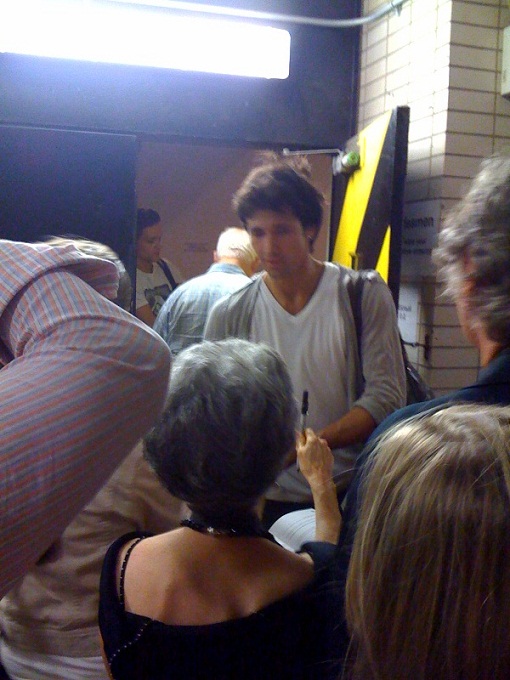
I didn’t actually go to the Friday night performance. I watched the David Michalek slow motion films out on Lincoln Center Plaza (more about that later). But I’d planned to meet ballet-goer friends anyway for late dinner. At the stage door, several of the dancers came out – including our Diana Vishneva, who danced Carmen that night – but everyone (a mix of women, men and teenagers of both sexes) seemed to be waiting for someone in particular. Finally, at the tail end of the string of exiting dancers, he arrived. Vladimir Shklyarov. I knew he was the one everyone was waiting for by the outburst of giggles was followed by a mob-like rushing of the poor guy. Since I hadn’t gone to the performance, I wondered what was so great about him. He seemed like an ordinary guy. He seemed very American. He was wearing his hair in that kind of mussed-up style that is trendy here right now. And he was wearing American style jeans with the low-pockets, suede loafers, and a button-up shirt with the collar up at the top, preppy-like. And when he spoke (at least as much as I heard him),Ā  he seemed to have only a trace of a Russian accent. Seemed like a very nice guy.

The next night I saw him in Balanchine’s Symphony in C, and immediately understood why everyone was going to gaga over him the night before. He only had a small part in the third movement but he stood out so much, he really made that ballet. His jumps are enormous and, more, his personality – that endearing combination of cocky and charming- really shone through, even in the mere ten minutes I saw him dance. How much did I wish I’d seen more of his while the Mariinsky was here??? Well, I’ll know for next time…

Anyway, I found a couple YouTube videos of him:

Other reflections on the Mariinsky’s NY tour: also fell in love with Alina Somova, who danced the Saturday matinee lead in The Little Humpbacked Horse, a fantastical Ratmansky ballet based on a Pyotr Yershov tale. I’ve heard people express dislike of her, but I don’t know what they’re talking about. I absolutely loved her. She’s very flexible and very fast and fluid, so perhaps she can sometimes look a bit like a rubberband. But I loved her lines, and her speed, and her playfulness, and her sweet personality. She made that ballet for me. During lunch after the performance, my friend Art said it depends on what she’s cast in – and this, he thought, was her best. Everyone agreed it suited her. (So fun hanging out between performances with Art, critic Marina Harss, and Emilia from The Ballet Bag! Emilia is originally from Brazil, which I didn’t know šŸ˜€ ) Anyway, I’ll have to see Somova in other things, because from what I saw, I can’t imagine not liking her.

Here’s a video:

And here’s a video of her in Humpbacked, for which, apparently she won an award.

I also found myself smitten with Yevgenia Obraztsova, who seemed really sweet at the stage door as well, and who danced with Shklyarov in Symphony in C. She’s a tiny powerhouse who I imagine would dance well with our Daniil Simkin. She’s very lyrical as well.

I didn’t care much for Ratmansky’s Anna Karenina. (A big thank you to Marie Mockett for giving me her ticket to that by the way!) I have to agree with Sir Alastair on this one. There were some impressive stage theatrics – particularly a rotating train that you see from both outside and in, and some moving images on a background screen that were used to interesting effect – but overall the production didn’t really convey the story. It was more like a series of tableaux than a narrative, which has worked in other productions (a San Francisco Ballet production of an Ibsen play comes to mind) but didn’t work here – maybe because thematically and mood-wise, it was all so one-note: suicide, encroaching death, the aftermath of death, actions leading up to death, etc. But also, I really didn’t find the choreography interesting at all. It was really basic. I mean, many of the lifts were lifts I learned in the ballroom studio for my cabaret routines. You learn all the very basic lifts: the t-lift, the shoulder-sit, the fish, etc. etc. I’d get so annoyed with my teachers for not being more artistic, for not being able to come up with creative partnering that was more evocative of the story or mood we were trying to convey. That’s one reason I left ballroom – I got bored. So I feel like when I see those same basic lifts in ballets created by supposed choreographic greats and produced all over the world, I feel like I’m in the Twilight Zone. This is why I love MacMillan so. None of his partnering is something you’d learn in a studio lesson – it’s specific to the story and characters.

I also wasn’t too enthralled with the Mariinsky’s Carmen Suite, choreographed by Alberto Alonso. There was a big round mat in the middle of the stage where the dancing – most of it by Carmen alone, some of her dancing duets with men – took place. There were chairs setting on a raised platform that encircled the mat, and the men sat on the chairs and watched her. My Carmen was Ulyana Lopatkina (who was also my Anna Karenina), and her dancing to me looked, in Carmen, very gymnastic. But I think it was the way the stage was set up – it looked like a gymnastic mat – and she kept doing these standing poses that reminded me of a gymnast about to take off in a tumbling pass during a floor routine. It was another ballet that didn’t focus so much on recounting a narrative than creating a feeling, a tone, through vignettes. It worked a little better here than in Karenina, maybe because it was a shorter piece, but I think the gymnastic thing, and the overall creepiness of the men sitting in their chairs just watching her, didn’t really work for me.

Favorites were definitely Little Humpbacked Horse and Symphony in C.

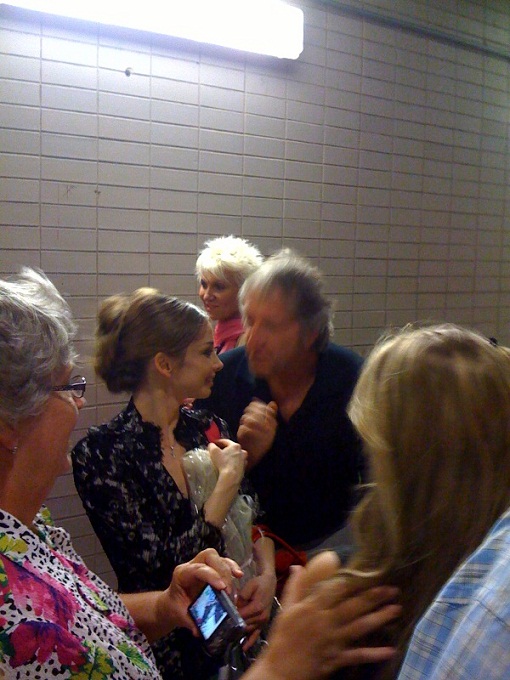
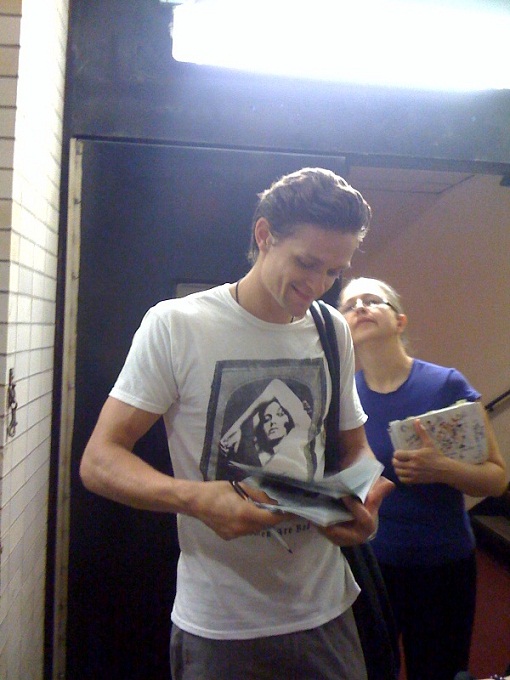
Here are a few more stage door photos:

Yevgenia Obraztsova.

Yuri Smekalov.

Danila Korsuntsev.

And princess Diana, who is even more beautiful up close than she appears onstage.

Wish now I’d have gone every night. Trip to St. Petersburg… šŸ™‚

More VIENNA WALTZES


Here are some photos of the most recent cast of Balanchine’s Vienna Waltzes that debuted at New York City Ballet last week. Top photo is of the radiant Sara Mearns, who had the main role in the final part of the ballet – “Der Rosenkavalier” – as the girl sweetly lost in her dreams during a moment alone in the ballroom. Bottom photo is of fairy-tale princely Tyler Angle dancing with Teresa Reichlen, from the first part of the ballet, the two young lovers waltz-frolicking in the woods. Both photos are by Paul Kolnik.


American Ballet Theater Spring 2011 Opening Night Gala

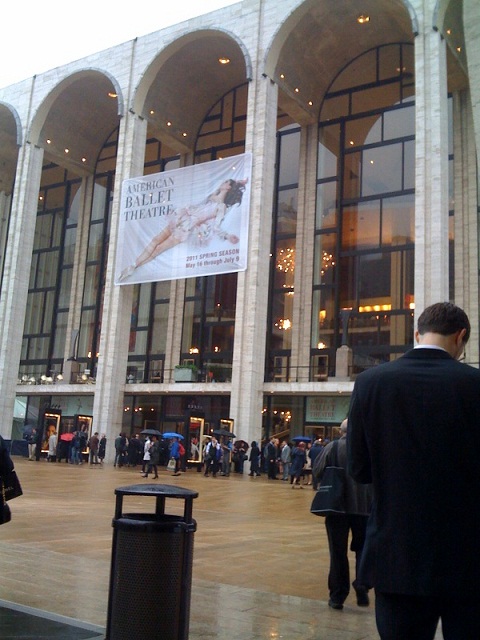
Last night was ABT’s Spring 2011 opening night gala. Dreary, rainy night … but what else is new for New York these days?

Once inside, I really enjoyed the show though. (I’m hoping to receive photos soon, which I’ll post). The program began with a short preview of Ratmansky’s The Bright Stream, which I’m excited to see next week. Seems to have a lot of humor, some bravura dancing, a cute storyline.


(Photo: The Bolshoi’s production of Bright Stream; Natalia Osipova is jete-ing).

Then, there were introductions by Rachel Moore, executive director of ABT, wearing a beautiful green dress, and Kevin McKenzie (AD), followed by Caroline Kennedy, who introduced the students of the Jacqueline Kennedy Onassis School of American Ballet as they danced a world premiere, Karelia March, by Raymond Lukens. The program says the students are Level 7, which must be the highest level, because some of those dancers looked like ABT principals. I’m not kidding, I swear. They really amazed me. That school is doing incredible things!

Next was Balanchine’s Tchaikovsky Pas de Deux, danced by David Hallberg and Gillian Murphy. Everytime I see David dance I think he must be the most perfect male dancer in the world. Gillian was stunning too.

Then came the Grand Pas de Deux from Ratmansky’s new Nutcracker, danced by Marcelo Gomes and Veronika Part. (No, they’re not performing that ballet during the Met season, but there seemed to be a few excerpts in the program from ballets they’re not performing). I missed seeing this couple – overall still my favorite – when the company premiered Ratmansky’s version in December. They were so sweet. Veronika danced with such wonderment in her eyes, such joy. And Marcelo was her perfect, adoring cavalier, all eyes on her. I don’t have kids, but I’d think they’re the perfect wedding couple to wow very young audiences.

Then came Majisimo, a classical ballet piece with Spanish flourishes created by Georges Garcia for the Ballet Nacional de Cuba in 1965 and set to Jules Massenet’s Le Cid. This piece was mainly meant to highlight Jose Manuel Carreno, who of course retires from ABT later this season. But it was really a dance for eight couples, and he danced only the male part of one of them – there were very few solos. He danced with Paloma Herrera. Xiomara Reyes was paired with Reyneris Reyes, guesting from Miami City Ballet. The other couples were comprised of Cuban dancers guesting from other companies as well: Lorena Feijoo and Joan Boada from San Francisco Ballet, and Lorna Feijoo and Nelson Madrigal from Boston Ballet. The dancers were spectacular, but I didn’t think that much of the choreography, which reminded me of a more bland version of an ensemble scene from Don Quixote. Jose had a series of turning jumps, and a really beautiful multiple pirouette that wowed the audience – drawing those turns out are what he’s most known for. And Xiomara really took my breath away with this crazy fast series of traveling turns in a diagonal down the stage. I’ve never seen her dance like that!


(Photo: Jose Carreno dancing with Polina Semionova in Diana e Acteon)

After intermission came two pas de deux from Swan Lake. A Twitter follower asked me why they needed to perform two scenes from the same ballet. I think that ABT, same as everyone else, is just trying to benefit from the Black Swan craze. They should have had Sarah Lane dance one of the pdd though! šŸ˜€ Anyway, first pas de deux – White Swan- was Paloma Herrera and Alexandre Hammoudi, which was good. But the second – the Black Swan – I found surprisingly magnificent! It was danced by Michele Wiles and Cory Stearns. There have been so many guest stars from Europe lately gracing ABT’s stage, I’d forgotten how perfect an Odile Michele Wiles is. And Cory really impressed me as well. Whatever he may lack in dance ability (I can’t imagine he’ll ever be a David Hallberg or Marcelo Gomes), he more than makes up for in acting and stage presence. He’s really good at bringing you into the world of the ballet and creating a character you can sympathize with.

Sandwiched in between the two SLs was Jessica Lang’s Splendid Isolation III, danced by Irina Dvorovenko and Maxim Beloserkovsky. I joked on Twitter that Max earned the hot guy of the night award for that, but seriously – he did! Irina was really beautiful as well. And her party dress, which she came out in for the final stage bow, was, as usual, gorgeous. She has such impeccable fashion taste, imo.


Following that was the highlight of the night, for me – Diana Vishneva and Marcelo Gomes in the Act I pdd from Manon. Such a perfectly choreographed pas de deux – beautifully romantic and full of love / lust but with so many breathtaking but capriciously executed, dangerous-looking lifts you sense something out of control. As beautiful as it is, this story isn’t going to have a happy ending. I am liking Diana Vishneva more and more. I’ve always thought she was a great dancer but she always seemed to play too much to the audience for the story ballets. She didn’t take me into the world of the character as much as I want an actor to. But the last two seasons she’s been doing just that: really developing the character and dancing to her partner – Marcelo here and in Lady of the Camellias last season, which is the first time she really blew me away – instead of the audience. This – the Manon pdd – was the audience favorite last night as well. The two got a storm of whoots and bravos at their curtain call, and practically had a standing ovation the audience was so loud in their applause. “So beautiful,” exclaimed the woman beside me. “Okay, we can go home now,” she joked.


(Couldn’t find a photo of Diana and Marcelo, but here is Diana dancing Manon with Manuel Legris. With all photos I post now, I’m linking to the original site via a click on the photo.)

Here are Marcelo and Diana in Lady of the Camellias:


Then, Alina Cojocaru, one of the European guest artists this season, danced the Rose Adagio from Sleeping Beauty. I’m not a huge fan of this ballet in general, but she was lovely. Patrick Ogle replaced Sascha Radetsky as one of the cavaliers.

Second to last was the Act II pdd from Lady of the Camellias danced by Julie Kent and Cory Stearns. Again, Cory did a very good acting job – and physically he fits the character perfectly, as Julie does hers, but I think some of those lifts are so difficult-looking… I just worry about the dancers. Isn’t that how Roberto Bolle got hurt last season – performing this role?

And the evening ended with another ensemble excerpt from Ratmansky’s Bright Stream. People who stood out most to me were Daniil Simkin and, again, Xiomara Reyes. I really am excited to see this ballet.

Tonight Don Quixote begins and runs through the beginning of next week. I’m excited to see Alina Cojocaru dance with Jose Carreno on Friday night, and Russian ballerina Polina Semionova guesting in the Saturday matinee with David Hallberg.

NYCB Spring Gala with SEVEN DEADLY SINS Premiere

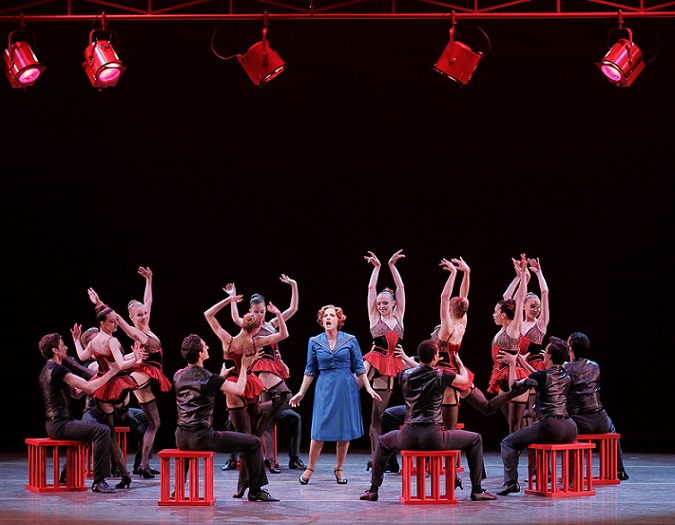
Here are some photos, all by Paul Kolnik, of Lynne Taylor-Corbett’s play-ballet, The Seven Deadly Sins, which premiered last night at New York City Ballet’s Spring gala performance. Above is Patti LuPone, who guest-starred with the company (performing the singing role of course!) and Wendy Whelan, who danced the lead. The top photo is from the “Prologue” of the play-ballet (or ballet chante as the program calls it).

This is from the second part: “Pride”: Patti LuPone and cabaret dancer ensemble.

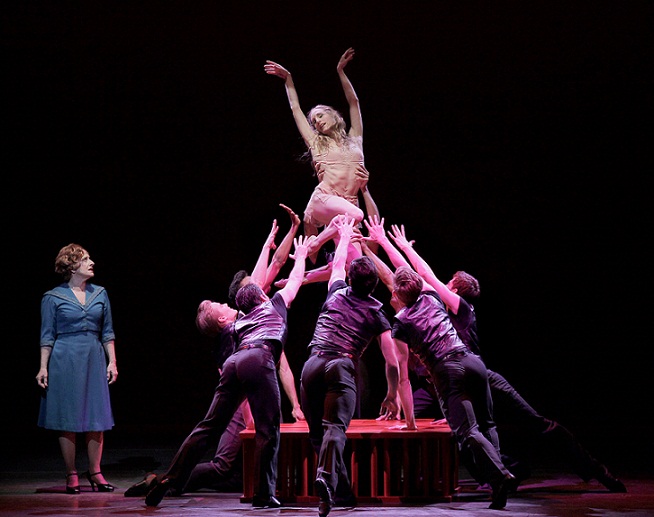
Also from “Pride.” Wendy Whelan is in the middle.

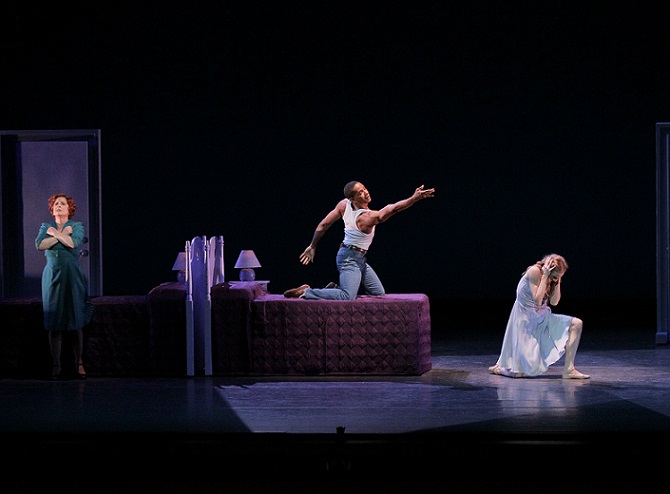
And this is from sixth part, “Lust,” probably my favorite over all. Craig Hall and Wendy Whelan are the dancers in the photo. Craig Hall and Sara Mearns (who danced the role of “Latina Diva” in the “Anger” section, and who I don’t have a picture of unfortunately), most stood out to me, as well as Vincent Paradiso as the Count in the “Greed” section. I think those dancers most stood out – at least Mearns and Paradiso – because they seem to have some kind of acting training. Maybe they don’t, maybe they’re just natural actor-types, but the more actor-ly you are, I think the easier this kind of role would be. Wendy Whelan said in an interview with Roslyn Sulcas in the New York Times that she was used to expressing herself with her body and her lines, that she was used to Balanchine’s dictum “don’t act, don’t think, just dance,” and that she found this kind of role challenging. As much of a NYCB star as she is, and as stunning as she is in Wheeldon and Balanchine’s more modern, angular-lined ballets, I just wonder if she was mis-cast for something like this.

Which isn’t to say that she didn’t dance very well last night. She danced a really beautiful pas de deux with Craig Hall, which is what made “Lust” my favorite section. And LuPone sang in a gorgeously powerful voice. The dancing was all superb. But something just didn’t work to me.

Balanchine choreographed the original Seven Deadly Sins, set to libretto and score by Bertolt Brecht and Kurt Weill, in 1933. The Balanchine version was revived in 1958. According to the Times article linked to above, both the original version and revivals received very good reviews. Since the Balanchine version appears to be largely lost now, and Peter Martins wanted to revive the ballet, he commissioned new choreography from Taylor-Corbett.

Maybe it was that the new choreography didn’t really express the story, which follows Anna, a woman whose various life experiences each represent one of the sins. It wasn’t really a full story, but one composed of scenes, each of which dramatized a sin (and LuPone and Whelan portray different aspects of Anna). But, I didn’t feel the scenes always worked well at doing that. For example, in my favorite section, “Lust,” I thought the Hall/Whelan bedroom scene was really beautiful, very romantic, but nothing said lust, as in sinful lust, to me. I almost felt like Whelan’s Anna had a loveless relationship with her husband, danced by Allen Peiffer, and she was really in love with Hall, and her leaving her husband and running into Hall’s arms was an urgently needed escape.

In my other favorite section, “Anger,” Sara Mearns is a kind of sexy, but rather humorously so, Copacabana dancer. She gets angry at Whelan’s Anna for something – I’m not quite sure what – maybe Anna stole her lover or took over Mearns’ role as head diva, drawing too much attention to herself…Ā  Anyway, Mearns twists her face into a look of utter anger, then points at Whelan, who runs off crying and is then stripped down to her underwear by a group of men. But I thought it was done rather cartoonishly. So it was more funny and cute to me than a dramatic representation of the tragic consequences of anger.

In the “Greed” section, a count and a senator vie for something and end up in a duel, both of them getting killed. But it didn’t have any tragedy or pathos to me. Instead, it felt a bit like Balanchine’s Slaughter on Tenth, which made me want to giggle – probably the fact that it was Paradiso playing the role of the Count.

I don’t know. I guess I was expecting something with more tragedy and pathos and weight, and I felt like I saw a version of Slaughter on Tenth but without a through story-line. Maybe that was the intent. I’m going to see it again over the weekend, and maybe my opinion will change.

Did anyone else see it yet? I’m interested to hear what others think. Has anyone seen the Balanchine version?

After intermission,

— here’s my photo of the promenade – Balanchine’s Vienna Waltzes was performed beautifully.

Photo by Paul Kolnik.

All of the dancers were very good, but I particularly liked Megan Fairchild and Joaquin DeLuz in the fast-footed, playful scene in the forest, “Fruhlingsstimmen,” and Maria Kowroski and Charles Askegard in the last, beautifully ballroom-y section, “Der Rosenkavalier.”

NYCB Opens its Spring 2011 Season with “Balanchine: Black & White”


Photo from 2004 of Wendy Whelan and Jock Soto in Balanchine’s Agon, by Paul Kolnik.

Last night New York City Ballet opened its Spring season with three Balanchine “leotard” or “black and white” ballets (so-called because of the costumes). I have very little time to write because I’m off for a short trip to Phoenix later today. But I’ll just say, all the dancers looked very refreshed, in tiptop shape, and everyone danced very well and with lots of expression.

First on – and the highlight of the evening to me – was Square Dance, which I haven’t seen a huge number of times but which is really growing on me. The leads were Megan Fairchild and Anthony Huxley, who is really growing on me as well. He reminds me a bit of Alex Wong, except he’s more lyrical and it’s a little less about the stunning feats with him, though he is a very good dancer and I’m sure can do the stunning feats! His difficult-looking often flexed-footed solo was mesmerizing. He was even mesmerizing when he just stood off-center and watched Fairchild do her solo, the way he’d look at her, at times longingly, at times in awe. Megan danced with a lot of joy as well – all dancers were very emotionally compelling in this. And I’m not the only one who thought so – the audience really went crazy with applause after this dance.


Next on was Agon. The main couples were Wendy Whelan and Sebastien Marcovici, Teresa Reichlen and Andrew Veyette, Ashley Laracey and Amar Ramasar, and Amanda Hankes and Craig Hall. Andrew Veyette (above, photo by Paul Kolnik) really stood out to me in this. I think he is well-suited to all the angular lines so pronounced in these leotard ballets. Wendy Whelan and Sebastien Marcovici had a couple very minor flubs. During intermission, the little group of balletomanes I hang out with were reminiscing about how stunning she was when she used to dance this part with Jock Soto (which is why I posted the top picture). I really wish I could have seen that. It looks stunning from the picture.

The evening ended with Stravinsky Violin Concerto; leads were Maria Kowroski and Amar Ramasar, and Sterling Hyltin and Ask LaCour.Ā  I always like this ballet and I always look for my favorite part – where, in the third section, Aria II, the man stands over the woman and turns her around and around, like a barrel. I think I’ve seen Robert Fairchild do it only once, but it was the first time I ever saw the ballet and now, to me, he owns that role and no one can do it like him. I thought of that when my intermission friends were reminiscing about their favorite dancers from the past and how differently they looked doing these black and white ballets – how much more precision there used to be – and it’s funny because Robert Fairchild is obviously not the first dancer to dance my favorite part but he’ll always define it to me. The first dancer, or the first set of dancers, that you see in a role or a dance will definitely leave an indelible impression. But someday I still very much would like to see the original Balanchine dancers in these ballets.

Anyway, this was opening night, but there was no red carpet since NYCB has their gala next week, on Wednesday – when the Patti LuPone collaboration will premiere!

Okay, I’m off to the land of lizards and gila monsters and sun and 99-degree temperatures! Assuming I’m able to finish packing…

Moonlight on the Beach

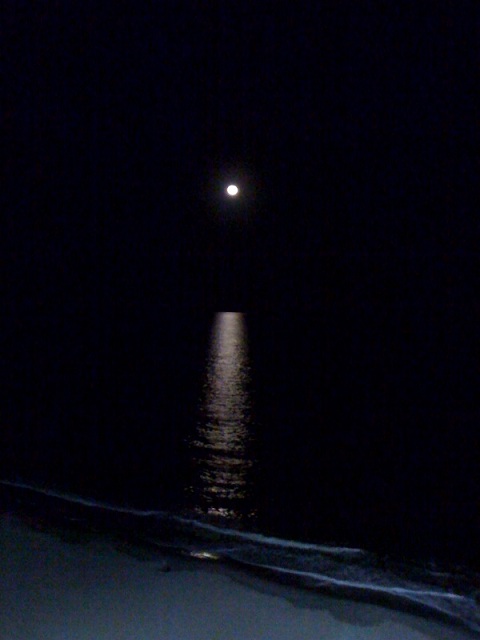
Happy President’s Day everyone! I’m spending the week in South Carolina at my cousin’s timeshare – I needed a few days away from New York and the ocean isĀ  my favorite place. (If I ever have money, I’m definitely buying a beach house somewhere.Ā  I could never be one of those New Yorkers who buys a country home up in the mountains. I don’t understand those people. Who wants to risk a run-in with a bear or coyote or jaguar? Not to mention deal with permanently cold temperatures…) Anyway, the light from last night’s full moon on the ocean was gorgeous. My iPhone is not so good at taking pictures at night, so you’ll have to take my word for it šŸ™‚

The condo’s wireless connection is a bit off and on, plus, it’s unexpectedly nice weather here – 71 degrees today, plus I’m supposed to be working on my novel, so I don’t know how much time I’ll have to blog. But here are a few items of interest:

Roberto Bolle makes his Hollywood debut;

John Epperson talks about his role as “Jaded Piano Player” in Black Swan; and

Our friend Benjamin Millepied is now getting hounded by the tabloids for working too hard and not paying enough attention to Ms. Portman

Also, here are some photos I just received of the magnificent Sara Mearns debuting as the Siren (opposite Sean Suozzi) in Balanchine’s Prodigal Son a couple weeks ago at NYCB:


Finally, if you haven’t seen Natalia Osipova dance yet, next Sunday, March 6th, will be your chance. She’ll be dancing Kitri in Don Quixote with the Bolshoi, in a performance that will be live-streamed direct from Moscow via Emerging Pictures’ Ballet in Cinema series. NY performance time is 11:00 a.m., at the Manhattan Big Theater, and she’ll be dancing opposite Ivan Vasliev. This is the role that made her famous, and she owns it, so try not to miss it if it’s showing at a theater near you. Check Emerging Pictures’ website for times and locations.

Okay, that’s all for now. Happy holiday everyone!

Last Week at New York City Ballet


Last week I went to two performances of NYCB – opening night and Thursday night’s “See the Music” program – and to two of the free all-day Balanchine events on Saturday. First, I’ll talk about the last two since I found them so informative. The free studio talk on Saturday afternoon – Balanchine’s birthday – was moderated by Sean Lavery (former NYCB principal dancer, now ballet master), and included Sterling Hyltin (in Paul Kolnik photo above with Robert Fairchild), Chase Finlay, and Jenifer Ringer. Lavery asked the dancers to talk about their first Balanchine ballets, their favorites, and what drew them to NYCB. Hyltin named as her favorite Duo Concertant (pictured above) which I’d just seen her dance on opening night. She said she liked the syncopated movement, the he goes and I go kind of back and forth movement conversation with her partner, and with the musicians. I really liked it too. The violinist and pianist are onstage (the music is Stravinsky), and I like the interaction between the dancers and the musicians, and between the two dancers, and I like the sharp, angular movement. She seemed particularly animated when I saw it. I love Robert Fairchild and think he’s such a sharp, masculine mover with a presence that commands your attention without meaning to – he kind of reminds me of a less cocky Ethan Stiefel – but she seemed so happy to be dancing this piece that she stood out to me more. It was nice to hear her talk about it.

But what I really loved was the School of American Ballet class taught by Peter Martins. He interacted cutely with the students, particularly “Cyrus,” (at least I think that was his name…) a tall, long-limbed young man who I think will soon be in the company. Cyrus didn’t always do everything perfectly (at least in Martins’s eyes) but he had a charming presence and a great leading-man physique and you can tell he works hard.

Martins had the class demonstrate ballet basics – beginning with the five positions, and they showed us a perfect fifth position (with the toes of the front foot touching the heel of the other and vice versa). More interestingly, he had the class show us the difference between a Balanchine hand and a classical ballet hand. I’d always noticed there was a difference but couldn’t figure it out exactly. God gave us five fingers, Balanchine had said, so we shouldn’t hide two of them. The Balanchine hand shows all five fingers, the classical ballet one only three (with the ring finger and pinky held so that they are hidden from view behind the middle finger).

Martins also had the students show us how Balanchine’s fourth position differed from others’. In Balanchine’s the back leg is straight; in all others’ the back leg is bent. Martins didn’t go into any functional explanation for this – just said “here, we think it looks better.” But I thought about it and thought, wow, it must be hard to take off in a jump for example with the back leg straight. And then I realized that’s partly why Balanchine’s choreography always looks so fluid, like one step leading right into another, without a lot of stopping to build up to a big athletic feat – a big jump or series of turns. Other companies – like the Russians, like the Bolshoi – are all about preparing so that you can do something astounding. So they’re all about the building up.

This was mentioned in the studio talk as well. Lavery also talked about how fluid Balanchine’s movement was, and how, for example, in a lift, a guy would pick up a girl, then take two steps, and put her down rather than walk all over stage with her hoisted above his head. Balanchine wanted her to come up, then down right again, because that was more fluid, rather than have her head bobbing around up there while the guy was running all around with her.

Martins also demonstrated the bows. At City Ballet, he said, we just do them as such, and the girls did a little curtsy with the back leg slightly bent, without going down on one knee. Making fun of the dramatic Swan Lake bows, Martins went all the way down on one knee, exclaiming, “Yes, yes, I know I’m good!!!” while putting his head down, forehead nearly touching the floor, and raising his arms up in back of him like wings, fingers pointed toward the ceiling. It was hilarious.

Anyway, here are a couple more photos of opening night:


Above: Ashley Bouder in Valse-Fantaisie, and below, the cast, including Andrew Veyette, in the same (all photos by Paul Kolnik)


I liked Balanchine’s Valse-Fantaisie (Veyette replaced Joaquin DeLuz – but don’t know why because DeLuz danced Concerto DSCH two nights later) but I really loved the first of the evening, Walpurgisnacht Ballet. I’d never seen Walpurgisnacht before and it’s funny but I always seem to love the Balanchine ballets that are the least often performed. This was really beautiful. It’s from Gounod’s Faust, and features a group of women (and only one man – here Charles Askegard) in deep red dresses, their hair down in the second half as the music increases in tempo so that there’s almost kind of a hedonistic madness in the mood – and the footwork is so intensely complicated and fast fast fast. Wendy Whelan even made a tiny little flub, which I’ve never seen her do before. Crazy! And breathtaking!

And the evening ended with The Four Temperaments. I’ve said before and I’ll complain again that I still don’t understand why everyone goes on about how brilliant this one is. To me, there are supposed to be four temperaments, and the ballet is divided accordingly into four variations after the theme: melancholic, sanguinic, phlegmatic, and choleric. But they all seem to be the same to me. The dance seems one-note throughout so that after the first variation, I’m waiting for it to end. I’ll keep seeing it though, perhaps performed by a variety of companies if I have the chance, and will keep looking for the nuances…

“See the Music” night opened with Faycal Karoui’s discussion of Mozartiana, Tchaikovsky’s homage to / riff on Mozart, which made me appreciate Tchaikovsky even more. Then that piece was danced – by Maria Kowroski, Daniel Ulbricht, and Tyler Angle. Tyler stood out to me. As always, he dances with so much meaning, so much intention, and so much expansiveness. He’s a really beautiful dancer.

Then came Ratmansky’s Concerto DSCH, danced by Wendy Whelan, Ashley Bouder, Joaquin DeLuz, Andrew Veyette (replacing this time Gonzalo Garcia), and Benjamin Millepied. Oh, Natalie Portman was there, albeit late – she came in with a friend after Karoui’s lecture and right before Mozartiana was performed. Then, she left right after Concerto DSCH, after Millepied was done performing, and before the last piece. I thought it was a shame she missed Sara Mearns in the last dance, but a Twitter friend said she had a movie premiere that night, so I guess she needed to leave early for that.

Anyway, as usual, Millepied did not stand out to me, and I couldn’t stop thinking of seeing Tyler Angle in that role before and the way he lunges romantically toward the main girl, making it clear how much he yearns for her. Millepied’s knees nearly touch the ground in his deep steps toward her and it just looks like a dance step, not like anything evoking a specific emotion. As always I loved Bouder and DeLuz in the fast, playfully firtatious three-some part. I missed Garcia – where is he? I hope not injured! – but thought Veyette did a fine job in his stead.

And the evening ended brilliantly with Sara Mearns and Charles Askegard dancing the ballet leads in Balanchine’s Cortege Hongrois, while Rebecca Krohn and Sean Suozzi just as brilliantly danced the folksy Hungarian leads. I really love that dance and it made me all the more eager to see Mearns in Swan Lake!

On both nights, I went with my friend, author Maria Mutsuki Mockett. She writes an author blog but has been attending the ballet much more frequently and is now blogging a lot about ballet as well. She’s an excellent writer, so please check out her blog!

Imagine Edward Gorey in Fur Coat and Sneakers, Nightly, at NYCB

I met this writer, A.N. Devers, at a party last week, and when she enthused about a piece she wrote recently for the Paris Review about a favorite writer of hers, the late Edward Gorey (in photo above, from Squidoo) and his fur coat collection, I made a mental note to find it on the web. I’d forgotten, but just remembered to look for it this morning. It’s a sweet piece about her attending a recent auction of his furs where she was determined to hold her own amongst the seriously seasoned bidders and, despite her comparably meager bank account, get herself a coat.

She also mentions that Gorey (who was best known as an illustrator) often attended New York City Ballet – decked out in fur coat and Converse sneakers. This was during the 70s, when, according to some quick internet research I did, he was well known at the ballet, was quite the eccentric, and knew Balanchine. He even wrote and illustrated a book about NYCB, The Lavender Leotard.

(top image from the Winger, bottom two from StoryCulture)

Actually, he wrote a couple books about the ballet.

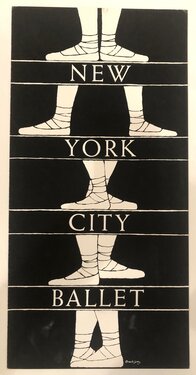
He also created a poster:

(image from Chisholm online gallery)

He supposedly so loved NYCB he was there every night. He must have been quite the figure in those full-length furs and tennis shoes. Kind of sounds like something out of a Jonathan Ames novel. But this was all in the 70s. Sometimes I really feel like I’m in NYC in the wrong era

Anyway, just found all this interesting and thought I’d share. Is there anyone here who remembers him?

Is Ballet A Dying Art?


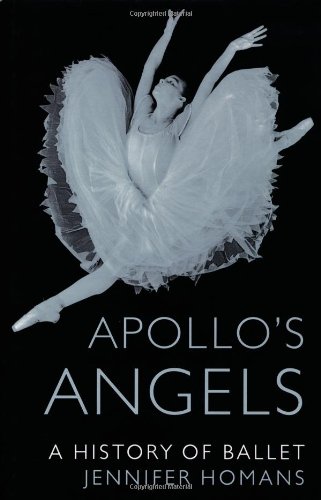
I must confess I haven’t yet read Jennifer Homans’ acclaimed but controversial history of ballet, Apollo’s Angels. I’m working hard on my second novel and have been knee deep in prison and cop memoirs and haven’t had time for much outside reading. I hope to read it soon though.

In the meantime, I have read some of the reviews, including Laura Jacobs’ in the WSJ and Toni Bentley’s in the NY Times. The two reviews focus on very different aspects of the book so it’s interesting to read both of them. Bentley says Homans is best on Balanchine (both Bentley and Homans danced with him). But Jacobs find the earlier sections enlightening as well.

The controversial aspects of the book seem to be toward the end when Homans argues that, for various reason (but according to Bentley many of them being that Balanchine has passed and his legacy is not being kept alive), ballet is a dying art.

I don’t want to go on too much since I haven’t yet read the book, but I will say that ballet seems to be alive and well in many European and Latin American countries. I do notice a real influx of visitors to my blog whenever the big European stars perform with ABT. I don’t think Roberto Bolle, Alina Cojocaru and Natalia Osipova fans think ballet is dying and certainly not because Balanchine is no longer with us. Ballet may be less popular in this country since the Baryshnikov era passed though, and it remains to be seen whether movies like Mao’s Last Dancer and Black Swan can do anything to revive it. I’m doubtful but want to be hopeful. I think it’s more likely that Natalie Portman marrying Benjamin Millepied will draw audiences to ballet than the actual movie will.

But then I recently ran across this interview with Homans over at the Ballet Bag, a London blog. At the beginning of the post, the writers say audiences there have been dwindling a bit and they’re worried about the future of the art form as well. Which scares me.

Anyway, has anyone read the book?

Another thing I wanted to call attention to is the book cover. The top one is the British cover, the second the American. Which do you guys like better, and think will sell more books? Just about every single time I see a European cover beside an American cover, I like the European better. But maybe it’s just me.

SLSG’s Dance Highlights of 2010

Instead of trying to remember which were my favorite performances of the year, I’m just going back through my blog archives from January of this year and linking to the most memorable posts. More fun that way! A lot happened in a year…

January

Pacific Northwest Ballet made their debut at the Joyce; it was my first time seeing them live.

The Post‘s Page 6 announced that you know who and you know who are dating, and the ridiculous homewrecker attacks began.

Baryshnikov and Annie Liebovitz starred in a very cool Louis Vuitton ad.

February

I totally fell for New York City Ballet’s Sleeping Beauty.

…and Mark Sanchez šŸ™‚

I found myself quoted in Colin Jarman’s book, Dancing With the Quotes.

I also fell for Sara Mearns’s Odette in Peter Martins’s Swan Lake.

On a personal note, my former judge, the esteemed Honorable Sylvia Pressler, passed away.

The Kings of Dance came to town.

Morphoses shocked the ballet world by announcing that Christopher Wheeldon was leaving the company.
March

My friend’s organization, Art for Change, held a benefit for Haiti after the earthquake.

Rasta Thomas’s Bad Boys of Dance announced that Danny Tidwell and SYTYCD’s Jacob Karr were joining the company.
Corella Ballet Castilla y Leon finally made their NYC debut!

I found myself actually getting press for liking Kate Gosselin – or for not hating Kate Gosselin rather – on Dancing With the Stars.

I fell for Keigwin + Company’s Runaway.

I was delighted to receive an email from NYCB ballerina Yvonne Borree’s aunt regarding of all things, my novel.

April

I had my first experience as a dance writer panelist! Thank you, Marc, from TenduTV!

Tiler Peck appeared on Dancing With the Stars in a Travis Wall routine, which everyone was so excited about. But it ended up amounting to not a whole lot…

Roberto Bolle danced a naked Giselle, in Italy of course.

May

New York City Ballet opened their spring season with premieres of Millepied’s Why Am I Not Where You Are and Ratmansky’s Namouna, both of which I liked, though Ratmansky’s had to grow a bit on me.

Baryshnikov returned to the stage.

I greatly enjoyed ABT’s new production, Lady of the Camellias, though most critics panned it.

June

ABT celebrated Alicia Alonso’s 90th birthday with three all-star Latin American casts (plus Natalia Osipova) dancing in Don Quixote.

Yvonne Borree gave her farewell performance at NYCB.

Bill T. Jones won a Tony for best choreographer for Fela!

Philip Neal gave his farewell performance at NYCB.

Natalia Osipova was mugged right outside of Lincoln Center.

Two of the greatest ballerinas in Europe – Osipova, and Alina Cojocaru – gave back to back Sleeping Beauty performances at ABT.

Albert Evans gave his farewell performance at NYCB.

Tap great Savion Glover made headlines by voicing his annoyance with Alastair Macaulay’s NY Times criticism of him – onstage, during a show.

Conductor Maurice Kaplow gave his farewell performance with NYCB.

Darci Kistler officially ended the era of the Balanchine-trained dancer with her farewell performance with NYCB.

July

Carlos Acosta announced his retirement from ballet and his foray into modern dance.

Alex Wong, probably the second greatest contestant ever on SYTYCD was injured and unable to finish the show.

My friend, Taylor Gordon, was profiled as a freelance ballet dancer in a New York Times article šŸ™‚

Alvin Ailey American Dance Theater’s beloved Denise Jefferson passed away.

Nilas Martins retired from NYCB oddly sans fanfare, sans criticism, sans a performance.

August

I interviewed tWitch about his role in the movie Step It Up. Fun fun interview!

I had a blast covering Ailey Camp.

I nearly fell over when Wendy Perron, esteemed E-I-C of Dance Magazine recommended Swallow on Twitter!

September

NYCB began their excellent “See the Music” series.

October

I loved Ashley Bouder’s Serenade.

Emerging Pictures’s awesomely exciting Ballet in Cinema series began with the Bolshoi’s Flames of Paris.

This cool new Lincoln Center-area street art sprouted up.

One of my favorite posts of the year, though it received no comments, was about Anne Fortier’s novel, Juliet. I jokingly daydreamed about it being made into a film, and which of my favorite ballet stars might take the lead.

November

ABT made an historic visit to Cuba and oh how I wished I could have gone with them.

I think I was the only person in the entire dance world to sympathize with Bristol Palin on Dancing With the Stars.

I had a blast covering New York So You Think You Can Dance auditions.

All of a sudden Black Swan was everywhere.

Nearly fell over again upon hearing Riccardo Cocchi and Yulia Zagoruychenko took the world Latin ballroom title – making them the first U.S. couple ever to do so.

December

My take on SugarPlumpGate.

Black Swan finally premiered which I didn’t love but was happy to have ballet brought back into the spotlight.

I was in awe of Alvin Ailey’s 50-dancer Revelations, staged in honor of the 50th anniversary of that dance. I also loved several other dances in their City Center season – Ailey’s Cry, Ronald K. Brown’s Dancing Spirit, and Geoffrey Holder’s The Prodigal Prince – just to name a few.

Robert Wilson / Roberto Bolle’s Perchance to Dream exhibit in Chelsea was a lot o’ frightening fun.

ABT’s new Nutcracker premiered, which I really enjoyed, almost as much as the Bolshoi’s.

Portman and Millepied revealed they are now engaged and expecting.

I had great fun, despite the crazy snowstorm, going down to Wall Street and covering Judith Jamison’s ringing of the closing bell at the NYSE.

Pretty busy year.

Happy New Year, everyone!