
American Ballet Theater’s Original New Nutcracker


More photos coming soon. This one (of Gillian Murphy and Catherine Hurlin as the two versions of Clara) is taken from culture.wnyc.org.

Last night was the official opening of ABT’s much awaited new Ratmansky-choreographed Nutcracker at BAM. I loved almost every single second of it. I’ve only seen about six different versions of this ballet, but this one to me seems most original. It’s very entertaining, very humorous at points, and can somehow maintain the attentions of small children while being clever and witty – and beautiful – for adults. It’s very theatrical and it’s not as “dancy” as the one I just saw from the Bolshoi (Grigorovich’s version)- there’s more non-balletic jumping and playing around in Act I at the party, but there’s plenty of beautifully choreographed classical ballet during the grown Clara and Nutcracker Prince pas de deux and the ensemble snow scene and waltz of the flowers.

It opens with the cooks and maids in the kitchen preparing Christmas dinner. They’re going about their merry preparations when suddenly their space is invaded by mice. The mice completely take over, chase out the cooks, jump up on the tables and grab for the hanging meats. Adorable and hilarious. There’s one very cutely mischievous little mouse who appears throughout.

Then the party scene happens and Drosselmeyer (a non-dance role here) presents the children with two sets of life-sized dolls. The dancing was very good, but there were no sharp, stunted staccato movements as in the Bolshoi’s, so the dancers didn’t look like real dolls to me. I loved the costumes for Harlequin and Columbine though. They looked the most commedia dell’arte that I’ve seen. All costumes were brilliant – one of the most excellent things about ABT’s production. They, and the equally brilliant sets, were made by Richard Hudson, of Lion King fame.

When the dolls are ordered to return to their boxes, the children do a group dance that looks more like fitful stomping than anything balletic. But it’s still musical and evocative and cute, and it got a lot of laughs. The nutcracker that Drosselmeyer then gives Clara (danced brilliantly by Catherine Hurlin) is half-doll, half-human. He’s danced by a boy (Tyler Maloney) but he has a full nutcracker head, so he can’t do as much as the Bolshoi’s human nutcracker doll – his movements are much more limited. Once Clara’s dream begins, the boy removes his doll head before escorting her off to the Kingdom of the Sweets. I have to say, I really liked the boy who danced Clara’s bratty brother, Fritz – Kai Monroe. He was very entertaining, did a good job with both the acting and the dancing (high jumps!), and I think he will be one to watch for.

The Battle scene between the mice and the nutcracker and his soldiers was good, and, again, the costume for the mouse king (Thomas Forster) was fantabulous. I couldn’t even count the heads he had there were so many. I think of all battle scenes, I like Balanchine’s the best. I love how a mouse will scurry ominously across the floor right in time with a flute chord. Then the mice begin to gather and organize right in time with the flute ensemble so that it seems like the mice are talking. And Balanchine’s battle scene seems the most theatrical. Balanchine’s growing tree is also magnificent. Here, the tree only grows a bit, but soon they multiply and trees begin to eat up the wings, which was also spectacular.

The snow scene was really beautiful and this is where we first meet the grown-up Clara and her nutcracker prince (last night they were Gillian Murphy and David Hallberg, but there are many casts – see James Wolcott’s review of a preview starring Veronika Part and Marcelo Gomes here). Their first pas de deux is a beautiful waltz, and it’s made very clear that this is Clara’s grown-up vision of herself and her prince. The child Clara and Nutcracker boy waltz alongside Gillian and David until the classical ballet steps takes over, and the children stop dancing and gaze longingly at their grown-up selves as they finish the pas de deux. There’s a really beautiful Viennese waltz-type of lift where he spins around with her perched on his shoulders.

The Kingdom of the Sweets is really different from other versions. The “Sugar Plum Fairy” or “Nanny” as she is alternately called here, is not a dance role, but more of an escort through this kind of tour of It’s a Small World. She dons an absolutely gorgeous ancient Indian costume, as does her male companion. The dancer representatives from various countries are not dolls; they are real, but most of the dances are very different. The Arabians, for example, are danced by one man (last night, Sascha Radetsky) and four women, and the women are all cutely chasing the one very wickedly flirtatious man. It reminded me a bit of Kevin McKenzie’s von Rothbart deviously flirting with all the court women at the beginning of the Black Swan pas de deux. At the end of this dance, though, the tables are turned and the women come into their own and no longer need him. Now of course, he’s not very happy about that. It’s great fun and I loved this dance the best.

The Russians (Mikhail Ilyin, Craig Salstein and Arron Scott) were more folksy than bravura ballet, which was fine, because they later did a circle of barrel turns as their part of the final ensemble dance.

And we see Mother Ginger again (or who, as a child, I called The Fat Lady with the big skirt). I haven’t seen her since Balanchine! And there’s an added element of hilarity here involving the mischievous little mouse from the kitchen!

The only dance I didn’t really care for was the Chinese. As I’d expected, these roles were danced by Daniil Simkin and Sarah Lane. But Ratmansky didn’t really use them for what they are known for and the dance is very tame compared to this dance in the other Nut versions. I really wanted to see Daniil go flying around the stage in those crazy million times-overrotated turning leaps that he’s known for. There weren’t even any high jumps. It’s just that I look to the Russian and Chinese dances for the bravura parts and it’s okay if they’re lacking in one dance, but not both! The Chinese weren’t as goofily portrayed though as in other versions, so I appreciated that.

And I loved the waltz of the flowers. Included here are some very charming bees, but they’re not used in a slapstick way at all, which I thought they would be when I initially saw them. They dance is very classical and there’s a beautiful part where the four male bees toss the red and pink-clad ballerinas into each others’ arms in a circular rotation. That received a lot of audience applause.

And then is the ending pas de deux again between Gillian and David. I’d written before, when I saw an excerpt at the Guggenheim, that it looked more modern lyrical than classical, but last night it looked very classical to me. Ratmansky used my favorite lift from the Grigorovich Bolshoi version where the prince lifts and holds Clara up by one lower leg and carries her all around stage like that. The solo variations were nice. David didn’t seem to have the height he normally does on his jetes (I was told later at dinner though, by a dancer – not from ABT – that that choreography was crazy hard) but he made up for it in a series of spins. I know in ballet they’re called turns, but he was going so fast they looked more like ice-skating spins to me!

The only thing I found bothersome was the acoustics in the BAM opera house. Maybe I’ve just never heard live music played there but it just seemed like the orchestra was playing so softly. The sounds of the toe shoe-clad feet and the sounds of children coughing dominated.

Oh, one final thing: when David Koch, who financed a good part of the production, gave his opening speech, he accidentally called Kevin McKenzie “Peter.” Got a lot of ooooohs from the audience. I couldn’t hear through the ooooohs what he said after that – I assume it was an apology – but whatever it was it elicited even more ooooooohs. Funny.

Overall it’s a brilliant new ballet, a very original new production. Definitely get out to BAM if you can! Go here for the rest of the schedule.
Paperback Dolls and Nutrackers

I have a guest post up today at the Paperback Dolls blog! They’re currently featuring New York authors and bloggers as part of their “Passport to New York” series. So, since I’m both, I talked about both my novel and the blog.

Regarding the blog, I gave their readers some recommendations on what to see in New York for the next couple of months dance-wise. I then realized I haven’t done that for my own readers yet, because I’ve been so blasted busy. But of course everyone who regularly reads my blog knows what I’ll recommend: Alvin Ailey, upcoming at City Center for the month of December (it’s Judith Jamison’s last season as artistic director so there will be lots of tributes to her); New York City Ballet’s Balanchinian Nutcracker which has already begun and continues on through the beginning of the year; and ABT’s new Nutcracker, which begins December 22nd and will be at Brooklyn Academy of Music.

I didn’t have a chance to write about it but I saw a small sneak preview of ABT’s new Nut at the Guggenheim’s Works & Process event a couple weeks ago, at which choreographer Alexei Ratmansky and conductor Ormsby Wilkins spoke. Several excerpts were performed including Veronika Part and Marcelo Gomes dancing part of the final Clara and the Prince pas de deux, the Russian dance, and some of the snow scenes. Ratmansky and ABT representatives had said earlier during a press conference that it would be pretty much traditional, but from what I saw it looks very modern. The costumes and sets – which are gorgeous and are made by Richard Hudson, the Tony award-winning set designer of the Lion King – are period, but the movement looked very modern to me, not at all classical. The pas de deux looked like lyrical and more romantic (without a capital “r”) and less fairy tale-like than I’ve normally seen, and the Russian dance looked folksy and even a bit slapsticky rather than the classical bravura dancing we’re used to with “Trepak.” Anyway, Ratmansky had noted that the original choreography for this ballet is no longer extant so that’s why there are so many different versions. The only two versions I’m really that familiar with, I guess, are Balanchine’s and the San Francisco Ballet’s two-year-old version, the DVD of which I reviewed a while back.

Anyway, I think the new Ratmansky Nutcracker is going to be a departure from the ordinary, and it will be interesting to see the whole and see how audiences react!

Happy Thanksgiving, everyone!

New York City Ballet’s First “See the Music” Program

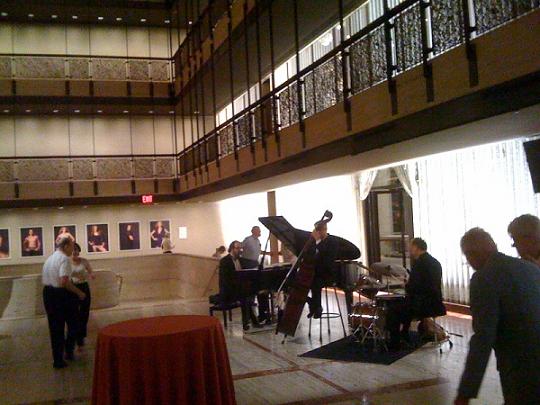
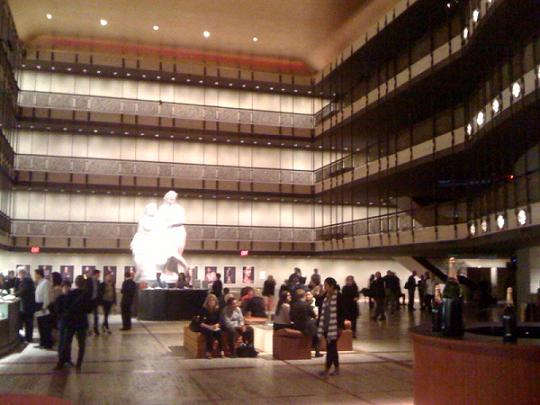
Friday night, my friends Hsien and Alyssa came with me to see the first program in NYCB’s “See the Music” series. First, we met for drinks on the promenade, which, as I mentioned, they’d opened an hour before showtime for the first week of this fall season. We watched members of the orchestra play some soft jazz music, which some patrons were dancing to. I know Hsien from my ballroom dancing days and we had to laugh because some of that music sounded straight out of Blackpool! (Blackpool’s one of the only – perhaps THE only – ballroom dance competition with live music.) (Above are a couple of my pictures of the promenade, about an hour before the performance, with people beginning to gather. My iPhone seems to take better photos outside…)

The two ballets performed were Ratmansky’s Namouna: A Grand Divertissement, which premiered last season, and Jerome Robbins’ The Four Seasons, which served for the first week of this first fall season as a tribute to fall.

Before the performance, Peter Martins came out and introduced the new series, explaining that it was inspired by Balanchine’s highly musical approach to dance, his belief that dance is music made visual, summarized by his words, “see the music, hear the dance.” Then the newly movable orchestra pit rose (as I knew it would!), and up came conductor Faycal Karoui with his crew, to explain a few things about Eduaord Lalo’s Namouna score. No one could give these talks but Karoui. He is hilarious, such a character!


Photo of Karoui by Paul Kolnik, taken from The Faster Times.

Karoui joked, in his thick French accent, that the music is very French, because of its … charm of course. Okay, then he became serious. The Lalo score is too long, of course, to talk about all of it, but Karoui focused on a few sections. One of the sections, he explained is characterized by its transparency of orchestration, meaning the harmonies don’t always  behave the way you expect them to; they are a surprise. He talked about how the beginning of the score had a nautical theme, and it opened with a sound like waves, but more German waves than French, he said, as the opening crescendo sounded more like Wagner’s The Flying Dutchman. He talked about the conversation between the harps and the strings, how Lalo plays with flexibility inside the tempos by following a quick tempo with a slower one, and he showed how Ratmansky had the dancers visualize part of that tempo by having the corps women at one point use cymbals onstage. After Karoui did a little dance himself while clapping the cymbals, he and Martins had the audience clap where the cymbals should be played to get us to internalize that rhythm a bit.

Karoui spoke at length about one of my favorite scenes in the ballet, where a group of smokers (led by Jenifer Ringer) really kind of tantalize the poor male lead, blowing smoke right into his yearning little face. It’s called “The Cigarette Waltz” believe it or not, and Karoui showed how the music really teases and tantalizes you into desperately wanting a cigarette, just like Ringer and her friends tantalize the poor sailor into wanting one of them. “Oooh, I really want one now,” Karoui cried after the orchestra demonstrated part of that waltz.

I liked Namouna much much better on seeing it a second time. I wrote about it earlier here (also, read Marina Harss’s fabulously detailed and in-depth description in Faster Times). It seemed less long this time, and each of the the parts seemed entertaining and compelling, each having its own theme and it own little storyline, however abstract the whole was. Maybe it was because of Karoui’s brief humorous explanations of the music, or maybe it’s just Ratmansky, because I always feel this way with his work – that nothing strikes me that much on first viewing, but that the more I see each ballet of his, the more I see in it, and the more entrancing I begin to find it.

That ballet was all the same, except this time Tyler Angle took over for Robert Fairchild as the main sailor guy. I’m told Robert is out for the moment with an injury. I loved Robert, but I really liked Tyler as well. Robert is so boyishly charming like Jose Carreno, and his dancing is more sharp and precise, hitting every count with spectacular flair and pizzaz, whereas Tyler’s more Romantic with his expression, with stretching port de bras and longing lunges, and he really draws out the music. They are such different dancers and it’s always nice to see another’s interpretation.

The next “See the Music” program will be this Sunday’s matinee.

New York City Ballet’s First Fall Season Opening Night


Tuesday night, New York City Ballet opened its very first fall season with performances of Balanchine’s Serenade, Peter Martins’s Grazioso, and Jerome Robbins’s The Four Seasons. First, before the performance began, Peter Martins came out and introduced each of the principal dancers, who came out onstage one by one, and said this season would be a celebration of them. Tiler Peck in particular was wearing this really gorgeous silky fuchsia dress. Martins said all principals were there except for Benjamin Millepied, who was doing something movie-related “en France,” he said with a funny faux Euro accent. Everyone laughed and gave the dancers a huge round of applause. The house was packed and it was clear how thrilled the company’s many fans are with there being a fall season this year. Martins made fun of himself for being so into toasts and said that during intermission, we’d all be given be given free champagne to toast the principals. Which we were – very fun!

The part of the performance I was mainly looking forward to was Janie Taylor’s debut in Serenade (above headshot and Serenade photo by Paul Kolnik) as the main ballerina. As usual with her, she completely made the ballet her own. I thought the ballet had a somewhat dark element with her, that I’ve never seen before. When she first ran out onstage, late for class, instead of looking like she was all frantic about being late because she’d been held up by a boy, it looked like she was running from something – from him. That man was Charles Askegard and when he danced the middle waltz part with her, the huge size difference between them added to the sense of foreboding, that she was fragile, he was pushing her around, and she’d eventually be hurt by him. At certain parts, it was literally like he was pulling her along. When he lifted her and she raised her legs in a split, it looked almost like she was trying to get away from him. Sara Mearns was the angel and Ask La Cour was the man who I call “blind justice” who take care of Taylor when she falls, and it was interesting how much the two male leads and two female leads looked alike. I almost got Taylor and Mearns mixed up at parts, thinking they were taking on the other’s role. And the end when the men raise Taylor up like pallbearers and she is carried off by them, arching her back, arms outstretched  – so hauntingly beautiful. It reminded me a bit of Balanchine’s La Valse.

I was also looking forward to Martins’s Grazioso, in which three handsome men – Gonzalo Garcia, Andrew Veyette and Daniel Ulbrich – vie for Ashley Bouder’s attention with their bravura moves. I don’t think this ballet has been performed since it premiered a few seasons ago. And I loved it all over again. I love how each guy has his own personality – Garcia is the romantic, Veyette is the manly man one, and Ulbrich is the one with all the high jumping tricks. And Bouder really played the tart, looking at each of them up and down at points kind of lasciviously, really trying to choose. The guy next to me was really giggly over it.

And the evening ended with Robbins’ The Four Seasons, which itself ends with a lovely tribute to fall.

This whole season the Koch theater will open an hour early. The promenade overlooking Lincoln Center Plaza will be open for cocktails, the gift shop will be open, and, for the rest of this opening week, there will also be live jazz performed by the NYCB Orchestra one hour before performance time. They have the promenade and mezzanine area done up nicely, with big plush chairs. Also taking place the rest of this week will be a “meet the artists” session whereby, beginning at 6:45 p.m. in the first ring of the auditorium, the principals dancers will be available to chat with ticket holders. There’s also a photo exhibition of the dancers by photographer HenryLeutwyler on display in the theater throughout the season.

Tomorrow night will be the first of seven “See the Music” performances which will provide a look inside NYCB’s 62-piece orchestra. At the beginning of each performance, Peter Martins and musical director Faycal Karoui will briefly discuss the program’s music, followed by the orchestra performing an excerpt of one of the ballet scores. The subject of tomorrow night’s discussion will be Eduoard Lalo’s score for Ratmansky’s Namouna: A Grand Divertissement, which premiered last season. Additional “See the Music” programs are Sept. 26 matinee, January 20, Feb. 1, Feb. 19 matinee, May 25 and June 11.

NYCB CLOSES ITS FIRST CLASSICAL SEASON WITH BALANCHINE AND ROBBINS


(photo of Liebslieder Walzer by Paul Kolnik, taken from Washington Post review).

New York City Ballet is closing out its Winter season — and first ever Classical season — this week. Tomorrow begins Balanchine’s masterpiece (imo), Jewels (which continues through Sunday); last week were two programs of mixed rep, which included Balanchine’s Liebeslieder Walzer and Tschaikovsky Piano Concerto No. 2, and Jerome Robbins’s Dances at a Gathering and West  Side Story Suite.


Making his debut in Liebeslieder was corps member Justin Peck (headshot above by Paul Kolnik, from NYCB website); he danced the part that Nilas Martins is dancing in the photo at top, along with Jennie Somogyi (who is also in that photo). I thought they really did well, and they stood out the most to me of the four couples.

This ballet is divided into two sections: it begins with the ballroom section where the women are in ballgowns and dancing in regular heeled ballroom shoes, and the section section where they are in long skirts made of tulle, and toe shoes. The men remain in tuxedos throughout. Balanchine has said that in the first section, it is the couples who dance; in the second it is their souls.

And that sentiment is really beautiful. But I don’t see a real difference, except for the obvious — the women’s costumes and shoes. I still thought each section was lovely though, particularly the opening ballroom section, but that could be because I’m trained in ballroom.

Critics have also said that each couple is supposed to represent a man and woman at a different stage in their romantic lives (one couple was supposed to be young love — which I thought would be Justin and Jennie; another more mature love, etc. — so I thought Darci Kistler and Philip Neal). But I didn’t really see that — I thought at points Justin and Jennie represented young, sprightly love, but then at other points their movement is slower and more deliberate and less scoop-me-off-my-feet — and at one point he picks her up and carries her horizontally, as if she’s collapsed, either from fainting or from sleep or perhaps sickness? It’s a beautiful lift whatever it means. And then at points Darci will run playfully and let Philip chase her. It’s sweet and made me fall in love with them momentarily and become involved in their story. But it didn’t seem then like they were this more mature couple. Not that you can’t run and jump and be excited and playful if you’re not “the young ones” of course, but I mean, the couples didn’t really seem different to me. And the fact that I couldn’t discern any particular story behind any of their actions made me less involved in the ballet than I wanted to be. But I still found the movement and the music (Brahms Opus 52 and 65) relaxing and engaging. Maybe I need to see it a few more times.

Every time I see Tschaikovsky Piano Concerto No. 2 on the program I think I’ve never seen this Balanchine / Tchiakovsky piece before, and then once it begins, I realize it is the ballet ABT calls Ballet Imperial. I think ABT has a set though, which resembles a palace, which makes it seem more “imperial.” At NYCB the stage is bare. This is the ballet with all the beautiful brises for the main man — the jumping from side to side with many beating together of the feet in the air. Here, that man was Stephen Hanna and he did an excellent job. Teresa Reichlen and Kathryn Morgan were the female leads. Hanna was most memorable to me though. Hanna partnered Reichlen very well, and I’m thinking he and Jared Angle are probably two of the strongest male partners in the company.

The Dances at a Gathering production on Sunday afternoon (Feb. 21) was the best I’ve ever seen of that ballet. SLSG favorite Gonzalo Garcia (!) was the guy in brown, and he did an excellent job. That character really sets the ballet in motion as, at the end of his opening solo, he looks out with a bit of nostalgia at the stage, surveying it, kind of preparing the audience for all of the characters who will appear on it — who seem to be people from his life, his memories. It’s like he’s taking you on a journey with him and Gonzalo set that up perfectly. And then everyone else was just so on! Maria Kowroski was the carefree, independent girl in green cutely shrugging off male onlookers, Jenifer Ringer and Abi Stafford were the younger, frolicking girls; when Jenifer partnered with Jared Angle those two did some of those lifts with the most sweep I’ve ever seen — the audience exclaimed practically in unison.

And Jared Angle was stunning with his tour jetes and his series of corkscrew jumps flowing right into the Russian folk-steps afterward. He is definitely one of the best men overall at NYCB right now — in terms of his technique, his form, his ability to both partner strongly and dance those bravura solos perfectly. You don’t think of him as a bravura dancer, and he’s not really — he’s more of a great partner, which is probably why I’m just now recognizing his brilliance, during this classical season where strong partnering is essential for being a successful romantic lead.

Sara Mearns was brilliant (again) as the dreamy, pensive woman in mauve, and I realized at one point what it is that makes her a favorite of mine. She was dancing alongside two other women — all three were partnered by men and they were all doing supported slides with the women in a dipped position, the men sliding the women across the floor like that. Well, the two other women immediately brought their free arm down at the beginning of the slide and held it in that position, which was pretty and created a nice line. But Sara brought hers down slowly and made a fuller, kind of half-circle motion, nearly brushing the floor with it. She doesn’t seem to strike poses so much as she is always moving and I think that’s what makes her so captivating — she’s always doing something, carrying out the line and extending the shape, and embellishing the music.

As for the other dancers: Antonio Carmena was very on with all of his jumps and turns, as was the fast-moving Megan Fairchild, and Jonathan Stafford and Amar Ramasar stood out in their roles as well. Amar always looks good in those strutting walks and that Russian folk-like movement Robbins uses in many of his ballets.

And that day ended with West Side Story Suite, which the audience went wild over. A woman behind me exclaimed that it was better than what she’d seen on Broadway. This ballet is always a romp, though I think it starts to lose some of its thrill the more times you see it. Still, I always love Andrew Veyette as the leader of the Jets and watching Georgina Pazcoguin do all those gorgeously high kicks and belt out the tune to America. I can’t imagine ever seeing anyone else in that role. And of course she gets loads of applause at curtain call. Benjamin Millepied danced Tony, which I’ve seen him dance before. He did fine, as always, but I wondered what Gonzalo might be like in this part?

Okay, on to Jewels!

Two Big Ballet Companies Begin Their Winter Seasons

Last night marked the start of Miami City Ballet‘s New York City Center season, which is very exciting because, not only is this that company’s Manhattan debut, but it marks the return of the company’s director, the famous Edward Villella, to the stage on which he began his career as a ballet dancer, in 1957, with Balanchine’s company — New York City Ballet. NYCB’s current home, the State Theater (now known, after recent renovations, as the David H. Koch Theater) wasn’t yet built then so City Center was the company’s main stage. I’ll be going to a couple of their performances later in the week and can’t wait. I especially can’t wait for Tharp’s In the Upper Room, one of my favorites. So psyched they’re doing it!

Last night was also San Francisco Ballet’s opening night gala. The co-founder of Twitter was there and he mobile tweeted that the event was like an unofficial Twitter headquarters. Most cool! Hopefully, we’ll be getting a full report of the evening from Jolene.