CORELLA BALLET CASTILLA Y LEON UPCOMING AT CITY CENTER

Just a reminder that Angel Corella’s new company is making its U.S. debut at City Center next month (March 17-20 to be exact). Here are a few pictures to whet your appetite:


Angel with his sister, Carmen Corella (who, if you remember, was a SLSG favorite before she left ABT); photo by John Anderson;


Angel and dancers in String Sextet (Corella’s first piece of choreography), photo by Manuel de los Galanes;


Two pics of Angel, in Corsaire by Joseph Aznar (top), and in Bayadere by Rosalie O’Connor; and


Rehearsal photo of dancers Kazuko Omori, Ashley Ellis, and Alba Cazorla by Fernando Bufala.

In addition to Angel’s first piece of choreography, String Sextet (set to Tchaikovsky’s Souvenir From Florence), the program will feature new work by Russell Ducker, a new pas de deux by flamenco dancer Maria Pages danced by Angel and Carmen (which I am particularly excited about), and works by Christopher Wheeldon (DGV: Danse a Grand Vitesse, which was nominated for an Olivier award when it premiered in London in 2006) and Leonid Lavrovsky, and Vladimir Vasilyov and Natalia Kasatkina’s Sunny Duet to be danced by Adiarys Almeida and our Herman Cornejo (who is married to Carmen, for those who didn’t know).

Go here for more info and schedule.

NEW PLANS FOR MORPHOSES

Most of us have already heard (and were somewhat shocked by) the news that Christopher Wheeldon has decided to leave Morphoses, the company he founded three years ago. And most of us were wondering how or if the company was going to go on without his name attached. Today, Lourdes Lopez, Morphoses’ co-founder and executive director, announced a new plan for the company: to have resident artists curate programming on a seasonal basis.

Here is more from the press release:

“Morphoses will adopt a curatorial model in which the company will invite artists from various disciplines to take on the role of resident artist for one season, leading the company’s artistic vision for that year,” said Ms. Lopez.

The embrace of a curatorial model is a natural evolution and expansion of the company’s mission and vision.  To date, more than half of the company’s repertory is comprised of works by a diverse group of emerging and well-known choreographers that include Michael Clark, William Forsythe, Tim Harbour, Adam Hougland, Lightfoot León, Edwaard Liang, Pontus Lidberg, Annabelle Lopez Ochoa, Liv Lorent, Emily Molnar, Alexei Ratmansky, as well as Frederick Ashton, George Balanchine and Jerome Robbins; the balance of the works were created by Christopher Wheeldon.

Morphoses has become a robust platform for some of the most talented choreographers in contemporary ballet, enabling them to create work with a versatile company of dancers.  Collaborators have included such artists as Los Carpinteros, Francisco Costa, Hugo Dalton, Narciso Rodriguez, Joby Talbot, Isabel and Ruben Toledo, and Martha Wainwright.

“Christopher’s artistic vision and talent has helped make Morphoses one of today’s most important dance companies,” said Ms. Lopez.

By adopting this curatorial model, the company will afford artists the opportunity to use Morphoses as a stage to forge dynamic creative partnerships that will produce innovative works for the dance world. This model will enhance the company’s capacity to reach out to a larger, broader audience and engage a younger generation.  The company has begun the process of identifying the roster of resident artists for the upcoming seasons and will be announcing plans in the near future.

“In addition to its artistic achievements, Morphoses has established a successful business model and self-sustaining administrative structure that allows the company’s resources to be focused on its artistic goals, bringing forward a new generation of talent to younger audiences,” added Ms. Lopez.  Since its founding, Morphoses has achieved artistic and financial success through annual seasons in New York and London, domestic and international touring, and private and institutional support.

“The company has built up a reserve of funds to support the curatorial model,” stated Catherine Gildor, a member of the board of Morphoses. “We see this as validation of the crucial role that Morphoses has taken on in the world of contemporary ballet and are therefore committed to building upon our success.”

Morphoses’ mission is to broaden the scope of classical ballet by emphasizing innovation and fostering creativity through collaboration.

For more information, visit www.morphoses.org.

KINGS OF THE DANCE SHOWS HOW DANCER-RICH BUT CHOREOGRAPHY-IMPOVERISHED BALLET IS IN THE BALANCHINE-INUNDATED U.S.


Photo of Desmond Richardson by Andrea Mohin, taken from NYTimes.

So, “Kings of the Dance” made the New York stop of its international tour this weekend at City Center. I was there Friday night. The last time this show toured here several years ago (it is produced by Russian dance promoter Sergei Danilian) there were only four male dancers — Angel Corella, Ethan Stiefel (both of American Ballet Theater), Johan Kobborg of the Royal Ballet in England, and Nikolay Tsiskaridze of the Bolshoi. This year, there were many more dancers and Tsiskaridze was the only one who returned (and, funny, but I totally didn’t recognize him). The others were: David Hallberg, Marcelo Gomes and Jose Manuel Carreno from ABT, Joaquin De Luz from NYCB, Guillaume Cote from Canada, Denis Matvienko from Ukraine, and Desmond Richardson from NY-based Complexions Contemporary Ballet (So You Think You Can Dance fans may recognize his photo above, since he has guest performed on the show a couple times).

What I liked about this program the last time it toured here was that there were fewer dancers, and that way you kind of “got to know” them better, by seeing them each perform several different pieces. Here, you basically only saw many dancers once, and a few twice. If you weren’t familiar with them (as my two friends who came with me weren’t), you could easily get them confused. They played a short movie at the beginning where each dancer (besides Desmond Richardson; I think he may have been a late addition to the American tour) talked a bit and you saw them dance. Jose’s cute Cuban accent seems to have gotten more pronounced 🙂 — I think he did it on purpose, knowing how many female fans would be in the audience! David’s voice somehow sounded a bit deeper than it does in person. Matvienko (who, for ballroom dancers, looks A LOT like former US champ Andrei Gavriline) and Tsiskaridze spoke in Russian and their words were translated.

What I loved about this program though was that there were so many solos that exposed us to so many different choreographers whose work I’d never seen (and some of whom I’d never even heard of) before. Every company in this country is obsessed with Balanchine, so it’s a wonderful wonderful change when we actually get a taste of something else. But more on that in a moment.

As with every Danilian production, there were lots and lots of Russians in the audience, and I think Desmond Richardson and Joaquin De Luz in particular grew a new fan base. Poor Joaquin — well, maybe: after the performance and during intermission I kept hearing, “That little guy was great!”, “That little guy was just incredible,” “Where can I see that little guy dance?” So, Joaquin is the great “little guy” whom everyone is seeking out now. And everyone went wild after Richardson’s solo, Lament, choreographed of course by Dwight Rhoden, an absolute master at presenting his friend’s spellbinding combination of gracefulness and masculinity. My friends were floored, along with the rest of the audience judging by the exclamations.

After the movie, they opened with Christopher Wheeldon’s For 4, for four dancers, which is a carry-over from the last performance. On the night I went it was performed by Matvienko, Carreno, De Luz, and Cote (but the cast varied each night). It’s an adagio lyrical piece, as with the vast majority of Wheeldon’s work, and I wished there would have been some more allegro parts with bravura solos. But that’s just not Wheeldon’s thing.

Then, after intermission, we saw a solo performed by each man, ending with a drop dead gorgeous duet danced by Cote and Gomes choreographed by French choreographer Roland Petit, from his Proust ou les Intermittances du Coeur. The men were dressed in skin-toned unitards, which almost made them look naked, and the duet to me seemed to be about a man obsessed with his reflection, or another side of himself, as each’s movement was mainly a reaction to the other’s. But at some points there was some really beautiful partnering, some really beautiful lifts and it seemed like a man dancing with his soul. Breathtaking!

Anyway, other highlights of the solo section were: a really beautiful solo for Marcelo choreographed by Adam Hougland, called Small Steps, which was like lyrical iron-pumping — a series of beautiful poses showing off his musculature interspersed with flowing lyrical movement; a beautiful, lyrical piece danced by David Hallberg from Frederick Ashton’s Dance of the Blessed Spirits; a fast, fun, more virtuosity-heavy solo by David Fernandez for Joaquin De Luz called Five Variations on a Theme; Jose Carreno dancing a gorgeous adagio to Ave Maria — a modern version — by Igal Perry (which I’d seen before and fell in love with it all over again); and Rhoden’s Lament for Richardson, which, like Marcelo’s solo, reminded me of lyrical iron-pumping (which I mean in a good way of course) highlighting as it did that seemingly incongruous combination of male elegance and virility.

The only ones that didn’t really work for me well were Boris Eifman’s Fallen Angel danced by Tsiskaridze, which I think just didn’t have enough context, and Vestris by Leonid Jakobson danced by Matvienko, which was by turns a comical and bravura piece first danced by Baryshnikov in 1969. I thought Matvienko was a lovely dancer with really beautiful lines who could really deliver on the jumps and especially turns, but I just think it needed to be better acted because there were some places where it almost seemed like he made a mistake, and then you realized it wasn’t a mistake by the dancer; it was supposed to be the character who humorously screwed up. I heard Baryshnikov was excellent and I wish I could see a video of that.

Then, we saw Spanish choreographer Nacho Duato’s Remanso, which I’d never seen live before, but saw in a video performed by ABT. It involves a wall with three dancers interacting with each other around it, climbing over it, looking around it. It’s sweet, flirtatious in places, and loving and romantic. The night I saw it it was danced by Gomes, Cote, and Hallberg, though this cast alternated each night as well.

The program ended with a bravura “Grand Finale” with each dancer coming out and doing jumps and turns, and all the big fancy “male things” of classical ballet.

But the thing I kept thinking throughout was, wow, that’s really cool choreography, who’s that choreographer? Oh,  I’ve never heard of him, or, oh I’ve heard of him, how cool that I finally got to see something by him! I mean: Roland Petit, Igal Perry, David Fernandez, Adam Hougland, Nacho Duato, Leonid Jakobson. We NEVER get to see choreography by these people here. Petit is a major choreographer. As is Duato (we really see his choreography only when his own company tours here, infrequently), ditto for Eifman, and the others I’ve never even heard of. Why don’t we see more variety here? Why don’t we see more Mats Ek and Pina Bausch and John Cranko? Why do we have to drown in Balanchine over and over and over again? Why do dance companies think that we want to see Balanchine? Why do they think Americans are into this man? As far as I’m concerned, his only truly great work is Jewels. The rest, okay, his footwork is more intricate and there are certain subtle little embellishments in the variations, but really, what was so great about his ballets in their entirety? What was so great that we have to be so completely inundated with him here in the US? I mean, it makes sense that NYCB does his work because they were founded by him but every other major company in the US is likewise obsessed – San Francisco Ballet, Miami City, Boston, Pennsylvania, even the Kirov and POB when they tour here they think we want more of this crap. And whenever ABT doesn’t do classical, there seems to be an overload of Balanchine. Does anyone consider that maybe, just maybe, we might get bored? That he doesn’t speak to younger generations of Americans AT ALL? Did someone tell POB and Kirov that Americans only understand Balanchine so you have to do Balanchine when you come here? I think ballet is dying in this country because of every artistic director’s completely inscrutable obsession with this boring boring man.

Anyway, I greatly thank Mr. Danilian for allowing Americans to see something else for a change.

For a completely different perspective, see Macaulay’s review.

MORE BEAUTIES


So, toward the end of last week I saw two more casts of Sleeping Beauty in New York City Ballet’s production. Above are the beautiful Kathryn Morgan as Aurora and Tyler Angle as her Prince Desire (Paul Kolnik is the photographer). Below are some photos of the other couple I saw, Tiler Peck (both she and Kathryn were making their Aurora debuts), with Gonzalo Garcia, albeit not from this ballet.


(in Four Bagatelles, photo by Paul Kolnik)


(and in the Christopher Wheeldon / Martha Wainwright collaboration over the summer, photo from NYTimes by Andrea Mohin; I like this photo because I think it shows each of their personalities well).

And then last week, I saw Ashley Bouder and Andrew Veyette.

I’ve been thinking about who I thought was best in what role but it’s actually really hard to do that. I honestly ended up liking everyone, though there were definite differences.

I do have a lot to say about Gonzalo Garcia though. I LOVED him as Prince Desire — he really melted me, he really completely stole the show that night and I feel like I’m not ever going to like anyone quite as well in that role now. I mean, you just have to see him in a classical ballet, as the romantic lead, and you realize why San Francisco audiences were so upset when he left SFB for NYCB a couple years ago. Some of those SFBallet fans were really devastated when he left. And I think it’s been such a puzzle to those fans that New Yorkers haven’t really fallen for him the same way. And I think it’s because he hasn’t had the chance to shine because NYCB is so Balanchine-heavy. He needs roles where he can act and become a character. He’s such the quintessential romantic prince.

You can really tell how differently he’s trained than the other NYCB dancers, who’ve nearly all come from SAB and been trained on Balanchine’s non-actable abstract ballets. I felt like with Gonzalo I was seeing someone from ABT — mainly Angel Corella (in terms of the body type, dramatic style and boyishly handsome face). The way he’d hold onto the music, draw it out while it crescendos, by for example in the vision scene holding out a finger to the princess and then leaning back, then looking out to the audience — not AT the audience but in the audience’s direction — to show how enthralled he is, how much he wants to catch her, all before then turning and running toward her. The other two — Tyler and Andrew — they didn’t do all that. They just kind of looked toward her standing more and more toward the tips of the toes, ready to run toward her when the music told them to. Gonzalo’s way was so much more Petipa and Tchaikovsky and Bolshoi and Romantic Russian and all that, and it might all seem overly melodramatic to audiences who aren’t used to that. But that’s what I’m used to with ABT — and that kind of stuff makes me swoon!– so that’s why I think I loved him so much. But I’m wondering what others who saw this cast thought?

And Gonzalo just knows what’s expected of him, as the prince. Later, when he went to do that crazy series of jetes, he was rested up and ready and he nailed them like I’ve never seen him nail anything. I’ve never seen his legs straighter, in perfect splits, and the whole way around the perimeter of the stage, without tiring. And it’s like he knew that was a very important part, and he had to do them perfectly because that’s just what the romantic hero does — that’s the way he shows his love for the princess, and that he’s worthy of her. The other two obviously took them seriously (because they’re crazy hard, you have to take them seriously), but it just was more of a difficult feat, instead of having the same meaning. You know what I mean? Like he looked out all across the stage wistfully, and then he just took off flying around it. It gave it a different meaning than just flying around.

It makes me wonder though if contemporary audiences understand that, or appreciate it. Or whether they prefer for the emotion to look more “natural”? I’m not saying Gonzalo was better than the other two, just different.

I wonder what Joaquin De Luz was like, since he’s not SAB trained either. Did anyone see him?

As far as partnerships, Kathryn and Tyler were my favorites. Tyler had a few flubs on some of his solo variations (but I still love him!), but he was always the perfect partner, he was always solid when supporting her. And the series of fish dives in the wedding pas de deux were some of the most breathtaking I’ve ever seen. Her legs were pointing completely up toward the ceiling! Magnificent! And the final hands-free fish dive was picture perfect.

I liked all of the Aurora interpretations, but they were different too. Kathryn was the most princess-like, the most regal, though that may just be the way she looks. She just kind of looks like royalty! Ashley and Tiler seemed more “real girlish”  – all smiles and sweetness and awe at the world and their cute suitors.

The rose adagios were all near perfect. (ABT’s Sarah Lane is still the queen of the balances to me — it seems like she could hold them for hours.) Kathryn had the most absolutely gorgeous extensions. Do I have to giggle every time Robert Fairchild comes out leading the cavalcade of suitors? I loved Craig Hall as the “African prince,” – I don’t know what exactly stood out about him but something did. And even though it wasn’t a dancing role, I loved Henry Seth as the King; he acted it really well. Chase Finlay was lovely as Gold in the wedding scene – -he’s a really beautiful dancer with exquisite lines. Everyone’s talking about him being the next romantic lead. I loved tiny Erica Pereira as the fairy of eloquence and Ana Sophia Scheller as the fairy of courage, thought Faye Arthurs and Adrian Danchig-Waring were brilliant as The White Cat and Puss in Boots, and Daniel Ulbricht is the quintessential gymnastic court jester.

And there’s NEVER been a better Carabosse than Georgina Pazcoguin! Nor has there ever been (or, perhaps, could there be) a better Lilac Fairy than Sara Mearns. I love how she arches her back so luxuriously and opens up her chest. And the rich, full-out port de bras. Such beautiful expansiveness, that, with her beatific face, makes her perfect for this angelic role. She reminds me of Veronika Part.

Okay, that’s all I can think of, for now!

This week begins the Swan Lakes. I’ve never seen Peter Martins’ version, so I’m really excited. In particular, I’ve heard wonderful things about Maria Kowroski as Odette and I’m psyched for Stephen Hanna’s debut as Prince Siegfried!

RHAPSODY FANTAISIE


I am extremely behind on reviews but here are a couple of pictures (by Erin Baiano) of the cast of Christopher Wheeldon’s Rhapsody Fantasie, which the choreographer premiered with his company, Morphoses, in October. I can’t write a full review but I guess it’s interesting to see what lingers in the mind. I remember a variety of movement — from neo-classical ballet to more contemporary with some ballroom thrown in — I remember some swing-y moves and even some salsa basics! I remember interesting ensemble work — with dancers at times breaking into pairs for partner dancing, at times the men dancing together, performing various complicated lifts, which I found rather mesmerizing. And I remember Wheeldon’s signature modern ballet pas de deux with the complicated “pretzel shape” lifts (as in the top photo, of NYCB’s Wendy Whelan and Australian dancer Andrew Crawford). Besides Whelan and Crawford I found Drew Jacoby and Rubinald Pronk to be the most compelling pair, dancing their series of twisted shape after twisted shape with passion and psychological intention.


Opening Morphoses program 2 was Continuum, a Wheeldon ballet from several years ago (photo above, also by Erin Baiano). This was a very abstract work set to sharp, at times tense Ligetti music with brilliant lighting that made the dancers appear ghostly, as if their shadows, silhouetted on the back wall, were doing the dancing.

I love Christopher Wheeldon, who’s always trying to give audiences insight into the dance-making process. At the beginning of this program, he spoke a bit about the dances, and, regarding Continuum, he told us all to look out for a part where, as he was making that dance, he became mesmerized by a neighbor’s cat and dog. It was only all too obvious which pas de deux this was, and everyone laughed as the two dancers kind of crouched around each other getting ready for a playful (or maybe not so playful) attack. I don’t think the audience would have thought anything of it if he hadn’t pointed that out. Now if he can give us insight on how the whole thing comes together!…

JACOBY AND PRONK IN LIGHTFOOT LEON’S SOFTLY AS I LEAVE YOU


Photo by Bill Cooper of the mesmerizing Drew Jacoby and Rubinald Pronk in Lightfoot Leon’s spellbinding Softly as I Leave You, which is on both Morphoses programs (currently at City Center) and which I’ve been going on about in my last post, here, and earlier here.

And look — finally an American critic has something good to say about it!!

Says Lisa Jo Sagolla of Backstage magazine, “Lightfoot Leon’s Softly as I Leave You, a stunningly inventive duet involving a frightening coffinlike wooden box, is so fiercely emotional that its impact is universally chilling.”

I couldn’t find any YouTube clips of Jacoby and Pronk in Softly but, if you’re unfamiliar with them, here are a couple of others I found: the first a sexy little music video and the second is of them rehearsing with Mia Michaels.

Review coming soon of Program B, which includes Christopher Wheeldon’s new Rhapsody Fantaisie, which I liked.

MORPHOSES OPENS ITS 2009 NEW YORK SEASON WITH ITS BEST PROGRAM THUS FAR


Performance photos coming soon; in the meantime please enjoy another BRILLIANT photo by Kyle Froman.

Christopher Wheeldon’s Morphoses opened its NY season last night at City Center and I felt it was the best program they’ve done in their three years of existence. (At least Program A was; tonight I’ll see Program B). It’s a varied program with work by four different choreographers: Wheeldon himself; Bolshoi A.D.-turned ABT resident choreographer Alexei Ratmansky, whom all the critics downright worship; Australian Tim Harbour; and the Dutch husband and wife team Lightfoot Leon.

I must talk first about the third piece on the program, that by Lightfoot Leon, Softly As I Leave You. This is one of the most riveting pas de deux I’ve ever seen and it’s performed by the absolutely mesmerizing Drew Jacoby and Rubinald Pronk. Every single person who is not a professional critic was absolutely spellbound by it, could not stop talking about it. This happened at both the Fall For Dance Festival, where the work premiered (which I wrote about here), and last night. It’s simply about a couple, one partner’s decision to leave the other, and it’s a harrowing decision. After the lights went out on the final poignant image, the elderly woman on my left, whom I didn’t know, grabbed me and said, “Oh my God, that was so good!” And from my friend, who thinks the Arvo Part music used (Spiegel im Spiegel) is completely over-used and was expecting not to like it for that reason: “Oh my God, that music actually worked here!” she exclaimed, open-mouthed. She agreed it was one of the best duets she’d ever seen. And people were going on and on about it during intermission, both here and at FFD.

So why in the world do the critics hate it so much??? They ALL do. ALL OF THEM. It’s like in order to be a professional critic there are certain things you’re required to hate and this is one of them. And yet audiences are so overwhelmed by its power. Clement Crisp rants, “I can find not one iota of merit in its vulgar posturings.” Guardian critic Luke Jennings calls it “slick surfaced” and replete with “glib insincerity.” I can’t remember Alastair Macaulay’s exact words after its FFD premiere, but he hated it too. And a Ballet.co critic whom I spoke with at an ABT Guggenheim event (and who was the only non-Brit of the lot) complained how awful he thought it was as well.

This happened — I’m sorry, I’m getting off on a tangent — but this happened with practically every Fall For Dance piece, and with ABT’s recent season: EVERY SINGLE CRITIC hated every single one of the pieces the public adored (Barton, Millepied, Mark Dendy’s BRILLIANT Afternoon of the Fauns) and loved those they found least compelling (Ratmansky). I mean, more on this later, but what do you do if you’re an artistic director or choreographer? Do you cater to the critics — the “important people” or do you trust us, the commoners?

Anyway, mine and my friend’s second favorite piece of the night was Tim Harbour’s Leaving Songs. Guess what: all the critics hated it. I need to move to Europe… This dance had such emotional depth. It was about the cycle of life, death and rebirth — though I’m not sure you’d know that if the choreographer hadn’t said so in a little film clip shown before the program. But that doesn’t matter; you can come up with your own meaning anyway. The movement was kind of a combination of modern, classical and what looked to me to be African, and the music, by Australian composer Ross Edwards, is equally varied, at points sounding classical European, at points more percussive and African-sounding.

There were several striking moments, such as the point during a pas de deux where a man puts his hands around a woman’s neck and she falls before him. It kind of seems as if he’s strangling her out of anger, but then her arms flutter about beautifully, almost-bird like. It’s a combination of violence and grace. And there’s a moment where the group is dancing in ensemble and the movement is very wavy and undulating, very African, and everyone’s moving in unison and the music slows and the dancers slow, almost like they’re approaching death. Then the drums start pulsating and the dancers come to life and begin sidling cautiously but with intention toward the front of the stage. There are also several very sexually suggestive scenes with women’s legs splayed in the air. No tights are worn, and my friend and I couldn’t stop wondering how in the world they keep those leotards from shifting…

Anyway, I found the Harbour very compelling. And Rubinald Pronk really stood out here as well. He has so much fluidity and expansiveness in his body, and I don’t think anyone has more intense eyes.


(photo from Vail website)

Alexei Ratmansky’s Bolero was enjoyable too, largely because of the familiar Ravel music. For me, Ratmansky is one of those artists whose work doesn’t jump out at you and hit you over the head with its brilliance. Rather, I’ll need to see a dance of his several times before I get a sense of what it’s about, before I can fully appreciate it. Wheeldon’s work is the same. The critics seem to think this is the mark of a good choreographer — that it grows on you and you notice new things with each viewing, and I suppose it is. But for the average consumer, going to the ballet so often to see pieces over and over again to understand and appreciate them more fully can get prohibitively expensive. Dance art is not like a museum or art gallery where you can stand there for as long as you like.

Anyway, in Bolero, there are four pairs of women and men, each person wearing a number on his or her top. The women wear white tops and little skirts, almost like cheerleaders and the men wear black. If the women were cheerleaders, the men didn’t seem to be any kind of sports players though. They danced in groups divided between male and female, almost as if they were competing with each other, or as if their movement was some kind of back and forth dialog. And then toward the end, they began to partner each other more, the crescendo of the music complemented by various lifts that I found at points to be a little humorous, though it may have just been me. For example, when those trombones (I think that’s what they are anyway; maybe they’re tubas), are blaring kind of off-key at the end, the men lift the women over their heads, upside-down and the women do these upside-down developes, their legs splaying along with the warped trombones. I thought it was funny but I might be the only one.


And then the first piece on the program was Wheeldon’s Commedia (photo above by Erin Baiano), which was made in homage to Ballets Russes and was premiered last year. I wrote a bit about it here and here.

Here’s an excerpt from the company performing Commedia at the Vail International Dance Festival:

Also, this season marks the company’s collaboration with the young orchestra (most players are under 30, Wheeldon said), Philharmonic Orchestra of the Americas, founded and directed by the very entertaining, energetic Alondra de la Parra — yes, a female conductor OMG! The evening opened with Wheeldon giving a little address and then the orchestra playing on Overture to Estancia: Malambo by Alberto Ginastera. At the same time the orchestra played the Overture (this was their first time playing in a pit for dance, and not centerstage, by the way), a screen was dropped over the stage and a delightfully humorous film was shown of the dramatic conductor directing her crew, the violinists all swaying dramatically in unison at points. It was a lot of fun. Whole night was very good.

NO IT’S NOT THE TOE SHOES, CHRISTOPHER WHEELDON!


Here’s a Sarah Crompton interview with Christopher Wheedon in the London Telegraph. Morphoses is about to open their fall season there, debuting a new ballet by Wheeldon and one by Australian choreographer Tim Harbour. At the end of the month, New York audiences will get to see those premieres.

In the article, Wheeldon talks about trying to increase ballet’s appeal to new audiences. He surmises it may be certain ballet aesthetics, such as the toe shoes, that are a turn-off, that may make ballet inaccessible. I strongly disagree though. I think people are generally awed by the toe shoes and by the beauty and immense athleticism of the art form. They’re all the more awe-inspiring when you see them up close, a thought I had recently in the Guggenheim’s tiny theater watching ABT, their studio company, and the students at ABT’s Kennedy-Onassis School of Ballet perform in a Works & Process event there.

I really think people in general are drawn to stories. That’s what I hear anyway from other dance-goers, or would-be dance-goers (who patronize theater and opera but shy away from dance). I think abstract ballets can definitely be intriguing but I think if your repertoire consists of only the kind of story-less ballets Balanchine made it’s going to suffer. I’ll be very excited to see the Alice in Wonderland that Wheeldon’s doing for the Royal.

FALL FOR DANCE ’09 PROGRAM 2

Highlights of Program 2, which I saw last night, were Morphoses and Tangueros Del Sur.


I was wandering around the lounge beforehand and ran into a couple of old friends from my first ballroom studio, Paul Pellicoro’s Dancesport. Always fun to catch up with old friends — especially since one of them belonged to my swing team and I shared with her my first ever lovely competition experience. Anyway, little did we know then, but one of our former tango teachers was in the show! Ivan Terrazas! I was so proud; he was absolutely electrifying (along with the rest of the Tangueros)!

Sir Alastair had gone on and on about this troupe — led by Natalia Hills and Gabriel Misse — when he saw them at the Vail Dance festival recently, and rightly so! Oh my gosh, that was the most astounding tango I’ve ever seen! The piece was called Romper el Piso and was mainly tango but with some footwork and rhythms from other Latin dances like Samba and a little bit of Cha Cha thrown in — but all danced with tango aesthetics. There were duos and trios, both mixed-sex and same-sex. The choreography was original and enlightening and the dancing so polished, precise, lightning fast, sharp, passionate, everything you can imagine in a tango, in a dance. I really hope some of you can see them tonight.

Afterward, my friend Alyssa and I hung out in the lounge. When we left we were a little tipsy (c’mon, the wine is $2!) and I kind of tripped over nothing on the way out, causing us to both burst out laughing. One of the cute tango guys said to us, “tranquilo, tranquilo!” but very flirtatiously 🙂

All photos above by Carlos Furman, courtesy of City Center.


The other knockout performance of the night — for me — was Softly As I Leave  You, choreographed by Lightfoot Leon and performed by the stunning Drew Jacoby, who is now one of my favorite female dancers (Alyssa’s as well) and Rubinald Pronk, performing on behalf of Morphoses. Christopher Wheeldon was in the audience and he got mobbed during intermission 🙂

It was the best thing I have ever seen by Morphoses — more Lightfoot Leon, Mr. Wheeldon, please please!

It’s set to a combo of music by Bach and Arvo Part (including the Part section all New Yorkers are now so familiar with, from Wheeldon’s After the Rain pdd), and begins with the statuesque Ms. Jacoby standing inside a box opening out to the audience, contorting herself to fit within its confines, struggling to break free, making the most mesmerizing shapes with her body. Then, in the second movement, Mr. Pronk comes out and they dance an, at times somber, at times peaceful, duet. Then, in the third (with the After the Rain music), they continue dancing together, but now come to a closure; he ends up in the box, she slowly walks behind it, disappearing offstage.

To me, this was about the human need for connection or the struggle between wanting to be alone and wanting to be with another. Alyssa saw it as someone being held back by something and struggling to overcome that; she was moved by the change of positions between the two dancers. Or, as the title suggests, I guess it can be about a woman leaving a man. The most compelling of these abstract duets Wheeldon is known for (either choreographing himself or including in his Morphoses programs) I think allow for that kind of interpretative range, while giving the viewer enough that they can really latch onto something and let their imaginations go with it.

The above photo of Jacoby and Pronk, by Erin Baiano (courtesy of City Center), is not from this piece.

Also on Program 2 was Martha Graham’s sweet ode to spiritual and human love, Diversion of Angels. Nice to see some of the Graham dancers, who are beginning to become familiar to me, again.

And closing the program was Noces by Dutch choreographer Stijn Celis, performed by Les Grand Ballets Canadiens de Montreal.

1

2

32

This was Program 2’s tribute to Ballets Russes. Branislava choreographed the original Les Noces, and there have been several versions since (Jerome Robbins’, Pascal Rioult’s). It was danced to Stravinsky’s choral score (which he created for Ballets Russes), but with some remixing too (I think). The music seemed to be longer, and there seemed to be some German language in the score, which sounded like it was from a Broadway show like Cabaret (but not Cabaret exactly). The program doesn’t seem to note any addition to the Stravinsky though so I may well have been hallucinating.

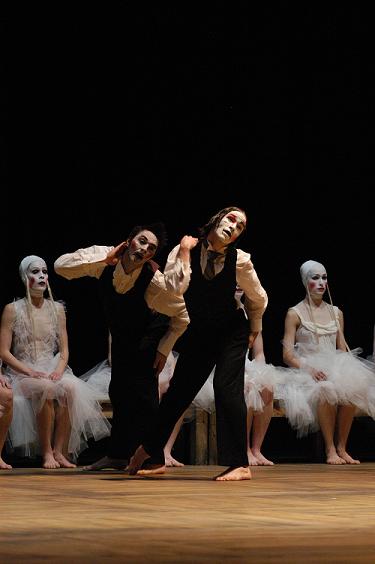
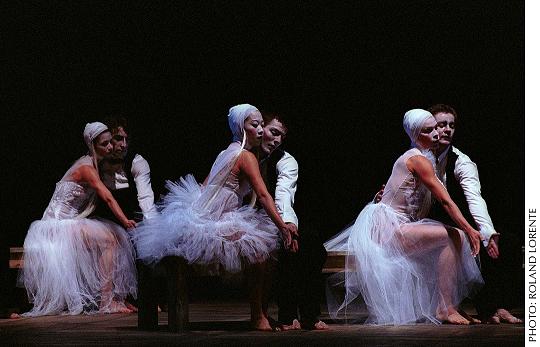
The dance (and the Stravinsky music) depicts a Russian peasant wedding and it’s very Rite of Spring-like — more focused on the sexual rite of passage, the consummation, and the rather forced marriage rituals than love or anything weddings evoke for us today. In the Celis (as well as Rioult) version, there isn’t a single man and woman but a group of men and women undergoing the marriage ceremony. The women here are dressed in sexy white bridesgowns, the skirts short and much of the material see-through mesh. The women have white-powdered, very made-up faces that look almost clownish, as do the men, who are dressed in tuxes. Alyssa thought their make-up looked zombie-like, like they’re walking dead. The movement is very frenetic, with lots of thrashing about, and the group consummation scene would have been comical, as the women bounced around on the men’s laps, if it wasn’t so violent.

I’ll be interested to see what the critics and other viewers say of this –whether it gets dismissed as gaudy “Eurotrash” or whether people take it more seriously as a commentary on ritual (or something else). I do think it worked as an homage to Ballets Russes because from what I know of that legendary company, they seemed to have been very cutting-edge, going far out to push ballet to its extremes, even if it induced a lot of eye rolling.

Big kudos to the dancers though for performing that long, near-continuous frenetic movement.

Photos of Les Grands Ballets Canadiens de Montreal courtesy of City Center.

STAND IN LINE FOR FALL FOR DANCE TICKETS AND LET MONICA BILL BARNES ENTERTAIN YOU


I think this is pretty funny. Fall For Dance tickets go on sale this Sunday, September 13th, at 11:00 a.m. In the past crowds have been known to line up beginning at 4 a.m. (this festival is popular), and the line’s been known to wend its way practically all around midtown. Well, this year, festival participant Monica Bill Barnes (above, on the left), a modern / experimental dancer and choreographer, is going to entertain the queued-up crowd from 10-11 Sunday morn. She and her dancers can be rather amusing.


These pics are from a site-specific performance of hers I saw last summer downtown and wrote about here.

Also, during the festival there will be three free, open-to-the-public talks in City Center’s Studio 5 (which is upstairs, I think on the 5th floor). All three talks will be about the legacy of the Ballets Russes (in honor of their centenary this year).

The first, on September 23rd at 6:30 p.m. will be a discussion with three original members of the legendary troupe: Frederic Franklin, Raven Wilkinson and Eleanor D’Antuono and will be moderated by Robert Greskovic, author and dance critic for the Wall Street Journal.

The second, on Sept. 25th, same time, will be about how BR’s collaborations with clothes designers, painters, and musicians of the day created lasting change for the dance world. Panelists include Christopher Wheeldon, Alexei Ratmansky, Juliet Bellow and Simon Morrison and the moderator is Lynn Garafola, a dance historian at Barnard.

The third, on October 3rd, same time, will be about BR’s influence on today’s choreography. Panelists are choreographers Nicholas Leichter, Robert Johnson, Mark Dendy, and Virginia Johnson and the moderator is Wendy Perron, the editor-in-chief of Dance Magazine.

Speaking of Ballets Russes, one final reminder: if you haven’t yet seen the fantastic exhibit at the New York Public Library for the Performing Arts, at Lincoln Center, you only have until September 12th to do so. They’ve got videos of Baryshnikov dancing Balanchine’s Prodigal Son, of Anna Pavlova, of Fokine’s Les Sylphides, of Branislava Nijinska’s Les Noces, of original BR choreographer Leonid Massine instructing Joffrey dancers on reconstructing his Parade, they’ve got original costumes and poster designs by Picasso, letters and diary entries by Diaghlev, etc. etc. etc. Definitely worth seeing.

SOME FAVORITES FROM VAIL

Wow, there are a lot of video clips up of the many many companies and dancers that performed at this year’s Vail International Dance Festival. Here are some of my faves:

Dance Brazil in a modern / capoeira combo, Luna:

Daniel Ulbricht and Misa Kuranaga doing a Corsaire pdd:

Sofiane Sylve and Simon Ball in Forsythe’s In the Middle Somewhat Elevated:

Wendy Whelan and Edwaard Liang (dancing with Morphoses) in Forsythe’s Slingerland pdd:

Matthew Rushing in Ailey’s beautifully bluesy Reflections in D:

Linda Celeste Sims rehearsing Ailey’s classic Cry:

Gillian Murphy and Ethan Stiefel’s Black Swan pdd:

Tyler Angle and Tiler Peck in the pdd from Wheeldon’s Mercurial Manoeuvers:

Some Lindy Hop with Naomi Uyama and Todd Yannacone:

And some Argentine Tango by Natalia Hills and Gabriel Misse:

There are many more vids and photos though, so visit the festival’s blog. I don’t see any up yet of the Ballroom evening — Hanna Karttunen and Victor DaSilva and J.T. Thomas and Tomas Mielnicki, et al. Hoping to see some of those soon. Excellent blog though, letting peeps who couldn’t be there in on what all went on. And splendidly diverse festival!

WHEELDON IN WONDERLAND


So London is abuzz about the Royal’s official announcement that Christopher Wheeldon will make a full-length ballet based on Alice in Wonderland, set to premiere in 2011.

I’m excited, especially since some of my favorites of his have been his more dramatic ballets, like The Nightingale and the Rose. Thankfully, he doesn’t plan to make a children’s ballet: “A lot can be read into Alice in Wonderland. One could take the more Freudian route…” he says.

Critics expect Wheeldon to “bring a sophistication and an understanding of the darker sides of the text.”

Music will be by Joby Talbot, whose work he also used for the mysterious, poetic Fool’s Paradise, which makes me all the more intrigued.