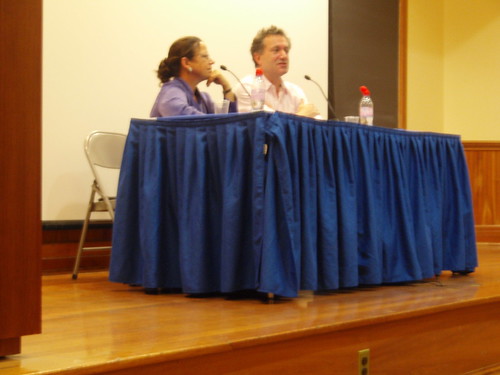
But he didn’t say much. And I should probably stop calling our new(ish) Chief Dance Critic ‘Sir Alastair’ and come up with a different nickname; he came across more as a jolly, down-to-earth commoner than a lord. Anyway Mr. Macaulay, along with dance writer and professor Mindy Aloff, addressed a crowd of mainly students, critics, and dance insiders last night at Barnard College. He spoke of: his move to New York (he’s still not completely moved into his new apartment and has no television, allowing him neatly to evade the question of the moment — what about all this dance stuff on tv?); what he misses about London (his garden, the West End’s plethora of Shakespeare plays); how he felt about becoming the NY Times’ chief dance critic (it was a welcome mid-life change, he and his audience at the Financial Times in London had grown a bit tired of each other, he was worried his appointment wouldn’t be well taken since he was from out of town — and rightly so, why should a critic not be homegrown?– people laughed at this, not sure why); his most trying life moments (serving jury duty and having to announce the verdict to a raucous courtroom, being charged with taking indecent pictures of minors after an officer saw him photographing frolicking children on a beach– don’t worry, it all worked out well as charges were eventually dropped); his dance training (ballroom, reading ballet technique books and sitting in on ballet classes); his favorite artists (Shakespeare and Mozart), etc. etc. — things on that level. It was nice to see his face and hear his voice, and it did make you realize he was human despite his sometimes harsh reviews, which was probably the point of the whole thing, but it was hardly the in-depth discussion of issues important to the dance world that I was hoping for.
During the Q & A, a student asked him if he felt that bad reviews played any part in declining dance audiences. He thought for a moment and answered that he didn’t know how much of an effect reviews really had on audiences. He thought his reviews had absolutely no effect on that of American Ballet Theater, as the Met Opera House was far from packed each week during the their summer season regardless of what he’d said in his most recent review. He also felt as a critic a certain degree of harshness was necessary, as it was the critic’s responsibility to “hav(e) a passionate subjective response” to a work. Wendy Perron, editor in chief of Dance Magazine, after noting that he’d largely written subjective reviews frequently inserting his own voice, asked if he’d ever taken a more objective tone. He responded that he wasn’t sure of the difference between subjective and objective with respect to criticism, but felt that his writing was a combination of the two. He viewed the objective part as describing what he saw, the subjective to tell why it mattered.
Eva sweetly asked him in her beautifully mellifluous voice whether he was going to explore the entire New York City dance scene and all the wonderful things it has to offer. He brightened considerably and said he’d just discovered “downtown” and had gone to a performance entitled something like “Accounting” and really liked it. He sounded authentic and it was actually rather cute. I don’t think he knows he got reemed for his review of that 🙂 Countercritic guy asked him something along the lines of whether he had to consider something beautiful in order to value it. I thought it was an interesting question and Macaulay did too, and even said so. “But I’m not sure how to answer it,” he replied. He said he liked it when a choreographer challenged his notion of beauty as Mark Morris has on occasion. Which I thought was a good answer. He mentioned other such choreographers, but I’ve forgotten who– I’d put my notebook away by then and was packing to go.
Hmm, what else do I have in that notebook?… He takes a few notes during performances but usually they don’t amount to much. He was first seriously impressed with the New York Times when he picked up a copy of the paper in London and saw a review of a classical dance performance on the front page. Such a thing would never have happened in a London paper, he said, as concert dance wasn’t considered “sexy.” He doesn’t regularly read others’ reviews of a piece because he doesn’t want them to influence his own, although his favorite critics are the New Yorker’s Joan Acocella (who has an “engaging” “shrewd” voice that, even if you disagree with, “you really want to spend time with”) and Wall Street Journal’s Robert Greskovic, who has a gift for detailed description (and is his good friend and sends him copies of his reviews). He said dance and music criticism were very challenging because the dialog one had with the piece was not a direct or natural one (as with a play) but forced the critic to translate from one language into another. I thought that was nicely stated.
That’s all. It was about an hour and twenty minutes altogether. It was okay, just wish the discussion would have gone deeper.
I came home and watched the video I’d taped of Dancing With the Stars. I’ll blog about it more tomorrow — am too tired now — but, very briefly: ridiculously, he hasn’t even danced yet and I am totally in love with Helio 😀 Does Marcelo have that same accent 🙂 🙂 😀 Am also in dancerly love with Mark Ballas 😀 How great were the perfs by those “girls” — Cheetah and Spice?! Whoa! And that opening pro number: you can’t say the ballroom dancing, despite Pasha and Anya, is better on So You Think You Can Dance! I wish there were more pro numbers like that! You can tell how different the demographic is for this show as compared with SYTYCD though — they have a lot of older contestants here. I thought Marie Osmond was a bit of a goof, but charming in her own way, and Jane Seymour was sweetheart 🙂 Could some ballroom insider please smack Chmerkovskiy for me for that self-description: “I’m known as the bad boy of the ballroom. But how can I be so bad when it feels so good?” 🙂 Okay, more tomorrow, I’m off to bed…