Because This is a "Teachable Moment" in History…

…I am revealing that, at least according to the top test in the first link listed in this OpEd piece, I supposedly have a slight unconscious preference for white people but a strong unconscious preference for Barack Obama.

Of course I knew the latter assessment, but am angry at myself for the former, especially given that I practiced law as an appellate public defender in NYC representing almost all non-whites for many years. But according to the test-makers, most people, of all races and ethnicities, come up with that result. Yet, seeing as how Obama won by a pretty strong margin, there have to be a good many people who receive the same evaluation I did. Hmmmm. It looks like people were able to look past race for the election, although race is still an issue in the way people process information and view their surroundings.

Anyway, these tests are very interesting and they’re worth taking (you have to be aware of your unconscious thoughts in order to overcome them, no?). They’re made by Harvard and University of Chicago. The Chicago one is a bit creepy and speaks to the Sean Bell and Amadou Diallo cases. I think I was fair, but quite slow in my reactions… Anyway, take the tests!

By the way, yes, I know this is a dance / arts blog, which you’d never know by looking at the “recent entries” side bar. I will return to writing about dance this week (and get up to date on some posts — there are several things I’ve seen that I haven’t written about yet) 🙂 This is just such a momentous time and it’s impossible not to reflect on it. (Thanks to Eva for the link to the OpEd piece.)

Democracy in America

I don’t have time to write a full review but yesterday I went to the Democracy in America exhibit at the Park Avenue Armory (Lex between 67th and 66th). It’s free and definitely worth seeing. Runs only through this Saturday though. Go here for more info.


I’d gone mainly to see Steve PowersWaterboard Thrill Ride, which had premiered at Coney Island over the summer; I wrote about it here. There really wasn’t much to it; you put your dollar bill into the slot and for just a number of seconds watch a life-sized robot/puppet aim the spout of a flower pitcher at a supine man’s face, which was covered with a wet cloth. The water just kind of dripped out, as if he was delicately watering flowers. I’m thinking perhaps there were too many viewers and the water supply was getting low because I’d have thought it would be coming out a little more rapidly. Still, I found the exhibit pretty frightening and don’t know how Coney Island tourists could have found otherwise.


There are a few other interesting installations too, most of them on the main floor in the big room. There’s one by John Hawke of a make-shift shelter constructed with wood. Inside are a series of journal-like entries and pictures documenting where all the shelter was placed — usually busy city streets — who all used it — people waiting for the bus, the homeless, people needing a little place to eat, especially when it rained — and how it was treated by police and other authorities — usually taken down, dragged out to the street.

There’s another exhibit, all of photos, aligning the side wall, by Greta Pratt. The pictures, taken throughout the country between 2007 and 2008, are of various pictorial renditions of the American flag — on bumper-stickers, on sides of buildings, on the cover of a magazine, on someone’s t-shirt, on someone’s mailbox, on the face of a grocery bag, etc. Sometimes the subject paraded the flag with intent, others seemed completely unconscious of it, just happening to don a t-shirt bearing such an emblem for the day. There are hundreds of pictures and it can take you all day to look at them. What I found interesting was that they show such an expansive view of middle America, one that is somehow neither ironic nor nostalgic, or perhaps rather a combination of both.

Third piece of art I had a very visceral reaction to was at the back of the ground-floor room, by Jon Kessler. A big installation involving numerous barbie dolls and tiny video cameras that were projected onto several TV screens aligning the back wall. Barbies (or Ken dolls, rather) depicted men at war, men being tortured. Just imagine all the things you can do with little plastic bodies to show the horrors… It was visually stunning, compellingly, thought-provokingly disgusting.

There are several video exhibits on the mezzanine and second and fourth floors that I found less interesting, except for one, by Carlos Motta, though I can’t say I liked it. The artist is a young Colombian man who shot a bunch of videos of Latin Americans talking about their governments. They are projected onto about ten or so screens throughout the room. On one screen, however, there is simply a starving dog looking desperately for food, nearly unable to stand up. He licks the dirt ground for water. It’s so horribly upsetting, and as a viewer sitting at a remove from the dog on the screen, you’re completely helpless to do anything for him, which is perhaps the point. A shop woman finally throws the dog a chicken wing, which he gobbles down, but still, he’s all bone and fur. It’s so upsetting.

I feel like there’s got to be something legally wrong with this kind of art — with hurting, sometimes killing defenseless animals for artistic aims. Human beings can make the decision to starve themselves for a movie, etc., but non-human animals cannot. I don’t know if Motta found this dog on the streets and just decided to film him, or if he starved the dog himself in order to use him for his little film, but it really shouldn’t be legal. Animal cruelty is a felony, at least in New York, and the artwork is being distributed here.

Plus, I’m not sure that watching a starving or victimized animal or human (the artist has done other projects on human victimization) really leads the average person to think, to be more compassionate. At least public executions in the past haven’t seemed to have that effect.

Waterboard Thrill Ride

Sorry for the posting hiatus! It’s been a long time since I’ve gone half a week without blogging… There’s just nothing much going on in New York right now, and I’m trying to get a couple of writing projects done before the fall is officially underway.

Anyway, this post is about a piece of installation art that I didn’t actually get to see, but just read about via Claudia’s latest Culturist post. Apparently, artist Steve Powers had a small exhibit, called Waterboard Thrill Ride, out on the Coney Island boardwalk, among all the amusement rides and hot dog and cotton candy stalls. Like a peep show, you put a dollar into a slot and peeked through a small window covered with bars to see a couple of hooded “interrogator” robots perform waterboard torture to a robot dressed in orange prisoner garb, in imitation of a Guantanamo Bay detainee. The interrogators pour water onto the prisoner’s head for a number of seconds while his body convulses and he yells out things like, “I think I’m dying.” On the outer wall of the exhibit is a cartoon of Sponge Bob having water poured onto his head saying, “it don’t Gitmo better.” Powers said he created the installation in part to make people aware of the controversial form of torture currently used by our military. The writer of this NYTimes article went out to Coney Island on the day the installation premiered and describes onlooker response.

Most annoying thing to me is that it only seemed to be up — by design not because of public response — for one week, from August 6-15. On the 15th, apparently Powers and a couple of lawyer friends subjected themselves to waterboard torture conducted by actual trained officers, in front of the exhibit. This is just the kind of thing I would love to have seen — both in terms of the art itself, how it makes its presentation, how it questions, how it fits within its surroundings — particularly these surroundings — and how the public reacts. It’s now moved to the Park Avenue Armory on the upper east-side, a private museum and collection of antiques that you need an appointment to visit. Seems kind of ridiculous to have a public art exhibit in a private collection, but apparently it is to be part of a larger exhibition at the Armory called Democracy in America, sponsored by the public art fund Creative Time, which will take place September 21-27. Go here for deets. Unfortunately, I likely won’t be in town that week. So, looks like I’m going to miss out. But if anyone goes, or if anyone saw it on Coney Island, please give your thoughts!

How I managed to miss the exhibit while it was here is another issue, for which I’m royally pissed at myself. I have GOT to stop relying on blogs and websites for all my info; I must return to good old fashion newspapers and magazines… And I mean hard copy. You don’t always see everything on the website; you’ve got to make sure you click on every heading, every subheading, every little box. It’s just not the same as flipping through actual, physical pages.

Why Thinking Lawyers Leave the Law

“Shortly after the article [in the New York Times, about murder convict Gary Gilmore] caught his eye, almost immediately in fact, Susskind’s old friend and associate Stanley Greenberg called, and they had a good conversation. Stanley had written a TV story fifteen years ago about a man awaiting execution. The man had been so long on Death Row that he changed in character, and the question became, “Who was being executed?” Metamorphosis the play had been called, and Susskind always felt that it had had some effect on the end of capital punishment in New York State, and maybe even a little to do with the Supreme Court decision that saved a lot of men’s lives on Death Row.”

From The Executioner’s Song, by Norman Mailer.

Intelligent lawyers leave the law because they know art produces social change, not legal arguments.

Hearing On Police Accountability

On Monday, I attended a public Hearing held in lower Manhattan convened in the wake of the Sean Bell verdict, to address ways to increase police accountability. I wrote about what went on at the hearing for the Huffington Post

There was a pretty good turnout.

My favorite witness was Kamau Karl Franklin, a race justice fellow at the prestigious Center For Constitutional Rights here in NY. He had some very intriguing ideas for new legislation, which I wrote about here.

Sean Bell Verdict

Thank you thank you thank you, Michael Wilson, for posting a full transcript of the verdict in PDF form on his NYTimes City Room blog! It’s the next best thing to being allowed in the courtroom!

In case it’s not permanently available, I’ll quote and paraphrase in pertinent part.

First, regarding the unit’s presence at Kalua Cabaret, Justice Cooperman said:

“Because establishments known as “strip clubs” often generate criminal activity including prostitution and narcotics, the Police Deptartment Club Enforcement unit was given the task of infiltrating such places and pursuing violations of law that would lead toward shutting them down.”

“So it was that the detectives charged in this case found themselves in the vicinity of Club Kalua in the morning hours of November 25, 2006.”

Later, the judge says credibility of the People’s witnesses was of paramount importance:

“The Court has found that the People’s ability to prove their case beyond a reasonable doubt was affected by a combination of the following factors: the prosecution witnesses’ prior inconsistent statements, inconsistencies in testimony among prosecution witnesses, the renunciation of prior statements, criminal convictions, the interest of some witnesses in the outcome of this case, the demeanor on the stand of other witnesses and the motive witnesses may have had to lie and the effect it may have had on the truthfulness of a witness’s testimony. These factors had a significant part in the People’s ability to prove their case beyond a reasonable doubt, and had the effect of eviscerating the credibility of those prosecution witnesses. And, at times, the testimony just didn’t make sense.”

Justice Cooperman found that the confrontation in front of the club between Coicou and the Bell group was heated, Coicou was perceived as having a gun, and that someone in Bell’s group said they’d take Coicou’s gun from him. Cooperman credited the testimony of Isnora and Sanchez and discredited all prosecution witnesses in finding that Guzman told someone to go get his gun.

Because of this, Isnora was justified in following Bell and Guzman, “two of the more active participants” the judge said, “in this heated confrontation.”

The Court also found, consistent with most of the witnesses, both prosecution and defense, that Bell’s car “sped away from its parked position,” hit Isnora, struck the police minivan head-on, reversed into a gate, and went forward again, hitting the minivan again. The incident “lasted just seconds,” and the “officers responded to perceived criminal conduct, the unfortunate consequences of their conduct were tragic.”

Because the defense was justification (self-defense), the People had the burden of proving that the defendants were not justified (acting in self-defense), which he found the People could not do. Thus, the defendants were not guilty of any of the charges.

Finding Benefield’s credibility “seriously impeached,” the Court said the evidence showed he was not shot while running.

Cooperman also found some of the defense testimony “not necessarily credible,” but, because the People have the burden of proof, that didn’t have the degree of significance as what he found to be the People’s witnesses’ contradictions and lack of credibility.

The judge also said his verdict didn’t touch upon any possible carelessness or incompetence on the part of the officers. Those are different standards of conduct, applied in a civil context, and will not be addressed here but “are left to other forums.” The detectives’ conduct simply did not rise to the level of criminality. Cooperman also said he did not consider either the Bell community or the NYPD as being on trial here, simply these particular detectives.

Sean Bell Shooting Trial Day 29: "What Are We All Going To Do; We Got Nothing Left."

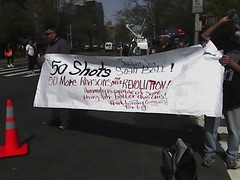
Despite arriving at the courthouse at 7:10 a.m., and being close to the front of the line, I didn’t get in. No one did. No one who wasn’t either a police officer, a member of the press (and not even they all were allowed in; apparently, if they had a colleague inside as no two reporters from the same media outlet were admitted), or a family member or friend of someone on one of the sides. It really annoys me because I have been there every single day — more than I can say for most of the press — and one of the most disturbing things about this case is how absolutely deficient the press coverage has been. Most reporters go for the flash, for the sensationalistic, without bothering give their readers or viewers the nuances of the testimony or anything even approaching in-depth analysis.

So, I really would have liked to have heard for myself what exactly Justice Cooperman said. The best coverage of the case has been by Michael Wilson of the Times, so according to him, Cooperman gave a brief recounting of the events of the early morning of November 25th, then said he found the three detectives not guilty of all counts on grounds that the People’s witnesses’ testimonies was unclear, confusing and conflicted with each other, and that, from the perspective of the officers, they reasonably believed deadly force was about to be used against them and so were justified in firing. It’s not clear from Wilson’s report whether the judge went into any detail in his verdict on the reckless endangerment counts for all of the bullets that pierced cars, a fence, a home window, and a crowded Air Train station.

About ten or so minutes after 9, a reporter came running out of the courthouse, down the steps. I knew this meant he had the verdict. We all waited silently while he gave the word to a spokesperson who shouted out to the crowd, “Not guilty of all counts.”

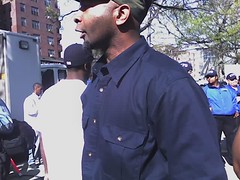
People immediately began chanting “fuck the police.” A woman cried. Another woman screamed, “not guilty of anything? Nothing?” But the crowd didn’t get out of control. A man was very angry at our new Governor Patterson for appearing to be more interested in talking to the press about his sex life than serious racial issues, and was disappointed that neither he nor Mayor Bloomberg were at the courthouse. Another man said he believed the mayor was in cohoots with Cooperman as evidenced by all of the talk about increased police presence in Queens and throughout New York following the verdict. Mayor Bloomberg, he concluded, must have known what the verdict would be. He also said he couldn’t believe black attorneys were representing the detectives:”That just shouldn’t be; it’s just wrong.”
Another man told a reporter he was there because this could have happened to his son, now 12. He came out to “let society know, let Bell’s family know we feel your pain.” That same man later turned around and throwing up his hands, exclaimed to a fellow bystander, “look, people can’t leave because they can’t believe it. What are we all going to go out and do? We got nothing left. We’re Americans; we were born here and we got no rights.”

A large crowd converged around the Bell group — which included Guzman, Jean Nelson, Johnell Hankerson, and others — as they left, but I was too far away to hear if anything was said.

As I was returning to the subway, I saw a man lying in the street, surrounded by all of two people. One woman was trying to pull him up. He looked injured. There seemed to be about a million police officers around, but no one helped the man. And the police formed a human barricade blocking the street from the sidewalk, so passersby couldn’t go out and help him. I watched though as he eventually got up, dusted himself off, and with the help of the woman, walked on. I just saw him on the news in a crowd of people appearing to be shoved around.

A group from Sean Bell’s church walked up and down the sidewalk singing a hymnal.

A lot of people were yelling at the uniformed officers guarding the courthouse, picking out black and Latino officers and calling them “sell-outs.” Apparently one of the officers gave a dirty look to one man, which really set the man off. “Who the hell do you think you are, giving me that look? You got some damn nerve,” he yelled. One man told a ruddy-complected white officer he was going to get skin cancer if he spent any more time out in the sun like this. The officer just smiled and shook his head.

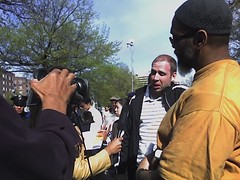
A very young white man came up to me and handed me a copy of a newspaper called “Challenge,” which the subtitle says is “the revolutionary Communist newspaper of the Progressive Labor Party.” He told me he was saddened that there seemed to be more press people there than organizers for change. “I can’t believe the low turnout. Only the Black Panthers are here,” he said.