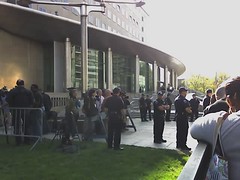
Originally uploaded by swan lake samba girl via mobile.
It doesn’t appear they are letting non family in courthouse.

Originally uploaded by swan lake samba girl via mobile.
It doesn’t appear they are letting non family in courthouse.
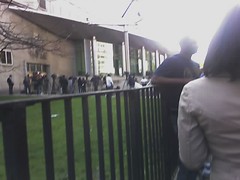
Nervously awaiting sean bell verdict
Originally uploaded by swan lake samba girl via mobile.
It’s packed. News vans take up 2 blocks.
A couple of friends I made during the trial (two young women getting their PhDs from John Jay College of Criminal Justice) and I were just discussing this the other day: if the detectives happen to be acquitted of all or the top homicide counts, what will happen to them? Would they be able to keep their badges and go straight back to regular duty?
So I was happy to see that Michael Wilson, my favorite official news reporter who covered this case, answered just that question in his NYTimes article yesterday. Apparently, they could still be brought up on departmental disciplinary charges within the NYPD, and if found guilty, would be fired, or they could even be prosecuted federally. According to Wilson’s article, chances of both are slim, since such proceedings are usually brought against officers accused of brutality toward inmates already in custody. But if the fate of the officers who shot and killed Amadou Diallo is any indication (Diallo was an unarmed male immigrant from Guinea whom officers, who were acquitted, shot 41 times, mistakenly thinking he was reaching for a gun), Isnora, Oliver and Cooper would likely be assigned desk duty and have their weapons taken away. One officer from the Diallo case is still trying to be re-assigned to street duty and regain his weapon privileges; the other three officers have left the force.
Anyway, it’s an interesting article. Read it here.
I’m sorry for this insanely long post, but this is what happens when lawyers talk for seven hours straight: you end up with an entire legal pad — both fronts and backs of pages — full of notes. Ugh. I’ll try go focus on just the highlights of the lawyers’ summations.
I just want to start off by saying big kudos to prosecutor Charles Testagrossa for delivering a very moving summation. He’s been criticized throughout the trial for being too lenient with the defense attorneys, not objecting enough to their cross examination of his witnesses, not putting forth strong enough evidence on his direct case, etc. So, I felt it was really important for him to give a powerful closing that showed he was doing everything he could to prosecute these officers. And he came through on that with flying colors. People were talking about how inspiring it was on their way out of the courthouse, people were crying in the restroom afterward … it was a perfect end to an emotionally fraught and hugely important case.
And of course much of his summation was directed toward the courtroom spectators, the family and friends of Sean Bell, and the press and, through them, the larger public. Actually, with the exception of Detective Michael Oliver’s attorney, James Culleton, all of the attorneys focused little on the actual law, or even the evidence, figuring, rightly so, that Justice Cooperman would be able to figure out all of that on his own. Rather, they spoke to the larger picture, and directed their arguments just as much if not more to the courtroom audience and larger public as to Justice Cooperman.
“Guzman Was the Only One With the Testicular Fortitude to Threaten To Use a Gun; It’s Because of Him That We’re Here Today.”
First to speak was Paul Martin, defending Detective Mark Cooper, who was charged only with reckless endangerment for the shot he fired that missed its target and wound up in the Air Train station. Martin’s initial proclamations set a good tone for the defense arguments:
“This trial is not about who’s a thug, about who was drinking, about who’s the best pole dancer in the city, about what part of Queens one is from (issues that at times have received a ridiculous amount of attention), and it’s not about a cold-blooded killing on Liverpool Street. It’s about whether the People have proven beyond a reasonable doubt the defendants acted recklessly.” With regard to Cooper, this means they must have shown his conduct created a substantial risk of serious bodily injury to another person, that he was aware of and disregarded that risk, and that such disregard constitutes a gross deviation from what a reasonable person — a reasonable police officer — would do under the same or similar circumstances. There was no proof Cooper grossly deviated from the conduct of a reasonable police officer in similar circumstances, Martin said.
Martin argued there was no direct evidence it was Cooper’s bullet and not Isnora’s (who also used a Glock handgun) that pierced the Air Train, though there was circumstantial evidence of such, since Isnora shot from the other direction. Even so, Cooper is entitled to every inference of non-guilt, Martin argued. Plus, expert Alexander Jason had testified that the bullet could have ricocheted off of another hard surface before ending up in the station, testimony which was unrebutted.
Even assuming Cooper did shoot directly into the Air Train, Martin continued, the People didn’t show that under these circumstances — Cooper’s hearing gunfire and seeing Bell’s back car window blow out making him think someone inside was shooting at him — he did not respond in a manner consistent with a normal NYC police officer. After all, Cooper acted reasonably with respect to Trent Benefield, not shooting him as he saw him running down the street, after assessing he had no gun and posed no threat.
Is a 14 degree angle a “gross deviation” Martin queried the judge. The prosector presented no one to testify that Cooper discharged his weapon in an unsafe manner, in a way that was inconsistent with his training as a police officer.
Turning to the rest of the defense case — the other reckless endangerment, assault, and manslaughter charges — Martin pointed out inconsistencies in the People’s witnesses’ testimony: Coicou’s trial statements that he never heard anyone say they were getting a gun but statements to the DA that he did hear someone say exactly that; Marseillas Payne’s claim that only one collision occurred which was at odd’s with just about everyone else’s testimony that they saw a total of three; Trent Benefield’s saying at trial he was shot while running and there was only one collision but his telling the police right after the shooting that he was shot in the car and there were three crashes.
But the most controversial part of Martin’s closing statement was with respect to Joseph Guzman. Detective Isnora didn’t follow Guzman, Martin asserted, because Guzman was black, because he was large, or because of the way he was dressed: every single man on the street that night was black and dressed in street clothing, and at least one other man — Jean Nelson — was a big guy too. Isnora followed Guzman because Guzman was the only man there to say, “go get my gat (gun),” and Guzman was the only one with the “testicular fortitude” and the confrontational attitude to go and use it, and Isnora recognized that. Martin reminded Justice Cooperman how Guzman fought with attorneys on the stand. In probably the most controversial statement of the day, Martin said, “Guzman’s the reason why we’re here today.” Mumbles spread through the courtroom and Guzman’s wife got up and walked out.
“Martin’s the one with ‘testicular fortitude’!” my friend said to me afterward. “I can’t believe he said that! It’s a good thing Guzman wasn’t in there then!” Guzman and the others did come into court for the second half of the day, for Testagrossa’s summation.
In conclusion, Martin argued that if Cooper was convicted, a dangerous precedent may be set: if a police officer may be indicted for recklessness for firing his weapon in a dangerous situation without both feet firmly on the ground, without both hands completely steady, he or she may hesitate, with fatal consequences:
“[If you say to these officers] next time wait until your hand is set and your feet are stable, next time wait until you are more balanced, well, next time you’re dead.”
“Dr. King said the moral arc of the universe is long but ultimately the truth will come to light.”
On to Anthony Ricco, Detective Gescard Isnora’s attorney, by far the most odd but interesting summation of the day. It was odd in that he spent much of the time talking about why he chose to take on the case and his own involvement with it and other black defendants. He began by saying, “It’s hard to find a starting place. I would love to just give you my notes.” “That’s a good idea,” Justice Cooperman joked.
Ricco was angry at the way the Jamaica community had demonized Isnora, at the way the press had characterized the issues in an overly simplistic way, at critics of the defense attorneys who were doing their jobs to the best of their ability. A lot of people, he said, tried to discourage him, a black man, from representing another black man charged with a serious crime. But that’s exactly what he does, he said, represents black men charged with serious crimes. He’s done lots of defense-side death penalty work in the Midwest and South, he said. People wanted this case to fit a script, he said. The last thing they wanted was for someone like him to stand behind someone like Isnora.
All of the defense lawyers acted professionally here. No one went scrambling to get before the cameras afterward, Ricco said, referencing (I think) civil attorneys for the shooting victims here.
Ricco lauded Jean Nelson, one of the civilian witnesses and a friend of Bell’s, calling him “the voice of reason” in a case fraught with inconsistencies; said he “broke rank to tell the truth,” and in doing so, “contradicted every proseuction witness called.” He loved Sean Bell but that didn’t prevent him from coming to court and telling the truth (Nelson is the only one to say he heard Isnora speak before shooting; what he heard was “Yo, let me holler at you.” Nelson also described the fight between Coicou and Bell and Guzman as being serious and fraught with danger, said that Coicou told Bell “I’ll shoot you,” that Bell said to Coicou “we’ll take that [gun] from you,” that Coicou had “an icy stare” and that Bell could be hostile when drunk, and that he was drunk that night. Nelson also said Isnora would have been “squashed” by Bell’s car had he not jumped out of the way).
Returning to his theme of how the press and Jamaican / Far Rockaway community had oversimplied the truth here, Ricco spoke about Isnora’s background. Isnora wasn’t exactly from an upper-class community and he certainly wasn’t white; rather, he grew up in Bushwick, a neighborhood not unlike that of Jamaica, where Bell, Guzman and their friends are from. But instead of turning to a life of crime, Ricco said, Isnora went to college and became a fighter of crime. Instead of selling crack, possessing firearms illegally, stashing guns in his car, spending time in prison, he works in the community putting his life on the line everyday so that community’s children don’t have to live in fear. And for this, Ricco said, for going to college (“which we don’t like”) the community demonizes him, says “to hell with you,” wants him to be deprived of solid legal representation.
Ricco contrasted Isnora with Trent Benefield, one of the shooting victims. Benefield, Ricco said, called Isnora in his taped interview with the police officers after the shooting, “a nigger with a gun.” (I didn’t hear this when the tape was played in court, but like I said before, it was very difficult to hear anything on it, or to see the words of the transcript on the monitor.)
They (meaning either the prosecution, the Jamaican / Far Rockaway community, or the civil attorneys representing Guzman and Benefield in their multi-million-dollar civil lawsuit against the NYPD) did their best to “dress up” their witnesses, Ricco said, in perhaps the second most controversial statement of the day. Trent Benefield, James Kollore, Johnell Henkerson, all showed up in “borrowed suits” and cried fake tears on the stand in order to arouse sympathy and make them look professional. (Those on the prosecution spectator side did not take kindly to this, understandably). The civil attorneys responsible for the multi-million dollar lawsuit, he said, did their best to make sure Benefield and the other civilian witnesses in Bell’s group fit a certain image. Ricco asked Justice Cooperman to juxtapose Benefield’s racist name-calling of Isnora and the images of Bone, Hugh Jensen, and Larenzo Kinred on the videotape of the scene shortly after the shooting, where they were pumping their arms at the camera, wearing do-rags, and talking about “burn” — slang for guns — with the images he saw of them in court, besuited and sedate.
Turning to the evidence, Ricco said it makes no sense that Isnora would walk up to Bell’s car and without a word, begin pumping bullets into it. He asked Cooperman to consider all the police officers who testified and Isnora’s character witnesses who said he was a highly competent, good-hearted, quiet, reserved man — an image sharply at odds with that propounded by the People’s civilian witnesses.
Fabio Coicou’s testimony was so riddled with contradictions and so nonsensical that the courtroom giggled and laughed throughout much of it, Ricco said. But is perjury really funny, he asked. Coicou’s testimony, Ricco said, was “designed to get a cop and make him pay.”
One truthful thing about Coicou’s testimony, Ricco said, was that he saw Isnora standing nearby, figured out he was a cop, and tried to so indicate to Guzman. Putting this together with Hugh Jensen’s testimony that Guzman said to him at that point, “take me to my bitch’s house,” Ricco argued that Guzman, no dummie, realized what Coicou was doing, saw Isnora standing around, and made the statement to Jensen in order to pull Isnora off his trail and make him think they were all leaving peaceably. Guzman, inexplicably walked to Bell’s car, when he’d originally arrived at the club in Henkerson’s car. Why didn’t he return to the car he’d arrived in, Ricco queried, before implying that, knowing Isnora was a cop and was following him, didn’t go to the car with the gun in it. Then, when he saw Isnora again in front of the car, realizing he hadn’t successfully got him off his trail, Guzman directed Bell to run him over. Ricco admitted he had no real proof of any of this, but this was one reading of the facts.
Much of Guzman’s testimony was belied by other facts, Ricco said. The ballistics evidence is inconsistent with shots being fired when the car was going in reverse, as Guzman said. Isnora’s belief that Guzman and his friends may be going back to Coicou was substantiated with Coicou’s seeing some of them down at the corner peeking back up at him. That fabric from Isnora’s pants was embedded in Bell’s car’s front grill shows that Bell’s car had to have hit him. And Guzman’s claim that he heard nothing from Isnora’s mouth was unbelievable when there were witnesses, such as Detective Sanchez, Mrs. Hernandez who lived nearby, and Mr. Rafael, who lived at the end of the block, who heard men shouting before the shots.
What else was Isnora supposed to do, Ricco asked. If he believed deadly force was about to be used against him and he had no cover, how else should he have acted? He told his boss, Lt. Napoli, what he’d seen outside of the club, and Napoli directed him to follow Guzman. Was he supposed to not follow his boss’s orders? Wouldn’t he have been incompetent and careless if he didn’t? How did Isnora deviate from the standard of conduct a regular police officer would have engaged in? What was he supposed to have thought as Bell’s car reversed and backed up at him, Ricco asked. When he shot, Isnora made a split second decision in a rapidly escalating situation. After Bell’s car had reversed and collided again with the police van, Isnora thought he saw Guzman reaching for a gun. It doesn’t actually matter, Ricco said, whether Isnora told the men in the car he was a police officer; it only matters whether he reasonably feared for his life.
(I have two brief things to say about Ricco’s summation: 1) he tried to bolster the testimony of Officer Carey and Detective Sanchez, by saying they have no reason to lie; they’re cops and they wouldn’t risk their careers over lying for a fellow officer. The prosecutor didn’t object, likely because there was no jury here, but there’s case law saying those arguments constitute improper vouching for police witnesses; you can’t use the police or prosecutor’s office to vouch for their credibility. And 2) he said all of the People’s civilian witnesses had prior convictions for violent felonies including gun possession offenses. I know right off the bat Trent Benefield didn’t have any priors at all, and I’m pretty sure some of the others had only non-violents or priors not involving weapons possession.)
In conclusion, Ricco said he appreciated the court’s indulgence in letting him go on at length, and that this has been a difficult case for everyone. He said some people were angry with his cross examination of some of the People’s witnesses. But this is his job, he said, and he takes it seriously. He stands between the accused and a mob who by definition don’t wait for the facts to come out. We need to give the process a chance and have faith that the partipants will be served.
“Like All Criminal Cases This All Boils Down to Credibility”
Compared to the first two attorneys, James Culleton, Detective Oliver’s attorney, gave a pretty bland summation, but one that most focused on the evidence. The prosecution had not disproven that the officers were “justified” (the legal term for self defense) beyond a reasonable doubt, he said. Instead, it had presented a parade of convicted felons, crack dealers and weapons possessors, in contrast to five officers who’d never before fired in the line of duty.
Culleton went through many of the inconsistencies in the People’s case: Benefield’s testimony that there was only one collision was belied by his telling the officers there were three. His testimony that he put his hands over his eyes after initially seeing Isnora and left them there throughout the incident was belied by blood belonging to him found on the front passenger’s seat headrest, which could only have got there by Benefield holding his wounded leg then grabbing the headrest. Benefield’s claim that he was shot while running was belied by Jason’s expert testimony that, because of the bullet holes in his pants, he must have been shot while sitting down. Nor did anyone state that they saw anyone shooting at Benefield as he ran down the block.
Culleton cited Gannolo’s expert testimony that the bullets fired into cars and windows and fences down the block had ricocheted from a hard surface before landing there, and Jason’s testimony that the bullet recovered from Mrs. Rodrigues’s lampshade had to have ricocheted there. Because the crime scene had no integrity at all due to the number of ambulances, medical and police personnel, and civilians running around the scene, none of the shell casings or bullets could be said conclusively to have landed where they were actually found — so the positioning of much of the ballistics evidence is inconsequential.
The trajectories of the bullets — all into the Altima’s front windshield or passenger side, belied Guzman’s claim that the officers were shooting as the Altima reversed toward the gate. Further, if the shots had begun while the Altima was in reverse, Culleton asked, why would Bell have driven back into the line of gunfire, instead of turning and driving in the other direction.
Culleton pointed out other witness inconsistencies. Though Marseillas Payne said she saw officers emerge from the police van and begin rapidly shooting, no other witness even saw her on that street. She said Benefield had intended to have Bell drive up to her car so they could tell her where they were going for food, but Benefield remembered no such thing. Larenzo Kinred said on Anthony South’s video of the scene that he’d seen everything, then gave an account of the shooting, but admitted at trial he was not on the block when the shooting happened.
After highlighting Jason’s testimony that Oliver could have discharged two magazines in only 12.3 seconds, to show how quickly it all happened, Culleton, echoing Ricco, asked, what should Oliver have done? He aided his fellow officer, Isnora, whose life he believed to be in danger and, on seeing what he thought was Guzman reaching for a gun, while Isnora yelled “he’s got a gun,” made a split-second decision to use deadly force. Culleton cited Jason’s testimony about the blow-back effect of glass, arguing that Oliver reasonably believed someone was firing from within the Altima when the window blew out at him.
This is a very sad case, Cullerton concluded, but not one in which a crime was committed.
“The Road to Hell Is Paved With Good Intentions”
As I said above, prosecutor Charles Testagrossa delivered a very moving closing argument. “Before we pin medals on these defendants for their heroism,” he began, “let’s look at the reality here. These officers’ supposedly good actions left one man dead and one seriously wounded, after a total of 50 shots in all were fired.” While the defendants argue the number of shots is irrelevant, it is not, Testagrossa countered. Are they’re allowed to just keep shooting until they run out of ammunition?
Isnora acted recklessly, Testagrossa said. The evidence shows that he never identified himself as an officer to Bell and Guzman. With the sole exception of Officer Carey, no one — including the civilian witnesses as well as Isnora’s fellow officers (Detective Oliver, Lt. Napoli, Detective Sanchez, and Detective Headley) heard him identify himself as an officer. And Carey’s testimony should be called into question, Testagrossa suggested, since Carey was on the side of the car farthest from Isnora — how could Oliver have not heard the words “police, don’t move” when Carey did?
Since Isnora didn’t identify himself (or, even if he did, the evidence suggests Guzman and Bell didn’t hear him or see his badge), this means that the men in Bell’s car were, rightly, trying to flee when faced with deadly force. This is what rationality dictates. What could they be expected to do?
Testagrossa argued that if Isnora was so concerned Guzman was going to do a drive-by of Coicou, he would have paid more attention to Coicou, he would have noticed that Coicou drove right past him, turned the corner, and drove on down Liverpool Street, leaving the club.
Because, according to Isnora and Oliver, the passenger-side window of the Altima was blown out early on, the two officers could easily see into the Altima, and could see that Guzman had no gun. And, the cars were directly under a working streetlight, Testagrossa said. They should have known there were no weapons in the car. More, had they paused to reassess, they should have seen the Guzman was no longer a threat after he began leaning toward Bell’s side of the car, lying down on his stomach, hands reaching toward Bell’s window, trying to escape the gunfire. The ballistics evidence — bullets recovered from Guzman’s clothing — substantiates Guzman’s testimony that he was trying to lean onto and lie over Bell in order to move as far as possible from the shots being fired at him.
More, there was cover available to Isnora and Oliver in the form of car engine blocks, both of the police van and the many other cars parked nearby.
Why did they fire, Testagrossa asked. Out of anger? The shooting didn’t begin until after the Altima hit the police van for the final time. So even if the officers perceived that the Altima had initially tried to run down Isnora, it was no longer a threat. Was Isnora mad at Bell for hitting him?
There was more force used here than anyone could reasonably believe to have been necessary, Testagrossa said, showing photographs of the many trajectory rods sticking out of the Altima’s passenger side. Neither Isnora nor Oliver ever stopped to pause and think about what they were doing and whether the threat remained, both emptying their weapons instead.
Lt. Napoli’s realization that there was no return gunfire and his decision not to shoot, was a perfect illustration, Testagrossa said, of how a reasonable police officer should have acted under the same circumstances. Detective Headley apparently came to the same conclusion as Napoli, Testagrossa contended, seeing as how he fired only once. Headley and Napoli served as standards of conduct by which to measure how a reasonable officer should have acted in this situation.
The two other police officers who fired their weapons — Carey and Headley — were not charged Testagrossa argued, because they acted reasonably, stopping to re-assess the situation well before unloading two magazines, and taking available cover.
The People’s civilian witnesses, Testagrossa said, may have had inconsistencies in their testimony, but, aside from Coicou’s, those inconsistencies were all minor. More, the fact that all of the People’s civilian witnesses were close friends with each other and lived in the same neighborhood, yet still presented somewhat inconsistent testimony, evinces that they weren’t lying, that they didn’t get together and plan their testimony.
Testagrossa reminded the judge that, there may be a multi-million dollar lawsuit pending, but those with the greatest interest in this case, with the greatest incentive to lie, are those with the most at stake — Isnora and Oliver. It’s no mystery that those witnesses who put the greatest fighting words in Bell’s mouth at the scene outside of the club (“let’s go fuck him up”) were Sanchez and Isnora.
Sanchez and Carey had tailored their testimony to help their fellow officers, Testagrossa said. Sanchez claimed he heard commands before the shooting, but couldn’t make out the exact words. So, how did he know they were commands? And Carey’s claim that Bell’s car came out of its spot as fast as a parked car possibly could, has the ring of tailored testimony designed to help Isnora’s contention that Bell nearly ran him over. In describing Isnora as laid back and confident, Carey contradicted even Isnora’s character witnesses — a longtime friend and a pastor — who said he was quiet and soft-spoken, and who were surprised he went into the police force because he was so non-confrontational.
If Isnora was acting as he should have, Testagrossa continued, he would have displayed his shield prominently — on a chain around his neck — not latched to his upper collar, thereby relying on the vagaries of other people’s eyesight (Bell was nearly blind in his right eye) to see it. Assuming he shouted any commands at all, ordering, “police, don’t move,” and “police, show me your hands,” both of which Isnora said he shouted, were contradictory. What would a reasonable person being given such conflicting commands be expected to do? And how could it appear to Isnora and Oliver that Guzman was continuously raising his hand as if to bring a gun up the whole time, even as he was moving to Bell’s side of the car to avoid gunfire, which Carey said he saw him do?
Benefield likely sustained the wound to his upper thigh as he was running, Testagrossa contended. If he was seated in the car, as Jason had testified was more likely, how then was there no damage to the car seat, since the bullet, having both an entry and exit wound on Benefield’s body, would have had to have gone through the seat as well. With all of the bullets that went into various things down the street — several parked cars, a house, a fence — it’s highly likely those aren’t all ricochets; someone was shooting at Benefield as he ran, Testagrossa asserted.
It was clear Isnora was scared of Kalua Club, Testagrossa said, as indicated by Sanchez’ having to go in before him to ensure the women from the prior arrest were not there to jeopardize his safety. And, Isnora said in his Grand Jury testimony that being an undercover was dangerous, if one is recognized, he could be subject to violence, and he’d been robbed before. All witnesses who knew Isnora — both civilian and officers — said he was quiet, reserved, his friends couldn’t believe he was going into the police force because of his non-confrontational personality. Well, Testagrossa said, “the road to hell is paved with good intentions”; if Isnora was scared, meek, too non-confrontational to be an effective undercover, if his personality meant he’d lead his fellow officers into such a tragic blunder, then he shouldn’t be an officer. At this, mumbling emanated from the prosecution spectator seats and someone must have punched the air to symbolize solidarity with Testagrossa, because the court stopped the prosecutor and told the audience, “please keep those gestures and thoughts to yourselves. This isn’t a ballgame.”
Testagrossa went through each civilian prosecution witness, showing how each was unfairly slandered, branded a liar by the defense. Marseillas Payne’s testimony that she spoke to a bald man on her way outside the club was backed up by Sanchez, and her claim that she went back into the club and told everyone about the shots was substantiated by the bouncer. Yet, because she was a witness, she was carted off to the police station where she was held against her will for 18 hours, unable to care for her children, unable to leave, treated like a criminal. And she was here branded a liar all because she only remembered seeing one collision.
Larenzo Kinred was branded a liar and a thug because of the way he sounded on Anthony South’s footage of the scene, angrily punching the air, saying his friend was killed and he didn’t even have “burn.” Kinred had a right to be angry; his friend had just been killed for no reason, Testagrossa said. And he was called a liar because he, along with all others besides Nelson, never heard any commands.
James Kollore too was reduced to “thug” and “liar”, but his only point of departure from the officers’ accounts was that he thought he saw the police van crash into the Altima instead of the other way around, and he didn’t remember saying “we’ll take that gun from you” to Coicou, while admitting on the stand he might have said it.
And what was the defense’s purpose in belittling Benefield, Testagrossa asked. This is a man who did nothing, took no part in the fight outside of the club, had no prior convictions, was wounded badly and permanently in the leg, was running down the street for his life — the personification of an innocent victim. Attacking him for claiming he had his arm in front of his face during the shooting was ridiculous — it makes perfect sense someone would do such a thing if faced with such a threat.
Regarding Guzman’s belligerent demeanor toward the defense attorneys during cross examination: how could he not be angry at the officers who killed his friend and wounded him for life, Testagrossa asked. And why keep bringing up the lawsuit as if it’s a bad thing — Guzman has $200,000 in unpaid medical expenses, and it’s not as if he set himself up to be shot so he could get the money. If anyone has the right to sue, it’s Joe Guzman. And why attack his claim that he moved to Bell’s side of the car in order to avoid gunfire. Who wouldn’t? Even Officer Carey substantiated that, saying he saw Guzman moving to the other side. “There was a lot of blaming the victims going on here,” Testagrossa said. And it went way too far.
Many of the witnesses were drunk and tired that night. They weren’t prepared for a shoot-out and weren’t closely and consciously watching everyone and everything making sure they’d remember it all. Everything happened extremely quickly, in a matter of seconds. This is likely why there are inconsistencies about who was where, who parked where and which cars they took, where Isnora came from, exactly when the gunfire began and how many shots there were and whether there were any pauses, and how many collisions there were — not that all of the People’s witnesses are lying thugs.
Though many heard shouts (Hernandez, Rafael, Sanchez), such shouts could have been any words. They could have been as Nelson said, “Yo, let me holler at you,” but what were Guzman and Bell supposed to think of a man with a gun approaching them saying such a thing? “Police” was not one of the words used, Testagrossa argued.
Testagrossa argued the way the bullets pierced the side of the Altima, the way they were evenly spaced, it looked like the officers were shooting at target practice. This was inconsistent with the claim that they shot as quickly as they could. Oliver made 31 decisions to fire, 31 decisions to use deadly force, 31 decisions to adjust his recoil and re-aim, he had 31 opportunities to pause and reasses, 31 opportunities to potentially save an innocent life.
If Isnora had acted in a responsible, reasonable manner in approaching Bell, Bell would have done exactly as he did with the officer who stopped his car before he went into the club: given him his license and registration, obeyed orders. That earlier incident with the other police officer, Testagrossa said, shows Bell wasn’t out for trouble, and was a rational actor. If only Isnora had acted as that earlier officer had.
The whole Club Enforcement Initiative itself was a problem. There was no real planning, the TAC meeting was poorly organized, the car was poorly equipped having no police light, none of the officers were familiar with the neighborhood, Napoli gave wrong information on who was being followed and who was to be stopped. The victims are considered thugs, Testagrossa said, while this shoddy operation is praised.
Everyone is entitled to the American dream and to justice, including people who make CDs about the streets and who have some prior convictions. There wasn’t one punch, one blow that night, coming from this group of so-called thugs, Testagrossa said. They all acted with far more restraint than the officers. “We ask this court to let justice reign and find the defendants guilty on all counts,” Testagrossa concluded.
Justice Cooperman said court is in recess until April 25th, at which time he’ll give his verdict.
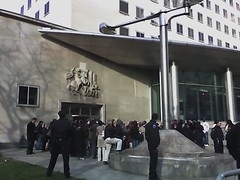
Last day for sean bell shooting trial
Originally uploaded by swan lake samba girl via mobile.
Press lined up outside courthouse for interviews with bell family and attorneys.
Last week ended with the defense resting, then making a motion to dismiss the charges for legal insufficiency — a standard motion made in all criminal cases and one that almost never wins, but that is necessary in order to preserve issues for appeal (and for the attorneys to avoid claims that they were ineffective).
Right before the defense rested, they entered into a stipulation (agreement) with the prosecution that all of the minutes of Grand Jury proceedings, witness interviews with the District Attorney, and witness interviews with police officers, that were used throughout the trial to show a prosecution witness’s prior statement was inconsistent with what he or she said at trial, were accurate. This was legally necessary for the defense to prove those prior inconsistences, but it also gave the defense the chance to give a little round-up of all the prosecution witnesses’ inconsistent statements, as they went through them one by one. The inconsistencies ranged from pretty harmless (Mr. Dossantos, the owner of a bullet-pierced car, said at trial his wife told him about the car’s damage but told the Grand Jury it was an unidentified man who notified him of that), to those going to the heart of the case (Fabio Coicou, aka “SUV guy”, told the DA in an interview shortly after the shooting that someone in Bell’s party said, “we can take you right now” and “we’ll get the gat (gun)”, that Bell told his friend not to reveal his real name, that Coicou was scared the men were going to “charge” him, and that he saw the some of the Bell party men “peeking” around the corner after walking away and feared they “were going to go get whatever to do whatever”, yet claimed at trial that he never heard or thought any of those things). There were 11 such inconsistencies in all, but I think Coicou’s were the most important.
The defense motion to dismiss the charges for legal insufficiency was full of legalese and I’m sure mind-numbingly boring to most people, so I won’t go into it all, except the one part I found interesting. Anthony Ricco, Detective Isnora’s attorney, pointed out that there have been no cases in this country involving on-the-job police shootings of suspects who ended up dying from their gunshot wounds in which the prosecution has proceeded on a theory of acting-in-concert to commit reckless manslaughter. Since it is not known which detective’s bullets killed Sean Bell or injured Joseph Guzman or Trent Benefield, in the prosecution’s original motion papers, they charged Detectives Oliver and Isnora with acting in concert to commit the reckless manslaughter of Bell and reckless assault of Guzman and Benefield by aiding each other in firing (a theory others have noted is problematic). To substantiate that theory, the prosecutor cited a case called People v. Russell.
But, Ricco pointed out, that that case involved gang warfare. In that case, two rival gangs open fired on each other in a crowded area, thereby killing innocent bystanders. It could not be determined exactly whose bullet killed each victim, so all of the shooters were charged together with acting in concert to commit reckless homicide.
But this case is wholly different, Ricco said. Here, there were not two violence-prone gangs so caught up in murdering each other that they grossly disregarded the welfare of innocent bystanders. Rather, this case involves a group of police officers trying to maintain order and peace in the community, trying to prevent violence, not cause it. To allow Oliver and Isnora to be convicted on a theory of acting in concert to commit reckless manslaughter, akin to gang members, would be anathema to public policy, to proper policing functioning.
The District Attorney (this time in the form of eloquent but soft-spoken John Castellano, head of the Appeals Bureau, approaching the podium for the very first time this case), responded to this particular argument, by saying that there were other cases of acting in concert to commit recklessness manslaughter that did not involve all out gang warfare (albeit none involving police officers acting in the line of duty), that the theory wasn’t that unusual here, and that the People reserved the right to argue under a variety of theories, such as that Isnora set in motion a chain of events that ended in Oliver’s shooting, and both men could be found guilty by acting alone.
Ricco countered that it would violate due process for the People to change theories at this late date and asked, regarding that causation theory, where one would draw the line at who set what in motion: was it when the car hit Isnora that the events were set in motion, when Isnora put on his badge that night, Ricco queried. One could argue, the events culminating in the shooting actually began when the team decided to try to make one last arrest at Kalua that night.
The acting in concert issue interested me though. Even theoretically, notwithstanding the specific facts of this case (ie: Isnora’s witnessing the fight between the Bell group and Coicou before the shooting, Isnora’s thinking Guzman was reaching for a gun and Bell was trying to run him over with the car), but just theoretically, are police acting in the line of duty, who end up killing or seriously injuring innocent people, akin to a gang involved in illegal activity doing the same? Would it deter police from properly doing their jobs to hold them so accountable?
Anyway, Justice Cooperman, as expected, denied the motion to dismiss. That means, as a matter of law, he held that the charges were sufficient to proceed to the finder of fact — here, himself — to determine whether as a matter of fact, Oliver, Isnora, and Cooper committed the crimes charged. Monday morning begins summations, and then Cooperman will likely take several days to deliberate, issuing his verdict probably late next week or the following week.
Yesterday wrapped up the defense case. They’re supposed to rest when court resumes on Thursday, followed by closing arguments, and Justice Cooperman’s decision, likely next week. I can’t believe it’s almost over. I’ve struggled to wake up at 6:00 every weekday morning for the past seven weeks, but I’m honestly sad. I feel like I’m going to miss all the court officers, the friends I’ve made, watching the judge and defense attorneys and Bell family and supporters and overhearing Detectives Endowment Association members, and just the crazy goings-on in and around the courthouse.
Yesterday’s testimony was rather bland. Alexander Jason was re-called from Monday, for his cross-examination, during which nothing all that important (in my mind) was elicited. He didn’t perform his bullet-through-the-lampshade experiment with a screen in place — and a screen did cover Mrs. Rodrigues‘s window — but he said that would have had no difference on the speed of the bullet as it pierced the window and shade; shade still couldn’t have stopped the bullet if it was traveling at full force.
Also testifying was James Gannolo, another expert called by Detective Oliver. Gannolo, a retired NYPD detective, was declared by the court to be an expert in firearms identification and microscopic examination and comparison of ballistics evidence. He testified about five specific pieces of ballistics evidence: 1) a deformed bullet fired from Oliver’s gun found on the side of the street was damaged in a way that indicated it had ricocheted at an angle off another hard object; 2) a bullet fired from either Oliver’s or Carey’s weapon found all the way down the street from where the collision of the Altima and police van occurred had struck something hard and fragmented severely before ending up where it did. That bullet also had foam stuck to it — so it passed through something containing a foam filler; 3) another deformed bullet fired from Oliver’s gun found by the gated area Bell’s car struck when it reversed had struck a hard surface before landing where it did; 4) the bullet found in Mrs. Rodrigues’s lampshade, which was fired either from Oliver’s or Carey’s gun, was damaged in such a way that it had struck a hard surface at an angle before piercing her window and ending up in the shade; and 5) a bullet from either Oliver’s or Carey’s weapon found in a Mercury Villager parked on the street had also ricocheted off of a hard object at an angle before ending up where it did.
Unable to tell what all of those bullets may have deflected off of before landing where they did, Gannolo said with all of the ambulances driving down the street, emergency workers, and police officers running around, a lot of the small light-weight bullets and shell casings could have been scattered and moved away from their original landing position.
So, much of the defense case was devoted to the lesser reckless endangerment charges. If bullets were ricocheting this way and that before ending up in living rooms and cars and Air Train stations and other places where people might be, it negates that the officers misfired, and would seem to lessen their responsibility for where those bullets ultimately went.
The day ended with the defense admitting into evidence the entire taped interview officers who responded to Mary Immaculate Hospital shortly after the shooting conducted with Trent Benefield. They played the tape in court and also had prepared a typed transcript for the judge to follow along with the tape. Unfortunately, I could hear very little of the warbled talking on the tape and could hardly see the small type on the court monitor from where I was sitting. Next time I have to get a press pass so I can sit up front! — although I don’t know if they could see much better…
Anyway, I heard Benefield tell the officers he was definitely shot while in the car, which is why he got out and started running (although he also said at trial, he was shot in the car, but also shot while running, so I don’t know how contradictory that is). I heard him say Bell’s car hit the van, then reversed, then went forward and hit it again, whereas at trial he said there was only one collision. I also heard him say on the tape that he didn’t know Isnora was a police officer. Benefield didn’t see a shield and didn’t hear him identify himself and had no idea why he was shooting. He’d told the officers “you all shot us for nothing,” shortly thereafter because he quickly figured out what had happened once he was being cuffed and arrested, which all supports what he said at trial.
That’s all I could hear of the tape. There may well have been more of significance that I could not hear.
Last night, News Channel 2 broadcast a short interview between reporter Pablo Guzman and Sean Bell’s parents, Valerie and William Bell. In court everyday, they said it was difficult but necessary to relive everything. Mr. Bell broke down at one point and had to excuse himself, which Guzman said he didn’t expect. When asked whether they thought there would be violence or protests if the verdict was acquittal on all counts, Mrs. Bell said, “whatever the verdict is, we just pray for peace.”
Today was not my day. First, on my way into the courthouse I was almost tripped by a cameraman running backward — literally running — to make sure he captured Nicole Bell and her attorneys on their entire way down the sidewalk and up the courthouse steps.
Then court got off to a very late start, due in part to the prosecution team’s (habitual) tardiness, followed by a lengthy side-bar. I could see Isnora’s attorney Anthony Ricco getting into it with Assisant D.A. Peter Reiss, but could only see lips moving. In my notes taken during this time I have: “Oliver chatting up pretty female court asst., as usual. Isnora sitting still looking down as usual. Cooper fiddling with something in hands. Front row sketch artist drawing beautiful portrait of the three def’s — should sell her work in a gallery.”
Then, during lunch the place I ate at — Samurai something or rather — a teriyaki place on Queens Boulevard, was closed down by the Health Department just as I was wondering if the cabbage tasted a bit off. I was sitting up front, near the window, along with a couple other female patrons, as a woman walked up and smacked two huge yellow signs on the door and window reading, “Closed By Health Department For Health and Hygiene Violations,” then promptly walked away. The two women near me and I all looked at each other. “Ah, ‘xcuse me,” said one woman, standing up and shouting to the servers in the back. “You just got shut down.” They didn’t seem to hear so she said it louder, this time flailing about. “Excuse me! The Health Department has just shut you down.” At this the several Asian women behind the counter along with the half dozen patrons currently ordering food all looked up at us. A woman behind the cash register simply nodded, and the whole lot of them went back to doing what they were doing. “They don’t care,” said the woman to me in disbelief. Right then the woman’s boyfriend walked in. He’d apparently been parking the car while she came in and got a table. “Okay, what do you want,” he said excitedly walking toward the food line. “What? You blind?” she yelled at him. He looked stunned. “I ain’t eatin’ here now,” she said pulling him by the coat sleeve toward the door. “Only in New York,” she said to me shaking her head as they left. I looked at the woman on my other side, then down at my veggie teriyaki bowl. We both laughed nervously. I finished my Coke, threw the rest of my food away, and went to the card store next door to get a candy bar, which became my lunch. My sugar-filled meal ended up giving me a decent-sized headache.
Anyway, the testimony:
First on was Nelson Rafael, a 21-year-old college student who was living with his family in a house around the corner from the end of Liverpool Street where Trent Benefield was stopped. He said he was watching TV with the volume low around 4:00 a.m. on the morning of 11/25 when he heard at least two male voices shouting, though he couldn’t hear what they were saying. Soon thereafter he heard continuous gunshots. He peeked out his window to see an officer arresting Benefield. The significance of his testimony is that he heard shouts from quite far away (judging by the photo shown in court, his house was all the way at the end of the block and slightly around the corner, so he heard the shouts from over a block away), and the shouts preceded the shots. He knows no one on either the prosecution or defense side.
Next was Alexander Jason, from California, called by Det. Oliver. Jason’s an expert in just about everything from forensic psychology to blood stain pattern analysis to wound ballistics identification, to shooting incident reconstruction, including glass analysis. Using the NYPD Crime Scene Unit’s surveys, photos, lab reports and diagrams, and performing his own measurements and tests, Jason arrived at several of his own conclusions. First, by firing a gun similar to that used by Det. Oliver, he found that, firing continuously, he took 4 1/2 seconds to fire the first 16 shots, and 12.3 seconds to fire all 31 rounds from both magazines. Since the trigger pull on his gun was slightly heavier than that of Oliver’s, it could have taken Oliver less time.
Next, Jason testified that when a shot is fired into a glass window, the glass can blow both inward and / or outward. So, when shots were fired through Bell’s Altima’s passenger-side window, and through the back windshield, the windows could have shattered entirely or mostly outward onto the street (thus, back toward the shooters), and not only inward into the car. (This testimony is likely meant to substantiate the detectives’ claims that they thought someone in Bell’s car was shooting out at them since the glass exploded in their direction).
Jason also examined the gunshot holes on Benefield’s pants, and compared them to those on his body. He concluded that, because the upper portion of the pants contained only two bullet holes — one going through the seat of the pants, the other through the waist-line — Benefield must have sustained the bullet wound to his thigh while he was in a seated position in the car, wearing the waist of his pants low down around his hips. The way the bullet holes were placed in his pants, he couldn’t have been standing up. These findings were consistent, Jason said, with the trajectory of a bullet hole in the Altima’s rear open door, and with blood splatters inside the back seat of the car. (So, the significance of this testimony is that, according to Jason, Benefield was not, as Benefield had said, running at the time he sustained the bullet wound to his thigh, but was likely still in the car, opening the door, and right before he emerged from it.)
Third, Jason analyzed the bullet hole through Mrs. Rodrigues‘s living room window. He found that the CSU detective’s measurements here were faulty, which you could see in a picture of the trajectory rod that CSU detective had placed through the bullet hole, which didn’t even come close to connecting with the lampshade. Jason said the way one should trace such a trajectory is by starting with the place where the bullet was found — here, the lampshade — then work backward through the window the bullet came through, to get the bullet’s proper trajectory. (This testimony made sense to me; I’d said earlier the CSU detective’s diagram appeared facially nonsensical.) Jason also performed his own gunshot analysis and found that there was no way a simple lampshade would have stopped a bullet fired from a Sig Sauer (Oliver’s type of gun), having pierced only a double-paned window. The bullet, if fired directly into the window, would have gone straight through that shade and continued on, striking other things in the house behind it. Rather, in order for that bullet to have landed where it did, it would have had to have ricocheted off of something else before going through the window.
Next, Jason testified that the bullet found inside the Altima’s engine would have had to have been fired when the Altima’s hood was ajar, after the third collision between the Altima and police minivan. There was no bullet hole in the Altima’s hood, and, if the hood was not somewhat opened, there was no way that bullet would have ended up in the engine without piercing the hood. Also, rubber transfers on the front bumper of the minivan are consistent with the Altima’s tires having rubbed up against it and rotated inward to the right of the van (showing, I assume, the Altima was trying to get around the minivan, which we already know).
Finally, Jason examined the bullet that pierced the window of the Air Train station (which was presumably fired by Cooper, though the bullet recovered was so deformed that couldn’t be said with certainty from the bullet alone). He found that if that bullet was fired from near the Camry, the gun was elevated upward at a 14-degree angle. The bullet was aimed right at the Altima, but would have passed right over it. Jason used a laser connected with a protractor to show us in court how, with such distance, one’s aim only has to be slightly elevated in order for the bullet to end up a great deal higher than intended. Alternatively, the bullet that ended up in the Air Train station also could have ricocheted off of a hard object and gone upward, Jason said.
We didn’t get to hear the cross examination of Mr. Jason, since civilian witnesses called by Det. Isnora had arrived, and Mr. Ricco requested the testimony be taken out of sequence. So, there may be more elicited from Jason later in the week, on cross.
Isnora called two character witnesses: Neftali Agosto, the pastor of his church; and Omar Santiago, a childhood friend of his who is now also a police officer. Agosto testified that Isnora has been a member of his church for over 20 years, beginning when his mother would bring him to church as a child. Isnora had later stopped coming to church, but returned to regular attendance about a year and a half ago. Agosto, who was very close friends with Isnora’s family, said he was surprised when he learned Isnora had joined the police force. He knew Isnora as a “very quiet, soft-spoken, nonconfrontational person.” He knew Isnora had a reputation in the church community (the only way to establish character evidence in NY is through knowledge of the defendant’s “reputation in the community”) for peacefulness and honesty through speaking to members of the church, and his own and Isnora’s families.
Santiago, 31, was a lifelong friend of Isnora’s. Both men grew up in the same Brooklyn neighborhood, worked as lifeguards together, attended John Jay College of Criminal Justice together, and eventually become police officers. Santiago said Isnora has a reputation in the community where they live for peacefulness and honesty. Interestingly, just like Agosto, Santiago said he was surprised when Isnora decided to become a police officer, because he was so “nonconfrontational, quiet, and calm.” “We said we can’t see him as a police officer, he’s so calm,” Santiago said he and their mutual friends had thought.
Today marked the beginning of the defense case with testimony by police officer Michael Carey, who was in the unmarked minivan with Detective Oliver. (Officer Carey is uncharged; Det. Oliver is one of the two officers charged with manslaughter. For the record, Carey and Oliver are white; the other three officers who fired their weapons are black.) Carey seemed honest and was well-spoken, and seemed to have a pretty clear memory of the events. His account made Lt. Napoli, the one in charge of the whole operation, look totally negligent, while exonerating defendant Det. Isnora. From his point of view, it looked to Carey as if Bell’s car had intentionally tried to run over Isnora, both when it first went forward, then when it backed up. He said he thought this because of the path the car took.
Carey, 27, has been an officer for 6 years, having mainly served routine uniformed foot patrol until July 2006, months before this shooting, when he was transferred to the street narcotics enforcement unit to work in undercover “buy and bust” operations. In September 2006 he was transferred to undercover work in the Vice Unit, and in October to the Queens Enforcement Unit. (So, most of the officers here were new to undercover work in general, to the Vice squad in particular, and had only weeks before the shooting been assigned to the Queens Club Initiative.)
On the night of 11/24/06, Carey and Oliver were assigned to drive the ‘prisoner van,’ meaning their duty was to transport anyone arrested by Det. Headley, designated arresting officer that night. The two decided Oliver would drive and Carey would “record” or sit on the passenger side. They arrived on the scene around 12:30 a.m. on the morning of the 25th and parked a few blocks away from Kalua Cabaret.
After notifying Lt. Napoli they were in place, Carey saw the two other team cars — Napoli’s Camry and the car the undercovers occupied (which included Sanchez, defendant Isnora, and two female officers), drive by. A little before 1:00 he saw Isnora and Sanchez walk by on their way into the club, and soon after heard from Napoli radio that the undercovers were in the club.
Around 2:00, Napoli radioed an update, saying the undercovers were still in the club, nothing much was happening, and to “stand by.” Around 3:00, Napoli radioed again saying the undercovers were still inside, still no action, and to “stand by.” Around 3:40, Napoli again radioed saying the undercovers had a possible prostitution situation and were watching a large black man wearing a black jacket and White Sox hat whom they thought had a gun because of threatening gesture’s he’d made. Napoli told them to stand by for further description.
Soon, another communication came over from Napoli, this one telling the team the prostitution situation was negative and that the undercovers were still watching the man fitting the prior description. Napoli told Carey and Oliver to “move in.”
Oliver and Carey drove closer to the club, and parked around the corner. Carey put on his bullet-resistant vest, and they waited for further instruction.
A few minutes before 4:00, Napoli radioed again saying the undercovers were now outside the club looking for the man with the White Sox hat and black jacket whom they believed had a gun.
In the next transmission, a couple of minutes later, Napoli said one of the undercovers was following that same man — the big black man wearing a black jacket and a White Sox hat — out of the club. They believed he was going to get a gun.
Napoli told Carey and Oliver to “follow them.” However, Napoli neglected to tell the men both where the undercovers and the White Sox man were and which undercover he was speaking of — Isnora, Sanchez, Cooper? Carey radioed back Napoli asking him where the undercovers were, where were he and Oliver supposed to drive to? And exactly which undercover were they looking for? Napoli never responded. Carey asked again. Again no response.
Not knowing what to do, Carey and Oliver began driving down the street toward the club, when they happened to see Napoli’s Camry driving further down the street. They sped up to catch the Camry so they could follow it, the Camry being the only reference point they had. Carey believed they were looking for a large black man wearing a black jacket and a White Sox hat. He also looked for any of his undercover team members.
When the Camry made a right turn onto Liverpool Street, Oliver and Carey followed in the van. He estimated they were going about 40-45 mph when turning the corner, as they’d had to “slow down.” Seeing the Camry’s break lights light up up the block, Carey realized they were stopping, and told Oliver to stop, which Oliver did. Carey then saw Isnora on the sidewalk. He had his gun in his right hand and was walking from the sidewalk to the street toward an Altima, which was parked on the side of the street. That car had its headlights on.
Carey heard Isnora yelling, “police, show your hands, police, show your hands.” Suddenly, the Altima revved up its engine and pulled out of its parking spot at a fast speed — according to Carey, it was the fastest a car could go if it was just pulling out. The car went in the direction of Isnora, hitting him in the leg. Isnora wasn’t directly in front of the car, but off slightly to its side. Isnora didn’t fall, but stumbled and regained balance.
The Altima then sped out into the street, colliding with Carey’s stopped van. Bell put his car in reverse and backed up. It looked to Carey like the way Bell had turned his steering wheel in order to back up, he was going directly toward Isnora, making Carey think the Altima was trying to run Isnora over.
Isnora, yelling “police, don’t move, police, show your hands, police, don’t move,” jumped out of the way, and the Altima crashed into a pull-down gate over a building’s entrance.
Thinking the Altima would take no further action at this point, Carey began to get out of his car. He had one leg out, one leg in, when the Altima sped forward again, crashing into the van again. Carey tried quickly to get back into the van, the car door hitting his leg on his way in. [He eventually needed surgery to repair torn ligaments in his knee which he sustained when the door closed on his leg. When asked by defense counsel Anthony Ricco if he had filed a multimillion dollar lawsuit against the police department for that injury (as had Guzman for the 19 bullet wounds and permanent neurological damage he suffered), Carey said no, but workers’ comp had paid for everything.]
When the Altima crashed into the van the second time, its engine was still going. Isnora started yelling, “he’s got a gun, he’s got a gun” and fired two to three shots at Guzman, in the passenger side of the Altima. Carey jumped out of the van and fired three shots at Guzman as well, believing he was the man Isnora had yelled had the gun. He came to that conclusion mainly because there was no way the driver — Bell — could have made the deft turns of the steering wheel and shifting of gears so quickly if one hand was holding a gun; he’d need both hands for those maneouvers. Carey didn’t issue any commands himself before firing because Isnora’s directives obviously didn’t work; he felt they’d be futile. He could only see Guzman from the chest up; he saw him moving his torso onto Bell’s side, leaning over into Bell’s seat.
Noticing Isnora was walking into his line of fire, Carey lowered his gun and stopped shooting, not wanting to hurt Isnora. He ducked behind the passenger door. He quickly looked out past the car door and saw Benefield open the back Altima door and run down the street. Benefield fled with a severe limp, dragging one leg behind him. Carey knew Benefield had been hit. Seeing Det. Hedley down the street, Carey knew he could get Benefield, so Carey didn’t bother following him. He also didn’t see anything in Benefield’s hands so didn’t consider him a threat.
Suddenly realizing the car’s door offered no real cover, Carey ran around behind the van. He knew the van’s engine was heavy enough it could be used for cover. By the time he got there, the gunfire had stopped. Carey went around to the driver’s side of the van, where he now began shouting, “police, show your hands.”
Carey walked over to Guzman’s door, opened it, and looked inside. He wanted to ensure his fellow officers were safe and that there were no guns within reachable distance of the men inside the car. He saw no such guns. Instead, he saw Guzman lying nearly on top of Bell, both men completely silent and still. Carey thought they were deceased. Seeing Napoli at Bell’s door, Carey stepped back and let him take over. He soon saw Oliver running back to the van. He was impressed because Oliver was on the radio telling central to send over ambulances and backup. Carey would never have thought to do such a thing at that point.
Carey wore his police badge around his neck, but had his sweatshirt over it, covering it. He never saw Isnora from the front, so couldn’t see whether he was wearing his badge during the shooting, but saw him seconds after, when he noticed the police badge pinned to the collar of his sweatshirt. Mr. Ricco presented Carey with a newspaper photo showing all of the officers involved, including Isnora. In the photo, his badge is pinned to his collar. Carey said the photo was taken soon after the shooting.
Carey said Isnora seemed like a “confident undercover” who’d performed several successful operations. Carey described him as a “laid back,” “quiet,” “reserved” guy who was “friendly enough” the few times Carey spoke with him, and able to “blend in well” with the community, making him a “good undercover.”
On cross, ADA Testagrossa elicited that Carey waited until both feet were firmly on the ground and he had an identifiable target to begin firing. I assume this was supposed to indicate that Det. Cooper was reckless when he fired into the Air Train station because one foot was in, the other out, of his car door. But why wasn’t it ever established in the People’s direct case that that was how an officer is trained to fire, with both feet on the ground? Is this all supposed to be obvious? I don’t get this “back door” proof. In general, at the end of the People’s case, I feel confused more than anything, like something is just missing. I hope closing arguments will bring things together and make clear what everything was intended to show.
Carey heard Isnora shout the commands, “police, don’t move” and “police, show your hands,” close in time to each other. (It seems to me, Isnora probably gave the “show your hands” command up front, and changed it to “don’t move” after the Altima started moving, meaning, “stop moving.” Still, the two commands shouted around the same time are contradictory and confusing, assuming Guzman and Bell ever even heard them, which I don’t think they did).
Carey couldn’t ever see Guzman’s hands, so never saw him move them in a way that indicated he was reaching for a gun. He fired at Guzman because he believed someone in the car had a gun because of Isnora’s words and knew it couldn’t have been the driver. He also thought because of the car’s movements, the occupants were trying to harm Isnora. This the first time Carey’s ever fired his gun in the line of duty.
Yesterday was the biggest day in the trial so far: Joseph Guzman testified. Guzman is by far the most important prosecution eyewitness: unlike Trent Benefield, who was intoxicated and somewhat high, and sitting in the back seat during the shooting, and the other eyewitnesses who only saw part of the events that night, Guzman is the clue to just about everything at issue: how out of hand that fight with Coicou got beforehand, whether he ended up telling Sean Bell or anyone else to “go get my gat,” and whether the police officers ever identified themselves as such and commanded everyone not to move before firing.
Guzman’s responses to all above questions were a resounding “No.”
Overall, Guzman seemed to me to be telling it like it is, honest, for the most part, though his testimony conflicted with others’ in some significant points, perhaps owing to mental fogginess due to substantial blood loss and oxygen deprivation after the shooting, perhaps honestly forgetting certain details, or perhaps leaving them out purposefully.
Guzman is a very large man, who walks slowly with a pronounced limp and uses a cane. In comparison to Benefield, I can see someone thinking he is somewhat “tough-looking” though judging books by their covers, as this case makes more than clear, can be fatal, sometimes criminal. He was very composed, dressed professionally in a suit, but became angry and somewhat belligerent during cross, especially when questioned by Anthony Ricco (Isnora’s attorney). At points, cross became a bit of a Ricco / Guzman showdown. Ricco twice asked the judge to seriously consider evacuating the courtroom of spectators because of unrest over his questions. If he’d have got everyone kicked out of the room, I’d have been so mad; I am always quiet as a mouse!
Anyway, Mr. Guzman, 32 and engaged with two children, is not currently employed, though he’s worked previously in masonry. He has two prior convictions: one in 1995 for reckless endangerment, for which he served three years; and one from 2002 for selling crack, for which he received 2-4 years, being released about a year before this shooting. (On the 1995 reckless endangerment case, the complainant had accused Guzman of acting in concert to rob him with his friend, who had a gun, though Guzman did not wield a weapon in that case. Long story short, Guzman eventually pled guilty only to reckless endangerment).
Guzman was close friends with practically everyone in Bell’s group of friends, having met Bell through Johnell Henkerson, whom Guzman had known all his life. He knew Sean “real well,” seeing him “everyday.” He was in the infamous rap band, but was not a rapper or a writer, he said with a self-conscious laugh. Years ago they put out a CD in order “to make money, like anybody else.”
He’d been to Kalua 3 or 4 times before the fatal night. He arrived at the club late that night, around 2-2:30 on the morning of November 25th. Henkerson drove him, but not in Henkerson’s Mercedes; in his cousin Elliot’s car. Henkerson had to turn around and leave, however, after dropping off Guzman, because he had to drive his underage cousin home. (Henkerson later returned; his testimony is here. Henkerson said he drove the Mercedes to the club, which is significant since the defense suggestion seems to be that Henkerson may have had a gun in the Mercedes).
After being thoroughly searched, Guzman went to the back of the club and joined Sean Bell’s bachelor party. Guzman drank only one Vodka and cranberry juice; he was diabetic and couldn’t drink much.
Around 4:00 a.m., the lights dimmed, indicating the club was closing. He and Sean were planning to go to the Flagship Diner for food, then home. (Henkerson said Sean was staying with him so he wouldn’t see Nicole until the wedding; Guzman knew Sean wasn’t seeing Nicole until the wedding but either didn’t know or forgot that Sean was going to stay with Henkerson. Henkerson said he was standing at Bell’s car door talking with Bell moments before the shooting, but neither Guzman nor Benefield remember that, and defense attorneys have asked the two if they are trying to distance themselves from Henkerson and if so why).
When Guzman left the club he saw Coicou standing in front of his SUV, in front of Kalua. Coicou had his right hand in his jacket pocket, and was talking to members of the Bell group; he stood sideways in front of them, holding his hand in a manner that indicated he had a gun. Guzman in fact thought Coicou had a gun. Coicou was saying, “I don’t fight no more, I don’t fight anymore.”
Guzman said, “What’s going on?”
James Kollore said, “I’ll take your gun.” Guzman didn’t hear Sean say that as well, only Kollore. (Jean Nelson said Sean said it as well as Kollore.)
Guzman said, “Listen, we’re not going to get into this tonight.”
Coicou said, “I’m from Far Rockaway.”
Guzman said, “I’m from Far Rockaway too, but that means nothing. We had a good time and we’re outta here.”
Guzman said he never said “go get my gun” or anything of that nature, never substituting a slang term for “gun.”
Guzman and the group walked to the corner of 94th Avenue and Liverpool, when Coicou drove down the street and passed them. At the corner, Coicou indicated for Guzman to go ahead first, but Guzman motioned to him to go ahead. Coicou passed them, drove down the street and turned at the next corner. Guzman, Bell, and Benefield got into Bell’s car (Bell in driver’s seat, Guzman in front passenger, and Benefield in rear driver’s side). The windows were all closed since it was cold outside.
As they were pulling out of their parking space and driving into the street, suddenly a minivan collided head-first with them. At that point, Guzman saw Isnora (whom he identified in court, pointing at the defense table and saying “that kid over there”; Isnora was the only officer he could identify, which I bolded because newsreports have erroneously stated otherwise). Isnora was standing in front of him holding a silver gun, which he pointed at the front windshield. He saw him shouting but didn’t hear him say anything. He didn’t see a police badge and had no idea who he was.
The next thing he knew, Isnora had shot him, striking him on the upper right shoulder right above the breastbone. (In court, he pulled down the collar of his shirt in order to show the judge his bullet hole.) Guzman’s arms were just hanging around his waist; there was nothing in his waistband. At that point, everything to Guzman slowed down, went into slow motion; the first shot “was like wind.” He looked into Isnora’s eyes.
Guzman told Sean, “let’s go, let’s go, let’s do it. This is not a robbery; he’s trying to kill us.” Guzman felt himself get struck again, over his right shoulder. He saw Isnora fire that shot too. Guzman then saw a white man standing at the minivan’s passenger-side door (this had to have been Officer Carey). That man had a gun pointed at him as well. Guzman began trying to turn himself sideways, to lay down in Sean’s area so he wouldn’t be shot again.
Sean put the car in reverse, backed up, and hit something, then shifted into drive and tried to pull back out and get around the minivan. But he hit the minivan.
The gunfire was continuous throughout this time. “This dude was shooting crazy, like it’s a take-out,” said Guzman pointing at Isnora. Guzman continued trying to reach across Sean’s seat in order to avoid the gunfire coming into his passenger-side area; he tried to reach across and get to the door. While doing so, he grabbed a handful of shattered glass from the shattered driver’s side window, slicing his palm, for which he eventually received stitches. While trying to get out the driver’s side, Guzman was shot on the top of his back, on his torso, in his buttocks several times, four times in his right leg, and the last bullet hit his left ankle. He sustained 19 bullet wounds altogether.
Guzman saw Trent Benefield open the back door and flee. After he did so, all gunfire and attention shifted to Benefield. The shooters shot at him, and eventually Guzman saw Benefield fall (though, according to a photo taken by CSU detectives of the scene, there was no way he could have seen Benefield fall from where the car was located. I took this not as a lie, but as Guzman’s mind, woozy from blood and oxygen loss, misremembering, after knowing what eventually happened to Benefield).
When the fire ended, Guzman’s arms were outstretched, his neck and arms now outside the driver’s side window, Sean underneath him. “There wasn’t much left,” when the gunfire ended. Guzman said to Bell, “S, I love you, son,” and claimed Bell said the same to him, though the medical examiner said that it wasn’t possible for Bell to speak after being shot in the larynx; another instance of Guzman’s mind playing wishful tricks on him while foggy). Guzman thought “it was all over” for both of them. (Sean Bell’s parents left the courtroom briefly at this point; Mrs. Bell crying.)
Soon, an undercover officer approached him, said, “let me see your fuckin’ hands,” and handcuffed him. Around the same time, the paramedics arrived. They arrived fast (Guzman’s emphasis). When the EMT opened the car door, Guzman’s head hit the ground, and he sustained an abrasion to his chin. It was then he realized the men who shot him were police officers.
He was taken to Mary Immaculate Hospital, where he stayed until December 12th, when he was transferred to Jamaica Hospital where he stayed for another five weeks.
Guzman sustained 19 bullet holes, 7 bullets lodging inside of him (two of them had been removed, one came out on its own, and four remained inside), permanent nerve damage to his foot, resulting in “drop foot” (which accounts for the limp), a shattered tibia resulting in a permament metal rod in his leg, and had holes in his intestines, lung, and ribs. He continues physical therapy for the nerve damage to his leg, visiting his therapist three times per week for 2/12 to 3 hours at a time.
Glaring at the detectives in the Detective’s Endowment Association group, who occupy the first two rows of the defense spectator seats, Guzman said he had joined in the $50 million lawsuit with Benefield against the NYPD. His health insurance didn’t come anywhere near covering his overall treatment, and remaining medical bills totalled over $20,000.
On April 19, 2007, he went to the doctor’s office to have another bullet removed. On that day, Henkerson had been shot in the neck. I couldn’t understand all of the testimony, but somehow undercover officers were at the doctor’s office when Guzman arrived with Henkerson, and while he was there, they confiscated Guzman’s keys, car, and wheelchair, not returning those items to him for over 1 1/2 weeks.
On cross, Guzman said he never carried a gun with him for protection, including when he was selling crack. “I don’t need protection,” he snickered.
He said he was not talking on his cell phone at any point during the shooting, though a picture of the car shows his cell phone opened on the passenger-side seat. He wears his cell phone clipped to his waist, he said on re-direct.
Benefield saw Isnora standing in front of the car before they pulled out, and at that point Guzman said “drive man, go, go, go.” Guzman said he never saw Isnora until they’d already collided with the van, and it was at that point that he said, “let’s do it, let’s go.” Guzman said they never hit Isnora; Isnora never jumped over the hood, but that’s what Jean Nelson saw.And Coicou had told prosecutors Guzman said to Bell “go get my gat”; Guzman said he never said that. When asked by Ricco whether he was pretending to have a gun for bravado purposes, or to call Coicou’s bluff, Guzman laughed and asked him where he was from. I don’t think Ricco ever answered, unless he did so under his breath, but Guzman kept asking, and the judge didn’t stop him and Ricco didn’t ask him to. They just kept going back and forth like that for a while:
“did you pretend to have a gun?”
“man, where you from?”
“did you pretend to have a gun?”
“where you from, man?”
“did you pretend to have a gun?”
“seriously, where you from?”
It was kind of funny that Justice Cooperman let this continue; I didn’t know when it was going to end. Later, Guzman said where he comes from, that’s really stupid to act like you have a gun if you don’t. Which led Ricco down the “and what did Henkerson (who was talking to Sean by the window before he started his car) have in his car?” road. “Where did you not have a gun?” he asked. To which Guzman said, “Oh come on, are you serious man, are you serious, are you serious?”
Before reading his Grand Jury testimony (in which Guzman said he first saw Isnora on the sidewalk, not on the street in front of the windshield), Ricco had his client rise. “And you say you saw this man…” Ricco began. “I’m not respecting anyone on that side as a ‘man,'” Guzman declared, and proceded to refuse, no matter how many times Ricco referred to Isnora as a man, to call him such, insisting on calling him “kid.” When Ricco asked him if he’d just made up that he first saw Isnora in front of the windshield, Guzman said, “you can’t make this up, man, you can’t make this up man, you can’t make this up.” For a good many seconds, every time Ricco tried to start a new question, Guzman’d say, “you can’t make this up, man.”
Finally, Ricco got a question in, asking, “I bet you was pretty tough out there on the street in front of Club Kalua…”
Guzman answered, “You don’t know me. Yeah, that’s what you would think.”
“No one gets anything by with you, do they?” Ricco said, referring to Coicou’s antagonizing him.
“You really don’t know me,” Guzman said snickering and shaking his head.
Ricco asked, “did you recognize Isnora at the club as an undercover officer? Was Coicou trying to hint that Isnora was an undercover officer?” (Coicou had testified that this is what he was trying to do).
Guzman smiled and rolling his eyes, asked again, “Are you serious, man?” Guzman then said he didn’t even know if he truly believed Isnora was in that club that night.
Guzman had told a uniformed officer at the scene, while he was being removed from the car onto the stretcher, “you all shooting us for nothing! We have nothing in this car, no guns, nothing. You all shooting us for nothing!” Ricco asked Guzman how he knew officers had shot him; who was the “you all?” Guzman now got really mad; he said loudly, “that officer (the ‘let me see your fuckin’ hands’ one) was there too quick.”
Guzman is clearly street smart. Bleeding and lightheaded from lack of oxygen though he may have been, he probably could piece together pretty quickly what had just happened. But he also seems like the kind of guy who would have spotted a police badge a mile away. Unless it just all happened so quickly…
Today, Dr. Albert Cooper, the emergency physician who treated Guzman, testified about Guzman’s many wounds, some of which were life-threatening. He sustained 19 bullet wounds in all, including one on his upper jawline, a couple on the right side of his chest, a couple in his abdominal area, several in his right thigh, several in his lower leg, several in his buttocks, and two on his back. There was also a deep laceration across his palm. He had trauma to his lung and urinary tract, and his small and large intestines and colon were pierced, causing dangerous toxic leakage of fluids into his surrounding tissues. His tibia was shattered and he had seven bullets in his body.
Dr. Cooper immediately operated on Guzman, repairing his intestines and lung, the most threatening of the injuries, then transferred him to intensive care for further management. Guzman sustained permanent neurological damage in the form of “drop foot,” making it difficult for him to control his lower leg, for which he continued to receive physical therapy. Dr. Cooper had since removed two bullets from Guzman’s body, and several remained inside him. He would also have the metal rod in his tibia permamently.
Toxicology reports indicated that Guzman’s blood alcohol level was only .041, below the legal limit of intoxication of .08, and Benefield’s was .11, above it.
The day ended with the prosecution resting. Tomorrow begins the defense.
Today’s testimony consisted solely of that of Trent Benefield, one of the three men shot by police detectives in Sean Bell’s car on the morning of 11/25/06.
Honestly, Mr. Benefield was not what I was expecting, after seeing Anthony South‘s on-the-scene footage of him handcuffed from behind and lying on the ground on his stomach screaming of pain in his legs and at paramedics that they were hurting him as they placed him onto a stretcher. Of course he was in serious pain at that point (when asked today by prosecutor Testagrossa on a scale of 1-10 how much pain he was in, he said “15”; the audience laughed), so his screams were understandable.
But today he was extremely well-mannered, very soft-spoken, very nervous-seeming, and very unimposing and unthreatening. No wonder several earlier eyewitnesses never even saw him get into Sean Bell’s car that night; he’s a small, quiet guy who could easily have gone unnoticed. Overall, Benefield seemed honest, at times admitting things against his interest (like having a marijuana addiction and being drunk when leaving the club that night), but because he was intoxicated and somewhat high, his ability to observe and remember events that evening were hindered. Also, he seemed sensitive, and because of the obvious stressfulness of the events, seems not to have seen it all. In any event, there were some real inconsistencies in his testimony.
A small, thin man, Mr. Benefield, 24 years old, had no prior covinctions, and, while currently unemployed, had formerly worked in a tire shop repairing tires. He had known Sean Bell for 6 or 7 years, and had met him through his lifelong friends, Johnell Hankerson (I can’t always hear very well in the courtroom, and may have spelled his name wrong earlier), and Joe Guzman (the other man in the car, whom I expect to testify tomorrow).
Benefield went to Kalua with Sean and James Kollore, in Sean’s Altima. After Sean parked and the three were getting ready to go inside, a police officer pulled up and asked Sean for his driver’s license and registration, which Sean gave him. After inspecting both, the officer returned them to Sean and told him to have a nice day.
After being frisked by the bouncer, the three ordered a round of Long Island Ice Teas, then went to the back of the club, where they were joined by others. Throughout the night, Benefield had three such drinks (though he’d told officers at the hospital, when medicated, that he had Hennesseys instead of Long Island Ice Teas), as well as two blunts of marijuana, which he smoked outside with Bone. Though admitting he had a marijuana addiction, Benefield only used, never sold, the drug. Benefield said he was “intoxicated” and “feeling nice” but not “high” from the marijuana when he and the Bell group left the club, around 3:40-3:45 a.m.
Benefield and his friend Larenzo Kinred were the last of the group to leave the club, as Benefield wanted to finish his drink. By the time he left, everyone was already outside. When he walked out, he saw Coicou standing in front of his SUV holding his right hand in his pocket as if pointing something, making Benefield think he had a gun. Benefield had told District Attorneys when meeting with them shortly after the shooting that Coicou said, “I got it; it’s in my pocket. I’ll shoot you.” He heard Coicou say to Guzman that he was from “Far Rock,” and Guzman respond that he was from Far Rockaway too. He didn’t hear anyone use the word “gun” or any slang for the word, and never saw Hankerson put his arm around Sean and tell him to calm down, as Hankerson testified he did. He never saw Sean return to the club to retrieve his hat.
They all began to walk toward Liverpool Street. As they rounded the corner, Coicou drove up, went past them, and made a right down Liverpool. The men continued on, Guzman, Sean Bell, and Benefield all getting into Sean’s car. Sean got into the driver’s seat, Guzman the passenger front, and Benefield the driver’s-side back seat, behind Sean. All car windows were closed; Benefield never saw Sean speaking with Hankerson through the window. Nor did he remember talking to Marseillas Payne, or her calling out to him from her car, as she’d said she did.
As soon as Bell started his car, Benefield suddenly saw a man (Det. Isnora) approach the car, holding a gun. He came right up to Sean, pointing his gun at Sean, and, since he was sitting directly behind him, Benefield as well. Benefield immediately covered his face with his hands, including his eyes. He saw nothing more, though he heard Guzman call out, “Go, go, drive, go.” He felt Sean step on the gas and felt the car “bump” something. It’s unclear whether the “bump” — Benefield’s word — was the car hitting Isnora or hitting the police minivan. The next thing Benefield remembered was hearing shots fired in rapid succession, with no pause. It was about two seconds between the collision, or bump, and the shots beginning. Benefield never heard Isnora say anything, and never saw anything on him (ie: a badge) to indicate who he was (ie: an officer)
Feeling himself get shot in both calves, Benefield reached over, opened the back driver’s side car door, and began running south, down Liverpool Street. As he ran, he was shot again, in the thigh, right below the right buttock. All officers who’ve testified at trial, or whose Grand Jury testimony we’ve heard, have said they saw Benefield running down the street but didn’t fire at him because they saw he was unarmed, so this testimony is interesting. I’d surmised Friday that it looked from one of the CSU detective’s diagrams like the shot that eventually went into Mrs. Rodrigues’s house appeared to have been fired from way down the street, not at all near Bell’s car, and that, unless it just ricocheted weirdly off of something else, someone may have shot at Benefield. Unfortunately, that bullet entered and exited his thigh, and, I think — unless it had blood on it and the blood could be traced to Benefield — we can’t tell which bullet that was. So, it may be impossible ever to know for certain who fired that shot.
And, Benefield said that he fell immediately after he was shot, which would have been further down near the end of the street, not in front of the Rodrigues house. So, that bullet must have been a bullet other than the one that went into her house. Unless of course, he just doesn’t remember cleary. Extremely complicated crime scene.
Anyway, after he fell to the ground, Benefield looked up to see a tall, dark, heavy-set man (Det. Headley, from the Camry) approaching him with a gun. He saw nothing on him to indicate he was an officer, and, seeing the gun, was scared. Headley told him to “stay down.” Benefield responded, “I didn’t do nothing. I got shot.” Someone told him to put his hands behind his back, and handcuffed him. He repeated that he was shot and needed help. Soon, EMS workers arrived to take him to the hospital, removing his clothing. He identified by photo all clothing found at the scene, besides the gloves and hat, as his. When asked on cross if the marijuana found near those items was his as well, and he said no, there were grumbles in the courtroom and the court officers swifty told everyone to be quiet. (Jean Nelson had testified earlier that the marijuana was his). Benefield didn’t remember cursing at police officers at the scene or getting angry at the hospital over the whereabouts of his jacket (an officer earlier testified, Benefield said, “go fuck yourself,” when he asked him for information and another officer said he’d got upset upon learning his clothing was missing.)
Benefield was at the hospital for 9-10 days, recuperating from the three gunshot wounds. He sustained a permanent injury to his calf: the metal rod holding the bone together. Unable to work since, he lived on payments from a charity organization and a bank loan. At the hospital, he learned the shooters were police officers. There is currently pending a $50 million civil suit against the city, of which he is a part.
The main problem in Benefield’s testimony is that he said he’d heard only one bump followed almost immediately by shots. But he’d told interviewing officers at the hospital about an hour and a half after the shooting that Bell’s car hit something, then reversed and crashed into something else, then sped forward again and crashed a third time: “my man, trying to get away, backed up into another car, then go forward.” Not knowing how to rectify the inconsistencies, he said he must have been mistaken in the hospital; that he “made up” that Bell’s car had reversed, hit something else, then crashed again. The officers taped their conversation with Benefield at the hospital, and that tape was played in court; Benefield acknowledged the voice on it was his.
On cross examination, defense counsels James Cullerton (for Det. Oliver) and Anthony Ricco (representing Det. Isnora) focused a bit on Benefield’s marijuana habit. Cullerton asked Benefield how he paid for it, saying sarcastically, “I take it you make a large amount of money working for the tire maker.” Benefield said he paid for the marijuana with money he earned, and that he didn’t know exactly how much of the money he’d received from the charity organization went for marijuana. And, after he said he must have “made up” the sequence of events to the officer in the hospital, Ricco asked Benefiel how much “reefer” he’d had that morning. Laughs emanated from the second two rows of the defense side of the courtroom (where all the officers sit). A court officer immediately yelled, “Quiet!”, which made me happy because at least everyone’s getting yelled at for making noise, not just those on the prosecution side.
I still found Benefield to be sympathetic, despite inconsistencies between his testimony and what he’d told the officers at the hospital that morning. It was a meaningless inconsistency for one thing — it doesn’t really make a difference whether Sean backed up and went forward again, does it??? It all happened extremely fast. I felt like Benefield was kind of caught on the spot after they played the tape recording of him talking to the officers in the hospital and the inconsistency was glaringly there, and then he didn’t really know what to say, so said he “made it up”. Did Testagrossa not adequately prep him for trial? And, then, all the questions about his marijuana smoking, which he admitted to doing, after all. Again, he’s being made, unnecessarily, into the bad guy, when the poor guy was shot after all and has a metal rod in his leg for life. Yes, the marijuana likely dulled his senses on the morning of the shooting, reducing his observational capacities and calling into question his memory of the events. But is he a liar because he has an addiction, which he may sometimes pay for with borrowed money?
I know the lawyers are doing their jobs, and they’re doing a superb job of pointing out significant inconstencies between witnesses’ trial testimonies and prior Grand Jury testimony or statements made to officers or DAs. But there is definitely something to the Bell family’s claim that the tables are being turned and the prosecution witnesses (and perhaps the black community, or at least a certain segment of it) are being put on trial here with all the focus on the rap lyrics, the 10+-year-old prior convictions, the marijuana habits. Regarding all of this, by the way, there’s a good but too short article in today’s NYTimes by Michael Wilson on Anthony Ricco, the black attorney who’s arguably attacking black prosecution witnesses in order to defend black defendant Gescard Isnora.
Friday was another short day. There was only one witness, another CSU detective, Michael Cunningham, whose testimony really only pertained to the reckless endangerment counts against Detective Cooper for the bullet that went into the Air Train station, and Detective Oliver for the bullet that went into the house on Liverpool Street.
Cunningham returned to the scene in June 2007, over six months after the shooting, to try to re-do all of the measurements and create a new map of the trajectories of the bullets that pierced the Air Train station, Mrs. Rodrigues‘s living room window, and Mr. Hernandez‘s fence. Cunningham had to do this because, after examining measurements done by prior CSU detectives, he realized there was no way some of the previously projected trajectories could be correct. For example, according to Detective Anzalone‘s measurements and trajectory tracings of the bullet that pierced the Air Train station, the shooter would have had to been standing several blocks further South from where the shooting actually happened (unless he was the 14-foot-tall shooter from previous cross examination testimony).
The problem is, by the time Cunningham returned to the scene to re-do the measurements, things were very different: the Air Train station’s windows had been fixed (so, obviously, the original bullet holes were gone), and Liverpool Street had been re-paved, making the curbside, street levels, and other measurements different from what they had been at the time of the shooting.
Nevertheless, Cunningham tried, using photographs of the scene and video stills from Anthony South‘s footage. He took more measurements and, using Crime Scene Unit computer software, drew some 3-D diagrams of the whole scene which were shown in court.
Cunningham found another bullet impact mark in the Air Train station, and traced its path to a point on Liverpool Street, this one on the block of the shooting. But this new placing is in a location nowhere near the point where Cooper said he shot from (and we know it’s his bullet which pierced that Air Train window). Not that Cooper couldn’t have exaggerated his position, been wrong about it, or even have outright lied, but the new placing doesn’t make much sense; according to the 3-D diagram, it was out in the middle of the street, not near any car, or any place where Cooper would have had cover. Cooper said he had crouched down inside the Camry, opened its door, stepped out with one foot, and, peeking around the car door using it for cover, fired at Bell’s Altima’s back window. But according to Cunningham’s new measurements, as shown on the 3-D diagram, Cooper would have been standing up, out in the middle of the street, shooting. Shell casings were found both in the Camry and in the street.
The diagram also showed the path of Oliver’s bullet that pierced Mrs. Rodrigues’s window. According to that diagram, its trajectory was a straight line to a point smack in the middle of the block, where no one was supposedly standing, far away from where Bell’s Altima was. I’d thought — and I thought that CSU detectives had surmised as well — that that bullet missed the Altima and went into her house instead, but according to this diagram, her house was nowhere even close to Bell’s Altima. Cunningham had no explanation for this. When asked on cross examination whether that bullet could have ricocheted from another point, after hitting some kind of hard surface, then changed direction and gone into her window, he said it was possible. Either that’s what must have happened — the bullet ricocheted, someone was shooting at Benefield as he ran down the street (which none of the eyewitnesses have testified happened, but we haven’t heard from Benefield yet), or else the diagram simply isn’t accurate.
In any event, the CSU evidence all seems to have created more confusion than answers. And people are angry at what seems, at best, to have been careless investigatory work all the way around. Advocacy groups, like 100 Blacks in Law Enforcement Who Care, are asking whether the NYPD may have even intentionally botched this investigation. Retired NYPD Detective Graham Weatherspoon, head of that group, said that Cunningham is known as a very good investigator, but was called in way too late. So, why wasn’t he called in to examine the original crime scene?