Brief Update & Review of Peter Martins / Paul McCartney Collab at NYCB

Hey everyone,

Just a brief update since this motel’s wifi is expensive and not secure: but I now have a car (a cute little Toyota Prius – used) as well as an apartment in LA that I love but that unfortunately won’t be ready for move in for two more weeks. Which means I’m back in Phoenix for the next two weeks, shuffling around between family who have space for me and who aren’t allergic to Rhea and pet-friendly motels. Once I’m settled in to my new place – which, again, I LOVE!!! – I will most definitely resume regular blogging.

In the meantime, I did see the much spoken about new Peter Martins / Paul McCartney collaboration – Ocean’s Kingdom – at New York City Ballet when it premiered a couple weeks back. NYCB has sent me some pictures but I don’t have time to post them now. I will soon! I liked but didn’t love the ballet. I thought the story-line was simplistic and not very compelling and didn’t love the choreography, although there were some good pas de deux between Sara Mearns and Robert Fairchild – the lovers. I very was impressed with Paul McCartney’s ability to create such a rich orchestral score – really lovely. I thought Mearns, Fairchild, Amar Ramasar, and Georgina Pazcoguin all danced very well. Ramasar, who as most of you know is non-white, danced the part of the bad guy… So sigh on that. But he danced very well. For the most part, I wasn’t in love with the costumes, designed by Stella McCartney, except Pazcoguin’s, which was lovely and worked well. I kept worrying Mearns’s was going to come off, an idea my male friend liked and wished would have come to fruition. It didn’t; at least not the night we saw it.

McCartney was in the audience and gave a big wave to the audience when Martins introduced him. He has big, big hair! He doesn’t look his age at all. Martins toasted him not with champagne but with a cup of tea. Alec Baldwin was sitting right behind him in the audience. I don’t recall seeing any other celebs there but I’m sure there were oodles.

Anyway, as I said, I promise to post pictures of that ballet as well as some others from the beginning of the season that City Ballet has sent to me as soon as I’m home and have a secure (and free) internet connection. This afternoon is Charles Askegard’s farewell performance, which I unfortunately won’t be able to see. I hope to see his new company tour LA though, soon soon soon!

Thank you so much for continuing to read my blog, everyone, when I’ve been too busy to post much lately! I very greatly appreciate everyone’s support through this rather huge transition in my life. Thank you again, and will talk soon!

Jose Manuel Carreno’s ABT Farewell


Thursday night at the Met, Jose Manuel Carreno, a longtime favorite of mine, gave his farewell performance with American Ballet Theater. (He will dance a few more performances with the company as they tour Los Angeles and Japan later this month, and he ended up filling in unexpectedly for an injured dancer in Saturday’s matinee, but Thursday was the night ABT celebrated his illustrious career).

He danced Swan Lake with Julie Kent as Odette and Gillian Murphy as Odile. Of course Odette and Odile are danced by the same ballerina but this was a special performance and so he chose to have not one but two ballerinas he’s often partnered throughout his career as alternating white and black swans.

Above photo is of the white swan pas de deux with Julie Kent. Below is of the black swan pdd with Gillian Murphy. All photos are by Rosalie O’Connor.


And below, of his curtain calls.


The performance was spectacular but not flawless. Jose danced wonderfully. I’ve personally been more moved by his performances in Romeo and Juliet and Manon, but then I’m more a fan of modern ballet choreographers like MacMillan, than classical ballet. I wish he would have danced one of those as his farewell but I totally understand why he chose Swan Lake – it’s only the quintessential ballet after all 🙂

The best part was Act III, with Gillian as the black swan. It was just amazing feat after amazing feat. I swear I’m pretty sure I saw Gillian put a quintuple pirouette in between her fouettes; there were definitely quadruples in there. I wonder sometimes if Natalia Osipova has not substantially raised the bar for this kind of thing. I feel like everyone’s trying so hard to do as many athletically stunning things as they can. I honestly almost screamed when she threw in the quintuple. Can you imagine someone actually screaming in the audience in the middle of the performance? Glad I managed to hold it in 🙂 Suffice it to say Gillian was definitely a thrill, and Odile is her forte. She did have a tiny stumble toward the end, coming out of the fouette sequence, but I’m not one to care about things like that. I personally care more that a dancer takes chances than plays it so safe she fails to move or wow the audience (as I think I’ve said a few hundred times by now on this blog). Then Jose followed her crazy fouettes with a turn sequence of his own, with more multiple pirouettes thrown in. It also seemed that some of their assisted pirouettes went on for, like, five minutes! At the end of the pdd, the applause went on for quite some time.

I should say, every time Jose did any kind of solo, no matter how small – a few turns, a few jumps, anything – the audience went crazy with applause. As they did when his Siegfried first entered the stage. I thought for a minute the orchestra was going to have to stop the story for him to take a bow, but he kept on going with the action, in character.

So, Julie Kent’s white swan: well, I think she is an absolutely beautiful dancer, and she does things that Sara Mearns and Veronika Part and other ballerinas I love as Odette either can’t or don’t do – like the fast tiny fluttering of the feet that really make her look swan-like, or the super quick changes of the feet between her traveling passees that make it look like she is really a swan about to take off in flight. Her legs and feet are super strong and she can attain really surprising speed and precision at certain points. And I was sitting in the back of the orchestra and I could still see that incredible footwork. And yet somehow I’m not nearly as moved by her as by Sara and Veronika. She doesn’t make me feel her pain or take me into her world the way they do. Maybe she’s just not as powerful an actress, although I thought she was very good in Lady of the Camellias. I thought Jose generally partnered Gillian better, which is interesting because she’s a larger ballerina. He lifted Julie high above his head just beautifully, but then there were some moments that the assisted pirouettes that went on forever and a day with Gillian were more problematic with Julie. At one point, Julie veered sharply to one side and I worried she’d fall. But she didn’t.

Still, it was a beautiful performance all in all.

This was my first time seeing David Hallberg as von Rothbart. (You can see him in one of the curtain call photos above, in the purple). He’s a beautiful, beautiful dancer. Seriously, I don’t think any man can dance as beautifully as David Hallberg, and I’ll go to any ballet with him in (with good choreography for him of course), just to see that. But. I like Marcelo Gomes better. I know that’s controversial, and I’ve been thinking a lot about how I’m not really a fan of classical ballet partly because of this (judging by the difference of opinion between myself and my classical ballet-fan friends), but I just don’t like black and white. I prefer sexy, charmingly dangerous von Rothbarts, not pure evil von Rothbarts. And David was evil. The way he masterfully whipped around that purple cape, the way he worked his facial muscles into a hard hard look, the way he approached the queen and each woman at the ball with intention, the way he pointed straight at poor Siegfried when he first arrived with Gillian. He scared the hell out of me. And I guess if you think von Rothbart is pure evil and should be portrayed as such, then there’s no one more perfect than David to dance him. The evil is tempered a bit by David’s beautiful dancing, which made him the second best von Rothbart in my opinion, just because it added a nuance that otherwise wouldn’t have been there. But Marcelo’s v.R.’s sexiness, his irresistible charm, his deviousness, make him so much more deliciously dangerous.

I was a slight bit disappointed in the curtain calls. I think I was spoiled by Julio Bocca’s farewell being my first at ABT. That man was such a prima, his curtain calls went on forever, ending with him in underwear (well, tights), taking his time drinking a beer, then dousing himself with it. Or was it champagne he poured all over himself? (Will have to look back at my old blog post.) Anyway, it was all as if to say, I’ve had a blast here, I’ve worked my arse off, and now I’m so so ready to let loose. This all would have been inappropriate for Jose though, especially since his two daughters came out onstage with him at the end, sharing his bows. So sweet. But yeah, no getting plastered and prancing around in underwear for him. Marcelo, David, and Cory did hoist Jose over their heads, as David and Marcelo did Julio.

A couple ballerinas from the past – Alessandra Ferri, Susan Jaffe – presented him with bouquets. And Julio himself was there as well. He walked out onstage toward Jose doing a hip-shaking little rumba. Almost all the principals were onstage at the end – Paloma Herrera in particular was dressed to the nines, which was sweet since she was one of his main partners. I didn’t see Diana Vishneva or Natalia Osipova or Michele Wiles. I was hoping Carlos Acosta might show, but no such luck.

Jose’s daughters are really beautiful. Afterward some friends and I went to Ed’s Chowder House for drinks and snacks and we were debating whether the older one was his stepdaughter with Lourdes Novoa or biological daughter. Does he have one stepdaughter and two biological daughters or one of each? Anyway, the littlest daughter looks to be a teenager now. She’s really beautiful. But she was just a baby not so long ago. I guess time does go by when you’re not paying attention. The audience didn’t seem to want to say goodbye. Finally, the curtains went down and the lights went on, management making clear it’s over, folks, go home. But people kept standing there kind of dumbfounded.

Well, I’m really going to miss him. I’m going to miss him as Basilio in Don Quixote, I’m going to miss him as both the harem owner and Ali the slave in Le Corsaire (like Marcelo, he’s endearing in every single role he has – how can one be an endearing  harem-owner? I have no idea, but just watch him), I’m going to miss him as Des Grieux in Manon, I’m going to miss him as Albrecht in Giselle (I think he was the only one who still did the Baryshnikovian brisees in his near dance to death scene instead of the entrechats), I’m going to miss his sexy cocky Latin sailor in Robbins’ Fancy Free, I’m going to miss his sexy cocky leading man in Tharp’s Sinatra Suites, and most of all I’m going to miss his Romeo. In most recent years, he’s been the oldest dancer in that role, and somehow the most boyish, the most innocent, the one who’s made me cry the most times at the end in that crypt with his Juliet draped lifelessly over his arms.

Well, I still have memories. And YouTube videos 🙂

More VIENNA WALTZES


Here are some photos of the most recent cast of Balanchine’s Vienna Waltzes that debuted at New York City Ballet last week. Top photo is of the radiant Sara Mearns, who had the main role in the final part of the ballet – “Der Rosenkavalier” – as the girl sweetly lost in her dreams during a moment alone in the ballroom. Bottom photo is of fairy-tale princely Tyler Angle dancing with Teresa Reichlen, from the first part of the ballet, the two young lovers waltz-frolicking in the woods. Both photos are by Paul Kolnik.


NYCB Spring Gala with SEVEN DEADLY SINS Premiere

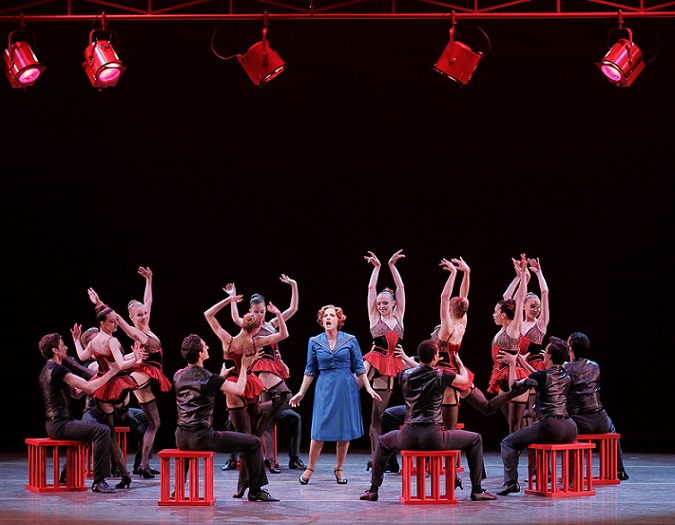
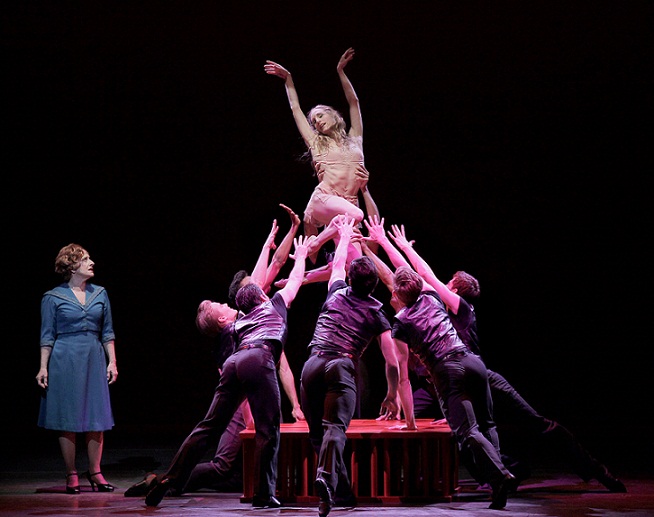
Here are some photos, all by Paul Kolnik, of Lynne Taylor-Corbett’s play-ballet, The Seven Deadly Sins, which premiered last night at New York City Ballet’s Spring gala performance. Above is Patti LuPone, who guest-starred with the company (performing the singing role of course!) and Wendy Whelan, who danced the lead. The top photo is from the “Prologue” of the play-ballet (or ballet chante as the program calls it).

This is from the second part: “Pride”: Patti LuPone and cabaret dancer ensemble.

Also from “Pride.” Wendy Whelan is in the middle.

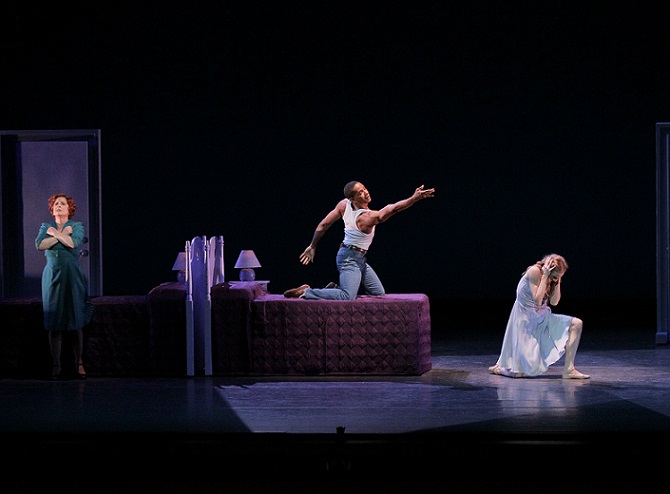
And this is from sixth part, “Lust,” probably my favorite over all. Craig Hall and Wendy Whelan are the dancers in the photo. Craig Hall and Sara Mearns (who danced the role of “Latina Diva” in the “Anger” section, and who I don’t have a picture of unfortunately), most stood out to me, as well as Vincent Paradiso as the Count in the “Greed” section. I think those dancers most stood out – at least Mearns and Paradiso – because they seem to have some kind of acting training. Maybe they don’t, maybe they’re just natural actor-types, but the more actor-ly you are, I think the easier this kind of role would be. Wendy Whelan said in an interview with Roslyn Sulcas in the New York Times that she was used to expressing herself with her body and her lines, that she was used to Balanchine’s dictum “don’t act, don’t think, just dance,” and that she found this kind of role challenging. As much of a NYCB star as she is, and as stunning as she is in Wheeldon and Balanchine’s more modern, angular-lined ballets, I just wonder if she was mis-cast for something like this.

Which isn’t to say that she didn’t dance very well last night. She danced a really beautiful pas de deux with Craig Hall, which is what made “Lust” my favorite section. And LuPone sang in a gorgeously powerful voice. The dancing was all superb. But something just didn’t work to me.

Balanchine choreographed the original Seven Deadly Sins, set to libretto and score by Bertolt Brecht and Kurt Weill, in 1933. The Balanchine version was revived in 1958. According to the Times article linked to above, both the original version and revivals received very good reviews. Since the Balanchine version appears to be largely lost now, and Peter Martins wanted to revive the ballet, he commissioned new choreography from Taylor-Corbett.

Maybe it was that the new choreography didn’t really express the story, which follows Anna, a woman whose various life experiences each represent one of the sins. It wasn’t really a full story, but one composed of scenes, each of which dramatized a sin (and LuPone and Whelan portray different aspects of Anna). But, I didn’t feel the scenes always worked well at doing that. For example, in my favorite section, “Lust,” I thought the Hall/Whelan bedroom scene was really beautiful, very romantic, but nothing said lust, as in sinful lust, to me. I almost felt like Whelan’s Anna had a loveless relationship with her husband, danced by Allen Peiffer, and she was really in love with Hall, and her leaving her husband and running into Hall’s arms was an urgently needed escape.

In my other favorite section, “Anger,” Sara Mearns is a kind of sexy, but rather humorously so, Copacabana dancer. She gets angry at Whelan’s Anna for something – I’m not quite sure what – maybe Anna stole her lover or took over Mearns’ role as head diva, drawing too much attention to herself…  Anyway, Mearns twists her face into a look of utter anger, then points at Whelan, who runs off crying and is then stripped down to her underwear by a group of men. But I thought it was done rather cartoonishly. So it was more funny and cute to me than a dramatic representation of the tragic consequences of anger.

In the “Greed” section, a count and a senator vie for something and end up in a duel, both of them getting killed. But it didn’t have any tragedy or pathos to me. Instead, it felt a bit like Balanchine’s Slaughter on Tenth, which made me want to giggle – probably the fact that it was Paradiso playing the role of the Count.

I don’t know. I guess I was expecting something with more tragedy and pathos and weight, and I felt like I saw a version of Slaughter on Tenth but without a through story-line. Maybe that was the intent. I’m going to see it again over the weekend, and maybe my opinion will change.

Did anyone else see it yet? I’m interested to hear what others think. Has anyone seen the Balanchine version?

After intermission,

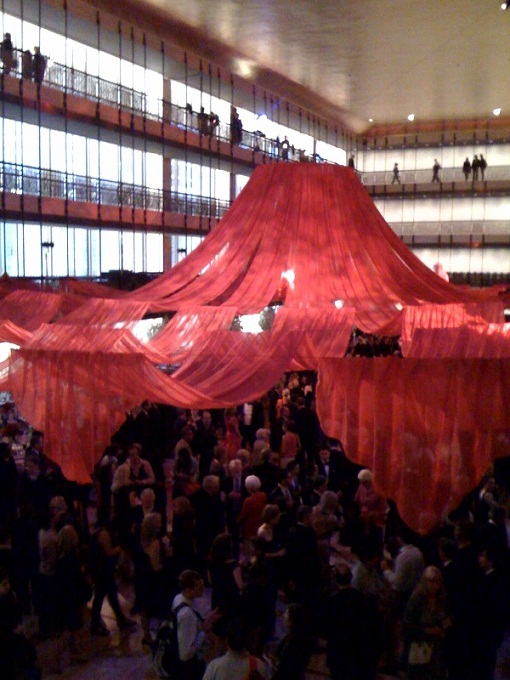
— here’s my photo of the promenade – Balanchine’s Vienna Waltzes was performed beautifully.

Photo by Paul Kolnik.

All of the dancers were very good, but I particularly liked Megan Fairchild and Joaquin DeLuz in the fast-footed, playful scene in the forest, “Fruhlingsstimmen,” and Maria Kowroski and Charles Askegard in the last, beautifully ballroom-y section, “Der Rosenkavalier.”

Moonlight on the Beach

Happy President’s Day everyone! I’m spending the week in South Carolina at my cousin’s timeshare – I needed a few days away from New York and the ocean is  my favorite place. (If I ever have money, I’m definitely buying a beach house somewhere.  I could never be one of those New Yorkers who buys a country home up in the mountains. I don’t understand those people. Who wants to risk a run-in with a bear or coyote or jaguar? Not to mention deal with permanently cold temperatures…) Anyway, the light from last night’s full moon on the ocean was gorgeous. My iPhone is not so good at taking pictures at night, so you’ll have to take my word for it 🙂

The condo’s wireless connection is a bit off and on, plus, it’s unexpectedly nice weather here – 71 degrees today, plus I’m supposed to be working on my novel, so I don’t know how much time I’ll have to blog. But here are a few items of interest:

Roberto Bolle makes his Hollywood debut;

John Epperson talks about his role as “Jaded Piano Player” in Black Swan; and

Our friend Benjamin Millepied is now getting hounded by the tabloids for working too hard and not paying enough attention to Ms. Portman

Also, here are some photos I just received of the magnificent Sara Mearns debuting as the Siren (opposite Sean Suozzi) in Balanchine’s Prodigal Son a couple weeks ago at NYCB:


Finally, if you haven’t seen Natalia Osipova dance yet, next Sunday, March 6th, will be your chance. She’ll be dancing Kitri in Don Quixote with the Bolshoi, in a performance that will be live-streamed direct from Moscow via Emerging Pictures’ Ballet in Cinema series. NY performance time is 11:00 a.m., at the Manhattan Big Theater, and she’ll be dancing opposite Ivan Vasliev. This is the role that made her famous, and she owns it, so try not to miss it if it’s showing at a theater near you. Check Emerging Pictures’ website for times and locations.

Okay, that’s all for now. Happy holiday everyone!

Sara Mearns Was Gorgeous in Swan Lake, But Overall Production Was Lacking


Last week was Sara Mearns week for me (well, for many New York ballet fans, I suspect). On Tuesday night, she made her debut as the Siren in NYCB’s Prodigal Son. (I’m still awaiting photos and will post as soon as I receive them!) Sean Suozzi danced the lead role. He did very well, but she just always stands out to me whatever she is in – particularly the story ballets. She was the best, most tantalizing, sinister, seductive, all around captivating Siren I’ve ever seen. The way she whipped that cape in between her legs, wrapping it around each one, the way she’d bend her knees slowly into a second-position plie while on point, basically squatting over the son’s head in a suggestive but also sinister manner, the way she’d raise her hand behind her head with the wrist bent and the fingers splayed to indicate her triumph over the son’s will, even just the way she’d walk out onstage on pointe, tiptoeing all around him – everything, every movement was in service of the character and was an integral part of the character’s story. I often feel like I’m seeing steps with other dancers. Just steps. The pas de deux between the son and the siren contains some of Balanchine’s oddest-looking choreography- especially those lifts – ‘here, stand on my knees, wrap your legs around my neck and let me carry you around like that,’ etc. I imagine it would feel very odd and foreign doing some of that, which of course was the point. It’s supposed to look warped and off-kilter. Everyone has mastered those steps, but to me, Mearns makes it the most deliciously warped. I love her.

Then, on Friday night, the company premiered their Swan Lake (Peter Martins version), and she danced the lead. (Photo above by Paul Kolnik, from Playbill Arts.)

In sum, I loved her; I wasn’t in love with the production. I went with several friends, two of whom don’t regularly go to the ballet, and that seemed to be the consensus. Everyone was excited to see Mearns dance again, but not to see that production. She was wonderful for all the same reasons I’ve written about before – she’s like a Veronika Part to me; she does such a full job of developing character, she brings you so fully into her world, you feel all of her pain with her. But of course she’s also an excellent dancer. She has a way of arching her back so, of working her arms and hands so, of extending her leg so high in arabesque, of extending her line so beautifully and making such full shapes – it’s a cliche, but her adagio / White Swan is just breathtaking. It almost makes you want to cry, and one of my friends did!

But she excels in the Black Swan / allegro role as well – not so much because she can do athletic feats like Gillian Murphy or Natalia Osipova (there were “just” a bizillion fouettes during the pas de deux, not a bizillion fouettes divided by multiple pirouettes and wild swan-like port de bras thrown into it all) but because she can do that all perfectly fine while still making it all about the character. When she does a series of lifts with Jared Angle where she spreads her legs into a straddle split in the air above his head, it’s just so wicked! And even at the beginning of the Black Swan, when she makes her entrance and presents her hand to the queen – it’s clear she’s up to no good. But she also doesn’t overdo it. She’s conniving and sinister but with a sweet face.

But the rest of the production: Jared’s an excellent partner, that’s clear. Mearns was way off her center of gravity in much of the White Swan partnering, and he securely held her balance, freeing her up to make those gorgeous shapes, and to act it all out the way she so brilliantly does. But in his own dancing, he just, like practically all dancers these days, goes for the cliche. It all looks so fake. I don’t believe he’s in love with her, or that he’s ever longing for what he doesn’t have, and that he’s devastated when she leaves him in the end. It’s all her sorrow and longing alone. So the performance was so unbalanced. I wish so much I could see her dance this with Marcelo Gomes, who really brings Prince Siegfried’s internal conflicts to life like no one else.

The other major issue I have with this production is the costumes – the costumes and the sets. I always forget about them until I see the ballet again, and, especially when I go with friends. My friends Friday night really found it hard to look beyond those costumes. For some reason, I kept thinking of the Flinstones, my friend, Marie, called them Jackson Pollack on speed or something to that effect (I haven’t read her review yet but will after I finish this post), and the others we went with just couldn’t stop talking about the brash colors. I remember my friend in the fashion industry saying of the Romeo and Juliet costumes (Per Kirkeby designed sets and costumes for both Martins productions) that the colors needed to be muted; these brash, bright, almost neon colors made the characters look like cartoons. Same with the Swan Lake costumes. Cartoonish is NOT what you want to go for in serious ballets like this.

Also, the RACISM. This is another thing I hate to admit I often forget about until I see the ballet again with a friend, and the friend is horrified at the fact that a black man is playing the evil character. Must von Rothbart always be danced by Albert Evans or Henry Seth? Are we not living in the year 2011? I mean, this is a huge reason why young people are so turned off from the ballet. And none of the very educated critics ever seem to be calling Martins on this. What’s up with that? Seriously? I think once you go to the ballet a lot you begin to forget about these things, you become immune to them. Which is horrible. But really, asking your audience to associate black men with evil is a horrible insult to that – probably very educated – audience.

Another problem here: Faycal Karoui (the conductor) was seriously on speed. He was flying through the first half. The poor dancers couldn’t even express the story. They really had to rush falling in love. If I’d never have seen this ballet before (and there were probably some such people there due to the Natalie Portman film), I don’t know if I would have gotten much out of the White Swan pas de deux. And that’s kind of an important part of this ballet…

All other dancers did well – I particularly liked Ana Sophia Scheller and Anthony Huxley (filling in for Sean Suozzi as Benno) in the first act Pas de Trois, and, in the second act, Abi Stafford and Joaquin DeLuz in the Divertissement Pas de Quatre, and Antonio Carmena in the Neapolitan Dance – but everyone did very well (those were just the ones who stood out to me). Oh and I loved Daniel Ulbricht throughout as the Jester. With his immense skill at jumps and turns – and combo jumping turns – and his comical sensibilities, he is perfect for such a role, as he is for Puck in Midsummer Night’s Dream – my favorite roles for him.

But I have to say, I was floored when none of the other dancers came out and took bows at the end of the production. Why? Whose idea was that? Only Mearns and Angle and Evans took bows. I realize the dancers are all very hard-working and probably needed to get home to get sleep for the next day’s matinee. But this severely cut Mearns’s bow and curtain calls short. It reduced the celebratory aspect of a production well done. Worse, it also really makes it look like none of the other dancers cared about Mearns, and about the production. It made it look like the company is not really a company of dancers who all work together and support each other. I’ve honestly never seen such a thing before. I’ve seen it where dancers who only dance during the first act will take their bows and curtain calls after the first act and not at the end of the whole, but the dancers who danced in the last act always come out for their bows at the end. Anyway, it really stood out to me. What did other people think?

Here is my friend Marie’s write-up.

For the Love of Duke


On Friday night Susan Stroman’s For the Love of Duke premiered at NYCB. Photos above by Paul Kolnik. Top: Tiler Peck, Sara Mearns, and Amar Ramasar; bottom: Mearns and Ramasar. Stroman is primarily a Broadway choreographer (I think her most famous work is probably Contact), and it shows both in her ballets’ strengths and limitations.

For the Love of Duke is divided into two parts. In the first, entitled “Frankie and Johnny … and Rose,” Tiler Peck and Amar Ramasar are Johnny and Rose, a couple in love. They perform a lovely lyrical pas de deux. Then along struts Sara Mearns – Frankie – and Johnny’s attentions are completely lost on her, to the disappointment of Rose. Johnny and Rose are snuggling on a bench together, and when Frankie comes prancing along, Johnny pushes Rose right off the bench, behind it, as if to hide her. Then he does a snazzier dance with Mearns / Frankie, she disappears, and he’s back with Rose … until Frankie comes strutting along again. And so on. At one point, Rose becomes the seductress, and Johnny pushes Frankie off the back of the bench. It was cute, and everyone danced spectacularly, but it got a bit old to me after a while.

The second part – “Blossom Got Kissed” – Stroman had actually choreographed before, creating it for NYCB in 1999. I liked this one better. Both parts, by the way, are choreographed to Duke Ellington and Billy Strayhorn, which is where the title of the whole comes from. Anyway, “Blossom” begins with a bunch of girls all dressed in sassy, jazzy red sitting on a bench tapping their feet to Ellington’s rhythm. Along comes Savannah Lowery as Blossom, dressed in a frilly ballet tutu. She sits alongside them on the bench and tries to tap with them. But she has no rhythm and is horribly off. Then they stand and do a jazzy dance, and, again, she tries to join, but just can’t get the hang of it. She is simply too classical ballet. Lowery was hilarious though and it was funny to see her continually try to get the rhythm and technique of jazz dance right by taking a foot and pounding it down flat on the floor. Then, a group of tux-clad men come along and do some swing dancing with the red-clad women. Blossom again tries hard to fit in but just can’t. Finally, a musician in the band (which was onstage), in the person of Robert Fairchild, comes out from the back of the stage, orders the music changed, and does a sweet lyrical ballet pas de deux with her.

I feel like I’ve seen “Blossom” before because Lowery’s hilarious flat-footedness looked familiar. I liked it better than the first part because to me it was funnier, and the story went a little further.

I think Stroman is very good at creating a story through dance, and that’s what I like about her. You can tell she’s not really a ballet choreographer though. Compared to the first two pieces of the night – Ratmansky’s Concerto DSCH and Wheeldon’s Polyphonia – the actual dance just wasn’t that rich. Still, I think she complemented the program well. It can never hurt to include in an evening of ballet a cute narrative dance with music that’s not usual ballet fare.

As always, I loved Concerto DSCH. Ratmansky was in the audience. I felt the music was played a bit too fast though (conductor was Ryan McAdams, Elaine Chelton the pianist). It looked like Ashley Bouder had a slight mishap, though I’m not sure because I was busy watching Joaquin DeLuz do a sequence of crazy fast steps into a somersault at the speed of light. Andrew Veyette again replaced Gonzalo Garcia, who I am really missing. I hope he’s okay. Veyette is doing a fine job as one of the two playful guys in blue, but there’s this repeating series of throws – where they each kind of propel the other into the air, and I love how Garcia always gets such height when he bounces off the other two.

Tyler Angle replaced Benjamin Millepied, and did wonderfully. I always notice things with Tyler that I haven’t noticed before – like how when he and the girl in green (Wendy Whelan) make their entrance, he’s spinning her around and around, and she looks like she’s hanging on to him for dear life. It kind of sets the tone of their relationship. I always notice the music much more when he dances as well.

Christopher Wheeldon’s Polyphonia is definitely one of my favorites of his. I love the musicality of it, and the originality of the combinations. It’s set to ten piano pieces by Ligeti, who, the program notes, developed micropolyphony – a type of music involving sustained dissonant chords that shift slowly over time. You can really see that “micropolyphony” in the dancing, as the sets of dancers (eight all together, divided into four pairs) begin dancing together in a line but each pair doing something completely different. Then, they eventually come together and dance in unison, but then they drift apart again later. There’s some very clever, almost humorous partnering throughout, but particularly in the second movement, Arc-en-ciel, Etudes pour piano, danced by Maria Kowroski and Jared Angle. I haven’t seen this ballet as often as I would like to. I was going to say I wish he’d include this one more often in Morphoses programs, and then I remembered

NYCB Swan Lake Casting Is Up & There’s an Added Performance!


New York City Ballet has decided to add an additional performance of Swan Lake to its SL run. The added performance will now take place Friday, February 11th, at 8 p.m. It will star Sara Mearns – yes!!!!!!! and will replace that evening’s scheduled performance of mixed repertoire. The company decided to reschedule for the additional performance because of overwhelming demand this year: all of the regularly scheduled performances are virtually sold out at this point. Mearns will also be dancing the first regularly scheduled performance, the Sunday February 13th matinee. During both performances, her Siegfried will be Jared Angle. Casting hasn’t yet been announced for the rest of the run but you know I will post it here the second it is! There will be nine SL performances total, continuing through February 26th.

Go here to buy tickets.

Above photo taken from here.

Last Week at New York City Ballet


Last week I went to two performances of NYCB – opening night and Thursday night’s “See the Music” program – and to two of the free all-day Balanchine events on Saturday. First, I’ll talk about the last two since I found them so informative. The free studio talk on Saturday afternoon – Balanchine’s birthday – was moderated by Sean Lavery (former NYCB principal dancer, now ballet master), and included Sterling Hyltin (in Paul Kolnik photo above with Robert Fairchild), Chase Finlay, and Jenifer Ringer. Lavery asked the dancers to talk about their first Balanchine ballets, their favorites, and what drew them to NYCB. Hyltin named as her favorite Duo Concertant (pictured above) which I’d just seen her dance on opening night. She said she liked the syncopated movement, the he goes and I go kind of back and forth movement conversation with her partner, and with the musicians. I really liked it too. The violinist and pianist are onstage (the music is Stravinsky), and I like the interaction between the dancers and the musicians, and between the two dancers, and I like the sharp, angular movement. She seemed particularly animated when I saw it. I love Robert Fairchild and think he’s such a sharp, masculine mover with a presence that commands your attention without meaning to – he kind of reminds me of a less cocky Ethan Stiefel – but she seemed so happy to be dancing this piece that she stood out to me more. It was nice to hear her talk about it.

But what I really loved was the School of American Ballet class taught by Peter Martins. He interacted cutely with the students, particularly “Cyrus,” (at least I think that was his name…) a tall, long-limbed young man who I think will soon be in the company. Cyrus didn’t always do everything perfectly (at least in Martins’s eyes) but he had a charming presence and a great leading-man physique and you can tell he works hard.

Martins had the class demonstrate ballet basics – beginning with the five positions, and they showed us a perfect fifth position (with the toes of the front foot touching the heel of the other and vice versa). More interestingly, he had the class show us the difference between a Balanchine hand and a classical ballet hand. I’d always noticed there was a difference but couldn’t figure it out exactly. God gave us five fingers, Balanchine had said, so we shouldn’t hide two of them. The Balanchine hand shows all five fingers, the classical ballet one only three (with the ring finger and pinky held so that they are hidden from view behind the middle finger).

Martins also had the students show us how Balanchine’s fourth position differed from others’. In Balanchine’s the back leg is straight; in all others’ the back leg is bent. Martins didn’t go into any functional explanation for this – just said “here, we think it looks better.” But I thought about it and thought, wow, it must be hard to take off in a jump for example with the back leg straight. And then I realized that’s partly why Balanchine’s choreography always looks so fluid, like one step leading right into another, without a lot of stopping to build up to a big athletic feat – a big jump or series of turns. Other companies – like the Russians, like the Bolshoi – are all about preparing so that you can do something astounding. So they’re all about the building up.

This was mentioned in the studio talk as well. Lavery also talked about how fluid Balanchine’s movement was, and how, for example, in a lift, a guy would pick up a girl, then take two steps, and put her down rather than walk all over stage with her hoisted above his head. Balanchine wanted her to come up, then down right again, because that was more fluid, rather than have her head bobbing around up there while the guy was running all around with her.

Martins also demonstrated the bows. At City Ballet, he said, we just do them as such, and the girls did a little curtsy with the back leg slightly bent, without going down on one knee. Making fun of the dramatic Swan Lake bows, Martins went all the way down on one knee, exclaiming, “Yes, yes, I know I’m good!!!” while putting his head down, forehead nearly touching the floor, and raising his arms up in back of him like wings, fingers pointed toward the ceiling. It was hilarious.

Anyway, here are a couple more photos of opening night:


Above: Ashley Bouder in Valse-Fantaisie, and below, the cast, including Andrew Veyette, in the same (all photos by Paul Kolnik)


I liked Balanchine’s Valse-Fantaisie (Veyette replaced Joaquin DeLuz – but don’t know why because DeLuz danced Concerto DSCH two nights later) but I really loved the first of the evening, Walpurgisnacht Ballet. I’d never seen Walpurgisnacht before and it’s funny but I always seem to love the Balanchine ballets that are the least often performed. This was really beautiful. It’s from Gounod’s Faust, and features a group of women (and only one man – here Charles Askegard) in deep red dresses, their hair down in the second half as the music increases in tempo so that there’s almost kind of a hedonistic madness in the mood – and the footwork is so intensely complicated and fast fast fast. Wendy Whelan even made a tiny little flub, which I’ve never seen her do before. Crazy! And breathtaking!

And the evening ended with The Four Temperaments. I’ve said before and I’ll complain again that I still don’t understand why everyone goes on about how brilliant this one is. To me, there are supposed to be four temperaments, and the ballet is divided accordingly into four variations after the theme: melancholic, sanguinic, phlegmatic, and choleric. But they all seem to be the same to me. The dance seems one-note throughout so that after the first variation, I’m waiting for it to end. I’ll keep seeing it though, perhaps performed by a variety of companies if I have the chance, and will keep looking for the nuances…

“See the Music” night opened with Faycal Karoui’s discussion of Mozartiana, Tchaikovsky’s homage to / riff on Mozart, which made me appreciate Tchaikovsky even more. Then that piece was danced – by Maria Kowroski, Daniel Ulbricht, and Tyler Angle. Tyler stood out to me. As always, he dances with so much meaning, so much intention, and so much expansiveness. He’s a really beautiful dancer.

Then came Ratmansky’s Concerto DSCH, danced by Wendy Whelan, Ashley Bouder, Joaquin DeLuz, Andrew Veyette (replacing this time Gonzalo Garcia), and Benjamin Millepied. Oh, Natalie Portman was there, albeit late – she came in with a friend after Karoui’s lecture and right before Mozartiana was performed. Then, she left right after Concerto DSCH, after Millepied was done performing, and before the last piece. I thought it was a shame she missed Sara Mearns in the last dance, but a Twitter friend said she had a movie premiere that night, so I guess she needed to leave early for that.

Anyway, as usual, Millepied did not stand out to me, and I couldn’t stop thinking of seeing Tyler Angle in that role before and the way he lunges romantically toward the main girl, making it clear how much he yearns for her. Millepied’s knees nearly touch the ground in his deep steps toward her and it just looks like a dance step, not like anything evoking a specific emotion. As always I loved Bouder and DeLuz in the fast, playfully firtatious three-some part. I missed Garcia – where is he? I hope not injured! – but thought Veyette did a fine job in his stead.

And the evening ended brilliantly with Sara Mearns and Charles Askegard dancing the ballet leads in Balanchine’s Cortege Hongrois, while Rebecca Krohn and Sean Suozzi just as brilliantly danced the folksy Hungarian leads. I really love that dance and it made me all the more eager to see Mearns in Swan Lake!

On both nights, I went with my friend, author Maria Mutsuki Mockett. She writes an author blog but has been attending the ballet much more frequently and is now blogging a lot about ballet as well. She’s an excellent writer, so please check out her blog!

This Week at New York City Ballet

I hope everyone had a nice holiday weekend, and happy belated Martin Luther King Day!

Tonight begins the Winter season at NYCB. Highlights for the season will be a world premiere by Susan Stroman on January 28th, and Peter Martins’ Swan Lake in February. I highly recommend seeing Sara Mearns as Odette / Odile (White Swan / Black Swan), especially if you are a new dance-goer in search of a good Swan Lake after seeing the Black Swan film. The Martins production is very modern, and very accessible to contemporary audiences, and Mearns is a beautiful dancer who manages to excel at both roles. Her swan queen is very human, with great emotional depth. She has a way, like ABT’s Veronika Part, of making you feel like you’re inside her character’s world, going through everything right along with her. She’s not just a great ballerina, but a compelling actress, in other words. And her black swan is a thrill. Here’s what I wrote about her last year. I’m not sure yet which days she’ll dance, but casting should be announced very soon. All of the ballerinas will be good (and I’ll need to see Ashley Bouder’s this year!), but try hard not to miss Mearns.

My recommendations for this week are:

January 18 (tonight), opening night, early 7:30 curtain
It’s a mixed rep program including Walpurgisnacht Ballet, Duo Concertant, Valse-Fantaisie, and one of Balanchine’s most revered works, The Four Temperaments.

Thursday night, January 20th, 8 p.m.
Another night of mixed rep: Mozartiana, Concerto DSCH, and Cortege Hongrois. The special things about this evening are that it’s another in the excellent See the Music series, and Millepied is dancing Ratmansky’s DSCH (one of my favorites of Ratmansky’s). Plus, will be interesting to see if there’s any kind of crowd increase for Millepied now after all the fanfare. Also SLSG favorite Tyler Angle is debuting in Mozartiana.

Friday night, January 21st 8 p.m.
Sara Mearns will debut in Concerto DSCH. Also showing are Robbins’ well-loved Dances at a Gathering, and Walpurgisnacht again.

Saturday, January 22nd, all day.
It’s an all-day celebration of George Balanchine, in honor of his birthday. In addition to the regular matinee and evening performances (all Balanchine of course), there’s a movie at 10:30 a.m., a studio talk in the afternoon, and a performance by students at the School of American Ballet at 6 p.m. The movie, studio talk and performance by SAB students are all free but require tickets. Everything takes place in the Koch Theater at Lincoln Center. For more info on the Saturday events, click on the link below.

Continue reading “This Week at New York City Ballet”

SLSG’s Dance Highlights of 2010

Instead of trying to remember which were my favorite performances of the year, I’m just going back through my blog archives from January of this year and linking to the most memorable posts. More fun that way! A lot happened in a year…

January

Pacific Northwest Ballet made their debut at the Joyce; it was my first time seeing them live.

The Post‘s Page 6 announced that you know who and you know who are dating, and the ridiculous homewrecker attacks began.

Baryshnikov and Annie Liebovitz starred in a very cool Louis Vuitton ad.

February

I totally fell for New York City Ballet’s Sleeping Beauty.

…and Mark Sanchez 🙂

I found myself quoted in Colin Jarman’s book, Dancing With the Quotes.

I also fell for Sara Mearns’s Odette in Peter Martins’s Swan Lake.

On a personal note, my former judge, the esteemed Honorable Sylvia Pressler, passed away.

The Kings of Dance came to town.

Morphoses shocked the ballet world by announcing that Christopher Wheeldon was leaving the company.

March

My friend’s organization, Art for Change, held a benefit for Haiti after the earthquake.

Rasta Thomas’s Bad Boys of Dance announced that Danny Tidwell and SYTYCD’s Jacob Karr were joining the company.

Corella Ballet Castilla y Leon finally made their NYC debut!

I found myself actually getting press for liking Kate Gosselin – or for not hating Kate Gosselin rather – on Dancing With the Stars.

I fell for Keigwin + Company’s Runaway.

I was delighted to receive an email from NYCB ballerina Yvonne Borree’s aunt regarding of all things, my novel.

April

I had my first experience as a dance writer panelist! Thank you, Marc, from TenduTV!

Tiler Peck appeared on Dancing With the Stars in a Travis Wall routine, which everyone was so excited about. But it ended up amounting to not a whole lot…

Roberto Bolle danced a naked Giselle, in Italy of course.

May

New York City Ballet opened their spring season with premieres of Millepied’s Why Am I Not Where You Are and Ratmansky’s Namouna, both of which I liked, though Ratmansky’s had to grow a bit on me.

Baryshnikov returned to the stage.

I greatly enjoyed ABT’s new production, Lady of the Camellias, though most critics panned it.

June

ABT celebrated Alicia Alonso’s 90th birthday with three all-star Latin American casts (plus Natalia Osipova) dancing in Don Quixote.

Yvonne Borree gave her farewell performance at NYCB.

Bill T. Jones won a Tony for best choreographer for Fela!

Philip Neal gave his farewell performance at NYCB.

Natalia Osipova was mugged right outside of Lincoln Center.

Two of the greatest ballerinas in Europe – Osipova, and Alina Cojocaru – gave back to back Sleeping Beauty performances at ABT.

Albert Evans gave his farewell performance at NYCB.

Tap great Savion Glover made headlines by voicing his annoyance with Alastair Macaulay’s NY Times criticism of him – onstage, during a show.

Conductor Maurice Kaplow gave his farewell performance with NYCB.

Darci Kistler officially ended the era of the Balanchine-trained dancer with her farewell performance with NYCB.

July

Carlos Acosta announced his retirement from ballet and his foray into modern dance.

Alex Wong, probably the second greatest contestant ever on SYTYCD was injured and unable to finish the show.

My friend, Taylor Gordon, was profiled as a freelance ballet dancer in a New York Times article 🙂

Alvin Ailey American Dance Theater’s beloved Denise Jefferson passed away.

Nilas Martins retired from NYCB oddly sans fanfare, sans criticism, sans a performance.

August

I interviewed tWitch about his role in the movie Step It Up. Fun fun interview!

I had a blast covering Ailey Camp.

I nearly fell over when Wendy Perron, esteemed E-I-C of Dance Magazine recommended Swallow on Twitter!

September

NYCB began their excellent “See the Music” series.

October

I loved Ashley Bouder’s Serenade.

Emerging Pictures’s awesomely exciting Ballet in Cinema series began with the Bolshoi’s Flames of Paris.

This cool new Lincoln Center-area street art sprouted up.

One of my favorite posts of the year, though it received no comments, was about Anne Fortier’s novel, Juliet. I jokingly daydreamed about it being made into a film, and which of my favorite ballet stars might take the lead.

November

ABT made an historic visit to Cuba and oh how I wished I could have gone with them.

I think I was the only person in the entire dance world to sympathize with Bristol Palin on Dancing With the Stars.

I had a blast covering New York So You Think You Can Dance auditions.

All of a sudden Black Swan was everywhere.

Nearly fell over again upon hearing Riccardo Cocchi and Yulia Zagoruychenko took the world Latin ballroom title – making them the first U.S. couple ever to do so.

December

My take on SugarPlumpGate.

Black Swan finally premiered which I didn’t love but was happy to have ballet brought back into the spotlight.

I was in awe of Alvin Ailey’s 50-dancer Revelations, staged in honor of the 50th anniversary of that dance. I also loved several other dances in their City Center season – Ailey’s Cry, Ronald K. Brown’s Dancing Spirit, and Geoffrey Holder’s The Prodigal Prince – just to name a few.

Robert Wilson / Roberto Bolle’s Perchance to Dream exhibit in Chelsea was a lot o’ frightening fun.

ABT’s new Nutcracker premiered, which I really enjoyed, almost as much as the Bolshoi’s.

Portman and Millepied revealed they are now engaged and expecting.

I had great fun, despite the crazy snowstorm, going down to Wall Street and covering Judith Jamison’s ringing of the closing bell at the NYSE.

Pretty busy year.

Happy New Year, everyone!

Benjamin Millepied’s “Plainspoken”

Last Thursday was NYCB’s Fall gala, during which they presented the New York City premiere of Benjamin Millepied’s Plainspoken (photo at left, of Teresa Reichlen and Sebastien Marcovici, by Paul Kolnik; the ballet originally premiered in Wyoming this August), along with Robbins’ fabulous homage to Fred Astaire and Rita Hayworth, I’m Old Fashioned, and Balanchine’s Tarantella and Western Symphony.

The evening began with the orchestra pit rising and the always lively Faycal Karoui leading the orchestra in a rendition of Leonard Bernstein’s Candide Overture. I love that movable orchestra pit – best thing, in my opinion, about the recent renovations to the Koch Theater.

I was hoping there would be introductions and short speeches, including one by Sarah Jessica Parker, who served as honorary chair for the after-performance party. But no such luck – I guess because it wasn’t the beginning of the season, like galas usually are. I didn’t even get to see Parker come down the red carpet, there were so many paparazzi blocking my view. I certainly heard her though – or, rather, the paparazzi, as they screamed her name like she was the Messiah. I didn’t recognize anyone else. Lots of good-looking people perfectly coiffed and dressed in black tie but no one I recognized. I didn’t see Natalie Portman, though I heard she was there. I never recognize famous people, though. I’m really bad that way.

Anyway, I’m Old Fashioned was, as always, enjoyable, albeit too long. No dance-maker needed an editor more than Jerome Robbins in my opinion- and Tyler Angle stood out to me in his solos and duets with Maria Kowroski. But my favorite part of the evening was the second half of the post-intermission, when Ashley Bouder and Daniel Ulbrich just nailed Balanchine’s super fast-paced bravura-heavy duet, Tarantella (Ulbrich smacked the tambourine so hard one of the little metal things came flying off) and then Sara Mearns just astounded me in the last section of Western Symphony. How in the world does she stand on pointe, on her own unsupported by a male dancer, and lift her other leg in the air into a perfect split, into practically a six o’clock penchee? How how how? She and Charles Askegard really put on a show as tart-y saloon dancer and cowboy. She is really just unbelievable.

Okay, so onto Plainspoken. Well, sometimes I like Millepied, and sometimes the work just falls a bit flat to me. I didn’t much care for this one, though I’ve liked his last several ballets for ABT and NYCB. This was very abstract, no story that I could find, and I’m just not a fan of purely abstract ballets that I can’t find any story in whatsoever. It was a ballet for four couples: Sterling Hyltin and Tyler Angle, Teresa Reichlen and Amar Ramasar, Jennie Somogyi and Sebastien Marcovici, and Janie Taylor and Jared Angle (the last were generally my and my friend’s favorite pair – I think because Janie always brings something dark to her roles, there’s always something beneath the surface with her even if you can’t put your finger on what it is). The couples sometimes changed partners though, and there would be different-sized groupings.

The music was by Pulitzer prize-winning composer David Lang – it was a commissioned score – but to me the music here wasn’t nearly as rich as, for example, that used by Morphoses recently. This was mainly strings and piano and each section seemed emotionally the same. There didn’t seem to be a lot of contrast between the movements or a build-up toward the end. The sections were each differently lit – by a different color and a background curtain that would rise and lower to reveal more or less light than the section before. But the set was nothing very dramatic and the different colors didn’t, for me at least, evoke a different mood.

Movement-wise, there seemed to be a swimming theme. At various points the dancers would sit on the floor and make motions evocative of swimming – sweeping arms through the air, paddling legs – backward, then forward, then all dancers lying on their backs with their feet in the air like a synchronized swim team. At other points, the women would be carried somewhat Chaconne-like across the stage. I remember a slide characterizing Janie’s section, and she made it seem as if she was being taken by the men who slid her, against her will, across the floor.

I also have in my notes that the movement toward the beginning, in the first section, was a combination of robotic and more casual walks, kind of like the ensemble walking across the back of the stage in the second part of Robbins’s Glass Pieces. This kind of movement was interspersed with the swimming-like motions. In later sections, dancers seemed to run in place.

Oh, and during Janie’s section, there was a point where the men all picked her up and hoisted her high above them, like in MacMillan’s Manon or the Balanchine ballet where the woman is carried around the whole time by a group of men and the lone man on the floor keeps reaching up for her (sorry, can never remember the name of that ballet). My friend loved this part, and I did as well, but couldn’t really figure out how it played into the rest of that section.

In general, my first impressions of this ballet were: some interesting movement reminiscent of other ballets that didn’t seem to add up to much and didn’t really make me feel anything.

At the end, Millepied, Lang and the costume designer (Karen Young) and lighting designer (Penny Jacobus) took the stage for a bow. The applause seemed more polite than hearty (in contrast to the crazy applause Wheeldon always gets!), but that could just be me projecting my own thoughts onto everyone else.

What about you guys? I saw some mentions on Facebook of people liking it. Who else saw it and what did you think?