MORE BEAUTIES


So, toward the end of last week I saw two more casts of Sleeping Beauty in New York City Ballet’s production. Above are the beautiful Kathryn Morgan as Aurora and Tyler Angle as her Prince Desire (Paul Kolnik is the photographer). Below are some photos of the other couple I saw, Tiler Peck (both she and Kathryn were making their Aurora debuts), with Gonzalo Garcia, albeit not from this ballet.


(in Four Bagatelles, photo by Paul Kolnik)


(and in the Christopher Wheeldon / Martha Wainwright collaboration over the summer, photo from NYTimes by Andrea Mohin; I like this photo because I think it shows each of their personalities well).

And then last week, I saw Ashley Bouder and Andrew Veyette.

I’ve been thinking about who I thought was best in what role but it’s actually really hard to do that. I honestly ended up liking everyone, though there were definite differences.

I do have a lot to say about Gonzalo Garcia though. I LOVED him as Prince Desire — he really melted me, he really completely stole the show that night and I feel like I’m not ever going to like anyone quite as well in that role now. I mean, you just have to see him in a classical ballet, as the romantic lead, and you realize why San Francisco audiences were so upset when he left SFB for NYCB a couple years ago. Some of those SFBallet fans were really devastated when he left. And I think it’s been such a puzzle to those fans that New Yorkers haven’t really fallen for him the same way. And I think it’s because he hasn’t had the chance to shine because NYCB is so Balanchine-heavy. He needs roles where he can act and become a character. He’s such the quintessential romantic prince.

You can really tell how differently he’s trained than the other NYCB dancers, who’ve nearly all come from SAB and been trained on Balanchine’s non-actable abstract ballets. I felt like with Gonzalo I was seeing someone from ABT — mainly Angel Corella (in terms of the body type, dramatic style and boyishly handsome face). The way he’d hold onto the music, draw it out while it crescendos, by for example in the vision scene holding out a finger to the princess and then leaning back, then looking out to the audience — not AT the audience but in the audience’s direction — to show how enthralled he is, how much he wants to catch her, all before then turning and running toward her. The other two — Tyler and Andrew — they didn’t do all that. They just kind of looked toward her standing more and more toward the tips of the toes, ready to run toward her when the music told them to. Gonzalo’s way was so much more Petipa and Tchaikovsky and Bolshoi and Romantic Russian and all that, and it might all seem overly melodramatic to audiences who aren’t used to that. But that’s what I’m used to with ABT — and that kind of stuff makes me swoon!– so that’s why I think I loved him so much. But I’m wondering what others who saw this cast thought?

And Gonzalo just knows what’s expected of him, as the prince. Later, when he went to do that crazy series of jetes, he was rested up and ready and he nailed them like I’ve never seen him nail anything. I’ve never seen his legs straighter, in perfect splits, and the whole way around the perimeter of the stage, without tiring. And it’s like he knew that was a very important part, and he had to do them perfectly because that’s just what the romantic hero does — that’s the way he shows his love for the princess, and that he’s worthy of her. The other two obviously took them seriously (because they’re crazy hard, you have to take them seriously), but it just was more of a difficult feat, instead of having the same meaning. You know what I mean? Like he looked out all across the stage wistfully, and then he just took off flying around it. It gave it a different meaning than just flying around.

It makes me wonder though if contemporary audiences understand that, or appreciate it. Or whether they prefer for the emotion to look more “natural”? I’m not saying Gonzalo was better than the other two, just different.

I wonder what Joaquin De Luz was like, since he’s not SAB trained either. Did anyone see him?

As far as partnerships, Kathryn and Tyler were my favorites. Tyler had a few flubs on some of his solo variations (but I still love him!), but he was always the perfect partner, he was always solid when supporting her. And the series of fish dives in the wedding pas de deux were some of the most breathtaking I’ve ever seen. Her legs were pointing completely up toward the ceiling! Magnificent! And the final hands-free fish dive was picture perfect.

I liked all of the Aurora interpretations, but they were different too. Kathryn was the most princess-like, the most regal, though that may just be the way she looks. She just kind of looks like royalty! Ashley and Tiler seemed more “real girlish”  – all smiles and sweetness and awe at the world and their cute suitors.

The rose adagios were all near perfect. (ABT’s Sarah Lane is still the queen of the balances to me — it seems like she could hold them for hours.) Kathryn had the most absolutely gorgeous extensions. Do I have to giggle every time Robert Fairchild comes out leading the cavalcade of suitors? I loved Craig Hall as the “African prince,” – I don’t know what exactly stood out about him but something did. And even though it wasn’t a dancing role, I loved Henry Seth as the King; he acted it really well. Chase Finlay was lovely as Gold in the wedding scene – -he’s a really beautiful dancer with exquisite lines. Everyone’s talking about him being the next romantic lead. I loved tiny Erica Pereira as the fairy of eloquence and Ana Sophia Scheller as the fairy of courage, thought Faye Arthurs and Adrian Danchig-Waring were brilliant as The White Cat and Puss in Boots, and Daniel Ulbricht is the quintessential gymnastic court jester.

And there’s NEVER been a better Carabosse than Georgina Pazcoguin! Nor has there ever been (or, perhaps, could there be) a better Lilac Fairy than Sara Mearns. I love how she arches her back so luxuriously and opens up her chest. And the rich, full-out port de bras. Such beautiful expansiveness, that, with her beatific face, makes her perfect for this angelic role. She reminds me of Veronika Part.

Okay, that’s all I can think of, for now!

This week begins the Swan Lakes. I’ve never seen Peter Martins’ version, so I’m really excited. In particular, I’ve heard wonderful things about Maria Kowroski as Odette and I’m psyched for Stephen Hanna’s debut as Prince Siegfried!
NEW YORK CITY BALLET’S SLEEPING BEAUTY IS THOROUGHLY CAPTIVATING FROM START TO FINISH


This past week, New York City Ballet began its two-week run of Sleeping Beauties. I saw the opening night performance, with Ashley Bouder (above with Damian Woetzel, in Paul Kolnik photo) in the lead. She danced opposite Andrew Veyette, as Prince Desire. Both did really, a near-perfect job (just because nothing’s ever completely perfect!). Really, I don’t know what more you could ask for, although I’m waiting to write my full review on the production until later this week, after I’ve seen two more casts: Kathryn Morgan as Aurora and Tyler Angle as PD (with Janie Taylor as the Lilac Fairy!), and then Tiler Peck and Gonzalo Garcia as the leads.

I love NYCB’s production — a lot more than ABT’s — and I can’t really figure out why. In NYCB’s there’s really never a dull moment — there’s no boring court dancing, just all the wondrous ballet, the very intricate and complicately awe-inducing variations for the various faeries (Sara Mearns was gorgeous as Lilac Fairy — in photo below by Paul Kolnik, as were Amanda Hankes, Lauren King, Rebecca Krohn, Erica Pereira, and especially Ana Sophia Scheller as Fairies of Tenderness, Vivacity, Generosity, Eloquence, and Courage respectively), the fun “wedding scene” with all the cute virtuosity-driven duets for the fairy tale characters (once again, loved Sean Suozzi last week — here as Puss in Boots, and Stephanie Zungre as his partner the White Cat; loved Tiler Peck and Daniel Ulbricht as Bluebird and Princess Florine, loved Henry Seth as the Wolf but not sure why they had a little girl dance Little Red Riding Hood…), the “jewels” starring Stephen Hanna :), and of course the beatific Grand Wedding Pas De Deux between Bouder and Veyette.

I don’t know, there’s just never a dull moment: you go from the Rose Adagio with all the virtuosic balances for Aurora (and the handsome cavaliers), to the richly choreographed fairy variations (that seemed to me more Balanchine than Petipa), to the drama of Carabosse’s arrival with her creepy minions and the frightening spell she casts, to the sweet Vision scene, to the quick Awakening (nothing in this production is long and drawn out; each scene gets right to the point), to the Wedding with the entertaining guests, and ending with the beautiful pas de deux between Beauty and the Prince.

I can’t figure out what exactly is different between this version and the others I’ve seen before, but honestly, this hasn’t been one of my favorite story ballets. So I was just really floored by how captivating NYCB’s production was. I can’t wait to see a few more this week. NYCB is good at story ballets! If you’re in NY and you can make it sometime this week, do go!


NEW YORK CITY BALLET OPENS THEIR WINTER SEASON WITH MIDSUMMER NIGHT'S DREAM & GERSHWIN

New York City Ballet opened their Winter 2010 season last week with rotating performances of Balanchine’s Midsummer Night’s Dream, and a two-ballet program of his Who Cares?, set to Gershwin music, and Peter Martins’ Naive and Sentimental Music.

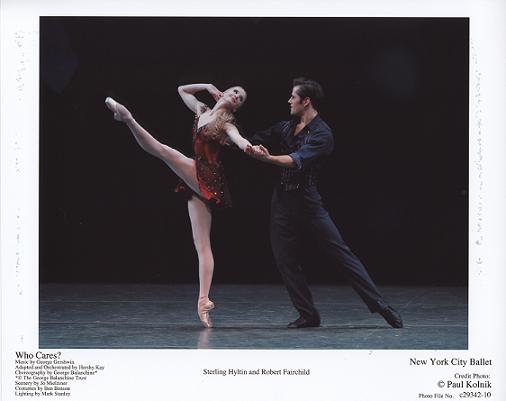
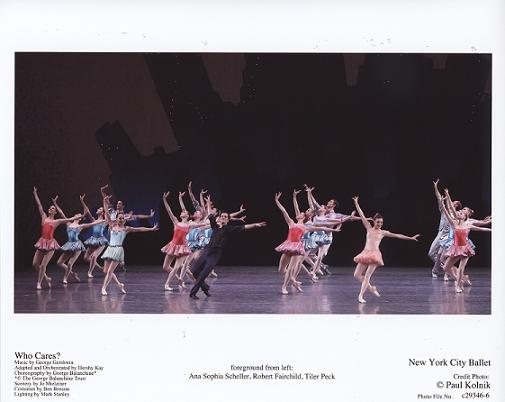
I LOVED Who Cares?! (photos above — of Robert Fairchild and Sterling Hyltin, and of the whole cast — by Paul Kolnik.) I’d only ever seen the pas de deux before and didn’t even realize the whole was comprised of a whole slew of Gershwin songs, some danced by the ensemble, some by only the women, others by only the men, with solos and pas de deux mixed in. I particularly loved Tiler Peck’s duet with Robbie Fairchild in The Man I Love. She has such a clean, beautiful line and she’s so expressive and so engaging. She can make a story out of anything. And of course Fairchild is always the perfect romantic male lead 🙂 Crowd went wild over his and Ana Sophia Scheller’s duet to Embraceable You as well as Scheller’s My One and Only solo. Such a fun ballet — I’m going back for more this week.

Also shown in that program was Martins’s new Naive and Sentimental Music, set to John Adams’ score of the same name. I wrote about that ballet when it premiered here and posted pics of it here. Seeing it again evoked a bit of Balanchine’s Jewels, particularly the lovely lyrical white section (my favorite) and the sexy red.

One little thing I have to say: this ballet was created on and is danced only by principals but Adrian Danchig-Waring danced in last week’s production as well, and he is still a soloist (I think he may have been replacing Amar Ramasar, who must be injured because he was replaced a few times over the week…) Anyway, I realize NYCB is top heavy at the moment, but I think Danchig-Waring definitely needs to be next in line for a promotion!

And earlier in the week I saw the best EVER cast of  Midsummer Night’s Dream. I finally got to see my Gonzalo Garcia as Oberon 😀 (photo above by Paul Kolnik, of Garcia as Oberon and Darci Kistler as Titania). I’d missed him in this role at the end of last season. He did very well – -not only with the dancing — particularly that crazy fast scherzo — but also, and less expected for me, with the acting. I thought he’d be a sweet, glowingly endearing Oberon, but, no, he was a pissy, demanding fairy king — just as much as Andrew Veyette last season (cutely pissy and demanding though!) He wanted Titania’s servant boy and he wasn’t letting her say no to him. Only thing regarding the dancing — his legs don’t seem to be as flexible as they once were. It seems like he may have injured an adductor muscle, or else he’s built up so much thigh muscle or something — but his legs when he jumps are not making perfect splits. But his upper body is so fluid and graceful and he exudes such charm that he’s still the perfect lyrical male dancer nonetheless.

Titania was the beautiful Sara Mearns (headshot by Paul Kolnik — a new headshot for her, right?)– and she was the best Titania I’ve personally seen. Oh she’s such a beautiful dancer! She throws herself so fully into every move she makes. If Garcia is the ideal male lyrical dancer she is the ideal female – they were so perfect together.

And I’m so glad Stephen Hanna is back at NYCB (still annoyed with the Billy Elliot directors for not making good enough use of him on Broadway). He was Titania’s cavalier and his pas de deux with Mearns was the best Titania / Cavalier pdd I’ve ever seen. He’s so big and strong — which certainly amps up the romance factor — and his numerous tour jetes just have so much power. Honestly I often get bored during that pdd and just want Oberon to return, but not with Hanna’s cavalier!

And new to the cast of human characters who get their hearts messed with by a mischievous Puck (Troy Schumacher) was Janie Taylor, as Helena. She is another one who excels at story dances, always delving into a character and making clear to the audience what’s going on in her mind. She’s pathetically, endearingly funny from the time she enters the stage all forlorn over Demetrius, to her being completely bewildered by Lysander’s sudden attraction to her, to her searching the forest madly for Demetrius, to her cat-fights with Hermia, etc. She really brought out the humor.

In the section where I was sitting, there were at least three large groups of people you could tell had never seen the ballet before — nor likely the play; they didn’t seem familiar with the story. But they were laughing hysterically throughout the whole thing and were really awed by the dancing, and by some of the tricks (like Puck’s being pulled up to the ceiling via harness at the end). That’s when you can tell with a story ballet that the cast really brought it to life, when the newcomers are enthralled.

NYCB’S FIRST NUT OF THE SEASON


Photo by Paul Kolnik, copied from NYCB website.

Okay, after blabbering on about the audience Friday night and new post-ballet restaurants, on to the actual performance.

It was magical, as always. Megan Fairchild and Joaquin De Luz were charming as the leads (the Sugarplum Fairy and her cavalier) — above headshots by Paul Kolnik, from NYCB website. I always love watching these two — Megan’s so sweet and she always seems to have this “cat who just swallowed the canary” smile on her face. She’s the ideal ballerina for this role. Maybe it’s just that I haven’t seen City Ballet in a while now, but Joaquin, who was injured at the end of last season, seems to be jumping higher and spinning far faster than ever before. As always, he was the perfect manly cavalier.

Beautiful Sara Mearns danced the other main role — Dewdrop. (Headshot by Paul Kolnik)


I wonder if something was done to the stage floor during renovations because Ashley Bouder had slipped on opening night in the new Martins ballet, and Mearns slipped twice on Friday night. I don’t think I’ve ever seen Mearns fall and Bouder was just kind of standing when she fell, so it made me wonder if something’s slippery. Anyway, Sara seemed a bit shaken at first, but she soon recovered and danced with her typical beautiful fluidity and lush, expansive lines.

The little girls are so cute — you can hear all the ooohs and aaaahs when Dewdrop and her ladies in pink fill the stage. Below, Megan Fairchild in that role, photo by Paul Kolnik, taken from Explore Dance.


Other highlights were the magical-seeming Christmas tree that in little Marie’s dreams rises up from the floor and shoots straight through the ceiling, Sean Suozzi as Candy Cane — the incredible things he did with that hoop! — and, even though the Chinese stereotypes bother me in the Tea section, high jumper Daniel Ulbricht did expectedly well as the lead there, although I thought I remembered that dance being longer? And of course Justin Peck was a lot o fun as Mother Ginger, the role many of us most remember from seeing the ballet during childhood.

Balanchine’s version of the Christmas classic is a little shorter with a more children-heavy cast than most, making it the ideal holiday treat for families. It runs through January 3rd.

NYCBALLET OPENING NIGHT: NEW MARTINS’ NAIVE & SENTIMENTAL MUSIC A SUCCESS!


New York City Ballet officially opened its 2009-10 winter season last night, with a performance and black tie gala dinner. The performance included Alexei Ratmansky’s Concerto DSCH (above photo of that ballet — dancers are Ana Sophia Scheller, Gonzalo Garcia, and Joaquin De Luz — by Paul Kolnik, taken from NYTimes), stars of the Paris Opera Ballet Aurelie Dupont and Mathias Heymann dancing the central pas de deux from Balanchine’s “Rubies,”


(photo taken from Kulturkompasset; Dupont is center, Heymann is holding the hand of another dancer).

And then the evening finished off with the world premiere of artistic director Peter Martins’ Naive and Sentimental Music, set to John Adams’ (brilliant) score of the same name (I’ll post photos when I receive them).

But first, there was a short film of the reconstruction of the inside of the Koch Theater (still can’t help but think of it as the State Theater…) while the orchestra played Tchaikovsky’s Sleeping Beauty overture (as it turned out, the perfect music to highlight the comically sped-up but ultimately awe-inducingly huge renovation process). Highlights of the renovated theater are — most importantly and coolly — the orchestra pit with a floor that can rise to stage-level (! — and this is how the orchestra played the overture), and two aisles now carved into the orchestra seating section. (Before, orchestra section had no aisles — so, though this is how Balanchine wanted it, apart from being extremely hard getting to a middle seat, it was a fire hazard).

Anyway, after the mandatory thank-you speeches by Peter Martins and David Koch (who funded the renovation), came the  Ratmansky. The fun frolicking threesome in blue (top photo) were danced by Joaquin De Luz, Gonzalo Garcia and Ashley Bouder (all three brilliantly on, Bouder thankfully back from an injury), and the adagio couple in green were Benjamin Millepied and Wendy Whelan (photo below). I think this was danced better than I’ve ever seen it done before — it could have been because I was so excited to see Bouder return, or because the dancers are all beginning-of-season fresh… but this is by far Ratmansky’s best, imo — it’s got the most complex structure and original movement.


(photo by Paul Kolnik, taken from Danza Ballet)

Next were the POB couple, who danced “Rubies” brilliantly — not only with precision and clarity but with great exuberance as well. One thing I meant to say earlier about La Danse (the Wiseman film about the POB) and forgot, was that the POB dancers are all so trained to make meaning out of every little thing they do — every step, every gesture, no matter how small. You have to have some kind of thought in your mind whatever you do. (This is not what Balanchine taught his dancers; he taught them simply to do his steps and those would contain everything the audience needed to know.) I feel that this allows POB dancers to bring a certain passion and humanity to all of the works they do — I noticed that from performance footage from that film as well as from last night.

And third came the highlight — for me anyway — of the night: the new Peter Martins’ ballet. The John Adams music was absolutely gorgeous — rich, many-layered, complex, intense, varied and structured into many sections — some lighter, many heavier, evocative, etc. etc. Beautiful! Oftentimes music like that overpowers the dancing, but not here.

In a short film shown before the dance (methinks Martins is taking after Wheeldon here with these little introductory films), Adams says the title refers to the difference between musicians whose music was fresh and original (the “naive” composers — like Mozart, he says) and those whose music was meant to speak to the past, to convey a sense of history, music that kind of carried the weight of the world on its shoulders so to speak (the “sentimental” — which he considers Beethoven). You could really see that in the music — some of it lighter, much of it weightier. Martins said in the film he tried to evoke that visually through dance, and I think he did so successfully — there’s a lighter, adagio section with dancers dressed in pristine white, another light but fast section with dancers in red, and then the more intense, almost severe sections with dancers in blues and deep greens and black.

Though most sections are danced in ensemble, Martins created the ballet for the principals only. This created an interesting dynamic, because, except for the middle section with the three pairs of dancers in white, almost all roles had equal weight — and yet practically all of the dancers stood out. It was an overload of star power!

And, though some sections seemed a slight bit underrehearsed (or maybe it was just that the footwork was so difficult and fast), everyone shone since Martins highlighted each dancer’s strengths: Maria Kowroski and Sara Mearns as lyrical women in white, Sterling Hyltin and Teresa Reichlin as kind of sharp-edged, sassy women in fiery red, Andrew Veyette and Daniel Ulbrich at the high-jumping bravura guys in black, there were some jazzy moves for Amar Ramasar, etc. etc.

Oh and I just love Tyler Angle 🙂 He partnered Yvonne Borree and I don’t think I’ve ever seen her so at ease and so fluid! She looked really beautiful. Nice also to see Stephen Hanna back from Billy Elliot! He partnered Darci Kistler in the white section.

It’s a rather long ballet but I was thoroughly engrossed and can’t wait to see it again. I hope they keep it in the rep.

Okay, that was the gala. Now onto the Nuts. Regular season begins in January.

New York City Ballet Season Finale and Wrap Up With Response to Sir A


So, Sunday marked the end of New York  City Ballet’s winter season. I was honestly in a blue funk all day yesterday, which shows, I guess, that I am really beginning to love this company since I’ve normally only gotten so sad over ABT and Alvin Ailey.

Sunday was a one-day only program, the All-American Season Finale, which included Robbins’s Glass Pieces, Martins’s Hallelujah Junction, and Balanchine’s Tarantella and Stars and Stripes. Tarantella (this is the only time it showed this season) is always fun, with its cute Neapolitan peasant boy-tries-to-get-girl caricatures, lightening-charged footwork, and series of bravura solos for both man and woman, all performed with a tambourine. I was completely out of breath after watching Joaquin de Luz fly across the stage and ultimately steal a kiss from Megan Fairchild. Joaquin is not just a dancing virtuoso but a dramatist as well and his characters are always these virile, sexed-up, but charming, innocuous men. I really love him.

Glass Pieces and Hallelujah Junction also really grew on me. I don’t know if it was Maria Kowroski or what, but the  slower, more adagio section of Glass Pieces was very compelling this time, and it really spiced up the last man-centric, drum-beating, section as well. At first I wasn’t a huge fan of Maria Kowroski, but either she has improved or she has really grown on me. I always thought she had an excellent dancer body, but now she is using it in a much more expressive way, really to say something. The only thing I’m not in love with choreography-wise in Glass Pieces is in the last section, how the men come jogging out, hands powerfully punching the air, doing their ‘man things’ to the booming drums, and then the women daintily slink in to the sound of the flutes. Corny.

I was able to watch more than just the mesmerizing lighting in Hallelujah Junction this time. I love the movement theme –toward the beginning — of the landing a jump or phrase on releve and then swiftly lowering the ankle to the floor. On Andrew Veyette it looked kind of teasing but in a sinister way, like the slicing of a knife. There is something very sinister in general about Andrew Veyette, very virile in a threatening way, which makes him perfect for the devious man dressed in black here.

And I love how Sebastien Marcovici, the man in white, kind of Janie Taylor’s saviour, would powerfully jete across stage after him, threatening him, banishing him. Sebastien and Janie are such the romantic couple, in part because they work so well together and in part because of their respective sizes. Someone very knowledgeable in the dance world told me they thought he’d been working out a lot, trying to build muscle. I do think he seems to have become more muscular lately, especially his legs. Building muscle often decreases the muscle’s flexibility and he doesn’t seem to make a perfect split on a jete like some of the others, but I still think it’s so romantic that he’s so much larger than little Janie; he can just sweep her off the floor and scoop her up into his arms — aw 🙂

The program notes state that Stars and Stripes, the somewhat cheesily patriotic but excellently danced Balanchine ballet, was shown at presidential tributes, like that of Kennedy and Johnson, and at Nelson Rockefeller’s NY gubernatorial inauguration. It’s so weird to me to think of that, though I could see it performed back then. But now? At President Obama’s inauguration? It just doesn’t seem like it would fit. It would seem kind of anachronistic, sadly…

Anyway, the talk of the ballet world lately has been Sir Alastair’s New York Times season wrap-up.

Taylor Gordon, my friend and fellow blogger / dance writer, says, “whether you agree with him or not, it boggles me that one person has the power to say these things in basically the one print medium dance criticism has left. Ouch.”

Macaulay basically takes the women of NYCB to task, saying none of them really command authority like true ballerinas,

Continue reading “New York City Ballet Season Finale and Wrap Up With Response to Sir A”

DAVIDSBUNDLERTANZE!


Say that five times in a row 🙂 (

Last Wednesday, my friend Judy and I went to NYCB for their Founding Choreographers II program, which included two by Balanchine — Ballo della Regina, and Robert Schumann’s Davidsbundlertanze (it’ll be a miracle if I don’t misspell it at some point), and Jerome Robbins’s Glass Pieces.

My favorite was the middle one (whose name translates to “Dances of the League of David” — Schumann’s imaginary society of artists organized to combat Philistinism), and it’s becoming one of my favorites of Balanchine’s in general, though many people can’t stand it and think it moves way too slowly. Made in 1980 and one of Balanchine’s last works, it’s meant to depict the mid-19th Century composer Schumann’s relationship with his wife, a pianist named Clara Wieck, and his ensuing mental breakdown, which led to a suicide attempt, followed by institutionalization.

There are four couples who seem to me to depict various stages of the same relationship — one is older and more mature, another is young, hot-headed and full of passion, another frolicking and playful, and the last and most pathos-ridden somewhere in between, full of loving and longing but pockmarked with fateful misunderstandings and missed connections, generally standing I think for the tragic impossibility of true human connection.

Continue reading “DAVIDSBUNDLERTANZE!”

A SIMPLE SYMPHONY at New York City Ballet


Last night Ariel and I went to the premiere of a new ballet by Melissa Barak, A Simple Symphony, at NYCB. It was really lovely and not at all what I was expecting! The program they included it in was entitled “21st Century Movement” and it was an evening of abstract ballets with lots of sharp, angular motion. But Barak’s ballet was very beautifully Balanchine, very classical — or neo-classical — with the ballerinas dressed in pretty Romantic pink-skirted tutus with pink and white striped form-fitting bodices designed by Barak herself.

Suited to its title and set to music by Benjamin Britten, it was simple in a Balanchinian sense, generally storyless and without lots of drama, but with an underlying complexity in the steps and rhythms, and not at all without emotion. At one point, several men partner several women, all of them doing assisted pirouettes for a really beautiful visual effect, with all the skirts flying about in the same direction at the same time. There was lots of bouncing on pointe for the women, then the men would respond with turning jumps into the air, followed by bouncing on the landing foot, the other foot held back in arabesque.

The main couple was danced charmingly by Sara Mearns and Jared Angle. But as always, it’s Jared’s brother, Tyler, who blew me away. Everything he does is in such perfect form. Ditto for Robert Fairchild, who stole the show in the first piece, Jorma Elo’s Slice To Sharp.

Anyway, at the end, Barak came out onstage for a bow, as is customary with premieres. She looked so cute in this gorgeous white baby doll dress, empire-waisted with the area below the high waistline lined with fringe, and high-heeled silver Cinderella-like slipper-sandals. I wondered if she’d designed her outfit too!

Read Philip’s interview with Barak here.

The rest of the evening consisted of abstract very modern ballets that are not always to my liking 🙂 On first was Slice To Sharp, as I mentioned, which does hold my attention with all its lightening-speed quick-footedness and high-jumping, fast-turning theatrics, mainly performed by Joaquin De Luz. I don’t know if I’ve never seen Robbie Fairchild before in this ballet or not, but he danced on a different level from everyone else, made me understand like never before the ballet’s title as his arms sliced propeller-like through the air with razor sharpness and exactitude.

Also shown were Peter Martins’s Hallelujah Junction, set to piano music by John Adams, played on two pianos. The stage was so wondrously lit I couldn’t think of much else besides those pianos. They were set up on a platform at the back of the stage, back to back, and the back of the stage was all dark except the golden light made by the lights over the sheet music. Some dancers were dressed all in white — including the main, angelic couple, Janie Taylor and Sebastien Marcovici — others all in black — including the kind of devilish fast-footed character danced by Andrew Veyette. I’d need to see it again for the themes, but the shades of light and the way Martins used color were really stunning.

The evening ended with Christopher Wheeldon’s Mercurial Manoeuvres, which I thought I’d seen before but hadn’t. I have to say, I’m not always on the same page as Wheeldon, but I was very pleasantly surprised and I’d love to see this one again. Like the others, and as its name suggests, it was full of quick-footed dancing and interesting visuals — bright red costumes on some combined with lush red curtains at various points, dancers weaving between them sinuously, Gonzalo Garcia kind of the main elfish character full of innocuous mischief.

I found the music really interesting as well — Dmitri Shostakovich’s Piano Concerto No. 1 in C minor, for a trumpet and piano, neither instrument secondary to the other, both fighting for prominence but in kind of a teasing way. At one point, the trumpet sounds very sexy, and the couple then dancing, Abi Stafford and Tyler Angle, give their partnering a kind of Argentine tango twist. Later the more calming, harmonious violins sweep in, and a female dancer is picked up by several men who carry her about the stage, raising, then dipping her romantically (or, if you prefer, pashmina-like, ala Kenneth MacMillan’s Manon, except here it’s sweet, not seductive).

Afterward, we ended up at P.J. Clarke’s. Again. This time we saw Timothy Hutton eating up front with several friends. I was excited but Ariel had no idea who he was! I tried to think of movies he was in but, ridiculously, all I could come up with was Taps, and something about a Snowman, which were two of his first. Don’t know why I thought first of those and not all the rest!

New York City Ballet: Tradition and Innovation


On Friday, Judy and I went to see New York City Ballet’s “Tradition and Innovation” program. I know, I really should just move into Lincoln Center…

On the bill were Balanchine’s Concerto Barocco, Mauro Bigonzetti’s Oltremare, and Balanchine’s Tschaikovsky Suite No. 3 (I’m using their spelling of Tschaikovsky, with the first “s”; I often see it spelled without).

Concerto Barocco is one of Balanchine’s leotard ballets that makes music visual (the two ballerinas — here Wendy Whelan and Rachel Rutherford — almost become the double violins of Bach’s Double Violin Concerto in D Minor) and, according to Terry Teachout, is one of Balanchine’s most definitive. It’s funny. I’ve seen it before and really liked it then, but I think in contrast to the similar Stravinsky Violin Concerto, that I saw on Wednesday, it didn’t fascinate me as much. There didn’t seem to be as many interesting little flourishes. I still enjoyed it though — especially where the groups of women all hop repeatedly on pointe — it’s so sweet — and the way the dancers nearly become the violins is always fascinating.

Oltremare is one of my favorites this season. I’ve written about it before. It’s an expressionistic piece with some brilliant lifts, some high-charged jumps, at times the mood rather haunting, about immigrants coming to the New World, dejected about all they are leaving behind and fearful of what may lie ahead. My favorite part is always Andrew Veyette’s bravura turn. See a great video here of him talking about that role and the ballet in general, along with scenes from the ballet. (you may have to scroll down for it; I don’t know if the link will go directly to that video — but do scroll down, it’s worth watching!)


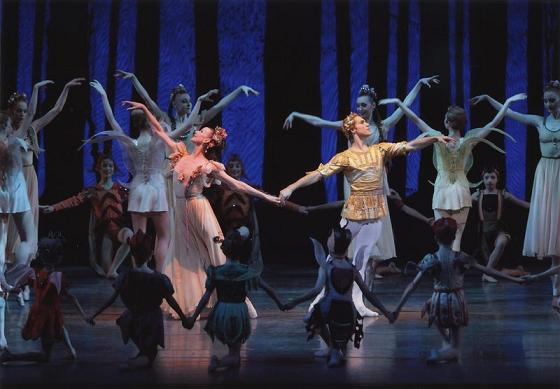
And my favorite of the night was Tschaikovsky Suite No. 3. It’s divided really into two parts, and I’ve seen the second — Theme and Variations (pictured above, Sterling Hyltin and Benjamin Millepied in the leads) — before a few times. (I wrote about a small bit about it here when ABT did it). I hadn’t realized though until now that there even was a first part.

Well, the first section is really beautiful (pictured at top), and kind of reminded me of La Valse. The ballet begins behind a black netted scrim, and takes place in a kind of Romantic dreamscape. A man, Ask La Cour, searches for his beloved, his ideal, represented by the poetic Sara Mearns, who kind of gets lost in all the women, all dressed in long, floating lavender gowns. Interestingly, no one was on pointe; everyone was barefoot, which would seem to undermine the women’s ethereal quality. And yet it gave the whole a kind of softness and lightness. They were almost like ghosts floating through the air.

The next part of this section was a soft, melancholic waltz performed by a duo — Rebecca Krohn and Jared Angle, which was juxtaposed with a fast, sprightly “Scherzo” by a really impressively quick-footed Tiler Peck (don’t think I’ve ever seen her like that before!) and the always high-jumping Daniel Ulbricht.

And then the curtain went down and when it lifted again, we were in a courtly ballroom in imperial Russia, no scrim in sight, the chandeliers shining brightly. Beautiful as the first Romantic, part with Sara Mearns, was, I still love this courtly celebration the best with the Tchaikovsky music swelling to a climax, the floor flooded with dancers, all performing the extremely fast combinations, the big huge twisty jumps for the men — my favorite. I first saw my favorite dancer dance this part, so it’s hard for me to judge fairly anyone else, but Benjamin Millepied did very well with that first set of continuous jumping turns that seem wondrously to go on and on and on, and then, in the end, when the music starts to go at the speed of light, because he is so much smaller than Marcelo, he seemed to keep up with it a little more. Marcelo is still more leading-manly though 🙂 And Sterling Hyltin was the perfect princess. Funny, but when I see ABT perform, I tend to miss the women because the men so stand out to me. Not so with NYCB; they’re more equal. I kind of feel like I saw Sterling’s part for the first time.

New York City Ballet: Founding Choreographers I


Tuesday night I went to see New York City Ballet’s Founding Choreographers I program (I know, I’m very late; it’s been a nasty week of migraines and sanity-destroying upstairs neighbors — more on the latter later).

It was a good, varied program. First on were two short abstract but very musical “leotard ballets” by Balanchine, both set to Stravinsky, that went together nicely (though they were choreographed years apart), Monumentum Pro Gesualdo and Movements for Piano and Orchestra. The pieces are mainly abstract and play with geometrical shapes and configurations, and there’s a bit of cute “Egyptian” styling in the flexed hand and feet gestures, and the ballets really give the dancers the chance to show off their musicality, especially the second, fast-paced one. I’m liking Maria Kowroski (in the top picture with Charles Askegard) better and better. She was very charismatic. Even though the ballets were story-less, she was kind of playing a part, and it really drew your attention to her. Askegard was really on too.

The second piece, Robbins’ Dances at a Gathering (pictured second, up top) was what I really went for. It was Kathryn Morgan’s debut in the ballet. She was very good, but who really ended up standing out to me was Sara Mearns. She danced her part in a way that really reminded me of ABT’s artiste supreme Julie Kent in Robbins’ similar but shorter, more virtuosic version, Other Dances. Mearns, like Kent, really connected with the music — not just like she was dancing to the music but with it; it, rather than the male dancer, became her partner. I remember in Other Dances when Kent girlishly lifted her shoulders and a big, joyful grin sweetly overcame her face when the onstage pianist first put his fingers to the keys. Sure Angel was there too, but the music is what made her dance, he was secondary. Robbins has I think three (that I know of) of these dancers-interacting-with-musicians dances: this one, Other Dances, and Suite of Dances, danced by a solitary man to/with an onstage cellist.

The problem to me with Dances at a Gathering is that there’s so much, it’s just too long, and you lose the quality and the mood that are so prevalent in the other two. Instead of one dancer connecting with a musician, or a duo with each partner connecting in his and her own particular way, here there’s a multitude of dancers, each trying to do that throughout the l-o-n-g dance. Every time I see it, I’m in love with it until about half-way through when it starts to drag. Then there’ll be another section that draws me in, and then another section that drags, then another section that drags, then another that begins to draw me in again where I begin to think, gee if there weren’t all those sections earlier that dragged, this one would be quite engaging, but by this point, I just want the damn thing to end already. And I know I’m not the only one who felt that way. You can feel the whole audience shifting in their seats. You can hear the heavy breathing. Someone needs to seriously edit that ballet!

Anyway, that said, I also really liked Benjamin Millepied. He dashed around the stage as if he were desperately searching for someone or something he’d lost. There was a longing and a quiet urgency to his performance that was really quite poignant.


See principal Megan Fairchild talk about that ballet (and see excerpts) here.

Last on was Balanchine’s Stars and Stripes, the high-speed, super-energetic ballet danced to John Philip Sousa’s marching band music that today looks kind of goofy in its hyper-patriotism. At first you want to roll your eyes at what seem to be a cheesy series of Rockette-like high kicks and formation changes and almost circus-like high jumps and stage-traversing turning jetes in the soldier section, but then you realize that in 1958, when it premiered, it was still kind of a point at which America was becoming acquainted with ballet, with the movements and with the Petipa structure — the wondrous in sync ensemble work, the pas de deux with the breathtaking lifts, the solos with their athletic jumps for the man, fouettes and fast chaine turns for the woman. As eye-rolling as this ballet may now be, if you look at it with a historical eye it was very original in its celebratory Americanization of the classical.