
Benjamin Millepied, Christopher Wheeldon, and Alexei Ratmansky Premieres at ABT


Above: Isabella Boylston and Marcelo Gomes in Christopher Wheeldon’s Thirteen Diversions, which premiered at American Ballet Theater two weeks ago. (Photo by Rosalie O’Connor.)

Once again, I’m behind on posts. May was a crazy month, filled with family emergencies, last minute travel, and trying to juggle paying legal work with book industry stuff and blogging. Hopefully June will be a bit quieter, though not likely at the rate it’s going thus far…

Anyway, on May 24th, ABT held a night of premieres, showing three new works by today’s “in” choreographers. Wheeldon’s Thirteen Diversions, set to Benjamin Britten’s Diversions for Piano and Orchestra, was overall my favorite. It seemed to have the most going on in terms of emotions, the most developed sections, the most varied movement, and interesting lighting design (by Brad Fields) to boot, though I know others were bothered by that. Background was lit with different colors each section and began with part of the back darkened, with light slowly encroaching. It created an atmosphere of mystery. I also felt like Wheeldon’s dance allowed the dancers to shine the most. Gillian Murphy and David Hallberg were a duo whose dancing had a sweet, light feel to it, like a relationship in bloom, while Marcelo Gomes and Isabella Boylston kind of went back and forth, with more depth and nuance to their relationship. She’d go from peaceful to needy to wanting to escape him back to needing him. They danced it well.


Above: Michele Wiles and Thomas Forster in Ratmansky’s Dumbarton, which I liked as well. (Photo by Rosalie O’Connor.) Dumbarton, set to Stravinsky’s Dumbarton Oaks, was mostly light and lyrical, with dancers clothed in light-colored contemporary costumes (by Richard Hudson). At times, though, the dance took on a more mournful tone, as the music would grow slower and Misty Copeland would collapse, then be carried off by a group of men. But then she’d reappear again in the next, lighter scene, as if nothing had happened. Then, it would happen again. I wasn’t sure if we were going back and forth in time or if there was a continuity of life kind of motif at play.


Millepied’s Troika was a relatively short dance, for three men, set to Bach.  Above are Sascha Radetsky, Alexandre Hammoudi, and Daniil Simkin (being thrown) in photo by Mikhail Logvinov. I started out really liking it but it kind of lost steam. I thought each man would have a different personality or embody a different mood: Simkin more playful, Radetsky more masculine, Hammoudi more soft and lyrical. To an extent it was danced that way, but then mid-way through they each seemed to be doing the same things. They started to blend into one another. Maybe that was the point. At the end, there was a series of lifts where Radetsky and Hammoudi kind of threw Simkin. He’d playfully try to escape them, but they’d catch him, scoop him up, and toss him. Someone remarked that this reminded them of Tharp. It also reminded me of Millepied’s earlier work for ABT, where Simkin was tossed in the air by a group of men in the midst of trying to escape a group of women. So Millepied repeats his themes over a few times.

Also on the program was a revival of Tudor’s Shadowplay with Craig Salstein and Xiomara Reyes in the leads. Created in 1967 and set to Le Livre de la Jungle by Charles Koechlin, it had a very dated feel and many have noted this is not one of Tudor’s better works. To me, it had a kind of Rite of Spring meets Prodigal Son feel to it. Salstein plays a poetic, monk type of figure who wants to be alone to meditate. But he is constantly bothered by this group of beings who appear to be half human, half primate who swing around gymnastically on a set of tree branches. Eventually they bring to him a woman, who’s very Siren-like, and whose sinister charms the protagonist is ultimately able to ignore. That’s what I saw in it anyway.

I felt a bit underwhelmed by the evening overall. It’s always exciting to see new dances though. And it could just be me and my penchant for full-length story ballets 🙂

One other thing: some of the gossip blogs stated that ABT had stricken Sarah Lane from the performance because of Natalie Portman’s presence. I didn’t know Lane was supposed to be dancing that night so have no idea if that’s at all true. Can’t imagine it is. Boylston still danced, and, as I said, I thought she danced very well.
Alina Cojocaru and Polina Semionova Guest Star in ABT’s DON QUIXOTE

Over the weekend, two European star ballerinas – Alina Cojocaru from the Royal Ballet in London, and Polina Semionova from the Berlin State Opera Ballet – guest starred in American Ballet Theater’s Don Quixote as Kitri.  Cojocaru danced with Jose Carreno, and Semionova with David Hallberg. I saw both performances. Overall, I thought both are beautiful dancers, have an innate sweetness that shines through, are absolute balance queens who can hold balances on one leg on pointe for many many seconds unassisted, and can dance the role nearly perfectly. But I thought that both of them lacked fire; they both played it too safe. Maybe it’s just that Natalia Osipova has ruined me and I just can’t see anyone else in this role now.

One thing I loved about the Cojocaru / Carreno performance were that the two seemed to have a real rapport, a genuine affection for each other. Did they ever dance together at the Royal, does anyone know? Or was Jose there too early for her? Cojocaru never threw herself into his arms with the wild abandon that Osipova did last year, and I missed that. But I don’t think Jose did 🙂 Seriously, he didn’t seem to appreciate Osipova’s theatrics that much. Cojocaru seemed to tone it down and they worked very well together. Also, as I complained about on Twitter ad nauseam, during those insane one-handed overhead lifts, Jose did not go on releve and hold one leg up in arabesque the way Ivan Vasiliev did with Osipova in the Bolshoi’s live-streamed performance. It’s okay; I still love Jose 🙂 But seriously, Vasiliev and Osipova have ruined me! Cojocaru has absolutely gorgeous developpes. She can lift her leg up so high – really stunning. And I mentioned the balances earlier. She held those for so long; crowd went wild. And sweetest thing: Jose kept demanding she return for an encore bow after each of her solos. Made me really love Jose.

Cojocaru was a little shaky during the first act, and she had a little stumble. But it wasn’t memorable. Far more memorable was her strong performance in the third act, her best. That’s when she did the crazy balances.

In the third act fan variation, Cojocaru did a completely different series of steps than I’d ever seen before, which makes me think there are a bazillion ways to do that variation. Or at least three – the American, the Russian, and the British. The Ballet Bag ladies sent me a You Tube link via twitter, of Cojocaru dancing with Johan Kobborg. Around the 7 minute point is where she does this different variation.


Jose is such a great Basilio. He’s a natural flirt, a natural macho Latin guy, and a natural actor who can be a macho and a flirt and still be totally endearing. And it really kind of made me melt when he kept insisting she take more bows.

I really enjoyed Sarah Lane and Isabella Boylston as “the flower girls.” They often weren’t in sync because Boylston danced with more expressiveness, arching her back, taking her time and drawing out the turns, playing with the musicality. Lane was more sharp and precise, hitting poses right on the beat. But I could have cared less that they weren’t perfectly in sync. I loved that each had her own personality, as people do in real life.

I missed Sascha Radetsky as Espada the matador. I’ve never seen him in that role and I think he’d make a good one. He was replaced by Gennadi Saveliev. He was replaced on opening night too, which worries me that he’s injured.

I thought Polina Semionova was really beautiful, and, where Cojocaru had a few wobbles, Semionova had none. She was very very near perfect. Like Cojocaru, the third act was the one that most brought her to life. She kind of veered all over stage on her third act series of fouettes but she threw several multiple pirouettes in, and her balances were even more stunning than Cojocaru’s, as, during her final balance, she took her leg out of arabesque and straightened it out in front of her, without ever holding Hallberg’s hand to steady herself. Audience went absolutely crazy with applause. They really loved her, and called her and David out for several curtain calls.

In the third act, she did “the American” fan variation. She’s Russian and dances in Berlin, so I really think each ballerina just chooses whichever version looks better on her body and feels most comfortable to her. I thought the little hopping “horse steps” on pointe were really sweet on her.

She and David seemed to like each other as well. The partnering was a little off at points, though, and he almost dropped her in a fish dive. She played it very safe with the second act swan dives into his arms as well, and he didn’t try any Vasilievs on the one-handed lift.

David is a beautiful dancer on his own though, and, as a critic said to me during intermission, it’s sometimes hard to focus on anyone else when he’s onstage. His movements were absolutely perfect, both the more balletic and those kind of side to side matador-looking movements. His jetes are beautiful – he’s just the most beautiful male dancer and you can completely lose yourself in the story of the ballet just watching him.

Acting-wise, I think David is wonderful in the romantic scenes. He’s definitely a romantic. But the rest of the time I think he should just be himself, make Basilio his own, and not try to be so cocky and macho. In him, I find it comes across as anger, an an intimation of violence even, like he’s really going to go off and whack someone. He’s not a natural cocky flirty Latin shit like Jose and Marcelo Gomes 🙂 And so it loses its charm with him. My thoughts anyway.

It probably won’t come to a surprise to anyone who’s read my blog for some time that Veronika Part (here as Mercedes, the “street dancer”) stood out to me. In the first two acts, I found her even more captivating than Semionova. One thing I love about her is her attempt to make the styling as authentic as possible. Part really looked like a Spanish dancer to me. And in the second act’s dream scene, I found her jetes across the stage really breathtaking – just as much as Semionova’s.

Sarah Lane danced the part of Amour in the white scene. I always want to call that character Cupid. Anyway, before the performance began, I overheard one teenage girl behind me say to another, “Sarah Lane! She was the one in Black Swan!”

All in all, really lovely performances, but I do think Cojocaru makes a better Sleeping Beauty and Giselle than Kitri. She’ll be dancing Giselle this Saturday night. She’ll also be dancing Don Quixote again with Jose tomorrow night (Monday, the 23rd). I’m excited to see Semionova in Swan Lake later in the season.

American Ballet Theater Spring 2011 Opening Night Gala

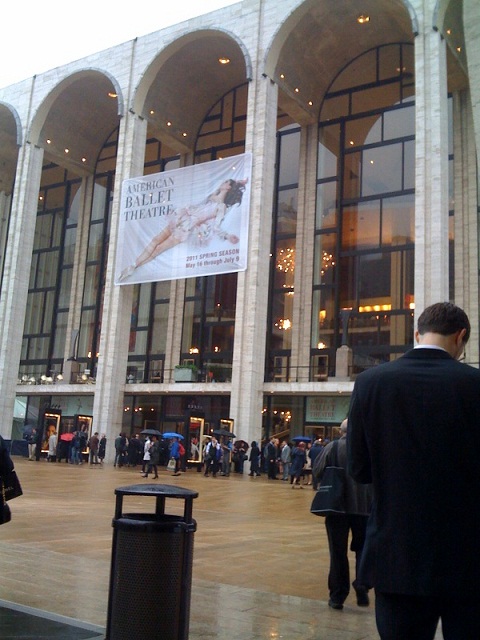
Last night was ABT’s Spring 2011 opening night gala. Dreary, rainy night … but what else is new for New York these days?

Once inside, I really enjoyed the show though. (I’m hoping to receive photos soon, which I’ll post). The program began with a short preview of Ratmansky’s The Bright Stream, which I’m excited to see next week. Seems to have a lot of humor, some bravura dancing, a cute storyline.


(Photo: The Bolshoi’s production of Bright Stream; Natalia Osipova is jete-ing).

Then, there were introductions by Rachel Moore, executive director of ABT, wearing a beautiful green dress, and Kevin McKenzie (AD), followed by Caroline Kennedy, who introduced the students of the Jacqueline Kennedy Onassis School of American Ballet as they danced a world premiere, Karelia March, by Raymond Lukens. The program says the students are Level 7, which must be the highest level, because some of those dancers looked like ABT principals. I’m not kidding, I swear. They really amazed me. That school is doing incredible things!

Next was Balanchine’s Tchaikovsky Pas de Deux, danced by David Hallberg and Gillian Murphy. Everytime I see David dance I think he must be the most perfect male dancer in the world. Gillian was stunning too.

Then came the Grand Pas de Deux from Ratmansky’s new Nutcracker, danced by Marcelo Gomes and Veronika Part. (No, they’re not performing that ballet during the Met season, but there seemed to be a few excerpts in the program from ballets they’re not performing). I missed seeing this couple – overall still my favorite – when the company premiered Ratmansky’s version in December. They were so sweet. Veronika danced with such wonderment in her eyes, such joy. And Marcelo was her perfect, adoring cavalier, all eyes on her. I don’t have kids, but I’d think they’re the perfect wedding couple to wow very young audiences.

Then came Majisimo, a classical ballet piece with Spanish flourishes created by Georges Garcia for the Ballet Nacional de Cuba in 1965 and set to Jules Massenet’s Le Cid. This piece was mainly meant to highlight Jose Manuel Carreno, who of course retires from ABT later this season. But it was really a dance for eight couples, and he danced only the male part of one of them – there were very few solos. He danced with Paloma Herrera. Xiomara Reyes was paired with Reyneris Reyes, guesting from Miami City Ballet. The other couples were comprised of Cuban dancers guesting from other companies as well: Lorena Feijoo and Joan Boada from San Francisco Ballet, and Lorna Feijoo and Nelson Madrigal from Boston Ballet. The dancers were spectacular, but I didn’t think that much of the choreography, which reminded me of a more bland version of an ensemble scene from Don Quixote. Jose had a series of turning jumps, and a really beautiful multiple pirouette that wowed the audience – drawing those turns out are what he’s most known for. And Xiomara really took my breath away with this crazy fast series of traveling turns in a diagonal down the stage. I’ve never seen her dance like that!


(Photo: Jose Carreno dancing with Polina Semionova in Diana e Acteon)

After intermission came two pas de deux from Swan Lake. A Twitter follower asked me why they needed to perform two scenes from the same ballet. I think that ABT, same as everyone else, is just trying to benefit from the Black Swan craze. They should have had Sarah Lane dance one of the pdd though! 😀 Anyway, first pas de deux – White Swan- was Paloma Herrera and Alexandre Hammoudi, which was good. But the second – the Black Swan – I found surprisingly magnificent! It was danced by Michele Wiles and Cory Stearns. There have been so many guest stars from Europe lately gracing ABT’s stage, I’d forgotten how perfect an Odile Michele Wiles is. And Cory really impressed me as well. Whatever he may lack in dance ability (I can’t imagine he’ll ever be a David Hallberg or Marcelo Gomes), he more than makes up for in acting and stage presence. He’s really good at bringing you into the world of the ballet and creating a character you can sympathize with.

Sandwiched in between the two SLs was Jessica Lang’s Splendid Isolation III, danced by Irina Dvorovenko and Maxim Beloserkovsky. I joked on Twitter that Max earned the hot guy of the night award for that, but seriously – he did! Irina was really beautiful as well. And her party dress, which she came out in for the final stage bow, was, as usual, gorgeous. She has such impeccable fashion taste, imo.


Following that was the highlight of the night, for me – Diana Vishneva and Marcelo Gomes in the Act I pdd from Manon. Such a perfectly choreographed pas de deux – beautifully romantic and full of love / lust but with so many breathtaking but capriciously executed, dangerous-looking lifts you sense something out of control. As beautiful as it is, this story isn’t going to have a happy ending. I am liking Diana Vishneva more and more. I’ve always thought she was a great dancer but she always seemed to play too much to the audience for the story ballets. She didn’t take me into the world of the character as much as I want an actor to. But the last two seasons she’s been doing just that: really developing the character and dancing to her partner – Marcelo here and in Lady of the Camellias last season, which is the first time she really blew me away – instead of the audience. This – the Manon pdd – was the audience favorite last night as well. The two got a storm of whoots and bravos at their curtain call, and practically had a standing ovation the audience was so loud in their applause. “So beautiful,” exclaimed the woman beside me. “Okay, we can go home now,” she joked.


(Couldn’t find a photo of Diana and Marcelo, but here is Diana dancing Manon with Manuel Legris. With all photos I post now, I’m linking to the original site via a click on the photo.)

Here are Marcelo and Diana in Lady of the Camellias:


Then, Alina Cojocaru, one of the European guest artists this season, danced the Rose Adagio from Sleeping Beauty. I’m not a huge fan of this ballet in general, but she was lovely. Patrick Ogle replaced Sascha Radetsky as one of the cavaliers.

Second to last was the Act II pdd from Lady of the Camellias danced by Julie Kent and Cory Stearns. Again, Cory did a very good acting job – and physically he fits the character perfectly, as Julie does hers, but I think some of those lifts are so difficult-looking… I just worry about the dancers. Isn’t that how Roberto Bolle got hurt last season – performing this role?

And the evening ended with another ensemble excerpt from Ratmansky’s Bright Stream. People who stood out most to me were Daniil Simkin and, again, Xiomara Reyes. I really am excited to see this ballet.

Tonight Don Quixote begins and runs through the beginning of next week. I’m excited to see Alina Cojocaru dance with Jose Carreno on Friday night, and Russian ballerina Polina Semionova guesting in the Saturday matinee with David Hallberg.

American Ballet Theater’s “On To Act II” at the Guggenheim

Did you guys watch the live-stream last night or tonight? If you missed it, you can watch the video now archived on the Guggenheim’s ustream channel.

It feels weird to review a program that everyone can easily watch online, but I’ll just say my favorite moments last night were: the ABT II dancers in excerpts from Jessica Lang’s Vivace Motifs, which I thought looked like a lovely ballet; Hee Seo in the prayer scene from Coppelia; Susan Jaffe coaching Sarah Lane in another scene from that same ballet; and Jose Manuel Carreno’s interview by Wes Chapman.

I wasn’t really in love with the dance Carreno performed with Melanie Hamrick – Ronald Savkovic’s Transparante. I thought there was a bit too much falling down and standing up again, and, though some of the partnering and lifts were beautiful they were pretty basic and didn’t reveal much about the relationship of the characters and the dramatic action. But I loved hearing him talk – love how he still has that thick accent! Love that he said “oh shit” in reference to all the Don Quixotes he’s cast in during week one of ABT’s Met season! He doesn’t seem to have a plan for the future, but said he’d still do some freelance dancing for the next few years, and said he’s interested in exploring more contemporary work, other forms of dance. I think that’s why he wanted to dance Transparante instead of something from ABT’s season.

I liked Martine van Hamel’s discussion and performance of some of the character roles she continues to do – the wicked stepmother, always either drunk or hung-over, in Kudelka’s comical version of Cinderella, and the wicked fairy Carabosse in Petipa’s Sleeping Beauty. But they left out the Dacha Dweller from Ratmansky’s Bright Stream, which was on the program! None of us have seen that ballet yet and I was eagerly awaiting that excerpt … and then she said she wouldn’t do it because she couldn’t get something in it quite right yet. Well, I guess we’ll see it soon enough.

I really did like the excerpt from Jessica Lang’s Vivace Motifs. The ABT II dancers are always very good, especially Irlan Silva. Every time I see him dance I get annoyed that ABT hasn’t yet brought him into the main company. I don’t understand what they’re waiting for. He stands out so much to me. He seems better than most of ABT’s soloists and even some principals. And he’s not even in the corps yet. I really really really don’t get it.

Anyway, I’ll conclude this post with an excerpt of Carreno and Susan Jaffe dancing the Black Swan pdd from an earlier documentary about ABT:


And footage of Silva from the documentary, Only When I Dance:


Kurt Froman on Training Natalie Portman to Dance


But his funniest, most interesting words are about Mila Kunis:

“Mila, and I mean this in the best way, she is such a loud-mouthed kind of broad. You know exactly where you stand with her, if she’s not happy with something. All she wanted to do is smoke cigarettes and drink coffee, where it was like, “Come on Mila, we’ve got to work!” And Natalie was like completely the opposite, in a way. She never complained once…

“Mila was the further behind in terms of training. She’s not — she doesn’t have a really good sense of her body, she’s not really a dancer or whatever.”

It’s funny, but I know exactly what he means about not having a good sense of your body… something I never knew about myself until I started trying to to dance.

Anyway, this is from an interview in Front Row Magazine, by Peter Simek, with Kurt Froman (former NYCB dancer- turned – Movin’ Out lead dancer and choreographer for Billy Elliot on Broadway.) Apparently, the interview with Froman was originally published around the time the movie came out, but these excerpts didn’t make the final cut. Simek decided to publish them now in light of the current who danced what controversy. Btw, you all probably already know this, but Sarah Lane gave an interview to 20/20 about said issue. Froman gave the interview a long time ago, without knowledge that this would become a controversy, so it has the air of truth. Scroll down to the bottom to read exactly what he said about Portman.

But I also find it really interesting what he said about training Kunis. At least at the beginning, their intention was to make her like a real Odile – marked by virtuosity. Froman choreographed while Millepied was busy with a prior commitment and that’s what he was trying to go for with Kunis – to make her as believable as a virtuoso as possible. But then when Millepied returned, he changed everything, making Kunis’s character more about her sex appeal, and her sexual comfort level with herself (as opposed to Odette / Portman’s lack thereof). So then they added things like Kunis’s dancing with her hair down, being so comfortable with herself that she didn’t care about messing up, etc., and they took out the virtuosity. This, he said, was okay because it went along far better with what Aronofsky wanted than what Froman had been trying to train her to do. I just find that interesting, because that was one of the parts of the film where I had the hardest time suspending disbelief – that the company director would seriously consider replacing the lead with a seemingly ditzy girl who thought it was funny when she couldn’t do a series of turns without nearly falling over. Of course everyone keeps pointing out that the movie wasn’t about dance but about sexuality, madness, etc. And they’re right. It’s just interesting to me that initially the film seemed to be a little more about the actual ballet than it ended up. Makes me wonder if things were changed after everyone realized how impossible it was to make a couple of very good actresses believable as high-level ballerinas.

Sorry this is all I’ve been blogging about lately! It’s definitely not all I care about. But I’ve returned to practicing law and so am now trying to juggle three things: my job, my book, and this blog. I apologize if it’s slow going from time to time. I definitely plan to cover as much NYCB and ABT as I can this summer!

Jose Carreno in “Swan Lake” on Dancing With the Stars

Did you guys see it last night? I don’t know who choreographed but it’s obviously a version created for fans of Black Swan the movie, showing both black and white swans vying for Prince Siegfried’s attention, and shortened for the allotted time. Lorena Feijoo from San Francisco Ballet and her sister, Lorna, from Boston Ballet, danced the white and black swan. Interesting that they didn’t have Jose in tights. I hate it when male ballet dancers don’t wear tights. You can’t see the movement at all; it just doesn’t look like ballet. Still, I think our Jose looked better than Jose Martinez in pants.

Also, regarding yet more Black Swan controversy: E! is now positing that because Sarah Lane and Isabella Boylston are both in ABT, Lane’s statements to Dance Magazine about the amount of dancing she did for the film were motivated by sympathy for Boylston. This is becoming just a little absurdist.

More BLACK SWAN Controversy, and The Paris Opera Ballet’s COPPELIA


I’m still crazy busy but just wanted to point out two things. First, if you haven’t already heard, there’s now a storm of controversy over how much dancing Natalie Portman actually did in Black Swan. Dance Magazine EIC Wendy Perron wants more credit given to Sarah Lane, Portman’s ABT double (whose dancing I love; for image credits above, click on the photos). Portman didn’t mention Lane in her Oscar acceptance speech (though she did mention the dancers in general) but, further, there was apparently also a special effects video produced about the making of the film in which Lane’s face was never shown, though her dancing body was, and in which Lane was never credited. Lane seems not to want to say too much, says she was asked to remain silent on the issue, to not talk about the film, particularly before the Oscars. Lane gave an interview to Dance Magazine in December about her role in the movie, saying she wasn’t “looking for any sort of recognition.” Millepied of course defends his muse, saying Lane did “just the footwork.”

Lane also mentioned in that Dance Magazine interview that Maria Riccetto did some of Mila Kunis’s dancing, which I didn’t know. Both Portman and Kunis must be very petite women!

Anyway, will the controversy surrounding this film ever end? Hopefully not! It’s keeping ballet in the minds of the public, if you ask me…

Thanks to reader Jeff (who I noticed is also mentioned in Perron’s blog, linked to above) for pointing me to the controversy.


Also, this Monday, March 28th, the Paris Opera Ballet will live-stream its Coppelia, via Emerging Pictures’ always excellent Ballet in Cinema series. Curtain is Paris time at 7:30 p.m., which is 1:30 p.m. here on the east coast. In Manhattan, it’s showing at the Big Theater again. For other times and locations, visit the Ballet in Cinema website.

Okay, all I have time for now. Thanks for continuing to read my blog while I remain swamped 🙂

American Ballet Theater’s Original New Nutcracker


More photos coming soon. This one (of Gillian Murphy and Catherine Hurlin as the two versions of Clara) is taken from culture.wnyc.org.

Last night was the official opening of ABT’s much awaited new Ratmansky-choreographed Nutcracker at BAM. I loved almost every single second of it. I’ve only seen about six different versions of this ballet, but this one to me seems most original. It’s very entertaining, very humorous at points, and can somehow maintain the attentions of small children while being clever and witty – and beautiful – for adults. It’s very theatrical and it’s not as “dancy” as the one I just saw from the Bolshoi (Grigorovich’s version)- there’s more non-balletic jumping and playing around in Act I at the party, but there’s plenty of beautifully choreographed classical ballet during the grown Clara and Nutcracker Prince pas de deux and the ensemble snow scene and waltz of the flowers.

It opens with the cooks and maids in the kitchen preparing Christmas dinner. They’re going about their merry preparations when suddenly their space is invaded by mice. The mice completely take over, chase out the cooks, jump up on the tables and grab for the hanging meats. Adorable and hilarious. There’s one very cutely mischievous little mouse who appears throughout.

Then the party scene happens and Drosselmeyer (a non-dance role here) presents the children with two sets of life-sized dolls. The dancing was very good, but there were no sharp, stunted staccato movements as in the Bolshoi’s, so the dancers didn’t look like real dolls to me. I loved the costumes for Harlequin and Columbine though. They looked the most commedia dell’arte that I’ve seen. All costumes were brilliant – one of the most excellent things about ABT’s production. They, and the equally brilliant sets, were made by Richard Hudson, of Lion King fame.

When the dolls are ordered to return to their boxes, the children do a group dance that looks more like fitful stomping than anything balletic. But it’s still musical and evocative and cute, and it got a lot of laughs. The nutcracker that Drosselmeyer then gives Clara (danced brilliantly by Catherine Hurlin) is half-doll, half-human. He’s danced by a boy (Tyler Maloney) but he has a full nutcracker head, so he can’t do as much as the Bolshoi’s human nutcracker doll – his movements are much more limited. Once Clara’s dream begins, the boy removes his doll head before escorting her off to the Kingdom of the Sweets. I have to say, I really liked the boy who danced Clara’s bratty brother, Fritz – Kai Monroe. He was very entertaining, did a good job with both the acting and the dancing (high jumps!), and I think he will be one to watch for.

The Battle scene between the mice and the nutcracker and his soldiers was good, and, again, the costume for the mouse king (Thomas Forster) was fantabulous. I couldn’t even count the heads he had there were so many. I think of all battle scenes, I like Balanchine’s the best. I love how a mouse will scurry ominously across the floor right in time with a flute chord. Then the mice begin to gather and organize right in time with the flute ensemble so that it seems like the mice are talking. And Balanchine’s battle scene seems the most theatrical. Balanchine’s growing tree is also magnificent. Here, the tree only grows a bit, but soon they multiply and trees begin to eat up the wings, which was also spectacular.

The snow scene was really beautiful and this is where we first meet the grown-up Clara and her nutcracker prince (last night they were Gillian Murphy and David Hallberg, but there are many casts – see James Wolcott’s review of a preview starring Veronika Part and Marcelo Gomes here). Their first pas de deux is a beautiful waltz, and it’s made very clear that this is Clara’s grown-up vision of herself and her prince. The child Clara and Nutcracker boy waltz alongside Gillian and David until the classical ballet steps takes over, and the children stop dancing and gaze longingly at their grown-up selves as they finish the pas de deux. There’s a really beautiful Viennese waltz-type of lift where he spins around with her perched on his shoulders.

The Kingdom of the Sweets is really different from other versions. The “Sugar Plum Fairy” or “Nanny” as she is alternately called here, is not a dance role, but more of an escort through this kind of tour of It’s a Small World. She dons an absolutely gorgeous ancient Indian costume, as does her male companion. The dancer representatives from various countries are not dolls; they are real, but most of the dances are very different. The Arabians, for example, are danced by one man (last night, Sascha Radetsky) and four women, and the women are all cutely chasing the one very wickedly flirtatious man. It reminded me a bit of Kevin McKenzie’s von Rothbart deviously flirting with all the court women at the beginning of the Black Swan pas de deux. At the end of this dance, though, the tables are turned and the women come into their own and no longer need him. Now of course, he’s not very happy about that. It’s great fun and I loved this dance the best.

The Russians (Mikhail Ilyin, Craig Salstein and Arron Scott) were more folksy than bravura ballet, which was fine, because they later did a circle of barrel turns as their part of the final ensemble dance.

And we see Mother Ginger again (or who, as a child, I called The Fat Lady with the big skirt). I haven’t seen her since Balanchine! And there’s an added element of hilarity here involving the mischievous little mouse from the kitchen!

The only dance I didn’t really care for was the Chinese. As I’d expected, these roles were danced by Daniil Simkin and Sarah Lane. But Ratmansky didn’t really use them for what they are known for and the dance is very tame compared to this dance in the other Nut versions. I really wanted to see Daniil go flying around the stage in those crazy million times-overrotated turning leaps that he’s known for. There weren’t even any high jumps. It’s just that I look to the Russian and Chinese dances for the bravura parts and it’s okay if they’re lacking in one dance, but not both! The Chinese weren’t as goofily portrayed though as in other versions, so I appreciated that.

And I loved the waltz of the flowers. Included here are some very charming bees, but they’re not used in a slapstick way at all, which I thought they would be when I initially saw them. They dance is very classical and there’s a beautiful part where the four male bees toss the red and pink-clad ballerinas into each others’ arms in a circular rotation. That received a lot of audience applause.

And then is the ending pas de deux again between Gillian and David. I’d written before, when I saw an excerpt at the Guggenheim, that it looked more modern lyrical than classical, but last night it looked very classical to me. Ratmansky used my favorite lift from the Grigorovich Bolshoi version where the prince lifts and holds Clara up by one lower leg and carries her all around stage like that. The solo variations were nice. David didn’t seem to have the height he normally does on his jetes (I was told later at dinner though, by a dancer – not from ABT – that that choreography was crazy hard) but he made up for it in a series of spins. I know in ballet they’re called turns, but he was going so fast they looked more like ice-skating spins to me!

The only thing I found bothersome was the acoustics in the BAM opera house. Maybe I’ve just never heard live music played there but it just seemed like the orchestra was playing so softly. The sounds of the toe shoe-clad feet and the sounds of children coughing dominated.

Oh, one final thing: when David Koch, who financed a good part of the production, gave his opening speech, he accidentally called Kevin McKenzie “Peter.” Got a lot of ooooohs from the audience. I couldn’t hear through the ooooohs what he said after that – I assume it was an apology – but whatever it was it elicited even more ooooooohs. Funny.

Overall it’s a brilliant new ballet, a very original new production. Definitely get out to BAM if you can! Go here for the rest of the schedule.

My Take on BLACK SWAN


I saw it over the weekend. Overall, I thought it was hilarious. Totally campy and just plain funny. Way too silly to be scary though. And I think Aronofksy was going for both. So, to me, it failed to that extent. But it may have just been me. Maybe I just have a dark sense of humor, because I went with two friends – one a ballet fan of the Gelsey Kirkland era, the other not. They both loved it and were on the edge of their seats throughout, although they also laughed quite a bit (particularly Gelsey Kirkland friend). Gelsey Kirkland friend said it reminded him of Dancing on My Grave. I must read that! I don’t know why I haven’t yet…

Anyway, so if you don’t know the story, it’s about this young ballerina who dances with a New York City ballet company housed in the Koch Theater. The artistic director (played by Vincent Cassel) is basically Peter Martins but with brown hair and a French accent.  Peter Martins guy tells the company that they are doing a new production of Swan Lake and to attract new audiences, they are going to cast a brand new ballerina, a new face. The old prima, Winona Ryder, is approaching menopause anyway. Never mind that she looks the same age she did in Reality Bites, at least to me. Apparently this company doesn’t have a system of principals and corps members because no one has any idea who the new face is going to be.

Peter Martins guy soon reveals that he favors Nina (Portman), but thinks she can only do the White Swan. He thinks she’ll have trouble with the Black Swan (he never uses the names Odette and Odile, which I know annoyed some ballet fans on Twitter, but I think it would have alienated non-ballet audiences had he used those names). He tries to seduce her (literally) in the name of getting her into the character of the Black Swan, which of course in the film is characterized as a sinister, conniving slut. But maybe he goes too far and unleashes the inner beast in Nina. She suddenly seems hell-bent on destroying herself (and she’s had problems in the past with self-mutilation and, it’s hinted at, anorexia). Or, maybe it’s that a new dancer from San Francisco (Mila Kunis) is trying to destroy her in order to take her place as the lead. My biggest problem with the movie is that it’s billed as a thriller but we never really find out the answer to that question. At the end, you’re still left wondering WFT was that about??? I mean, you’re left wondering that with many David Lynch films too, but with those, if you think long and hard enough, you can piece it all together. This, I don’t think so. I think it was just meant to be scary, sexy, creepy, gory camp.

For serious ballet fans, you have to suspend disbelief. Natalie Portman I thought did an excellent acting job, and her dancing is very very good for someone with very little training. I know Sarah Lane was supposedly her double, but you never really see any stunning dancing. The camera mostly focuses on Portman’s arms – and Benjamin Millepied did say he focused on the port de bras when training her and Kunis because you just can’t teach someone with no training to go on pointe and do the fouettes and pirouettes and all. So, you simply have to suspend disbelief that someone at Nina’s level would land the lead in the first place. And if you’re looking for thrilling dancing – the fouettes, the lightening-speed chaine turns, a beautiful pas de deux, etc., you’re not going to get it.

When we were all walking out, I did hear a couple people say now they wanted to see Swan Lake. Of course I hope it renews interest in the ballet, but it does worry me a bit that people will be disappointed, because the film makes it seem like the black swan pas de deux is a sex scene. The Peter Martins character keeps yelling at Nina to “seduce me, seduce me!” During a break he rhetorically asks Millepied (playing the role of Siegfried) if he would ever sleep with Nina (except he termed it differently). No one in the audience laughed but me. What am I the only New Yorker who reads the tabloids??? But in the ballet, the ballerina seduces both Siegfried and the audience with her allegro dancing, with her athletics. It’s more dance than theater; the seduction is in the dancing not the acting.

The whole thing had a Valley of the Dolls feel to it. Barbara Hershey is Portman’s mother, and she seems a bit off herself. You sometimes wonder if the mother (who never made it out of the corps, and who left ballet to have Nina) is trying to sabotage her daughter as well. There are some really funny (though I’m not sure if they were meant to be) screaming screeching cat-fight scenes between the two of them. But I think the funniest are between Winona Ryder as the aging ballet star forced into retirement and Nina, particularly those involving discussions of how to get ahead in the ballet company (guess; not by great dancing)… I miss Winona Ryder. I miss movies like Heathers

Anyway, I still don’t know how to feel about this movie. I’m happy that it’s put ballet on people’s minds again, but how misleading is it to what an actual ballet performance is all about? What do you guys think? It seems to have received fairly good reviews from the film critics.

MORE BEAUTIES


So, toward the end of last week I saw two more casts of Sleeping Beauty in New York City Ballet’s production. Above are the beautiful Kathryn Morgan as Aurora and Tyler Angle as her Prince Desire (Paul Kolnik is the photographer). Below are some photos of the other couple I saw, Tiler Peck (both she and Kathryn were making their Aurora debuts), with Gonzalo Garcia, albeit not from this ballet.


(in Four Bagatelles, photo by Paul Kolnik)


(and in the Christopher Wheeldon / Martha Wainwright collaboration over the summer, photo from NYTimes by Andrea Mohin; I like this photo because I think it shows each of their personalities well).

And then last week, I saw Ashley Bouder and Andrew Veyette.

I’ve been thinking about who I thought was best in what role but it’s actually really hard to do that. I honestly ended up liking everyone, though there were definite differences.

I do have a lot to say about Gonzalo Garcia though. I LOVED him as Prince Desire — he really melted me, he really completely stole the show that night and I feel like I’m not ever going to like anyone quite as well in that role now. I mean, you just have to see him in a classical ballet, as the romantic lead, and you realize why San Francisco audiences were so upset when he left SFB for NYCB a couple years ago. Some of those SFBallet fans were really devastated when he left. And I think it’s been such a puzzle to those fans that New Yorkers haven’t really fallen for him the same way. And I think it’s because he hasn’t had the chance to shine because NYCB is so Balanchine-heavy. He needs roles where he can act and become a character. He’s such the quintessential romantic prince.

You can really tell how differently he’s trained than the other NYCB dancers, who’ve nearly all come from SAB and been trained on Balanchine’s non-actable abstract ballets. I felt like with Gonzalo I was seeing someone from ABT — mainly Angel Corella (in terms of the body type, dramatic style and boyishly handsome face). The way he’d hold onto the music, draw it out while it crescendos, by for example in the vision scene holding out a finger to the princess and then leaning back, then looking out to the audience — not AT the audience but in the audience’s direction — to show how enthralled he is, how much he wants to catch her, all before then turning and running toward her. The other two — Tyler and Andrew — they didn’t do all that. They just kind of looked toward her standing more and more toward the tips of the toes, ready to run toward her when the music told them to. Gonzalo’s way was so much more Petipa and Tchaikovsky and Bolshoi and Romantic Russian and all that, and it might all seem overly melodramatic to audiences who aren’t used to that. But that’s what I’m used to with ABT — and that kind of stuff makes me swoon!– so that’s why I think I loved him so much. But I’m wondering what others who saw this cast thought?

And Gonzalo just knows what’s expected of him, as the prince. Later, when he went to do that crazy series of jetes, he was rested up and ready and he nailed them like I’ve never seen him nail anything. I’ve never seen his legs straighter, in perfect splits, and the whole way around the perimeter of the stage, without tiring. And it’s like he knew that was a very important part, and he had to do them perfectly because that’s just what the romantic hero does — that’s the way he shows his love for the princess, and that he’s worthy of her. The other two obviously took them seriously (because they’re crazy hard, you have to take them seriously), but it just was more of a difficult feat, instead of having the same meaning. You know what I mean? Like he looked out all across the stage wistfully, and then he just took off flying around it. It gave it a different meaning than just flying around.

It makes me wonder though if contemporary audiences understand that, or appreciate it. Or whether they prefer for the emotion to look more “natural”? I’m not saying Gonzalo was better than the other two, just different.

I wonder what Joaquin De Luz was like, since he’s not SAB trained either. Did anyone see him?

As far as partnerships, Kathryn and Tyler were my favorites. Tyler had a few flubs on some of his solo variations (but I still love him!), but he was always the perfect partner, he was always solid when supporting her. And the series of fish dives in the wedding pas de deux were some of the most breathtaking I’ve ever seen. Her legs were pointing completely up toward the ceiling! Magnificent! And the final hands-free fish dive was picture perfect.

I liked all of the Aurora interpretations, but they were different too. Kathryn was the most princess-like, the most regal, though that may just be the way she looks. She just kind of looks like royalty! Ashley and Tiler seemed more “real girlish”  – all smiles and sweetness and awe at the world and their cute suitors.

The rose adagios were all near perfect. (ABT’s Sarah Lane is still the queen of the balances to me — it seems like she could hold them for hours.) Kathryn had the most absolutely gorgeous extensions. Do I have to giggle every time Robert Fairchild comes out leading the cavalcade of suitors? I loved Craig Hall as the “African prince,” – I don’t know what exactly stood out about him but something did. And even though it wasn’t a dancing role, I loved Henry Seth as the King; he acted it really well. Chase Finlay was lovely as Gold in the wedding scene – -he’s a really beautiful dancer with exquisite lines. Everyone’s talking about him being the next romantic lead. I loved tiny Erica Pereira as the fairy of eloquence and Ana Sophia Scheller as the fairy of courage, thought Faye Arthurs and Adrian Danchig-Waring were brilliant as The White Cat and Puss in Boots, and Daniel Ulbricht is the quintessential gymnastic court jester.

And there’s NEVER been a better Carabosse than Georgina Pazcoguin! Nor has there ever been (or, perhaps, could there be) a better Lilac Fairy than Sara Mearns. I love how she arches her back so luxuriously and opens up her chest. And the rich, full-out port de bras. Such beautiful expansiveness, that, with her beatific face, makes her perfect for this angelic role. She reminds me of Veronika Part.

Okay, that’s all I can think of, for now!

This week begins the Swan Lakes. I’ve never seen Peter Martins’ version, so I’m really excited. In particular, I’ve heard wonderful things about Maria Kowroski as Odette and I’m psyched for Stephen Hanna’s debut as Prince Siegfried!

FRANCIS MASON, DANCE WRITER, DIES AT 88

I’m so sad to hear of this. I didn’t really know Mr. Mason, but over the last couple of years, he’s been seated next to me at many dance performances. I knew who he was because so many critics would stop by our row and greet him. He was the most lively man. I remember sitting next to him last year when then new ABT wunderkind Daniil Simkin danced Flames of Paris with Sarah Lane, and after Simkin completed an astounding series of barrel turns, Mr. Mason whistled, raised his eyebrows and shook his head, letting out a little laugh. I remember thinking, okay if this man, who’s apparently been around a while and seen a lot, is impressed by this guy, Simkin is officially impressive.

I also remember seeing Mr. Mason not long ago at a Cedar Lake installation performance. A young woman slid off our bench and began stretching and several of us kind of looked at each other, obviously wondering whether she was a dancer and part of the performance but too shy to ask. Mr. Mason took one look at her, and got up and called out to her, “Are you part of the performance?” (She wasn’t, she laughed.)

I feel like I just saw him and he looked perfectly healthy, although with elderly people I guess you never know — it can be any little thing that causes death. I’m actually shocked he was 88; I thought he was in his early 70s — probably because he was so active and sprightly.

And active he was, as you can see from the obituaries. I was just recently introduced to the excellent critical journal he edited, Ballet Review, one of the many things he did.

It’s just so sad thinking that you just saw the person and, now, that’s going to be the last time you ever saw them. I thought the same with Clive Barnes.

Here is James Wolcott’s obituary, and here Alastair Macaulay’s.

INDIANAPOLIS CITY BALLET TESTS THE WATERS


“You have guests from all over the world to do their forte; it inspires the audience there to keep going and to commit to it. You are going to see a broad range of things. If you’re not into tutus and tiaras, you’ll see something more contemporary. You’ll be exposed to something you didn’t know existed. Your humanity will be opened to something very moving and very memorable.”

— Julie Kent on Indianapolis City Ballet’s upcoming all-star gala performance, in which she is a participant. And wow, look at this lineup: David Hallberg, Tiler Peck, Joaquin De Luz, Miguel Quinones, Sarah Lane, Jason Reilly (from Stuttgart) etc. etc. — dancers from all over the world are participating next Saturday night.

Apparently, Indianapolis City Ballet, which doesn’t yet have its own set of dancers, is testing the waters to see how much local interest there is in ballet. The company hopes to have its inaugural season during 2010-11.