"The New York City Dance Community"

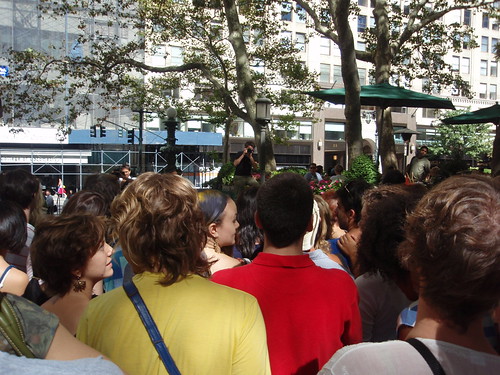
dance community NY group photo in bryant park

I don’t know who in the dance community annoys me more: those who consider themselves hipper than thou and call themselves “downtown,” or those who consider Ballet the only form of dance.

Spurred by Eva’s suggestion, I went to Bryant Park this afternoon to take part in the first ever group photograph of the New York dance community, organized by Belgian online dance initiative Sarma and local dance collective Chez Bushwick. Everyone who considered themselves part of the dance community was invited. Since I’m a dance blogger, ballet and modern fan and amateur ballroom dancer, I decided that included me.

When I arrived I spotted a robust, jovial-looking, curly-haired man wearing a t-shirt that announced he was a member of the photo op, and headed toward him. I kind of look like Sylvia Plath but shorter and with darker hair, or maybe Suzanne Farrell but not anywhere near as pretty 🙂 I have long hair and was wearing a ballet-y black bouncy-skirted sundress bow-tied at the waist by a red silk scarf, and sandals whose straps were topped with embroidered flowers. I was carrying an oversized pink bag bearing books. After making brief eye contact with me, the man peered around me to another woman and began greeting her, until I stopped right in front of him.

“Oh hi,” he said to me, surprised. “Um, we’re actually taking a photograph of the New York dance community here. Would you like to participate?” he asked hesitantly.

“Uh-huh, that’s what I’m here for,” I said.

“Oh. Oh good,” he said handing me a piece of paper announcing the rules (you gave them permission to use the photos of you on the internet and in magazines, yadda yadda). He also told me after the picture was taken, I was to sign my name on a roster of attendees and would receive a sticker entitling me to a free drink at one of the concession stands. He then told me they were running a little behind schedule and directed me to take a seat at one of the tables in an adjacent elevated area along the path.

I did as he suggested. Turned out to be the perfect little perch for me since its elevation gave me a good view of the crowd. I enjoy being an observer. Plus, I was having a bad hair day and was a little worried of running into Marcelo or David or one of my ballet heartthrobs, so could be on the lookout and duck for cover if need be. I had nothing to worry about as it turned out: there wasn’t a soul from the ballet world there.

Many people began arriving, and I didn’t know anyone. Finally, I spotted a fellow blogger in the crowd. As he was making his way to the tabled area after receiving his instruction paper, I waved to him.

“What are you doing all the way over here?” he said as he approached. I didn’t really understand the question so responded with a quizzical look.

“We don’t ever see each other,” he then announced, “because you’re a snobby elitist who only goes to uptown things. I go to all the cool downtown things.”

I just stared at him, not really knowing what to say. He laughed. Apparently I was supposed to take it as a joke.

“Well, I’m going to go around and meet new people while you sit here like a wallflower.” And he was off.

I kind of sat there stupefied. I think I saw Eva, but after that didn’t feel like getting up to say hello. Maybe some other time. I saw Jonah Bokaer, one of the organizers of the event and a dancer with Merce Cunningham. He’s rather cute in person 🙂 He was going around giving people who looked like they belonged small bottles of water. That didn’t include me. He looked right through me when he passed directly in front of my table even though I had my piece of paper with the instructions prominently displayed. A twenty-something woman with dark hair bearing a green “press pass” around her neck was going around with a notepad. She stopped at a table in front of me at which sat a man and two women with really cool-looking dreadlocks. I overheard them tell her they were retired dancers, now choreographers. I wondered if the interviewer was Gia.

About half an hour later, an announcer muttered something over a microphone that barely worked. From the crowd’s actions, I figured he was telling people to line up to his left. I followed suit, but kind of wish I’d just have stayed where I was to take pictures. I got a space all the way in the back of the crowd. I could hear him now telling taller people to move to the back, but apparently the average man over six feet either doesn’t understand English or has no sense of his size in comparison to others. Or else “downtown” male dancers are just rude. Some tiny women in the back brought over some chairs and stood on them. Soon, a security guard was in on the action ordering the people to get off the chairs. They paid him no mind. He yelled louder. They continued to ignore him. I couldn’t believe their audacity. And it did look dangerous: the plastic chairs were very insubstantial and the ground was really rocky and unstable. I wouldn’t stand on such a thing and these were dancers. He walked right up to one of them and yelled in her face to get off the chair or else. This was far more exciting than the photographer up front!

“Oh come on, officer” she whined like a character in Rent. Thankfully the last picture was snapped and the whole experience over, so there was no further trouble.

Good thing about being in the back was I was first in line to record my name. That of course didn’t mean I was actually first to do so. As the man handed me pen and paper, someone reached over my head and snatched the whole right out of my fingers, bumping me on the crown with the back board. Other pens and rosters were handed about, arms flying feet stomping everywhere. About fifteen minutes later I was finally able to scribble my name, identity (blogger), place of birth and email address, and receive my sticker, which I promptly took to the nearest concession stand.

“What’s this thing?” the clerk snapped.

“We’re supposed to get a free drink?” I said.

She laughed shaking her head. “I don’t know nothin’ about this.”

“The dance community gathering, over there,” I pointed to the raucous crowd bombarding the man with the rosters and stickers.

“I don’t know and I don’t wanna know,” she spit.

I guess it was a fitting end to a discomfiting experience. Weird, I was just saying how good it felt to be part of the dance community.

What What What?

Okay, what bumblehead recommended this movie?! I have got to stop doing this — going to see a movie or play based on the fact that there’s supposed to be some miniscule amount of dancing. (Did the same with Gypsy, knowing only that the production I was to see contained original Jerome Robbins choreography and therefore expecting West Side Story, not realizing “choreography” can sometimes mean simply placement of actors on a stage). Someone — I think it was Dance Magazine in one of their e-newsletters — mentioned that the brilliant Desmond Richardson was to be in this movie (Julie Taymor’s “Across the Universe” — could they have come up with just a slightly more imaginative title??), which, according to the credits, he was, but I have no idea where. Probably in the one scene that looked like it was trying incredibly hard to be something out of The Wall, with cartoonish block-headed military goons doing some kind of group number that looked like it required people slightly more skilled with body movement than actors, but cannot under any circumstances be called dance. Why someone of Desmond’s stature would take on something that amounted to extra work I have no idea.

Anyway, lack of dance and the beautiful Desmond aside, this movie in a word sucked. It was full of cliches, bad acting, an utterly boring and predictable narrative, cheesy cameos (could anyone make Bono look creepier than Taymor), and renditions of the greatest songs of our time that somehow, obscenely sucked the life right out of them (the sole exception to this being “Let it Be” which begins with a young African American boy cowering in the entrails of a burned-out car during a race riot and climaxes with a black choir belting out the lyrics during the slain boy’s funeral).

The only way I made it through the whole thing was this guy. I guess you can’t really blame actors for crappy material; perhaps the fact Joe Anderson gave all the scenes he was in an actual heartbeat attests to his skill. I’ll have to see more of him. Dana Fuchs‘s Janis Joplin-esque diva was fun at the start but somehow began to drain you, likely because of the predictability of her character. I enjoyed her performance far more in the original, off-Broadway play, “Love, Janis.”

Interestingly, there’s a split-second Butoh sequence during one of the Vietnam scenes that failed only semi-miserably because of, once again, the cliched way in which it’s used. Of course, unlike with real Butoh, the dancers here are all women instead of a combo of sexes since male nudity in movies might spook the fifteen-year-old straight boy who it’s assumed is their main patron, or maybe his parents, or whoever … the powers that be who need to maintain for whatever reason the sexist, homophobic status quo. Anyway, I guess kudos to Taymor for even trying to inject a bit of multiculturalism into her film.

The twenty-somethings in my audience cheered wildly at the film’s end, so maybe it’s just that I am just too old for it 🙂 What gets me is, gasp and moan though these young people did during the scenes involving the Vietnam war and the violent police crackdown on campus protesters, do these people see any relevance whatsoever to what is going on in the world today? What’s the difference between the 60s and today? No baby-boom-produced generation gap? Is it because those who are serving in the current war are largely not white and from middle-class families?

So, to the young people who happen to read my blog: perhaps you will really enjoy this movie. If you do see it, though, please please please please please think when you see those aforementioned scenes of all the people coming home in body bags today. Just because they are black and Latino and working-class, unlike the characters in the film, they are still human.

Brief Snapshots From Downtown Dance Festival

I’m exhausted from spending the weekend down at the lower tip of the island watching other people dance (how does that happen?), so this is going to be short (word-wise at least). The Downtown Dance Festival took place during lunch hour each day last week at Chase Manhattan Plaza in the Financial District, then moved for the weekend to a nice little outdoor amphitheater in Battery Park. I wasn’t able to see all of the dance companies (nearly 20 in all), but here are some highlights from what I did see.

First, sorry, but I simply must bombard people with just a couple more photos of Quorum Ballet, who performed again Saturday in Battery Park. They were really so lovely… so, just, HOT for lack of a better word 🙂


I wrote in my last post on them that their lifts looked a bit “trick-happy” and on watching again I think that might be in part because the lead female dancer, Theresa da Silva, would often look out into the audience and choose someone to flirt with, which seemed to happen most often while she was airborne. Very interesting, and something I haven’t really seen in concert dance before, only in ballroom comps and some club acts. Anyway, their next performance in NY will be February 13th at the Tribeca Performing Arts Center. I urge everyone in the city to check them out!


I also liked the Ashley Browne / Kinetic Project. Some very sweet duets with fun, pop music from Jill Scott, Mos Def, and Fiona Apple.


Ms. Bne is a choreographer I could really see working on SYTYCD. I really wish they would open the show up to other choreographers besides the same ole Mia Michaels and Wade Robeson. I mean, keep them, but instead of having them choreograph something practically every week, let the country see some of this other awesome talent!


Another favorite, Vissi Dance Theater. I loved them! Their mission statement reads, “Vissi is committed to art that explores moral and social issues… Vissi seeks to speak to the human condition, lift the spirit, ask questions, celebrate the joy of life and reflect the truths of human nature.” I felt they did that splendidly. This piece above, danced by four women, reminded me a bit of Alvin Ailey’s Cry with its upbeat celebration of womanhood, and was kind of a combo of modern dance with disco / hustle, to music by Macy Gray and Jocelyn Brown.


Their second piece, named “Melbabcd,” was a combo of all kinds of stuff — modern, hustle, hip hop, Latin, African, you name it. Great fun, as dance that makes you think and has social relevance can often be 🙂 This one kind of reminded me of Bill T. Jones with its very colorful cast of characters. I’d love to see more full-length work by this company.

The choreographer, Courtney Ffrench, by the way, is another whom I can really see peppering up SYTYCD with some romping group numbers. C’mon Nigel, expand those horizons!

Another highlight:


Gallim Dance Group. This piece is from “Snow” based on the novel by Orhan Pamuk and choreographed by Andrea Miller (yet another who could inject that aforesaid pop-fest with a blast of brain power). This was a haunting piece, like I imagine the book to be (okay, admitting I haven’t read it here!). The women bent their bodies every which way, inched forward, ran backward — the movement was beautiful but juxtaposed with musical lyrics like “question democracy…” became chilling. A Juilliard grad formerly with Ohad Naharin’s Batseva, which I’ve enthusiastically blogged about before, Miller’s mission is to “explore issues such as feminity, power, community and solitude.” Gallim will be performing at Dance Theater Workshop in Chelsea in September. See them there if you can.

On Sunday, we were treated to Darshana Jhaveri Manipuri Dance who came all the way from India, and who specialize in bringing the classical Indian dance, Manipuri, to contemporary audiences. So sweet, so lovely, and so educational.

This guy BLEW ME AWAY. He had this amazingly intense look of concentration the whole time. Sometimes when a performer has that look in his or her eyes, you’re almost mesmerized just by the face. He beat the hell out of this double sided drum, as well as another that required a stick, later on. Not only did he play those drums, he danced while playing. And not only did he dance, he did these continuous barrel turns at whiplash speed. The entire audience sat there open-mouthed.


And here he is barrelling all over stage with the other, larger drum. Between turns, he made beautifully intricate gestures with that drumstick. At one point, he put the drum down on the center of the stage and did repeated turns around it, beating it with the stick after each rotation, and managing somehow to hit the stick on the drum right in time with the lightening-fast music. Talk about the necessity of great speed and precision on those turns — if a turn was off, you wouldn’t just see it, you’d hear it. It was breathtaking, and I can’t tell you how much respect I now have for this classical Indian dance form.

Okay, I can’t write anymore. I do have a few more pictures of the whole festival, along with the Sitelines performance series, in my photoalbum, here.

Speaking of Sitelines, Apollinaire and Eva Yaa Asantewaa are having a very interesting discussion of the Macaulay NYTimes review of the Reggie Wilson / Andreya Ouamba work I wrote of earlier. Eva’s review of the piece puts me to shame — she saw all kinds of things I hadn’t thought of — do read it! I do have thoughts on the subject of socio-cultural meaning in dance and whether the choreographic duo’s mission statement should have been confined to grant application writing, as Macaulay argues, but am far too exhausted to formulate them now…

At the Doors of U.S. Customs

As promised, here are a bunch of pics I took of yesterday’s first peek at the collaboration between Brooklyn-based choreographer Reggie Wilson, and Andreya Ouamba (originally from Congo but now residing in Senegal), entitled, intriguingly, “Accounting For Customs.” The work is part of the Lower Manhattan Cultural Council’s “Sitelines” project — comprised of dances that are created specifically for a certain site, outdoors, free and open to the public 🙂

This dance took place on the steps of the U.S. Customs House, which the dancemakers assured was significant. I honestly had to stop and think of what the Customs House represented. I have no background, or interest, in economics and actually almost got lost trying to find the place, since I think of this building as The Museum of the American Indian (which it now is; in 1973 Customs was moved to the WTC, don’t know where it is now…). Well, I guess the work that goes on in an official Customs Building is the setting of tariffs U.S. citizens have to pay on goods over a certain amount that they purchased abroad, right? So, a customs house deals with the price one pays for bringing something “foreign” into one’s own culture. A custom is also of course a cultural tradition.

Wilson has said (see Kourlas article linked to above) that one of his interests is to examine the intersection between “traditional” (by which I assume, in the African context, he means traditional African dance) and “contemporary” (by which I assume he means, in the American context, modern, hip hop, jazz, etc.). How do people react to contemporary dance containing traditional movement, he asks. Do they see the contemporary movement “evolving” the traditional, or “bastardizing” it. And how does innovation happen in this context — which force is credited with being “innovative?”

Thought-provoking questions no doubt. I’m not sure I can answer them, but I did really like what he and Ouamba came up with here. It was short but evocative and fun. The dancers began in a horizontal line on a low step, then two by two they paired off, greeted and hugged each other, then, holding hands, ran up the stairs, both together and apart, as they were separated by a central hand rail. Some dancers fell and lay down on a middle step, forcing others to find a way around them. Soon all dancers had fallen and lay down on a step, some atop each other. After a short silence, a loud bang emanated from the speakers (was it a car’s backfire, a gunshot?…), and the dancers then began rolling up the steps, eventually manoevering themselves to a crouched position, and crawled downstairs. All then stood up and danced, each his or her own way, up and down and all around those steps — at times fighting each other, at times being playful, at times embracing, helping each other up or down, carrying each other, stopping on a step to do a pose — a pretty arabesque evoking flight / freedom, a more urban, hip-hoppish stance — at times they would crash up against the side pillars, pushing and shoving against them, at times holding onto them for dear life while another tried to pry them off. All the while a woman dressed in traditional African costume sat off to the side, under a pillar, making crafts and from time to time looking over at the dancers — the children of the diaspora… her children. The music (not live, but played over loudspeakers that in my opinion were not amped up enough for outdoors) varied between what I assume was Senegalese music, poppy tunes with pulsating drums, folksy guitars playing a melody that sounded like a patriotic American song, and silence. At one point the woman on the side hummed a spiritual.

Anyway, great thing about outdoor performances is that you can take many pics!


I really liked these two guys. At one point they kind of hustled each other down the steps — rather playfully aggressive, each throwing the other down a few notches in a funky little turn. I think I’d be too scared to do that on narrow stairs. According to the articles, they only had two weeks of rehearsal!

In places the scene as a whole was even a little Rent-esque. Very urban. The photographer in the front with the long dreadlocks and the colorful outfit — he must work for some major publication around here because I see him practically everywhere!

Here’s the woman making her crafts and humming spirituals off to the right.


I loved this guy in the front … obviously — I kept taking pictures of him!


As I said, it was short and not entirely fleshed out, but their larger project together is to take place in 2009 at the Brooklyn Academy of Music. I’ll definitely be excited to see what they come up with given more time!

If you’re in New York, to see this work, about 20 minutes in length, just go down to the Customs House, at Bowling Green station, at either 12:30 or 1:30 today and tomorrow.

"As Far As We Know" on the Fringe

On Saturday night my friend, Evangelina, invited me to a play showing as part of the currently underway NYC Fringe Festival, in which her husband, Michael Batelli, was an actor. I’ve never been to the Fringe Festival before, and haven’t been to a dramatic play in a while, so it was quite a treat.

As Far As We Know” is a fictional re-imagining of the true story of an Army reservist who went missing in Iraq in April 2004 after his convoy was ambushed en route to Baghdad. Five days later, Al-Jazeera TV broadcast a videotape showing that 20-year-old reservist (whose real name is Keith Maupin but is here given the name Jake Larkin) surrounded by masked men. Six weeks later, another videotape emerged, showing, possibly, some kind of execution, though the tape was of such poor quality that the Army deemed it “inconclusive” both of whether it indeed showed a slaying, and whether, if so, it was actually that of Maupin. Unlike with all other military persons, journalists, and missionaries shown in similar tapes, Maupin’s body was never recovered, and there has been no word from him or his captors ever since. The Army has since promoted Maupin three times, in abstentia, and his family and friends in his hometown of Batavia, Ohio, continue hopefully to await his return.

I’m embarrassed to admit, but, somehow I’d never heard of Maupin. It’s impossible of course not to find his story immensely powerful and poignant, but I was also intrigued by the fact that, to this day, nearly three years later, there’s been no closure. Captors have been so up front with other kidnappings; either they were oddly out of step on this one, Maupin is still being held, or as the play hints, there was some kind of Army coverup. According to the play the ambush was partly the result of information sent by a Private to an incorrect email address, and Larkin’s drill sergeant, who later left the Army disillusioned, tells Larkin’s sister she believes the troops received inadequate training, ultimately confiding that she feels partly responsible.

The story was, interestingly, told in non-linear fragments and used mixed media (videoclips –both actual footage and tapes filmed by the actors — were interspersed with the staging). My only problem was that I found it a little too unwieldy and lacking in focus, which is, I’d assume, wont to happen when something is directed by the entire ensemble instead of a single person. It was, by turns, about Larkin’s family members and how they dealt with the situation, about the politics of the possible Army coverup, and about the Army personnel assigned to assist the family and act as go-between between family, military and media. Kelly Van Zile, who played Larkin’s sister, was a powerhouse of an actress and she really made me feel the sister’s pain as well as her internalized conflict between anger at and desperate need to believe in the military.

But it’s pretty obvious how the sister is going to feel. I thought a more dramatically interesting focus would be the young female Army captain charged, in her first assignment, with acting as liaison between the Army and the family. At the beginning of her portion of the story, she is shown listening to a tape dictating the proper way to break horrible news to a family: succinctly and with restrained compassion. With the Larkin family, of course, since there is no such “news” but only indefinite puzzlement, her job is near impossible, and infinite in duration (the Army moves her into a hotel down the street from the Larkins). The most powerful, most human scenes are those where the sister’s pain permeates the captain’s continuous attempt at a tough exterior and the captain gives in — first allowing the sister to keep hold of an all-important cell phone giving her instant access to the Pentagon (and on-the-spot news of Larkin), then writing personal checks to pay the distraught family’s utility bills, and eventually, against firm orders, allowing the family to attend an emotional homecoming for the soldiers returning from Larkin’s unit.

Glitches aside, though, it was a very compelling play and I’m definitely going to keep my ears open now for info about Maupin.

I’m late in getting this post up seeing as how it’s now mid-week, but kind of coincidental given that I received an email today from one of our servicemen, Paul, from Stamford, Connecticut, now serving in Iraq. Paul tells me that he’s enjoying learning some salsa dancing over there. Thanks for emailing, Paul. Take care of yourself, and please come home safe and sound 🙂 Oh, and of course please let us know how your salsa is coming along!

The Gay / Straight Thing Revisited: We Must All Just Say No to Homophobic Men!!!

There have been a few more good comments added to that former post on Pasha and Marcelo and all that stuff. Since I don’t yet know how to have “recent comments” show on the side bar (I know, it’s ridiculous that I still don’t entirely know how to use my blogging software! Sorry!), I wanted to point them out to everyone because the comments are so astute.

I just want to say that, though I love the commentary and think this is obviously a very important discussion, it makes me so mad that we even have to have it, because if homophobic men didn’t exist we wouldn’t. When women (or gay men) ask about a guy’s sexuality, like the girls enquiring about Pasha, we’re simply trying to figure out whether he’d be into us — if a guy isn’t into your gender, you don’t want to embarrass yourself by going after him, obviously! Not that you still can’t flirt with a dance star who turns out to be gay, but you flirt in a different way. Bottom line: with us, there’s nothing wrong with wanting to know!

The problem is that we dance fans (particularly ballet fans, but all dance fans really), have ALL had that absolutely horrible situation where you’re talking to your male friend or maybe even boyfriend and you suggest going to a dance performance and he turns on you like a rabid beast. “I’m not going to see a bunch of —- in tights,” he screams at you. And what do we all say — WHAT DO WE ALL SAY??? “Oh no, they’re not all gay! So and so’s not gay, and so and so is straight, and look, so and so has a girlfriend and so and so’s even married!…” When what we should be saying is, “homophobia is wrong.” Period. End of discussion. And if he can’t understand what we’re saying, or replies, oh I’m not homophobic, no not me, I just don’t want to look at a bunch of ‘sissies, it’s just not my thing, I have better things to do with my time, etc. etc. etc., then we should ask him why he has such issues, is he confused? Why should he have such a problem seeing another man’s body if he’s at peace with his own sexuality?

I recently had this exact altercation with someone. It was so horrible I can’t even express (especially since this person is in the dance world). He asked me what my plans were for the coming week and I excitedly began chirping on about ABT saying that one of my favorite dancers would be performing the next night (not Marcelo but the other ABT guy I’m always on about). I asked him if he’d like to join me. Was I in for rejection. “Oh my god, that guy is so gay it’s not even funny … I knew the second I saw him. I’ll never watch any of that crap. It’s so unappealing to a straight man, you have to understand that, Tonya. It’s just … it’s just … ick,” he said as if I was a child who needed to be taught a life lesson. I’ll never forget that intense look of disgust in his eyes, and how awful it made me feel that someone could be so hateful toward a man who’s never done anything wrong to him, who creates such beauty, whom I have so much admiration for. I opened my mouth to reply but no words would come out; there’s no way to combat that kind of visceral emotion with appeals to logic and reason.

For me personally, I’m honestly not sure I really want to associate with that guy again. He then started making sexist remarks that really bothered me too. People who are filled with such anger and disgust over someone’s sexuality not only have problems with their own, but in general, I just find them to be uncultured, shallow, not very well-read, not very sophisticated, not very well raised — how could such a person expand my universe, make me think, be an interesting, kind, caring friend? What could their companionship possibly offer me? If someone is disrespecting your favorite dancer, your hobby, or your passion, then he’s disrespecting you. And none of us should put up with that.

Anyway, go here to re-view the post and new comments!

Is Pasha a Nureyev or a Baryshnikov: What's In a Dancer's Sexuality Anyway?

Okay, I’m probably going to get attacked right and left for this post, but I’ve been receiving a lot of emails asking me if my former dance instructor, the extremely personable and talented (not to mention sexy 🙂 ) Pasha Kovalev, who is now a serious contestant on SO YOU THINK YOU CAN DANCE, is gay or straight. My first thought was, argh, why does it even matter! But then I thought about it and realized, homophobia is totally passe and no one is asking because they want to judge anyone and, although of course it is completely irrelevant to the actual dancing, it does inform your crush on the guy (if you’re a straight female dance fan, which a good number of us are). I mean, you have a different kind of crush depending on whether he’s straight or gay, right?! (mine are usually far worse on the gay ones, but go figure…)

When I first fell big time for this one, my favorite dancer in the world (besides Pasha of course!), I did what everyone living in the 21st Century would do, an internet search of course. And how did my heart drop when I saw this, his cover story in The Advocate! NOOOOOOOO, I must have let out the most horrid cry. We’re never getting married now! (Because of course otherwise we were, since he’s not a big huge famous ballet dancer or anything…) But I have to say, it was far worse finding out this one, my second favorite, was married, and that this one is engaged to be married. After all, I’m never going to have to be jealous of any of Marcelo’s partners (you can’t envy a man; it just doesn’t make any sense).

And reading the Marcelo article of course made me fall in love with him all the more, and realize why he is, as Dance Magazine called him, the guy all the girls want to dance with. He is a big strong warm Brazilian guy, a kind of teddy bear, albeit a gorgeous one — in whose arms could you feel safer or more comfortable and secure?! Of course the actual story of the dance performance that unfolds onstage or TV is not real anyway, but dramatic narrative aside, to me Marcelo and Julie Kent, his frequent partner, are the greatest partnership around today, and that’s precisely because of the way you can tell they feel about each other: it’s obvious they truly love each other as friends and partners, and that’s everything in making a performance come to life!

I’ve never had the opportunity to dance with Marcelo of course 🙁 but in my own experiences, gay men are crazy fun as partners. Straight men are too, but, I dunno, there’s just something about gay men, that IMO, takes some pressure off and just lets you be you. If something gets touched, you know it was an accident, or if something stupid happens like this, or this, it’s not THAT embarrassing! And back to Marcelo briefly (I know, I can never stop talking about him; it’s an illness really…), big warm swoony stage door kisses like this could never happen if the dancer was straight, right — I mean, that might be looked on … just… a little perverted or something.

But, I also think that a dancer’s sexuality, as with all aspects of his or her personal life, though completely irrelevant to the dancing, do, rightly or wrongly, come into play in constructing the dancer’s persona or mystique, should he or she ever become really famous. Joan Acocella, in reading from her latest book at Barnes & Noble recently, said that she thought part of Baryshnikov‘s fame stemmed from his reputation for being a skirt-chaser. The press, she said, just went on a field day with a straight male dancer. I personally think it was more the political situation at the time (he defected from a country we were obsessed with hating after all), because, how does that explain the fame of Nureyev? To me personally, it is Nureyev who is the more intriguing: in addition to dealing with the shock of fame and wealth after having grown up in abject poverty, the horribly difficult decision to defect and leave his family forever behind (his mother was very ill), he also had to deal with societal and political oppression based on his sexuality. And the attacks that he had to endure, of leading a life of “debauchery” in the West while those left behind in his homeland starved, were criticisms I’m sure Baryshnikov never got. And, as for partnerships, please — that between Nureyev and Margot Fonteyn was the stuff legends are made of. For a very good, rather poetic book on this most fascinating of all dancers (IMO) please go here.

Anyway, back to Pasha, and THE QUESTION! Sorry for the long-windedness, I just wanted to make everyone read about all my favorite dancers 🙂 Okay, well, I don’t want to be gossipy, but I feel there is nothing wrong with pointing you all toward something he said on TV on either the first or second episode of the show! Remember! Remember what he said about why he wanted to become a ballroom dancer, what led him to dance in the first place! That’s a pretty good indication 🙂 If you can’t find it anywhere on the show’s website, I’ll give you a hint — it’s the same thing said by this other dance hearthrob on what drew him to ballet in the very fun documentary, “Born to Be Wild,” which if you haven’t seen, you can read his words on that issue here.

Dance of The Best Kind — Provocative, Evocative and Meaning-Laden: Ohad Naharin’s DecaDance

Wednesday night I went to contemporary ballet company Cedar Lake‘s performance space in west Chelsea to see “DecaDance,” a new work comprised of pieces from the past 20 years choreographed by Israeli dancemaker Ohad Naharin for his Tel Aviv-based company, Batsheva.

Still a bit disoriented from jet lag, a long drawn-out meds-laden TAC headache, and coming down from my ballroom high, I was worried I just wouldn’t be into a small, modern dance performance enough to appreciate it (I’d ordered the ticket a while ago). But, happily, I was very wrong! “DecaDance” was just what the doctor ordered to get me out of my Blackpool-withdrawal depression and back into the ever-alive NYC dance scene.

To me, this is the best kind of dance: movement creating images that, combined with provocative words and/or exhilarating, exotic, or evocative music, unsettle, evoke, just compel you stop, look, and think. I remember Joan Acocella reviewing in the New Yorker Telophaza, the work Batsheva performed nearly a year ago at last year’s Lincoln Center Festival. I remember her saying she wished with all the goings-on in the world at the time, Israel’s premier dance company would have put on a program infused with some kind of political meaning. I understood her sentiment, mainly because I like that kind of work as well and am always immensely interested in knowing what it’s like to be a citizen of another country, to exist in a world completely different from my own, but I thought it unfair to demand dance containing some kind of meaning about world politics from a troupe simply because of the geopolitical situation of its country. But the funny thing is that, watching Wednesday night, though none of the pieces made any kind of simplistic statement, I think my brain just naturally infused everything I saw with a socio-political undertone, perhaps because of that geopolitical situation.

The program began with a line of dancers, dressed in white leotards and black tights. The dancers shouted chants whose meaning I couldn’t understand, then one by one, each dancer took a couple of steps forward and danced, then stepped back into line while another dancer took a turn. Then, after each dancer had his or her piece, the line stepped backward together, fading into the background shadows. The way the light reflected only the bright white leotards had the effect of making their legs fade into the dark, so that they looked like limbless torsos. The chanting made me think of a military regime, and the legless bodies of the effect of war. I have no idea if that was what Naharin had in mind, but that’s what I got.

That scene led to a very brief pas de deux between two women (or was it a woman and a man … can’t remember) dressed in black corsets lifting, scratching at, bouncing off of each other, and that blended into a scene with several men engaging either in a monk-like ritual cleansing involving a bucket of dark, muddied water, or else splashing themselves with war paint. About three-quarters of the way through that scene a scantily-clad yet virile-looking woman wearing a feathery headdress and a face-full of garish make-up (perhaps another kind of war paint) walked sexily across stage on low stilts. After the men left, she returned with a free-standing microphone atop a giant pitchfork and, in the manner of a cabaret performer, lip-synced the words to an industrial techno-aria. Because of her raunchy garb, gawdy makeup and the manly yet sexy way she walked on the body-distorting stilts, she evoked for me a frightening vision from the late Weimar Republic or perhaps a contemporary Russian sex slave (thanks to Blackpool, I have Russia on the mind lately: anytime there’s a ballroom dance competition, the environs are tranformed into a “little Russia”) — either way, a grotesque reminder of the way a time of uninhibited freedom can turn into a reign of terror or how one person’s idea of fun is another’s hell.

My favorite piece involved several women who danced to a spoken word accompaniment. In all of the reviews I’ve read where this program or different versions of it have been performed elsewhere, none mention this piece, so I have no idea what it’s called and unfortunately can’t remember the words of the voice-over perfectly. One of the annoying things about this program is that the playbill doesn’t specify which piece is from which longer work, and which musical number accompanies which work, so I couldn’t figure out what each piece was called or research it very well. Naharin says, the playbill notes, that he enjoys “breaking down and reconstructing” his work, “enabl[ing him] to look at many elements in the works from a new angle,” so he obviously doesn’t want us to get bogged down in trying to figure out which piece is from which larger work, but wants us to see it as a new whole. The ‘problem’ or maybe I should say ‘challenge’ with this for me is, I’m unfamiliar with his work and so have no idea if I’m totally reading anything completely wrong. I may have a wholly different interpretation if I saw, for example, the Weimar / Russian slave woman in the context of the whole “Sabotage Baby.” It made me want to see his other works so I could compare, see if I “got it right” or see how my interpretation shifted depending on context.

Anyway, back to my favorite piece, about which I couldn’t research since I couldn’t figure out it’s title, longer whole, or sound accompaniment …: the male (if memory serves correctly) voice-over, issues forth various orders to the women dancers, and perhaps to the audience, providing, as I saw it, an ironic commentary on living female. The voice orders you / them to play the game enough to be able to own a house and car, resist working or thinking too hard so as to over-stress their fragile compositions, reject big ideas or philosophies, reject too much beauty so as not get carried away with art, and my favorite line — always wipe your ass really well because it’s uncouth to let others know you just shit. The piece – both the lyrics of the voice-over and the dance movements, was repetitive: the speaker repeated each line before adding a new one. And each woman had a certain movement corresponding with each word. Everytime the phrase repeated, so did each woman’s dance phrase. It was really interesting seeing the way the dance phrase corresponded to the written, and the way the movement added to the meaning of the words. For example, when the voice-over dictated, “reject Beethoven, the spider, the damnation of Faust,” a phrase near the beginning of the piece and thus repeated many many times, it was interesting to see each dancer’s interpretation of “spider,” “Beethoven,” and “damnation of Faust.” Some movements were unique to each dancer; others universal. It definitely didn’t speak to the state of Israel or have any huge overarching meaning for world affairs in the way the Acocella article wished for, but sometimes I find those quietly ‘personal-is-political’ pieces to have the most profundity.

Then there are a couple of pieces that “break the fourth wall”– ie: involve audience participation. One female dancer tried to pull me onstage with her to participate in this group jumpy hip hop – turned tango-y number, but I had to refuse because I was still woozy from the meds and, perhaps, ridiculously, still jet lag. Anyway, I never feel comfortable doing such things. She was nice and let me go, found someone else to get up there with her!

There are some other compelling pieces that I left out. I’m really interested to hear what others think about this. I found it very evocative, thought-provoking, very open to interpretation, and just a lot of fun. It’s showing through July 1st at Cedar Lake. Go!

Is The Ability To Express Oneself Through Dance An Issue of Free Speech?: The First Annual New York Dance Parade!

Yesterday marked the first annual New York Dance Parade, held as both a celebration of social dance and a protest against the city’s increasingly infamous Cabaret Laws, which sharply restrict the number of clubs and restaurants that allow dancing. In order to allow more than two people to dance simultaneously, an establishment must apply for a cabaret license, which is apparently incredibly difficult to obtain. According to Time Out New York (read their article here), this obscure law was enacted in 1926 in order to restrict public lewdness and racial intermingling, then was given new vigor during Guiliani’s reign, though I’m not sure of his ostensible reasons for that. The issue of whether such laws are unconstitutional and should be struck revolves around whether dance is viewed as a form of expression important enough to deserve First Amendment protection, an issue recently addressed by the State Supreme Court, which held that it was not. I haven’t followed this litigation, but apparently the test case has made its way to through the Appellate Division (where it likewise failed), and is hoping for consideration by the high court. I think it’s an interesting issue. According to the TONY article, the law has affected more than just people who want to dance: some bands, such as a Zydecko one, have trouble finding locales who will even allow them to play since that music, with it’s fast fun rhythmic beat leads naturally to the forbidden activity.

The parade, which began at 31st Street and snaked downtown to Washington Square Park in the Village, where it culminated in a little party, was a lot of fun. Above are some hula dancers.


Some break-dancing guys doing some crazy overhead lifts!


This girl was amazing; she could really move on those stilts!

This guy was fun too — rocking out to some techno music!

Now in the park, where Samba New York, a super fun Brazilian percussion band entertained the crowd, compelling people to really get down…

… before taking to a small stage, set up below the arches, where they added this gorgeous Samba dancer donning a brilliant costume and very elaborate feathery headgear.


There was a pretty good crowd, though I think the turn-out would have been better had the weather not been so miserable (cold, rainy and windy — worst combination possible — and for mid-late-May — totally unjustified!!)

I think the issue is really interestesing and something I’ll definitely think more about and will keep my eyes open for the litigation. But I feel that there’s always two sides to every story. I’d moved into a lovely apatment in Astoria a few years ago only to undergo a stupidly difficult ordeal of breaking my lease after realizing my apartment, in the back of the building, abutted the back room of this rather tucked away Greek nightclub (not visible from the street) that stayed open until 5:00 a.m. every night but Monday and had singers and music. I’m a lawyer, though, and have to sleep at night; perhaps someone who either worked nights or was just a very heavy sleeper would have been fine with the apartment, but there was simply no way I could stay. Maybe the answer is either some kind of zoning or just apartment buildings being forced to be up front about something like that, but I can see the issue. Also, even if the law changes restaurants may have to increase their security, which is a very unfortunate stupid pain in the butt but may be necessary. At the park, I noticed one older guy was a little out of control really kind of grabbing this female dancer, and thrusting his pelvis into hers a bit too much. It seemed to make her uncomfortable but she was young and didn’t really know how to handle it and didn’t want to be rude. Unfortunately, there are guys who still don’t seem to get that a woman’s dancing is not an invitation to sex and doesn’t entitle them to grab and grope and do whatever else they want. Of course professional female dancers sometimes get harassed as well so that’s not at all an issue specific to social dancing… Dance is most definitely an invaluable form of expression, but very unfortunately, it’s not always the law that vitiates it.

Where Does the "Queen" End and the "Woman" Begin?: Alexis Arquette. And, Alonzo King’s LINES Ballet

Last night, I saw at the Tribeca Film Festival a documentary about the journey of Alexis Arquette, of the famous acting family, from man to woman.

I’m glad I pre-ordered tickets; door sales lines were long:

Entitled “Alexis Arquette: She’s My Brother,” this was one of the most fascinating documentaries I’ve seen, but not for the reasons touted by the filmmakers, who, unfortunately, had to return to L.A. and England and were unable to stay for an after-show Q&A. Will teach me not to wait until the end of the festival to see a movie — that’s one of the reasons I go to festival films, argh. And how much I would have LOVED to meet Alexis — a true character! Anyway, the press release stated that, though filled with celebrities, drag queens and Hollywood glitterati, the film was a serious look at transgendered life. I felt like it was actually more about the former, and regarding the latter, it left me with more questions than it answered — neither of which made it at all a disappointment. To the contrary, it was absolutely mesmerizing.

My only other experiences with the subject of transgender life come from Jeffrey Eugenides’s profound, brilliant novel Middlesex, one of the greatest American novels, ever, I think. And that story differered from this because the main character was hermaphrodic and, without an operation, decided to re-define himself as a man after being raised female. I missed the Felicity Huffman movie, which Oberon blogged about in detail. Other than that, I remember a person in college, who called herself Tatiana. My school was huge, though, and I never knew her; I only knew she tried out for both male and female parts on the cheer squad, freaking out many a male cheerleader, including my lovely then boyfriend. I felt sorry for her.

But this, I found to be more a very sympathetic portrait of a younger sibling lost in the shadows of his very famous sisters and searching desperately for his own voice. It drove home the point, without necessarily meaning to, that growing up in the light of the cameras with a large family and many flamboyant, big-personalitied drag queen friends, can, ironically, make for a very lonely life.

Of course he doesn’t seem lonely, having adopted that same ‘huge personality’ as his sisters and drag companions. It’s a self-made documentary, so his face and voice are everpresent, and, while his incessant whining can really grate on your nerves at times, overall he’s just simply fascinating. By the way, I’m very aware that some would say it’s wrong to use masculine pronouns to refer to him since he sees himself as a woman, but this was the crux of my problem here. Unlike Cal in Middlesex, who begins life as a girl but narrates his story from his older, male point of view which compels the reader to envision him as a man, Alexis, who changed his name in his teens but, interestingly, never says what from, for the vast majority of the film actually is a man and seems, to me, essentially masculine — a total preening Queen, who loves dressing in drag and wearing makeup and continuously changing hair colors, but definitely a man. The film includes several clips of him growing up, and spending his teens, twenties and early thirties as a gay man, and a really good-looking one at that — in fact, he kind of reminded me of Evan McKie on the Winger 🙂

A gay man, he seemed to know little of women’s bodies. When he goes to the plastic surgeon, of course he wants humongous breasts, with nipples practically at chin-level. The surgeon can only laugh. “What, you can’t do that?” Alexis asks dejectedly. Forced to undergo psychiatric therapy in order to gain the right to have the surgery — understandably humiliatingly aggravating (is this mandatory for people having breast enhancement or lyposuction?) — Alexis brings his therapist a self-made drawing of how he envisions his future vagina: it resembles a sweet, tiny peach core. First thing though, he is quick to assert, the nose has got to go. His nose, he tells his surgeon, is that of a man — the type of man he is attracted to for sure — but it’s just not a female nose. So, he has a very idealized notion of the exact female body he wants. It wasn’t surprising to me that many of his friends began to accuse him of making the film not because he actually wants the reassignment surgery, but for attention.

For a film about changing one’s sex organs, it dealt very little with actual sexuality. There are some really interesting interviews with doctors about how far male to female reassignment surgery has come in the last few years: parts of the penis are maintained and used to construct the clitoris, making the new clitoris nearly as sensitive as a real one — but that’s more physical than sexual. As a gay man attracted to and used to sleeping with other gay men, if he became a woman he would need to turn to straight men for romantic partnership, with whom he seemed to have little experience. That’s just so completely mind-boggling to me. I’d think it would take a very open-minded straight man to go for someone who was once another man. At one point, he does film himself with a very young boyfriend, but he is still male then, and it’s unclear whether this shy, untalkative young man, so different from Arquette, is gay, straight, or bi.

Unlike in Middlesex, where I felt myself vehemently hating any character who wanted Cal to remain female, here I found myself wanting so badly for Alexis NOT to get the surgery. Maybe it was just that I kept thinking of that young Alexis as so Evan-y and such a beautiful man, or maybe it’s that I was just so scared for him, as I would be for anyone, to have such a serious surgery. I won’t reveal the end, but he begins to freak out a little as well after he “passes” his psych exam.

All in all, I found it an absolutely fascinating portrait of a preening but confused, emotionally needy, but very human person whose need to feel comfortable in his skin, though taken to another level here, is ultimately something everyone can relate to. If he was trying to gain celebrity, and I DON’T think he was, I have to say, he is as unforgettable as Cal, Eugenides’s main character. From here on, I think every time I see anything starring any Arquette, I will definitely think of him. I highly highly highly recommend it when it hits the theaters.

On Thurday night, Dea and I, used Dance Link’s two-for-one ticket offer (you’ll get a one-year subcription to their discount program if you attend the Fall For Dance Festival), and went to see the fabulous Alonzo King’s LINES Ballet at the Joyce in Chelsea. They danced two pieces, “Migration” (about “the hierarchical migration of birds and mammals”), and our favorite, “The Moroccan Project,” a gorgeous contemporary ballet danced to beautifully rhythmic and melodious African, Moroccan, Arabic, and Andalusian Flamenco music. To me, it epitomized what I love in contemporary ballet — dance ripe with possibilities for taking traditional ballet and fusing it with other kinds of beautiful movement from around the world — here, African, Spanish, Moroccan, Indian — to create something really sublime and worldly.

The piece consisted of a combination of beautiful duets — some romantic, some playful, some fraught with discontent — solos, and ensemble work. During the group parts, the dancers would never dance alone but always worked with and off of each other, looking closely at each other, reacting to each other’s movement, at one point literally bouncing off of each other: during one of my favorite parts, four men laced arms and turned away from a lone woman who, in “Red Rover” fashion, thrashed and hurled her body at them desperately attempting to convince them to allow her into their fraternal circle.

Another favorite part of mine were the “solos” — where only one dancer is actually moving on one part of the stage, but other dancers are onstage as well, very closely watching the moving dancer, examining his or her movement, their facial expressions and tilted heads intently trying to understand the statement that moving dancer was making with her or his body. Visually, it had the effect of being an exercise in learning another language: the moving dancer was definitely speaking to the stationary dancers, and they were surely listening and understanding. With the music bearing foreign lyrics beating in the background, the point is compellingly made that dance is another language as vibrant, complex and meaningful as any spoken.

Dea and I also noticed that the dancers — all wearing matching costumes of understated peach dresses for the women, tan gaucho-styled pants for the men — somehow blended in with each other, though they had varying skin color: no one person stood out as being, for example, “the African American dancer” or “the Latino dancer.” Because it was a truly multi-ethnic company, it did not look at all out of the ordinary for, for example, a red-haired freckled man to be doing intense African-based movements to Gnawan percussive instruments. How awesome is that!! “If I could be a ballet dancer,” Dea said, “this is the kind of company I’d want to be in!”

Also, Dea brought this for me from Brazil:


It’s a CD by a Brazilian singer named Marisa Monte, with lots of really pretty samba songs. I’ve never heard of her and I love the music — how sweet is Dea 🙂