Gender Bender Confusion!

Last night I went to see the last third of a three-part dance series on the theme “Gender Benders” at Symphony Space. This one was by Monica Bill Barnes & Company and Nicholasleichterdance. (Unfortunately, I missed the second part of the series, by Les Ballets Grandiva; the first was Keigwin Kabaret, which I blogged on earlier). Like the Keigwin, this was comprised of a series of short pieces, some mostly dance, others more like wordless skits, some containing both, and all presumably aiming to challenge our notions of gender.A couple of the pieces choreographed by Barnes and performed by her and Deborah Lohse that stuck in my mind were these cutely humorous Vaudeville-esque sketches featuring the two women in overdone makeup and platinum blonde wigs and wearing maid-like aprons over ruffly skirts, who were kind of simultaneously sexed-up — one kept bunching her skirt and wanting to lift it — and naively sweet and confused. It was very funny, very cute, and Lohse’s expressions were brilliant. She has a tall, thin, somewhat gangly frame, and she really seemed to know how to use that to maximum comical effect here. I recognized her name in the progam then her face as soon as I saw her onstage, and I realized where from when I read her bio: she has her own newly-started company, ad hoc Ballet, whose website I’d visited after the introduction of a new Winger contributor from that company. Anyway, I’d actually like to learn more about Vaudeville since I’ve seen a few modern companies use it now. Kind of ridiculous that I know so little since my boyfriend in grad school was writing his dissertation on its history, and I read Fred Astaire’s autobiography

I really LOVED Nicholas Leichter though. My favorite pieces were his “Baby Doll,” a solo which he performed, and “Undertow,” a piece for four men wearing tight form-fitting skirts with sexy thigh-high back slits, leather jackets with nude mesh undershirts, and finger and toenail polish. That piece explored in a short time a rather large panoply of male interactions, as the men, flirted with, hugged and caressed, lifted, fought with, and threw each other about. The costumes, along with some of the snaky Samba-y hip swaying would have been very “sexy” on women — but how did they look on men, I felt Leichter asked.

In “Baby Doll,” Leichter came out onstage alone, dressed in a man’s pinstriped suit, then, pretending to have a conversation with someone else — initially maybe someone gazing at him, then coming onto him, then perhaps a lover who was jilting him — reacted against what that absent other was doing. Initially, he seemed embarrased about being looked at, then nervous and somewhat frightened, then burst into hysterical laughter, then hurt and crying, lashed out. At one point, he pulled his pants down and mooned the absent other, then waddled around the stage, too lazy or angry to pull them back up. It was funny but disconcerting to see a man do such a thing, do all these things. Also, I thought how “feminine” the emoting and the reactions were, which contrasted sharply with his muscular “masculine” physique.

The thing that threw me was, I hadn’t known who Leichter was before this, so I looked in the program and saw the name of the performer for this piece listed as “Clare Byrne.” I then looked at the insert, and saw that they had changed it to Leichter as the performer for tonight’s show. I thought, huh, “Clare” is a strange name for a man … then when I got home looked up the name on the web and found that she was not a man at all. (In fact, she’s the one who’s doing that Kneeling piece throughout next week at various NY locations, which I am definitely going to scope out!) But, unless the whole thing was just a misprint, I couldn’t believe he had choreographed this piece for a woman — it would have been so completely different for a woman to have performed it — gone would be everything I just said above. And that made me think that, of everything I saw in this “gender bender” series, it was really only the men’s performances that I found “gender-assumption” challenging. Not that I didn’t find the women’s dancing beautiful or remarkably athletic. But, I guess women can kind of look or act any ole way — we can wear short sexy skirts, pantssuits, men’s underwear, army camoflauge or ruffly skirts, and we can be ballerinas or pole dancers or breakers or sexy sambistas and it’s all just that; nothing looks out of the ordinary. But for a man to cry or emote at all, to don nail polish and a skirt with a high back-slit and move his hips in a sexy figure eight motion… it just makes you stop, look, and think. And, I mean, how many of the DWTS celebrity males have (beyond annoyingly) freaked over looking too feminine in the Latin dances — Ian and Billy Ray this time around, George Hamilton last time; and there were several guys in my old social dancing school who dropped out of the international Latin classes because they were “too girly”… It’s interesting though, because at the same time, I don’t think this greater gender flexibility amounts to women actually having more power…

Anyway, this was a short program, but it’s inexpensive and thought-provoking. Visit Symphony Space for tix; it’s on through the 21st.
Help, I Don’t Want a Lap Dance!!!

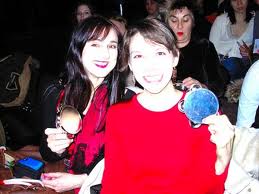
Last night Alyssa and I went to see the closing night of Keigwin Kabaret at Symphony Space on the Upper West Side. Here we are with our little silver tambourines that were atop each seat’s armrests when we arrived. If audience tambourines are supplied, you know you’re in for a little zaniness!

Anyway, the show didn’t start until 8:30, so we met at Cleopatra’s Needle beforehand, where we caught the beginning of a jazz band and got some drinks and snacks.

I have GOT to stop snacking at night on chocolate martinis and french fries … I’ve gained five pounds in the last couple of weeks; Luis is going to drop me flat on my butt in my lesson tomorrow night…

Anyway, even with the fries to soak up the alcohol, the martini was rather strong and by the time we arrived at Symphony Space, we (or I anyway) were a little tipsy. When we sprinted into the lobby ten minutes before the show was to begin, and the usher asked us which show we were there for so as to direct us either to the upstairs or downstairs theater, we looked at each other quizzically. I’d completely forgotten the name… Alyssa, quicker than I, blurted out “Gender!” and the guy told us, “downstairs.” No gender upstairs, nope, all gender is downstairs…

When we got downstairs, the place was pretty full and the only available seats were in the first two rows. A bit of a tiff eruped between us and several other near-late-comers, over who would have to sit in the first row. “What are they going to be doing,” one woman shrieked? “I don’t want a lap dance!” No one up front at least seemed to know what to expect. Alyssa and I eventually ended up with the highly coveted second-row seats, I am, as it turned out, very happy to say! Note to everyone who is unfamiliar with extreme hyperactive drag king extraordinare, Murray Hill: if you’re a shy, non-audience-participation-type, DO NOT SIT IN THE FRONT ROW OR ANYWHERE NEAR IT when seeing a show that he emcees. Alyssa and I seemed to be either too non-visible and uninteresting, or else too obviously completely freaked out, to be his fodder, but an unfortunate but well-humored guy in the first row who happened to be wearing a colorful, Christmas-y sweater, was not so lucky. Nor were the people in back of us, nor the guy in back of them … but more on HIM later…

Anyway, the, as the name implies, cabaret-style show, was a lot of fun. The company’s artistic director, Larry Keigwin, was a great dancer (and really cute to boot!), and I LOVED assistant artistic director Nicole Wolcott. She was such a beautiful dancer. I so wanna be like her! Seriously, she really makes me want to learn modern now. She made it seem freeing and fun while also being based in solid formal technique, if that makes any sense, and she just moved so amazingly gorgeously in her solo, to “Stand Back” by Stevie Nicks. I also really liked her duet with Keigwin, a tango-y kind of thing to French music, the first part of which involved chokehold-drop (what they’re called in ballroom anyway) after chokehold-drop. This is where the man wraps his hands around the woman’s neck and it looks like he’s strangling her, then drops her into a dangerous-looking dip. Teachers of mine have wanted to put it into my routines, but I’ve refused to do it because it seems dangerous to me (all the more so since I’m a frightened amateur who doesn’t really know what she’s doing) and because I feel like it just looks somewhat misogynistic. But, since this was a gender-bender thing and they were specifically questioning that, it worked here. Although, I would have preferred for her to do it to him a few times as well, but perhaps it is hard for a woman to balance a man’s body that way … but isn’t that what gender-bending stuff is made of…?

Anyway, the show was a combo of modern dance performed by Keigwin and Wolcott and their company, which includes Patrick Ferreri (who’s damn cute! and performed a hilarious drunk-off-his-butt riff on Tharp’s final Sinatra Suite, danced to One For My Baby, which I think Angel should DEFINITELY try out on ABT audiences next time he performs it 🙂 ), and Julian Barnett (who did this sweetly endearing thing to a heavy mental number on overcoming being a picked-on gay kid). And, there were the cabaret performers including my favorite Mike Albo, who did this scream-inducing parody of TV show “Ugly Betty” by mimicking the gay male character who plays the slavish, somewhat whorish employee of Vanessa Williams’ Cruella deVillish boss and sidekick to her scheming receptionist, Amanda. Other dancers included Ying-Ying Shiau, Liz Riga, Alexander Gish (who portrayed a cute but frightening cherub-faced waiter who got a little over excited about a big ole butcher knife he carried around in his pocket), and Jamacian burlesque dancer Akynos, whose pasty came off at the end of her number, leading her to finish with her left hand over her breast. How do those things stay on anyway???

One of the craziest parts of the evening was when they ran this audience-participation contest, drawing three people out of the audience at seemingly random to compete in ‘sexiest in dance’ to Justin Timberlake music. Hill picked on the guy from the fourth row who was cackling loudly throughout, and insisted he come up onstage to be the male contestant. Hill kept calling him “a gay” while he was in the audience, and when he got onstage, Hill said, “Oh, I thought you were a gay out there in the audience, but now that you’re up here I see that you’re not one at all.” Alyssa and I were DYING of embarrassment; he is nuts. Anyway, I don’t know if this guy was part of the act, but after initially looking out at the audience, like, crap, what did I get myself into, he proceeded to, I swear, perform the funniest, sexiest, cutest, lewdest cheesecake / beefcake strip-tease I’ve ever seen. Afterward, Hill asked him what he did for a living and he said vaguely that he was in show-biz. Don’t know who he is, but I definitely want to see him again! I don’t know what the guy’s sexuality was — I try not to make assumptions since I’m usually wrong — but if Hill was right in his final analysis, I think it’s perhaps funniest to see straight men who are freaking out try to do strip-tease…

All in all, I thought it was fun, though, I have to say, it was billed as part of a several-part program Symphony Space is doing entitled “Gender Benders,” and nothing besides the presence of Murray Hill, who is the biggest walking talking gender bender I’ve ever seen, challenged my notions of gender. I guess Shiau and Riga ridiculed the male gaze, the former by standing at the edge of the stage doing nothing more than licking an ice cream cone, the latter by kind of “talking” with her breasts with the assistance of Wolcott, standing behind her; and there were plenty of gay men humorously grabbing their crotches and riffing on both straight and gay male identities, etc. Hill remarked that he’s never been north of 23rd Street (though I saw him at the Supper Club, in Times Square, not long ago…), acting like it’s such a big deal to be all the way uptown, but uptown is still New York City, for cry-eye. This kind of show is more needed for the middle-Americans who frequent Hooters and drool over the waitresses’ tight shirts only to have near-nervous breakdowns when people like Matt and his fellow ABT guys sing at the bar. Also, I found it interesting how the audience would go “woooo” and hoot anytime the women were onstage being ‘sexy’, but when the men were on grabbing their crotches, everyone laughed. I just think as a society in general, we’re still very uncomfortable “objectifying” men the same way we do women… Anyway, Keigwin & Co. will be performing at Skirball Center near NYU next week. I definitely want to see more of them!

Just really quickly since this post is now about 100,000 words long, Friday night, on Gia’s Winger recommendation again, I went to see “Becky, Jodi and John” at Dance Theater Workshop. Much more mellow than Keigwin Kabaret, but I found it compelling in its sublelty and bittersweet humor. Choreographed by John Jasperse and featuring him, Becky Hilton, and Jodi Melnick (all 43 years old, oddly enough), it dealt mainly with aging and dance: the dancer’s ‘aging’ body; how changing self-esteem and increasing self-knowlege alters how you present yourself and what you’re willing to do during a performance (after Jasperse asks her to do the project, Melnick goes through a long, humorous litany of problems she’s been having lately with her joints and muscles, and tells him there are certain things she doesn’t like to show anymore, such as her arms); the choreographer’s ‘aging’ mentality and how s/he’s perceived by critics and peers as “old” (at one point, Jasperse came out onstage naked, carrying a load of bricks, placed the bricks down and assembled them into a structure while another dancer read a critic’s review of his work, telling him he was too “formalist” and needed to loosen up); and the power and absolute necessity of maintaining friendships with each other over the years and across the miles (after Jasperse finishes his ‘building’ he walks to Melnick who stares down at his genitals questioningly, humorously, then they perform a beautiful pas de deux illustrating their mutual reliance on each other for physical and emotional support. Like the Forsythe and Young works I blogged about recently, this also was multi-media, using video projections, spoken word, and of course dance to explore its themes. While it was centered around dance, I still think many people could relate to the themes — to the process of aging, feeling your body begin to give, feeling “old” compared to the younger generation, maintaining friendships while people go their separate ways, etc.

Also, I just have to say, I just saw Melnick in another piece, Vicky Schick’s Plum House with Laurel Dugan, also at Dance Theater Workshop, and it blows my mind that she is 43. She looks soooo young. Not that 43 is not young of course! All three dancers did amazing things with their bodies, especially in the first part, where they’re spread out on the floor in various stretch poses. I, for one, could not have the turnout required to do some of that floor work…

Here is a picture of the lobby, where they have a splendid chocolate bar! It was the most crowded I’ve ever seen it, and I think the shows sold out all nights, so hooray for them!

Finally, I just want to point out that Dance Theater Workshop has an interesting little thing on their MySpace blog. In their playbills, they pose a series of questions about the performance you’re there to see, titled “Cat Got Your Tongue?” They are: 1) How did the body move?; 2) How did you feel during the dance?; 3) How was the piece organized?; 4) What was the dancers’ relationship to each other, to the audience?; and 5) What, if anything, do you think the artist wanted to communicate with you? I think they’re interesting questions designed to make you think about what you just saw, thereby getting more out of it. Sometimes, oftentimes, modern dance is difficult to make sense of for the average viewer, which is the main reason, I think, why modern dance does not draw the audiences that ballet and other kinds of dance do. I feel like I get more out of a performance after I blog about it, so I think DTW’s MySpace blog is a potentially wonderful tool.

Gender Trouble

I don’t want to violate anyone’s privacy so am talking in very general terms, but something that happened at work recently kind of made me go ugh. One of my colleagues is pregnant and, about two weeks ago, a bunch of us were having lunch together and someone asked her the sex of her unborn baby and she said she didn’t yet know but was hoping it would not be a girl. Another co-worker, somewhat shocked, cried out, “why?” Pregnant colleague said she already had a two-year-old girl and she and her sister didn’t get along so well and she didn’t want to repeat that.

Shocked co-worker (whom I’ll call Alison) then said, “ohhhh, I dunno, there are some … uh, issues … with having a younger boy and older girl…”

“What do you mean?” I said.

“Well, because he’ll look up to her and want to be like her and imitate her and everything, and sometimes you just don’t know what to do…”

I must have looked really confused, so she gave an example. The other day, she said, she’d taken her kids (little girl is 7, boy is 5) shopping for beach attire for an upcoming trip to Florida. They were looking at shoes and the boy expressed a strong preference for a pair of turquoise crocs. “Turquoise!!!” she emphasized. She tried to explain to him that no, he just couldn’t have such a color, but he couldn’t understand why. So, she pointed out to him the lovely shit brown and puke green varieties and told him how much she’d LOVE to buy him one of those beauties! His eyes started to well with tears. “He only wants what his sister has,” she said. “What could I say? I mean, he only wants to be like her; it’s just a phase!”

I was wondering why it was such a big deal to just let him wear what he wanted since he was only five, when someone else said her mother-in-law told her she should start dressing her daughter in feminine clothes so the little girl would have more “self-respect.” Fortunately, to this everyone laughed.

“But but but, I can’t buy him the turquiose shoes,” Alison went on, “I mean, I just can’t; he’d be the laughingstock … he’ll start wanting stuff like that all the time and everyone will make fun of him at school.” To this, no one said anything.

So, as I said, that was about two weeks ago. Yesterday, the kids were on spring break so Alison brought them to the office. We have a little work station outside of my office, with a couch and a little lounge area, and she thought it would be a perfect place to park them (her office is just another door down the hall, so she’s close too). She brought them into my office to introduce me, since we’d be next-door neighbors for a couple of hours.

Hehehe. SO CUTE!!! “Say hello to Tonya, you guys,” Alison said. The girl, whom I’ll call Jennifer, walked in and shyly said hi. The boy, whom I’ll call … Marcelo … no, just kidding 🙂 Just kidding! I just imagine that he was a very fun little boy too 🙂 🙂 … — actually the little boy looked more like Angel, who had to be the coolest little kid as well 🙂 … Okay, okay I’ll call this little boy Michael.

So Michael shouts out, “Hi Tonya!!!” with an ear-to-ear grin. Alison and I giggled. “Okay, let’s go out here, guys,” she said taking them to the work station. Jennifer promptly took her pink backpack off, pulled out a Curious George book, sat on the couch, and began reading.

“Hey Tonya! I’m gonna make you some pictures, okay?” Michael yelled out, grabbing a pink highlighter and a packet of post-its.

“Shhhh, honey,” Alison said, “she’s working.”

“Oh, that’s okay, I like pictures,” I said.

A few seconds later, he was in my office posting little yellow squares bearing pink scribbly designs all over the place — on the sides and front of my desk, my computer stand, the bottom shelf of the bookcase — anywhere he could reach. “Oh, pretty,” I said, which made him scribble and post even faster.

“Oh honey!” Alison said entering my office. “No, this is, it’s a mess.”

“No no, it’s okay,” I laughed.

“Sorry,” she mouthed at me and took him back outside.

A few seconds later I heard the copy machine going crazy.

“Mommy!” Jennifer called out. I peeked outside just in time to practically collide with Michael.

“Hey Tonya! Here, I want you to have this,” he said handing me a piece of paper.

“What is that?” Alison said, running up.

“This is my dad’s office people,” he explained to me, pointing at a list of names. “Mom, I made 1,000 copies!”

“Honey, there’s personal information on there, including everyone’s passwords, we can’t just give those out to people,” she said exasperated, trying to figure out how to stop the copy machine.

“Mom, I really think that Tonya needs to have it,” he said. So cute!

I thanked him for thinking of me and walked back into my office to let her get things sorted out in the work station.

“I know, Mom, it’s just that I’m SO excited,” I overheard him say.

Minutes later:
“Hey Tonya!”

I peeked out my office door to see Michael now sitting at the work station computer.

“I’m working on this computer. My mom said I could!”

“Wow, that’s great!” I looked at the screen. He was playing paper dolls. There was a figure of a grown woman, not a little girl, wearing a black bra and underwear. So far, he’d given her a beautiful diaphonous light blue chiffon-looking scarf knotted around her neck. “Wow, that’s a very pretty scarf,” I said approaching him.

“She’s going to the store! She needs to put on her shoes!” he said using the cursor to drag a pair of black pumps over to her feet.

“She needs to put on more than that,” Alison said, flatly, now standing behind us. “It’s just a phase,” she whispered to me while gathering his things. “Come on, honey, let’s go back to Daddy’s office. He has a full-time secretary…”

And then he was off 🙁 My little buddy! True, I would not have got a single thing done yesterday, but oh he was just so cute. I want one!!! Where do I get one!!!

Today, Alison again made a point of telling me he was just going through a phase and that he was just into whatever his sister was, she’d found the paper dolls on the internet and dressed them all the time and he was just imitating her, etc. etc. When pregnant co-worker popped into my office to chat, Alison told her the whole story of yesterday, and they both said, almost in unison, “oh it’s just a phase.”

But why does this have to be a ‘phase’? Is Jennifer just going through a ‘phase’ too? Is Jennifer’s example forcing a false construct on him and is that construct somehow more true for her? I personally would much rather my son be into wearing turquoise shoes to the beach and decorating the room with pink and yellow designs and dressing paper women in chiffon scarves than pretending to blow off his friends’ heads with toy guns. But then he might be taunted by his lovely peers… which obviously no one wants. I don’t have any kids yet, but if and when I do, I’d like to think that I can teach them to think independently, experiment with identities, and stand up to peer pressure… but maybe it’s a lot harder than I think…

The Internet Can Be a Very Unsafe Place — Update

I’m really upset about something that happened yesterday on The Winger, a big dance website for anyone who might not know, and just have to talk about it since no one there is. Basically, I got caught up in cross-fire between two contributors, both of whom I like very much. One of them, a young dancer, used a term that I’ve never heard of before and the other told him some of his fans, such as I, would be offended because it was a sexist and racist term and he shouldn’t use it. Since I’d been drawn into the argument, I searched the internet to try to figure out what the term meant. When I realized it was being used, at least these days, to refer to just about anyone, I wrote in saying I wasn’t offended by it but thanking the other contributor for his sensitivity. Another person, who I’ve never seen on The Winger before then got involved attacking the young dancer for being racist and sexist, and eventually, after I defended him, hurling nasty personal insults at me for not being offended and being stupid enough to not know about this term. I can’t believe I actually spent time on this and I’m kind of embarrassed to admit I took time out of my day to even engage in this battle, but I asked some of my youngish co-workers if they’d ever heard the term and no one had. We are public defenders in NYC after all; we have heard a lot. Anyway, the whole thing escalated completely out of control, and in the end, I felt very vulnerable, upset, and even threatened.

I did receive a personal apology from one of the contributors, who brought me into the debate, and I’m very thankful for that. I also received some personal messages of support from one very nice commenter. But I feel like now it is being brushed under the rug and I don’t know exactly what I want, but I feel like more should be said. I realize that dancers, and anyone really — definitely me– can become emotional over something and can be fragile, and get easily upset over something that to no one else may seem to be a big deal. And I know I didn’t have to get involved and definitely felt like there was something more going on between these two contributors than I knew about or could control, but I liked them both a lot and felt the need to say something, especially given that my name was mentioned. In the end I felt like I was somewhat taken advantage of and now the two contributors seem to be trying to make amends with each other, but I am left feeling vulnerable and weakened. I felt like The Winger was a safe place, and now it is not.

I’ve also received some emails through the blog that have upset me, and am trying to deal with it all. Some of my friends have told me they think blogging and commenting on blogs is dangerous, which used to make me laugh. Now I’m seeing their point. I don’t know why I’m writing this exactly, I don’t know exactly what I want other than an assurance that people are sorry and will be more careful not to let things get so out of control. I am still really upset while I’m writing this, but writing it does make me feel a little bit better, and hopefully by the end of the weekend I’ll be a little less bummed. It’s nice weather out (at least in NYC); everyone should enjoy their weekend.

Update: Just wanted to say, as per my post following this one, everything is good now! Thanks, people, for being so nice 🙂 I was going to take this post down, but decided to leave it up and just say, in one commenter’s words, “don’t let other people make their anger your own.” Sometimes if someone who’s not a friend and whom you’ve never met before is attacking you unfairly, it’s best not to respond at all, and if you feel like you need to, you can just say that it wasn’t meant the way they are taking it. Period. It’s just not worth having so many unnecessary battles! Anyway, thanks 🙂

Calling Forth My Own Dancer Alter Ego, and Other Thoughts on Women and Dancers and Bodies and Men…

Last night I went to the monthly Writers’ Room member readings at Cornelia Street Cafe in the Village (in which I’ll be reading at some point in the not-too-distant-future). Reading were Susan Buttenwieser, a Pushcart Prize finalist, Lara Tupper, a lounge singer-turned novelist whose debut novel, “A Thousand and One Nights” has just been published (how jealous am I?!?!), and last but not least, Signe Hammer, who, because of her bio, I was very interested in hearing. The funny host, playwright Stan Richardson, whom I personally like (though I’m not sure that sentiment is universal amongst the WR crew) always asks the readers what, from the bio they provide him, they are most proud of (still have no damn clue what I am going to say when it comes my turn…) Susan said hers was being nominated for the prize, Lara said hers was being a member of the Barry Manilow fan club (hehehe), and Signe said her short-lived career as a dance / performance artist with Meredith Monk‘s original dance group, The House, was her proudest moment! Immediately everyone clapped loudly; all the writers and their friends knew already of Monk with no further explanation. So, Yay For Dance!! She gave some brief little humorous tidbits about her work with Monk, saying they founded site-specific “Dance Theater” (performing at the Guggenheim and Judson Playhouse before obtaining their own space), as opposed to “Dance Dance” which is what she termed Twyla Tharp’s main enterprize, after trying and failing at Dance Theater. Tharp, she said with humor, realized the genre wasn’t for her after her first effort, which Monk remembered as being a piece where bodies hurled through the air as if propelled by a canon, one after the other, and … that was it. After labeling her and Monk as “Downtown,” Stan asked her if she considered herself “downtown” in terms of her writing, and she snapped, “no, downtown is dead!” Because there is no derriere-garde anymore, she proclaimed, there is no avant-garde either. Hmmmm.

Anyway, the readings were interesting, but maybe it’s just that I’ve seen so much dance lately (and, I guess contemporary Dance Theater), that, I kinda think, uh, the art of simply reading from some pieces of paper requires somewhat of a performance artist. I mean, lying down on your futon with your legs hanging over the back of the frame with a book open in your face — how I read anyway — that’s just the way words were meant to be taken in– by visualizing them on the page. Hearing them spoken just doesn’t allow them to penetrate my brain the same way. Usually. Except when spoken by Ann Liv Young and Laurel Dugan and Forsythe’s dancers. Hmmm, maybe I should ask Laurel to help me, to be my dancer alter ego! Ha ha. No, stage is far too small, and Stan would freak. I’ll have to call forth my own dancer alter ego 🙂

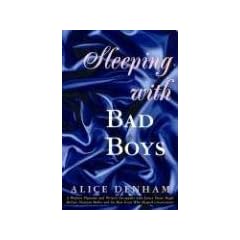
Anyway, in the audience, I met this lady:

Her name is Alice Denham and she was all excited about her new book, whose full title is “Sleeping With Bad Boys: Literary New York in the 1950s and 1960s,” being reviewed in the New York Times. I looked her up and she’s been reviewed all over the place! She gave me a little flyer showing the front and back covers of the book. Back cover reads “Denham’s lusty memoir is a juicy tell-all about a time when male writers were gods and an aspiring and gorgeous female novelist tries to win respect… Caught between the sheets are James Dean, Norman Mailer, Philip Roth… The steam rises page by page as Denham — the only Playboy Playmate to have her fiction published in the same issue as her centerfold — chases her dream of writing as a young, oversexed beauty in the literary swirl of 1950s Greenwich Village…” The Denham I met seemed interesting, intelligent, quirky, and opinionated, as she rolled her eyes at some of our host’s jokes and wasn’t shy about yelling out, “that’s the ONLY funny one of the night” at the one that actually made her laugh (and she’s of course a lot older now than in her picture as shown above)… but she didn’t seem so ‘oversexed’ to me. I guess she read my thoughts because she said, “Oh, they sexed it up, you know,” rolling her eyes. “It’s really a feminist account of a woman in the 50s trying to be taken seriously as a writer.” Looks good, and I do think I’ll check it out. And Susan Brownmiller of “Our Bodies Our Selves” gave it a thumbs up!

One thing though: feminism and the whole (false) mind / body binarism has captured my interest of late, and Denham’s back cover made me think of it again. As dancers, our bodies are all important, and in a way, I guess we are our bodies. But we are also obviously intellectual beings. It’s just upsetting when someone — a man, doesn’t want to accept that, who thinks that because you’re a dancer he can treat you a certain way, disrespect you, say certain things, look at you a certain way — all things that can even be a bit threatening. I’m a lawyer, I’m not used to this. And it’s definitely not all men — definitely not even most; most men are totally cool; it’s just some who ruin it. Do a lot of female dancers get this treatment? What about “sexy” female writers like Denham? Or Candace Bushnell? Ann Liv Young said she got some suggestions about ways she could make her piece “sexier” by men who didn’t understand her work; she just rolled her eyes inwardly and thanked them. Very Dorothy Parker. I love her. Someone asked for Santoro’s phone number, I think she said as well. I wonder how Santoro reacted.

Anyway, on a more positive thought, regarding feminism: there are some really cool things going on in the city this weekend. There’s a “Global Feminisms” exhibit at the Brooklyn Museum on feminist art, and “Indwelling” — a combination of photography exhibits on women’s bodies by female artists, screenings of shorts films such as the movie “A Girl Like Me” which I saw at TriBeCa film festival and blogged about earlier — awesome awesome AWESOME short film by a high-schooler about young African-American girls’ self-perceptions — and some play readings such as The Vagina Monologues. The theme is women’s body images, and it celebrates the 25th Anniversary of the Women’s Therapy Centre Institute and takes place at Cooper Union’s Great Hall. Sounds excellent.

You Made Me a Monster

Last night, I went to see another piece by Forsythe, this time at the Baryshnikov Arts Center. My usual dance friends were all busy, so I managed to convince my friend and fellow co-worker, Jonathan, who rarely goes to dance events, to accompany me. This task proved to be quite difficult since the website described the work as involving “audience participation.” When you’re a ballroom dancer and you invite your very dance-shy friends to socials at your studio promising them they can simply sit and watch all the action, only to get there and have everyone and their dog dragging them kicking and screaming out onto the dance floor, then go and invite them to an audience participatory dance event, they simply won’t trust you. I had to promise him on my life that this was a world-class concert dance company and the only ones doing the actual dancing would be the professionals.

Anyway, You Made Me a Monster was, like Three Atmospheric Studies, dance theater, and involved not only dance but other elements of theater as well, this time sculpture, sound effects, and words (this time not spoken but written, and projected from a video monitor onto a screen). The theme was the devastating effects of cancer on the body.

A group of 80 of us walked into a room where about 10 or so tables were set up, each bearing a partially constructed model of a human skeleton made from cardboard pieces. Guides divided us into smaller groups, took each group to a different table, and directed us to build off of the partly put-together puzzle, but not in a logical way. In other words, a spine should not resemble an actual spine, but the audience-member should twist and bend the carboard bone so that it made an artful design, then attach it to the model not where it “should” go on a “normal” human body, but in a more unconventional, surprising place. If we liked, we could also take some of the pieces of white paper below the table and trace the shadows made by the distorted model body.

Okay. Can you pick the lawyers out of the art crowd?… Yes, with us, this proved almost as bad as if we’d been asked to dance. While everyone else at our table enthusiastically went to work, Jonathan and I looked at each other, picked up a cardboard piece, looked quizzically at it, surreptitiously regarded the instructions we were told to pay no attention to, looked at each other again hopeless confusion covering our faces. Beginning to stress out about looking like a couple of idiots, I finally shrugged my shoulders and started bending and twisting a femur. Jonathan frowned at what I think was a collarbone, then put it down and excused himself to go to the bathroom for the next ten minutes. He’s never coming with me to a “dance event” again, I know it… In the end, I contributed to our table’s body by placing a very long, twisty bone protruding straight up from the center. It looked more amusing than anything else.

About ten minutes into our “body-building” project, shrill, screeching sounds began to emerge from the speakers, and dancers, three in all, came out, approached a table (each a different one), and began conveying through movement the design we’d created with our “bodies.” Their movement was much like that of the mother and diplomat’s assistant that I described in Three Atmospheric Studies — twisted, distorted, and contorted to grotesque, misshapen effect. I recognized the dancers from Atmospheric Studies, since I’d just seen it.

Funny thing, Matt Murphy had told me one of his favorite dancers from Atmospheric Studies was “the bald guy.” That man was one of the dancers here. I hadn’t noticed him much at Atmospheric Studies, since he didn’t “play” one of the main characters. Here, he took my breath away. Matt was so right! Dancers … they do notice dancing! With me, I guess supreme dance skill has to be shoved right in my face for me to see it…

After finishing at the tables, the dancers went to the front, stage area, and danced behind three separate stands each holding a piece of paper with a tracing an audience-member had made of the shadows of their model. They resembled musicians playing instruments while reading music sheets.

Behind them was a screen, onto which was projected a series of sentences, each running across the screen one by one. This use of words was somewhat ineffective to me. Every once in a while, I’d see solitary words or phrases that shouted-out to me, like “xenophobia,” “seeds of one’s internal destruction,” “reproductive organs were removed,” “grasp of space … uncanny, delirious,” “repulsive, occult, lethal,” Aliens” etc. etc. But I couldn’t focus on the words because that would take my concentration away from the dancers, and I didn’t want to do that. So, I only got an intermittent sensory effect from various words or sentence parts, without understanding how they fit together into a fuller narrative. I would have much preferred the words to have been spoken. There were sound effects blaring over the speakers as well, but to have the words on top of the sound effects would have enabled me to better understand them, since I feel that sounds can better compete with each other than visuals. You can only look at one thing at a time!

I noticed right before leaving that the pieces of paper on top of and underneath the tables contained those same sentences. I snatched one and put it into my bag. I’m not sure if they were there for us to take, but I’m very glad I did, because I read it on my subway ride home, and it made the performance all the more sorrowfully compelling to me. A man, whether it’s Forsythe I’m unsure, tells about his wife’s illness then death from cancer of her reproductive organs. The woman, a dancer, had been bleeding profusely, obviously weakening her and making her unable to perform. Her doctor, who happened to be a woman, told her it was just that she was dancing too much — obviously a judgment laced with sexism and devastatingly destructive medical inaccuracies — something with which a few of us are just a bit familiar. He goes on to talk about what a “dance genius” his wife was: “She had been able to reach into the profound heart of dancing and bring it to light…” The two were working on a piece about xenophobia, in response to several murders of political refugees in Germany. She had likened her cancer to xenophobia, which “constitutes a fear that the seeds of one’s internal destruction reside in a foreign body…” One thing I love about Forsythe is his ability to merge and analogize seemingly disparate things to shed new light on both. The “story” ends when, years after the woman has died, the man and his children began to assemble a cardboard jigsaw puzzle-like model of a human skeleton given to the wife before her death by a friend. They did not follow instructions, however, but “randomly bent, folded and attached the various intricate pieces until there was a model of something I understood. it was a model of grief.”

Amazing writing central to the piece that I thought should have been more central to the performance. As Jonathan and I were walking to the subway, I said that the dancing seemed one-note to me. He said he thought it was thematic and he enjoyed it overall and didn’t need a narrative with a big-bang climax. It WAS thematic and I didn’t need those things either, but I still wished there would have been something beside all the images of distorted, mangled, devastated bodies. I wished there would have been some beauty somewhere. I guess I found that in this writing, which was beautifully written. I just don’t know how many people saw the pieces of paper to pick up before leaving, so I don’t know how many people missed out on it.

One last note, on gender: two of the dancers here were men, one a woman. I thought it was interesting that Forsythe used male dancers to portray a woman’s illness from a feminine form of cancer. He also used female dancers in traditionally male roles in Atmospheric Studies — ie: a diplomat. This is interesting to me, this kind of playing with gender roles and assignments, unless I am reading too much into it. However, there was one line in this written story that struck me. After the woman’s cancer-ridden reproductive organs were removed, the man says, “I noticed afterward, she no longer smelled like a woman.” He goes on to talk about how, once she started on a course of radiation therapy, she began to “bend” “los[ing] the ability to fully lengthen her body” as a dancer must. So, the cancer depleted her of both her ‘womanness’ and her ‘dancerness’ — the two things that defined her, at least to the man (who is the one, after all, left to speak for her). But the line about the reproductive organs and “smelling like a woman” bothered me. It’s horrible for a woman to lose her reproductive organs — it’s horrible for anyone to have to lose any of their organs — and I definitely think doctors have been too haste to recommend hysterectomies and mastectomies and have done so out of pure and simple laziness over having to deal with the complexities of our bodies. But what exactly does ‘a woman’ smell like? Do we all smell the same? Are we all one thing, are we all defined by the same thing — our reproductive organs?

Can (Or Should) Dance Have "(Political) Meaning"?

As with DEATH IN VENICE, I’m totally late in writing this (blasted briefs, annoying job!), but better late than never, right?… On Thursday night, Dea and I went out to BAM to see THREE ATMOSPHERIC STUDIES choreographed by American-expatriate-in-Germany, William Forsythe.

I’ve seen excerpts of Forsythe’s work before, but this was the first full-length piece I’ve seen by him, and I had no idea what to expect, but I absolutely LOVED it. Instead of pure dance, it was German ‘dance theater’ (“tanztheater”) so there was dialog, as well as acted-out or talked-about images, in addition to movement. There were three “studies” (ie: Acts). In the first, a woman comes out and tells the audience that the scene is going to be about the arrest of her son, and she points to the dancer, wearing a bright red shirt, who is portraying that character. Aside from that, the first scene consists entirely of dance, and, from there, becomes rather chaotic and remains so throughout. Dancers violently grab each other, hurl themselves at each other, jump on each other, throw each other, run from each other, fight, fear and comfort each other. It was honestly really amazing to me that no one got hurt. I also attended a pre-performance discussion at which Forsythe spoke a bit, and one audience member asked him if he considered whether his dancers would be injured and he assured us that dancers have a “very meticulous” sense of time and space. There was no music (apart from the dancers’ heavy breathing which acted as a kind of natural sound effect), so he must have been making a huge understatement! If someone was one millisecond of time or one milimeter off on floorspace, they or the person they were hurling themselves at at full force and lightening speed could have really got whacked. When I dance, I count my music by the beats; still baffles me how they all kept such exacting time with no music?…

At various points, the dancers momentarily freeze to make painting-like tableaux. It wasn’t until the second scene when the woman whose son had been arrested began speaking to a translator to tell her version of the events that I realized that, because there was so much violent commotion in the first scene and because I was so in awe of the amazing ways the dancers manipulated the floor and moved their bodies, I’d totally missed ‘the story’ of the arrest. Forsythe had said that one of the ideas he wanted to play with was our ability as an audience, both in the theaters of dance and of world affairs, “to pay attention”. I realized that I’d failed that test, and had no idea how the arrest happened, even after the woman had specifically pointed out to me what I was supposed to watch for!

So, in the second scene, the woman tries, unsuccessfully, to give her account to a translator so that she can make a police report. The language barriers, the fact that there simply are no words for certain concepts or objects (“you say ‘bird’, I can give you ‘airplane’ … for ‘castle’ how about ‘apartment building'”) is a metaphor for the severe limitations of language to connect people. At the same time that this dialog is happening, there’s a dancer in the middle, speaking and illustrating with movement, the content of several different photographs and paintings. Sometimes his words overtake the woman’s and the interpretor tries unsuccessfully to translate his descriptions of the images into words as well. There was a lot of confusion as to the meaning of this, but to me, it was a way of saying that we can be bombarded with so many images that, ironically, they ultimately prevent us from empathizing with the subjects depicted in them. Forsythe said another thing he wished to explore was “compassion fatigue” — how the multiplicity, and perhaps sensationalism, of images of others’ suffering exhausts our ability to feel compassion for them, and results in drowning out the truth depicted therein. So the image becomes more important than the reality. At the end of the second scene, the woman, interrupted by the dancer’s voice describing yet another “composition” cries out, in frustration, “which composition are we on now?”

The most powerful, disturbing part of that scene was toward the end, when the woman rises from her chair and moves around the stage, contorting and distorting both her body and voice in quite grotesque ways. That frightening distortion I thought graphically illustrated both her emotional devastation and the impossibility of her truth being told because of the distorting effects of images and language. Forsythe is known for exploring the relativity of truth. Perhaps he is saying pure movement is the best way of getting to truth?

I guess the last “study” is the most “political” if you want to call it that — at least in terms of it echoing a current, specific geopolitical situation. There has been a bombing and the woman, whose whole village has now been destroyed, is so devastated she can now hardly move. A man is struggling to hold her up. A dancer portraying a diplomat tries to console the woman, telling her (rather amusingly at times) the bombing has been for the good of the community, etc., and a dancer whom she (interestingly, the diplomat is played by a woman) points to as her assistant (also a woman) conveys the diplomat’s words through dance. The assistant’s body-distorting, somewhat grotesque movements, reminiscient of the woman’s in the second scene, evince the ludicrousness of the diplomat’s words and their powerlessness to explain, defend, or console.

I found that the combination of the dialog, images, and most importantly, the brilliant movement, made me think about all of those ideas that were explored — the relativity of truth and its vulnerability to reduction to false images, the effect of bombardment of images on the observer’s attention span and ability to connect to the subject, and the distorting effect of language. And I felt the theatrical combination of the three art forms was more powerful than one alone. Discussion of this piece has centered on whether dance can (or should) provide political commentary. But I’m unsure of the reasons for this focus. I think this ballet was ‘political’ in the sense that everything is political — the word comes from the word “polis” — the people, after all — so anything that has as its subject matter human beings, is to an extent ‘political.’ But I was compelled to think about the issues mentioned above, not that war is bad or the current situation in Iraq is the U.S.’s fault or something simplistic and obvious like that. In general, I think it’s far more productive to talk about the ideas presented by a work of art than whether they are political.

Anyway, today Ashley commented on Matt’s blog as well, posing some more interesting questions related to the Forsythe discussion underway there: what meaning professional dancers as opposed to audience members with little or no dance training extract from a ballet; whether non-dancers can understand pure movement in the same way pro dancers do; and, if non-dancers don’t comprehend pure movement, what then attracts them to the ballet — particularly the contemporary, story-less ballets and modern dance? I thought those queries were really intriguing, particularly in light of viewing this work. I, for one — someone with very little dance training — don’t “understand” pure movement at all, and don’t really try to either. The contemporary story-less ballets that I enjoy, I enjoy because I love watching the dancers move in amazingly beautiful ways. But then, the dancers have to be really really good. And, in fact, sometimes they have to be dancers with whom I’m already familiar. I don’t know if I would have loved “Clear” which ABT recently did, if David, Max, Angel, and Jared were not dancing it; I don’t know if I would have liked “Meadow” as much if it wasn’t Marcelo and Julie performing. I need to connect to the dancers, especially with story-less ballets (which is why I think books like “Round About the Ballet,” magazine interviews, and websites like the Winger are so important to promoting ballet and concert dance).

I think a lot of dance fans also go to the ballet for the sensual experience: they perhaps enjoy Balanchine, for example, because they savor the feminine beauty, the pretty, dulcet charm of his ballets. I prefer ABT’s celebration of masculine (including both male and female) beauty and strength exuded by the ballets they present. I think people often go for the sensations the experience, the way the ballets make them feel, rather than to make them think. But then, for me, Forsythe is a welcome change to all that, at least once in a while. I think I’ve been seeing so much contemporary ballet of the “Clear” and “Meadow” variety during ABT’s recent City Center season, I was quite starved for more — to be given a chance to use my mind, to be compelled to decipher meaning, at points rather complex. That’s me, anyway. Very interesting to ponder just what it is that draws non-dancers who presumably derive no solid ‘meaning’ from pure movement to concert dance though…

Pasha, Get Well Soon!!!!

Pasha and Anna at USDSC

Received some very worrying news. One reason I’d begun taking lessons with a new teacher is that Pasha, my teacher of a year and a half (pictured above, competing at the U.S.National Championships last September with his pro partner, Anna Garnis) has been MIA from the studio since our last showcase in October. I’d originally been told he was “taking a short break” and would be returning soon to resume lessons. Being the most popular teacher at the school (that’s where looking like a 26-year-old Latin Baryshnikov, and being an awesome dancer to boot, will get you here in these United States 🙂 ) and having so many students that in that last showcase they had to set up a Chinese screen in the wings for him so he could zip in and out of his various costumes during the show, I figured we’d all run the poor guy down to the point that he needed a big long break from us all. But it’s now been a while.

So I made some inquiries. Found out that he wasn’t just taking a break, he’s been very ill, and even spent some time in the hospital.
Apart from the sadness of his being sick, everyone is so worried about him financially. Most ballroom dancers (and I would suppose most dancers in general) have no health insurance, so these medical bills are just going to be astromonical. Plus, most ballroom dancers make their living entirely by teaching, and they’re not salaried, so every day he’s bedridden is another day he’s losing out on essential income derived from his lessons. People are thinking of organizing some kind of benefit for him at the studio, and I’ll definitely post about that if it comes to fruition. I’m just so worried. Please keep him in your prayers and thoughts.

"Tappy Holidays" and More "Revelations"

Alvin Ailey member pics in CC lobby

Whew, another dance marathon weekend. Saturday afternoon, I went to see another Alvin Ailey performance. Top pic is of the dancers’ profiles, in the City Center lobby. This show was particularly special for two reasons. One was that it was one of the few “All Ailey” specials they’re doing this season, so they performed several excerpts from his ballets, some of which I’d never seen before. My favorites (besides “Revelations” of course, which they performed last, and which they almost always do each show) were: “Night Creature” — a jazzy tribute to Duke Ellington; “Opus McShann” — a gorgeous pas de deux performed by Olivia Bowman and Glenn Allen Sims (one of my favorite dancers with the company) and to music composed and performed by Jay McShann whom, I’m embarrassed to say, I don’t know; “For ‘Bird’ – With Love” — a fun theatrical piece that took place in a jazz club replete with ‘musicians,’ ‘singers,’ and ‘showgirls,’ and in tribute, obviously, to Charlie Parker (whom Sims, again, played / danced); and “Cry” — which I’d seen before, danced to disco music performed by The Voices of East Harlem and in celebration of “all Black women everywhere, especially our mothers.”

I think what I love so much about Ailey is that I completely recognize every move his dancers make — they’re so natural, so organic to the character and meaning of the ballet. With so much modern dance, I find the movements are so abstract that I can’t understand them, and the ‘story’ — whether it’s a linear narrative or not — is either nonexistent or just not accessible to me. With Ailey, I recognize everything his dancers do: the arabesques or battements (back and front kicks, basically), look like something someone who’s putting his heart and soul into playing his sax would naturally do. But they’re not just straight arabesques and battements as taught in classical ballet; they have a jazzy attitude. And, the hands in the air, palms facing upward, at the beginning of Revelations, look like worshippers searching for God, praying for salvation. It’s like he told his dancers to go out on the streets and into nightclubs and churches and watch people intensely, and then bring that to their dancing. The result is characters everyone immediately recognizes; stories that make sense to the viewer, while still taking him/her to a higher level with the beauty of classically-trained movement.

Alvin Ailey dancers giving post performance audience qa

The second reason the matinee was special was that it was one of their “family days” which meant, apparently, that they gave discounts to families, so lots and lots, and LOTS of them showed up. Made for a somewhat noisy audience! But that aside, it was really nice to see very young people being exposed to dance.

At the end of the performance, some of the dancers hosted a Q & A with the audience. Guillermo Asca, Olivia Bowman, and Vernard Gilmore fielded audience queries ranging from what made them want to dance with Ailey (Gilmore said the first time he saw “Wade in the Water” from Revelations — my favorite piece from that ballet too! — he was a goner), how old they were when they began dancing (all were children), to how they kept the choreography — some of it rather old now — fresh and alive, and what they ate before performing. Okay, answers to that last one revealed to me that I cannot, no how no way, ever be a pro dancer! Bowman said she “juiced frequently” and sometimes had some yogurt too, but really just “juiced” a lot. Gilmore said he just went to some place called “Wh—” something or rather; some organic food store I’d never heard of and loaded up on — and here I swear he began speaking a foreign language. I heard wheat grass, but couldn’t understand anything else. This guy (on far right in the above pic) had a body to die for; had the most finely sculpted abs I have seen. What, pray tell, is wheat grass??? The moderator, whose name I forgot — I think she was Nasha Thomas-Schmitt, the arts-in-education director, who used to dance with the company, saved us from all feeling like a bunch of lard asses by claiming that she used to eat burgers and pasta before each performance. “Please, if I just drank juice before dancing ‘Cry’, I’d faint!” Definitely! Anyway, it was a lot of fun, and many little kids were the ones asking the questions, so it was cute. Afterwards, I saw Nasha and some other dancers in the lobby signing autographs and posing for pictures with the little ones.

Also, I saw this flier in the program. How sweet would it be to have an Alvin Ailey birthday party?! Almost makes me want to have kids…

Ailey birthday party flier

Then, tonight, I went to see “Tappy Holidays,” a tap dance show celebrating the Christmas season that was recommended by Matt, whose sister, Carson Murphy, performed alongside such tap legends as Michelle Dorrance, Jason Samuels Smith and Jared Grimes. I thought Carson was so sweet — she danced really well and had a great stage presence; she seemed like she had some acting experience because I thought a lot of her facial and body expressions really helped to sell her dancing. Anyway, it’s been a very very long time since I’ve seen any tap dancing, and it was really just so amazing. I’d never seen Samuels Smith and Grimes before, and those two, they really just floored me. The way they moved, the speed, the attitude, and the complicated steps, the many turns, I just hadn’t realized tap dancing could be so brilliant. They were simply stunning.
Here’s a picture of Samuels Smith taking a bow:
Jason Samuels Smith and Tappy Holidays cast
And here are some other dancers in the cast: Carson is the one in the middle in black, and Michelle Dorrance is on the left, on the mike:

cast of Tappy Holidays

The event was extremely popular. It was general admission seating, and when I got to Symphony Space, half an hour early, the line was already around the block: (please forgive the reverse-order of these pics!). Passersby were all asking people in line what in the world was going to happen in there!
line outside Symphony Space

Tap and ballroom used to be so popular, in the era of Fred Astaire and Ginger Rogers at least. Perhaps since ballroom is enjoying a resurgence, tap will too?…

One last thought. I hope it is okay for me to say this. But all weekend, I couldn’t help thinking of my clients, that many of these amazingly brilliant dancers could have ended up like them. And yet they didn’t; and my clients did. Is it just a simple matter of “there for the grace of God go I” that some people end up becoming pimps and crack dealers and spend a good part of their lives behind bars, and some become great performers, or it there something more that can explain the difference? At the end of “Tappy Holidays,” they pulled down a movie screen and showed some pictures of the dancers as children. Jason Samuels Smith looked like he was bouncing right off the walls with energy as a little kid. He must have been a real handful for his mother, who I know is a great jazz dancer herself. Being introduced to dance at at young age (as he presumably was, by being blessed with parents in the business) must definitely have given him a creative outlet for all that energy, enabling him to use it in an extremely productive way, providing an invaluable service to humanity. I wonder if dance was introduced to more kids, before they had a chance to mess up their lives forever (because the consequences of one conviction, tragically, can last a lifetime), it could make a real difference in this society. How awesome for the Alvin Ailey company for seeking the answer.

I May Be a Man…

I had my first dance lesson last night since my headache episode! I’m still a tiny bit hazy from the whole ordeal, but I’m so so SO glad to be dancing again! And, since one of the group classes was cancelled, one of the many former ballet dancers at my studio who’s training to teach ballroom was free to help teach me how to do my dream trick: the hands-free fish. A picture of real dancers (ie: Marcelo Gomes! and Gillian Murphy from ABT) is here. Oooh, but it’s soooooooooooo unimaginably hard! I couldn’t do it, try as I did. Your back needs to be so incredibly strong. It makes me realize how tough ballerinas are; elegant and graceful as they seem, their backs and legs are made of steel! I need to hook my leg around Luis’s back and hold myself onto him with that leg only. If I let my back collapse, I will fall to the floor. And it doesn’t look like it from the picture or when you see people perform it, but it’s so hard to keep your back arched and not collapse it. The ballet dancer gave me some serious exercises to do, mainly where I lie on the floor on my stomach and arch my back up to the waist as high as I possibly can, and hold and hold and hold and frigging hold. Ugh, it hurts! But I wanna be able to do this so so bad, it’s worth all the work! Happily, I’ve been able to sell Luis on it; he thinks it would be so cool to end the Latin routine with it. Consummate Latin dancer though he is, he’s been really receptive to much of my ballet-y suggestions — Luis’s great!

Tomorrow, I have an appointment with my regular primary care doctor to discuss my headache episode (see last post). The doctor on call phoned yesterday to tell me the sinus x-ray was normal. So there was no sinus infection, which scares me because that means it was neurological, as he said. I did some internet research today, and from what I’ve read, I truly think it was a kind of cluster headache, which is an extremely rare neurological condition, even more rare in women (at least 70% of sufferers are men). But migraine descriptions just don’t describe my pain very well. With migraines, you have pulsing pain on one side of your face, no necessary sinus connection, and you want to lie down and try to sleep it out. With mine, and clusters in general, the pain is sharp sharp sharp, boring, drilling into your skull, exruciating, searing, honestly even suicide-inducing, making the sufferer want to scream out in pain or even knock his or her head against a wall. One sufferer whose account I read described it as having surgery without anathesia, which is precisely how I felt, and hence was why I was begging the doctor, who laughed at me, for an emergency morphine injection. And your eye on the side of the face where your pain is located is watery and red, and you have sinus congestion on that side as well; not so with migraine.

Most interestingly, you absolutely positively cannot lie down with a cluster or the pain is even more excruciating; instead sufferers pace the room, walk, run, must remain active at all times, which is exactly how I was, to the confusion of one friend who commented that I “take pain like a man” — ie: actively jumping around, not passively lying on the couch. That characterization made some sense to me, but it wasn’t like I was trying to act like a man. When I read about cluster headaches (hereinafter “CH”), and realized they described my pain more precisely than migraine, and read that men are overwhelmingly the sufferers of such head pain, I realized I was possibly handling my pain “like a man” because I had a predominately male headache. The only part of the description that doesn’t fit me is that mine was one long, 4 1/2 day headache, whereas CH’s are typically 1/2 to 3 hours in duration coming and going throughout the day for a period of weeks. I found this amazing CH support group website and almost cried when I read some of the accounts. I know this is badly anti-feminist of me, but when I first read that most sufferers were men, I immediately thought, oh my gosh, I can’t imagine a man going through this. Last week I was literally walking the streets of Manhattan screaming and bawling out in pain, with cab drivers, store clerks, pharmacists, even a group of police officers in a deli where I went to buy ice taking pity on me, trying to hold my hand, helping me get to where I wanted to go. Not to mention all of my friends and co-workers… But in our society, which stigmatizes any male showing of pain or emotion, it seems a man would have to try to hide his pain, would never be able to act like this, or would surely scare people. Sure enough, some of the accounts on the support group website talk about running to the basement to pace, bang heads against the wall and cry and scream out, desperately not wanting wives and children to witness such a state of helplessness. Other men likewise talked of “not feeling like a man,” being humiliated, feeling out of control, etc. So much worse to have to deal with these societally-based feelings on top of this horrendous, horrific pain. And, in my New York example, especially with the police or even begging the doctor for injectible narcotics, so much the worse if the man is minority — he may automatically be suspected of being an addict or criminal… Ugh, so nasty on so many different levels…

Anyway, I’m gonna talk to my doctor about it all tomorrow, and ask her to consider sending me to a headache specialist instead of my same neurologist. Even if I end up with a diagnosis other than CH, I feel like I’ve learned about another sad world through all of this. Bottom line: if you know people who suffer from chronic headaches, of whatever type, please offer all the love and support you can, and please don’t dismiss them!!

What Is the Point of Building a World Trade Center Memorial…

if it, along with all of lower Manhattan, San Francisco, and about three-quarters of Florida in this country alone, are soon going to be underwater, if Greenland and western Antartica continue to melt at their current rate? A favorite dance blogger of mine first recommended this film, then a fellow alum, director Davis Guggenheim, sent around a heartfelt email discussing his motivations for making it, and I just had to go. I had no idea how urgent the threat of global warming was until I saw An Inconvenient Truth this weekend. Al Gore presents the issue in a very clear way with lots of pictorials and graphics, and even a little humor, to make it interesting. Everyone should see it regardless of political affiliation. So compelling — really, terrorism is far from the only thing we have to fear…

I just finished transferring to video the tape I made on my camcorder last Monday of Luis and me dancing the choreography he’s done so far for our routine. Video recorders are an absolute must-have for dance students wishing to perform. Professional dancers can easily remember their choreography, but for a beginner, there is no other way to memorize than to videotape it. I tried writing it all down with my first teacher, Kelvin, and, when I showed him my notebook, he burst out laughing, “these are damn lawyer notes; I have no idea what they mean!” I had no dance vocabulary and just described in excruciating, and hence meaningless, detail every single movement. So found out the hard way writing is absolutely no use to a dancer, who is by trade visually- not verbally-oriented. A camcorder is the only way to go. And even at that it’s so hard for me to memorize. I wish so much I’d never quit dance as a child!!!!!

I normally don’t see the same ballet twice during the same season, but Friday I saw ABT‘s Cinderella again to see David Hallberg dance the role of Prince Charming, so I could compare him to his dressing-room roommate, Marcelo! (whose name I must follow with an !) My favorites are Jose, Alessandra, and Marcelo!, and I normally try to get tickets when one of them is performing, but David‘s contributions to my favorite dancer blog made me interested in seeing him too. And I’m very glad I did: he made a very dashing prince — and it’s interesting to see two different dancers interpret the same role. David‘s slightly smaller so kind of gets around the stage more quickly and does really amazing jumps, and his lifts with Gillian looked completely effortless. But Marcelo! is so big and it’s so romantic to see him envelope little Julie in his arms… And he has such a wonderful appreciation for women (as he expresses in many a good interview) — it really shows in his beautiful partnering 🙂
Tony’s are on, gotta go…