Flouting Genre Boundaries and Stereotypes of Stereotypes (and Just Creating a Fun Time!): Bad Boys of Dance and Mimulus at Jacob’s Pillow

Okay, here are my reviews, finally. Sorry it took so long!

The word Dance can be political, as I’ve discovered lately. A certain TV show combined with a current local exhibit (which is, sob sob, no longer local) have caused a bit of a stir here over what constitutes dance, and who, if anyone owns its definition. I thought when I left my job at night to go to my ballroom studio or a ballet performance I was leaving the world of politics behind 🙂 Don’t get me wrong: I’m very glad people are becoming more aware of diversity in dance and are thinking and speaking more critically about it, but if you’re a lover of both ballet and Latin, you can feel kind of caught in the middle sometimes.

Anyway, this is all by way of saying how wonderful it was to get away for a couple of short days and head up to Jacob’s Pillow, the oldest dance festival in the country now celebrating its 75th Anniversary with a host of diverse dance programs ranging from ballet to social to hip hop to world dance. The festival, which this year includes 21 companies from four continents and 10 countries, takes place in the idyllic Berkshire Hills on a farm that dance pioneer Ted Shawn bought in 1931 to house his Men Dancers, a company he created to showcase male talent, foster respect for dance as a suitable occupation for men, and combat stereotypes of male dancers as effeminate (which we know nothing about these days right!! — oh and thanks so much you guys for those excellent comments on my homophobia post!). The farm also served during the 1850s as a safe house on the Underground Railroad. With this history, it’s only fitting then that the festival, the only one to be declared a National Historic Landmark, encompass as it does the virtues of democracy, internationalism, and diversity. For a powerful, personal account of the history of the land and the festival from the perspective of one of last year’s dancers, go here.

So, I saw Mimulus, a Brazilian social / contemporary troupe on Wednesday night, and Rasta Thomas‘s Bad Boys of Dance, created with a nod (but just a nod!) to Shawn’s Men Dancers, on Thursday.

Okay, first Mimulus:

So fun! Their program, entitled “Do Lado Esquerdo De Quem Sobe” which translates from the Portuguese to “On the Left-Hand Side of Those Who Go Up,” was a splendid blend of social Latin and “contemporary” dance. Since I know there’s some confusion over what “contemporary” means — and I don’t profess to know myself — I’ll just say that to me it’s ballet without toe shoes or the themes and ‘pyrotechnics’ of classical ballet (like the 10,000 fouette turns performed by women or big walloping barrel turns all around the circumference of the stage done by men). And, to me, contemporary is not “modern” because modern has a certain look and feel to it — perfectly parallel, almost inwardly pointed toes, Martha Graham-ish arms appearing to emanate directly from the back as if they’re wings, etc. etc. Modern is interesting, but it has a certain quality about it to me that is dated, the same way modern art or modernist literature (Picasso, Matisse, Virginia Woolf, James Joyce, etc.) has a time period. Although… the woman who taught our modern dance class at the Pillow taught us a routine she learned from Urban Bush Women, which is not dated… So, okay, I don’t really know anything about all of this nomenclature, but contemporary dance to me (and the way I’m using it here) means updated, modernized ballet that can easily be blended with other dance forms like social Latin (as in Mimulus) or jazz and hip hop and gymnastics (as in Bad Boys) to create new movement that contemporary audiences can identify with and relate to.

Okay, back to Mimulus… I love this company, from their name to the title of their program to their blend of dance styles! A “mimulus” is a genus of fauna known as the “monkey flower,” which, supposedly when squeezed, resembles a monkey. It is also, in medicinal folklore, a remedy for fear, any fear, so long as it’s named. The title of their piece, as they explain, refers to “those who go up the hills, who go up through history, who go up the body” (the heart, they point out, is located on the left side of the body). It has literal meaning: on the left-hand side of Ituiutaba Street in Belo Horizonte, Brazil, there is a group of sheds in which company members gather each day to practice, and to follow “the pulse of the city, stretching and shrinking in its confusing occupation of urban spaces.” The left also has political meaning, as the group aims to “construct and deconstruct, subvert, re-read dance and life.” Slavery was abolished in 1888 in Brazil, making it longer-lasting there than elsewhere. Social dance and music served to integrate newly freed slaves into the culture, which was then already a blend of Portuguese and indigenous peoples, resulting first in Choro, an eclectic, urban form of music and dance, then Samba (yay!!!), the national dance, a mix of African, Latin, and European. I feel like, ironically, and maybe I’m totally wrong about this, but from the people I’ve met and films and videos I’ve seen, it seems that, though slavery lasted longer in Brazil than here and elsewhere, there’s more integration there. Here for example, whites are not integrated at all with Native Americans, who remain confined to their reservations..

Anyway, I’m not sure I saw all the “subversion” and “deconstruction” and “re-reading dance and life” that they referred to in the program, but what I did see I loved nonetheless! What I definitely liked about Mimulus was that the combination of contemporary and Latin social dance worked so very well for me. There was just enough abstraction and enigma in the contemporary, balletic movement and the use of some of the props — giant rubber bands, shoes, plastic bags — to keep me curious and wondering what the piece was all about, while the Latin social dance — movement understandable to me and to most, I’d think — created an atmosphere of fun flirtiness, romance, harmony, elegant partnership, and just overall happy togetherness. The social dances themselves were all merged together into a unique blend of samba, salsa, tango, and even American-based swing. There would be several couples dancing this melange of Latin and American social dances, and then a balletic couple would emerge performing more abstract, lyrical movements with beautiful lifts, etc. But the social and balletic actually melted together here, rather than being on some kind of continuum. To me, this contrasted with, for example, Twyla Tharp’s Deuce Coupe from 1973, in which a classical ballerina, dancing on pointe would be center stage, surrounded by dancers doing more swingy jazzy movement, then the poppy social dance of the time. Tharp, I thought, was saying, classical ballet is my origin, the basis for all dance, but there are other, more popular forms of dance I’m interested in as well that stem from ballet, and they can all take up space on the stage at once. But here, it was as if the contemporary was more part and parcel of the social.

The running theme of the piece was symbolized by shoes: at the beginning, there are several pairs of unfilled lyrical shoes setting on the edge of the stage. Dancers would put them on, take them off, dance barefoot, dance with one foot bare the other shoed, and one dancer (usually male) would, at points, lift a female dancer who ran along the side of the stage, creating foot impressions right onto the set! These sets were really cool too. Symbolizing Brazilian urban architecture, at first they looked like they were made of some kind of boring, mundane metal. But you soon realized, when the dancers leaned against them (either from the front or back of the stage), or walked against them, they were completely pliable, so were actually made of silver-colored styrofoam or something. At one point, dancers from the wings would throw little blocks at the dancers onstage, and when the playfully humorous “block tossing” ended, you’d see little missing squares from the back wall, creating very interestingly abstract designs. The dancers offstage were clearly running along behind the set, taking blocks from it, then running into the wings and throwing them at the dancers onstage. So, architecture, as public space, is made for, and reflects, the needs of the community, and it grows and evolves right along with it.

And, regarding the shoes: when newly-freed slaves walked for the first time as free people, the program notes, shoes were a symbol of freedom, of status. Even if shoes were not constructed to fit the wearer’s feet correctly, they hung from the owner’s shoulder, a symbol of consumption. I’m not sure if the trajectory of the shoes, unworn, then worn by some, then taken off and worn by another, then one pair shared between a couple, then taken off and the foot freed, etc. completely made sense, but it was evocative and funny and fun to try to figure out. And all of the beautiful partner dancing was a delight!

At one point, as I noted in my photo essay, a male dancer took out a plastic bag (the same kind inserted into our programs), then, with a music-less background, rubbed it, creating beats of sound for the center-stage sambista to dance to. He motioned for us to do the same with our bags. Who knew what a plastic bag could do?! To me, this said that dance in Brazil, and anywhere, stems from the people, along with sound. One doesn’t need an orchestra or stereospeakers to create music; danceable music can easily be human-made right on the spot.

Okay, on to Bad Boys of Dance, which we saw, first in snippets at an outdoor production on Wednesday afternoon, then in whole in the Doris Duke theater on Thursday night. What fun, as I knew it would be 🙂 Like Mimulus, the multi-cultural, multi-ethnic, very multi-talented group blended ballet with contemporary social dances — here not ballroom, but jazz, hip hop, capoeira / martial arts, gymnastics, and, as danced by guest artists, the cute Argentinian Lombard twins, bluesy tap and hip hop. The four-man group is led by probably the most famous contemporary dancer with ballet origins, Arab-American heartthrob Rasta Thomas. The others include Filipino-Canadian Bennyroyce Royon (a Winger contributor without whom I wouldn’t have heard of the group – thanks Bennyroyce!); Bryan Arias, a ballet dancer from Puerto Rico; and Broadway and competitive dancer Robbie Nicholson. Here are some pictures from their outdoor performance (which I posted in the album but am posting again here because I can’t help myself 🙂 ):

This was such a fun, juicy hodge-podge of dance that, like Mimulus, interfused together well. It was such a medley of movement it’s a little hard to describe, with most of the pieces containing within themselves several different types of dance. There was a lot of contemporary ballet (most of the men have extensive ballet training). But the ballet was combined, to fun, thrillingly unpredictable effect with gymnastics, capoeira / martial-arts-like movement, jazz, hip hop and even silly poppy social dances, like — I kid you not — in a piece choreographed by the dancers themelves, the Macarena! To be honest, I thought that was a bit corny, but Alyssa ate it right up! The mood would go from cutely funny to raucous and brazen to silly to beautifully serene and lyrical, to bluesy, to fast-paced, to techno and robotic- looking and so on. At one point, ballet’s classical vocabulary might be ridiculed (along with opera, as in “Figaro”, that piece choreographed by the dancers themselves that included Macarena), but in the next breath, ballet’s beauty and grandeur would be upheld. My favorite pieces were “Steel Visions,” a fast-paced jazzy number choreographed by Darrell Moultrie and set to Astor Piazzolla music; Robert C. Jeffrey’s “Heartbreak on Repeat,” a bluesy, beautifully lyrical piece danced by all, but containing a solo by Rasta that left me and Alyssa nearly on the floor; and “Take 4” choreographed by dancer Bennyroyce Royon, a fun, fast, rhythmic, at times techno and robotic-like, very imaginative combination of ballet, hip hop and jazz. I was also blown away by the guest artists, the very hot Martin and Facundo Lombard — “the Lombard Twins” — from Argentina who were able somehow to combine hip hop, swingy blues and tap dance to mad fun, very sexy effect.

The funny thing is, what led me to the production, I have to confess, was the troupe’s name 🙂 I am such a sucker for those crazy sky-high leaps and jumps and turn / jump / leaps, etc. that only male dancers are capable of 🙂 Sorry, I can’t help it!!! But, besides the very first, very short number, in which Rasta did some of those aforesaid leaps from the classical ballet Le Corsaire — and then it’s only to show what the night is NOT going to consist of — no such thing existed here. I felt like, personality-wise there was a certain cockiness (albeit cute) to the Lombard twins that seemed very male, but, other than that, this program didn’t really showcase any type of dance strengths that were essentially male. Which ended up being brilliant.

Unfortunately, I never got a chance to see any archival footage of Shawn’s original Men Dancers, but, according to the resident Pillow scholar, Philip Szporer, who wrote a little note of commentary on the program, Shawn’s purpose with his troupe was, as I said above, to counter the then stereotype of male dancers as effeminate. So he often showed his male dancers in heroic, athletic poses, going out of his way to depict them as macho and ruggedly virile.

But here, there was no goofy crazy he-man posturing, no ‘look at me, I am man, I can lift my fellow man high above my head and toss him clear across the floor,’ no crazy stage-length leaps; it was just a bunch of guys dancing, dancing really really well. So, maybe Rasta is making fun of stereotypes with his naming of the troupe? Maybe his “Boys” are “Bad” because they don’t give a crap how they’re perceived; they’re dancers and they should be accepted as such, nothing more nothing less. It’s like he’s giving a big ‘screw you’ to all the homophobes. And how much do we love him for that!!! At the end, he has an emcee introduce the dancers by name, as if they’re heavyweight champions: “Ladies and gentlemen, weighing in at — pounds, from the Philippines is Bennyroyce Royon,” etc. It’s hilarious. And don’t get me wrong, what Szporer calls “the swoon factor” is most definitely there; if female dancers would have performed the same roles, Alyssa and I wouldn’t have been drooling all over the floor like we were, but we still would have been awed at the eclecticism, the excitingly unpredictable versatility, the talent.

Just a little note on Mr. Thomas, for people unfamiliar with him: I guess it makes perfect sense that this program was such a mouthwateringly savory stew of contemporary dance since Rasta himself is virtually a one-man amalgam of different dance genres. After being told by doctors he’d never walk properly following a horrible car accident at age 2, he threw himself first into martial arts, winning bizillions of black belt titles, then gymnastics, placing in the junior Olympics. When his plethora of championships led to serious cockiness problems 🙂 , his father threatened to take his hubris down a notch by forcing him into a tutu. Not one to resist a challenge, Thomas took his first ballet lesson. At first, he hated it, but admitted that after he reached puberty and began to take an interest in girls, that all changed. After going on to, of course, win a bunch of ballet competitions, Thomas danced with Kirov Ballet, then began guesting at a slew of prestigious ballet companies. But he’s most known as the star of Twyla Tharp’s Broadway hit, “Movin’ Out,” and as an actor in the Patrick Swayze film “One Last Dance.” Anyway, Thomas now says he loves ballet, it’s his heart and soul, but its vocabulary is limited and there’s only so much you can do with it. The classics are at least 50 years old now, he says. He’s hungry for more.

I guess I both agree and disagree with him about ballet having limits. While certain classics’ ability to speak to the human condition, to provide poetry for the soul, to entertain and move audiences, make them timeless, like a Shakespeare play, ballet, like literature, will die as an art, will become only a historical artifact if the classics are relied on too heavily and there’s never anything new. But new doesn’t mean that balletic movement has to be abandoned, that it can’t be expanded, its vocabulary broadened, and its boundaries with other forms of dance tested to bring new meaning and vigor to the dance form. Isn’t that what he did here???

I’m sorry this ‘review’ goes on and on and on — they give you so much info at the Pillow — with their elaborate program notes, pre-show lectures by resident Pillow scholars and post-show talks with the artists themselves, there’s just so much you wanna talk about! Sorry!

For Ms. Dunning’s much more compact and far less sprawling take on these programs, go here for Mimulus, and here for Bad Boys.
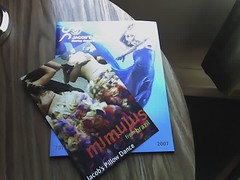
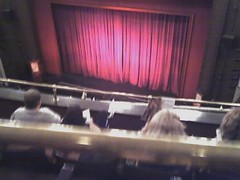
Jacob's Pillow Pictures Are Up!

I’ve finally posted my pictures from the dance festival this week in my photo album here. Just double-click on each picture for a larger photo and the caption. I tried to get as many pictures as I could of Rasta Thomas and his “Bad Boys of Dance” performing at the free outdoor show prior to their actual in-theater debut. I was also blown away by Zimbabwean dance-maker Nora Chipaumire of “Urban Bush Women” performing a solo called “Dark Swan” so I have several of her, as well as Argentinian choreographer Jimena Paz performing on that same outdoor stage immediately after Chipaumire. I will blog about all the dance performances I saw very shortly!

I also included our goofy adventures (barely) surviving a modern dance class at the Pillow and side-trips to the Norman Rockwell museum and a Shaker Village. Enjoy 🙂

Ugh!

Oh! Look at what I am missing! Right up my alley 🙂 Am so so SO jealous of anyone going to Jacob’s Pillow this year!

Update: thanks to my wonderful, spontaneous friend (who has not lived in NYC for so long now that she has forgotten how to operate a motor vehicle :)), we are going up after all! Will be seeing Bad Boys as well as Mimulus, a Brazilian company that fuses tango, samba, ballroom, theater, and contemporary dance — right up my alley as well! This is my first time at the Pillow. Can’t wait!

I Finally Got My Dramatic Odette!: "Swan" Wrap-Up, Taye Diggs, and a Fun Reader-Participation Survey!

So, Saturday afternoon I saw my third, and probably overall favorite, Swan Lake at ABT. As I mentioned in my last post, I had gone hoping to see Veronika Part in the lead role but, sadly, she was unable to perform due to an injury. I MUST see her perform this role at some point! Next year…

The Trouble With Favorites

So, taking her place were Irina Dvorovenko, as the White Swan, Princess Odette / Black Swan, Odile, and her husband and frequent partner, Max Beloserkovksy, as the Prince. Seeing Irina, whose performances I used to go to much more often, made me realize what I miss by having my favorites and only going to see them. Not that it’s unimportant to have favorites — I think it’s a huge part of what draws you to a certain company and then, in turn, to ballet or dance, in general. And, my two are of course him and most definitely him 🙂 🙂 . The problem for me is, it means missing out on ballerinas like Irina, who, for some odd reason, doesn’t ever dance with these two guys. And I ended up getting everything from Irina that I had complained about not getting from the two previous ballerinas I’d seen!

Backtracking for a sec, I first saw Diana Vishneva and First Favorite Man 🙂 , and, as I had blogged earlier, wasn’t very moved by Diana, mainly because she seemed to have no connection with Marcelo’s Prince Siegfried; her Odette (White Swan / Princess), as I said, existed in a completely separate world from him.

Then, Friday night I had my second SWAN viewing, with Second Favorite Man 🙂 ) and Michele Wiles in the leads. To this one, I brought a friend, and one who has never, at least to her recollection, seen a live ballet performance. She’s familiar with classical music though, and with Tschiakovsky, and was interested in going because of that.

Classical, Story Ballets Involve Dramatic Action

It’s always fun to introduce a new person to ballet to see what they think, what their initial reaction is: whether they found the love of their life, were bored to tears, were completely stupefied, were completely mesmerized, or, by turns, were actually all of the above. I guess my friend was pretty much the last: in the end, she said she found Ballet intriguing enough to try another, but concluded that Swan Lake really was just not going to be her favorite. I’m a relative newcomer to the scene too, having been going for a couple years, and I pretty much shared her issues with this cast / production, which were the same as with the Diana / Marcelo one: a fun, flirtatious, overall good Black Swan who made the second half of the production a little more lively than the first, but a too ethereal White Swan who couldn’t garner audience sympathy, forcing the first half to be long and boring, and overall preventing the audience from connecting to the characters, story, and action. My friend said she thought the second ballerina (in the black) was better than the first: she didn’t know they were the same!

My feelings about Michele are a repeat of Diana: at the beginning, David’s Prince spots the Swan at the lake, prepares to shoot her with his crossbow, until he sees her transform into the beautiful girl Odette, then hides in the bushes and watches, transfixed by her beauty. Odette is supposed to spot him, and began fearfully to flutter away until he convinces her he means no harm. She then supposedly tells him her tragic story of being turned into a bird by the evil von Rothbart; mesmerized, he listens attentively, falls deeply in love. She falls for him too, and her plight is caught up in their love, as only his pure love can break the spell, allowing her to become a girl again.

Diana’s and Michele’s Odettes, however, are completely unmoved by, even unaware of, their princes. They danced beautifully as swans (Diana had more feathery, watery arms than Michele, though Michele blew me away at the tail end of the scene as her arms turned airy and liquidy and she nearly flew on pointe into the wings– don’t know why she couldn’t have done that throughout), their princes come out of hiding, toss their crossbows away, shake their heads to say, “no, I’m not going to hurt you,” and run to the girls. The girls are supposed to tell their princes the story of the spell, through that beautiful pas de deux. But Diana and Michele don’t even so much as look at the men throughout this entire scene. So, the men are basically having a conversation with themselves, an internal conflict over this creature, while she dances about in her own world. “Wait, when did she tell him the story?” my friend asked at intermission, frowning down at her Playbill. “I feel like I missed all of this,” she said pointing to the synopsis. She did; she missed everything because it didn’t happen.

Diana and Michele were better in the second half (where von Rothbart casts his daughter, Odile — the false Odette — in Odette’s likeness to trick and seduce the Prince), but still weren’t ideal. Their dancing was spectacular, all those crazy fast fouettes and pirouettes and jumps were thrilling, but, apart from the dancing, there was no drama: they still weren’t connecting to their princes, so the seduction and flirtation wasn’t there.

In other words, a drama happens when two or more people interact with each other. One character wants something from another and there is a conflict, leading to a dramatic situation. I realize that a ballet is not exactly the same as a play. A ballet involves, obviously, movement, part of which tells the story. But story-ballets (and, to me, even shorter, more abstract ones, as I’ll talk about later) are dramas and they need full, three-dimensional characters who bounce off of each other.

Irina understood this. Irina’s gorgeous Swan is dancing beautifully center stage, arms aflutter, in her own tragic world, just turning from swan to girl, when Max’s Prince, overtaken by her beauty, rushes toward her bow and arrow still in hand. Irina’s girl actually looks at him, realizes she’s in danger, holds her arms up to her face, shielding herself, and begins bourreing quickly backward. He tosses the bow and arrow aside and runs toward her, gesturing that he won’t hurt her. She then performs the beautiful pas de deux with him, perfectly conveying to him her sad story of the spell. Obviously, she can’t say anything in words (and the words are in the Playbill so it doesn’t matter), but, I mean, she tells him everything with her body and her facial expressions. She’s not in her own world; she’s “talking” to him. Even when her body is turned away from him, and she can’t look at him, she registers his presence with closed eyes, head tilted back ever so slightly, subtely, toward him. And his body language and facial expressions convey that he listens, hears, and understands. The whole story was perfectly, compellingly HERE. When von Rothbart enters from the back of the stage to claim her his Swan, taking her from the Prince, and the Prince retrieves his bow and arrow, Irina quickly bourres backward to von Roth., shielding his body entirely with hers, her head turned dramatically up, as if even to protect even his head from a blow. She even shakes her head “no” at the Prince. Irina’s Odette makes it all too clear that the Prince can’t kill v. Roth or she will die as well.

I know critics don’t often like Irina, and I’m not entirely certain as to why, but I’ve heard it’s partly because she “overacts.”And I seem to remember hearing specific complaints about those turned-up chins of hers. Well, all I can say is that I felt that she made more dramatic sense of this story than anyone else I’ve seen, and I wished my friend would have seen her Swan.

The Men, And What Makes Hallberg So Sexy?

As for the men: I’m not a huge fan of Max — he doesn’t seem to have the technical prowess or the stage personality of either of my favorite guys — his jumps are not as high and his legs don’t fully straighten out into splits when he does them, unlike with the other two, and doesn’t have Marcelo’s humanity and relatability or David’s brainy sensitivity or either man’s inherent sexiness of movement (can I just ask, for a minute, WHAT IS IT ABOUT THE WAY DAVID WALKS across stage? He has this way of settling into his hip socket, or maybe it’s that he lifts his pronounced, pointed foot entirely off the floor with each step, or maybe his weight is a slight bit more foreward, like in Rhumba walks — whatever it is, the way he moves about stage when he’s not leaping or pirouetting is so crazy sexy and so unlike anyone else’s movement. Since he’s practically the only American man in ABT, I wonder, is it an American thing — something in his training? Maybe it’s nothing more than that he simply has longer legs than most). And it’s definitely not something he does on purpose. Joan Acocella recently noted that he doesn’t seem to know he’s a star. He doesn’t seem to know how hot he is either 🙂 !!– I hope it stays that way. I don’t want him to become a pompous ass!

But back to Max: regardless of the above, I thought he did a very good job with this character. He showed the growth of the Prince, noble but immature at the start, into a man transformed by love. He was princely, yet human and real. And, as I said, he worked very well with Irina’s Odette, listening to her story, reacting to it, using his body and face.

Miming Doesn’t Work

I met up with Delirium Tremens afterward and we chatted a bit. She has a big ballet background, having studied ballet at School of American Ballet and Joffrey, and she gave me this brief lesson in mime in case I missed something. It was really interesting, but some of the miming gestures looked to me nothing like what they actually are. Like, making fists with both hands and crossing your arms at the wrist is supposed to symbolize “death.” I thought when I saw the various ballerinas doing that, it meant “no” or was somehow intended to convey some sort of angst. But I didn’t know it meant, “if you do this it will result in death.” I’d have to see them again, but it made me wonder if perhaps the first two ballerinas I saw relied very heavily on mime to convey their stories, and that’s why I couldn’t understand? I know Irina did a little, but she backed it up with generally understood facial expression and body movement. If the choreographers and stage directors are going to rely on mime to tell a story, which I don’t think is a good idea, they need to somehow make everyone aware of what everything means, so that not only people with dance background can enjoy the performance!

Dancers Are Smaller Than They Appear!

I ended up hanging around Lincoln Center for much of Saturday afternoon since I was to meet Apollinaire at the Library of the Performing Arts (adjacent to the Met Opera House) later in the day for an evening performance. I ran into several dancers on their way to work– Adrienne Schulte, Herman Cornejo, and Jared Matthews on his way away from work (he performed yesterday as the Prince’s sidekick, and he was excellent by the way! Sky-high jumps, very agile and quick-footed dancing with a lot of precision and clarity. His prince sidekick was almost as good as the athletically spectacular Sascha Radetsky‘s — not quite as clean but almost, almost. Jared is working super hard, as is Sascha. Anyway, it’s so amazing to me how much smaller they all are up close when you see them on the street!

Vitali Krauchenka’s Awesome Swampy von Rothbart

And, one more little note on SL: can I please please please see more of this guy:


His swamp-creature-y von Rothbart was compelling beyond words. The ballet ends with him, dying after Odette’s death has taken the life from him. I’m not a fan of pure evil; but rather prefer nuance and complexity, and, not to sound cheesy,but his performance honestly almost brought me to tears.


His von Rothbart loved Odette and is just in so much pain in that last scene after she’s committed suicide. He makes me feel so much sympathy for him, even though he’s supposed to be “the bad guy.” And with that intense, oh so familiar music building to a dramatic crescendo, he makes the tragic ending so moving. Please, Kevin, more Vitali!

Taye Diggs

Okay, Taye Diggs: Very briefly, since this post is now bordering on 100,000 words — Saturday night, Apollinaire invited me to go with her to see Taye Diggs’ newish modern dance company, Dre Dance, at the Joyce in SoHo. I know Diggs only for his role in the movie GO, but he was a star of the original Broadway show, Rent, and acted in the movie version as well. He has other Broadway credits, but who knew he was a modern dance choreographer!


It was a lot of fun. I sat next to Diggs himself during the first half, then his co-choreographer, Andrew Palermo, during the second. Diggs is a much smaller man in real life too! I guess that is kind of the rule in the performing arts: everyone looks larger than life on stage or screen… The dancing was very interesting, very dramatic. They gave us press packets including a DVD of rehearsal and I’m going to look over everything and perhaps write more later, but for now, my initial reaction was that I thought it was, just, really cool. Choreography was original and involved a lot of emotional intensity and was set to mostly contemporary, very rhythmic music with a strong, fun beat — kind of poppy but not recognizably so, except for a little Rufus Wainright. The program was a compilation of pieces they’ve choreographed over the past two years, with the exception of one new piece, so the performance as a whole didn’t have a single narrative or theme. But, storyless though the whole was, with each piece the dancers themselves, through interactions with each other, told a kind of mini story — angry and fighting one another at times, at points hungry for attention from each other, needily begging each other for compassion (one dancer tried to climb atop another, hugging her, the other pushing her away). Each dancer very intensely wanted something from another, from the others as a unit; it was full of drama, which is Diggs’ thing after all. During the last piece, a woman came out in a business suit, hair tied in a bun. In a moment of anger, she ripped off the suit jacket, ripped the knot out of her hair and shook and shook and shook, first body then hair. Then, she calmed herself, took a deep breath, and slowly put her suit jacket back on and hair up. I found this such a short, yet powerful statement about the necessity of composing yourself for work, for life, of taming the inner self in order to get along in society. All of the pieces were this way: small vignettes containing characters who desperately wanted something from each other, creating intriguing, compelling sitations that made you desperately want to know the fuller story. The complete antithesis of my first two SWANS.

Fun, Reader Survey!

One last thing: there’s a really fun discussion underway on the Foot in Mouth blog. Apollinaire Scherr and I were discussing the never-ending question of why ballet is not as highly revered right now as it once was, and I had posed the question of why opera and some other of the “high arts” are currently more popular. San Fransisco dance critic Paul Parish surmised that it’s because opera is better recorded and therefore more accessible to the public. As someone who became an avid balletomane initially through a video not a live performance, I disagreed, and responded here.

This is a really fun discussion, and please, all of you Ballet fans out there, do participate! What initially drew you to ballet? Was it a film / video or a live performance? Was it “Center Stage” or another ballet movie? What are your favorite videos? Is a live performance better than a video? Why or why not? And do you agree that ballet is not well-recorded and thus cannot reach as large an audience as opera? Why do you think other arts or other dance forms are more popular right now than ballet? And, what can be done to better promote ballet? To add your two cents to this debate, please go to Foot in Mouth and add your comment, either here or here.

First Ever Reading Survived!!!

Hahahahhaha — I look SO intense!

Tonight I had my first ever public reading of my novel at the Cornelia Street Cafe. I read as part of the Writers Room Member Reading series, which takes place there every third Tuesday of the month from September through June.

Hehe, so much fun. I was so nervous, but once I got started, I was fine… at least that’s what my wonderful friend, Evangelina, told me 🙂

Here I am with Evangelina, my good old trustworthy friend from my writing class days. She’s known (main character) Sophie and all of her nutty problems since her inception so it was PERFECT to have her in the audience! I would have invited more people, but I was really nervous going into it and didn’t know how well I’d do, so I wanted to minimize the number of people to see me screw up!

But as it turned out, it went fine, and now of course I can’t wait to do it again. When I do, I promise to invite everyone I know in the NYC area 🙂

Here’s playwright and Writer’s Room Reading Series host, the hilarious Stan Richardson, about to introduce me.

Hehehe, I’m such a goof. I actually wrote out my intro to my piece that I was reading. I always do such silly things — whenever I give an oral argument in court, I absolutely MUST write at the top of my outline the words, “May it please the court. I am Tonya Plank and I represent (client’s name)” … my friends like to make fun of me — because what, am I going to forget my name?? — but I’m always so nervous approaching a podium, I just must have those words on my paper in order for me to get myself actually talking.

All in all it went really well. Like I said, I was very nervous and shaky-voiced at the beginning — which I felt and Evangelina confirmed — but after I got into it, it got much better. After I read, Stan said my reading made him think and there were a lot of things that he really wanted to talk about but there was no time — how sweet! And then later, he made a couple of jokes about Freud and everything in this post-Freudian universe being sexual, which was a riff on my first couple of lines 🙂

Then, after all readings were over, a writer, Jim Story, approached me and told me he thought I did well and my work sounded interesting but that I read way too fast and needed to slow down. Evangelina agreed, but said I only read how I talk (which is way too fast!). She also said that I need to learn proper comic timing — when I have a funny line, I need to PAUSE afterward to give the audience time to get it and respond. I know, I know, I know, but eeek, I just feel so weird doing that; I feel like I am begging for laughs, basically telling the audience I want them to think this is funny and to laugh by pausing in certain places — no??? I guess maybe just reading slower in general would do the trick…

Hehehe, also Stan asks everyone a question or two when introducing them. For mine, he asked me what I liked best about my website. I was thinking he was going to ask something like when did you join the Writers Room and / or why, what publishing house would you like to publish your book (questions he’s asked others), but instead I got this one and I couldn’t think quickly. I said the first thing that came to mind which was the graphic! I do really like the graphic designer my web builder, Gregory Tomlinson, hired, and those couple of little outlines he did of me and Pasha dancing in my first showcase, one on the main blog, and one on the home page. And then I started vomiting on (when I’m nervous I just start blabbing incessantly; it’s really just BAD), about how I used to take ballroom and, oh can you believe the guy in my graphic, my former dance teacher, is now on “So You Think You Can Dance” and woo-hoo a famous person on my blog, who knew Pasha would make it so big, and how awesome, and blah blah blah… have no idea what else I said; it’s just a blur now! Well, Stan had no idea what I was talking about — he’s like, So You Think You Can Dance, is that American!? I’m such a goof, I have to remember not everyone is as obsessed with dance as I am … And, hello, what kind of writer says their favorite thing about their website is the graphic!!!!!!!

Anyway, it was all so much fun and such a great experience and I so want to do it again. I could totally get used to this writer life 🙂 Thanks to Stan for being his humorous self and easing my nerves, along with my two co-readers tonight Dan Klein and Lauren Yaffe, and Evangelina, friend extraordinaire for her never-ending support :), and to Cornelia Street Cafe and the Writers Room (the most awesome of all urban writers colonies!) — as well as the Jerome Foundation, NYC Department of Culture, and National Endowment of the Arts for underwriting the WR Reading Series — all for giving new writers such a wonderful opportunity to be heard and to engage in the writing life in this way. Happy night!

Front of Cornelia Street Cafe, where Evangelina and I had dinner and caught up with each other after the reading. And, across the street, we noticed this very happening restaurant, Petra or something like that? Hmmm, will have to check it out someday…

"Writing (Or Scribbling Messily) in the Dark," "The Nightingale and the Rose," and My Sleeping Beauties

On Friday night I went to New York City Ballet to see the premiere of a new ballet, “The Nightingale and the Rose,” by current resident choreographer (though soon to leave NYCB and focus on his own new company) Christopher Wheeldon.

Above picture is of my crazy notes, hehe. After attending a marathon post-modern dance panel discussion, about which I previously blogged, and hearing a small consensus of choreographers name Arlene Croce a good (former) critic, I’ve been flipping through her book, “Writing in the Dark, Dancing in The New Yorker” (which is a lot of fun by the way — reads almost like a novel or memoir of going to the ballet practically nightly in New York for two and a half decades and makes the NYC dance scene look like THE place to be from the seventies through early nineties — which, with the likes of Barsyhnikov and Suzanne Farrell and Merce Cunningham and all, it WAS … but, hey, it still is, just with different people!) Anyway, she talks up front about her method of note-taking, by which she carries a pad and pen to the performance, then jots things down, or sometimes — more often actually — gets so carried away by the performance that she forgets to write anything down at all, then is forced to rely on memory, which didn’t always work for small details like colors of costumes, etc., which is not a good thing when on deadline. Still, she concludes minimal notetaking is best: “it is the afterimage of the dance rather than the dance itself which is the true subject of the review,” she says, and in order “[t]o let an afterimage form, one has to give the stage one’s full attention, without the distraction of notes” (pg. 6). When Apollinaire Scherr invited me to NYCB to see one of the “Romeo”‘s, I noticed she did the same thing — had a small notepad and pen. I don’t think she wrote anything down though — it’s hard – you don’t want to take your eyes off of that stage! Anyway, I often forget small details like costume colors and minor props and sometimes even the exact sequence of events, so, I figured I’d try to be like a ‘real writer’ and actually jot down deets. Well, suffice it to say, it didn’t go too well — I was writing while looking at the stage, my scribbling is so sloppy I can barely read a word, some sentences are completely atop others, and some run off the page and into the open Playbill, where they’re now superimposed over pictures of dancers rehearsing, etc. Oh well, I tried… Anyway, here are my “afterimages”:

I thought Wheeldon’s ballet was beautiful in the images he created and emotions produced by the sad story, a great idea that may not have been completely perfectly executed (but are they ever on very first try?) The ballet’s narrative derives from the Oscar Wilde short story of the same name, and the storyline is as follows: a nightingale is onstage singing of love when a professor’s daughter enters followed by an ardent student infatuated with her. The daughter, aloof and undesirous of his attention, refuses to entertain his affections unless he can bring her a red rose. He runs about the school gardens, searching for one, but can find only yellow and white. The nightingale, touched by his plight (and perhaps in love with the student herself?), agrees to help him. After searching long and hard, she finally finds a rosebush that produces red roses, but the winter has chilled its veins to the point that it cannot provide a vibrant red flower. In order to produce the desired object, the tree tells her, she must sing to it with her breast against its thorn giving the bush her life-blood, which she agrees to do. After the tree has produced the rose, the student hastily plucks it and presents it to the professor’s daughter, who, finding its aroma unappealing, refuses it and runs off. In his haste to continue pursuing her, futilely, the student steps on the discarded rose, crushing it and in the process nearly tripping over the now lifeless body of the nightingale.

It’s a sad but gripping story. Wendy Whelan danced the nightingale, Tyler Angle the student, Sara Mearns the professor’s daughter, and Seth Orza and Craig Hall led the ensemble who performed the part of the rosebush. I thought the tragic beauty of the piece really came alive in the scenes where the men forming the red rosebush surrounded the nightingale, raising her into a series of poetic lifts, enveloping her as she sings, then stabbing and ripping at her, a slicing arm here, a kicking leg there, eventually draining her of her life, before blossoming to produce the red rose. The costumes worked magnificently. The rosebush men wore brownish outer-clothing and must have been wearing red tights and tight undershirts underneath the brown, because, in order to show the nightingale’s blood-letting, reddening the bush’s stems, the dancers somehow discreetly rolled up their sleeves and outer tights to reveal the red under-clothes.

The parts that didn’t impress so well were the dancers who comprised the members of the white and yellow rosebush trees. They just kind of danced on their own, each seeming to do her own thing, and after Whelan passed them by holding up a hand to them, presumably to show that they had told her they had no red roses to give her, they continued dancing as before. I thought this could have been more powerful. The nightingale could have tried hard to wrest a red rose, climbing on them, reaching out to them, pawing at them, trying desperately to penetrate their core, while they could have pushed her away or huddled together, moving as a unit away from her, in rejection.

I also thought Sara Mearns, whose part was small, was too nice. She should have been more bitchy and spoiled in her rejection of Angle, who was perfect as the lovelorn male student, and her demand of the red rose. Another thing I don’t always understand and probably often lay the blame in the wrong place when something doesn’t work perfectly, is the music composition and the speed at which the conductor leads the orchestra, which in turn dictates the speed at which the dancers dance. Mearns took the rose from Angle, and in a split second, practically rammed it into her nose, tossed it down and fled, leaving no time for her character to take in the smell, determine it wasn’t good enough, and perhaps act at first as if she may accept it, playing meanly with Angle’s emotions. Her haste made the scene look very fake. But I don’t know whether it was Mearns’s acting or the orchestra playing way too quickly that was at fault.

Also, I love Wendy Whelan and think she is a wholly unique, very interesting dancer with a wiry, hyper-flexible body that well-suits the more contemporary pieces that NYCB does. I thought her angular body with its sharp lines made her nightingale very distinct and tragic in its own way — and that image at the end of her lifeless nightingale lying in a tangle on the floor is one only she is capable of making — but I would like to see another ballerina, known for her beautiful, swan-like evocations dance that part as well and see how it comes out. I know this nightingale is not a swan or a firebird, etc., but I’d still like to see someone else’s interpretation; I think it would make a very interesting contrast.

One final thing, that I can’t help but find endlessly amusing, but don’t know if anyone else will: at the beginning of the sound accompaniment, composed by resident composer Bright Sheng (this ballet marks the very first time he and Wheeldon have collaborated, which I didn’t know), the only sound is that of a lovely but very faintly chirping bird. Of course it’s beautiful and perfectly fitting. But, funny thing is, you can hear human voices speaking throughout the chirping, interrupting the bird. I thought this was intentional: I thought, oh that’s interesting, he’s trying to evoke the world of the humans — the professor’s daughter and the student who are offstage but presumably about to enter — encroaching as they do in ultimately tragic ways upon the sublimity of the natural world. And, I noticed this chatter resume whenever the orchestra stopped playing and the sound consisted only of the bird. I mentioned this to Philip, of Oberon’s Grove, at intermission, and he said it was the stage manager! He said he can often hear the talking whenever it gets very very quiet onstage! Haha, I had no idea — I honestly thought it was part of the composition! Anyway, the stage manager, as it turns out, added to my interpretation of the piece.

Yesterday, I went to my second, and my last, of two “Sleeping Beauties” at American Ballet Theater. This Beauty is a new creation by artistic director Kevin McKenzie, but ‘after Petipa,’ which, to be honest, I’m not completely sure what that means in terms of exactly how novel it is. This ballet in general is not my favorite, so I didn’t have many expectations nor much to compare it to, and I wasn’t that upset when I had to miss the original premiere, which happened while I was still in England. But I did see the original cast, performing a few days later. To be fair, one of the reasons the ballet is not my favorite is that I don’t really relate to the themes of the fairytale it is based on. Unlike others, such as Cinderella (who CAN’T relate to the hard-working slave who never gets any recognition from elites until, through friendship and compassion for those less fortunate, she gets her day in the sun?), the morals from Sleeping Beauty (don’t fail to invite someone to your party or they might wreak havoc??, etc.) don’t really speak to me. Anyway, those feelings aside, after viewing it twice, I actually ended up really liking it. I saw it on Monday night and again yesterday (Saturday, matinee), and I’m so glad I waited to blog about it until I’d seen it again because I was just way too tired to enjoy it fully on Monday night, just after I’d returned from my long trip.

So my first (Monday night) cast was Veronika Part and Marcelo Gomes in the leads (Beauty and her Prince, of course), with legend Gelsey Kirkland as the evil fairy Carabosse, Stella Abrera as the ethereal day-saving / kingdom-saving Lilac Fairy, and Herman Cornejo and Xiomara Reyes as Bluebird and Ms. Bird (the latter of whom Playbill refers to as Princess Florine, but here she enters as a caged bird, released by Beauty in order to dance with Mr. Blue) who ham it up for the crowd-cheering bravura parts during the wedding dance scene. Veronika was a dreamily serene Beauty who danced with splendid perfection, Marcelo a very cute prince who jumped sky high during his solos, and, together they completely overtook the stage with their glorious Grand Pas De Deux, complete with those gorgeous fish dives I live for 🙂 Note: Veronika’s feet are like no other ballerina’s — her point is so pronounced and her arch so high, they nearly pop right out of those toe shoes! Herman and Xiomara were astounding as the high-flying ‘birds’ and I got all of my breathtaking overhead lifts I missed out on in their opening night “Romeo and Juliet” excerpt (thank you, Herman 🙂 🙂 🙂 )!

But, oh, the one who really took my breath away that night was Gelsey! The way she hunched her back, scrunched up her face, and hobbled around, she was pure perfect fairytale wickedness on that stage, and with her tiny little body, she commanded your attention like no one’s business! The way she captivated your gaze, it actually made me sad to think of what I must have missed out on by never having had the opportunity to see her dance in her heyday — so sad I missed that era in ballet… she must have been amazing with Baryshnikov.

As perfect as all the dancing was on Monday night, though, I don’t know what it was — perhaps I was just still tired from my trip or missing my Latin men and their beyond sexy hip-swaying, pelvic contractions or what have you, but I just couldn’t get that into the ballet at that point and was really rolling my eyes over the silly story. BUT all that changed with yesterday afternoon’s performance, which really brought home to me “Beauty’s” magic. Cast was Gillian Murphy and David Hallberg in the leads, with Carmen Corella as Carabosse, Craig Salstein as the King’s Chief Minister (who tries futilely to warn of the coming danger) and Sascha Radetsky and Hee Seo as the birds. Part of the magic for me of yesterday’s performance could have been the children who filled audience. No one dances to kids like Gillian. I know she runs the children’s program at Stiefel and Stars over the summer in Martha’s Vineyard and she must be so good at that; little ones just eat her fairy-princesses up. And, there’s no more ideal ballerina than she to both show little girls the splendor of ballet with her beatific, glowing face, and to prove what women dancers are capable of with her bedazzlingly athletic jumps and turns. If others like Veronika and Diana Vishneva perhaps excel at conveying more mature subject matter through their subtle acting and artistry, Gillian is the consummate fairytale heroine.

And there’s no more perfect a prince than David. He doesn’t come on until the second half, and when he did, this row of little girls behind me, sighed almost in unison. They were so young and it was so real and so completely adorable, the grown woman next to me (who I didn’t know) and I took one glance at each other started cracking up. Who cares if there’s no relatable moral when Prince David, running all over stage with furrowed brow searching and searching for his princess, ends up saving you and the whole kingdom with just one heavenly kiss!!! One thing I noticed about David though, sitting so close: he looked overly sweaty and a bit out of breath quite early on — a little too early on. I’m sure no one noticed sitting further back, and it didn’t show in his dancing AT ALL — which was nothing short of spectacular, but I did worry. I heard he didn’t dance last night, as he was billed for, so I hope he’s okay and is just taking a breather. He’s both an amazing dancer and a dependable, almost preternaturally responsible man, so I know he is counted upon to fill in for anyone and everyone who gets ill or injured (Vladimir Malakhov, unfortunately, is out this season with injury, so David’s been cast to replace him), and I’m sure it gets to be a bit too much, especially to be dancing two principal roles in one day — as much as I long to see him onstage, the last thing I want is him getting sick!

Sascha and Hee were brilliant as the birds — Herman is known for his sky-high jumps, so it’s a little expected that he is going to go soaring across stage, but I thought Sascha performed his with just as much knock-out height and speed.

Philip, whose review is here, didn’t like the casting of Craig Salstein, a young dancer after all, in the non-dancing role of the king’s advisor, face painted to make him appear older. True, as Philip says, there are many older, retired dancers in the company perfectly capable of such a part (and I had Wes Chapman on Monday in that role), but I rather liked Craig. He was hilarious in his defeat, especially when getting his hair plucked out by Carabosse. I actually think he looks pretty good with longish hair (albeit without the male-pattern baldness up top) and think he should consider growing his real hair out a bit… 🙂 Seriously, his acting was really pretty extraordinary and he put so much umph into that goofy little part that at points I couldn’t take my eyes off his reactions to Beauty’s dancing to look at Gillian!

Carmen Corella: ooh la la, big time! Okay, I have always had a bit of a thing for her, and her Carabosse, though completely different from Gelsey’s, just sent chills up and down my spine! Her devious fairy, instead of being pure evil, was more sexy sultry vixen, albeit totally hilarious, kind of in the manner of her would-be seductress “Cinderella” stepsister (which I CAN’T WAIT to see her perform again later this season — I so wish they’d bring Erica Cornejo back just for the role of her little dorky sidekick — they were miraculous together; they MADE that ballet, IMO). After she makes her first crackling entrance, complete with pyrotechnic display, the whole kingdom aghast, Carmen turns toward the King and Queen and, raising a pinky to the air, gives a little wave, all sweet smiles drenched with wicked sarcasm crossing her face. It was so funny, I wanted to burst out laughing. Anyway, Philip hated Carabosse’s costume … well, after seeing Carmen wear that thing, ooh how much do I want it! She made that thing so gorgeous — I’d so cut it short, clip off those fairy wings and make it into a mad hot Art Deco-ey ballroom outfit — totally serious! Carmen really excels in these kind of roles — she does so much with them — the deliciously mischievious fairy, the goofy sexpot evil stepsister, Lescault’s frighteningly charming mistress (who she dances with Marcelo 🙂 ) in Manon… I wish they’d give her a principal role to try; I just love her!

Sarah Lane was so sweet as the Fairy of Joy, in both of my casts. Everytime I see her onstage, I can’t help but remember her ever-sweet performance and curtain call with Angel in Sinatra Suites last season. So cute she was dancing, then receiving, all wide-eyed, her numerous bouquets and curtain calls, with him! Oh and, hehe, the Fairy of Joy is dressed in bright yellow (a detail I wouldn’t have remembered but for this: Philip said he didn’t like the costumes — I thought nothing of them, but now am remembering overhearing a little girl behind me say, “yellow, really mother! I mean really!” just like an adult and as if her mother was somehow responsible … hmmm, maybe she was?? Anyway, I guess Philip is not the only one who didn’t like the costume colors…) Misty Copeland is a powerhouse, as always, and I’m so sorry I missed her in Sinatra Suite. Vitali Krauchenka stood out to me as well in the various smallish roles he had — don’t know why exactly — he didn’t have any huge dancing parts, but he seemed very tall and upright the way he just stood about and took up space, and he was always in character… and, he kind of looks like a little Max… don’t know, could just have Russia on the mind, having come from a ballroom festival (which I can’t stop mentioning for some reason…)

Gender Bender Confusion!

Last night I went to see the last third of a three-part dance series on the theme “Gender Benders” at Symphony Space. This one was by Monica Bill Barnes & Company and Nicholasleichterdance. (Unfortunately, I missed the second part of the series, by Les Ballets Grandiva; the first was Keigwin Kabaret, which I blogged on earlier). Like the Keigwin, this was comprised of a series of short pieces, some mostly dance, others more like wordless skits, some containing both, and all presumably aiming to challenge our notions of gender.A couple of the pieces choreographed by Barnes and performed by her and Deborah Lohse that stuck in my mind were these cutely humorous Vaudeville-esque sketches featuring the two women in overdone makeup and platinum blonde wigs and wearing maid-like aprons over ruffly skirts, who were kind of simultaneously sexed-up — one kept bunching her skirt and wanting to lift it — and naively sweet and confused. It was very funny, very cute, and Lohse’s expressions were brilliant. She has a tall, thin, somewhat gangly frame, and she really seemed to know how to use that to maximum comical effect here. I recognized her name in the progam then her face as soon as I saw her onstage, and I realized where from when I read her bio: she has her own newly-started company, ad hoc Ballet, whose website I’d visited after the introduction of a new Winger contributor from that company. Anyway, I’d actually like to learn more about Vaudeville since I’ve seen a few modern companies use it now. Kind of ridiculous that I know so little since my boyfriend in grad school was writing his dissertation on its history, and I read Fred Astaire’s autobiography

I really LOVED Nicholas Leichter though. My favorite pieces were his “Baby Doll,” a solo which he performed, and “Undertow,” a piece for four men wearing tight form-fitting skirts with sexy thigh-high back slits, leather jackets with nude mesh undershirts, and finger and toenail polish. That piece explored in a short time a rather large panoply of male interactions, as the men, flirted with, hugged and caressed, lifted, fought with, and threw each other about. The costumes, along with some of the snaky Samba-y hip swaying would have been very “sexy” on women — but how did they look on men, I felt Leichter asked.

In “Baby Doll,” Leichter came out onstage alone, dressed in a man’s pinstriped suit, then, pretending to have a conversation with someone else — initially maybe someone gazing at him, then coming onto him, then perhaps a lover who was jilting him — reacted against what that absent other was doing. Initially, he seemed embarrased about being looked at, then nervous and somewhat frightened, then burst into hysterical laughter, then hurt and crying, lashed out. At one point, he pulled his pants down and mooned the absent other, then waddled around the stage, too lazy or angry to pull them back up. It was funny but disconcerting to see a man do such a thing, do all these things. Also, I thought how “feminine” the emoting and the reactions were, which contrasted sharply with his muscular “masculine” physique.

The thing that threw me was, I hadn’t known who Leichter was before this, so I looked in the program and saw the name of the performer for this piece listed as “Clare Byrne.” I then looked at the insert, and saw that they had changed it to Leichter as the performer for tonight’s show. I thought, huh, “Clare” is a strange name for a man … then when I got home looked up the name on the web and found that she was not a man at all. (In fact, she’s the one who’s doing that Kneeling piece throughout next week at various NY locations, which I am definitely going to scope out!) But, unless the whole thing was just a misprint, I couldn’t believe he had choreographed this piece for a woman — it would have been so completely different for a woman to have performed it — gone would be everything I just said above. And that made me think that, of everything I saw in this “gender bender” series, it was really only the men’s performances that I found “gender-assumption” challenging. Not that I didn’t find the women’s dancing beautiful or remarkably athletic. But, I guess women can kind of look or act any ole way — we can wear short sexy skirts, pantssuits, men’s underwear, army camoflauge or ruffly skirts, and we can be ballerinas or pole dancers or breakers or sexy sambistas and it’s all just that; nothing looks out of the ordinary. But for a man to cry or emote at all, to don nail polish and a skirt with a high back-slit and move his hips in a sexy figure eight motion… it just makes you stop, look, and think. And, I mean, how many of the DWTS celebrity males have (beyond annoyingly) freaked over looking too feminine in the Latin dances — Ian and Billy Ray this time around, George Hamilton last time; and there were several guys in my old social dancing school who dropped out of the international Latin classes because they were “too girly”… It’s interesting though, because at the same time, I don’t think this greater gender flexibility amounts to women actually having more power…

Anyway, this was a short program, but it’s inexpensive and thought-provoking. Visit Symphony Space for tix; it’s on through the 21st.

Misnomer and Keigwin & Co. at Skirball Center

On Thursday night, Tony Schultz from the Winger invited me to an evening of performances by two fabulously innovative and engaging modern dance companies, Misnomer and Keigwin and Company. It was my first time being ‘comped in’ as a ‘press member’ and it was very exciting! Thank you Tony 🙂 🙂

After the performances, they had an after-show dance party, so that is what the above picture is about — regular people kicking off their shoes and preparing to take to the stage themselves! Both of these companies seem to have a kind of “bring dance to the people” mission, albeit executed in different ways. Misnomer has a very cool website, one of the most intricate I’ve seen by a dance company, and Chris Elam, the artistic director, has expounded an audience outreach initiative that landed him in the pages of Business Week. Keigwin, on the other hand, from what I’ve seen by him so far, seems interested in questioning / bridging the so-called “high-art / low-art” dichotomy by including in his modern pieces burlesque and vaudeville artists — as in Keigwin Kabaret, which I recently blogged about — or, as in his new piece celebrating NYC life — BOLERO NYC (which just debuted on Thursday) — by involving non-dance-trained actors and just regular people from the streets. So, I felt the dance party following the performance was kind of a continuation of that, a continuation of BOLERO NYC, saying dance is for everyone.

Anyway, this was my first time seeing Misnomer, and they were unlike anything I’ve ever seen. First, Chris Elam performed a mesmerizing solo, CAST-IRON CRUTCHES. The man just moves in the most incredible ways; he’s like a one-man Pilobolus or something. It looked somewhat animalistic but really really beautiful. His solo was followed by a short film depicting busy people on a crowded stairway, which was really cool — sometimes the heads and faces were such a blur I couldn’t tell whether they were going up or down. And, then he premiered his longer work performed by the whole company, FUTURE PERFECT, a sweet, humorous, thought-provoking take on human social and romantic interactions. I’ve read that he gets a lot of his ideas from his world travels and it is clear that he is an astute observer of other cultures and peoples; I think this is what makes his work so different and intriguing. Here are a couple of pictures of Elam from Misnomer’s website.


And go here for video snippets of FUTURE PERFECT during rehearsal.

This was my second time seeing Keigwin (first was the Kabaret), and, again, I really enjoyed them. His stuff is very fast-paced, sometimes aerobic (as in CAFFEINATED), oftentimes humorous and gender-bending (at one point, in the second piece, NATURAL SELECTION, Nicole Wolcott, whom I just love, carried small but powerful Julian Barnett), and filled with lots of incredible feats (Ying-Ying Shiau running sideways along a back wall assisted by two men), and dynamic, energetic dancing to fast, pulsing music. Liz Riga stood out to me more this time. She has a commanding presence and fills up the stage with her movement. Oh, and correction: I realized, Alexander Gish, who was in Thursday’s performance, was not the guy I said he was in Kabaret, who did the little cherub-faced waiter with the butcher knife number. I’m not sure who that guy was, but I saw him in the audience Thursday night! Here are a couple of pictures from their website:

The show is happening again tonight, Saturday, at the Skirball Center for the Performing Arts at NYU. Very interesting, very innovative and loads of fun with after-party for everyone including dancing onstage and alcohol and little snacky foods in the lobby 🙂

Help, I Don’t Want a Lap Dance!!!

Last night Alyssa and I went to see the closing night of Keigwin Kabaret at Symphony Space on the Upper West Side. Here we are with our little silver tambourines that were atop each seat’s armrests when we arrived. If audience tambourines are supplied, you know you’re in for a little zaniness!

Anyway, the show didn’t start until 8:30, so we met at Cleopatra’s Needle beforehand, where we caught the beginning of a jazz band and got some drinks and snacks.

I have GOT to stop snacking at night on chocolate martinis and french fries … I’ve gained five pounds in the last couple of weeks; Luis is going to drop me flat on my butt in my lesson tomorrow night…

Anyway, even with the fries to soak up the alcohol, the martini was rather strong and by the time we arrived at Symphony Space, we (or I anyway) were a little tipsy. When we sprinted into the lobby ten minutes before the show was to begin, and the usher asked us which show we were there for so as to direct us either to the upstairs or downstairs theater, we looked at each other quizzically. I’d completely forgotten the name… Alyssa, quicker than I, blurted out “Gender!” and the guy told us, “downstairs.” No gender upstairs, nope, all gender is downstairs…

When we got downstairs, the place was pretty full and the only available seats were in the first two rows. A bit of a tiff eruped between us and several other near-late-comers, over who would have to sit in the first row. “What are they going to be doing,” one woman shrieked? “I don’t want a lap dance!” No one up front at least seemed to know what to expect. Alyssa and I eventually ended up with the highly coveted second-row seats, I am, as it turned out, very happy to say! Note to everyone who is unfamiliar with extreme hyperactive drag king extraordinare, Murray Hill: if you’re a shy, non-audience-participation-type, DO NOT SIT IN THE FRONT ROW OR ANYWHERE NEAR IT when seeing a show that he emcees. Alyssa and I seemed to be either too non-visible and uninteresting, or else too obviously completely freaked out, to be his fodder, but an unfortunate but well-humored guy in the first row who happened to be wearing a colorful, Christmas-y sweater, was not so lucky. Nor were the people in back of us, nor the guy in back of them … but more on HIM later…

Anyway, the, as the name implies, cabaret-style show, was a lot of fun. The company’s artistic director, Larry Keigwin, was a great dancer (and really cute to boot!), and I LOVED assistant artistic director Nicole Wolcott. She was such a beautiful dancer. I so wanna be like her! Seriously, she really makes me want to learn modern now. She made it seem freeing and fun while also being based in solid formal technique, if that makes any sense, and she just moved so amazingly gorgeously in her solo, to “Stand Back” by Stevie Nicks. I also really liked her duet with Keigwin, a tango-y kind of thing to French music, the first part of which involved chokehold-drop (what they’re called in ballroom anyway) after chokehold-drop. This is where the man wraps his hands around the woman’s neck and it looks like he’s strangling her, then drops her into a dangerous-looking dip. Teachers of mine have wanted to put it into my routines, but I’ve refused to do it because it seems dangerous to me (all the more so since I’m a frightened amateur who doesn’t really know what she’s doing) and because I feel like it just looks somewhat misogynistic. But, since this was a gender-bender thing and they were specifically questioning that, it worked here. Although, I would have preferred for her to do it to him a few times as well, but perhaps it is hard for a woman to balance a man’s body that way … but isn’t that what gender-bending stuff is made of…?

Anyway, the show was a combo of modern dance performed by Keigwin and Wolcott and their company, which includes Patrick Ferreri (who’s damn cute! and performed a hilarious drunk-off-his-butt riff on Tharp’s final Sinatra Suite, danced to One For My Baby, which I think Angel should DEFINITELY try out on ABT audiences next time he performs it 🙂 ), and Julian Barnett (who did this sweetly endearing thing to a heavy mental number on overcoming being a picked-on gay kid). And, there were the cabaret performers including my favorite Mike Albo, who did this scream-inducing parody of TV show “Ugly Betty” by mimicking the gay male character who plays the slavish, somewhat whorish employee of Vanessa Williams’ Cruella deVillish boss and sidekick to her scheming receptionist, Amanda. Other dancers included Ying-Ying Shiau, Liz Riga, Alexander Gish (who portrayed a cute but frightening cherub-faced waiter who got a little over excited about a big ole butcher knife he carried around in his pocket), and Jamacian burlesque dancer Akynos, whose pasty came off at the end of her number, leading her to finish with her left hand over her breast. How do those things stay on anyway???

One of the craziest parts of the evening was when they ran this audience-participation contest, drawing three people out of the audience at seemingly random to compete in ‘sexiest in dance’ to Justin Timberlake music. Hill picked on the guy from the fourth row who was cackling loudly throughout, and insisted he come up onstage to be the male contestant. Hill kept calling him “a gay” while he was in the audience, and when he got onstage, Hill said, “Oh, I thought you were a gay out there in the audience, but now that you’re up here I see that you’re not one at all.” Alyssa and I were DYING of embarrassment; he is nuts. Anyway, I don’t know if this guy was part of the act, but after initially looking out at the audience, like, crap, what did I get myself into, he proceeded to, I swear, perform the funniest, sexiest, cutest, lewdest cheesecake / beefcake strip-tease I’ve ever seen. Afterward, Hill asked him what he did for a living and he said vaguely that he was in show-biz. Don’t know who he is, but I definitely want to see him again! I don’t know what the guy’s sexuality was — I try not to make assumptions since I’m usually wrong — but if Hill was right in his final analysis, I think it’s perhaps funniest to see straight men who are freaking out try to do strip-tease…

All in all, I thought it was fun, though, I have to say, it was billed as part of a several-part program Symphony Space is doing entitled “Gender Benders,” and nothing besides the presence of Murray Hill, who is the biggest walking talking gender bender I’ve ever seen, challenged my notions of gender. I guess Shiau and Riga ridiculed the male gaze, the former by standing at the edge of the stage doing nothing more than licking an ice cream cone, the latter by kind of “talking” with her breasts with the assistance of Wolcott, standing behind her; and there were plenty of gay men humorously grabbing their crotches and riffing on both straight and gay male identities, etc. Hill remarked that he’s never been north of 23rd Street (though I saw him at the Supper Club, in Times Square, not long ago…), acting like it’s such a big deal to be all the way uptown, but uptown is still New York City, for cry-eye. This kind of show is more needed for the middle-Americans who frequent Hooters and drool over the waitresses’ tight shirts only to have near-nervous breakdowns when people like Matt and his fellow ABT guys sing at the bar. Also, I found it interesting how the audience would go “woooo” and hoot anytime the women were onstage being ‘sexy’, but when the men were on grabbing their crotches, everyone laughed. I just think as a society in general, we’re still very uncomfortable “objectifying” men the same way we do women… Anyway, Keigwin & Co. will be performing at Skirball Center near NYU next week. I definitely want to see more of them!

Just really quickly since this post is now about 100,000 words long, Friday night, on Gia’s Winger recommendation again, I went to see “Becky, Jodi and John” at Dance Theater Workshop. Much more mellow than Keigwin Kabaret, but I found it compelling in its sublelty and bittersweet humor. Choreographed by John Jasperse and featuring him, Becky Hilton, and Jodi Melnick (all 43 years old, oddly enough), it dealt mainly with aging and dance: the dancer’s ‘aging’ body; how changing self-esteem and increasing self-knowlege alters how you present yourself and what you’re willing to do during a performance (after Jasperse asks her to do the project, Melnick goes through a long, humorous litany of problems she’s been having lately with her joints and muscles, and tells him there are certain things she doesn’t like to show anymore, such as her arms); the choreographer’s ‘aging’ mentality and how s/he’s perceived by critics and peers as “old” (at one point, Jasperse came out onstage naked, carrying a load of bricks, placed the bricks down and assembled them into a structure while another dancer read a critic’s review of his work, telling him he was too “formalist” and needed to loosen up); and the power and absolute necessity of maintaining friendships with each other over the years and across the miles (after Jasperse finishes his ‘building’ he walks to Melnick who stares down at his genitals questioningly, humorously, then they perform a beautiful pas de deux illustrating their mutual reliance on each other for physical and emotional support. Like the Forsythe and Young works I blogged about recently, this also was multi-media, using video projections, spoken word, and of course dance to explore its themes. While it was centered around dance, I still think many people could relate to the themes — to the process of aging, feeling your body begin to give, feeling “old” compared to the younger generation, maintaining friendships while people go their separate ways, etc.

Also, I just have to say, I just saw Melnick in another piece, Vicky Schick’s Plum House with Laurel Dugan, also at Dance Theater Workshop, and it blows my mind that she is 43. She looks soooo young. Not that 43 is not young of course! All three dancers did amazing things with their bodies, especially in the first part, where they’re spread out on the floor in various stretch poses. I, for one, could not have the turnout required to do some of that floor work…

Here is a picture of the lobby, where they have a splendid chocolate bar! It was the most crowded I’ve ever seen it, and I think the shows sold out all nights, so hooray for them!

Finally, I just want to point out that Dance Theater Workshop has an interesting little thing on their MySpace blog. In their playbills, they pose a series of questions about the performance you’re there to see, titled “Cat Got Your Tongue?” They are: 1) How did the body move?; 2) How did you feel during the dance?; 3) How was the piece organized?; 4) What was the dancers’ relationship to each other, to the audience?; and 5) What, if anything, do you think the artist wanted to communicate with you? I think they’re interesting questions designed to make you think about what you just saw, thereby getting more out of it. Sometimes, oftentimes, modern dance is difficult to make sense of for the average viewer, which is the main reason, I think, why modern dance does not draw the audiences that ballet and other kinds of dance do. I feel like I get more out of a performance after I blog about it, so I think DTW’s MySpace blog is a potentially wonderful tool.

New School, Cheese, Juilliard, Twyla Tharp, Alastair Macaulay, Paulina Porizkova, and Blackpool Tickets!!


Could this post have a longer title?? I just had a crazy weekend… Friday night, my friend Alyssa’s roommate, who is getting her MFA in drama at the New School, appeared in a series of one act plays as part of the school’s student showcase. So we went for support. It was a lot of fun and reminded me of my college days when we would go to downtown Tucson to watch small, but brilliant, theater. My favorite one-act of the night was the one Alyssa’s roommate was in, called “Desire Desire Desire,” by Christopher Durang. It was a riff on Tennessee Williams’s “Streetcar” and made me burst out in laughter several times, which I needed since I’ve been kind of stressed lately about dance showcases and other stuff… That also reminded me of Tucson because I remember being introduced to Durang (as I was to so many other playwrights) by some miniscule hole in the wall’s terrific production of “Beyond Therapy” which a friend of a friend was in as well. Fun memories.

Anyway, perhaps the funniest part of the night happened after the performance, during the post-production party. They brought out this lovely display of food, which everyone got a little over-excited about. Apparently no one, including me, had eaten dinner, so the table became a bit overcrowded — particularly the cheese platter (cheese being more filing to an empty stomach than fruit and sweets perhaps…) Well, there was only one cheese tray and a bit of a non-verbal fight actually erupted over it, mainly between two little old ladies, but others, including me I have to confess, got a bit into it as well. This one lady just could not figure out how to work the tongs, which, being made of cheap plastic, ended up breaking, so she stood there frowning trying to figure out how to politely take some cheese. People tried to wait patiently in line while she just stood looking around helplessly, and I for one was getting hungry. Then this other little old lady came from nowhere and basically pushed first lady out of the way, I guess assuming she was done (?), then picked up the broken tongs and looked sadly at them. She tried to slice into the brie with one half of the tong but was taking forever and making a real mess. While we were all trying to be patient, out of nowhere came this guy who, apparently not realizing there was a long cheese line, walked right up behind the lady with the half tong, reached with his fork out right over her head, and began jabbing around at the gouda cubes. When the lady turned around to give him a dirty look, thereby taking more time out of her brie-slicing mission, first lady came pushing her way back through the crowd with another pair of tongs, which she promptly broke on her first attempt to get at a mozzarella ball. That’s when it got ugly. After much harrumphing, people just began reaching over heads, in front of faces, grabbing with their bare hands whatever they could get. Wine cups went flying. First lady, practically in tears over the tongs, picked up an entire goat cheese ball and plopped it onto her plate. “She’s going to get constipated,” Alyssa said shaking her head. Anyway, next time I’ll have to remember to eat before the play, especially if there is an after-party. Above pic is of Alyssa, who is smiling brightly because she ended up with a bit of cheese after all!

Last night I went to another student performance, this one by dancers in the MFA program at Juilliard. The first was a new modern piece by Susan Marshall, the second (and my favorite of the evening) was Twyla Tharp’s Deuce Coupe — a combination of swingy jazz and traditional ballet set to Beach Boys music, and the third a beautifully haunting piece called Soldiers’ Mass by Jiri Kylian. It was my first time seeing the Tharp, which makes sense since this is the first time it’s been performed in NY since 1992 and I haven’t been here that long. I love her work the more I see of it, even with non-professional students performing, and I’d love to see Alvin Ailey do this one. She’s so fun, so funny, and I love how she is able to combine different dance styles to sometimes humorous, sometimes thought-provoking, but always entertaining effect. I know some see her as ‘poppy’ and roll their eyes at the mention of her name, but I stand by my thoughts that if anyone’s work can be used to take off from the current (and hopefully long-lasting!) ballroom craze to revive popular interest in ballet, it is hers.

At the end of Saturday night, I realized that, although I miss seeing all the theater I used to, as I get older I prefer dance. I guess I feel like I can relax and just let my senses take over — listen to the beautiful music and watch the beautiful movement and let it take me wherever it does; I don’t have to listen really intently for each spoken word fearing I may miss something crucial to understanding something else later on.


This is a picture of Lincoln Center, which is currently under construction. Normally, they have a walkway lined with benches passing over 66th Street and connecting Lincoln Center to Juilliard, which is on the side of the street where I’m standing to take the picture. Stupidly, I forgot they were doing construction until I was in the plaza at Lincoln Center, wondering where in the world that bridge went and how I was going to get over the Juilliard! I hate construction — especially since I really liked that bridge! I mean, I like the idea of revitalization, I just wish they could do it, like, overnight!


Today’s New York Times’ Arts and Leisure section contains the first real article I’ve seen by the new chief dance critic, Alastair Macauley. There was a bit of controversy caused by his appointment because of his sex and the fact that he’s from London, not New York (thus arguably bypassing several female critics far more familiar with the New York dance scene). So, since there will probably be a lot of scrutiny of his first few writings, let’s join in and make him feel REALLY welcome, ha ha! Just kidding 🙂 Anyway, this article is on the current Romeo and Juliet trend: the ballet is being performed by both ABT and the New York City Ballet this upcoming season; ABT is doing the 1965 version by Sir Kenneth MacMillan (my favorite!!!), and NYCB will be doing a new version choreographed by their artistic director Peter Martins. Kristin Sloan of the Winger (and a NYCB dancer of course!) has helped put together a behind-the-scenes video of the upcoming production, which can be viewed on the NYCB website, here. I also linked to it in my blogroll, on the right, under Dance: Ballet, etc. It’s a lot of fun to watch and see how the dancers learn to sword-fight and all that great stuff, so do check it out! Click here to read her post where she talks about it.

So, I guess that’s my biggest complaint about the Macaulay piece — he neglected to mention Sloan’s new exciting project, but then I am partial to her 🙂 The piece centered on placing the ballet within it’s historical context and comparing the different versions over the years both to each other and to some theatrical, non-dance, versions. He says it’s appropriate for him to write about this ballet as his first piece for the paper because this was the ballet that originally made him fall in love with the art form. I definitely hear him on that! Same with me 🙂

He starts off saying he thinks the ballet has been so oft re-choreographed because of the “popular idea . . . that in any case dance is all about sex.” I didn’t know that was a popular idea, and I’d thought of that ballet as being more about romance and doomed love and all that, but maybe that’s just me… But overall, a good article and I learned several new things — one being that the Nureyev version had Mercutio come back to life as a ghost to haunt Juliet and talk her into her final actions! He also talks about different dancers’ interpretations of the roles: Lynn Seymour, MacMillan’s original Juliet from the sixties, for example, danced a rather ‘naughty’ balcony scene fraught with sexual tension. When he’d asked the ballerina why she’d made that artistic choice, she said that she was emulating Judy Densch in the Zefferelli film version! The thing that most struck me though was, when describing Margot Fonteyn’s take on the part, he mentioned she was 56 when he saw her perform. I know she danced all the way up until she was in her mid-sixties, and I wonder why ballet dancers today retire SO young? If she could dance for so long, why not everyone?

I also saw in the Times a full-page ad for ABT!


Under each principal photo, they put a little blurb by a critic praising the dancer 🙂 Awesome advertising!

Finally in the Times, Style section this time, was a little story on Paulina Porizkova going to get a pedicure in a SoHo salon.


I thought it was funny because I’m pretty sure it was written before she got booted off DWTS (there was only a small parenthetical blurb mentioning it and most of the piece dealt with her new status as dancer and novelist — she has her first novel due out soon, apparently). It was cute, and I’m really glad they still decided to run it after she, unfairly dammit!!! 🙂 got kicked off.

Finally (and then I’m almost done for the night, I swear), I booked my plane ticket for Blackpool! I’m so excited! But it was a little too stressful, I hate to admit. Ever since 9/11 I have this crazy stupid nervousness of flying, and I say crazy and stupid both because it has been so long since everything happened and I just feel like I should be so over it by now, and because I really do love to travel and this obviously hinders that. For the first couple of years afterward, I wouldn’t even fly — I just kept taking trains and going on cruises — the latter of which can get ridiculously expensive, especially if you’re just using the ship as a mode of transportation and not appreciating all of the amenities like the entertainment and food and all. I started flying a few years ago when, believe it or not, I had to go to a dance competition in Florida and couldn’t take off all the time from work needed to take the 30-hour-each-way Amtrak. So, I guess dance got me flying again 🙂 I’ve since taken many flights, and I guess I’m okay once we’re in the air, but it’s just sitting on that runway thinking… ugh! It actually has been good for me to read the Winger and Matt’s blog and see all the fearless ABT people flying all over creation — makes me feel like if they can do it, everyone can do it, I can do it, ‘there’s nothing to fear but fear itself’…