
Calling Forth My Own Dancer Alter Ego, and Other Thoughts on Women and Dancers and Bodies and Men…

Last night I went to the monthly Writers’ Room member readings at Cornelia Street Cafe in the Village (in which I’ll be reading at some point in the not-too-distant-future). Reading were Susan Buttenwieser, a Pushcart Prize finalist, Lara Tupper, a lounge singer-turned novelist whose debut novel, “A Thousand and One Nights” has just been published (how jealous am I?!?!), and last but not least, Signe Hammer, who, because of her bio, I was very interested in hearing. The funny host, playwright Stan Richardson, whom I personally like (though I’m not sure that sentiment is universal amongst the WR crew) always asks the readers what, from the bio they provide him, they are most proud of (still have no damn clue what I am going to say when it comes my turn…) Susan said hers was being nominated for the prize, Lara said hers was being a member of the Barry Manilow fan club (hehehe), and Signe said her short-lived career as a dance / performance artist with Meredith Monk‘s original dance group, The House, was her proudest moment! Immediately everyone clapped loudly; all the writers and their friends knew already of Monk with no further explanation. So, Yay For Dance!! She gave some brief little humorous tidbits about her work with Monk, saying they founded site-specific “Dance Theater” (performing at the Guggenheim and Judson Playhouse before obtaining their own space), as opposed to “Dance Dance” which is what she termed Twyla Tharp’s main enterprize, after trying and failing at Dance Theater. Tharp, she said with humor, realized the genre wasn’t for her after her first effort, which Monk remembered as being a piece where bodies hurled through the air as if propelled by a canon, one after the other, and … that was it. After labeling her and Monk as “Downtown,” Stan asked her if she considered herself “downtown” in terms of her writing, and she snapped, “no, downtown is dead!” Because there is no derriere-garde anymore, she proclaimed, there is no avant-garde either. Hmmmm.

Anyway, the readings were interesting, but maybe it’s just that I’ve seen so much dance lately (and, I guess contemporary Dance Theater), that, I kinda think, uh, the art of simply reading from some pieces of paper requires somewhat of a performance artist. I mean, lying down on your futon with your legs hanging over the back of the frame with a book open in your face — how I read anyway — that’s just the way words were meant to be taken in– by visualizing them on the page. Hearing them spoken just doesn’t allow them to penetrate my brain the same way. Usually. Except when spoken by Ann Liv Young and Laurel Dugan and Forsythe’s dancers. Hmmm, maybe I should ask Laurel to help me, to be my dancer alter ego! Ha ha. No, stage is far too small, and Stan would freak. I’ll have to call forth my own dancer alter ego 🙂

Anyway, in the audience, I met this lady:
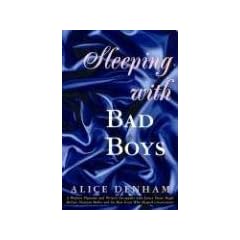
Her name is Alice Denham and she was all excited about her new book, whose full title is “Sleeping With Bad Boys: Literary New York in the 1950s and 1960s,” being reviewed in the New York Times. I looked her up and she’s been reviewed all over the place! She gave me a little flyer showing the front and back covers of the book. Back cover reads “Denham’s lusty memoir is a juicy tell-all about a time when male writers were gods and an aspiring and gorgeous female novelist tries to win respect… Caught between the sheets are James Dean, Norman Mailer, Philip Roth… The steam rises page by page as Denham — the only Playboy Playmate to have her fiction published in the same issue as her centerfold — chases her dream of writing as a young, oversexed beauty in the literary swirl of 1950s Greenwich Village…” The Denham I met seemed interesting, intelligent, quirky, and opinionated, as she rolled her eyes at some of our host’s jokes and wasn’t shy about yelling out, “that’s the ONLY funny one of the night” at the one that actually made her laugh (and she’s of course a lot older now than in her picture as shown above)… but she didn’t seem so ‘oversexed’ to me. I guess she read my thoughts because she said, “Oh, they sexed it up, you know,” rolling her eyes. “It’s really a feminist account of a woman in the 50s trying to be taken seriously as a writer.” Looks good, and I do think I’ll check it out. And Susan Brownmiller of “Our Bodies Our Selves” gave it a thumbs up!

One thing though: feminism and the whole (false) mind / body binarism has captured my interest of late, and Denham’s back cover made me think of it again. As dancers, our bodies are all important, and in a way, I guess we are our bodies. But we are also obviously intellectual beings. It’s just upsetting when someone — a man, doesn’t want to accept that, who thinks that because you’re a dancer he can treat you a certain way, disrespect you, say certain things, look at you a certain way — all things that can even be a bit threatening. I’m a lawyer, I’m not used to this. And it’s definitely not all men — definitely not even most; most men are totally cool; it’s just some who ruin it. Do a lot of female dancers get this treatment? What about “sexy” female writers like Denham? Or Candace Bushnell? Ann Liv Young said she got some suggestions about ways she could make her piece “sexier” by men who didn’t understand her work; she just rolled her eyes inwardly and thanked them. Very Dorothy Parker. I love her. Someone asked for Santoro’s phone number, I think she said as well. I wonder how Santoro reacted.

Anyway, on a more positive thought, regarding feminism: there are some really cool things going on in the city this weekend. There’s a “Global Feminisms” exhibit at the Brooklyn Museum on feminist art, and “Indwelling” — a combination of photography exhibits on women’s bodies by female artists, screenings of shorts films such as the movie “A Girl Like Me” which I saw at TriBeCa film festival and blogged about earlier — awesome awesome AWESOME short film by a high-schooler about young African-American girls’ self-perceptions — and some play readings such as The Vagina Monologues. The theme is women’s body images, and it celebrates the 25th Anniversary of the Women’s Therapy Centre Institute and takes place at Cooper Union’s Great Hall. Sounds excellent.

"The Virgin is a Lovely Number"


On Thursday night, I went to see Ann Liv Young‘s “Snow White” after seeing it posted on The Winger, by Gia Kourlas, who also has a good interview with the young iconoclastic choreographer in TONY. Very in-your-face, very rawly unabashedly unerotically naked, very hilariously WTF??, very post-post-post-feminist, and I LOVED it! This was my first time seeing anything by her, and I had to do some research, both on her work and the classic fairytale, to make a bit of sense (but I love that sort of thing — and I had no idea reinvention of the fairytale was so popular — in addition to Anne Sexton and Gregory Maguire, Angela Carter and A.S. Byatt have had their take). Young said it was based on the Grimm Brothers version and not Disney, which was pretty obvious, but I don’t think she needed to say that anyway: it’s really just her own thing entirely.

I’m not sure if I got what I was supposed to get out of it, or if there’s even some specific thing that she wanted me to get, but some themes I saw were pretense or illusion versus the real, tearing apart sex and gender stereotypes– rather lewdly too, subverting the (male, I guess) gaze, questioning the meaning of eroticism and nakedness versus nudity, etc.. It was kind of like a play within a play, but in a way that questioned what was performance and what was real. When the audience walked into the theater, the three performers were already standing onstage looking out at us waiting for us to take our seats. Young herself kind of glared out at us, a challenging look in her eye: she was not up there to please us, to show us prettiness and gratification. Similarly, at the end of the performance (which was rather abrupt), they just got up, took their things and walked off the stage, not waiting for or needing our applause, no bows, no “curtain calls.” And throughout the show, things would go wrong — sound devices that wouldn’t work, costume malfunctions, problematic props, etc. — and would be fixed onstage. It’s as if she’s questioning what a performance is, what are its confines, and at points, I wasn’t even completely sure if what was happening was supposed to be happening or if it was part of the show.

But back to the beginning. The three performers — one man (Michael Guerrero), two women (Liz Santoro and Young herself) — all wearing simple white ballet leotards and heavy black sneakers (the last of which is the only item of clothing that remains part of the costume throughout), play a rock song — Guerrero on drums, Santoro keyboards and Young singing. Each person, by the way, plays two characters — Guerrero the sound technician and The Queen, Santoro The Woodsman and The Prince, and Young the play’s director and Ms. White. After the song finished, all three stripped naked and changed into their next costume — all onstage. No strip-tease, nothing artful or sexy about it, just a clothing change done onstage — and therefore — really somewhat shocking. Certainly not Kenneth Clarke’s definition of “the nude.” Plus, none of the bodies are “idealized” — no makeup, no starving oneself for months on end or working out like a madperson for the idealized physique — these are real bodies.

For the next song, Young sings naked (except for the heavy black sneakers), while Guerrero works the sound and Santoro changes into her Prince costume — underwear with a giant strap-on dildo. The sound goes wrong, not enough is coming out of the mikes, and Young stops the performance mid-song to yell and scream at everyone for it. One male European blogger I read likened her to Eve Ensler, but to me, this ranting naked woman reminded me more of Karen Finley. Except, where Finley would often rant about overtly political issues, Young’s fist-pounding naked woman is political in another way: if traditional onstage female nudity (ie: for male gratification) must render (at least in fantasy) the woman vulnerable, humiliated, and subjugated to men in order for it to be titillating, Young’s dictating everyone around, forcing even the rather muscular man to run frantically about, his penis dangling between his legs, is nothing but amusing. She is hardly the vulnerable, submissive one, and is humiliating everyone else. Maybe the image is a bit shocking as well; I found it funny.

The Disney version has oft been criticized for reifying the virgin / whore dichotomy. As Sexton’s poem notes, the Queen is the sexed-up slut well deserving of her eventual demise, Snow the glorious good girl who is, for all intents and purposes a virgin — of course every woman must at some point perform those horrid ‘wifely duties’ but Snow’s “china-blue doll eyes … open to say Good Day Mama” but are “shut for the thrust of the unicorn…” Since she denies her sexuality, the fantasy of her virginity remains intact. Here, Young screws all such fantasies: the “Prince,” topless and with her giant strap-on dildo, climbs aboard Young, balancing his body over hers in a push-up, as if looking into the glass-box where the poor dead beautiful Snow lies. But instead of being a beautiful dead girl, Young is alive and active. She jumps up, pushes the Prince over, climbs atop him and straddles the dildo. Young told Kourlas part of what she wished to do was play with skepticism, so she wants the audience to see it penetrate her. The spectacle is rather outlandish and the audience kind of didn’t know how to react. Personally I don’t see how anyone could possibly find this ‘girl-on-girl action’ to be intended for male titilation — it seems way too vulgar — but Young told Kourlas that a European male viewer wrote to her that he thought the performance was quite sexy, but if she wanted to make it yet sexier she should lose the tennis shoes. In an earlier piece, entitled “Michael,” which I only read about and now wished I would have seen, apparently part of the action takes place in a trailer bearing three naked women dancing, and a male outside peering through the window, naked as well, and masturbating. He later comes inside the trailer, only to have his penis tied to the couch by the women, who pour soda over him while screaming, “I don’t love you anymore.” Is she saying that this is the fate that befalls the poor man who assumes women’s bodies exist solely for his gratification? Anyway, at one point during Snow White, Young reads to the audience some letters of criticism from former viewers, but she didn’t include this tennis shoe one and I wish she would have.

In the last section, the three performers pretend to be part of a radio talk show. One discussion revolves around how each character’s Valentine’s Day was spent. Young tells a story in which she was driving down the freeway topless, rocking out to cranked-up music and having herself a great time. A trucker sees her and begins following her. Of course, right then her tire goes flat. She throws a shirt on, jumps out of the car, and goes to the trunk to retrieve her spare, when the trucker stops and approaches her. He shoves her up against her trunk and pulls down his pants. Just then his black lab jumps out of the truck and attacks him, allowing her to run away. She flees into some bushes and hides, only to hear a shotgun go off. After the trucker pulls away, she goes back out to the street and holds the dog in her arms as he dies. A caller phones in and tells her if she’d just keep her clothes on her life would be much easier. Very disturbing, and Finley-esque.

Anyway, “Snow White” is playing at The Kitchen this Wednesday through Saturday. There’s tons of good stuff I left out. My friend, unfortunately, was disturbed by it, so I guess it may not be for everyone, but if you want to see a real spectacle that will likely challenge your notions of things and make you think, then just go and check it out for yourself.

You Made Me a Monster

Last night, I went to see another piece by Forsythe, this time at the Baryshnikov Arts Center. My usual dance friends were all busy, so I managed to convince my friend and fellow co-worker, Jonathan, who rarely goes to dance events, to accompany me. This task proved to be quite difficult since the website described the work as involving “audience participation.” When you’re a ballroom dancer and you invite your very dance-shy friends to socials at your studio promising them they can simply sit and watch all the action, only to get there and have everyone and their dog dragging them kicking and screaming out onto the dance floor, then go and invite them to an audience participatory dance event, they simply won’t trust you. I had to promise him on my life that this was a world-class concert dance company and the only ones doing the actual dancing would be the professionals.

Anyway, You Made Me a Monster was, like Three Atmospheric Studies, dance theater, and involved not only dance but other elements of theater as well, this time sculpture, sound effects, and words (this time not spoken but written, and projected from a video monitor onto a screen). The theme was the devastating effects of cancer on the body.

A group of 80 of us walked into a room where about 10 or so tables were set up, each bearing a partially constructed model of a human skeleton made from cardboard pieces. Guides divided us into smaller groups, took each group to a different table, and directed us to build off of the partly put-together puzzle, but not in a logical way. In other words, a spine should not resemble an actual spine, but the audience-member should twist and bend the carboard bone so that it made an artful design, then attach it to the model not where it “should” go on a “normal” human body, but in a more unconventional, surprising place. If we liked, we could also take some of the pieces of white paper below the table and trace the shadows made by the distorted model body.

Okay. Can you pick the lawyers out of the art crowd?… Yes, with us, this proved almost as bad as if we’d been asked to dance. While everyone else at our table enthusiastically went to work, Jonathan and I looked at each other, picked up a cardboard piece, looked quizzically at it, surreptitiously regarded the instructions we were told to pay no attention to, looked at each other again hopeless confusion covering our faces. Beginning to stress out about looking like a couple of idiots, I finally shrugged my shoulders and started bending and twisting a femur. Jonathan frowned at what I think was a collarbone, then put it down and excused himself to go to the bathroom for the next ten minutes. He’s never coming with me to a “dance event” again, I know it… In the end, I contributed to our table’s body by placing a very long, twisty bone protruding straight up from the center. It looked more amusing than anything else.

About ten minutes into our “body-building” project, shrill, screeching sounds began to emerge from the speakers, and dancers, three in all, came out, approached a table (each a different one), and began conveying through movement the design we’d created with our “bodies.” Their movement was much like that of the mother and diplomat’s assistant that I described in Three Atmospheric Studies — twisted, distorted, and contorted to grotesque, misshapen effect. I recognized the dancers from Atmospheric Studies, since I’d just seen it.

Funny thing, Matt Murphy had told me one of his favorite dancers from Atmospheric Studies was “the bald guy.” That man was one of the dancers here. I hadn’t noticed him much at Atmospheric Studies, since he didn’t “play” one of the main characters. Here, he took my breath away. Matt was so right! Dancers … they do notice dancing! With me, I guess supreme dance skill has to be shoved right in my face for me to see it…

After finishing at the tables, the dancers went to the front, stage area, and danced behind three separate stands each holding a piece of paper with a tracing an audience-member had made of the shadows of their model. They resembled musicians playing instruments while reading music sheets.

Behind them was a screen, onto which was projected a series of sentences, each running across the screen one by one. This use of words was somewhat ineffective to me. Every once in a while, I’d see solitary words or phrases that shouted-out to me, like “xenophobia,” “seeds of one’s internal destruction,” “reproductive organs were removed,” “grasp of space … uncanny, delirious,” “repulsive, occult, lethal,” Aliens” etc. etc. But I couldn’t focus on the words because that would take my concentration away from the dancers, and I didn’t want to do that. So, I only got an intermittent sensory effect from various words or sentence parts, without understanding how they fit together into a fuller narrative. I would have much preferred the words to have been spoken. There were sound effects blaring over the speakers as well, but to have the words on top of the sound effects would have enabled me to better understand them, since I feel that sounds can better compete with each other than visuals. You can only look at one thing at a time!

I noticed right before leaving that the pieces of paper on top of and underneath the tables contained those same sentences. I snatched one and put it into my bag. I’m not sure if they were there for us to take, but I’m very glad I did, because I read it on my subway ride home, and it made the performance all the more sorrowfully compelling to me. A man, whether it’s Forsythe I’m unsure, tells about his wife’s illness then death from cancer of her reproductive organs. The woman, a dancer, had been bleeding profusely, obviously weakening her and making her unable to perform. Her doctor, who happened to be a woman, told her it was just that she was dancing too much — obviously a judgment laced with sexism and devastatingly destructive medical inaccuracies — something with which a few of us are just a bit familiar. He goes on to talk about what a “dance genius” his wife was: “She had been able to reach into the profound heart of dancing and bring it to light…” The two were working on a piece about xenophobia, in response to several murders of political refugees in Germany. She had likened her cancer to xenophobia, which “constitutes a fear that the seeds of one’s internal destruction reside in a foreign body…” One thing I love about Forsythe is his ability to merge and analogize seemingly disparate things to shed new light on both. The “story” ends when, years after the woman has died, the man and his children began to assemble a cardboard jigsaw puzzle-like model of a human skeleton given to the wife before her death by a friend. They did not follow instructions, however, but “randomly bent, folded and attached the various intricate pieces until there was a model of something I understood. it was a model of grief.”

Amazing writing central to the piece that I thought should have been more central to the performance. As Jonathan and I were walking to the subway, I said that the dancing seemed one-note to me. He said he thought it was thematic and he enjoyed it overall and didn’t need a narrative with a big-bang climax. It WAS thematic and I didn’t need those things either, but I still wished there would have been something beside all the images of distorted, mangled, devastated bodies. I wished there would have been some beauty somewhere. I guess I found that in this writing, which was beautifully written. I just don’t know how many people saw the pieces of paper to pick up before leaving, so I don’t know how many people missed out on it.

One last note, on gender: two of the dancers here were men, one a woman. I thought it was interesting that Forsythe used male dancers to portray a woman’s illness from a feminine form of cancer. He also used female dancers in traditionally male roles in Atmospheric Studies — ie: a diplomat. This is interesting to me, this kind of playing with gender roles and assignments, unless I am reading too much into it. However, there was one line in this written story that struck me. After the woman’s cancer-ridden reproductive organs were removed, the man says, “I noticed afterward, she no longer smelled like a woman.” He goes on to talk about how, once she started on a course of radiation therapy, she began to “bend” “los[ing] the ability to fully lengthen her body” as a dancer must. So, the cancer depleted her of both her ‘womanness’ and her ‘dancerness’ — the two things that defined her, at least to the man (who is the one, after all, left to speak for her). But the line about the reproductive organs and “smelling like a woman” bothered me. It’s horrible for a woman to lose her reproductive organs — it’s horrible for anyone to have to lose any of their organs — and I definitely think doctors have been too haste to recommend hysterectomies and mastectomies and have done so out of pure and simple laziness over having to deal with the complexities of our bodies. But what exactly does ‘a woman’ smell like? Do we all smell the same? Are we all one thing, are we all defined by the same thing — our reproductive organs?

Can (Or Should) Dance Have "(Political) Meaning"?

As with DEATH IN VENICE, I’m totally late in writing this (blasted briefs, annoying job!), but better late than never, right?… On Thursday night, Dea and I went out to BAM to see THREE ATMOSPHERIC STUDIES choreographed by American-expatriate-in-Germany, William Forsythe.

I’ve seen excerpts of Forsythe’s work before, but this was the first full-length piece I’ve seen by him, and I had no idea what to expect, but I absolutely LOVED it. Instead of pure dance, it was German ‘dance theater’ (“tanztheater”) so there was dialog, as well as acted-out or talked-about images, in addition to movement. There were three “studies” (ie: Acts). In the first, a woman comes out and tells the audience that the scene is going to be about the arrest of her son, and she points to the dancer, wearing a bright red shirt, who is portraying that character. Aside from that, the first scene consists entirely of dance, and, from there, becomes rather chaotic and remains so throughout. Dancers violently grab each other, hurl themselves at each other, jump on each other, throw each other, run from each other, fight, fear and comfort each other. It was honestly really amazing to me that no one got hurt. I also attended a pre-performance discussion at which Forsythe spoke a bit, and one audience member asked him if he considered whether his dancers would be injured and he assured us that dancers have a “very meticulous” sense of time and space. There was no music (apart from the dancers’ heavy breathing which acted as a kind of natural sound effect), so he must have been making a huge understatement! If someone was one millisecond of time or one milimeter off on floorspace, they or the person they were hurling themselves at at full force and lightening speed could have really got whacked. When I dance, I count my music by the beats; still baffles me how they all kept such exacting time with no music?…

At various points, the dancers momentarily freeze to make painting-like tableaux. It wasn’t until the second scene when the woman whose son had been arrested began speaking to a translator to tell her version of the events that I realized that, because there was so much violent commotion in the first scene and because I was so in awe of the amazing ways the dancers manipulated the floor and moved their bodies, I’d totally missed ‘the story’ of the arrest. Forsythe had said that one of the ideas he wanted to play with was our ability as an audience, both in the theaters of dance and of world affairs, “to pay attention”. I realized that I’d failed that test, and had no idea how the arrest happened, even after the woman had specifically pointed out to me what I was supposed to watch for!

So, in the second scene, the woman tries, unsuccessfully, to give her account to a translator so that she can make a police report. The language barriers, the fact that there simply are no words for certain concepts or objects (“you say ‘bird’, I can give you ‘airplane’ … for ‘castle’ how about ‘apartment building'”) is a metaphor for the severe limitations of language to connect people. At the same time that this dialog is happening, there’s a dancer in the middle, speaking and illustrating with movement, the content of several different photographs and paintings. Sometimes his words overtake the woman’s and the interpretor tries unsuccessfully to translate his descriptions of the images into words as well. There was a lot of confusion as to the meaning of this, but to me, it was a way of saying that we can be bombarded with so many images that, ironically, they ultimately prevent us from empathizing with the subjects depicted in them. Forsythe said another thing he wished to explore was “compassion fatigue” — how the multiplicity, and perhaps sensationalism, of images of others’ suffering exhausts our ability to feel compassion for them, and results in drowning out the truth depicted therein. So the image becomes more important than the reality. At the end of the second scene, the woman, interrupted by the dancer’s voice describing yet another “composition” cries out, in frustration, “which composition are we on now?”

The most powerful, disturbing part of that scene was toward the end, when the woman rises from her chair and moves around the stage, contorting and distorting both her body and voice in quite grotesque ways. That frightening distortion I thought graphically illustrated both her emotional devastation and the impossibility of her truth being told because of the distorting effects of images and language. Forsythe is known for exploring the relativity of truth. Perhaps he is saying pure movement is the best way of getting to truth?

I guess the last “study” is the most “political” if you want to call it that — at least in terms of it echoing a current, specific geopolitical situation. There has been a bombing and the woman, whose whole village has now been destroyed, is so devastated she can now hardly move. A man is struggling to hold her up. A dancer portraying a diplomat tries to console the woman, telling her (rather amusingly at times) the bombing has been for the good of the community, etc., and a dancer whom she (interestingly, the diplomat is played by a woman) points to as her assistant (also a woman) conveys the diplomat’s words through dance. The assistant’s body-distorting, somewhat grotesque movements, reminiscient of the woman’s in the second scene, evince the ludicrousness of the diplomat’s words and their powerlessness to explain, defend, or console.

I found that the combination of the dialog, images, and most importantly, the brilliant movement, made me think about all of those ideas that were explored — the relativity of truth and its vulnerability to reduction to false images, the effect of bombardment of images on the observer’s attention span and ability to connect to the subject, and the distorting effect of language. And I felt the theatrical combination of the three art forms was more powerful than one alone. Discussion of this piece has centered on whether dance can (or should) provide political commentary. But I’m unsure of the reasons for this focus. I think this ballet was ‘political’ in the sense that everything is political — the word comes from the word “polis” — the people, after all — so anything that has as its subject matter human beings, is to an extent ‘political.’ But I was compelled to think about the issues mentioned above, not that war is bad or the current situation in Iraq is the U.S.’s fault or something simplistic and obvious like that. In general, I think it’s far more productive to talk about the ideas presented by a work of art than whether they are political.

Anyway, today Ashley commented on Matt’s blog as well, posing some more interesting questions related to the Forsythe discussion underway there: what meaning professional dancers as opposed to audience members with little or no dance training extract from a ballet; whether non-dancers can understand pure movement in the same way pro dancers do; and, if non-dancers don’t comprehend pure movement, what then attracts them to the ballet — particularly the contemporary, story-less ballets and modern dance? I thought those queries were really intriguing, particularly in light of viewing this work. I, for one — someone with very little dance training — don’t “understand” pure movement at all, and don’t really try to either. The contemporary story-less ballets that I enjoy, I enjoy because I love watching the dancers move in amazingly beautiful ways. But then, the dancers have to be really really good. And, in fact, sometimes they have to be dancers with whom I’m already familiar. I don’t know if I would have loved “Clear” which ABT recently did, if David, Max, Angel, and Jared were not dancing it; I don’t know if I would have liked “Meadow” as much if it wasn’t Marcelo and Julie performing. I need to connect to the dancers, especially with story-less ballets (which is why I think books like “Round About the Ballet,” magazine interviews, and websites like the Winger are so important to promoting ballet and concert dance).

I think a lot of dance fans also go to the ballet for the sensual experience: they perhaps enjoy Balanchine, for example, because they savor the feminine beauty, the pretty, dulcet charm of his ballets. I prefer ABT’s celebration of masculine (including both male and female) beauty and strength exuded by the ballets they present. I think people often go for the sensations the experience, the way the ballets make them feel, rather than to make them think. But then, for me, Forsythe is a welcome change to all that, at least once in a while. I think I’ve been seeing so much contemporary ballet of the “Clear” and “Meadow” variety during ABT’s recent City Center season, I was quite starved for more — to be given a chance to use my mind, to be compelled to decipher meaning, at points rather complex. That’s me, anyway. Very interesting to ponder just what it is that draws non-dancers who presumably derive no solid ‘meaning’ from pure movement to concert dance though…

"Dirty Talk"ing Angry Macho Homophobes

Evangelina and me at Dirty Talk

Who us? Of course not!!! Above is a picture taken last night of my good friend Evangelina (who is on the right) and me (sorry for poor picture quality; could my camera please not have a nervous breakdown whenever both zoom and flash are used simultaneously???) We’re in the very comfy lobby of the off-off-Broadway theater Center Stage, waiting to see a new play called “The Dirty Talk.” It was a special occasion because it marked the foray of Evangelina’s husband, Michael, an accountant and actor, into theater producing — go Michael!

Dirty Talk box office

The play was good. It was about these two men who agree to meet in person after having met online in one of those naughty-talking chat-rooms. Only the one guy, characterized by the title of this post, thinks he is going to be hooking up with a Hooters-working nursing-school student with the stereotypical enormous breasts, instead of a sensitive bisexual man. The two end up stuck alone together in a Jersey cabin out in the woods during a nasty thunderstorm, and the encounter eventually compels the first man to explore the reasons underlying his, shall we say, problematic personality traits, which are partly responsible for ending his marriage, and which stem from upsetting childhood experiences in which his father attempted to “make a man out of him” via various disturbing rituals.

Why do men do that to their sons??? My grandfather and grandmother did that “becoming a man” b.s. to my dad by forcing him into the army. But he was far too sensitive for the military, and I think it’s permanently damaged him psychologically.

Anyway, my only gripe with the play was with the second character, who I thought was just not fully fleshed out enough. I understood his need to pretend to be a woman online, but couldn’t fathom what he was thinking by actually showing up at the cabin as … himself. At one point, the other character asks him, “what were you thinking?” and he doesn’t really have an answer. So, he seemed to be more of a catalyst for the other, more compellingly dynamic character’s self- exploration.

The acting was excellent, and the play was by turns hilarious and sad. I used to go to these small off-off-Broadway plays all the time when I first moved to New York, and haven’t been in a while. I’d forgotten how much I like them. You can sit practically onstage, where you can see the action up close and really feel like you’re a part of it. To me, you get so much more out of the production than you do a big Broadway play, which, in those huge theaters, is so distancing in comparison. Evangelina and I have both been so busy — me with dancing and writing and working, and she with her new marriage and her and Michael’s decision to buy some property upstate and build their first house (!), that we haven’t seen each other in nearly a year. But, as with all close friends, the minute you plop down next to each other on the sofa with a glass of wine and start yapping away, it’s like you just saw each other!

I hope everyone had a nice day off today in honor of Dr. Martin Luther King. I didn’t have to go into the office, but I brought some work home, which makes me feel a bit guilty, being from the Evan Mecham state and all… But, at least I only read the transcript from my next case’s Voir Dire (Jury Selection), which I don’t see so much as work: it’s one of my favorite parts of the trial since it’s where I get to “meet” all the different kinds of New Yorkers who are considered for selection on my client’s jury. Anyway, WordPress blogs don’t take kindly to YouTube embeddings, so I’m linking to Doug Fox’s post today, for The Speech!

Merry Christmas and Happy Holidays Everyone!

Christmas card from client

This is a Christmas card I received from one of my clients in prison. He obviously spent a good portion of his inmate funds on this, and I found it so sweet when I received it Friday, I burst into tears. Anyway, I will share it with you all, to wish everyone a wonderful holiday. I have to say, Christmas sometimes really depresses me. I start thinking of everyone who is alone — my clients in prison, the homeless, the elderly, the mentally ill who have no one, orphans, etc. etc. etc. It’s just heart-breaking. Since I’m spending the holiday alone myself (though not ALONE alone; I expect to be receiving umpteenth phone calls from relatives 🙂 ), I contacted a local volunteer organization that sends people to soup kitchens and shelters, but they told me that, ironically, Christmas-time is just about the only time they are NOT lacking in help — just about any other time of the year they’d love me. I made a mental note to try to volunteer at some other point, if and when I’m ever not dancing or working!

Anyway, trying to keep sadness at bay and keep an upbeat attitude… this weekend I had another dance / theater marathon. Yesterday, I went to my last Alvin Ailey performance of the season, sadly. I saw some brilliant dancing and choreography, of course! The matinee’s ballets included The River, a gorgeously dreamy ballet choreographed by Ailey himself to Duke Ellington music, with all dancers dressed in light blue, which kind of reminded me of Clear or Drink to Me Only With Thine Eyes — beauty for beauty’s sake. And, I saw Pas De Duke for the first time, which was originally choreographed for Judith Jamison and Baryshnikov. I liked, but didn’t love it. Ailey called it a modern pas de deux (dance for two people), but there was hardly any partnering; it was mostly side by sides, with the dancers interacting a lot with each other emotionally, but not physically. I loved Dwana Adiaha Smallwood (probably the most famous current dancer in the company) in the female role — she was a badass! I can only imagine how Jamison must have performed the part! Then, Solo, by Hans van Manen, was next, a beautiful piece designed, despite its title, for three men, alternating between a pas de trois and each man dancing alone onstage. And the last was Love Stories, a very fun ballet choreographed in honor of Ailey by Jamison, Robert Battle and hip hop choreorapher Rennie Harris. It alternated between hip hop, disco-y jazz, and ballet, and had some absolutely spectacular lifts — man carrying woman over his head while circling the stage multiple times — and jumps — twice a woman jumped up on the chest of a man arching his back — crazy!

ailey dancers taking bow

I sat in the orchestra pit for this one! I don’t know why these seats are so cheap ($25) — they’re so close to the stage, you feel like you’re practically one with the dancers (a feeling that of course I savor!), and, unlike at the Met when you’re so near to the stage, at City Center you can still see the dances’ feet perfectly. Afterward, they held another post-performance panel discussion with some of the dancers, like last time.

ailey dancers at post discussion

This time we had two Frenchmen, Malik Le Nost and Willy Laury (in the glasses — one of my favorites, whom I always seem to see in the Sinner Man part of Revelations which is odd because they always say they alternate between all the roles; I recognize him partly by this cool tattoo that he has on his hip snaking down to his groin area, which is always peeking out from the top of his cinnamon red Sinner man pants 🙂 ), and I think the woman was Khilea Douglass (she was sitting on the far side from me, so I didn’t hear her name clearly or see her face). I really enjoy these discussions — I appreciate hearing the dancers talk about the work from their perspective.

Today, I went to see Spring Awakening, the new big thing on Broadway.

spring awakening

There were a lot of people out in NY for it being Christmas Eve day…! This Rent-like musical was recommended to me by my friend, Mark, who knew I liked Bill T. Jones, the show’s choreographer (hi Mark!) and I also saw a fellow Winger post about it on her website. I liked it, but I have to say it didn’t move me hugely on my first viewing. It’s something I may have to see again (when it comes down a bit in price!), but I did like the music, the singing was great, and the staging (which I assume was what Jones was responsible for, since there really wasn’t any dancing) was a lot of fun. I guess what I didn’t like was the basic story — it’s based on a German play from the 1890s — and wasn’t something I haven’t heard a zillion times before, so it definitely told me nothing new. And, it seemed a bit melodramatic and I couldn’t understand the motivations of some of the characters. I also wanted some real dancers for Jones to work with! Maybe I’ve just seen so much dance lately I expect everyone to go soaring through the air like an ABT or Alvin Ailey member. I’ve got so used to seeing abstract expressions of thought revealed through the sublime vehice of a near miraculous human body that I just didn’t want to hear any dialog! — which is VERY odd for me since I used to be so into dramas. But I guess I’ve never been a huge fan of musicals in the first place — the only one I think I’ve ever liked is the Cabaret of the Mendes / Cumming variety. But, everyone seems to love this musical, so I’m sure that whatever I didn’t see in it on first viewing is just me 🙂

Christmas dinner for the single girl!

So, this will be my single-girl-in-the-city Christmas dinner for tomorrow: an artisanal chicken pot pie made by Just Rugelach and bought at my local Sunday farmers’ market, fresh spinach with Olde Cape Cod honey mustard viniagarette currently on sale at my local Food Emporium, and Barefoot Sauvingon Blanc from Nancy’s Wines, preceded by my favorite appetizer of Greek taramosalata (red caviar mixed with pureed potatoes and other lovely ingredients) on Russian black bread, and for dessert, thick delicious (and immensely fatty) Southern Comfort Egg Nog, and some Haddington Farms chocolate-covered peanut caramel clusters sent by Mom 🙂 Yum!

Christmas reading

And, finally, here’s some of my Christmas reading! Two novels I’ve been hoping for time to sink my gums into — Home Land by Sam Lipsyte, which is a dark comedy in the style of Augusten Burroughs and consists of letters an alum writes to his alma mater on the eve of his high school reunion basically telling them how life DIDN’T pan out so hunky dory (just my type of thing 🙂 ), and the other, The Feast of Love by Charles Baxter, was recommended by Nick Hornby to his fans a long time ago, which I never got around to buying, but some nice person in my apartment building left this copy for me on top of the recycle bin! And these two lovely works of fiction sit here atop my stacks of trial transcripts for the next case I’ll be working on. I promised friends and family I WOULDN’T do any work work, but if I get antsy enough….

Anyway, happy holidays everyone!

Who Is YOUR Dancer Alter Ego?

Her Kind play

Last night I went to see this very interesting play / modern dance performance called Her Kind, about the life and poetry of Anne Sexton, recommended by Winger contributor Tony Schultz. The actress and playwright was Hannah Wolfe, who alternated fluidly between three different characters: the poet herself; Sexton’s sad but sweet daughter, Linda; and a rather comically nervous young professor trying to teach Sexton to a college class. I was more familiar with Sexton’s poetry than her life, other than the fact that she killed herself, like her friend, Sylvia Plath. Through a combination of recitations of Sexton’s poetry, video projections of interviews with her friends, monologues by Linda recounting anecdotes of life with her mother, and one of those fourth-wall-breaking ‘dialogues’ where Wolfe’s college teacher lectured us, her students, on the import of Sexton’s work, the performance taught me a great deal about Sexton in only a little over one hour. But what I found most fascinatingly unique about the show was modern dancer Laurel Dugan’s role. She ‘played’ the part of Sexton’s alter ego, Elizabeth, who was both a multiple personality of Sexton’s (she was arguably mentally ill) and served as a muse, figuring strongly in her poems. But instead of speaking, Dugan mainly interpreted Sexton’s words through dance. I’d never really seen dance as a direct expression of literature before, and, in a way, I felt like I got more out of watching a dancer interpret the poetry, read by Sexton herself via a tape-recording, through her body, than by listening to the actress use her voice to do the same. The whole conception was really brilliant, and Dugan was stunning.

Anyway, I had kind of a weirdly funny experience afterward. I suffered a bit of “professional identity confusion” when I got into a little disagreement with the woman sitting next to me, who was, it turned out, a former English teacher of Wolfe’s, and a writer herself. The woman immediately expressed dissatisfaction with the piece overall, saying it didn’t really work for her, and she thought she’d give suggestions to Hannah for improving it, since she was a former teacher of hers and all. “Oh really?” I said. “Well what I really loved about it was the dancer; I’ve never seen that kind of thing before and I was surprised that it brought so much more to the play than words could.”

“Oh,” she laughed. “No, that was exactly what I didn’t like!”

We both laughed at our disagreement, the way friendly, unantagonistic women do, then she asked me if I knew Hannah. It was a very small theater, and it seemed everyone who was there knew someone involved in the production. “No,” I said, “I’m here because it was recommended on the Winger, a dance website.”

“Oh, you’re a dancer,” she said, sounding somewhat embarrassed. “I should have known. Well, no no, don’t let my interpretation sway you at all. I’m sure I just feel the way I do because I’m a writer. I take Sexton very personally,” she laughed again.

“Oh, I’m a writer too,” I exclaimed. “I was an English major and I like Anne Sexton too.”

“Really?” she said sounding a little confused. “What do you write?”

“Oh well, I mean, I, I have a novel, but it’s not published. I mean, I don’t have anything published. Yet. I mean besides law review articles.” With this, her eyebrows shot straight up. “I mean, I’m a lawyer, but I’m also trying to start a writing career. And, um, I dance too. I mean I try.” Her eyes widened. Clearly I had multiple personalities just like Anne. “I mean, I just meant I understand what you mean about taking a writer you love personally, and um, I guess because I like dance too, I um…” I sounded like the biggest bumbling fool in the world. She just stared at me, while I tried, in vain, to figure myself out.

We talked a bit more and found that we both agreed that Wolfe had played the role too Sylvia Plath, and not Sexton enough: she was too much of a sweet schoolgirl (faux sweet schoolgirl of course, turned faux happy housewife) instead of sexy and deriving power partly from her attraction, and attractiveness, to men. What I didn’t think of to say to the English professor, what I didn’t think of until I was walking back to the subway, was that, while Wolfe didn’t really play the role Sexton-y enough, Dugan did just that with her more sensuous dance interpretation. Perhaps that was what the play was trying to say anyway: Anne the writer and woman held back, but her alter ego responsible for her creative spirit was completely unconstrained. And what better means to express this unrestrained spirit than through dance?

So maybe all writers, maybe all people, need dancer alter egos. Luis always used to tell me he thought I couldn’t let loose and do that crazy-ass mambo combo he choreographed for me because I was an upright (read: uptight) lawyer. So, he wanted me to think of myself as someone else while I was dancing. He suggested I even invent another name. Of course he came up with … Lolita. Luis!! Anyway, I have decided that I will take his advice. I just need a good name for her. Hmmm…

Snobby, Elitist, Grumpy Old Lady Fights Back!!!

Okay, who are all of these people who continuously invade my neighborhood every Halloween?? Grumpy old lady has a very oily t-zone and desperately needs to buy more face wipes, which she knows are conveniently located right at the counter! Grumpy old lady pays a damn lot of money to live on the upper-west-side and does not have the time or energy to stand in line behind a bunch of teenagers waiting to shop for Halloween costumes! Grumpy old lady wants to be able to walk into her neighborhood Rickys, go up to the counter, and buy her blasted face wipes. Grrrrrrrrrr…..

Seriously, I just got back from seeing Twyla Tharp’s “The Times They Are a Changin‘” and have to agree with all of the reviews. For me, I think the problem was in the whole conceptualization of it from the get-go. I’m not a huge Dylan fan, but I just don’t see how the goings-on behind a traveling circus act reflect or symbolize his body of work. Reviewers said she was too literal with what is essentially poetry that defies narrative. Maybe… but I think she could have organized his music into SOME kind of over-arching story — like guys going to Iraq, some kind of inner-city turmoil — some relevant social crisis of today I think would have spoken better to his ouevre — just not discontent within a circus show. Like, when they broke out into ‘Blowin’ in the Wind’ I just wanted to laugh. Because of the history of the song, it seemed kind of like she was comparing the circus owner’s mistreatment of some of his underlings to the atrocities of Vietnam. Maybe she just didn’t want to repeat her ‘Movin’ Out’ theme or be too ‘political.’ And it’s not that mistreatment of performers or father-son rivalry can’t ever speak to the human condition, but it needs to go a lot deeper than this. Also, for a so-called ‘Dancical,’ there wasn’t much dancing… a lot of great floor acrobatics, but not a lot of dancing; it was more like a basic musical. Still, I think she’s one of the most brilliant choreographers today — anyone’s entitled to a misjudgment now and then!