For the Love of Duke


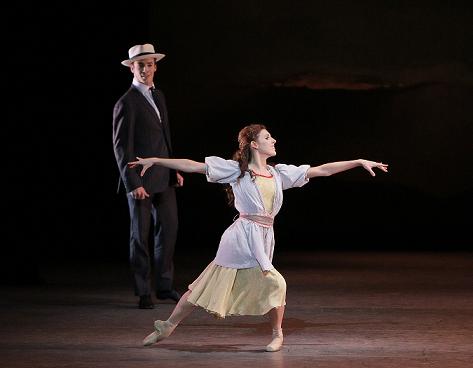
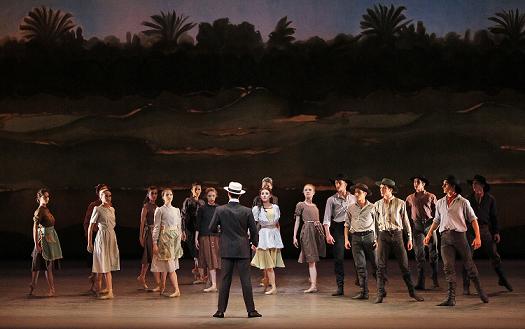
On Friday night Susan Stroman’s For the Love of Duke premiered at NYCB. Photos above by Paul Kolnik. Top: Tiler Peck, Sara Mearns, and Amar Ramasar; bottom: Mearns and Ramasar. Stroman is primarily a Broadway choreographer (I think her most famous work is probably Contact), and it shows both in her ballets’ strengths and limitations.

For the Love of Duke is divided into two parts. In the first, entitled “Frankie and Johnny … and Rose,” Tiler Peck and Amar Ramasar are Johnny and Rose, a couple in love. They perform a lovely lyrical pas de deux. Then along struts Sara Mearns – Frankie – and Johnny’s attentions are completely lost on her, to the disappointment of Rose. Johnny and Rose are snuggling on a bench together, and when Frankie comes prancing along, Johnny pushes Rose right off the bench, behind it, as if to hide her. Then he does a snazzier dance with Mearns / Frankie, she disappears, and he’s back with Rose … until Frankie comes strutting along again. And so on. At one point, Rose becomes the seductress, and Johnny pushes Frankie off the back of the bench. It was cute, and everyone danced spectacularly, but it got a bit old to me after a while.

The second part – “Blossom Got Kissed” – Stroman had actually choreographed before, creating it for NYCB in 1999. I liked this one better. Both parts, by the way, are choreographed to Duke Ellington and Billy Strayhorn, which is where the title of the whole comes from. Anyway, “Blossom” begins with a bunch of girls all dressed in sassy, jazzy red sitting on a bench tapping their feet to Ellington’s rhythm. Along comes Savannah Lowery as Blossom, dressed in a frilly ballet tutu. She sits alongside them on the bench and tries to tap with them. But she has no rhythm and is horribly off. Then they stand and do a jazzy dance, and, again, she tries to join, but just can’t get the hang of it. She is simply too classical ballet. Lowery was hilarious though and it was funny to see her continually try to get the rhythm and technique of jazz dance right by taking a foot and pounding it down flat on the floor. Then, a group of tux-clad men come along and do some swing dancing with the red-clad women. Blossom again tries hard to fit in but just can’t. Finally, a musician in the band (which was onstage), in the person of Robert Fairchild, comes out from the back of the stage, orders the music changed, and does a sweet lyrical ballet pas de deux with her.

I feel like I’ve seen “Blossom” before because Lowery’s hilarious flat-footedness looked familiar. I liked it better than the first part because to me it was funnier, and the story went a little further.

I think Stroman is very good at creating a story through dance, and that’s what I like about her. You can tell she’s not really a ballet choreographer though. Compared to the first two pieces of the night – Ratmansky’s Concerto DSCH and Wheeldon’s Polyphonia – the actual dance just wasn’t that rich. Still, I think she complemented the program well. It can never hurt to include in an evening of ballet a cute narrative dance with music that’s not usual ballet fare.

As always, I loved Concerto DSCH. Ratmansky was in the audience. I felt the music was played a bit too fast though (conductor was Ryan McAdams, Elaine Chelton the pianist). It looked like Ashley Bouder had a slight mishap, though I’m not sure because I was busy watching Joaquin DeLuz do a sequence of crazy fast steps into a somersault at the speed of light. Andrew Veyette again replaced Gonzalo Garcia, who I am really missing. I hope he’s okay. Veyette is doing a fine job as one of the two playful guys in blue, but there’s this repeating series of throws – where they each kind of propel the other into the air, and I love how Garcia always gets such height when he bounces off the other two.

Tyler Angle replaced Benjamin Millepied, and did wonderfully. I always notice things with Tyler that I haven’t noticed before – like how when he and the girl in green (Wendy Whelan) make their entrance, he’s spinning her around and around, and she looks like she’s hanging on to him for dear life. It kind of sets the tone of their relationship. I always notice the music much more when he dances as well.

Christopher Wheeldon’s Polyphonia is definitely one of my favorites of his. I love the musicality of it, and the originality of the combinations. It’s set to ten piano pieces by Ligeti, who, the program notes, developed micropolyphony – a type of music involving sustained dissonant chords that shift slowly over time. You can really see that “micropolyphony” in the dancing, as the sets of dancers (eight all together, divided into four pairs) begin dancing together in a line but each pair doing something completely different. Then, they eventually come together and dance in unison, but then they drift apart again later. There’s some very clever, almost humorous partnering throughout, but particularly in the second movement, Arc-en-ciel, Etudes pour piano, danced by Maria Kowroski and Jared Angle. I haven’t seen this ballet as often as I would like to. I was going to say I wish he’d include this one more often in Morphoses programs, and then I remembered

SLSG’s Dance Highlights of 2010

Instead of trying to remember which were my favorite performances of the year, I’m just going back through my blog archives from January of this year and linking to the most memorable posts. More fun that way! A lot happened in a year…

January

Pacific Northwest Ballet made their debut at the Joyce; it was my first time seeing them live.

The Post‘s Page 6 announced that you know who and you know who are dating, and the ridiculous homewrecker attacks began.

Baryshnikov and Annie Liebovitz starred in a very cool Louis Vuitton ad.

February

I totally fell for New York City Ballet’s Sleeping Beauty.

…and Mark Sanchez 🙂

I found myself quoted in Colin Jarman’s book, Dancing With the Quotes.

I also fell for Sara Mearns’s Odette in Peter Martins’s Swan Lake.

On a personal note, my former judge, the esteemed Honorable Sylvia Pressler, passed away.

The Kings of Dance came to town.

Morphoses shocked the ballet world by announcing that Christopher Wheeldon was leaving the company.

March

My friend’s organization, Art for Change, held a benefit for Haiti after the earthquake.

Rasta Thomas’s Bad Boys of Dance announced that Danny Tidwell and SYTYCD’s Jacob Karr were joining the company.

Corella Ballet Castilla y Leon finally made their NYC debut!

I found myself actually getting press for liking Kate Gosselin – or for not hating Kate Gosselin rather – on Dancing With the Stars.

I fell for Keigwin + Company’s Runaway.

I was delighted to receive an email from NYCB ballerina Yvonne Borree’s aunt regarding of all things, my novel.

April

I had my first experience as a dance writer panelist! Thank you, Marc, from TenduTV!

Tiler Peck appeared on Dancing With the Stars in a Travis Wall routine, which everyone was so excited about. But it ended up amounting to not a whole lot…

Roberto Bolle danced a naked Giselle, in Italy of course.

May

New York City Ballet opened their spring season with premieres of Millepied’s Why Am I Not Where You Are and Ratmansky’s Namouna, both of which I liked, though Ratmansky’s had to grow a bit on me.

Baryshnikov returned to the stage.

I greatly enjoyed ABT’s new production, Lady of the Camellias, though most critics panned it.

June

ABT celebrated Alicia Alonso’s 90th birthday with three all-star Latin American casts (plus Natalia Osipova) dancing in Don Quixote.

Yvonne Borree gave her farewell performance at NYCB.

Bill T. Jones won a Tony for best choreographer for Fela!

Philip Neal gave his farewell performance at NYCB.

Natalia Osipova was mugged right outside of Lincoln Center.

Two of the greatest ballerinas in Europe – Osipova, and Alina Cojocaru – gave back to back Sleeping Beauty performances at ABT.

Albert Evans gave his farewell performance at NYCB.

Tap great Savion Glover made headlines by voicing his annoyance with Alastair Macaulay’s NY Times criticism of him – onstage, during a show.

Conductor Maurice Kaplow gave his farewell performance with NYCB.

Darci Kistler officially ended the era of the Balanchine-trained dancer with her farewell performance with NYCB.

July

Carlos Acosta announced his retirement from ballet and his foray into modern dance.

Alex Wong, probably the second greatest contestant ever on SYTYCD was injured and unable to finish the show.

My friend, Taylor Gordon, was profiled as a freelance ballet dancer in a New York Times article 🙂

Alvin Ailey American Dance Theater’s beloved Denise Jefferson passed away.

Nilas Martins retired from NYCB oddly sans fanfare, sans criticism, sans a performance.

August

I interviewed tWitch about his role in the movie Step It Up. Fun fun interview!

I had a blast covering Ailey Camp.

I nearly fell over when Wendy Perron, esteemed E-I-C of Dance Magazine recommended Swallow on Twitter!

September

NYCB began their excellent “See the Music” series.

October

I loved Ashley Bouder’s Serenade.

Emerging Pictures’s awesomely exciting Ballet in Cinema series began with the Bolshoi’s Flames of Paris.

This cool new Lincoln Center-area street art sprouted up.

One of my favorite posts of the year, though it received no comments, was about Anne Fortier’s novel, Juliet. I jokingly daydreamed about it being made into a film, and which of my favorite ballet stars might take the lead.

November

ABT made an historic visit to Cuba and oh how I wished I could have gone with them.

I think I was the only person in the entire dance world to sympathize with Bristol Palin on Dancing With the Stars.

I had a blast covering New York So You Think You Can Dance auditions.

All of a sudden Black Swan was everywhere.

Nearly fell over again upon hearing Riccardo Cocchi and Yulia Zagoruychenko took the world Latin ballroom title – making them the first U.S. couple ever to do so.

December

My take on SugarPlumpGate.

Black Swan finally premiered which I didn’t love but was happy to have ballet brought back into the spotlight.

I was in awe of Alvin Ailey’s 50-dancer Revelations, staged in honor of the 50th anniversary of that dance. I also loved several other dances in their City Center season – Ailey’s Cry, Ronald K. Brown’s Dancing Spirit, and Geoffrey Holder’s The Prodigal Prince – just to name a few.

Robert Wilson / Roberto Bolle’s Perchance to Dream exhibit in Chelsea was a lot o’ frightening fun.

ABT’s new Nutcracker premiered, which I really enjoyed, almost as much as the Bolshoi’s.

Portman and Millepied revealed they are now engaged and expecting.

I had great fun, despite the crazy snowstorm, going down to Wall Street and covering Judith Jamison’s ringing of the closing bell at the NYSE.

Pretty busy year.

Happy New Year, everyone!

City Center’s Studio 5 Opens its Season Nov. 9 with Damian Woetzel, Violette Verdy, and NYCB

New York City Center’s Studio 5 will open its 2010-11 season on November 9th with a performance and discussion of three Balanchine ballets that are celebrating their 50th anniversary this year. Four New York City Ballet dancers (Tiler Peck, Joaquin De Luz, Jenifer Ringer and Jared Angle) will perform Tchaikovsky Pas de Deux, Donizetti Variations, and Liebeslieder Walzer, and Damian Woetzel and Violette Verdy (who danced in the original productions) will discuss. Verdy will also coach the dancers.

Later performance/discussions this season will center on Paul Taylor Dance Company and Dance Theater of Harlem. Click on link below to read the full press release.

Continue reading “City Center’s Studio 5 Opens its Season Nov. 9 with Damian Woetzel, Violette Verdy, and NYCB”

New York City Ballet’s First Fall Season Opening Night


Tuesday night, New York City Ballet opened its very first fall season with performances of Balanchine’s Serenade, Peter Martins’s Grazioso, and Jerome Robbins’s The Four Seasons. First, before the performance began, Peter Martins came out and introduced each of the principal dancers, who came out onstage one by one, and said this season would be a celebration of them. Tiler Peck in particular was wearing this really gorgeous silky fuchsia dress. Martins said all principals were there except for Benjamin Millepied, who was doing something movie-related “en France,” he said with a funny faux Euro accent. Everyone laughed and gave the dancers a huge round of applause. The house was packed and it was clear how thrilled the company’s many fans are with there being a fall season this year. Martins made fun of himself for being so into toasts and said that during intermission, we’d all be given be given free champagne to toast the principals. Which we were – very fun!

The part of the performance I was mainly looking forward to was Janie Taylor’s debut in Serenade (above headshot and Serenade photo by Paul Kolnik) as the main ballerina. As usual with her, she completely made the ballet her own. I thought the ballet had a somewhat dark element with her, that I’ve never seen before. When she first ran out onstage, late for class, instead of looking like she was all frantic about being late because she’d been held up by a boy, it looked like she was running from something – from him. That man was Charles Askegard and when he danced the middle waltz part with her, the huge size difference between them added to the sense of foreboding, that she was fragile, he was pushing her around, and she’d eventually be hurt by him. At certain parts, it was literally like he was pulling her along. When he lifted her and she raised her legs in a split, it looked almost like she was trying to get away from him. Sara Mearns was the angel and Ask La Cour was the man who I call “blind justice” who take care of Taylor when she falls, and it was interesting how much the two male leads and two female leads looked alike. I almost got Taylor and Mearns mixed up at parts, thinking they were taking on the other’s role. And the end when the men raise Taylor up like pallbearers and she is carried off by them, arching her back, arms outstretched  – so hauntingly beautiful. It reminded me a bit of Balanchine’s La Valse.

I was also looking forward to Martins’s Grazioso, in which three handsome men – Gonzalo Garcia, Andrew Veyette and Daniel Ulbrich – vie for Ashley Bouder’s attention with their bravura moves. I don’t think this ballet has been performed since it premiered a few seasons ago. And I loved it all over again. I love how each guy has his own personality – Garcia is the romantic, Veyette is the manly man one, and Ulbrich is the one with all the high jumping tricks. And Bouder really played the tart, looking at each of them up and down at points kind of lasciviously, really trying to choose. The guy next to me was really giggly over it.

And the evening ended with Robbins’ The Four Seasons, which itself ends with a lovely tribute to fall.

This whole season the Koch theater will open an hour early. The promenade overlooking Lincoln Center Plaza will be open for cocktails, the gift shop will be open, and, for the rest of this opening week, there will also be live jazz performed by the NYCB Orchestra one hour before performance time. They have the promenade and mezzanine area done up nicely, with big plush chairs. Also taking place the rest of this week will be a “meet the artists” session whereby, beginning at 6:45 p.m. in the first ring of the auditorium, the principals dancers will be available to chat with ticket holders. There’s also a photo exhibition of the dancers by photographer HenryLeutwyler on display in the theater throughout the season.

Tomorrow night will be the first of seven “See the Music” performances which will provide a look inside NYCB’s 62-piece orchestra. At the beginning of each performance, Peter Martins and musical director Faycal Karoui will briefly discuss the program’s music, followed by the orchestra performing an excerpt of one of the ballet scores. The subject of tomorrow night’s discussion will be Eduoard Lalo’s score for Ratmansky’s Namouna: A Grand Divertissement, which premiered last season. Additional “See the Music” programs are Sept. 26 matinee, January 20, Feb. 1, Feb. 19 matinee, May 25 and June 11.

ALBERT EVANS FAREWELL


Photos by Paul Kolnik (top, of Albert Evans during final curtain call, bottom with Wendy Whelan in Herman Schmerman)

Sunday afternoon longtime beloved principal with NYCBallet, Albert Evans, gave his final performance. He danced two roles he is well-known for – the pas de deux from William Forsythe’s Herman Schmerman, with Wendy Whelan, whom he’s often been partnered with, and Balanchine’s The Four Temperaments (he danced the third variation – “Phlegmatic”). It was perfect – -a humorous, playful pas de deux and a very serious, emotionally moving classic Balanchine ballet. He danced both fabulously. I haven’t seen Herman Schmerman much, and he made me want to see it again. And he danced “Phlegmatic” so well, with such precision and intensity (honestly, better than I remember seeing it danced previously) it made me take notice of a Balanchine ballet I honestly haven’t much liked before.

Also on the program was La Source, a pretty in pink ballet by Balanchine set to Delibes and danced very well by Joaquin de Luz and Megan Fairchild in the pas de deux and Lauren King as leader of the ensemble. I have in my notes “dive!!!” which means Megan must have dove into Joaquin’s arms with brilliant gusto!

And in the middle was The Lady with the Little Dog, a newish ballet by Alexey Miroshnichenko that premiered last season, danced again very well by Sterling Hyltin and Andrew Veyette. I think they re-staged and / or re-thought it a bit because it seemed so much better this time. I remember liking parts of it last time; I really loved it this time. The lifts are stunning and it’s very emotionally moving with lots of climactic build-up. I think it’s more focused on the couple this time and the “angels” are more functional and less involved in the choreography and I think that made a big difference. I always love Sterling’s little dog. This time he (or she?) wanted to be picked up a lot.

Anyway, Albert Evans is quite the character and his curtain call was probably the most celebratory I’ve seen at City Ballet. I said on Twitter that it was of Julio Bocca-esque proportions! Of course everyone – audience and the dancers – loves him, and many of the female dancers came out and did a little dance with him when giving him their bouquet. He did several little goofy dances himself, with lots of Rocky Horror Picture Show-style pelvic thrusts. He picked up one of his bouquets and flung it out to the audience. Then, he took off his shoes. Oh and he had a glass of champagne, brought out by a group of male principals. See, what I mean – Julio Bocca all over again! Crowd went wild, and didn’t want to leave the theater.

Since it was a nice day, after the performance I sat outside on the benches near the stage door with Oberon and we waited for Albert to emerge. He never did! Well, he probably did after several hours – Philip and I imagined he was getting plastered with Wendy Whelan and Maria Kowroski (neither of whom emerged either during the time we sat there) and his other regular female partners. A good hour after we’d been sitting out, a dancer came out and talked with Philip a bit and told him she just saw Albert inside yakking it up with everyone and he was still in his ballet clothes. So we decided we’d be waiting all night and we’d better leave. Did get to meet a lot of dancers though — all very charming and immensely polite and gentlemanly! Amar Ramasar, Robert Fairchild, Troy Schumacher (who made me want to dig back into Proust – have the tomes of his work but have never gotten around to cracking them open), Craig Hall, Tiler Peck, Abi Stafford… those are the ones I can remember. Fun day!

For more on Evans’s career, Oberon has a really good write-up with lots of photos.

TWO MORE NYCB PREMIERES: "LUCE NASCOSTA" AND "CALL ME BEN"


It’s been a season of new ballets and principal dancer farewells at New York City Ballet, and, between that and all the goings-on at ABT, it’s hard to keep up! I realized when meeting a blog reader yesterday at Philip Neal’s farewell performance (so nice to meet you, Vanessa!) that I hadn’t yet written about the last two premieres and people were waiting. I was going to wait until I’d seen each once again, but at least with one of them I won’t get that chance since there was a programming change.


Anyway, Maura Bigonzetti’s Luce Nascosta (two photos above, cast in top, Teresa Reichlen and Adrian Danchig-Waring directly above. All photos by Paul Kolnik): I really don’t know what to think of it. The title is translated in the program notes as “Unseen Light”. The stage was very dark except for a Santiago Calatrava moon-like disc, which throughout the course of the ballet expanded into multiple discs. Everyone was in black (costumes by Marc Happel), the men in flare-legged pants and the women in tight black tops and big ruffled skirts that resembled trendy Latin ballroom costumes from a couple years back.

The dancing was at times in ensemble, at times in pairs, but the partnerships changed. It seemed that Tiler Peck and whoever she was partnered by were kind of the leaders, and Maria Kowroski and whoever was partnering her at the moment, kind of concluded the action, with everyone else in between.

The music was gorgeous – by Bruno Moretti, but I didn’t think it accompanied the choreography well at all. The music was like something you’d see in an action-packed movie, like Mission Impossible, at times dark and eerie, at times melodramatic with crescendos like you’d hear when the hero’s coming to save the day. Seriously, perfect for a big summer blockbuster. Here … dunno? And weird because they collaborated closely, the choreographer and the composer…

I thought there were some interesting moments and some original movement, but overall I didn’t feel it added up to much of a whole. My favorite part of the choreography was when all the men were dancing in ensemble. Craig Hall began this rather African-looking movement sequence, then Sean Suozzi joined him, making the movement look more balletically lyrical than African, which made it all the more interesting to me – how the same movement looked on different bodies. Then, other men began to join until it looked ritualistic and celebratory. The women had less interesting movement — one recurring theme was when the women went on pointe, their legs splayed intentionally awkwardly, and they’d hold the balance on pointe while the men kind of darted around them, like the women were frozen. In another recurring theme toward the end, the women went sliding across stage into the men’s arms. The several times Tiler Peck slid like this into Gonzalo Garcia it made a loud, slapping sound. But that didn’t happen with any of the others. I didn’t know if that was intentional or not. The whole thing had a kind of threatening vibe. At times it seemed the women were the threat to the men, at other times the opposite.

The whole thing made me think black widows in the moonlight…

I’m interested to know what others thought of this one. Any thoughts? Critics seem genuinely divided, which I find exciting – often they all hate or all love the same thing.

And the premiere before Luce was Melissa Barak’s Call Me Ben, a story ballet about Benjamin “Bugsy” Siegel, the gangster, and his founding of the Flamingo, the first Vegas nightclub.


Robert Fairchild played / danced the part of Bugsy or Ben – the ballet sought to humanize him, focusing on the person and his ideals rather than the gangster, and it did so simply by having endearingly sympathetic Fairchild play the lead! Jenifer Ringer, who looked like a true Hollywood leading lady throughout, played his girlfriend, the one who swindles him, making other gangsters think he’s taken the money himself and fled, eventually leading them to kill him.

I thought the duets were really beautiful. Robert and Jenifer looked really good together, like a leading romantic couple in a movie. And the ballroom-y period costumes (by J. Mendel) were absolutely gorgeous. I really liked the sets, again by Calatrava, as well. More than his sets for any of the premiere ballets I’ve seen thus far this season (well, with the exception of Wheeldon’s Estancia), these seemed particularly suited for this ballet, evoking warm starry nights, palm trees, the Vegas-y climate, basically.


I think where the ballet fell apart for me was with all the speaking. Barak has said in interviews that she didn’t think she could tell the story purely through dance so she used spoken word as well. But there was too much spoken word, and the dancers were often so out of breath from dancing it took them a while to begin their lines. And that didn’t look natural. Something like this would work in a movie, obviously, where there are separate takes of each scene, but onstage with seriously exhilarating dancing, it took away from the realism. Plus, besides Vincent Paradiso, none of the male dancers really evoked gangster. Tyler Angle and Daniel Ulbricht, great as they are as dancers, just did not convince me that they were hit men. And at the end, when Ulbricht came out for his bow, it was funny but it seemed like people began their usual hearty applause then let up when they realized they didn’t really see Daniel Ulbricht. He didn’t do Daniel Ulbricht things.

And that makes me think maybe she didn’t need to have any talking. Why couldn’t Ulbricht have done his usual pyrotechnics as his expression of his character’s murderous nature?

It seems from interviews Barak has given, that she was given a score (by Jay Greenberg) that she really didn’t know what to do with, and since the score had already been commissioned she had to come up with something in a short period of time. It’s interesting how these ballets are being commissioned because when I heard Benjamin Millepied speak about his new ballet at a Guggenheim Works & Process event recently, he mentioned that he and his composer, Thierry Escaich, worked together, talking about what the music evoked and how that would be visualized, but that Calatrava designed his set for that ballet independently. So, all throughout Why Am I Not Where You Are, I was wondering whether Millepied meant for his color-clad dancers to be hailing from another world, mainly because of that space-like object of Calatrava’s. But Millepied hadn’t meant for that at all — it was just the set he got, which had nothing really to do with his ballet.

Is this how collaborations used to work in Diaghlev’s day though? I just assumed Stravinsky and Balanchine and Chagall all worked together to create a work of performance art. I mean, how else could Firebird have been created?

YVONNE BORREE’S FAREWELL PERFORMANCE


On Sunday afternoon, principal ballerina Yvonne Borree gave her farewell performance at New York City Ballet. I always find farewell performances so sad, especially for the ballerinas, for some reason. And Yvonne just doesn’t seem old enough to retire! At all.

Anyway, it was a really lovely program and she looked beautiful. She danced the third, “Andante,”  movement in Balanchine’s Brahms-Schoenberg Quartet. She was partnered by Benjamin Millepied, a very good partner for her, as she looks very comfortable dancing with him, and when they first took the stage, the audience really went wild with applause — and really wouldn’t let up! That’s uncommon for NYCB fans – even with a farewell performance; they usually save their applause until the very end. And the applause wasn’t just clapping; people were really whooting and screaming and calling out “Yvonne, Yvonne!” I think I am not the only one who will miss her. At the end of each section, she got more applause and at the end of Brahms, she and Millepied got three curtain calls. She deserved it. And he did too — I think Natalie Portman is giving him some acting lessons because he’s really doing much better, not just dancing (he’s always been a good dancer) but really projecting as well.

Then came Wheeldon’s new Estancia, which grew on me. I think the dancers found the humor in it — or maybe they did before and I was paying too much attention to the choreography to notice, but it seemed they really vamped it up, with Tyler Angle failing hilariously miserably at taming Andrew Veyette’s “horse,” letting Veyette get away after Tiler Peck roped him all up nicely, then Tyler being felled and rolling around the floor, nearly sweeping Tiler off her feet (in a bad way). It was really cute. And the dancing is really marvelous.

Then, the performance ended with Yvonne doing a pas de deux with Jared Angle — another good partner for her (for everyone really) – Balanchine’s Duo Concertant, which I love.


I love how the couple interacts with the onstage violinist and pianist, with the music, and with each other, and yet it is at times a very abstract ballet with lots of angular shapes. And the end is gorgeous but bittersweet, as the stage darkens and the spotlight begins to highlight only her, her head, then various parts of her body, ending with her arm, in the air, reaching upward and outward. It almost made me cry.

And of course the applause went on and on, and all of her partners (besides Nikolaj Hubbe unfortunately) came out onstage to give her a bouquet. Damian Woetzel and Peter Boal got the most whoots.

I’ve only been coming to New York City Ballet regularly for about the past three or four years and I feel I didn’t get to see enough of her. My favorite performances of hers are the delicate, ethereal sleepwalker in Balanchine’s La Sonnambula, which I think she danced with Sebastien Marcovici, and in that ballroom-esque ballet with the art deco mirror of Peter Martins that I love but no one shares my feelings about … 🙁 Can’t think of what it’s called right now but she was always Nilas Martins’s partner. I loved it. And now, my other favorite of hers is Duo Concertant, which I’d never seen her dance before.

Apparently, she’ll still be around. According to Oberon, she’ll stay at NYCB’s School of American Ballet and teach.

Photos by Paul Kolnik.

CHRISTOPHER WHEELDON’S ESTANCIA


Last Saturday night was the premiere of Christopher Wheeldon’s new ballet, Estancia, at New York City Ballet. Everyone in the audience seemed to go wild over it. When it ended, I overheard people saying they didn’t want it to end, and others saying they thought it was his best work, and in the lobby, several of my friends said they really liked it. I thought it was so so. And definitely a departure from Wheeldon’s usual.

Estancia is a story ballet, set to to music by Alberto Ginastera, that takes place on a ranch (Estancia is Spanish for ranch) in the Argentine Pampas (countryside). A young city man (Tyler Angle) is smitten with country life, and a girl he meets there (Tiler Peck), particularly after he watches her tame a horse (Andrew Veyette). The ballet is his attempt to woo her, and of course at the start she wants nothing to do with him and his annoying urbanity (he wears a suit throughout), but eventually she overcomes her prejudices and lets herself fall for him. He ends up proving his adroitness at being a rancher by taming another horse (Georgina Pazcoguin).

The dancing was all very good — Pazcoguin and Veyette were wonderful as the wild horses, and the T(i)ylers were perfect for these roles. Tyler Angle is always so good at those deep longing romantic lunges toward his partner. For the most part, though, the choreography was a bit blah, I thought. Except for some interesting backwards walks, that looked at bit like moonwalks, performed by the “horses,” the choreography seemed like nothing I hadn’t seen before, which is unusual for Wheeldon. The romantic pas de deux  between the leads were pretty but the lifts were rather basic.

The Ginastera score was originally commissioned in 1941 by Lincoln Kirstein for a ballet to be made by Balanchine to be shown when Kirstein’s American Ballet Caravan toured Buenos Aires. But the Caravan disbanded and the ballet was never made. I feel like Wheeldon, or someone at NYCB, felt the need for closure on the project. It had the feel of something out of a bygone era, particularly with the horses – you really don’t see dancers galloping around stage these days in horse costumes. But it doesn’t seem as corny if you think back to Firebird, for example, with all the forest creatures.

The sets were designed by architect Santiago Calatrava (and NYCB is showing a short film about his work and his collaboration with the choreographers every time his sets are used this season). They consisted of water-color-looking paintings displayed on the back wall, one of a countryside, another more abstract one of horses (I think – because of the storyline, but maybe they were bulls … they seemed to have horns).  Anyway, all in all, it was a fine ballet but didn’t blow me away like it did many others.

Two other ballets were performed, both by Balanchine — Danses Concertantes, with my favorite, Gonzalo Garcia and Sterling Hyltin in the leads, and Brahms-Schoenberg Quartet in which Yvonne Borree danced particularly well partnered by Benjamin Millepied. It’s going to be sad to see her retire this Sunday afternoon.

Above photo by Paul Kolnik.

DANCING WITH THE STARS MOVIE NIGHT

Here are my thoughts on this week’s Dancing with the Stars.

I was going to post a video of Tiler Peck for all the Huffington Post readers who’ve never heard of her, since she was seen so little on last week’s results show, but sadly — shamefully really — except for a couple of rehearsal videos from last year’s Vail Dance Festival, there are virtually no videos of her on YouTube other than last week’s DWTS.

TILER PECK ON DANCING WITH THE STARS NEXT WEEK IN TRAVIS WALL ROUTINE


According to the New York Times, Tiler Peck will appear in next Tuesday’s Dancing With the Stars elimination show in a dance choreographed by Travis Wall. The performance is part of the show’s Macy’s Stars of Dance series; she’ll appear along with 12 others.

I didn’t write about this week’s show. Just couldn’t get into it. Did love how Ochocinco shows us how he talks to himself though 🙂 Just overall, the show is getting boring to me again… Hopefully it’ll spice up soon. I think part of my boredom this week had to with the fact that I just don’t like Paso, or, rather, hate how it’s performed on these shows (loved it in Strictly Ballroom though).  And, then, last night I ended up watching most of the Yankees v. Red Sox game instead. I know Buzz got kicked off. Too bad!

Above photo of Peck by Paul Kolnik.

MORE BEAUTIES


So, toward the end of last week I saw two more casts of Sleeping Beauty in New York City Ballet’s production. Above are the beautiful Kathryn Morgan as Aurora and Tyler Angle as her Prince Desire (Paul Kolnik is the photographer). Below are some photos of the other couple I saw, Tiler Peck (both she and Kathryn were making their Aurora debuts), with Gonzalo Garcia, albeit not from this ballet.


(in Four Bagatelles, photo by Paul Kolnik)


(and in the Christopher Wheeldon / Martha Wainwright collaboration over the summer, photo from NYTimes by Andrea Mohin; I like this photo because I think it shows each of their personalities well).

And then last week, I saw Ashley Bouder and Andrew Veyette.

I’ve been thinking about who I thought was best in what role but it’s actually really hard to do that. I honestly ended up liking everyone, though there were definite differences.

I do have a lot to say about Gonzalo Garcia though. I LOVED him as Prince Desire — he really melted me, he really completely stole the show that night and I feel like I’m not ever going to like anyone quite as well in that role now. I mean, you just have to see him in a classical ballet, as the romantic lead, and you realize why San Francisco audiences were so upset when he left SFB for NYCB a couple years ago. Some of those SFBallet fans were really devastated when he left. And I think it’s been such a puzzle to those fans that New Yorkers haven’t really fallen for him the same way. And I think it’s because he hasn’t had the chance to shine because NYCB is so Balanchine-heavy. He needs roles where he can act and become a character. He’s such the quintessential romantic prince.

You can really tell how differently he’s trained than the other NYCB dancers, who’ve nearly all come from SAB and been trained on Balanchine’s non-actable abstract ballets. I felt like with Gonzalo I was seeing someone from ABT — mainly Angel Corella (in terms of the body type, dramatic style and boyishly handsome face). The way he’d hold onto the music, draw it out while it crescendos, by for example in the vision scene holding out a finger to the princess and then leaning back, then looking out to the audience — not AT the audience but in the audience’s direction — to show how enthralled he is, how much he wants to catch her, all before then turning and running toward her. The other two — Tyler and Andrew — they didn’t do all that. They just kind of looked toward her standing more and more toward the tips of the toes, ready to run toward her when the music told them to. Gonzalo’s way was so much more Petipa and Tchaikovsky and Bolshoi and Romantic Russian and all that, and it might all seem overly melodramatic to audiences who aren’t used to that. But that’s what I’m used to with ABT — and that kind of stuff makes me swoon!– so that’s why I think I loved him so much. But I’m wondering what others who saw this cast thought?

And Gonzalo just knows what’s expected of him, as the prince. Later, when he went to do that crazy series of jetes, he was rested up and ready and he nailed them like I’ve never seen him nail anything. I’ve never seen his legs straighter, in perfect splits, and the whole way around the perimeter of the stage, without tiring. And it’s like he knew that was a very important part, and he had to do them perfectly because that’s just what the romantic hero does — that’s the way he shows his love for the princess, and that he’s worthy of her. The other two obviously took them seriously (because they’re crazy hard, you have to take them seriously), but it just was more of a difficult feat, instead of having the same meaning. You know what I mean? Like he looked out all across the stage wistfully, and then he just took off flying around it. It gave it a different meaning than just flying around.

It makes me wonder though if contemporary audiences understand that, or appreciate it. Or whether they prefer for the emotion to look more “natural”? I’m not saying Gonzalo was better than the other two, just different.

I wonder what Joaquin De Luz was like, since he’s not SAB trained either. Did anyone see him?

As far as partnerships, Kathryn and Tyler were my favorites. Tyler had a few flubs on some of his solo variations (but I still love him!), but he was always the perfect partner, he was always solid when supporting her. And the series of fish dives in the wedding pas de deux were some of the most breathtaking I’ve ever seen. Her legs were pointing completely up toward the ceiling! Magnificent! And the final hands-free fish dive was picture perfect.

I liked all of the Aurora interpretations, but they were different too. Kathryn was the most princess-like, the most regal, though that may just be the way she looks. She just kind of looks like royalty! Ashley and Tiler seemed more “real girlish”  – all smiles and sweetness and awe at the world and their cute suitors.

The rose adagios were all near perfect. (ABT’s Sarah Lane is still the queen of the balances to me — it seems like she could hold them for hours.) Kathryn had the most absolutely gorgeous extensions. Do I have to giggle every time Robert Fairchild comes out leading the cavalcade of suitors? I loved Craig Hall as the “African prince,” – I don’t know what exactly stood out about him but something did. And even though it wasn’t a dancing role, I loved Henry Seth as the King; he acted it really well. Chase Finlay was lovely as Gold in the wedding scene – -he’s a really beautiful dancer with exquisite lines. Everyone’s talking about him being the next romantic lead. I loved tiny Erica Pereira as the fairy of eloquence and Ana Sophia Scheller as the fairy of courage, thought Faye Arthurs and Adrian Danchig-Waring were brilliant as The White Cat and Puss in Boots, and Daniel Ulbricht is the quintessential gymnastic court jester.

And there’s NEVER been a better Carabosse than Georgina Pazcoguin! Nor has there ever been (or, perhaps, could there be) a better Lilac Fairy than Sara Mearns. I love how she arches her back so luxuriously and opens up her chest. And the rich, full-out port de bras. Such beautiful expansiveness, that, with her beatific face, makes her perfect for this angelic role. She reminds me of Veronika Part.

Okay, that’s all I can think of, for now!

This week begins the Swan Lakes. I’ve never seen Peter Martins’ version, so I’m really excited. In particular, I’ve heard wonderful things about Maria Kowroski as Odette and I’m psyched for Stephen Hanna’s debut as Prince Siegfried!