NEW YORK CITY BALLET’S SLEEPING BEAUTY IS THOROUGHLY CAPTIVATING FROM START TO FINISH


This past week, New York City Ballet began its two-week run of Sleeping Beauties. I saw the opening night performance, with Ashley Bouder (above with Damian Woetzel, in Paul Kolnik photo) in the lead. She danced opposite Andrew Veyette, as Prince Desire. Both did really, a near-perfect job (just because nothing’s ever completely perfect!). Really, I don’t know what more you could ask for, although I’m waiting to write my full review on the production until later this week, after I’ve seen two more casts: Kathryn Morgan as Aurora and Tyler Angle as PD (with Janie Taylor as the Lilac Fairy!), and then Tiler Peck and Gonzalo Garcia as the leads.

I love NYCB’s production — a lot more than ABT’s — and I can’t really figure out why. In NYCB’s there’s really never a dull moment — there’s no boring court dancing, just all the wondrous ballet, the very intricate and complicately awe-inducing variations for the various faeries (Sara Mearns was gorgeous as Lilac Fairy — in photo below by Paul Kolnik, as were Amanda Hankes, Lauren King, Rebecca Krohn, Erica Pereira, and especially Ana Sophia Scheller as Fairies of Tenderness, Vivacity, Generosity, Eloquence, and Courage respectively), the fun “wedding scene” with all the cute virtuosity-driven duets for the fairy tale characters (once again, loved Sean Suozzi last week — here as Puss in Boots, and Stephanie Zungre as his partner the White Cat; loved Tiler Peck and Daniel Ulbricht as Bluebird and Princess Florine, loved Henry Seth as the Wolf but not sure why they had a little girl dance Little Red Riding Hood…), the “jewels” starring Stephen Hanna :), and of course the beatific Grand Wedding Pas De Deux between Bouder and Veyette.

I don’t know, there’s just never a dull moment: you go from the Rose Adagio with all the virtuosic balances for Aurora (and the handsome cavaliers), to the richly choreographed fairy variations (that seemed to me more Balanchine than Petipa), to the drama of Carabosse’s arrival with her creepy minions and the frightening spell she casts, to the sweet Vision scene, to the quick Awakening (nothing in this production is long and drawn out; each scene gets right to the point), to the Wedding with the entertaining guests, and ending with the beautiful pas de deux between Beauty and the Prince.

I can’t figure out what exactly is different between this version and the others I’ve seen before, but honestly, this hasn’t been one of my favorite story ballets. So I was just really floored by how captivating NYCB’s production was. I can’t wait to see a few more this week. NYCB is good at story ballets! If you’re in NY and you can make it sometime this week, do go!


ROBERT FAIRCHILD DEBUTS IN FANCY FREE (BUT TILER PECK GLOWS!)


Over the weekend, SLSG favorite Robert Fairchild had his debut in Robbins’ Fancy Free at New York City Ballet. This is one of my favorite short ballets: three sailors on shore-leave try to pick up women in a bar, but, there being only two women, they kind of get into a little competition, dance-off-style of course. Fairchild danced the role of the Latin guy, Tyler Angle the more head-in-the-clouds romantic one, and Daniel Ulbricht, the short Swing-y one with all the toe-to-finger splits jumps off the bar. The first woman was Georgina Pazcoguin and the one in purple who for a moment falls for the romantic one was Tiler Peck.

(photo above by Paul Kolnik, taken from Ballet.co, of, l-r Amanda Hankes, Tiler Peck, Damian Woetzel, Tyler Angle and Daniel Ulbricht)

Ah, Tiler Peck was so lovely! She dances that role so well — she really inhabits it, and when romantic guy cartwheels her over his head it just makes me swoon! I like her even better than the ABT ballerinas who dance this role – Gillian Murphy and Julie Kent. Peck brings the most to it I think — the dreamy girl who allows herself to get swept off her feet, at least until the guys get out of control. Pazcoguin and Kaitlyn Gilliland – who debuted in the ballet as well, as the third girl who comes on at the very end — did well too, although I thought Gilliland looked a slight bit unbalanced in the high heels.


(Robert Fairchild headshot by Paul Kolnik)

Ulbricht was perfect as the high-flying guy with his bag of tricks, and Tyler Angle was fine as the dreamy balletic one — the best role for him in this ballet, although I don’t really think this ballet suits him that well. I would really have preferred to see Robert Fairchild in his role though, rather than as the Latin sailor with bravado galore. I don’t think he has enough of the cocky shithead in him to quite pull it off. Of course I couldn’t stop thinking of Jose Manuel Carreno in the role — how he always cracks me up when he struts around with the lady’s purse after playfully snatching it, how he tries to please the ladies with those rumba basics that he thinks are oh so sexy but are really just silly the way he does them. I’m sorry Robert, I just couldn’t get Jose out of my head!

Also on was Prodigal Son, starring Joaquin De Luz (who I imagine really excels at the Latin sailor) and Maria Kowroski as the Siren. Joaquin is my very favorite Prodigal Son — including the ABT dancers I’ve seen (I never got a chance to see Daniil Simkin when ABT did it last Met season). De Luz’s jumps at the beginning perfectly emanate youthful restless angst without being too much about the acrobatics. And he acts it brilliantly. He really takes you on that journey with him from restless youth anxious to see the world, to seduction at the hands of the ruthless Siren, to beaten and begging his family for forgiveness.

Watch a tape of him performing and talking about the role here.


And last was Firebird starring the inimitable Ashley Bouder (photo above by Paul Kolnik from NYCB site). My favorite Firebird by far. I love the quick-changing shapes she makes during the pas de deux where she’s trying to break free of Prince Ivan’s (Jonathan Stafford) grip — her being caught by but also intrigued by him. And her liquid fluid arms with lush wingspan are so beautiful. And of course no one does the jetes around the perimeter of the stage like she does!

This program repeats a few times this week, alternating with Martins’ Romeo + Juliet and another program — which begins tomorrow night — and includes the world premiere of a ballet by Alexey Miroshnichenko.

NEW YORK CITY BALLET OPENS THEIR WINTER SEASON WITH MIDSUMMER NIGHT'S DREAM & GERSHWIN

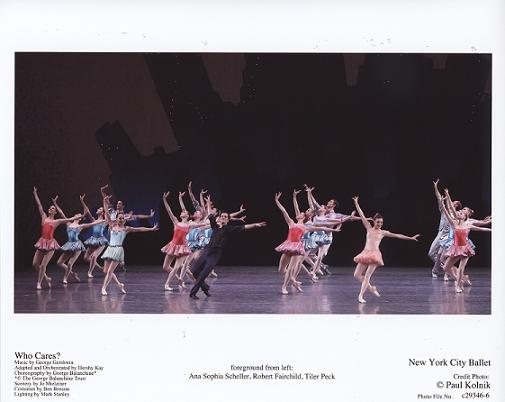
New York City Ballet opened their Winter 2010 season last week with rotating performances of Balanchine’s Midsummer Night’s Dream, and a two-ballet program of his Who Cares?, set to Gershwin music, and Peter Martins’ Naive and Sentimental Music.

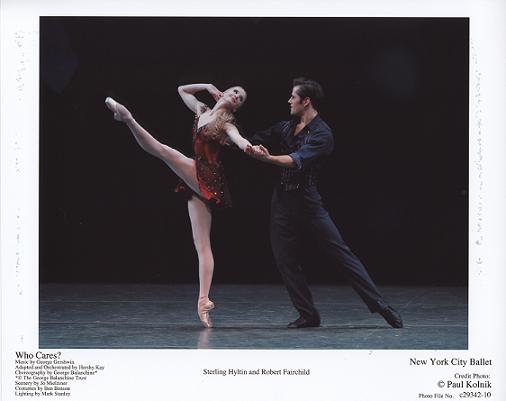
I LOVED Who Cares?! (photos above — of Robert Fairchild and Sterling Hyltin, and of the whole cast — by Paul Kolnik.) I’d only ever seen the pas de deux before and didn’t even realize the whole was comprised of a whole slew of Gershwin songs, some danced by the ensemble, some by only the women, others by only the men, with solos and pas de deux mixed in. I particularly loved Tiler Peck’s duet with Robbie Fairchild in The Man I Love. She has such a clean, beautiful line and she’s so expressive and so engaging. She can make a story out of anything. And of course Fairchild is always the perfect romantic male lead ๐Ÿ™‚ Crowd went wild over his and Ana Sophia Scheller’s duet to Embraceable You as well as Scheller’s My One and Only solo. Such a fun ballet — I’m going back for more this week.

Also shown in that program was Martins’s new Naive and Sentimental Music, set to John Adams’ score of the same name. I wrote about that ballet when it premiered here and posted pics of it here. Seeing it again evoked a bit of Balanchine’s Jewels, particularly the lovely lyrical white section (my favorite) and the sexy red.

One little thing I have to say: this ballet was created on and is danced only by principals but Adrian Danchig-Waring danced in last week’s production as well, and he is still a soloist (I think he may have been replacing Amar Ramasar, who must be injured because he was replaced a few times over the week…) Anyway, I realize NYCB is top heavy at the moment, but I think Danchig-Waring definitely needs to be next in line for a promotion!

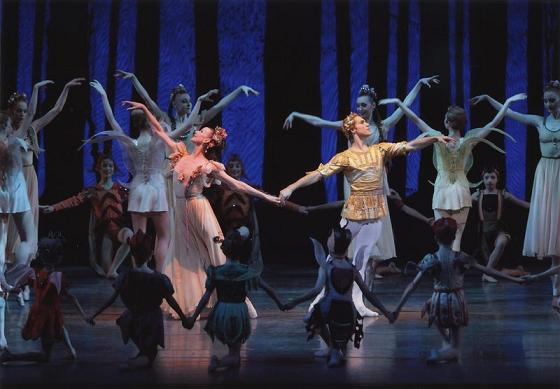
And earlier in the week I saw the best EVER cast ofย  Midsummer Night’s Dream. I finally got to see my Gonzalo Garcia as Oberon ๐Ÿ˜€ (photo above by Paul Kolnik, of Garcia as Oberon and Darci Kistler as Titania). I’d missed him in this role at the end of last season. He did very well – -not only with the dancing — particularly that crazy fast scherzo — but also, and less expected for me, with the acting. I thought he’d be a sweet, glowingly endearing Oberon, but, no, he was a pissy, demanding fairy king — just as much as Andrew Veyette last season (cutely pissy and demanding though!) He wanted Titania’s servant boy and he wasn’t letting her say no to him. Only thing regarding the dancing — his legs don’t seem to be as flexible as they once were. It seems like he may have injured an adductor muscle, or else he’s built up so much thigh muscle or something — but his legs when he jumps are not making perfect splits. But his upper body is so fluid and graceful and he exudes such charm that he’s still the perfect lyrical male dancer nonetheless.

Titania was the beautiful Sara Mearns (headshot by Paul Kolnik — a new headshot for her, right?)– and she was the best Titania I’ve personally seen. Oh she’s such a beautiful dancer! She throws herself so fully into every move she makes. If Garcia is the ideal male lyrical dancer she is the ideal female – they were so perfect together.

And I’m so glad Stephen Hanna is back at NYCB (still annoyed with the Billy Elliot directors for not making good enough use of him on Broadway). He was Titania’s cavalier and his pas de deux with Mearns was the best Titania / Cavalier pdd I’ve ever seen. He’s so big and strong — which certainly amps up the romance factor — and his numerous tour jetes just have so much power. Honestly I often get bored during that pdd and just want Oberon to return, but not with Hanna’s cavalier!

And new to the cast of human characters who get their hearts messed with by a mischievous Puck (Troy Schumacher) was Janie Taylor, as Helena. She is another one who excels at story dances, always delving into a character and making clear to the audience what’s going on in her mind. She’s pathetically, endearingly funny from the time she enters the stage all forlorn over Demetrius, to her being completely bewildered by Lysander’s sudden attraction to her, to her searching the forest madly for Demetrius, to her cat-fights with Hermia, etc. She really brought out the humor.

In the section where I was sitting, there were at least three large groups of people you could tell had never seen the ballet before — nor likely the play; they didn’t seem familiar with the story. But they were laughing hysterically throughout the whole thing and were really awed by the dancing, and by some of the tricks (like Puck’s being pulled up to the ceiling via harness at the end). That’s when you can tell with a story ballet that the cast really brought it to life, when the newcomers are enthralled.

NEW YORK CITY BALLET PROMOTIONS


Practically all of SLSG’s NYCB favorites who were not already principal dancers in the company have just been promoted: the always magical Kathryn Morgan (above, with Seth Orza in Martins’ Romeo + Juliet), heartthrobs Robert Fairchild and Amar Ramasar, the always dramatically compelling Tiler Peck and Tyler Angle, and the statuesque Teresa Reichlen.

Here are Tiler Peck and Robert Fairchild rehearsing Robbins’ Afternoon of a Faun for the Vail International Dance Festival over the summer.

And here are Tiler Peck and Tyler Angle performing the adagio from Christopher Wheeldon’s Mercurial Manoeuvres at said festival:

All promos are from soloist to principal, except young ‘un Morgan who was moved up from corps member to soloist.

All of the new principals will make their debut as such at NYCB’s winter season opening night gala, on November 24th, in Peter Martins’s new ballet set to John Adams’s Naive and Sentimental Music, which will make its world premier that night.

Visit Oberon for more dancer pix and info.

Above photo by Paul Kolnik from Voice of Dance.

MORE ON AMERICAN BALLET THEATER’S AVERY FISHER SEASON


Daniil Simkin and cast in Benjamin Millepied’s Everything Doesn’t Happen at Once in Gene Schiavone photo, courtesy of ABT; all photos by Gene Schiavone (except for Arron Scott headshot below and bottom picture).

Just to let people know, as the photos shows above, the guy who was flinging himself into the group lifts in the first cast of the Millepied was Daniil Simkin; in the second cast it was Arron Scott (below). The program notes only gave a special mention to the two dancers doing the pas de deux and a lot of people were asking who the main soloist was.


Anyway, here are a few more reviews:

Here is James Wolcott on opening night gala (and our fab Shun Lee dinner afterward ๐Ÿ™‚ ), here is Apollinaire Scherr’s FT review; and here are more of Apollinaire’s thoughts on her blog, Foot in Mouth. I’m surprised there aren’t more reviews — this was a pretty big season, with three world premieres — but that’s all I can find at the moment. (Update: Robert Greskovic’s WSJ review just went up; thanks to Meg for letting me know.)

Re the Wolcott write-up: I forgot to mention the models — Iman and Veronica Webb, who, instead of A.D. Kevin McKenzie, thanked the gala sponsors and introduced the program — screwing up Benjamin Millepied’s name. It wouldn’t have been such a big deal if they wouldn’t have been so giggly over it. It seemed like they were reading their notes for the first time and were really unprepared. I really don’t know how to pronounce his name either — I’ve always said the last two syllables to rhyme with plie (without the “l”) but have been told that’s wrong. But damn did ABT get a lot of press for signing them on. Just Google “ABT Fall 2009 Season” and it’s all about Iman.


(Gillian Murphy, Cory Stearns and Eric Tamm in Aszure Barton’s One of Three)

Anyway, I saw four of the six programs, saw the Ratmansky and the Millepied ballets four times and the Barton three, and they each grew on me the more I saw them. The Saturday matinee was my last performance and I found it by far the best. I felt like the dancers were finally comfortable with the new dances, knew what they were all about, and really made them meaningful. I described the ballets here.

Oh and regarding SanderO’s comment on that earlier post: yes, I do need to see the story in the dance. The dancer and choreographer won’t pull me in at all if they don’t each tell me some sort of story. That doesn’t mean the ballet has to be a traditional full-length dramatic novel or something with a clearly defined beginning, middle, and end, inciting incident, rising action with crises 1,2, and 3, climax and resolution, etc etc. but there needs to be some kind of story; there needs to be some intention in the abstraction. A lot of critics use the word “evocative” — a dance needs to be evocative of something, and I just mean the same thing. If there isn’t something meaningful going on, there’s no reason for me to see it. I can appreciate the neat geometric patterns and pretty images, but that’s not enough to make me go.

Anyway, I saw more in Millepied’s Everything Doesn’t Happen at Once on further viewings. At first I thought it was kind of everything but the kitchen sink the way Apollinaire kind of describes, but after several viewings I saw more of an evolutionary, battle of the sexes theme throughout, which becomes a more literal battle by the end. The piece starts with the stage looking swimming-pool like with the dancers making broad strokes with their arms. The stage gets over-crowded and eventually someone in charge — looking rather conductor-like, kind of throws his arms up and dismisses everyone.

Then, there’s a pas de trois (two men one woman), which becomes a double pas de trois (same), which turns into the central pas de deux (man-woman). Throughout there seems to be struggle going on — in the pas de trois the men kind of manipulate the woman around, until she’s practically on her side. In the central pas de deux is in places tender, in places more angsty as if the girl is trying to get away from the guy or fight him in some way, and he is struggling to hang onto her.

By the end, the scene has evolved into a kind of battlefield with marching music and the ballerinas doing those Balanchinian marches en pointe. Except they’re more unsettling than cutesy, like in Balanchine. This is the part where Daniil / Arron gets tossed into the crowd, throws himself with wild abandon at the groups of men, who catch him mid-split, then gets caught up with a bunch of grabbing girls.

Interestingly, the audience laughed when this role was danced by Simkin — I think because he is small and a bit long-haired and it kind of looked like he was afraid he’d be taken for one of them and was trying like hell to assert his masculinity. (I think it would have worked better had the girls been chasing him and then he flings himself into the groups of guys rather than the other way around, but not a big deal).

But no one laughed when it was Arron. It looked far more serious with him in the role — it looked like he was practically getting raped by that rabid group of girls.

Also I noticed with Arron that after the rabid group of girls leaves him alone, he kind of internalized the tauning; there was now an invisible fist punching him all about. It really looked like he was getting beaten up by that thing. But the fist was invisible so it was like he’d been driven mad. It was very unsettling, and I think, with the music and the rest of the action, this feeling is more of what Millepied was going for — not all the high air flips, crazy long spins, and windmill jumps that Simkin is known for and did here. Simkin’s character made the end of the ballet more playful than battle-like.

There’s also a short section where there’s all this marching music and there’s more centerstage chaos with all 24 dancers out there at once and suddenly a group of dancers standing at one corner break into partners and go waltzing through the crowd. But it’s really short-lived, like even courtship is a battle.

I don’t know — that’s what I saw on further inspection. But I could be making it all up. It’s kind of fun with abstract ballets (the ones that have a lot going on in them anyway) to make up your own story. I mean, the way dances get made anyway, as I learned at a Guggenheim event last night featuring ABT’s efforts to adapt ballets to different stages (including this small one in AF Hall, meant for concerts), is that things get changed depending on space, depending on the logistics of the stage, depending on dancers. Whoever knows if the end product is what the choreographer originally had in mind anyway.

I don’t think Millepied’s was a perfect ballet — I found a lot of the bird-like patterns from his recent NYCB ballet, Quasi Una Fantasia, to be out of place here – he didn’t need all that; he should have focused more on the battle — but I found his the darkest, the most thematically clear and the most absorbing.


Stella Abrera and Gennadi Saveliev in Alexei Ratmansky’s Seven Sonatas.

The Ratmansky grew on me, as did the Barton. On the last day, Michele Wiles danced the main female character (in the long white ballgown) in the Barton and I loved her. She gave the character a real story. When she comes out onstage she is all bitchy and glamorous, but Michele it’s really an act; she is seeking attention from the main man (in that cast Blaine Hoven) while trying to maintain her haughty demeanor so as not to be shown up by him if he dismisses her. At one point, she extends her arm out to him, as if he’s supposed to kiss it but he turns and runs offstage. She crumbles. It’s heartbreaking.

I also really loved Craig Salstein, Jared Matthews and Daniil Simkin in Barton’s second cast (Matthews and Simkin alternated parts opposite Salstein). They danced a section in the second part and all three made it clear (Salstein most so) that they were in a little competition for the girl’s attention. The girl (Luciana Paris), meanwhile, was just dancing on her own, in her own world, paying them no mind at all. It was hilarious.

But back to Michele Wiles for a minute: a wonderful ABT patron gave me her ticket for a company class, which she couldn’t attend, and Michele seemed so sweet — smiling out and waving at people during the class and even during warm-up.

Also, can some choreographer please please please create a little solo or some kind of dance just for Gillian Murphy! Please! During that company class, during the center floor work when the dancers divided into groups and did turns in a diagonal down the center, Gillian blew everyone completely away. She was like a tornado. But a technically perfect tornado! Everyone in my section literally began to laugh and shake their heads in amazement. She needs something to showcase her technical brilliance and athletic prowess. C’mon ABT!

Each of the dancers brought their own special thing to the Ratmansky. Christine Shevchenko (an up and coming corps member) was gorgeous with the role created by Julie Kent (danced opposite David Hallberg). She was more lyrical than Julie, with flowing, expressive arms that resembled Natalia Makarova in Other Dances. Julie’s arms were more staccato. Hee Seo, who completely blew me away as well, did a combination of the two — by turns feathery and lyrical, and modern and staccato. Alexandre Hammoudi and Jared Matthews both danced David’s original part and they were very different than David. Both connected with their ballerinas much more — when they were left alone onstage they clearly looked about for her, wondering where she was, then accepting they were alone and falling into their solo.

David Hallberg. I can never get enough David Hallberg. He didn’t look around for his ballerina when she left him, but when she returned to the stage, he danced well with her. But when she was offstage, she was out of sight, out of mind with him — he was too busy making Ratmansky’s movement wholly his own. He seems to be a rapidly maturing artist, playing with the music, playing with rhythm, giving some things more emphasis than others. When I first saw him dance this role I thought his “character’s” movement was more modern than classical, but I think that was just because of the way he did one section where he keeps pushing out with his hands, like he’s stopping the air, or stopping something from getting too close. He slowed down that movement a lot, really emphasizing the arms, and then did some ensuing footwork at the speed of light, whereas the others did everything in equal measures -so it didn’t have the same look.


Jared Matthews and Maria Riccetto in Some Assembly Required, photo by Rosalie O’Connor.

ABT also put on Clark Tippet’s Some Assembly Required from 1989, a male-female pas de deux evoking a lovers’ quarral replete with difficult-looking angst-filled lifts, struggling pushes and pulls, then more tender making up. It went on a bit too long; some middle parts that were repetitive could have been taken out, but the cast I saw — Jared Matthews and Maria Riccetto did very well with it. Jared is dancing and dramatizing better than ever before, imo.

And the company also did Robbins’ Other Dances, another male-female pas de deux (this one pretty famous) that was choreographed on Baryshnikov and Makarova. I saw both casts — Marcelo Gomes and Veronika Part, and David Hallberg and Gillian Murphy. I liked both — although I think I honestly prefer Tiler Peck and Gonzalo Garcia’s at NYCB. Gonzalo has a smaller body, more like Baryshnikov’s, and I think some of the gestures — like the placing the hand behind the head, kind of primping, looked sweetest on him. Ditto for Tiler. David is dancing very aggressively these days. He’s making the absolute most of every movement — it can be stunning at times, and at times it seems a bit overdone, which it seemed to me a tad here.

I also think that joke on the Kirov dancers getting dizzy and losing their footing because they don’t spot-turn doesn’t come across as such to new audiences. When Marcelo and Gonzalo did it, many in the audience honestly thought the dancers screwed up for real, not on purpose. David really didn’t do the joke because he’s a cheat ๐Ÿ™‚ I’m kidding — he did, but he spun, stopped, got dizzy, shook himself out of it, and started the next phrase all in the blink of an eye, so you didn’t even notice he “got lost.”

Gillian was good but it didn’t seem to be a dance that showcased her talents to their fullest. I’ll say it again — I really think she is the most athletic and technically one of the best female dancers in the world and she desperately needs more roles that prove that!

JUDGING A BOOK BY ITS COVER

scan0005

Sorry posting has been kind of lame over the past week. I’m working really hard on finishing the final read-throughs of my novel and, as always, it’s more involved than I expected. I have several exciting Fall For Dance programs still to write about — a puppet-performed Petrushka, Bronislava Nijinska’s Les Biches, the fabulous Trocks, Dance Brazil’s unique capoeira / samba / modern blend, Tiler and Gonzalo ๐Ÿ˜€ , the best Afternoon of a Faun (involving two fauns actually) I’ve ever seen — this is by far the best FFD Festival I can remember — and I plan to write about it all at the end of the weekend or early next week; after, hopefully, I’ve finished my rewrites.

In the meantime, above is my final cover. Took me forever to okay something I was happy with. At first I was going to go with this one:

scan0006

But then I had dinner with a gay male friend, who said of this bottom one, “Okay. This looks like it’s about a girl who goes around New York giving blow jobs.”

Which my novel is NOT about! I sought others’ opinions — nearly drove all of my friends crazy — and most people agreed that, since it’s about a young woman with a disorder, the cover should indicate that. It’s just that the disorder she develops is due in part to her moving into the city — a city she feels largely alienated by — and so it’s partly about her ability to make her own home here. Which is why I thought an arty cityscape would work.

But apparently not with this title!

breakfast-at-tiffanys

I’d gotten the idea for the arty cityscape cover from my favorite Breakfast at Tiffany’s edition.

I also love this cover, for Charles Jackson’s The Lost Weekend:

the-lost-weekend-lg

This is as large as I could blow it up, but it’s one of my very favorite covers. I’d asked my design team to come up with something similar (with a woman looking into the abyss), and they couldn’t. I showed a friend and she kind of burst out laughing and told me I’d need to hire an artist to make me something wholly original if I wanted something approaching it. I have that Lost Weekend edition (which I found at a rare bookstore in Durham, NC) and the cover is an actual piece art — it’s actually painted onto the cover, which is made of a sturdier material than regular covers — the result being that once the years go by and the cover ages, you literally can’t open the book without breaking it. So, the irony is that that book is unreadable; it must simply sit on my bookshelf facing out, to showcase the piece of visual art that it’s now solely become.ย  In any event, even if I did want a book that could only be enjoyed for its cover, I don’t have the money to hire my own artist.

But I think my design team came up with something that works anyway.

My biggest problem with having a photo of a woman on the cover is that I was afraid it’d be taken for Chick-lit, a moniker I think every female writer has some kind of issue with, or at least thinks about. I thought an illustration would make it look like it’s about art — which it partly is: one of the protagonist’s friends is an artist and he’s an important character. And I thought a photo of a woman would alienate male readers. But then a friend who works as an artistic director of a magazine said illustrations don’t sell; you gotta have a photo, which she insisted was pertinent to books as well as magazines (and she has two published books of her own out). She’s one of four or five people (as I said, I drove all of my friends stark raving nuts) who helped me come up with the idea for my final cover.

…which I’m happy with — I think it hints at what the book is about and is dramatic and somewhat provocative without being over the top. I just hope it doesn’t alienate potential male readers. But then, as practically everyone I know (of both sexes) have told me ad nauseam, men don’t read anyway — especially fiction; women read and Chick-lit sells. So just embrace it.

Anyway, there are many other issues involved in the whole Chick-lit quandary, and in book cover art, but I’ve blabbered for too long. Have to get back to my rewrites… And I need to go out for my Friday cupcake.

Have a good weekend everyone!

INDIANAPOLIS CITY BALLET TESTS THE WATERS


“You have guests from all over the world to do their forte; it inspires the audience there to keep going and to commit to it. You are going to see a broad range of things. If you’re not into tutus and tiaras, you’ll see something more contemporary. You’ll be exposed to something you didn’t know existed. Your humanity will be opened to something very moving and very memorable.”

— Julie Kent on Indianapolis City Ballet’s upcoming all-star gala performance, in which she is a participant. And wow, look at this lineup: David Hallberg, Tiler Peck, Joaquin De Luz, Miguel Quinones, Sarah Lane, Jason Reilly (from Stuttgart) etc. etc. — dancers from all over the world are participating next Saturday night.

Apparently, Indianapolis City Ballet, which doesn’t yet have its own set of dancers, is testing the waters to see how much local interest there is in ballet. The company hopes to have its inaugural season during 2010-11.


SOME FAVORITES FROM VAIL

Wow, there are a lot of video clips up of the many many companies and dancers that performed at this year’s Vail International Dance Festival. Here are some of my faves:

Dance Brazil in a modern / capoeira combo, Luna:

Daniel Ulbricht and Misa Kuranaga doing a Corsaire pdd:

Sofiane Sylve and Simon Ball in Forsythe’s In the Middle Somewhat Elevated:

Wendy Whelan and Edwaard Liang (dancing with Morphoses) in Forsythe’s Slingerland pdd:

Matthew Rushing in Ailey’s beautifully bluesy Reflections in D:

Linda Celeste Sims rehearsing Ailey’s classic Cry:

Gillian Murphy and Ethan Stiefel’s Black Swan pdd:

Tyler Angle and Tiler Peck in the pdd from Wheeldon’s Mercurial Manoeuvers:

Some Lindy Hop with Naomi Uyama and Todd Yannacone:

And some Argentine Tango by Natalia Hills and Gabriel Misse:

There are many more vids and photos though, so visit the festival’s blog. I don’t see any up yet of the Ballroom evening — Hanna Karttunen and Victor DaSilva and J.T. Thomas and Tomas Mielnicki, et al. Hoping to see some of those soon. Excellent blog though, letting peeps who couldn’t be there in on what all went on. And splendidly diverse festival!

MARTHA WAINWRIGHT, MORPHOSES, AND MARCELO IN THE PARK

copy-of-pic-17

Philip was really sweet and sent me some pictures taken by his friend, Kokyat, of the Morphoses / Martha Wainwright performance Saturday night in Central Park. Above are my three favorites from ABT and NYCB respectively: Marcelo Gomes, Gonzalo Garcia and Tiler Peck (seated). They’re dancing Christopher Wheeldon’s Fool’s Paradise.

It was a fun night. For people unfamiliar with Martha Wainwright’s music, she’s kind of a folksy, bluesy, country mix. So, the dances, mostly choreographed by Wheeldon, a couple by Edwaard Liang, complemented that with lots of wavy-armed, lyrical, softly jazzy, almost social-dance-like movement, with ruffly dresses for the women and open t-shirts, casual vests and buttoned Oxfords with ties for the men.

Here’s a photo by Andrea Mohin of the NYTimes, of Bleeding All Over You, chor by Liang and set to Wainwright’s song. Teresa Reichlen is in the middle, surrounded by Jason Fowler and Adrian Danchig-Waring of NYCB. See Mohin’s slide-show here.


Here’s another favorite of mine by Mohin from the NYTimes slide show, of Gonzalo Garcia and Tiler Peck in Love is a Stranger (set to Wainwright’s re-interpretation of the Annie Lennox hit). This was one of my favorite dances of the evening because, well I love both these two, and it kind of reminded me of when they danced Other Dances together at NYCB this season.


And my other favorite from that slide show, of Rory Hohenstein dancing a solo in Far Away, the first piece of the night.

I don’t know if it was Craig Salstein and the wine or the promise of seeing Marcelo in the second act or what, but everyone seemed to have an extra glow or something; everyone seemed to dance so much better than I’ve ever seen them before — particularly Hohenstein. He was really fluid, really beautiful in this dance.

See more photos in the Times slide show here. And read the accompanying review by Sir Alastair in which he gets just a bit caught up in the spelling of the word “Whither.” I don’t see that anyone has blogged about the review, but it’s certainly making its way around via email because of that paragraph. It’s like the critics are becoming part of the performance…

Anyway, Marcelo danced in the last two ballets — Wheeldon’s well-regarded Fool’s Paradise, and Tears of St. Lawrence (a new collaboration between Wheeldon and Liang). Paradise was set to recorded music by Jody Talbot (the only non-Wainwright music of the night) and Tears to Wainwright’s song of the same name.

Marcelo danced the opening pas de deux in Paradise with Tiler Peck and I feel like I saw things anew and like I was more connected to and moved by some of the twisted, unique, two-body shapes just by seeing a dancer I connect with in the part — his covering her ears, his bowing down to her in arabesque… No one could make the arabesques Marcelo was making, and there were several parts where he and another male dancer — at the beginning Gonzalo — would frame the women with those arabesques and Marcelo’s raised leg was always significantly higher. I always love Gonzalo, and it could just have been my seeing him next to Marcelo, but he didn’t seem as stretched-out Saturday night. His extensions weren’t as heavenly as they usually are. Actually, there was nothing in any of the ballets that really brought out the qualities that make Gonzalo Gonzalo. No Mercurial Manoeuvers, no Hallelujah Junction, no MNS Oberon, no Other Dances, no Concerto DSCH where he could fly all over stage and charm you to death. He doesn’t excel as well at the slower, pretzel-shape pas de deux-heavy dances. Well, it’s not that he doesn’t excel, it’s just that his personality doesn’t have the chance to shine. I want Wheeldon to choreograph something high-flying for him and put it in the Morphoses program ๐Ÿ™‚

Back to Paradise: I have to say, upset as I was over not being able to see the dancers up close, I was able to see the patterns better from sitting back in the sky box. Wheeldon and Liang both came back there and stood beside us to get a view of the overall, so I guess Susan and I ended up in the kind of ideal Balanchinian viewing area. From there I really could better appreciate the patterns and the look of the whole.

For all the “whither wather” goofiness, one of Macaulay’s lines in the afore-linked-to review really resonated with me: “I like the control with which Mr. Wheeldon keeps making you pay attention, but I can’t get interested in these dances as thought or drama.” I think that’s what prevents me from getting entirely into a Wheeldon ballet (at least his ballets for Morphoses; some of his ballets for NYCB have been far more dramatic or expressionistic); I feel like I need to come away from a work of art with something other than just a beautiful image. I need more in order to keep thinking about the piece over and over again, which is the effect I want a work of art to have on me.

But I’ll keep trying with Wheeldon — I’m sure if I liked Mercurial Manoevers and the After the Rain pdd, other dances of his will eventually grow on me. Especially if he uses my favorite dancers more often ๐Ÿ™‚

Here are some more Kokyat photos of Fool’s Paradise:

copy-of-pic-1-1

copy-of-pic-2-1

And here are some of Tears of St. Lawrence:

copy-of-pic-16-11

copy-of-pic-6-21

copy-of-pic-20-1

Cast taking a bow, with Wainwright and Wheeldon in center. Look how cute they are ๐Ÿ™‚

As I said earlier, there was a lot of music and it almost felt like a music concert with some dance thrown in, but, like others have mentioned, I’m glad the program exposed Wainwright fans to dance. Toward the end, Wheeldon came up onstage and introduced the dancers the way Wainwright introduced her band. He called his dancers “his band” and jokingly noted this wasn’t often done in the dance world. At one point, he remarked to Wainwright that he thought she might dance some and she responded, “Oh … no … oh, I don’t know… I could lie down and let people do things to me?” Everyone laughed. “Maybe it could be you,” she tacked on. “Ah, I don’t think it would be me,” he said after a long pause. He seemed a bit embarrassed. It was cute.

Anyway, thank you again to Philip for letting me use some of Kokyat’s photos. Definitely visit Philip’s blog where he has several posts filled with more gorgeous photos. The photos begin with this post (keep clicking on previous posts titled “Starry Night” to see more).

CRAIG SALSTEIN TO THE RESCUE


So last night I went to Christopher Wheeldon’s Morphoses at Central Park’s SummerStage, who were performing to live music by Martha Wainwright. Of course I would have gone no matter, but hearing that my favorite, Marcelo Gomes, was guest-performing with the company, made it all the more urgent.

Anyway, Morphoses events are often very well-attended and there was a bit of a mix-up with my tickets — they’d issued me a guest, rather than press pass and so my friend and I got ousted from the section up front. I understand these things happen, especially with very popular dance companies and it wouldn’t have been a big deal if I could see well at long distances at night (and if I hadn’t helped others get in whose tickets weren’t mixed up….) But whatever, I could deal I thought, even though I felt like a total loser.

So, my friend and I walked to the back dejectedly. But, then, when we got all the way to the back, it ended up our tickets weren’t for the reserved risers but for the skybox, a tent-covered, elevated section that put us far above the standing crowd. And in that elevated section, sat (among others) ABT soloist and one of my favorite dancers, Craig Salstein! He was sitting next to a really cute dancer-looking guy who turned out to be Marcelo’s bf ๐Ÿ˜€ Then a waitress came by serving us free wine and I knew this was THE place to be, not down there on the ground with those earthlings! I still couldn’t see tremendously well, but I can always see Marcelo from wherever I am and I kind of felt better being with the ABT peeps anyway.

So my friend Susan and I ended up chatting with Craig and Marcelo’s friend throughout the show and they are the sweetest guys! Craig seemed so different than he is onstage! For people who don’t know him, he’s the type of dancer who always gets the bravura roles that require a big personality, and very good acting (not to mention dance) skills, like Mercutio in R&J and the bespectacled nerdy guy who can nevertheless dance up a storm in Taylor’s Company B, and the poor guy who gets girls tossed at him from every which way in Tharp’s Baker’s Dozen, etc. etc. So because he has such a way with comedy I expected him to be cracking jokes every five seconds and acting all clownish and all. But he wasn’t like that at all – -he was really serious and calm, albeit gregarious and easy to talk to. I told my friends, who I went out with afterward, the same and one said, “well, he can’t be Mercutio ALL the time; he’d go crazy.” True.

He’d just got back from vacation (in Italy, where he saw “Roberto Bolle and Friends” — hmmm, didn’t know there was a “Roberto Bolle and Friends”!), and was sporting a serious tan. We talked about ABT’s upcoming season at Avery Fisher Hall and Italy and his choreography and how much I liked it and how great Marcelo is and what I tweet about (you, tossing your mandolin into the wings instead of Jared Matthews’s hands during R&J I said; he seemed bemused) and other chit-chat. Fun fun fun to meet a favorite dancer and another favorite’s boyfriend ๐Ÿ™‚

Okay, I’m running off to another Morphoses performance today and have to get going but will write about the actual show tonight or tomorrow morning. Obviously Marcelo was god, Martha Wainwright was good but to me it was too much about her — too much music, almost a music performance with some dancing thrown in — highlights were Edwaard Liang’s premiere and Wheeldon’s Fools’ Paradise (which I saw anew thanks to Marcelo), Tiler Peck, Gonzalo Garcia, a duet between Maria Kowroski and Jared Angle, Wendy Whelan, Rory Hohenstein, a funny joke by Wainwright about lying down and having people do things to her and Wheeldon’s somewhat embarrassed response, and did I mention Marcelo Gomes…

MICHAEL TO THE RESCUE!: TERESA REICHLEN, JANIE TAYLOR AND TYLER ANGLE STAND OUT IN FINAL MIDSUMMER CAST


Yesterday was stressful. Had to make a hard hard choice: whether to spend the matinee at New York City Ballet watching three of my favorite dancers — Gonzalo Garcia, Tyler Angle, and Janie Taylor — make their debuts in Midsummer Night’s Dream, or at American Ballet Theater seeing Hee Seo debut as the title character in La Sylphide, with one of my favorite ABT dancers, David Hallberg opposite her. (Review coming very soon, along with earlier Sylphide cast, and two Midsummer casts — yes, I’m behind behind behind!)

I’d actually contemplated running back and forth across the Plaza, like I know some have done in times past, but the running times for the first acts were totally different and there was no way I was going to be able to see Gonzalo’s Oberon in Midsummer and then make it to the Met in time for David and Hee in the first act of Sylphide. So, I chose my David, and the lovely debuting Hee. Ever so thankfully I talked my friend, author Michael Northrop, into covering the goings on across the Plaza.

p6202228

Afterwards, over drinks and food at the Alice Tully Hall Cafe (they have half-priced specialty drinks from 3-6 pm! And not watered-down at all! I nearly passed out after two sips of that mojito in front of me ๐Ÿ™‚ ), he told me that Gonzalo did just fine with that crazy high-flying scherzo for Oberon in the first act (I knew he would!), and that he really liked Teresa Reichlin as Titania and Janie and Tyler in the second act divertissement, which received a lot of applause, which I can just imagine! He also agreed to write a little review, which I’ll post in a minute. (If you don’t know the story of Midsummer, read about it here — Balanchine pretty closely follows the Shakespeare).

p62022292

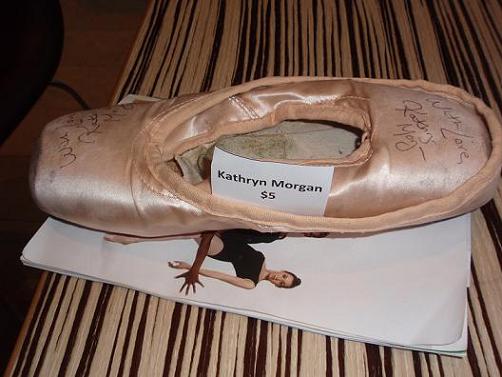
But first, it being Michael’s last day at NYCB this season, he browsed the gift shop, and ended up with a pair of Kathryn Morgan toe shoes. He told me (and, apparently the amused gift shop attendant) he figured she wasn’t going to be $5 for much longer ๐Ÿ™‚ I guess their shoes cost a certain amount according to their status: principal ballerina shoes are $30, soloists are $15 and corps members $5. I didn’t know all this. I’ve never wandered over to the toe shoes section. I initially wondered why, then realized, oh, my favorite dancers don’t usually wear toe shoes. Sorry to be lewd, honestly, but I then couldn’t help but wonder — just because of that crazy strong mojito that nearly put me on the floor — why they don’t sell other kinds of used dancewear that my favorites *do* wear, alongside the toe shoes. Sorry! But can you imagine? Total alternate universe.

Anyway, here is Michael’s review:

At Dunkin’ Donuts, they sell munchkins 25 at a time. That’s about how many you get at New York City Ballet’s A Midsummer Night’s Dream, as well. The squadron of young dancers from SAB added a nice dose of fun and energy to a matinee that already had plenty of both on Saturday.

Daniel Ulbricht didn’t dance the role of Puck, so instead of gravity-defying antics, we just got antics. Corps member Troy Schumacher was announced as a late sub for soloist Sean Suozzi in the role, and there were some disappointed Ohhs around me. The thought: We’re getting the third string. Schumacher did an excellent job, though. He moved with an appropriately sprightly energy and showed a nice touch with the comedic moments. When he realized his magical matchmaking mistake, you could almost hear the “D’oh!”

Teresa Reichlen was fantastic as Titania, displaying just the right balance of regal, playful, and otherworldly for a fairy queen. And Robert Fairchild, a very busy man this season, excelled in yet another role (albeit in a ridiculous Prince Valiant costume) as Lysander. His put-upon love interest was once again Sterling Hyltin. The leads from NYCB’s Romeo + Juliet both showed they can handle Shakespeare’s comedy as well as his tragedy. Hyltin, for example, dialed up a slightly manic quality to great effect.

And Balanchine’s choreography tells the entire story in Act I, leaving Act II free for the divertissement. A quick wedding march and then Janie Taylor and Tyler Angle were center stage. They brought down the house.

Angle is a strong presence, but he defers so gracefully and lifts so effortlessly that he never soaks up more than his share of the spotlight. I noticed that when he partnered Tiler Peck in Mercurial Manoeuvres, and again on Saturday. Janie Taylor was both a delicate vision and a physical wonder, sometimes in turns, sometimes simultaneously. It’s a complete oxymoron in print, but she pulled it off onstage. Amazing.

The final scene was especially poignant for me, because I knew this was the last performance I’d see this season. Fireflies flickered around Puck against the dark backdrop of, yes, a midsummer night. It was the kind of night you don’t want to end, and the kind of season.

And here is Oberon’s (I mean Philip’s) review of the same cast.

And this just in! Another review (I’m interested in what he says of Gonzalo Garcia) — the one (by a pro critic who doesn’t say things are good when they’re not, and with great detail and specificity) that I’ve been waiting for ๐Ÿ™‚ I knew Gonzalo’d nail it! I knew he’d be brilliant! I knew it!