More VIENNA WALTZES


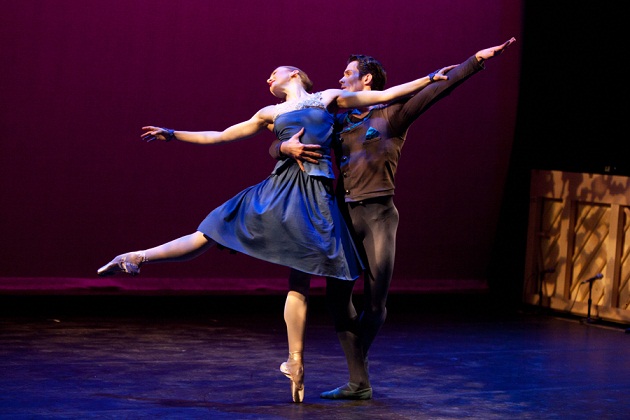
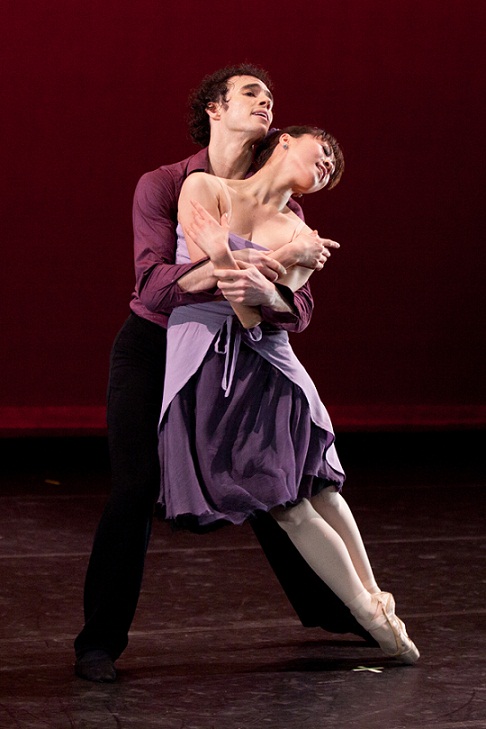
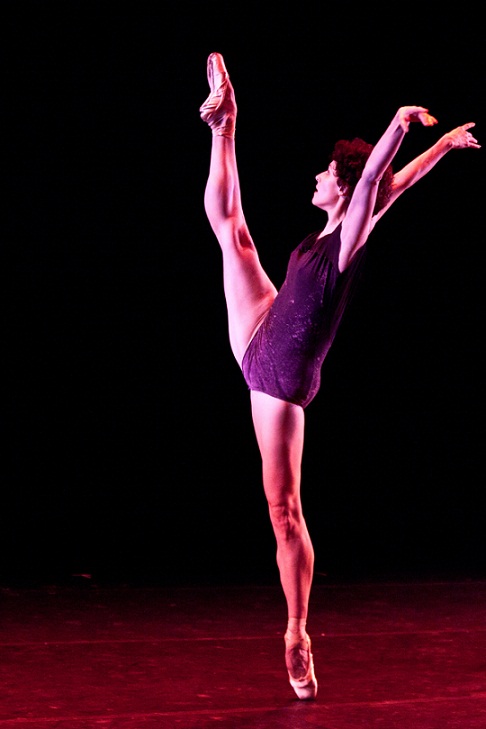
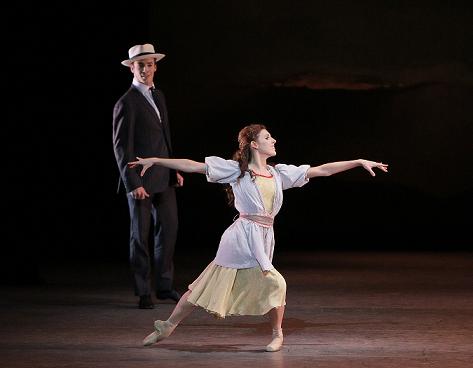
Here are some photos of the most recent cast of Balanchine’s Vienna Waltzes that debuted at New York City Ballet last week. Top photo is of the radiant Sara Mearns, who had the main role in the final part of the ballet – “Der Rosenkavalier” – as the girl sweetly lost in her dreams during a moment alone in the ballroom. Bottom photo is of fairy-tale princely Tyler Angle dancing with Teresa Reichlen, from the first part of the ballet, the two young lovers waltz-frolicking in the woods. Both photos are by Paul Kolnik.


Avi Scher & Dancers, Photos

Ack, you guys I’m working 13-hour days right now and have virtually no time for anything but working, eating, and sleeping, but I wanted to get some photos up of the recent performance by Avi Scher & Dancers that I saw at the Alvin Ailey Theater on Sunday afternoon. All photos are by fabulous dancer-turned photographer, Matthew Murphy.

I don’t have much time to write, but as always, I really enjoyed Avi’s choreography, combined with the excellent dancers he gets to perform his work. As always, it’s incredible – really truly incredible – to be able to see such renowned dancers on a small stage in a small, intimate theater.

Above are Carla Korbes and Seth Orza, principal dancers formerly with NYCB, now with Pacific Northwest Ballet, in Scher’s Mirrors, a somewhat Jerome Robbins-like piece (it reminded me a bit of Dances at a Gathering anyway), that had its premiere this weekend. Korbes and Orza beautifully danced the romantic pair at the heart of the piece. Also in that piece, ABT’s always entertaining Craig Salstein danced a comical duet with ABT’s Nicole Graniero. I love Craig. I do. As huge a crush as I used to have on Seth when he was with NYCB, I have to say Craig stole the show 🙂

Ooooh, I really loved this couple. It’s Joseph Gatti and Misa Kuranaga from Boston Ballet and they danced the second piece, Utopia. I loved both – and initially couldn’t figure out where I’d seen Gatti before but now I’m thinking it was a Wheeldon Morphoses piece. (Sorry, I don’t have time to look it up!) Kuranaga really took my breath away in this. She was really striking. She had such beautiful lines and danced with such passion. In the end, she threw herself at him ecstatically and he caught her. Sweet.

This is Ana Sophia Scheller, NYCB soloist, in Dreamscapes, the fourth piece of the night, which was also having its premiere. She had a fast-moving part up front and she did very well with it. She’s standing out to me more and more lately.

Scheller with Tyler Angle (NYCB principal, and one of my faves of that company). I thought the dancing in this last piece was spectacular. So many really top notch dancers… Sofiane Sylve, formerly of NYCB and now a principal with San Francisco Ballet, was stunning in a late section where she danced an insanely fast-footed allegro duet with with NYCB’s Savannah Lowery. Lowery always amazes me when I see her dance with Avi’s group on a small stage like this. She’s got such an athletic build and Scher always makes her look so good. He gives her choreography and costumes that really suit her. (NYCB’s Janie Taylor did the costumes).

Sofiane Sylve. It was nice to see her in NY again. And Orza 🙂

Scher is a very likable young choreographer who studied at the School of American Ballet. He has lots of NYCB connections and you can see influences of Balanchine, Robbins, and Christopher Wheeldon in his work (the third piece was called Classroom Fantasy, was danced by students of the Manhattan Youth Ballet, and reminded me a bit of Wheeldon’s early Scenes de Ballet albeit more comical). I think Scher is definitely a choreographer to keep an eye on for the future.

For the Love of Duke


On Friday night Susan Stroman’s For the Love of Duke premiered at NYCB. Photos above by Paul Kolnik. Top: Tiler Peck, Sara Mearns, and Amar Ramasar; bottom: Mearns and Ramasar. Stroman is primarily a Broadway choreographer (I think her most famous work is probably Contact), and it shows both in her ballets’ strengths and limitations.

For the Love of Duke is divided into two parts. In the first, entitled “Frankie and Johnny … and Rose,” Tiler Peck and Amar Ramasar are Johnny and Rose, a couple in love. They perform a lovely lyrical pas de deux. Then along struts Sara Mearns – Frankie – and Johnny’s attentions are completely lost on her, to the disappointment of Rose. Johnny and Rose are snuggling on a bench together, and when Frankie comes prancing along, Johnny pushes Rose right off the bench, behind it, as if to hide her. Then he does a snazzier dance with Mearns / Frankie, she disappears, and he’s back with Rose … until Frankie comes strutting along again. And so on. At one point, Rose becomes the seductress, and Johnny pushes Frankie off the back of the bench. It was cute, and everyone danced spectacularly, but it got a bit old to me after a while.

The second part – “Blossom Got Kissed” – Stroman had actually choreographed before, creating it for NYCB in 1999. I liked this one better. Both parts, by the way, are choreographed to Duke Ellington and Billy Strayhorn, which is where the title of the whole comes from. Anyway, “Blossom” begins with a bunch of girls all dressed in sassy, jazzy red sitting on a bench tapping their feet to Ellington’s rhythm. Along comes Savannah Lowery as Blossom, dressed in a frilly ballet tutu. She sits alongside them on the bench and tries to tap with them. But she has no rhythm and is horribly off. Then they stand and do a jazzy dance, and, again, she tries to join, but just can’t get the hang of it. She is simply too classical ballet. Lowery was hilarious though and it was funny to see her continually try to get the rhythm and technique of jazz dance right by taking a foot and pounding it down flat on the floor. Then, a group of tux-clad men come along and do some swing dancing with the red-clad women. Blossom again tries hard to fit in but just can’t. Finally, a musician in the band (which was onstage), in the person of Robert Fairchild, comes out from the back of the stage, orders the music changed, and does a sweet lyrical ballet pas de deux with her.

I feel like I’ve seen “Blossom” before because Lowery’s hilarious flat-footedness looked familiar. I liked it better than the first part because to me it was funnier, and the story went a little further.

I think Stroman is very good at creating a story through dance, and that’s what I like about her. You can tell she’s not really a ballet choreographer though. Compared to the first two pieces of the night – Ratmansky’s Concerto DSCH and Wheeldon’s Polyphonia – the actual dance just wasn’t that rich. Still, I think she complemented the program well. It can never hurt to include in an evening of ballet a cute narrative dance with music that’s not usual ballet fare.

As always, I loved Concerto DSCH. Ratmansky was in the audience. I felt the music was played a bit too fast though (conductor was Ryan McAdams, Elaine Chelton the pianist). It looked like Ashley Bouder had a slight mishap, though I’m not sure because I was busy watching Joaquin DeLuz do a sequence of crazy fast steps into a somersault at the speed of light. Andrew Veyette again replaced Gonzalo Garcia, who I am really missing. I hope he’s okay. Veyette is doing a fine job as one of the two playful guys in blue, but there’s this repeating series of throws – where they each kind of propel the other into the air, and I love how Garcia always gets such height when he bounces off the other two.

Tyler Angle replaced Benjamin Millepied, and did wonderfully. I always notice things with Tyler that I haven’t noticed before – like how when he and the girl in green (Wendy Whelan) make their entrance, he’s spinning her around and around, and she looks like she’s hanging on to him for dear life. It kind of sets the tone of their relationship. I always notice the music much more when he dances as well.

Christopher Wheeldon’s Polyphonia is definitely one of my favorites of his. I love the musicality of it, and the originality of the combinations. It’s set to ten piano pieces by Ligeti, who, the program notes, developed micropolyphony – a type of music involving sustained dissonant chords that shift slowly over time. You can really see that “micropolyphony” in the dancing, as the sets of dancers (eight all together, divided into four pairs) begin dancing together in a line but each pair doing something completely different. Then, they eventually come together and dance in unison, but then they drift apart again later. There’s some very clever, almost humorous partnering throughout, but particularly in the second movement, Arc-en-ciel, Etudes pour piano, danced by Maria Kowroski and Jared Angle. I haven’t seen this ballet as often as I would like to. I was going to say I wish he’d include this one more often in Morphoses programs, and then I remembered

Last Week at New York City Ballet


Last week I went to two performances of NYCB – opening night and Thursday night’s “See the Music” program – and to two of the free all-day Balanchine events on Saturday. First, I’ll talk about the last two since I found them so informative. The free studio talk on Saturday afternoon – Balanchine’s birthday – was moderated by Sean Lavery (former NYCB principal dancer, now ballet master), and included Sterling Hyltin (in Paul Kolnik photo above with Robert Fairchild), Chase Finlay, and Jenifer Ringer. Lavery asked the dancers to talk about their first Balanchine ballets, their favorites, and what drew them to NYCB. Hyltin named as her favorite Duo Concertant (pictured above) which I’d just seen her dance on opening night. She said she liked the syncopated movement, the he goes and I go kind of back and forth movement conversation with her partner, and with the musicians. I really liked it too. The violinist and pianist are onstage (the music is Stravinsky), and I like the interaction between the dancers and the musicians, and between the two dancers, and I like the sharp, angular movement. She seemed particularly animated when I saw it. I love Robert Fairchild and think he’s such a sharp, masculine mover with a presence that commands your attention without meaning to – he kind of reminds me of a less cocky Ethan Stiefel – but she seemed so happy to be dancing this piece that she stood out to me more. It was nice to hear her talk about it.

But what I really loved was the School of American Ballet class taught by Peter Martins. He interacted cutely with the students, particularly “Cyrus,” (at least I think that was his name…) a tall, long-limbed young man who I think will soon be in the company. Cyrus didn’t always do everything perfectly (at least in Martins’s eyes) but he had a charming presence and a great leading-man physique and you can tell he works hard.

Martins had the class demonstrate ballet basics – beginning with the five positions, and they showed us a perfect fifth position (with the toes of the front foot touching the heel of the other and vice versa). More interestingly, he had the class show us the difference between a Balanchine hand and a classical ballet hand. I’d always noticed there was a difference but couldn’t figure it out exactly. God gave us five fingers, Balanchine had said, so we shouldn’t hide two of them. The Balanchine hand shows all five fingers, the classical ballet one only three (with the ring finger and pinky held so that they are hidden from view behind the middle finger).

Martins also had the students show us how Balanchine’s fourth position differed from others’. In Balanchine’s the back leg is straight; in all others’ the back leg is bent. Martins didn’t go into any functional explanation for this – just said “here, we think it looks better.” But I thought about it and thought, wow, it must be hard to take off in a jump for example with the back leg straight. And then I realized that’s partly why Balanchine’s choreography always looks so fluid, like one step leading right into another, without a lot of stopping to build up to a big athletic feat – a big jump or series of turns. Other companies – like the Russians, like the Bolshoi – are all about preparing so that you can do something astounding. So they’re all about the building up.

This was mentioned in the studio talk as well. Lavery also talked about how fluid Balanchine’s movement was, and how, for example, in a lift, a guy would pick up a girl, then take two steps, and put her down rather than walk all over stage with her hoisted above his head. Balanchine wanted her to come up, then down right again, because that was more fluid, rather than have her head bobbing around up there while the guy was running all around with her.

Martins also demonstrated the bows. At City Ballet, he said, we just do them as such, and the girls did a little curtsy with the back leg slightly bent, without going down on one knee. Making fun of the dramatic Swan Lake bows, Martins went all the way down on one knee, exclaiming, “Yes, yes, I know I’m good!!!” while putting his head down, forehead nearly touching the floor, and raising his arms up in back of him like wings, fingers pointed toward the ceiling. It was hilarious.

Anyway, here are a couple more photos of opening night:


Above: Ashley Bouder in Valse-Fantaisie, and below, the cast, including Andrew Veyette, in the same (all photos by Paul Kolnik)


I liked Balanchine’s Valse-Fantaisie (Veyette replaced Joaquin DeLuz – but don’t know why because DeLuz danced Concerto DSCH two nights later) but I really loved the first of the evening, Walpurgisnacht Ballet. I’d never seen Walpurgisnacht before and it’s funny but I always seem to love the Balanchine ballets that are the least often performed. This was really beautiful. It’s from Gounod’s Faust, and features a group of women (and only one man – here Charles Askegard) in deep red dresses, their hair down in the second half as the music increases in tempo so that there’s almost kind of a hedonistic madness in the mood – and the footwork is so intensely complicated and fast fast fast. Wendy Whelan even made a tiny little flub, which I’ve never seen her do before. Crazy! And breathtaking!

And the evening ended with The Four Temperaments. I’ve said before and I’ll complain again that I still don’t understand why everyone goes on about how brilliant this one is. To me, there are supposed to be four temperaments, and the ballet is divided accordingly into four variations after the theme: melancholic, sanguinic, phlegmatic, and choleric. But they all seem to be the same to me. The dance seems one-note throughout so that after the first variation, I’m waiting for it to end. I’ll keep seeing it though, perhaps performed by a variety of companies if I have the chance, and will keep looking for the nuances…

“See the Music” night opened with Faycal Karoui’s discussion of Mozartiana, Tchaikovsky’s homage to / riff on Mozart, which made me appreciate Tchaikovsky even more. Then that piece was danced – by Maria Kowroski, Daniel Ulbricht, and Tyler Angle. Tyler stood out to me. As always, he dances with so much meaning, so much intention, and so much expansiveness. He’s a really beautiful dancer.

Then came Ratmansky’s Concerto DSCH, danced by Wendy Whelan, Ashley Bouder, Joaquin DeLuz, Andrew Veyette (replacing this time Gonzalo Garcia), and Benjamin Millepied. Oh, Natalie Portman was there, albeit late – she came in with a friend after Karoui’s lecture and right before Mozartiana was performed. Then, she left right after Concerto DSCH, after Millepied was done performing, and before the last piece. I thought it was a shame she missed Sara Mearns in the last dance, but a Twitter friend said she had a movie premiere that night, so I guess she needed to leave early for that.

Anyway, as usual, Millepied did not stand out to me, and I couldn’t stop thinking of seeing Tyler Angle in that role before and the way he lunges romantically toward the main girl, making it clear how much he yearns for her. Millepied’s knees nearly touch the ground in his deep steps toward her and it just looks like a dance step, not like anything evoking a specific emotion. As always I loved Bouder and DeLuz in the fast, playfully firtatious three-some part. I missed Garcia – where is he? I hope not injured! – but thought Veyette did a fine job in his stead.

And the evening ended brilliantly with Sara Mearns and Charles Askegard dancing the ballet leads in Balanchine’s Cortege Hongrois, while Rebecca Krohn and Sean Suozzi just as brilliantly danced the folksy Hungarian leads. I really love that dance and it made me all the more eager to see Mearns in Swan Lake!

On both nights, I went with my friend, author Maria Mutsuki Mockett. She writes an author blog but has been attending the ballet much more frequently and is now blogging a lot about ballet as well. She’s an excellent writer, so please check out her blog!

This Week at New York City Ballet

I hope everyone had a nice holiday weekend, and happy belated Martin Luther King Day!

Tonight begins the Winter season at NYCB. Highlights for the season will be a world premiere by Susan Stroman on January 28th, and Peter Martins’ Swan Lake in February. I highly recommend seeing Sara Mearns as Odette / Odile (White Swan / Black Swan), especially if you are a new dance-goer in search of a good Swan Lake after seeing the Black Swan film. The Martins production is very modern, and very accessible to contemporary audiences, and Mearns is a beautiful dancer who manages to excel at both roles. Her swan queen is very human, with great emotional depth. She has a way, like ABT’s Veronika Part, of making you feel like you’re inside her character’s world, going through everything right along with her. She’s not just a great ballerina, but a compelling actress, in other words. And her black swan is a thrill. Here’s what I wrote about her last year. I’m not sure yet which days she’ll dance, but casting should be announced very soon. All of the ballerinas will be good (and I’ll need to see Ashley Bouder’s this year!), but try hard not to miss Mearns.

My recommendations for this week are:

January 18 (tonight), opening night, early 7:30 curtain
It’s a mixed rep program including Walpurgisnacht Ballet, Duo Concertant, Valse-Fantaisie, and one of Balanchine’s most revered works, The Four Temperaments.

Thursday night, January 20th, 8 p.m.
Another night of mixed rep: Mozartiana, Concerto DSCH, and Cortege Hongrois. The special things about this evening are that it’s another in the excellent See the Music series, and Millepied is dancing Ratmansky’s DSCH (one of my favorites of Ratmansky’s). Plus, will be interesting to see if there’s any kind of crowd increase for Millepied now after all the fanfare. Also SLSG favorite Tyler Angle is debuting in Mozartiana.

Friday night, January 21st 8 p.m.
Sara Mearns will debut in Concerto DSCH. Also showing are Robbins’ well-loved Dances at a Gathering, and Walpurgisnacht again.

Saturday, January 22nd, all day.
It’s an all-day celebration of George Balanchine, in honor of his birthday. In addition to the regular matinee and evening performances (all Balanchine of course), there’s a movie at 10:30 a.m., a studio talk in the afternoon, and a performance by students at the School of American Ballet at 6 p.m. The movie, studio talk and performance by SAB students are all free but require tickets. Everything takes place in the Koch Theater at Lincoln Center. For more info on the Saturday events, click on the link below.

Continue reading “This Week at New York City Ballet”

More Photos of Millepied’s “Plainspoken”

Here are a couple more photos of Benjamin Millepied’s Plainspoken, which premiered last week at New York City Ballet and which I wrote about here.  Top is, from left: Amar Ramasar, Sterling Hyltin and Tyler Angle; below, from left: Jennie Somogyi, Amar Ramasar, Sterling Hyltin, Tyler Angle, and Jared Angle. Both photos by Paul Kolnik.


New York City Ballet’s First “See the Music” Program

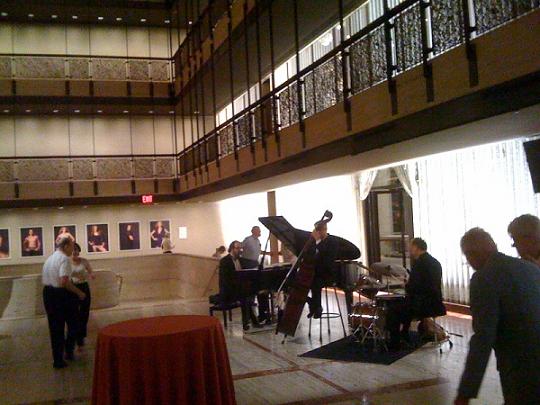
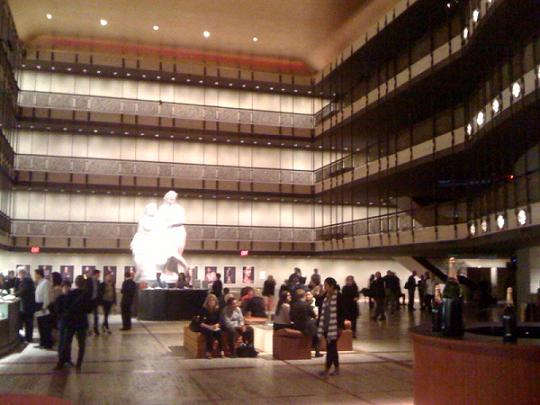
Friday night, my friends Hsien and Alyssa came with me to see the first program in NYCB’s “See the Music” series. First, we met for drinks on the promenade, which, as I mentioned, they’d opened an hour before showtime for the first week of this fall season. We watched members of the orchestra play some soft jazz music, which some patrons were dancing to. I know Hsien from my ballroom dancing days and we had to laugh because some of that music sounded straight out of Blackpool! (Blackpool’s one of the only – perhaps THE only – ballroom dance competition with live music.) (Above are a couple of my pictures of the promenade, about an hour before the performance, with people beginning to gather. My iPhone seems to take better photos outside…)

The two ballets performed were Ratmansky’s Namouna: A Grand Divertissement, which premiered last season, and Jerome Robbins’ The Four Seasons, which served for the first week of this first fall season as a tribute to fall.

Before the performance, Peter Martins came out and introduced the new series, explaining that it was inspired by Balanchine’s highly musical approach to dance, his belief that dance is music made visual, summarized by his words, “see the music, hear the dance.” Then the newly movable orchestra pit rose (as I knew it would!), and up came conductor Faycal Karoui with his crew, to explain a few things about Eduaord Lalo’s Namouna score. No one could give these talks but Karoui. He is hilarious, such a character!


Photo of Karoui by Paul Kolnik, taken from The Faster Times.

Karoui joked, in his thick French accent, that the music is very French, because of its … charm of course. Okay, then he became serious. The Lalo score is too long, of course, to talk about all of it, but Karoui focused on a few sections. One of the sections, he explained is characterized by its transparency of orchestration, meaning the harmonies don’t always  behave the way you expect them to; they are a surprise. He talked about how the beginning of the score had a nautical theme, and it opened with a sound like waves, but more German waves than French, he said, as the opening crescendo sounded more like Wagner’s The Flying Dutchman. He talked about the conversation between the harps and the strings, how Lalo plays with flexibility inside the tempos by following a quick tempo with a slower one, and he showed how Ratmansky had the dancers visualize part of that tempo by having the corps women at one point use cymbals onstage. After Karoui did a little dance himself while clapping the cymbals, he and Martins had the audience clap where the cymbals should be played to get us to internalize that rhythm a bit.

Karoui spoke at length about one of my favorite scenes in the ballet, where a group of smokers (led by Jenifer Ringer) really kind of tantalize the poor male lead, blowing smoke right into his yearning little face. It’s called “The Cigarette Waltz” believe it or not, and Karoui showed how the music really teases and tantalizes you into desperately wanting a cigarette, just like Ringer and her friends tantalize the poor sailor into wanting one of them. “Oooh, I really want one now,” Karoui cried after the orchestra demonstrated part of that waltz.

I liked Namouna much much better on seeing it a second time. I wrote about it earlier here (also, read Marina Harss’s fabulously detailed and in-depth description in Faster Times). It seemed less long this time, and each of the the parts seemed entertaining and compelling, each having its own theme and it own little storyline, however abstract the whole was. Maybe it was because of Karoui’s brief humorous explanations of the music, or maybe it’s just Ratmansky, because I always feel this way with his work – that nothing strikes me that much on first viewing, but that the more I see each ballet of his, the more I see in it, and the more entrancing I begin to find it.

That ballet was all the same, except this time Tyler Angle took over for Robert Fairchild as the main sailor guy. I’m told Robert is out for the moment with an injury. I loved Robert, but I really liked Tyler as well. Robert is so boyishly charming like Jose Carreno, and his dancing is more sharp and precise, hitting every count with spectacular flair and pizzaz, whereas Tyler’s more Romantic with his expression, with stretching port de bras and longing lunges, and he really draws out the music. They are such different dancers and it’s always nice to see another’s interpretation.

The next “See the Music” program will be this Sunday’s matinee.

TWO MORE NYCB PREMIERES: "LUCE NASCOSTA" AND "CALL ME BEN"


It’s been a season of new ballets and principal dancer farewells at New York City Ballet, and, between that and all the goings-on at ABT, it’s hard to keep up! I realized when meeting a blog reader yesterday at Philip Neal’s farewell performance (so nice to meet you, Vanessa!) that I hadn’t yet written about the last two premieres and people were waiting. I was going to wait until I’d seen each once again, but at least with one of them I won’t get that chance since there was a programming change.


Anyway, Maura Bigonzetti’s Luce Nascosta (two photos above, cast in top, Teresa Reichlen and Adrian Danchig-Waring directly above. All photos by Paul Kolnik): I really don’t know what to think of it. The title is translated in the program notes as “Unseen Light”. The stage was very dark except for a Santiago Calatrava moon-like disc, which throughout the course of the ballet expanded into multiple discs. Everyone was in black (costumes by Marc Happel), the men in flare-legged pants and the women in tight black tops and big ruffled skirts that resembled trendy Latin ballroom costumes from a couple years back.

The dancing was at times in ensemble, at times in pairs, but the partnerships changed. It seemed that Tiler Peck and whoever she was partnered by were kind of the leaders, and Maria Kowroski and whoever was partnering her at the moment, kind of concluded the action, with everyone else in between.

The music was gorgeous – by Bruno Moretti, but I didn’t think it accompanied the choreography well at all. The music was like something you’d see in an action-packed movie, like Mission Impossible, at times dark and eerie, at times melodramatic with crescendos like you’d hear when the hero’s coming to save the day. Seriously, perfect for a big summer blockbuster. Here … dunno? And weird because they collaborated closely, the choreographer and the composer…

I thought there were some interesting moments and some original movement, but overall I didn’t feel it added up to much of a whole. My favorite part of the choreography was when all the men were dancing in ensemble. Craig Hall began this rather African-looking movement sequence, then Sean Suozzi joined him, making the movement look more balletically lyrical than African, which made it all the more interesting to me – how the same movement looked on different bodies. Then, other men began to join until it looked ritualistic and celebratory. The women had less interesting movement — one recurring theme was when the women went on pointe, their legs splayed intentionally awkwardly, and they’d hold the balance on pointe while the men kind of darted around them, like the women were frozen. In another recurring theme toward the end, the women went sliding across stage into the men’s arms. The several times Tiler Peck slid like this into Gonzalo Garcia it made a loud, slapping sound. But that didn’t happen with any of the others. I didn’t know if that was intentional or not. The whole thing had a kind of threatening vibe. At times it seemed the women were the threat to the men, at other times the opposite.

The whole thing made me think black widows in the moonlight…

I’m interested to know what others thought of this one. Any thoughts? Critics seem genuinely divided, which I find exciting – often they all hate or all love the same thing.

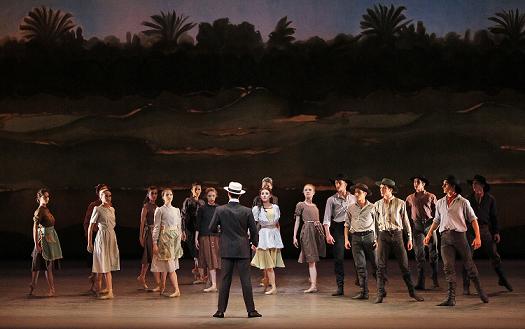
And the premiere before Luce was Melissa Barak’s Call Me Ben, a story ballet about Benjamin “Bugsy” Siegel, the gangster, and his founding of the Flamingo, the first Vegas nightclub.


Robert Fairchild played / danced the part of Bugsy or Ben – the ballet sought to humanize him, focusing on the person and his ideals rather than the gangster, and it did so simply by having endearingly sympathetic Fairchild play the lead! Jenifer Ringer, who looked like a true Hollywood leading lady throughout, played his girlfriend, the one who swindles him, making other gangsters think he’s taken the money himself and fled, eventually leading them to kill him.

I thought the duets were really beautiful. Robert and Jenifer looked really good together, like a leading romantic couple in a movie. And the ballroom-y period costumes (by J. Mendel) were absolutely gorgeous. I really liked the sets, again by Calatrava, as well. More than his sets for any of the premiere ballets I’ve seen thus far this season (well, with the exception of Wheeldon’s Estancia), these seemed particularly suited for this ballet, evoking warm starry nights, palm trees, the Vegas-y climate, basically.


I think where the ballet fell apart for me was with all the speaking. Barak has said in interviews that she didn’t think she could tell the story purely through dance so she used spoken word as well. But there was too much spoken word, and the dancers were often so out of breath from dancing it took them a while to begin their lines. And that didn’t look natural. Something like this would work in a movie, obviously, where there are separate takes of each scene, but onstage with seriously exhilarating dancing, it took away from the realism. Plus, besides Vincent Paradiso, none of the male dancers really evoked gangster. Tyler Angle and Daniel Ulbricht, great as they are as dancers, just did not convince me that they were hit men. And at the end, when Ulbricht came out for his bow, it was funny but it seemed like people began their usual hearty applause then let up when they realized they didn’t really see Daniel Ulbricht. He didn’t do Daniel Ulbricht things.

And that makes me think maybe she didn’t need to have any talking. Why couldn’t Ulbricht have done his usual pyrotechnics as his expression of his character’s murderous nature?

It seems from interviews Barak has given, that she was given a score (by Jay Greenberg) that she really didn’t know what to do with, and since the score had already been commissioned she had to come up with something in a short period of time. It’s interesting how these ballets are being commissioned because when I heard Benjamin Millepied speak about his new ballet at a Guggenheim Works & Process event recently, he mentioned that he and his composer, Thierry Escaich, worked together, talking about what the music evoked and how that would be visualized, but that Calatrava designed his set for that ballet independently. So, all throughout Why Am I Not Where You Are, I was wondering whether Millepied meant for his color-clad dancers to be hailing from another world, mainly because of that space-like object of Calatrava’s. But Millepied hadn’t meant for that at all — it was just the set he got, which had nothing really to do with his ballet.

Is this how collaborations used to work in Diaghlev’s day though? I just assumed Stravinsky and Balanchine and Chagall all worked together to create a work of performance art. I mean, how else could Firebird have been created?

YVONNE BORREE’S FAREWELL PERFORMANCE


On Sunday afternoon, principal ballerina Yvonne Borree gave her farewell performance at New York City Ballet. I always find farewell performances so sad, especially for the ballerinas, for some reason. And Yvonne just doesn’t seem old enough to retire! At all.

Anyway, it was a really lovely program and she looked beautiful. She danced the third, “Andante,”  movement in Balanchine’s Brahms-Schoenberg Quartet. She was partnered by Benjamin Millepied, a very good partner for her, as she looks very comfortable dancing with him, and when they first took the stage, the audience really went wild with applause — and really wouldn’t let up! That’s uncommon for NYCB fans – even with a farewell performance; they usually save their applause until the very end. And the applause wasn’t just clapping; people were really whooting and screaming and calling out “Yvonne, Yvonne!” I think I am not the only one who will miss her. At the end of each section, she got more applause and at the end of Brahms, she and Millepied got three curtain calls. She deserved it. And he did too — I think Natalie Portman is giving him some acting lessons because he’s really doing much better, not just dancing (he’s always been a good dancer) but really projecting as well.

Then came Wheeldon’s new Estancia, which grew on me. I think the dancers found the humor in it — or maybe they did before and I was paying too much attention to the choreography to notice, but it seemed they really vamped it up, with Tyler Angle failing hilariously miserably at taming Andrew Veyette’s “horse,” letting Veyette get away after Tiler Peck roped him all up nicely, then Tyler being felled and rolling around the floor, nearly sweeping Tiler off her feet (in a bad way). It was really cute. And the dancing is really marvelous.

Then, the performance ended with Yvonne doing a pas de deux with Jared Angle — another good partner for her (for everyone really) – Balanchine’s Duo Concertant, which I love.


I love how the couple interacts with the onstage violinist and pianist, with the music, and with each other, and yet it is at times a very abstract ballet with lots of angular shapes. And the end is gorgeous but bittersweet, as the stage darkens and the spotlight begins to highlight only her, her head, then various parts of her body, ending with her arm, in the air, reaching upward and outward. It almost made me cry.

And of course the applause went on and on, and all of her partners (besides Nikolaj Hubbe unfortunately) came out onstage to give her a bouquet. Damian Woetzel and Peter Boal got the most whoots.

I’ve only been coming to New York City Ballet regularly for about the past three or four years and I feel I didn’t get to see enough of her. My favorite performances of hers are the delicate, ethereal sleepwalker in Balanchine’s La Sonnambula, which I think she danced with Sebastien Marcovici, and in that ballroom-esque ballet with the art deco mirror of Peter Martins that I love but no one shares my feelings about … 🙁 Can’t think of what it’s called right now but she was always Nilas Martins’s partner. I loved it. And now, my other favorite of hers is Duo Concertant, which I’d never seen her dance before.

Apparently, she’ll still be around. According to Oberon, she’ll stay at NYCB’s School of American Ballet and teach.

Photos by Paul Kolnik.

CHRISTOPHER WHEELDON’S ESTANCIA


Last Saturday night was the premiere of Christopher Wheeldon’s new ballet, Estancia, at New York City Ballet. Everyone in the audience seemed to go wild over it. When it ended, I overheard people saying they didn’t want it to end, and others saying they thought it was his best work, and in the lobby, several of my friends said they really liked it. I thought it was so so. And definitely a departure from Wheeldon’s usual.

Estancia is a story ballet, set to to music by Alberto Ginastera, that takes place on a ranch (Estancia is Spanish for ranch) in the Argentine Pampas (countryside). A young city man (Tyler Angle) is smitten with country life, and a girl he meets there (Tiler Peck), particularly after he watches her tame a horse (Andrew Veyette). The ballet is his attempt to woo her, and of course at the start she wants nothing to do with him and his annoying urbanity (he wears a suit throughout), but eventually she overcomes her prejudices and lets herself fall for him. He ends up proving his adroitness at being a rancher by taming another horse (Georgina Pazcoguin).

The dancing was all very good — Pazcoguin and Veyette were wonderful as the wild horses, and the T(i)ylers were perfect for these roles. Tyler Angle is always so good at those deep longing romantic lunges toward his partner. For the most part, though, the choreography was a bit blah, I thought. Except for some interesting backwards walks, that looked at bit like moonwalks, performed by the “horses,” the choreography seemed like nothing I hadn’t seen before, which is unusual for Wheeldon. The romantic pas de deux  between the leads were pretty but the lifts were rather basic.

The Ginastera score was originally commissioned in 1941 by Lincoln Kirstein for a ballet to be made by Balanchine to be shown when Kirstein’s American Ballet Caravan toured Buenos Aires. But the Caravan disbanded and the ballet was never made. I feel like Wheeldon, or someone at NYCB, felt the need for closure on the project. It had the feel of something out of a bygone era, particularly with the horses – you really don’t see dancers galloping around stage these days in horse costumes. But it doesn’t seem as corny if you think back to Firebird, for example, with all the forest creatures.

The sets were designed by architect Santiago Calatrava (and NYCB is showing a short film about his work and his collaboration with the choreographers every time his sets are used this season). They consisted of water-color-looking paintings displayed on the back wall, one of a countryside, another more abstract one of horses (I think – because of the storyline, but maybe they were bulls … they seemed to have horns).  Anyway, all in all, it was a fine ballet but didn’t blow me away like it did many others.

Two other ballets were performed, both by Balanchine — Danses Concertantes, with my favorite, Gonzalo Garcia and Sterling Hyltin in the leads, and Brahms-Schoenberg Quartet in which Yvonne Borree danced particularly well partnered by Benjamin Millepied. It’s going to be sad to see her retire this Sunday afternoon.

Above photo by Paul Kolnik.

SARA MEARNS’ MOVING ODETTE, A TRIBUTE TO DARCI KISTLER, AND NEW ADAM HENDRICKSON BALLET


Photo of Sara Mearns in Swan Lake, by Paul Kolnik, taken from NY Times.

Last week was the first time I’d seen Peter Martins’ version of Swan Lake. Overall, I wasn’t in love with the production, but I was in love with the dancing, particularly Sara Mearns’ interpretation of Odette, which nearly moved me to tears, which just hardly ever happens with Swan Lake. She is the Veronika Part of New York City Ballet to me and I just love her. She inhabits whatever character she’s dancing with her entire being and she takes you to that place with her; she really creates another universe and she puts you right there and won’t let you leave it! I think here what I loved was that she humanized her Odette. So many ballerinas will focus on getting the fluttering foot just right, waving their arms about with just the proper fluidity that they look like actual wings, and of course totally nailing the chaines and fouettes in the second act. They make the White Swan all about the styling and the Black Swan all about the athletics. And they forget about the story.

But with Mearns — just the way she would wrap Prince Siegfried’s arms around her body, the way she’d nearly dive into an arabesque letting him catch her before turning her, or fall nearly to the floor and arch her back, wrapping herself around his kneeling knee — everything was about the tragic story, about Odette’s loving the prince and longing for him and her need for him, and then his inability to fulfill that need. I’ve honestly never been so moved before, and when she bourreed away from him at the end (there are no suicide swan dives into the lake here), leaving him, it just left me with such a emptiness. I couldn’t stop thinking about that — about her wrapping his arms around her in the pas de deux and then her sorrowful bourrees away from him at the end — for days; I still can’t get over it. I think those images will always be in my mind when I think of this ballet.

And she just had so much stage presence. Sometimes when all the swans are onstage together, I’ll lose Odette, but not with Mearns. I think that may partly be because she has a broad face, allowing her expressions to be more noticeable to the entire house. But of course she makes those expressions that not everyone does — her face, her body, she is always fully immersed in the role.

And Jared Angle was the absolute perfect partner. You can tell he’s a very strong guy and a very solid partner who’s easy to get along with. Because she’d really really throw herself into those arabesques and he’d catch her and she was so off her center of balance — she had to be in order to show the passion and emotion, and the full, expressive line – and he’d promenade her like that, and it was so incredible because you could tell he spent the better part of the ballet supporting a lot of her body weight.

And he acted it well too, and did perfectly on his solos. Very impressive performance by him!

The other cast I saw was on opening night with Maria Kowroski in the lead and Stephen Hanna making his debut as Siegfried. Hanna was very good — he’s a strong guy too, and that night, he performed a major save! Toward the beginning Kowroski went to jump into his arms, on her way into a shoulder-high lift, and she slipped before she ever got to him. He somehow reached out and caught her anyway, and took her up into that lift beautifully. The whole audience went “ahhhhhh”! I think it threw Kowroski a bit though because she seemed nervous and a bit shaky throughout the rest of the ballet. She might also have been a bit anxious because Hanna was debuting in the role, so they obviously hadn’t performed it together yet. At intermission, someone mentioned she might have been less nervous dancing with her usual Charles Askegard. Maybe that’s true. I thought Hanna did a very good job overall.

But I’m not in love with the production. Like Martins’ Romeo + Juliet, the sets are very modern, and the costumes for Siegfried and Benno and his friends are bright, color-coded, and basic with minimal embellishments. But the sets are the worst. In the beginning, you can’t even tell they’re in a palace. In the second act, the sets are not only minimal, but what’s there is so incredibly modern, just a few brown and beige slashes on some backboards. And yet, the people are dressed in Elizabethan costumes. Either set it in modern times completely or go with the historical thing, but don’t do half and half?…

And the production just moves way too fast, in my opinion. This worked for Sleeping Beauty (the paring down of all the miming and the boring court dances, in favor of getting right to the point and to those gorgeous variations), but it didn’t work here because there’s too much story up front missing. We see all these people dancing — we don’t know they’re in a palace, so we just see them all dance, and next thing we know, Siegfried’s all bouncing around with a bow and arrow. Then he runs offstage and a moment later, on comes Odette. Then Siegfried runs back out and they do a pas de deux, and after that’s over, Odette runs one way, Siegfried runs the other, and on come the swan ensemble. And — and maybe this is conductor Karoui’s doing — but you don’t even realize Odette’s run away from Siegfried because she’s afraid of Von Rothbart, and that now Siegfried is running around madly trying to find her. Instead, it just looks like a bunch of running. There should be pauses so that you know exactly what’s happening and why– the pacing is way way too fast. I never really did see Siegfried fall for her. I first realized there was something between them when Mearns’ Odette wrapped Siegfried’s arms around her in the White Swan pdd.

The other thing is the ending, which I both like and don’t like. In this ending, there is no suicide with the two lovers  ending up together in eternity. Instead, since Siegfried has betrayed Odette with Odile, they can’t be together. The problem is that Martins still has Von Rothbart die — he melts into a puddle and dies once he realizes their love is undying and real. But then, if he dies, the spell should be broken and Odette can resume human form. So, the ending then loses its mysticism and becomes a human ending — Odette leaves him because he’s betrayed her, and even though he’s horribly sorry, the damage is done and can’t be undone. So, basically she just can’t forgive him. But why not? It doesn’t really have the resonance to me that it should. I think Martins should just not have Von Rothbart die. That way the lovers can’t be together because of Siegfried’s betrayal. But she still loves him, so that when she bourrees away from him, letting go of him little by little, her arms still reaching out toward him as she disappears into the wings, it just makes you want to bawl your eyes out the same way as the Giselle ending.

One other thing: Martins has some children dance in the beginning courtly scene, which I love. It’s very Balanchine to put the children in, and they were very sweet. And I could tell the people around me thought the same.

Oh and one final other thing: there’s no real dancing for Von Rothbart — it’s really just a character part. But I missed the seductive Marcelo making all the women swoon with his sexy jumps, and then tossing his Odile all about!


Anyway — sorry, I’m behind on blogging and have to blog about these things all together — but earlier in the week, I attended a daytime tribute to retiring Balanchine ballerina Darci Kistler (above photo from the front of the program). She danced the Preghiera passage from Mozartiana beautifully, with some children from School of American Ballet, then the White Swan pas de deux with Jared Angle. And then Kathryn Morgan danced the Sleeping Beauty wedding pas de deux with Tyler Angle, which was sheer perfection. They also showed some excerpts of interviews with Kistler from a 1989 documentary, Dancing For Mr. B, and there was a short panel discussion where Bob Craft from the NYCB Board interviewed her. Later, the two were joined by Peter Martins, Philip Neal (who seems very polite and well-mannered), and the hilarious Albert Evans, who you can tell is the type of guy who puts everyone at ease. He got up there and immediately started reminiscing about a blue sweater Darci’d wear to rehearsals all the time and how much he wanted it (she ended up saying he could have it!) and some rather amusing (in retrospect) goof-ups they had together, and she just really burst into genuine laughter.

Oh and at the beginning, Kathryn Morgan presented Kaitlyn Gilliland with the 2010 Janice Levin Award (Morgan was the 2009 recipient). Both gave little speeches, and Gilliland (who seems like a natural speaker) prefaced hers by pronouncing Kathryn’s recent Sleeping Beauty debut “historical,” which nearly brought tears to my eyes. Can’t think of a more apt description!

And finally, earlier last week, I saw the debut of a new ballet by corps member Adam Hendrickson. It was presented in a small downstairs auditorium at Carnegie Hall and was part of a program featuring newly discovered Prokofiev music performed by students and faculty of Yale’s School of Music. Hendrickson’s ballet was set to his Music For Athletic Exercises, and it was fast, flirty, and fun. It was performed by three dancers — Matthew Renko (who is really a stand-out dancer — I kept wondering why he wasn’t with a major ballet company, and then realized later in the week he’s a corps member at NYCB), Elysia Dawn, and Colby Damon and one pianist — Boris Berman — and Hendrickson’s original, clever choreography had elements of Ratmansky’s Concerto DSCH as well as Jerome Robbins. At one point, Dawn’s feet are moving so fast and furiously, and the pianist just keeps at it and won’t let up, and she kind of stops and shoots him a look. It reminded me of Robbins’ Suite of Dances — it was cute and the crowd loved the joke. This is the second work I’ve seen of Hendrickson’s and I found both to be engaging and memorable. I think he may have a real future as a choreographer. Anyway, here is Philip’s account of the evening, and here is an article on the music.