NEW YORK CITY BALLET: JANIE’S DSCH, KATHRYN’S SCOTCH AND MORE VIEWINGS OF PREMIERES


I can see how ballet is so addictive, especially to those with dance training who’ve either danced the roles they see onstage or pick up choreography on sight. It’s so interesting to see different dancers perform the same roles, to see what they can each do with something, where they can take it. A ballet can look completely different depending on cast.

Janie Taylor recently debuted as the female lead in Ratmansky’s Concerto DSCH and I absolutely loved her. I thought she brought a certain vulnerability, delicateness, and romantic touch (both big and small “r”)to the role and as such created a poignant centerpiece to this ballet that is mainly full of fast, frolicking fun. She was perfect partnered with Tyler Angle, who gives everything an emotional, Romantic quality. There’s one point where the girl bourrees (tip toes) backward from the guy and he steps toward her in a series of lunges, arms outstretched. It was rather heart-grabbing when Janie and Tyler did that. It was like Tyler was reaching for her with all his might, but she just kept falling away from him, telling him no, it couldn’t be.

The original cast for the romantic couple was Wendy Whelan and Benjamin Millepied, and when I saw them perform it again a few days ago, I looked for that part. I almost didn’t see it until Wendy had bourreed practically into the wings. Benjamin, instead of reaching toward her with all his power, bent his knees and performed those walking lunges close to the ground, kind of bouncing up with every step forward. His arms were still outreached but the deep kneed, close to the ground walks gave it overall a more playful feel, or perhaps like he was looking up to Wendy, his supreme ballerina. Wendy’s of course such an icon in the ballet world and she’s stronger and less vulnerable and delicate than Janie and so it just had a kind of man worshiping woman instead of a boy trying desperately to hang on to his love feel.

Ashley Bouder has been out with an injury so Ana Sophia Scheller is filling in for her in the main allegro ballerina part, still dancing alongside Joaquin de Luz and Gonzalo Garcia.


There seemed to be a slight bit of drama going on between Scheller and Garcia at first — I don’t know what it was — he was his usual sexily mischievous, charismatic self and she seemed nervous and holding back a bit (albeit not with Joaquin), but hey, drama is always fun πŸ™‚ I think that has been all worked out though. The last time I saw them dance this together they were right on. She appears to be a lovely dancer and I’d like to see more of her.

I’ve also seen two very different casts in Scotch Symphony: the first Benjamin with Jenifer Ringer, the second Robert Fairchild and Kathryn Morgan. This is a sweet Balanchine ballet, telling the story of a young kilt-clad Scotsman lost in the Highlands who becomes completely smitten with an ethereal goddess dressed in Romantic tutu. He keeps trying to reach her but is thwarted right and left by a group of Scottish guards. Finally, they meet and dance a lovely pas de deux.

My friend, Alyssa, now has a huge crush on Benjamin. I don’t know how it happened; we were standing in line at the box office to pick up tickets one night and he was talking on the overhead screen, likely about his new ballet (I’m not sure because the sound was off) and Alyssa became mesmerized by his face. “That’s the guy who recently premiered a new ballet,” I said. “Oh, he’s a choreographer? He’s cute!!” Then when we got inside and were looking at the Playbills she screamed, “look, the cute guy is dancing!”


Afterward at dinner all she could talk about was how other dancers (like Daniel Ulbricht, who we saw in Tarantella that evening) were great jumpers and technically perfect and all, but Benjamin just brought so much more to the dance. “He was just so … so… he was perfect in everything he did, but he wasn’t just perfect, he was… ” she waxed unable to come up with the right word. It was Ethan all over again (whom she fell for after seeing at Martha’s Vineyard merely introducing his Stiefel and Stars and saying he was unable to dance because of the knee operations).

I nodded. He does have a certain beneath-the-surface charm (Benjamin that is), and he is a very good dancer, always coming through with those ever so challenging fast-paced Balanchine roles.

But of course I was dying to see Robert Fairchild in the same role, with Kathryn Morgan as his ethereal love object. They were so beautiful together. She’s just so angelic, and he always dances with such passion and boundless amounts of energy, and of course he’s always got that boyish charm that he’s had since debuting in Romeo two years ago at age 19 but that I don’t think is every going to go away. He’s such a hard-working young guy, you can tell — he puts everything he has into his dancing. He had a tiny fumble coming out of a jump and had to check himself with a couple extra steps to secure his footing (but he didn’t fall), and at one point he was a bit too far from Kathryn during a supported arabesque penchee and she couldn’t get her leg all the way up in the air. But, to me, honestly, when a dancer makes a blunder it only makes him or her all the more endearing, more human.


(Robert Fairchild, Kathryn Morgan)

I loved Tiler Peck in Tarantella — another role that usually belongs to Ashley Bouder, but Tiler brought a certain freshness and wit to this cutesy extreme high-speed dance. Ashley usually brings a sexy, flirtiness to it; Tiler was more sweet and smart. I like both, and, again, it shows dancers often make the dance.


Daniel Ulbricht (photo above by Paul Kolnik), as always, delivered on the technical and difficult athletic aspects of the dance — the high jumps the turns and all. Audiences always go absolutely wild over him. I personally like Joaquin de Luz a bit better (in this and the other roles he dances — he and Daniel usually alternate) because he delivers on the virtuosity as well but he makes it more about the character. At the end, the boy here steals a kiss from the girl. With Daniel, the high jumps and theatrics are the dance, the kiss is just a little reward at the end; with Joaquin the whole thing is about that kiss, the mad leaps and spins and turns with the tamborine are simply leading up to it. But audience do go completely wild over Daniel.


(Tiler Peck)

I saw the new ballets once again — Benjamin Millepied’s Quasi Una Fantasia and Jiri Bubenicek’s Toccata, and both grew on me. Funny, but I sat in orchestra this time for both — first time I was looking down from the first ring side, and it’s really interesting how different the ballets look from different vantage points — especially the Millepied. Looking down from above, this ballet really seemed to evoke a flock of birds, at times sinister and foreboding. Looking at it straight on, it was still unsettling — with that haunting Gorecki score — but at times the dancers resembled insects reminiscent of Robbins’s The Cage, and later, just figures — one weak and somewhat broken, the other strong — moving in various groupings. My friend Michael and I both noticed how he’d make various groupings or formations with the dancers — phalanxes, Michael called them. Sir Alastair had noted the same, saying he likely got the ability to work a large ensemble like that from Balanchine. I don’t always notice such things until someone points it out — I’m usually more focused on the theme, what the choreographer is trying to evoke, or make me think and feel.

I wish I had a picture of what the dance looked like from above. Overall, I think I still see Hitchkockian birds πŸ™‚

I still don’t know exactly what Toccata is about but I love how there is a great deal of really intense partnering, sometimes several duets happening at once, the dancers by turns pushing and pulling, sliding, strugging with and embracing each other, and I love how at points the bodies just kind of mesh into one another, just melt into each other. It’s really kind of sexy in its own way. I love Robert Fairchild in these kinds of abstract roles. As I think I’ve said before, he always makes a little character out of a role no matter how abstract, and he dances with such expansiveness. With that and his immense charisma he devours the whole stage.


(Robert Fairchild and Georgina Pazcoguin in Toccata, by Paul Kolnik, from Oberon’s Grove)

I’m also liking Maria Kowroski much better. I heard she is taking acting lessons and it shows. Every little step is meaning something, saying something, a little quip perhaps, a little retort, to her partner (who has often been Sebastian Marcovici these days) and to the audience. I particularly liked her in Balanchine’s modernist Movements for Piano and Orchestra and his sweet, more classical Chaconne. Huge kudos to Sebastien in the latter for doing some really intensely fast footwork and really nailing it all. He is a large guy and that’s not easy. A friend told me afterward he thought Sebastien looked a bit “heavy” in the role, and I can definitely see that — a smaller dancer would have looked much lighter and more frolicking and playful — where Sebastien brings more virility and power and intensity — but, again, what makes ballet so addictive is the different bodies, different strengths, different personalities, different interpretations.
NEW YORK CITY BALLET SPRING SEASON BEGINS! (PROGRAMS 1 AND 2)


NYCB’s Spring season began on Tuesday and I spent much of the weekend at the Koch theater. Friday night was my first time seeing Balanchine’s Divertimento No. 15, (set to Mozart), which Arlene Croce called one of his greatest ballets, and I can see why, particularly with all the complex, richly detailed variations. The ballet begins with an Allegro section danced by the whole ensemble, the women entering the stage first. But I have to say I felt like the dance properly began when the three male leads — Tyler Angle, Amar Ramasar, and Andrew Veyette– came onstage, particularly Angle and Veyette (I prefer Ramasar in the more dramatic roles but he always has a charisma that draws your eye). With the exception of Sterling Hyltin, who is becoming one of my favorite ballerinas, the men just stood out more. At one point, after executing a step perfectly on beat, Andrew looked out at the audience and flashed a knowing, mischievous grin that made me and my friend (and those around us) giggle, and that set the tone of the whole night for me.

Though all of the women seemed to keep time with the fast-tempo and execute all the intricacies of that insanely quick-footed choreography, Sterling’s dancing had the most dash and flair.

Continue reading “NEW YORK CITY BALLET SPRING SEASON BEGINS! (PROGRAMS 1 AND 2)”

New York City Ballet Season Finale and Wrap Up With Response to Sir A


So, Sunday marked the end of New YorkΒ  City Ballet’s winter season. I was honestly in a blue funk all day yesterday, which shows, I guess, that I am really beginning to love this company since I’ve normally only gotten so sad over ABT and Alvin Ailey.

Sunday was a one-day only program, the All-American Season Finale, which included Robbins’s Glass Pieces, Martins’s Hallelujah Junction, and Balanchine’s Tarantella and Stars and Stripes. Tarantella (this is the only time it showed this season) is always fun, with its cute Neapolitan peasant boy-tries-to-get-girl caricatures, lightening-charged footwork, and series of bravura solos for both man and woman, all performed with a tambourine. I was completely out of breath after watching Joaquin de Luz fly across the stage and ultimately steal a kiss from Megan Fairchild. Joaquin is not just a dancing virtuoso but a dramatist as well and his characters are always these virile, sexed-up, but charming, innocuous men. I really love him.

Glass Pieces and Hallelujah Junction also really grew on me. I don’t know if it was Maria Kowroski or what, but theΒ  slower, more adagio section of Glass Pieces was very compelling this time, and it really spiced up the last man-centric, drum-beating, section as well. At first I wasn’t a huge fan of Maria Kowroski, but either she has improved or she has really grown on me. I always thought she had an excellent dancer body, but now she is using it in a much more expressive way, really to say something. The only thing I’m not in love with choreography-wise in Glass Pieces is in the last section, how the men come jogging out, hands powerfully punching the air, doing their ‘man things’ to the booming drums, and then the women daintily slink in to the sound of the flutes. Corny.

I was able to watch more than just the mesmerizing lighting in Hallelujah Junction this time. I love the movement theme –toward the beginning — of the landing a jump or phrase on releve and then swiftly lowering the ankle to the floor. On Andrew Veyette it looked kind of teasing but in a sinister way, like the slicing of a knife. There is something very sinister in general about Andrew Veyette, very virile in a threatening way, which makes him perfect for the devious man dressed in black here.

And I love how Sebastien Marcovici, the man in white, kind of Janie Taylor’s saviour, would powerfully jete across stage after him, threatening him, banishing him. Sebastien and Janie are such the romantic couple, in part because they work so well together and in part because of their respective sizes. Someone very knowledgeable in the dance world told me they thought he’d been working out a lot, trying to build muscle. I do think he seems to have become more muscular lately, especially his legs. Building muscle often decreases the muscle’s flexibility and he doesn’t seem to make a perfect split on a jete like some of the others, but I still think it’s so romantic that he’s so much larger than little Janie; he can just sweep her off the floor and scoop her up into his arms — aw πŸ™‚

The program notes state that Stars and Stripes, the somewhat cheesily patriotic but excellently danced Balanchine ballet, was shown at presidential tributes, like that of Kennedy and Johnson, and at Nelson Rockefeller’s NY gubernatorial inauguration. It’s so weird to me to think of that, though I could see it performed back then. But now? At President Obama’s inauguration? It just doesn’t seem like it would fit. It would seem kind of anachronistic, sadly…

Anyway, the talk of the ballet world lately has been Sir Alastair’s New York Times season wrap-up.

Taylor Gordon, my friend and fellow blogger / dance writer, says, “whether you agree with him or not, it boggles me that one person has the power to say these things in basically the one print medium dance criticism has left. Ouch.”

Macaulay basically takes the women of NYCB to task, saying none of them really command authority like true ballerinas,

Continue reading “New York City Ballet Season Finale and Wrap Up With Response to Sir A”

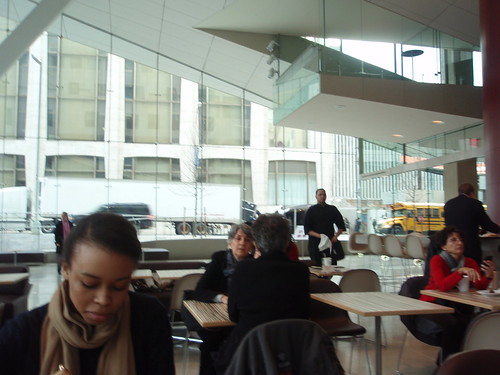
New Cafe at Alice Tully Hall

P2281944

Yesterday, Ariel invited me to a rehearsal at New York City Ballet. I love watching rehearsals! Especially with performers you really like; you kind of get to know their personalities a bit more. I don’t think we’re supposed to talk about anything in detail, but can I just say, methinks Tyler Angle must be every girl’s Dream partner πŸ˜€


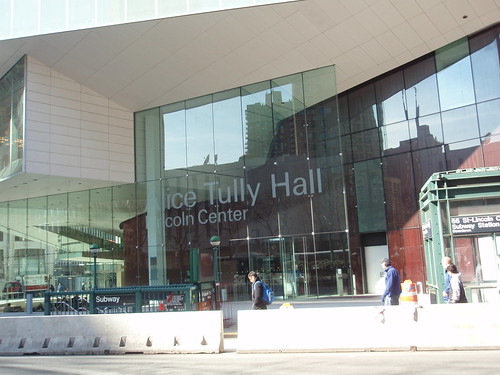
Anyway, afterward, Ariel told me about the new cafe at Alice Tully Hall, the northernmost building of Lincoln Center, that houses mainly music concerts. She’d heard the restaurant portion (apparently the mac ‘n cheese) got some negative reviews, but I thought their coffee was rich and the American cheesecake we had, which was creamy and topped with little swirls of white chocolate, was delic. The spacious cafe is on the bottom floor and, encased in glass, it lets a lot of sunlight in and gives you an excellent view of the surrounding area.

P2271940

(this is facing east).

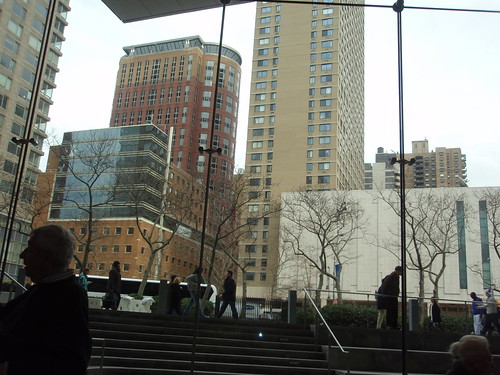
P2271936

(and this south, toward the rest of Lincoln Center. Ariel picking delicately at her cheesecake in foreground πŸ™‚ )

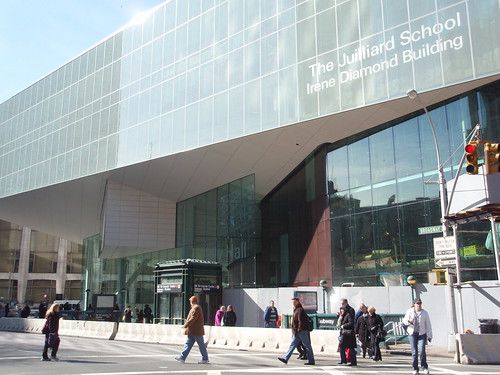
P2281946

(the renovated Juilliard School aka Irene Diamond Building atop Alice Tully Hall).

Lincoln Center’s been under construction forever, so it’s nice to finally see some of the building facades begin to crawl out from under their shells.

Also, last night I went to a very intriguing performance at Dance Theater Workshop, called Kisaeng becomes you by experimental dance-makers Dean Moss and Yoon Jin Kim. It’s on for one night more — tonight — and I highly recommend it if you’re in New York. I went to see it as part of Claudia La Rocco’s WNYC performance club. I found it to be powerful but subtle, and at least in part about the commodification of Asian women in contemporary society, although club members, who discussed the performance a bit afterward at a nearby French restaurant, saw different things. Review coming soon! In the meantime, here’s Gia Kourlas’s NYTimes write-up.

A SIMPLE SYMPHONY at New York City Ballet


Last night Ariel and I went to the premiere of a new ballet by Melissa Barak, A Simple Symphony, at NYCB. It was really lovely and not at all what I was expecting! The program they included it in was entitled “21st Century Movement” and it was an evening of abstract ballets with lots of sharp, angular motion. But Barak’s ballet was very beautifully Balanchine, very classical — or neo-classical — with the ballerinas dressed in pretty Romantic pink-skirted tutus with pink and white striped form-fitting bodices designed by Barak herself.

Suited to its title and set to music by Benjamin Britten, it was simple in a Balanchinian sense, generally storyless and without lots of drama, but with an underlying complexity in the steps and rhythms, and not at all without emotion. At one point, several men partner several women, all of them doing assisted pirouettes for a really beautiful visual effect, with all the skirts flying about in the same direction at the same time. There was lots of bouncing on pointe for the women, then the men would respond with turning jumps into the air, followed by bouncing on the landing foot, the other foot held back in arabesque.

The main couple was danced charmingly by Sara Mearns and Jared Angle. But as always, it’s Jared’s brother, Tyler, who blew me away. Everything he does is in such perfect form. Ditto for Robert Fairchild, who stole the show in the first piece, Jorma Elo’s Slice To Sharp.

Anyway, at the end, Barak came out onstage for a bow, as is customary with premieres. She looked so cute in this gorgeous white baby doll dress, empire-waisted with the area below the high waistline lined with fringe, and high-heeled silver Cinderella-like slipper-sandals. I wondered if she’d designed her outfit too!

Read Philip’s interview with Barak here.

The rest of the evening consisted of abstract very modern ballets that are not always to my liking πŸ™‚ On first was Slice To Sharp, as I mentioned, which does hold my attention with all its lightening-speed quick-footedness and high-jumping, fast-turning theatrics, mainly performed by Joaquin De Luz. I don’t know if I’ve never seen Robbie Fairchild before in this ballet or not, but he danced on a different level from everyone else, made me understand like never before the ballet’s title as his arms sliced propeller-like through the air with razor sharpness and exactitude.

Also shown were Peter Martins’s Hallelujah Junction, set to piano music by John Adams, played on two pianos. The stage was so wondrously lit I couldn’t think of much else besides those pianos. They were set up on a platform at the back of the stage, back to back, and the back of the stage was all dark except the golden light made by the lights over the sheet music. Some dancers were dressed all in white — including the main, angelic couple, Janie Taylor and Sebastien Marcovici — others all in black — including the kind of devilish fast-footed character danced by Andrew Veyette. I’d need to see it again for the themes, but the shades of light and the way Martins used color were really stunning.

The evening ended with Christopher Wheeldon’s Mercurial Manoeuvres, which I thought I’d seen before but hadn’t. I have to say, I’m not always on the same page as Wheeldon, but I was very pleasantly surprised and I’d love to see this one again. Like the others, and as its name suggests, it was full of quick-footed dancing and interesting visuals — bright red costumes on some combined with lush red curtains at various points, dancers weaving between them sinuously, Gonzalo Garcia kind of the main elfish character full of innocuous mischief.

I found the music really interesting as well — Dmitri Shostakovich’s Piano Concerto No. 1 in C minor, for a trumpet and piano, neither instrument secondary to the other, both fighting for prominence but in kind of a teasing way. At one point, the trumpet sounds very sexy, and the couple then dancing, Abi Stafford and Tyler Angle, give their partnering a kind of Argentine tango twist. Later the more calming, harmonious violins sweep in, and a female dancer is picked up by several men who carry her about the stage, raising, then dipping her romantically (or, if you prefer, pashmina-like, ala Kenneth MacMillan’s Manon, except here it’s sweet, not seductive).

Afterward, we ended up at P.J. Clarke’s. Again. This time we saw Timothy Hutton eating up front with several friends. I was excited but Ariel had no idea who he was! I tried to think of movies he was in but, ridiculously, all I could come up with was Taps, and something about a Snowman, which were two of his first. Don’t know why I thought first of those and not all the rest!

Splendid Night at NYCB: 20th Century Music Masters Program


Wednesday night was one of the most enjoyable nights I’ve had at New York City Ballet. I’m totally in love with Balanchine’s La Valse. I wrote about it here when Miami City Ballet performed it and it grew on me immensely when I saw it on NYCB. My friend, Judy, fell head over heels for it too — I think she was the first person in the whole theater to begin clapping (when the curtain began going down admist the swirling Viennese waltzing couples, the group of men carrying Janie Taylor’s limp body high above their heads, pall-bearer-like).


It’s such an intoxicating ballet, with the gorgeously bedazzling, mid-calf-length tulle (which fashion industry person Judy tells me is called “tea length” or is it “t-length” or “tee-length”?) — deep maroon for the waltzing women, bride-white for main character Janie. Janie and Sebastien (who played the leads, pictured in top photo) and Tyler Angle all gave the whole thing such a tragic pathos. When Janie was waltzing with the “devil-character” — a frightening Philip Neal (just about the most intensely captivating I’ve ever seen him) and getting swirled and whirled and tossed madly about, she did these gorgeously elaborate back kicks on the fast third step, when he lifted her high into the air, almost tossing her like a rag doll. It added greatly to the crazed momentum.


It was really Tyler Angle who blew me away though. (See Times article on him by Claudia La Rocco here). He danced one of the waltzing men, prone to romanticism, who gets swept away by the seductive atmosphere, kind of a foreshadowing of what will happen to Janie’s character. At one point, he falls to the floor, and just sits in the middle of the stage, unable to lift himself of out this dream, but doing this fabulously expansive port de bras, waving his arms all about dreamily all the time kneeling, while the women twirl around him, their skirts flying, and couples whiz by him, through him actually, almost ghost-like as they separate their waltzing bodies from one another just enough pass their connected arms right over his head. Somehow his swan-like arms narrowly manage to miss them. It’s really brilliant.

I was sitting really close to the stage this time (third row!) and picked up on so many things like this that I’d missed before, when I was just taking in the whole spectacle. Such a beautiful ballet.


Also on was Jerome Robbins’ West Side Story Suite, which is always a load of fun and I’m always floored by Andrew Veyette’s booming but melodious voice as the leader of the Jets, and Georgina Pazcoguin as the sexy salsera Anita. I love how Robbins uses dance style to separate the gangs from one another and identify each’s prevailing ethos: the Jets wear white and are Swingers performing crazy aerials, the Sharks wear red and are fast-dancing, hip-swaying Saleros.

Also performed was Balanchine’s Stravinsky Violin Concerto, a story-less leotard ballet. I love how sitting so close up you can see the dancers’ facial expressions, as well Balanchine’s delectably intricate choreography. At one point, while a main couple is dancing, several women line the back of the stage and stand in place, but they don’t stand still; they flex their wrists and splay their fingers and turn their hands back and forth to the beat. It creates a kind of twinkling star-like effect on the main couple. At another point, the men stand to the sides of the main dancers and simply do port de bras. It creates kind of a fluid, beatific effect, like they’re blessing the couple. I feel like a lesser choreographer wouldn’t have done anything with them, would just have had them standing around while the soloists dance. But Balanchine adds these little details that really make the dance.

Wendy Whelan was, again, very intense and striking (and we saw her and her husband, photographer and filmmaker David Michalek, after the performance, at P.J. Clarke’s, which was fun!) And Robert Fairchild: just, all I can say is show-stealer, naughty little show-stealer!!


“That’s Romeo,” I said to Judy.

New York City Ballet: Early Music Masters Program

Last night I brought my friend Judy with me to New York City Ballet for their Early Music Masters program. It happened to be a very ballroom-y night: I saw two sets of ballroom dance friends — one a fellow former Pasha student from Dance Times Square, and the other a former fellow West Coast Swing team member from my first studio, DanceSport. Always fun to reconnect and see what everyone’s up to. Actually I often see people I know from the ballroom world at the ballet. So, just a little note to ballet companies: I do really think serious ballroom dancers are a potentially big cross-over audience for ballet.

Anyway, first on the program was Balanchine’s Divertimento No. 15 set to Mozart and in the style of a courtly dance from his era in which ballerinas are clad in sky blue and yellow tutus and their cavaliers in blousy tops with ornate vests. Honestly I find Mozart rather bland for ballet.

Continue reading “New York City Ballet: Early Music Masters Program”