ABT OPENING NIGHT GALA FALL 2009: THREE PREMIERES IN BLACK AND WHITE, AND WOOD


Photo of Veronika Part in The Dying Swan, taken from Vogue; photos of the three premieres coming as soon as I receive them.

After ABT‘s fall season opening night gala performance last night, the really wonderful James Wolcott and Laura Jacobs took friend Siobhan and me out for dinner at Shun Lee (I’d never been there — but wow, excellent excellent food!) and when Laura asked me if I was going to write about the performance, I kind of rolled my eyes and said, “I’ll try!” We all agreed that dance is absolutely the hardest art form to review, especially on seeing a dance for the first time. Let alone THREE dances seen for the first time. With visual art you can stand there all day and examine at it, with music you have recordings and scores, film critics generally see a movie several times before writing a review. With dance you have one chance — often one split mili-second — to remember a half an hour or so of movement, images, patterns, structure, costumes, music, lighting — everything. It’s impossible. Since starting this blog I have so much more respect for dance critics.

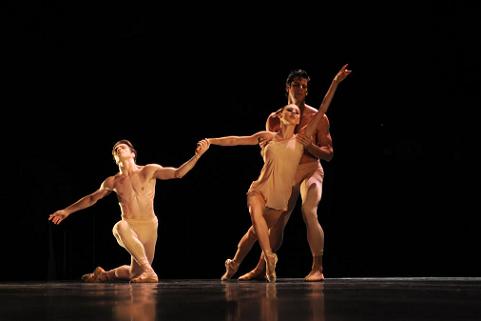
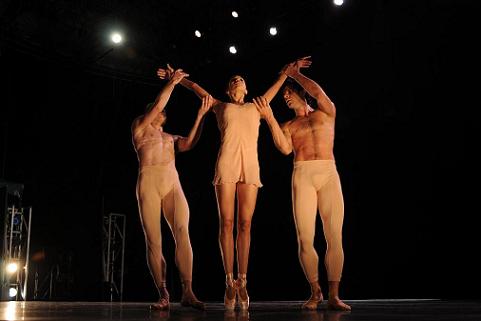
Anyway, there were three premieres last night: Seven Sonatas by Alexei Ratmansky, One of Three by Aszure Barton, and Everything Doesn’t Happen at Once by Benjamin Millepied. Also on the bill was a performance by Veronika Part of Fokine’s The Dying Swan. ABT performed, for the first time, in Lincoln Center’s Avery Fisher Hall, a concert hall not accustomed to housing dance performances. (ABT usually holds its fall season in City Center, but changed venues because of City Center’s renovation plans.)

I’m going to be seeing each premiere a couple more times this season and prefer to write after I’ve seen each more than once. But since the season is so short (it ends October 10, this Saturday), I’ll write something up front. These are only first impressions though, and I’ve found I see so many more things with repeated viewings.

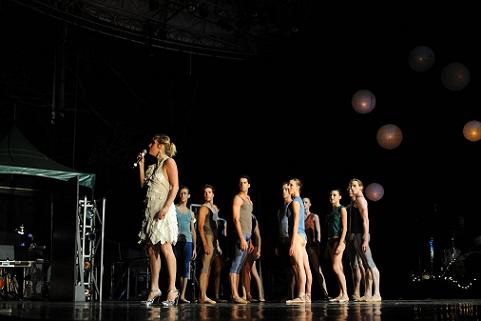
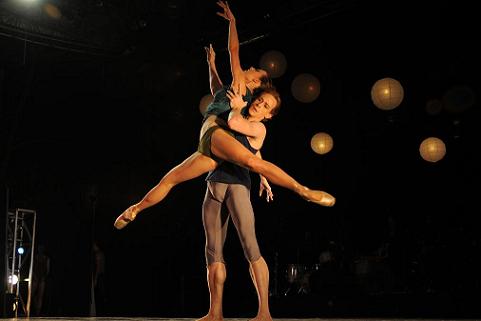
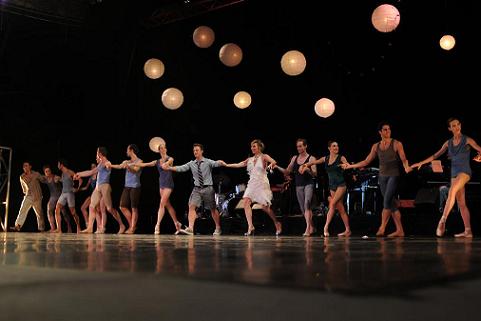
Honestly, everything kind of blended together for me. Part of this was because of the sparseness of the Avery Fisher stage — there were no sets, no wings, no curtains — so dancers warmed up onstage before us, giving each piece a kind of Cabaret-like feel; and part of it was because costumes for each piece were all black and white. I remember lots of black, lots of white and the hardwood of that stage.

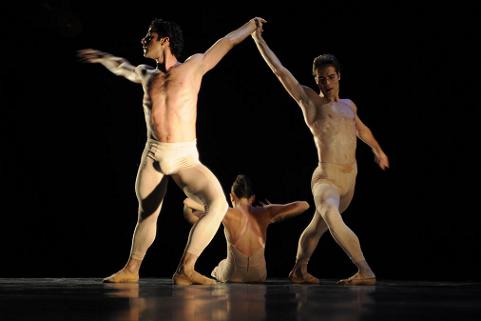
1) Ratmansky’s Seven Sonatas was performed to Domenico Scarlatti music by three male-female couples: David Hallberg and Julie Kent, Herman Cornejo and Xiomara Reyes, and Gennadi Saveliev and Stella Abrera. Costumes were all white — flowing dresses for the women, classical tights and 18th-Century tops for the men. The movement was a combination of classical and modern and, though the ballet was generally story-less, each couple seemed to have a little narrative: Cornejo and Reyes were the young, playful couple, Herman full of high jumps with many beats of the feet that really wowed the crowd and Xiomara dizzying rapid multiple turns. At one point Herman did this crazy turn in the air, landed on his back, and caught her. Crowd went wild.

Abrera and Saveliev seemed to be a more mature couple, perhaps in mourning. It seemed Abrera was a woman, possibly a mother, who’d lost a child or something — Saveliev seemed to be trying to console her and keep her from self-destructing. It seemed like she kept trying to break free of him and reach out to some invisible thing.

I’m not sure what Hallberg and Kent were meant to represent except maybe a modern couple — they seemed to have the most modern movement. David appeared to be trapped in a box and he kept pushing out; he had a lot of quick movement with fast stops in different directions and a lot of it in parallel — not turned-out — position. Julie had a lot of sharp, staccato movement. They could’ve also been a courting couple: at one point, David was on one knee and he invited Julie to run at him and jump on him. When she did, he took her into this lovely lift. It’s sweet and many in the audience lightly laughed.

The ballet was broken into duets and solos and bookended by two ensemble movements, the first pretty and lyrical, the latter more chaotic as they all perform their very different movement motifs at once, some trying on others’ movement styles — everyone does the staccato arm patterns for a while, etc. At the end, the women lay on the floor and the men wrapped their bodies over them.

One other thing: our David Hallberg is sporting longish hair these days πŸ™‚ I think it looks good, and fun for a change! Funny thing is, he’s so beautiful and glamorous, I tend to get jealous if him, even though he’s a man… which I guess should be kind of odd…

2) Barton’s One of Three was set to Maurice Ravel’s Violin Sonata in G and danced by a whole slew of tuxedoed men, and three women — Gillian Murphy, Misty Copeland, and Paloma Herrera. Why is it that women choreographers tend to use men so much more! (And female dance-writers tend to focus on male dancers πŸ™‚ — is this feminist?)

Anyway, the piece begins with Cory Stearns walking out dressed in a tux and black jazz shoes. He does a little solo and his movements are all modern, angular, which contrasted in an intriguing way with the tux. I don’t know if it was his being a bit weirded out by the curtainless stage (which forced him to walk out in the dark with all of us watching) or whether it was part of the character, but he seemed to have this loopy smile in the beginning, that was really rather endearing. I chatted with a friend during intermission and she felt just the same.

Anyway, soon Cory was joined by more tuxedoed men, and then by Gillian, who came prancing out in a long white cocktail gown with her radiant red hair tied back into a sleek twist. The men would kind of veer toward her, sideways, their bodies leading their heads in, to me, a rather amusing way. Gillian’s character was very haughty, very glam and posh and she acted like she was ordering the men around with her little finger. The men often seemed led by their bodies, moving first with the back, or at times one leg would take a step, the rest of the body reluctant to follow (I noticed that most with Jared Matthews, who I thought was dancing at his best last night). I found this a very interesting movement motif.

Misty Copeland was the lead character in the second movement. She wore a short black and white dress, her costume and character more flirty and wild. But same thing — she seemed to kind of taunt her tuxedoed men.

And third movement was led by Paloma, wearing a black lacey top and black pants. She smiled a lot more than Misty and Gillian, but she seemed to move in a slinky, sexually-empowered way, like a tanguera.

Now that I think about it, though there were many more men here, the women seemed to have all the power. Fun!

3) Next on was Part’s Dying Swan, which was really poignant, as I knew it would be. It’s a very short piece, but it’s funny how the ballerina can really do it however she wants to; I just saw Diana Vishneva perform this in the Fall For Dance Festival and her Dying Swan was very different. Whereas Diana spent most of the time on her toes, bourreeing, Veronika spent more time on the floor, one leg stretched out before her (like in above picture), then rising again to her toes for one more breath. Diana’s swan seemed to flutter about more, like she was fighting death, she lay down only at the very end. Veronika kept holding her arms up in front of her, her wrists bent and her hands cupped over, as if to foreshadow what would happen to her body. In general, Veronika’s swan accepted and approached death more gracefully or willingly, but Diana’s, with that broad wingspan, at times really looked strikingly birdlike. I don’t know if I can say I liked one interpretation better than the other — both were breathtaking and both very poignant.

Did anyone else see both swans?

4) And the program ended with Millepied’s Everything Doesn’t Happen at Once, set to David Lang music that was at times mellifluous and at times cacophonous or eerie. He used a large group of dancers but Marcelo Gomes, Isabella Boylston and Daniil Simkin had the main parts and so stood out the most (and Kristi Boone shone in a smaller role).

There was a lot going on here — both in the music and in the dance, and I felt that, unlike with Millepied’s earlier piece for ABT — From Here on Out — composed to music by Nico Muhly (who was in the audience) — in this one the movement kept up, didn’t let the music outshine it. The stage is set up to resemble — at least to me — a pool. Dancers would gather around it and watch the people dancing in the lit-up center. At the beginning there seemed to be a swimming motif, with large, rounded arm movements resembling breaststrokes. Movement is also evocative of birds as well though, and some of the same lifts were present as in Millepied’s recent work for NYCB, where the women are perched on the men’s shoulders, their arms outstretched sideways.

In the middle part, Marcelo and Isabella have a rather haunting solo. The ballet is generally story-less but as far as I could make out any narrative, it appeared she was sort of struggling against him. He seemed very careful and gentle with her (in sharp contrast to a later, more hostile duet he has with the super-strong Kristi Boone, who seemed to be either Isabella’s competitor or her double), but she — Isabella — nevertheless kept trying to push away from Marcelo as he held her. The duet ends with them walking toward the back of the stage holding hands, connected, but her body is lunging as far as possible away from his. A rather warped relationship.

Then there’s a rather amusing section where bravura dancer Daniil Simkin is struggling with a bunch of women. He tries to break free of them but then he keeps throwing himself into their arms, making them catch him in these rather breathtaking group lifts — one of them ending in a perfect split in the air. And he has a bunch of crazy multiple pirouettes that had the audience audibly gasping. It all went with his character though, who seemed rather crazed, like he may have just escaped from an asylum or something. I kept wondering who else was ever going to be able to perform that role…

I didn’t go to the gala party but in addition to Muhly, I saw Alessandra Ferri in the audience, one of the Billy Elliots, and apparently Natalie Portman was there.

Anyway, I’ll write more at the end of the season, when I’ve seen these new dances a few more times. Here is Haglund’s review.
MET MY FAVORITE TROCK, JOSHUA GRANT, LAST NIGHT

…after the Fall For Dance finale in the FFD lounge.


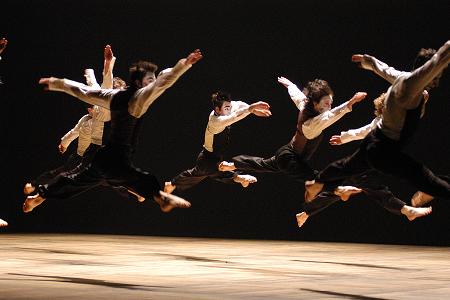
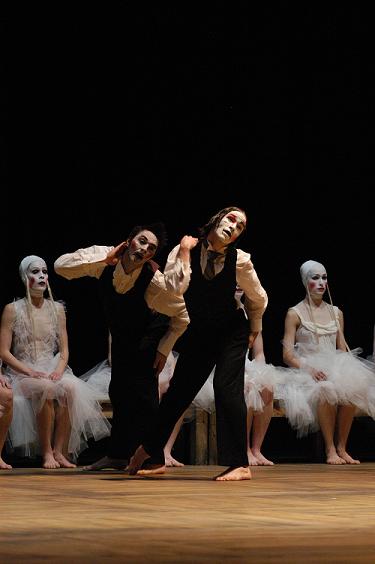
Top photo from the Trocks’ website; bottom photo (Grant is in back) by Sascha Vaughn, courtesy of City Center.

I was actually pretty proud of myself for recognizing him without his makeup on! After seeing them perform in the festival last weekend — they were my favorites from Program 3 — I did some research, particularly on Grant / aka Katerina Bychkova and found this interesting article, which happened to contain the only photo I could find of the guys not in costume (scroll down, on the right side); it wasn’t hard to figure out which one was him.

Anyway I was with my friends Michael and Taylor in the FFD lounge and, when I noticed him walking around I pointed him out to them. Michael initially wouldn’t believe me that he was the “big guy” — it’s really crazy how dancers DO always look so much smaller in person!! — but I was pretty sure. So of course outgoing as he is, Michael was soon off to confirm whether I was correct! After he did so, he made me and Taylor (both of us very very shy) go over and talk to him and some of the company people at his table.

And I’m happy we did. Mr. Grant was sooo nice! I love it when favorite dancers are all warm and fuzzy πŸ™‚ He’s the type of guy you feel like you could talk to forever.

Anyway, I liked all of the dancers — all of whom have superb classical technique and of course immense acting skills — but because Grant is the largest and had a main role, he stood out, and his body is naturally the most subversive for this kind of gender parody. At the festival, they performed Go For Barocco, one of the troupe’s earliest ballets, from 1974, a light spoof of several Balanchine ballets, including Concerto Barocco, after which the ballet is named. Here are some clips of it (which Grant isn’t in; he’s too new to the company):

I love their intentional humor — the way they present pretty, innocent ballerina faces to the audience but then get into little cat-fights with each other — but I also think in a way it’s more subversive when they dance seriously, especially when they dance Balanchine, who idolized / objectified women in so fervently declaring that “ballet is woman.” Ballet to him may have been woman, but of course one with a certain body type. When they do that, what I call a “group grapevine” so ubiquitous in Balanchine ballets (clip one around the 4:42-4:57 mark), of course their bodies are going to get all twisted around each other; that weaving in and out of each other in complicated patterns requires skinny, lithe little bodies. And those kind of showgirl-ish “strutting hip juts” (clip one: 3:56-4:12)– they don’t even need to give them any oomph; with their male bodies, they’reΒ  going to look different, and funny in a way you never noticed on, for example, the ballerinas in “Rubies.” I just can’t stop laughing at the 5:18 point on clip one — it’s so Balanchine taken to a hilariously ridiculous extreme. And I love the wrapping of the hands atop each other (clip two: 2:21-3:01) that here takes on lesbian undertones, which in Balanchine’s similar patterns and gestures looks innocuously sweetly girlish. They mean everything in good fun, but because it’s not completely off the wall, it makes you think, it makes you see things in a different way.

Anyway, unbelievably I haven’t seen this troupe since college. I don’t know how I’ve missed them all these years in New York but I’m definitely going to see them more often now.

More Fall For Dance reviews coming this week.

KANDINSKY’S BLUE RIDER IN PERFORMANCE AT COLUMBIA U


Over the weekend I saw the second of the two experimental performances sponsored by the Guggenheim in celebration of the museum’s current Kandinsky exhibit. (The first was the Isabella Rossellini reading / light show I wrote about earlier). This one, which took place at Columbia University’s Miller Theater, sought to honor the ideals of the early 20th Century Kandinsky-led Blue Rider movement, which advocated the bringing together of visual, music, and literary artists to produce art that would engage all of the senses.

So, this production, The Blue Rider in Performance, combined poetry/opera libretti, music, dance, and paintings and other visuals. During the first half of the program, soprano Susan Narucki sang libretti by various composers including Arnold Schoenberg, Thomas de Hartmann, Arthur Lourie, and Anton Webern, while Sarah Rothenberg (who also conceived and directed the show), played piano.

Both women were brilliant. I also loved the images projected onto the back wall during the singing and piano playing. Sometimes a vibrant full-blown painting by Kandinsky would appear, at other times the wall would go blank and a black line would slowly begin wending its way across that wall — a painting in progress. At other times, there would be no painting, but instead a kind of light show of shadow play of what was happening onstage. The lights would catch Rothenberg as she played. She’d sometimes appear rather ghostlike, sometimes macabre, sometimes threatening, as she’d hunch over her piano, creating a rather wicked shadow, while swaying her body rather violently about as her hands flew back and forth across the keys, producing an equally violent-sounding melody.


I didn’t know that much about Kandinsky, and so, after these performances did some research. ArtΒ  historians and critics have used his painting, The Blue Rider (above), to show how he used color. Kandinsky was considered the father of abstract art. He wasn’t as interested in painting figures realistically as he was evoking an emotional response in the viewer through color and shadow – -blue being the color of spirituality to him. In the image above, your eye is drawn to the movement of the rider. But the movement is depicted through a series of colors– the blue of his jacket is lighter than that cast on the ground by his shadow — rather than specific details. Is he carrying a child in his arms or not? It’s not really clear. But you get the sense that the rider is moving very fast toward something; you feel an urgency.

I felt that as well with the way they used the lights to shadow Ms. Rothenberg as she played piano. You couldn’t see details in her movement, which was illuminated in large shadows on the back wall, but she was moving across that keyboard madly, her movements blending into one another. She looked like a mad scientist at times. The sometimes chaotic melody, along with these shadows, combined to create this feeling of frenzy, or of being haunted by something.


In the second half of the program, the piano was removed and the Brentano String Quartet took the stage and played Schoenberg’s String Quartet No. 2 in F-sharp minor, Op. 10 (Arnold Schoenberg was a member of the Blue Rider Group as well). During the first part of this second half, four dancers from Armitage Gone! Dance performed choreography by former “punk ballerina” Karole Armitage. Opera Chic informs that Schoenberg wrote this piece during a rather trauma-filled period in his life, when his wife left him for another man – an artist Schoenberg had hired to teach him to paint — then returned home, upon which the artist committed suicide and destroyed all of his artwork.

The four dancers — two male, two female — in broad strokes portrayed this story, the two women initially beginning as companions, then fighting, breaking into couples with the two men. The couples would mirror each other — one would struggle, performing tension-filled lifts and supported stretches, while the other would be more at peace with one another. Then it would change. At one point, one of the couples was engaged in this really sadly beautiful statue-like embrace where the woman leaned toward the man, putting her weight into his chest, seemingly needing him, while he, considerably taller than she, rested one elbow atop her shoulder, and held his hand to his forehead, as if his mind was full of turmoil, trying to decide what to do about her. It was such a mesmerizing pose, especially with the way they held it for a considerable time, I almost couldn’t take my eyes off of them to watch the other couple dance.

During the second half, the dancers exited and the soprano returned. So there wasn’t a whole lot of dance. But, despite that, I really enjoyed these two experimental performances the Guggenheim put on. More please!

The Kandinsky exhibit continues through mid-January.


FALL FOR DANCE ’09 PROGRAM 2

Highlights of Program 2, which I saw last night, were Morphoses and Tangueros Del Sur.


I was wandering around the lounge beforehand and ran into a couple of old friends from my first ballroom studio, Paul Pellicoro’s Dancesport. Always fun to catch up with old friends — especially since one of them belonged to my swing team and I shared with her my first ever lovely competition experience. Anyway, little did we know then, but one of our former tango teachers was in the show! Ivan Terrazas! I was so proud; he was absolutely electrifying (along with the rest of the Tangueros)!

Sir Alastair had gone on and on about this troupe — led by Natalia Hills and Gabriel Misse — when he saw them at the Vail Dance festival recently, and rightly so! Oh my gosh, that was the most astounding tango I’ve ever seen! The piece was called Romper el Piso and was mainly tango but with some footwork and rhythms from other Latin dances like Samba and a little bit of Cha Cha thrown in — but all danced with tango aesthetics. There were duos and trios, both mixed-sex and same-sex. The choreography was original and enlightening and the dancing so polished, precise, lightning fast, sharp, passionate, everything you can imagine in a tango, in a dance. I really hope some of you can see them tonight.

Afterward, my friend Alyssa and I hung out in the lounge. When we left we were a little tipsy (c’mon, the wine is $2!) and I kind of tripped over nothing on the way out, causing us to both burst out laughing. One of the cute tango guys said to us, “tranquilo, tranquilo!” but very flirtatiously πŸ™‚

All photos above by Carlos Furman, courtesy of City Center.


The other knockout performance of the night — for me — was Softly As I LeaveΒ  You, choreographed by Lightfoot Leon and performed by the stunning Drew Jacoby, who is now one of my favorite female dancers (Alyssa’s as well) and Rubinald Pronk, performing on behalf of Morphoses. Christopher Wheeldon was in the audience and he got mobbed during intermission πŸ™‚

It was the best thing I have ever seen by Morphoses — more Lightfoot Leon, Mr. Wheeldon, please please!

It’s set to a combo of music by Bach and Arvo Part (including the Part section all New Yorkers are now so familiar with, from Wheeldon’s After the Rain pdd), and begins with the statuesque Ms. Jacoby standing inside a box opening out to the audience, contorting herself to fit within its confines, struggling to break free, making the most mesmerizing shapes with her body. Then, in the second movement, Mr. Pronk comes out and they dance an, at times somber, at times peaceful, duet. Then, in the third (with the After the Rain music), they continue dancing together, but now come to a closure; he ends up in the box, she slowly walks behind it, disappearing offstage.

To me, this was about the human need for connection or the struggle between wanting to be alone and wanting to be with another. Alyssa saw it as someone being held back by something and struggling to overcome that; she was moved by the change of positions between the two dancers. Or, as the title suggests, I guess it can be about a woman leaving a man. The most compelling of these abstract duets Wheeldon is known for (either choreographing himself or including in his Morphoses programs) I think allow for that kind of interpretative range, while giving the viewer enough that they can really latch onto something and let their imaginations go with it.

The above photo of Jacoby and Pronk, by Erin Baiano (courtesy of City Center), is not from this piece.

Also on Program 2 was Martha Graham’s sweet ode to spiritual and human love, Diversion of Angels. Nice to see some of the Graham dancers, who are beginning to become familiar to me, again.

And closing the program was Noces by Dutch choreographer Stijn Celis, performed by Les Grand Ballets Canadiens de Montreal.

1

2

32

This was Program 2’s tribute to Ballets Russes. Branislava choreographed the original Les Noces, and there have been several versions since (Jerome Robbins’, Pascal Rioult’s). It was danced to Stravinsky’s choral score (which he created for Ballets Russes), but with some remixing too (I think). The music seemed to be longer, and there seemed to be some German language in the score, which sounded like it was from a Broadway show like Cabaret (but not Cabaret exactly). The program doesn’t seem to note any addition to the Stravinsky though so I may well have been hallucinating.

The dance (and the Stravinsky music) depicts a Russian peasant wedding and it’s very Rite of Spring-like — more focused on the sexual rite of passage, the consummation, and the rather forced marriage rituals than love or anything weddings evoke for us today. In the Celis (as well as Rioult) version, there isn’t a single man and woman but a group of men and women undergoing the marriage ceremony. The women here are dressed in sexy white bridesgowns, the skirts short and much of the material see-through mesh. The women have white-powdered, very made-up faces that look almost clownish, as do the men, who are dressed in tuxes. Alyssa thought their make-up looked zombie-like, like they’re walking dead. The movement is very frenetic, with lots of thrashing about, and the group consummation scene would have been comical, as the women bounced around on the men’s laps, if it wasn’t so violent.

I’ll be interested to see what the critics and other viewers say of this –whether it gets dismissed as gaudy “Eurotrash” or whether people take it more seriously as a commentary on ritual (or something else). I do think it worked as an homage to Ballets Russes because from what I know of that legendary company, they seemed to have been very cutting-edge, going far out to push ballet to its extremes, even if it induced a lot of eye rolling.

Big kudos to the dancers though for performing that long, near-continuous frenetic movement.

Photos of Les Grands Ballets Canadiens de Montreal courtesy of City Center.

FALL FOR DANCE ’09 PROGRAM 1


I’m on a tight schedule with my book rewrites, but here are some of the highlights of the Fall For Dance Festival (Program 1) thus far.

It’s always a delight to see Paul Taylor’s hilarious Offenbach Overtures with the would-be ballet dancers tripping all over each other, the muscly men first dueling then making up and swinging their way offstage in each others’ arms, the female cabaret dancers comically warring for attention. I was happy to see SLSG favorite Michael Apuzzo in my cast (he’s not in the photo above unfortunately, as he wasn’t in the first night’s cast) — he’s always very dramatic, full of character, and I noticed he had the highest, most straight-legged jetes as he and the other guys went sailing offstage at one point.

I was at this performance with my friend, Michael, and we hung out for a while in the lounge afterward (where they have $2 wine and beer and $4-$5 plates of food). I’m very shy, but I always seem to have really outgoing friends, and Michael went up to a woman with a bouquet and asked her what it was for — something along those lines. It turned out she was in Paul Taylor, and once I knew that, I recognized her as the striking Parisa Khobdeh, Michael’s partner (Michael Apuzzo that is, and partner in Offenbach that is). I then realized a bunch of the Paul Taylor dancers were hanging out in the lounge (except for that Apuzzo!) — so the FFD brochuresΒ  are not lying about the “come mingle with the dancers” parts of the adverts for the post-performance parties in the lounge.


Anyway, the other highlight of Program 1 was B/olero performed by the highly respected Israeli company, Batsheva, choreographed by their artistic director, Ohad Naharin, and set to the familiar Maurice Ravel music. Except this was a remix — at times the music would be slowed so that it would sound somewhat warped. The music would also veer from speaker to speaker, so it was like the sound was traveling around the auditorium.

Well, there are many Boleros around and Naharin’s was a more minimalist one in terms of the action, but not the emotion. It was a duet for two women dressed in black dresses. At times their movement was basic, at times still, at times spastic and chaotic, at times sexual and almost kinky, and at many times hypnotic. A common motif was the swinging back and forth of the arms, mechanically, like the arms of a clock, the rest of the body still. I always feel with his work that I have to see it several times to get the full effect, and I wished I could have seen this one again.


In celebration of the centennial of Ballets Russes, every night at FFD one company performs a piece on honor of that legendary company. Program 1’s was the Boston Ballet’s rendition of Nijinksy’s original Afternoon of a Faun. This was a real treat for me, as I’d never seen the Nijinsky version live and in full before. I’d only ever seen it on tape or, if I remember correctly, only the faun version (without the nymphs) performed by Royal Ballet star Johan Kobborg with the Kings of Dance.

Anyway, Nijinsky’s version is from 1912 and you can really imagine how shocking it must have been in its day, with the faun so overtly sexual, so taken with the nymphs, he ends up masturbating with a cloth left by one, which he recovers, takes up to his little rock perch, places it on the ground and begins rubbing his groin into it. You still don’t see much of that today onstage (at least not in ballet), so I think it’s still somewhat risque. And yet the faun, at least as portrayed by Altankhuyag Dugaraa, is so sweet and so endearing, and you feel for him after those nymphs tease him and you’re happy for him when he retrieves that cloth. I would so love to see a clip of Nijinsky in this. I would also love to see his Rite of Spring some day; I don’t think it’s been performed for eons though, I think because the choreography hasn’t really been preserved, sadly.


And completing Program 1 was Savion Glover, which I wrote about briefly in my previous post.

See the rest of Andrea Mohin’s NY Times slide show of Program 1 here.

LUCY GUERIN’S KAFKAESQUE, FOUCAULDIAN "CORRIDOR"


Friday night I went to see Australian choreographer Lucy Guerin’s Corridor at the Baryshnikov Arts Center. I love these more avant garde (for lack of a better term) kinds of dance pieces — where the choreographer clearly has an idea in mind and wants to make you think about it. I seem to see a lot of this kind of work at BAC.

Corridor is about the effects of modern forms of communication on the human body, and the body’s ability to receive and transmit those forms of communication. Guerin said the work was inspired by a scene from Kafka’s The Castle, which was partly about the comings and goings of various people down a long corridor.

Here, there was a long walkway, a corridor that looked a bit like a catwalk, and chairs for the audience were set up on each side. The piece opened with one dancer receiving a call on his cell phone. He was sitting in one of the audience seats so it wasn’t at first clear that he was a performer and this was part of the performance. He sauntered around on the walkway as other dancers, likewise seated, received phone calls as well and followed him onto the walkway. As soon as the audience realized the performance had begun and quieted down, a sharp buzz sounded over the speakers (some of which were seated under our chairs) and the dancers immediately put their cell phones in their pockets, widened their eyes and, as if on command, began making lots of sharp, angular movements. Ambient sound (traffic, construction, chattering voices, chirping birds, etc.) now played over the speakers.

There was so much going on in this piece, which was, unbelievably, less than an hour long, and there were so many different parts to it, it’s almost impossible for me to remember them all (which is one of the things I liked about it). So I’m just going to talk about what I most remember.

At one point, toward the beginning, the dancers broke into pairs. There were three men and three women and each pair (comprised of one man, one woman) stood in three different sections of the corridor. The man of the couple would make various movements — an arm circling above his head, another arm jutting out, bending over sideways, etc. — and the woman standing facing him would follow him. Each man was facing the same direction, each woman was facing each man. At one point, it became clear that the man and woman farthest to the west end of the corridor were the “leaders.” Or rather than man was the leader. The men farther down the corridor kept watching him, and imitating him. Their women followers, who could not see that man since they were facing their own men instead, imitated their man. The more rapidly the first man moved, the crazier and more chaotic and confused was the movement of the other couples, particularly the women who basically were following a man following another man. It was really interesting, and you could see the frustration growing on the faces of the male followers and their women.

Continue reading “LUCY GUERIN’S KAFKAESQUE, FOUCAULDIAN "CORRIDOR"”

JULIETTE BINOCHE AND AKRAM KHAN BRING IN-I TO BAM


Last night In-I, the collaboration between French actress Juliette Binoche and British dancer / choreographer Akram Khan, opened at BAM, and of course I was there. She’s one of my favorite actresses and I’d been wanting to see this since it premiered at Sadlers Wells in London a year ago. New York is the last stop on their tour.

I loved it, despite its imperfections (and I largely agree with Judith Mackrell’s early review). But I loved it, partly because I just love her period, and partly because, for me, it ended up creating a new respect for both interpretive art forms, dance and acting.

This collaboration (Binoche has virtually no dance training and Khan no acting) made me remember back when, what seems like light years ago now, Baryshnikov and Mark Morris founded their company, White Oak Dance Project. For opening night they were collaborating with Yo-Yo Ma and I really wanted to go. I tried to use this as a selling point in convincing my friend, who loved classical music, to go with me. I’ve always had this stupid habit of stating the over-obvious and, in elaborating, I said to her, “Baryshnikov will be dancing and Yo-Yo Ma will be playing the cello.” She burst out laughing. “Well I hope it’s not the other way around!” she said. Then we got to joking around about how entertaining it would be if Yo-Yo Ma danced and Baryshnikov played the cello. I said I’d actually really like to see that. She said she wouldn’t — it may be a fun experiment for them to do in a garage or something, but to put before an audience?…

I still wonder how that would come off — Baryshnikov bending over a cello and Ma jumping around a stage.

Anyway, I thought this collaboration (hard to know what to call it; it was mostly dance with some spoken word –the two talk to each other onstage and address the audience in monologues, so maybe it’s “dance-theater”) was more than an experiment in two artists from different worlds trying on each others’ shoes. It had a storyline; it was about the life of a relationship — from youthful fantasizing evolving into mature passion, getting sick of each others’ bad habits (there’s a very funny scene where he keeps leaving the toilet seat down and getting it all wet when he pees and she wants to kill him over it), fighting, misunderstanding, eventually accepting and even learning to delight in the difficulty of it all, as part of life. I have to say I understood the through-line of the drama through her. She gave the piece its emotional core.

He is a brilliant dancer and I loved watching him move. It was apparent she has very little dance training — she doesn’t have the expansiveness and breadth in her movement or the precision and sharpness of a lifelong professional dancer — but I love her for trying, because I think it shows how blasted hard dance is no matter how hard you work at it (and you can tell she worked very very hard). And I love that she was not a very skilled dancer, the piece was mainly dance, and still so much of what I understood and got out of it was due to her performance.

The best parts I thought were where each performer was in his / her own element. Judith Mackrell (link above) likes the beginning, where Binoche’s character is sitting in a movie theater and sees Khan, he dances about and she becomes infatuated with him. That scene works well because she’s sitting and watching him, while telling the audience how she feels about him, and he’s moving. There’s another scene later on – -my favorite in the whole thing — where they’ve just gotten into a vicious fight. She stomps off behind the back screen and he begins this really riveting solo where he writhes on the ground, gets up and contorts his body, flings arms, head and torso every which way in utter emotional agony, then does a deep back arch, literally bending over backward to please her. About halfway through the solo she walks back out onstage and sees him. As she approaches him, her expression changes; she slowly realizes how much their fight has tormented him and she feels remorse. You can see all that on her face alone. His movement and her facial expression compellingly conveyed each character’s inner turmoil.

There’s another part where he delivers a monologue to the audience. He just stands at the edge of the stage and talks to us, telling us about a youthful romance he had in which he fell in love with a girl who was not the same religion as he. He tells his priest and the priest withdraws a huge knife and holds it against his throat, telling him having the girl means his soul will die and asking him if that’s what he wants. Khan spoke too fast and sometimes jumbled his lines but at one point he started punching the air with his right fist when he spoke in the voice of the priest, and he started pointing shakily toward the audience with his other hand when he talked in what I felt was the inner voice of his boyhood self. Sometimes these motions were back to back — the fist violently but with a dancer’s control punching the air, then the trembling index finger. Once he kind of got into a groove with it, it was really mesmerizing — especially when combined with his extreme sideways leans when confronted with the imaginary knife at the neck. He was expressing himself far better with his arms and neck than with his words and I kind of wished at that point, he would just have had a voice-over do all of his spoken word so that he could focus on using his body to express himself.

Conversely, I kind of wished for her that she didn’t have so much movement so she could have focused on her words and her facial expressions and wordless gestures (actors obviously do use their bodies as instruments of expression, but it’s to create subtext — little ticks that a normal person would do that show that person’s character; totally different from dance). You can tell how hard she worked if you’ve tried to learn dance as an adult. She had several very difficult things — a couple of high lifts, fast travelling chaine turns. You can see how she worked to get those turns right — her spotting was very good and she held her body steady and balanced with her footing while still trying to get sufficient speed. The fact that she was still able to chaine toward him, into him, with meaning, with intention (she often laughed, sometimes playfully, sometimes tauntingly) while focusing on getting difficult movement right was really amazing. But if she didn’t have those crazy spins to contend with in the first place, how much more depth she could have conveyed. And ditto for a lift, where he sits her atop his shoulder and walks along the back screen. She stretches out her arms and closes her eyes and traces the screen with her shoulders and hands, a look of ecstasy crossing her lips. But she has to worry about maintaining position atop his small shoulder, of tightening her muscles so she can hold herself up there, limiting, I felt, how far she could go emotionally.

Anyway, I could think of more things to say but I think I should stop, at least for now — particularly since it’s now evening and my allotted time for me to work on my novel. Suffice it to say, this collaboration really made me think how, similarities aside, fundamentally different the two art forms are, and made me respect each more. I do think dancers could highly benefit from more acting classes because I think for many theater-goers, that’s ultimately what moves them — body movement alone doesn’t always make complete sense. But more on this later…

In-I continues at BAM through September 20th.


ANOTHER PERSPECTIVE ON PIERRE RIGAL’S "PRESS"

By my friend, Christopher Atamian, who went to the Friday night performance.

Pierre Rigal’s Press

September 10-13 at the Baryshnikov Arts Center

Pierre Rigal’s “Press,” originally a 2008 commission from the Gate Theater in London should come with a warning for the claustrophobic or anyone who finds watching another human slowly get crushed Γ  la Star Wars trash compactor scene unsettling. Pierre Rigal, a French mathematician turned hurdler turned dancer performs this solo piece with remarkable aplomb.Β  For the better part of fifty minutes Rigal contorts, girates, sits, stands and otherwise dances (yes he “wri-gals” as well) inside a box that slowly compresses and threatens to flatten him like a pancake… His only sets are a chair and a slinky rotating lamp creepily reminiscent of Hal in 2001: A Space Odyssey. “Pressisn’t for everyone: watching Rigal stand on his head and negotiate the walls as the ceiling slowly close in on him is either frightening or frighteningly boring, depending on your point-of-view.

The box, Rigal explains in a previous interview, is a symbol for the danger man faces today in society and also for the solutions to these problems as well.Β  “The box” Rigal notes like a good Frenchman is eminently “cartesian.” These quasi-philosophical statements do Rigal’s cause little good-he should let the performance speak for itself.Β  It isn’t every performer after all who can carry off a solo like this with such brio.Β  Although it begins rather tediously, “Press” increasingly captivates as it heads towards its terrible, unavoidable (funny?) end.Β  Somewhere about forty minutes out, once Rigal has already swallowed the lamp’s red light bulb and caressed the light’s frame like a pet or perhaps even a lover, a voiced narration joins Nihil Bordures’ clever eerie score (“Inside my head…inside my head…”) implying as I read it that perhaps everything we are witnessing is taking place within his head. This to me is the wonderful if obvious stroke of genius, the redeeming touch that takes an otherwise repetitive performance and lifts it to something unique, powerful and worth watching.


GO SEE PIERRE RIGAL AT BARYSHNIKOV ARTS CENTER


Last night, despite a sinus infection that made my head feel as if it were stuffed with cotton candy, I ventured all the way over to the extreme west side of midtown to see the U.S. premiere of Press, by French dancer / choreographer Pierre Rigal, whose work I’d never seen before. And I’m glad I did — I loved it, even though some of its themes made me feel more claustrophobic than I was already feeling due to said cotton-head condition.

I guess there can be many interpretations but it’s a solo danced by Rigal himself, about an hour long, about, to me, a man feeling trapped … by everything — by the tiny room he’s in, by his clothes, by the furniture, by his body, by his own mind, by the room’s one piece of technology — a camera / halogen lamp / robotic-looking toy that kind of comes to life at one point. It was surrealist, very Magritte, with lots of tricks of the eye that make you think about the nature of reality. At one point, the way he runs in place in his trendy-looking work shoes, which at points — because of the way he moves —Β  almost resemble clown shoes, makes it look as if the floor is actually moving (at least I don’t think it was); at another point it appears the the ceiling has fallen on top of him, squashing his head down into his body (at which point the techno music begins playing, the voice singing, “I live in my head…” — many in the audience started laughing); at another point it seems his shoes and hands are magnetized and he can’t detach them from the ceiling; at another point his body almost looks like rubber. It reminded me a bit of the movie Being John Malkovich because the ceiling was continuously moving, mostly downward, toward him, and he constantly had to invent new ways of contorting his body so that he’d fit within the room’s constantly changing confines. This of course provides much of the dance drama.

I found it both comical and unsettling, often at the same time.

Here’s a video:

I’m interested to hear what others think, if anyone else sees it. It’s showing at BAC twice more — Saturday the 12th at 2 and 8 p.m. There’s a discussion with Rigal following the matinee.


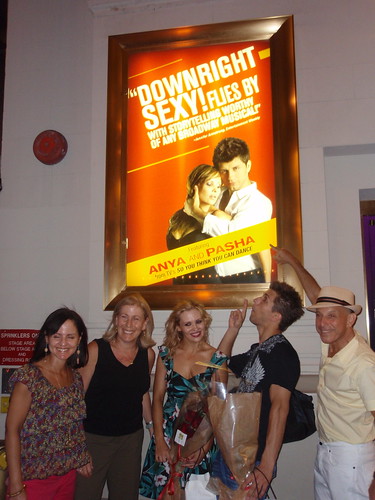
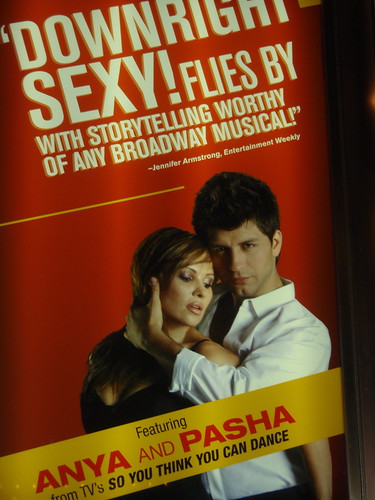
PASHA & ANYA TAKE BROADWAY!

P8182234

I remember several years ago — maybe five now — sitting in another, much smaller theater on Broadway watching a Dance Times Square teacher / student showcase and nearly falling out of my chair during the all-pro part when my teacher, Pasha (Kovalev), and his partner, Anya (Garnis), danced a West Coast Swing-turned Jive to Tina Turner’s Proud Mary. They also danced a Samba and, if I remember correctly a Rumba and though I’d started lessons with him, it was the first time I saw him dance with her. It was one of those performances where you feel kind of sick afterward because you don’t have a DVD or any kind of recording and you fear you’ll never see dance like that again. I also remember thinking how they should really be on Broadway. I mean, real Broadway, like in a regular theater.

So this is, to make a massive understatement, Surreal!

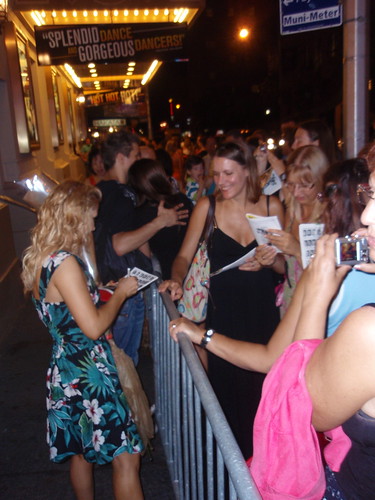
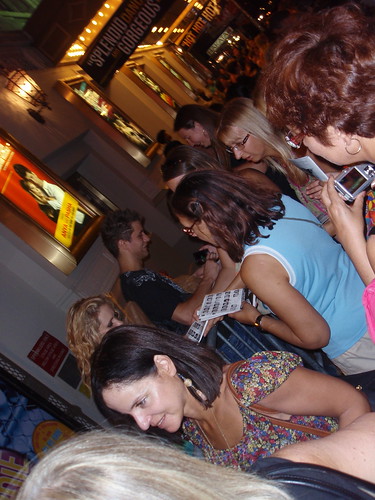
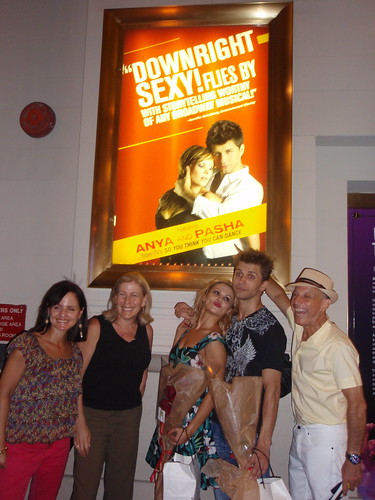
Several of my friends from Dance Times Square and I went to the Longacre Theater tonight to see our friends made their Broadway debuts in Jason Gilkison’s Burn the Floor. Of course we had to go to the (insanely packed) stage door afterward.

P8182231

P8182228

P8182219

Pasha’s about to give me a hug here πŸ™‚ I guess I repaid him by flashing my camera right in his face. Oh the endlessly annoying paparazzi…

P8182214

How gorgeous is Anya?! Posing with my friend Steve and his wife, Ina.

They took over the roles of Maks Chmerkovskiy and Karina Smirnoff and of course they were radiant. I think they worked better with the show size-wise because of that small stage (which Maks was too large for — I love him, but he made it look all the more crowded up there).

If you didn’t read it, see my earlier review of the show here.

I think the dancers got used to the small floor; everything went much more smoothly. My favorite parts remain the extended Swing / Jive section that ends the first half and the two Rumbas in the second half (Peta Murgatroyd’s classic, dance-hall Rumba, and the more contemporary, sensual, half-dressed Rumba by the leads — although I noticed Pasha and Anya wore more clothes in that number than Maks & Karina did πŸ™‚ ). But … I also like the Tango- turned dual Paso Dobles in the second half. Okay, I like the whole second half (mainly devoted to Latin).

In my earlier review, I don’t think I mentioned Sasha Farber as one of the dancers who most stood out to me. He’s a character dancer, kind of like Craig Salstein, and he has a rather fun part early on during a Jive where he’s trying hard to get the girl and gets carted off, kicking madly, by two men. He’s lively, actorly, and can really move quite fast. And Murgatroyd, which I wrote about in the earlier review, captivated me again, with her long limbs and gorgeous balletic lines. I mean, I really liked everyone; it’s hard even to single people out.

P8182223

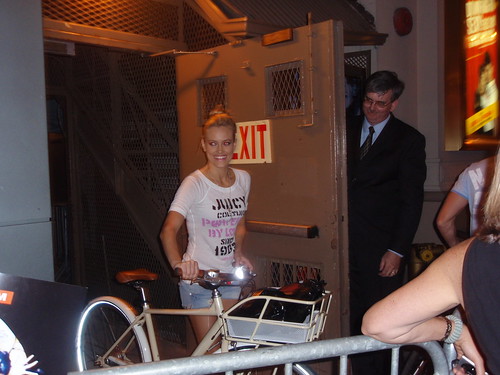
Here is Peta Murgatroyd exiting the stage door, on a bike! Actually, almost all of the dancers were on them. Apparently the show’s producers or someone from the company had given them the bikes so they could get around town more easily. Peta was popular with autograph-seekers too.

P8182229

P8182226

P8182235

Ooh, wonderful night. I miss them…

Oh and this seems to be making headlines.

P8182211

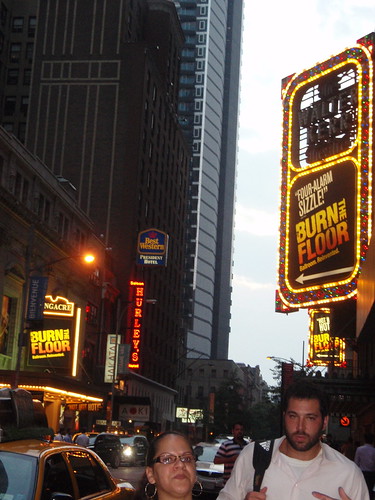
The Walter Kerr Theater across the street from the Longacre is advertising the show as well. See the arrow in the sign on the right side of the street. It’s pointing across the street. It’s the first time a Broadway theater has ever advertised for another show!

MARTHA WAINWRIGHT, MORPHOSES, AND MARCELO IN THE PARK

copy-of-pic-17

Philip was really sweet and sent me some pictures taken by his friend, Kokyat, of the Morphoses / Martha Wainwright performance Saturday night in Central Park. Above are my three favorites from ABT and NYCB respectively: Marcelo Gomes, Gonzalo Garcia and Tiler Peck (seated). They’re dancing Christopher Wheeldon’s Fool’s Paradise.

It was a fun night. For people unfamiliar with Martha Wainwright’s music, she’s kind of a folksy, bluesy, country mix. So, the dances, mostly choreographed by Wheeldon, a couple by Edwaard Liang, complemented that with lots of wavy-armed, lyrical, softly jazzy, almost social-dance-like movement, with ruffly dresses for the women and open t-shirts, casual vests and buttoned Oxfords with ties for the men.

Here’s a photo by Andrea Mohin of the NYTimes, of Bleeding All Over You, chor by Liang and set to Wainwright’s song. Teresa Reichlen is in the middle, surrounded by Jason Fowler and Adrian Danchig-Waring of NYCB. See Mohin’s slide-show here.


Here’s another favorite of mine by Mohin from the NYTimes slide show, of Gonzalo Garcia and Tiler Peck in Love is a Stranger (set to Wainwright’s re-interpretation of the Annie Lennox hit). This was one of my favorite dances of the evening because, well I love both these two, and it kind of reminded me of when they danced Other Dances together at NYCB this season.


And my other favorite from that slide show, of Rory Hohenstein dancing a solo in Far Away, the first piece of the night.

I don’t know if it was Craig Salstein and the wine or the promise of seeing Marcelo in the second act or what, but everyone seemed to have an extra glow or something; everyone seemed to dance so much better than I’ve ever seen them before — particularly Hohenstein. He was really fluid, really beautiful in this dance.

See more photos in the Times slide show here. And read the accompanying review by Sir Alastair in which he gets just a bit caught up in the spelling of the word “Whither.” I don’t see that anyone has blogged about the review, but it’s certainly making its way around via email because of that paragraph. It’s like the critics are becoming part of the performance…

Anyway, Marcelo danced in the last two ballets — Wheeldon’s well-regarded Fool’s Paradise, and Tears of St. Lawrence (a new collaboration between Wheeldon and Liang). Paradise was set to recorded music by Jody Talbot (the only non-Wainwright music of the night) and Tears to Wainwright’s song of the same name.

Marcelo danced the opening pas de deux in Paradise with Tiler Peck and I feel like I saw things anew and like I was more connected to and moved by some of the twisted, unique, two-body shapes just by seeing a dancer I connect with in the part — his covering her ears, his bowing down to her in arabesque… No one could make the arabesques Marcelo was making, and there were several parts where he and another male dancer — at the beginning Gonzalo — would frame the women with those arabesques and Marcelo’s raised leg was always significantly higher. I always love Gonzalo, and it could just have been my seeing him next to Marcelo, but he didn’t seem as stretched-out Saturday night. His extensions weren’t as heavenly as they usually are. Actually, there was nothing in any of the ballets that really brought out the qualities that make Gonzalo Gonzalo. No Mercurial Manoeuvers, no Hallelujah Junction, no MNS Oberon, no Other Dances, no Concerto DSCH where he could fly all over stage and charm you to death. He doesn’t excel as well at the slower, pretzel-shape pas de deux-heavy dances. Well, it’s not that he doesn’t excel, it’s just that his personality doesn’t have the chance to shine. I want Wheeldon to choreograph something high-flying for him and put it in the Morphoses program πŸ™‚

Back to Paradise: I have to say, upset as I was over not being able to see the dancers up close, I was able to see the patterns better from sitting back in the sky box. Wheeldon and Liang both came back there and stood beside us to get a view of the overall, so I guess Susan and I ended up in the kind of ideal Balanchinian viewing area. From there I really could better appreciate the patterns and the look of the whole.

For all the “whither wather” goofiness, one of Macaulay’s lines in the afore-linked-to review really resonated with me: “I like the control with which Mr. Wheeldon keeps making you pay attention, but I can’t get interested in these dances as thought or drama.” I think that’s what prevents me from getting entirely into a Wheeldon ballet (at least his ballets for Morphoses; some of his ballets for NYCB have been far more dramatic or expressionistic); I feel like I need to come away from a work of art with something other than just a beautiful image. I need more in order to keep thinking about the piece over and over again, which is the effect I want a work of art to have on me.

But I’ll keep trying with Wheeldon — I’m sure if I liked Mercurial Manoevers and the After the Rain pdd, other dances of his will eventually grow on me. Especially if he uses my favorite dancers more often πŸ™‚

Here are some more Kokyat photos of Fool’s Paradise:

copy-of-pic-1-1

copy-of-pic-2-1

And here are some of Tears of St. Lawrence:

copy-of-pic-16-11

copy-of-pic-6-21

copy-of-pic-20-1

Cast taking a bow, with Wainwright and Wheeldon in center. Look how cute they are πŸ™‚

As I said earlier, there was a lot of music and it almost felt like a music concert with some dance thrown in, but, like others have mentioned, I’m glad the program exposed Wainwright fans to dance. Toward the end, Wheeldon came up onstage and introduced the dancers the way Wainwright introduced her band. He called his dancers “his band” and jokingly noted this wasn’t often done in the dance world. At one point, he remarked to Wainwright that he thought she might dance some and she responded, “Oh … no … oh, I don’t know… I could lie down and let people do things to me?” Everyone laughed. “Maybe it could be you,” she tacked on. “Ah, I don’t think it would be me,” he said after a long pause. He seemed a bit embarrassed. It was cute.

Anyway, thank you again to Philip for letting me use some of Kokyat’s photos. Definitely visit Philip’s blog where he has several posts filled with more gorgeous photos. The photos begin with this post (keep clicking on previous posts titled “Starry Night” to see more).

CRAIG SALSTEIN TO THE RESCUE


So last night I went to Christopher Wheeldon’s Morphoses at Central Park’s SummerStage, who were performing to live music by Martha Wainwright. Of course I would have gone no matter, but hearing that my favorite, Marcelo Gomes, was guest-performing with the company, made it all the more urgent.

Anyway, Morphoses events are often very well-attended and there was a bit of a mix-up with my tickets — they’d issued me a guest, rather than press pass and so my friend and I got ousted from the section up front. I understand these things happen, especially with very popular dance companies and it wouldn’t have been a big deal if I could see well at long distances at night (and if I hadn’t helped others get in whose tickets weren’t mixed up….) But whatever, I could deal I thought, even though I felt like a total loser.

So, my friend and I walked to the back dejectedly. But, then, when we got all the way to the back, it ended up our tickets weren’t for the reserved risers but for the skybox, a tent-covered, elevated section that put us far above the standing crowd. And in that elevated section, sat (among others) ABT soloist and one of my favorite dancers, Craig Salstein! He was sitting next to a really cute dancer-looking guy who turned out to be Marcelo’s bf πŸ˜€ Then a waitress came by serving us free wine and I knew this was THE place to be, not down there on the ground with those earthlings! I still couldn’t see tremendously well, but I can always see Marcelo from wherever I am and I kind of felt better being with the ABT peeps anyway.

So my friend Susan and I ended up chatting with Craig and Marcelo’s friend throughout the show and they are the sweetest guys! Craig seemed so different than he is onstage! For people who don’t know him, he’s the type of dancer who always gets the bravura roles that require a big personality, and very good acting (not to mention dance) skills, like Mercutio in R&J and the bespectacled nerdy guy who can nevertheless dance up a storm in Taylor’s Company B, and the poor guy who gets girls tossed at him from every which way in Tharp’s Baker’s Dozen, etc. etc. So because he has such a way with comedy I expected him to be cracking jokes every five seconds and acting all clownish and all. But he wasn’t like that at all – -he was really serious and calm, albeit gregarious and easy to talk to. I told my friends, who I went out with afterward, the same and one said, “well, he can’t be Mercutio ALL the time; he’d go crazy.” True.

He’d just got back from vacation (in Italy, where he saw “Roberto Bolle and Friends” — hmmm, didn’t know there was a “Roberto Bolle and Friends”!), and was sporting a serious tan. We talked about ABT’s upcoming season at Avery Fisher Hall and Italy and his choreography and how much I liked it and how great Marcelo is and what I tweet about (you, tossing your mandolin into the wings instead of Jared Matthews’s hands during R&J I said; he seemed bemused) and other chit-chat. Fun fun fun to meet a favorite dancer and another favorite’s boyfriend πŸ™‚

Okay, I’m running off to another Morphoses performance today and have to get going but will write about the actual show tonight or tomorrow morning. Obviously Marcelo was god, Martha Wainwright was good but to me it was too much about her — too much music, almost a music performance with some dancing thrown in — highlights were Edwaard Liang’s premiere and Wheeldon’s Fools’ Paradise (which I saw anew thanks to Marcelo), Tiler Peck, Gonzalo Garcia, a duet between Maria Kowroski and Jared Angle, Wendy Whelan, Rory Hohenstein, a funny joke by Wainwright about lying down and having people do things to her and Wheeldon’s somewhat embarrassed response, and did I mention Marcelo Gomes…